Showing posts with label powell and pressburger. Show all posts

Saturday, July 28, 2018

A MATTER OF LIFE AND DEATH - #939


Man, I’ve been waiting a long time for A Matter of Life and Death to get the Criterion treatment. If there ever was a movie to deserve its own spine number, this is it.

Released in 1946, A Matter of Life and Death is a post-war fable made just after the war had ended, when the rebuilding had only just begun. The concoction of Michael Powell and Emeric Pressburger, also known as The Archers, their movies sometimes described as Disney for adults, A Matter of Life and Death is their most original production, spawned fully from their own imaginations as writers, directors, and producers.


A Matter of Life and Death stars David Niven as Peter Carter, an RAF officer who, at the beginning of the film, is in the process of crashing his bomber following what must have been a pretty nasty firefight. His crew has all escaped, except for his communications officer, who lies dead in his lap. Carter does not have a parachute, and as he tells June (Kim Hunter, A Streetcar Named Desire, the American soldier on the other end of the radio, he’d rather jump to his death than burn in a crash. The two share a moment, knowing it’s meant to be his last.


Only it isn’t. Instead, Peter washes up on the English coast. Cut to Heaven with a capital H, where they are waiting for him to arrive. The aforementioned communications man, Bob (Robert Coote, Scaramouche), has even delayed procuring his own angels wings, knowing his pal is due any moment. When this particular soul fails to materialize, it’s an unprecedented glitch in the system. The French conductor (Marius Goring, The Red Shoes [review]) meant to ferry him through the pearly gates missed Peter in the English fog. Luckily, retrieving him should be easy. Peter Carter was just lucky enough to receive an extra day of life. No harm, no foul.

Except, as fate would have it, in those intervening hours, Peter found June, and the pair fell in love. Peter insists it’s not fair for him to have to let that go, as he’d never have known such romance had the celestial world not screwed up. Peter demands his day in court, the chance to appeal his own death. Divine justice being what it is, Heaven agrees.


A Matter of Life and Death is split between two worlds: reality and...well, Powell and Pressburger don’t put too fine a point on it. I call it Heaven, but there is no mention of Christianity or Jesus, and the filmmakers take a rather cheeky, almost subversive approach to establishing their particular afterlife. This is a movie, after all, that opens with a view of the universe and an explanation of what each cosmic illumination represents delivered via an unseen narrator--one who implies he lives on Earth, too, and doesn’t claim to be a supreme being. His intro isn’t exactly a direct path to the mystical realm, unless we choose to accept science and religion as one. That said, A Matter of Life and Death pulls a reverse Wizard of Oz in that the Earth-based sequences are in color, and the afterlife sequences are black-and-white. If one rides the lengthy stairway to heaven, the film is monochrome; coming back down, even with heavenly bodies in tow, Technicolor!

This choice alone would suggest that the Archers consider the real world and its concerns to be the more important. In fact, they kind of lean away from the afterlife as being a fantastical environment, instead suggesting it is just one big administrative bureau. All of this is less a critique on religion, though, than it is a device to encourage us to question whether Peter Carter is hallucinating the whole thing. On Earth, he is prone to headaches and, of course, sounds a bit crazy when he tells June what he believes is going on. She enlists the help of Dr. Reeves (Roger Livesey, The Life and Death of Colonel Blimp [review]), a neurologist. Reeves is a man of science, but one that also enjoys poetry, and the closest to a God-like figure we get in A Matter of Life and Death, in so much as he sees all from his attic, which is outfitted with a 360° viewer that lets him look across the entirety of their village, allowing him to diagnose the problems of his subjects from afar. Livesey gives a spirited performance, projecting a natural optimism, and showing the good doctor as capable of adapting to anything, eager as he is to figure the whole thing out. Reeves quickly diagnoses Peter, believing him to have a rare neurological condition that so disrupts the senses, it only stands to reason he thinks these visions of another world to be real. Every part of his body says so.


A Matter of Life and Death offers no absolute stance on what we should believe, it champions no one internal truth. Peter goes on trial and has his day in Heavenly court, but is that really happening, or is the eventual verdict a product of the surgical operation he is undergoing on the ground? Narratively, I’d argue that the only proof we need is that the story regularly leaves the main character, so unless his brain is even writing the chapters of the story he is not supposed to be privy to, the other side is really looking to take him as their own.


As with all Powell and Pressburger films, A Matter of Life and Death is a visual treat. The large stairway to Heaven has the cosmos as its backdrop and statues of famous figures from history as decoration. Heaven itself is a space-age design, all curves and clean surfaces, well ahead of the space age. Gorgeous matte paintings and elaborate models are used to give the wide view of paradise. Cinematographer Jack Cardiff (Pandora and the Flying Dutchman [review]; subject of Cameraman [review]) gives the black-and-white sequences a sort of internal glow, as if it is suffused with light; alternately, he makes the earthbound scenes bright and colorful, creating the exaggerated reality that is the Archers’ stock in trade.


For all its heavier questions--including a debate about the virtues of freedom, and how they manifest differently and sometimes the same in both Britain and America--A Matter of Life and Death is another of P&P’s fantabulous fairy tales, full of romances and comic touches. (The arrival of a crew of American pilots to check into the hereafter is a particularly funny aside; likewise, the dig at James Cagney in the Midsummer Night’s Dream rehearsal on the military base.) It’s an enchanting mystery, more movie magic than genuine mysticism, and perhaps one of the best examples of how cinema can transcend the everyday. I saw it for the first time some two decades ago, during a revival and restoration championed by Martin Scorsese, knowing very little going in. Needless to say, I was mesmerized. Back then, I was watching it on a big screen with an audience, and I have since seen it on the smaller screen with friends and now on my own, and the change in venues by no means diminishes how spectacular A Matter of Life and Death really is. In fact, this current high-def restoration may be the most magical its every appeared. It’s an essential purchase, and so good I wouldn’t have blamed Criterion if they had waited to release it so it could have been #1000 rather than #939...but I’m glad they didn’t.


This disc provided by the Criterion Collection for purposes of review.


Monday, April 9, 2018

AN AMERICAN IN PARIS - FILMSTRUCK

In honor of Filmstruck and TCM naming Leslie Caron the Star of the Week, I'm de-archiving some old reviews. Original source from 2008.


An American in Paris is the movie that finally forced me to admit that I really did like musicals. Adolescent stubbornness had made me declare that all musicals were corny, and as a genre, I had no time for them. Even then, though, I had a few that I would insist were merely the exceptions to prove the rule. That changed when I saw some movie program or other, the source of which is now lost in my memory, that showcased the 18-minute-plus ballet sequence that closed the 1951 Gene Kelly vehicle. The commentators praised the guts that Kelly and director Vincente Minnelli displayed in asking their audience to watch a full dance sequence, with no dialogue or sung lyrics, based around a Gershwin orchestral piece. I was sufficiently intrigued to check the movie out, and An American in Paris forever changed how I viewed movie musicals.


As legend has it, George Gershwin's "An American in Paris" suite was the sole impetus for doing this movie. With the song and its title in hand, producer Arthur Freed went off to create a picture about an American artist living in post-War France, working in as much of the Gershwins' famous catalogue in as he could. One of the requests the songwriting duo made when setting up the deal for the adaptation was that "An American in Paris" remain intact and played in full, and this fit perfectly with the already in-place plan to include an extended dance sequence in the movie. Reportedly, Gene Kelly used the Powell & Pressburger film The Red Shoes [review 1, 2] to convince MGM that it could be done, and once everyone had signed off, a classic was born.

In An American in Paris, Kelly plays Jerry Mulligan, a veteran who stayed in France after the war to pursue a career in painting. Living in a Bohemian quarter of Paris, he is friends with other ex-patriots, including the jazz pianist Adam Cook (Oscar Levant). Adam provides Jerry with a comedic sidekick, as well as an added reason to launch into the occasional song-and-dance routine. Not that Jerry needs such a concrete reason to burst into song. Any everyday event will do. In one of the most memorable sequences of the film, he decides to turn an English lesson he's giving the neighborhood kids into a lesson in George and Ira's "I've Got Rhythm." The children chant the "I Gots," and Gene does the rest.


On a broke afternoon, Jerry takes some of his canvases to the open market to try to drum up some cash. There he meets Milo (Nina Foch), a wealthy American divorcee who takes a shine to his paintings and to their painter. She becomes Jerry's patron, though she has a little more than art on her mind. The pair agrees to disagree on the subject of romance, which doesn't mean that when Jerry becomes enchanted by tres jolie ingénue Lise (Leslie Caron), it doesn't cause trouble. Not only is Milo jealous, but Adam's friend, the French singer Henri Baurel (Georges Guetary), would have cause to be jealous, as well, if he knew what was going on. Lise is his girl. Cue the collision of dueling love triangles!


An American in Paris is at times a big, sappy romance, as well as a silly comedy trading on old vaudeville routines and Gene Kelly's rubber limbs. The story is as thin as the odor eater's in the stars' tap shoes, but it matters little. Vincente Minnelli keeps the pace moving, never taking too long between songs, giving us a variety of Gershwin numbers in a variety of tempos and styles. We get the slow and romantic "Our Love is Here to Say" when Jerry is serenading Lise along the Seine, as well as the peppy "Tra-La-La (This Time is Really Love)," with Jerry mugging alongside Adam while straddling his piano. Also quite funny is Oscar Levant's solo scene, playing every member of the orchestra in a daydream where he performs a Gershwin concerto to an enthusiastic crowd of people who aren't just like him, but are him. (Yep, he plays the audience, too!) The all-around tone of the film is jaunty, with gorgeous sets and likable actors strutting their stuff without a whiff of self-consciousness. Declaring that they don't make them like An American in Paris anymore wouldn't be a cliché, it's a simple fact.


And, of course, even if the first 94 minutes of the movie are two syrupy for your tastes, you can still appreciate the audacious artistry of the "An American in Paris Ballet." In an explosion of color and energy, Kelly recreates the entire movie as a ballet that plays out in his character's mind. Believing he has lost Lise to Henri, Jerry mulls over his short time with the girl, seeing Paris as a city alive with dance, and his romantic quarry as an uncatchable sprite leaping through its streets. It's as much a celebration of being in love with the city as it is a celebration of being in love with the girl. In fact, the whole movie is about being in love with the art, the food, and the freedom to live life according to one's passions. In the ballet, we see abstract representations of things that have made Paris great, from its personalities and architecture to sets and costumes that mirror the styles of famous French painters, including Kelly jumping into a Tolouse-Lautrec painting (Chocolat) and bringing it to life. It's a glorious summation of what preceded it, while also gently paving the way for the ending Jerry couldn't dare dream of.


Wednesday, January 31, 2018

PANDORA AND THE FLYING DUTCHMAN - FILMSTRUCK

This review was originally written in 2010 for DVDTalk.com


"Never dismiss the legends, Pandora..."

The tale of the Flying Dutchman is a ghost story. A haunted ship travels through the night, its lonely captain cursed to sail the empty seas for eternity. Having committed an heinous crime against love, he must now roam the waters until the day he finds a woman who loves him so much, she is willing to die for him. Love, we are told, is measured by what you will give up for the person you hold most dear. Thus, the irony would be that if the Dutchman were to ever meet the woman who loved him enough to die on his behalf, he would likely love her in equal measure and thus will give up his own salvation so that she may live.

Albert Lewin's 1951 romantic curio Pandora and the Flying Dutchman takes place on a strange dreamscape somewhere just on the other side of the expatriate fiction of Ernest Hemingway and F. Scott Fitzgerald. It is set on the coast of Spain, in a town called Esperanza--the name translating as "hope," which is all that remained after Pandora opened the box of horrors in the Greek myth. Lewin casts Ava Gardner as his Pandora, an American nightclub singer who leads a bored life by the beach. She is fawned over by the male transplants in the village, and they are all too ready to be manipulated by her. There is the drunk socialite Reggie (Marius Goring) and the renowned bullfighter Montalvo (Mario Cabré), and also a race car driver that is so taken with Pandora, he pushes his car into the sea on her urging. It doesn't matter that Steven (Nigel Patrick) is engaged to another, he's now engaged to Pandora.


Fittingly, Steven's car was named for his paramour, and the night the four-wheeled Pandora is dumped into the drink, so too does the two-legged Pandora see an unfamiliar yacht in the harbor. Intrigued by this fresh prospect, she leaves her new fiancé and swims out to meet the mysterious Hendrik van der Zee (James Mason). The Dutch sailor is alone on his boat, where he is marking time by painting a portrait of the mythic Pandora; only, she has Ava Gardner's face. It would appear that destiny is pushing these two tragic figures together, but we can tell by the way Lewin and cinematographer Jack Cardiff (Girl on a Motorcycle [review]) shoot their meeting that having that much tragedy in one place can only cause further imbalance. While they are on the ship, the image rocks up and down, subject to the caprice of the waves.


Since the basic premise of Pandora and the Flying Dutchman has its roots in classic literature, Albert Lewin gives his tale of doomed romance a literary framework. The main story is shown in flashback, narrated by a scholar (Harold Warrender) who is also caught in Pandora's web, but who has been relegated to the role of confidante and witness. He is the one who finds the old manuscript that purports to be the real diary of the Flying Dutchman, and so it is he who puts two and two together and realizes that van der Zee (whose name literally translates as "the sea") is the eternal wanderer from the folk tales. With the Dutchman swearing he will set sail the night before Pandora is to marry Steven, this realization is like the Dutchman's ever-present hour glass--it initiates a countdown to zero. The love of Pandora has unleashed all kinds of danger. Some suitors will survive, some will not, and it remains to be seen what either she or the Dutchman might give up in order to love the other.

Lewin is no stranger to literary films, having directed my favorite cinematic version of Dorian Gray in 1945. In that movie, he audaciously experimented with color, inserting full-color shots of Dorian's infamous portrait into an otherwise black-and-white film. For Pandora and the Flying Dutchman, the director goes all out, working with Cardiff to extend and expand upon the marvelous Technicolor landscapes the cameraman previously created for Michael Powell and Emeric Pressburger in Black Narcissus [review] and The Red Shoes [review]. Those films dealt with passion, spirituality, and art in their own ways, making them sort of distant cousins to Pandora and the Flying Dutchman. There is a breathless unreality at work in these movies, and the effect is hypnotic. Watching them is like stepping into a painting depicting a particularly vivid dream.


Unlike the Powell and Pressburger films, however, Pandora and the Flying Dutchman never quite finds its narrative footing. It remains as off-balance as those early shots of van der Zee's boat. Though the movie is always impressive to look at, it does tend to wander. The pacing is often slow, lacking the feverish rush that the story demands. Likewise, for as beautiful as Ava Gardner is, her performance is far too morose to get too worked up over. For an irresistible leading lady, she's a lot easier to resist than one might think.

On the other hand, James Mason is quite good as van der Zee. He embraces the role with such utter seriousness, his performance almost turns campy. It makes it all the more sad that Lewin didn't get more ridiculous with this story. Mason's stone-faced delivery could have sold whatever the writer/director sent his way. The sillier the events, the more starch in Mason's shirts, the better for all of us.


Then again, Lewin may be playing it smarter than I am giving him credit for. By withholding the histrionics and playing the more fantastical elements close to his chest, Pandora and the Flying Dutchman perpetually feels like it has something waiting just around the next edit, that there is a strangeness just out of frame that one whip pan will reveal. And, really, the story does escalate as it goes. The bullfighter's mother adds to the anxiety by predicting that death is coming for the men in Pandora's life, and so every rash action they take could be their last. Steven pulls his race car out of the water with the intention of making it roadworthy again and setting a speed record, while the hotheaded Spaniard has a date with a hotheaded bull. They both want to show Pandora what men they are, but it's Montalvo who takes us into the third act by escalating events and clearing the way for Lewin to deliver on all the hints and teases with a delirious finish. Myth collides with fairy tale, making for some unequaled cinematic magic.


Tuesday, July 18, 2017

CAMERAMAN: THE LIFE AND WORK OF JACK CARDIFF - FILMSTRUCK/CRITERION CHANNEL

This review was originally written for the Criterion Cast in 2011.


Any cinema fan knows the story of a good cinematographer is really the tale of a good painter. Legendary cameraman Jack Cardiff gives us solid proof of that idea, and Craig McCall’s documentary tribute to the influential artist lets us not only hear Cardiff’s opinions about classic painting, but to see his brushwork, as well. Cardiff, who is probably best known for working with Michael Powell and Emeric Pressburger on movies like The Red Shoes [review 1 2] and Black Narcissus [review], left us in 2009 at the age of 96, but he also left behind a tremendous legacy. Having started in the film business in 1918, acting in his first silent film at the age of four, he never stopped working, racking up 73 cinematography credits on IMDB and directing 14 films himself. He shot high art, such as the fevered romance Pandora and the Flying Dutchman [review], but he also made incredible entertainment. In the 1980s, he was behind the lens for action films like Conan the Destroyer and Rambo [review].

Cameraman: The Life and Work of Jack Cardiff lives up to its title. It stands as both a biography of the late filmmaker and an exploration of his extraordinary career. Cardiff worked a variety of jobs, including camera operator, in the British film industry at the advent of sound, and he was the principle photographer on his first full-length picture, Powell and Pressburger’s extraordinary A Matter of Life and Death [review], in 1946. He worked with many incredible directors, including Hitchcock, Huston, Hathaway, and Lewin, as well as some of cinema’s most celebrated stars. Sitting in front of McCall’s camera, Cardiff shares stories about Ava Gardner, Marilyn Monroe, Marlene Dietrich, Orson Welles, and Humphrey Bogart. Singing his praises are such commentators as Martin Scorsese, Lauren Bacall, Kirk Douglas, Thelma Schoonmaker, and Charlton Heston, as well as actresses from his Archers work, Kathleen Byron (Black Narcissus) and Kim Hunter (A Matter of Life and Death). Director Richard Fleisher shares tales of collaborating on films like The Vikings, and Peter Yates (The Friends of Eddie Coyle [review]) talks about what it was like to assist Cardiff on Jack’s directorial masterpiece, the 1960 feature Sons and Lovers.

All of this chatter is generously decorated with clips from Cardiff’s most famous efforts, including outtakes and photos from his archives that illustrate how he put some of his more innovative camera tricks together. Cardiff shows off a photo of himself and Marilyn, and tells a great story about how it came to be autographed by the actress and her then-husband, playwright Arthur Miller. He also lets McCall peek into his portfolio of photographs of famous actresses, a combination of obsession and work research. Cardiff loved taking pictures of the beautiful women he was charged with lighting, and the still photographs taught him how to best capture their famous faces.

When it’s all spliced together, Cameraman is a fascinating portrait of an artist at work. You might want to watch it with a pen and paper handy, because you’re going to walk out with a list of movies you will want to see as soon as possible. While it’s sad that Jack Cardiff passed away, it’s fortuitous that first-time director Craig McCall managed to get Cameraman: The Life and Work of Jack Cardiff in the can before he did. Cameraman is an invaluable document of the creations of a true original, and even with the heavy hitters analyzing his work here, there is nothing to compare to hearing it straight from the artist’s mouth. A must for all cinema lovers.


Monday, February 20, 2017

THE TREE OF WOODEN CLOGS - #854


Criterion fans know the name Ermanno Olmi from his excellent Neorealist films, Il posto [review] and I fidanzati [review], small dramas set in then-modern times (1961 and 1962) that are elegant, personal, and focused. And if that, like me, is all you know, then his Palm d’Or-winning The Tree of Wooden Clogs may be a bit of a surprise. Released in 1978, this three-hour-plus drama is modestly epic in scope, more open in approach, and yet surprisingly just as engaged with the personal.

Set in Italy's Bergamo province at the tail of the 19th Century, The Tree of Wooden Clogs tells a season in the life of a farming village. At the time, peasants lived as sharecroppers on a wealthy landlord's estate, working his fields, keeping 1/3 of what they produced, giving the rest to him (see also Bertollucci’s 1900 [review] for a similar scenario). The farmers shared one community building, four or five families per, individual tribes within a larger conglomerate. As his narrative progresses, Olmi dips in and out of different families in one particular dwelling, mining their collective stories. There is the young man looking to woo his neighbor's daughter, or the old timer looking to beat the others to the tomato harvest, and the various wives and mothers keeping their children in clean clothes and nourishment. Each action is individual, but it also adds to the whole. No one family, no patch of land, is an island. Or, to change metaphors, The Tree of Wooden Clogs is a tapestry, and each singular weave somehow ties back to the center, and you don't see the full tableau until you step back and take it all in.


The closest thing we have to a central family is the clan whose challenges give The Tree of Wooden Clogs its name. This incident is a small story embedded in the whole. The family’s young son, Minek, is a bit of a prodigy, and the parish priest insists his father send him to school, even if it is a four-mile walk each way. On one such trek, the same day his baby brother is born, the child breaks one of his clogs. His kindly father doesn't scold him or make a fuss. Instead, he sneaks out into the night and cuts a chunk of wood from a tree alongside the road. It's unclear whether he takes to this task quietly so as not to disturb the boy's mother, still recuperating from the birthing, or because he's taking the wood without clearing it with the landlord. All we feel is there is something momentous and heavy in the act, especially as he begins his carving while the rest of his family says their evening prayers. Is this plea to the heavens to be his absolution?

This is how connected everything is--religion, birth, survival. Within the relatively short period--short in the context of an existence, at least, because make no mistake, this is a long movie--we see the full circle of life. Crops are grown, animals slaughtered, children born. We see only a small sliver of the other side, a brief peek into the landowner's life. We see how faith holds sway, even when impractical. We also catch a glimpse of political tides to come. But as large as the land and the sky and the whole of the world may appear, it's still the little things that matter. The simple pleasures.


Olmi applies the Neorealist method to great effect. Like Roberto Rossellini did with the Sicilian fishermen for Stromboli [review], or even Michael Powell and the Scotsmen on The Edge of the World, the director worked with the real people of the Bergamo region, even having them speak in their native Bergamasque. The landscape of The Tree of Wooden Clogs is not populated by actors, but the actual citizenry of the world Olmi is capturing. Yet, they still are actors, aren't they, since they live in the now while dressing up to play their ancestors in front of a camera. Such is the illusion, and so powerful the effect, you'll be forgiven for how often you'll forget you are not watching a documentary. The details are real, and often not for the squeamish (if you've never seen a goose or pig butchered...), and the script so absent of point-A/point-B plotting, the final cut has the feeling of real life, not a cinematic construction. Like life, it can be a bit of a haul to reach the end, but hopefully we’ll all find both tasks worth it. (Though I’m not holding out much hope for this living business...)


The span of The Tree of Wooden Clogs only grows macro in its third hour, when the young couple we’ve watched court one another gets married and goes off on their honeymoon. Traveling with them, we see nearby townships, and people beyond the landlord’s property line. These new elements almost seem cartoonish by comparison, so used have we come to the quiet life within the farm. The honeymoon itself passes without much fanfare--at least until the newlyweds return home and, immediately after, other narrative threads finally start to pay off--some good, and some bad. I suppose it’s up to each viewer to divine where Olmi is coming down in terms of the divine and its relation to what happens to the peasants, or what that also says about the nature of small community. A sad fate befalls Minek’s family, one that is swift and without recourse. As neighbor turns away from neighbor and relies on prayer rather than intervening, I found myself caught between my empathy for their resorting to their faith due to a need for some kind of explanation of why life is cruel and my more visceral reaction. I can’t help but think they are using religion to sidestep their responsibility toward their fellow man, and that this is perhaps why the cycle of the wealthy oppressing the poor continues. (“I’ve got mine, let God take care of the rest.) One could surmise this is why Olmi includes glimpse of the socialist revolution on the rise. Certainly nothing happens on screen in The Tree of Wooden Clogs by accident, given that the director, in the truest auteur fashion, is credited with script, photography, and editing. Just as the hands of the farmers draw riches from the land, Olmi’s hands draw out this mis-en-scene. Soil has never been so beautiful, and yet so daunting. Soft and brown when giving life, dark and muddy as the day grows hard.


Yet, for the filmmaker to add any editorial or exposition would be to betray his motivating conceit. The Tree of Wooden Clogs is meant to be an observation, not an explanation. It’s a morality play without a coda. The staging, the lighting, everything is as natural and real as is possible in the confines of a motion picture construct. The camera itself seems to disappear in the crowd. The light is never brighter than the hazy grays the sun provides. The visual story is limited to what the eye can see, the same way it would be were this a newsreel. Olmi doesn’t dress the set, he doesn’t call attention to the design of his shots, he doesn’t zoom emphatically. His approach is as straightforward and quaint as the daily life he is chronicling. It’s also as intimate, and therein he finds his truth. From the supplements accompanying the movie on this disc, especially the British television special from 1981, we hear how the film was inspired by stories the Olmi’s grandmother told him about her life, and so we can see that the director’s exacting methods are born of a personal pride. He is reaching back into his own history, digging for the roots that would eventually put him on his own two feet and lead him here.


This disc provided by the Criterion Collection for purposes of review.

Sunday, June 19, 2016

HERE COMES MR. JORDAN - #819


Films about the afterlife and how hapless shmoes interact with divinity seem to have had their heyday in the 1940s, when inventive filmmakers dreamed up new visions of heaven and wrestled with the concept of second chances. Perhaps it was the post-Depression, wartime anxiety at work, launching Frank Capra’s It’s a Wonderful Life [review] and Powell and Pressburger’s exquisite A Matter of Life and Death into the zeitgeist. Both were released in 1946, but five years prior Alexander Hall (Let’s Do It Again [review] was leading the way by introducing us all to Mr. Jordan.

Here Comes Mr. Jordan is the story of Joe Pendleton, a random renaissance man played by Robert Montgomery (Lady in the Lake, Ride the Pink Horse). I say random because Joe’s vocational hobbies don’t have much rhyme or reason. A boxer on the way to being the champ, Joe is also a pilot and a saxophone player. It’s because he insists on flying himself to his next match that Joe ends up in a tailspin that shuffles him off to the other side, lucky sax in tow. It’s there that Joe meets Mr. Jordan (Claude Rains, Casablanca, Notorious [review]), a sort of stand-in for Saint Peter and the coordinator for souls flying off to their final destination. Quite literally. In this afterlife, one does not travel to heaven via the stairs, but on an airplane.


Turns out there was a mix-up and Joe was snatched too soon by an over-eager angel (longtime character actor Edward Everett Horton (Design for Living [review], It’s a Mad, Mad, Mad,Mad World). Joe was not meant to die that day, but the angel grabbed him before he could right his plane. More complications result from the fact that Joe’s body was cremated before he could be returned to it, and now the boxer is owed some 50 years of living. Mr. Jordan’s solution is to find him a new body, replacing him for someone else newly deceased. None of the options please Joe, however, he wants someone as fit as he was.

Mr. Jordan eventually plays on the boxer’s sense of right and decency, convincing him to take over for a rich man whose wife and trusted aide have conspired to kill him. By stepping into Farnsworth’s shoes, he can rescue poor Betty (Evelyn Keyes, The Lady in Question [review], Hell’s Half Acre) and her father, whom Farnsworth and his cronies have framed for lost millions. Joe quickly falls for the girl, and tries to change Farnsworth’s image, while also hoping to resume his boxing career, two destinies that are seemingly at odds with one another.


Destiny is an important factor of Here Comes Mr. Jordan. If a man is fated for a certain life, how can he maintain that track when the circumstances change unexpectedly? Even in Farnsworth’s body, Joe knows that he is Joe, though only he--and us--sees himself as Robert Montgomery. No one else can see Mr. Jordan, either, leading to some expected humor about the crazy tycoon talking to himself. Mr. Jordan serves as a bit of a guide, leading Joe to make the right decisions, culminating in a surprising ending that gives the man a little bit of everything, while also giving him peace. Without spoiling too much, imagine a life where you know you are not you. It’s not exactly a fix for the injury done against Joe by cutting short his existence.

Hall’s vision of paradise--which it should be noted was initiated by writer Harry Segall in his play Heaven Can Wait, which Here Comes Mr. Jordan is a loose adaptation of--is rather simple. Smoke on the ground, an empty horizon--though, I suppose that’s actually purgatory, we never go all the way to heaven proper. It’s a calm place, and Jordan himself remains calm throughout, never caught off guard or swayed, a soothing presence meant to ease the anxiety that apparently follows us from life to death. Rains is a perfect choice for the role. His even-handed charm can be as inviting when he’s a good guy as it is unnerving when he’s a bad guy. In fact, in a later film, he would play the flipside of Mr. Jordan, serving as the devil giving Paul Muni another go-around in 1946’s Angel on my Shoulder, this time from an actual Harry Segall screenplay. Claude Rains clearly sees the thin line between good and evil and can perform equally well on either.


The actor’s cool demeanor serves as a nice foil to Robert Montgomery’s chatty palooka. It’s funny, Montgomery is an actor I enjoy, though I never find him convincing. Not in the way Cary Grant or Jimmy Stewart can always be themselves and yet also make me believe in their characters; Montgomery always strikes me as someone who is putting it on, rather than getting absorbed in it. It makes no matter here, though, as Joe is all forward energy, and Hall aims for a comic tone that is just a step or two shy of screwball, a perfect spot for Montgomery to operate in.

The movie itself is similar: charming, if sometimes a little threadbare or even rushed, particularly at the end, when the explanation for why Joe suddenly can’t be champ practically contradicts certain exposition that came earlier. There’s a convenience to the new rules that would be off-putting if the finale wasn’t so satisfying. Here Comes Jordan was such a hit that it would later inspire a sequel in 1947’s Down to Earth, replacing Montgomery for Rita Hayworth and Rains for Roland Culver (and with Hall once again behind the camera). Not having seen it, I can’t say if Hall makes as good with his second chance as Joe Pendleton does with his, but then, I guess that’s just another of life’s little mysteries I’ll get to eventually solve before moving over to the next world myself. (No, seriously, what if I literally die after watching it?!)


Note: This disc was provided by the Criterion Collection for purposes of review.

Wednesday, January 21, 2015

KINOSHITA AND WORLD WAR II: PORT OF FLOWERS/THE LIVING MAGOROKU - ECLIPSE SERIES 41


The interesting thing about boxed sets sometimes is, if you’re not familiar with a particular filmmaker, they offer a crash course in his or her themes and style. You can build a foundation, either creating a starting point for further exploration (example: other Eclipse bundles like Early Bergman [review] or The First Films of Samuel Fuller [review]) or provide a broad overview, leaving you to fill in the gaps later (The Essential Jacques Demy [review 1, 2, 3, 4, 5, 6]).

With Japanese director Keisuke Kinoshita, my only prior experience had been with Twenty-Four Eyes [review], his 1954 film about a small-town schoolteacher. It was an assured drama lacking in histrionics, focusing instead on the common and, arguably, the banal--though, the “everyday” might be a more accurate term, as the small things are given equal weight to the stuff of bigger film narratives. One can immediately see the roots for that kind of storytelling in Kinoshita’s initial films, collected here under the banner Kinoshita and World War II. Indeed, the five films in this, the forty-first Eclipse collection, were made during and just after the war, and reflect Japanese life as it was being lived at the time.


The lead feature is 1943’s Port of Flowers, a seemingly light-hearted movie about two inept con men descending on an island town in hope of bilking the residents out of their hard-earned money. Shuzo (Eitaro Ozawa, When a Woman Ascends the Stairs [review]) and Tomekichi (Ken Uehara, Mr. Thank You [review]) mistakenly try to pull the same ruse. Having discovered that, at one time, an industrialist tried to build a shipyard in this village, only to have the Great Depression wash his dreams away, both men arrive within hours of each other claiming to be the son no one knew the industrialist had. Rather than blow the scheme, the two crooks pretend to be brothers, finding that the love the village had for their alleged father is so great, they are more than willing to believe anything.

They are also more than willing to drop every yen they have to help make the shipyard a reality, and before the con artists realize, they have more cash than they know what to do with. These small-time operators are not prepared for a big score, and fear that they’ll only mess it up. Add to that the charms of village life, and particularly the island women, and they start to have second thoughts about disappearing with the bounty.


Up until this point, Port of Flowers is fairly innocuous, offering only a slight social critique, particularly in relation to a young woman who had left the island in search of a more cosmopolitan existence, only to be sent back under questionable circumstances. There is also a division made between her brother (Chishu Ryu, Equinox Flower, Late Autumn, etc. [reviews]) and the other villagers, as he was able to go to Tokyo and attend college (an accomplishment the con men can’t even claim). Education is poised against traditional values. In its early stages, I assumed Port of Flowers was heading toward State and Main territory: the self-important city folk would find themselves taken advantage of by the country bumpkins.

That all changes on December 7, 1941. Following the attack on Pearl Harbor and the expansion of the war, a nationalistic surge takes over the town, and the con men find themselves swept up in it. If they can build a ship for real, the country could use it, and they can serve in their own small way.

It’s fascinating to see a story about Japanese patriots during the conflict, particularly as the war was still going while Kinoshita was making his film. Had Port of Flowers been made even a couple of years later, the drama would have a different tenor. As they say, the victors get to write history, and so most Japanese stories that followed show the regret and misgivings that were deemed appropriate in peacetime. Think of how some American pundits reacted to Hayao Miyazaki’s The Wind Rises [review] last year because its main character never questioned how the planes he was building would be used, and then imagine Port of Flowers being released today. Doesn’t it make sense that the Japanese citizenry would want their country to thrive and prosper and ultimately win? It’s no different than what Clint Eastwood was trying to do by leaving the politics out of American Sniper [review], and look how that turned out.


The thing is, there are no politics presented here, no anti-American or European rhetoric, just average folks seeing the direction their nation was heading and trying to do their part. Kinoshita avoids making the movie propaganda in this way, as opposed to say the straight-up rallying in something like Powell and Pressburger’s 49th Parallel [review]. While Kinoshita did have to get the approval of the government censorship board before making Port of Flowers, it doesn’t feel like he was being swayed to deliver a particular message.

Though, if he had to cut some things here or there, that might explain the abruptness of the ending. Without giving too much away, the con men disappear from the island before the ship they caused to be built is launched--and, indeed, on the same day some of the local fishermen are attacked by Allied submarines--without much explanation. We can fill in some of the pieces, but not to any exact detail. It’s almost like a reel, or at least a scene or two, is missing.


But then, if there is anything to quibble over in Port of Flowers, it’s some of  Kinoshita’s clumsy edits. Most noticeable are the times he tries to build tension by quick cuts that are so quick, they are practically subliminal. These mostly involve the local policeman, whom Kinoshita wishes to make an object of fear for his bumbling bad guys. Most of the rest of the movie has a much more patient mis-en-scene, more akin to Ozu, and thus it makes these sudden flashes of Hitchcockian style all the more jarring.


That said, the first-time director shows some flashes of ambition that work quite well. The natural setting, including the realistic sets, and the way Kinoshita handles the countryside, including bad weather, shows a confidence learned from his previous years as an apprentice. There is also one very effective sequence where the old woman Okano (Chieko Higashiyama, Tokyo Story [review]) relates memories of time spent with the real shipbuilder. She tells the story while on a carriage, and the scenery outside changes from the island view to a rear projection of a life she imagines for herself and her lost love in far away locales. It’s a pretty obvious technique to modern eyes, but it creates a dreaminess that perfectly evokes the feeling of having spent decades pining for what might have been. The effect is helped by Higashiyama’s careful performance. It’s a rare moment of vulnerability for a character who otherwise keeps her guard up. She is quite good, as are Ozawa and Uehara. The duo are subtly comic, avoiding going too broad, and thus making the poor intentioned thieves sympathetic rather than pitiable.


Nationalism is far less of a subtle topic in Kinoshita’s follow-up. Made the same year as Port of Flowers, The Living Magoroku is a propagandist fable, the kind of thing that might have run as a short subject between the cartoon and the main feature in wartime Hollywood, but here extended to full length.

The gist is this: in a rural community, the Onagi family maintains the same farmland that their ancestors fought on nearly 400 years prior. The Living Magoroku even opens with a flashback to samurai clashing on the meadow before cutting to modern-day warriors training for combat in the wilderness nearby. Superstition has left the family’s field untouched all this time. They believe that to break the ground would be to violate the spirits of the ancestors who fell there. The clan is currently overseen by its widowed matriarch (Mitsuko Yoshikawa, Apart From You [review]), who also believes she lost her husband at a young age, as the family has lost all of their men, for even thinking of violating the curse. Her own son, Yoshihiro (Yasumi Hara), believes he is suffering from lung disease. Outside influence is pushing him to cultivate the land, but he is scared.


Enter an army doctor (Toshio Hosokawa) and an ambitious sergeant (Uehara). Both are visiting the Onagi homestead for a similar reason. The doctor is looking to buy a vintage sword from the family, as he foolishly sold his own and needs to restore the lost heirloom and his good name; the sergeant believes he also has such a sword and wants it appraised. Between the two of them, they will sway mother and son to do the right thing.

The Living Magoroku was written by Kinoshita, as well as directed, and he attempts to stack the narrative, creating an ensemble of characters with similar goals and faults to match the Japanese climate of the period. The Living Magoroku consistently works on two levels, each chafing against the other, its own narrative locked in conflict. Kinoshita seeks a balance between tradition and necessity, superstition and reason, honor and pragmatism. Much like the educated man was seen as the voice of civilization in Port of Flowers, so too does logic and experience hold sway here. Land, armor, and weaponry are all things to be revered, but the battlefield is not as important as the fields where the citizenry lives and eats. Nor is sacrifice made only on the front lines.


This is the ultimate thrust of The Living Magoroku: each person must do his or her part, even if they don’t like it. Again, consider American drives for tin and rubber, or warnings how “loose lips sink ships,” the person next to you in this theater may be a spy. It’s not at all subtle, neither in its message nor even in its drama. (And, at its worst, the acting can either be stiff or corny in equal measures; at its best, unmannered and naturalistic.) Still, Kinoshita strives to find the humanity in it all. The personal cost can be repaid, and the group effort leads to extensive bonds. The sergeant strives to unite two young lovers who are unable to marry due to the argument over the land, and the doctor not only restores his family name, but he extends that family when it’s all said and done.


Though the writing seems heavy at times, the overall structure of The Living Magoroku is slick, with Kinoshita confining the action to a few small places, and also isolating the timeframe to two separate visits from both the army men. He also shows an increased movement through the scenes, including elegant pans from one happening to another, like moving from the ground up to spy through a window, creating an overall feeling of connectedness and realism. This is one world he’s operating in, one community. Likewise the visual connections between past and present, the objects and artifacts echoing back to those brief battlefield moments reminding us just how present history is in the day-to-day.


This disc was provided by the Criterion Collection for purposes of review. The stills shown are taken from the standard-definition DVD release and not the Blu-ray under discussion.


Wednesday, December 5, 2012

FILM SHORT: THE LIFE AND DEATH OF COLONEL BLIMP - #173


The NW Film Center is showing The Life and Death of Colonel Blimp this weekend, a rare treat that Portland-based folks will want to check out.

While I hope to do a full review of the film one day (I doubt I'll be making it out to see it myself, alas), the Portland Mercury asked me to do a capsule review this week, and I share it here because I think these short bursts (50-100 words) require a certain talent and style unto themselves. You can read a slightly edited version in the paper this week, or on their website.


THE LIFE AND DEATH OF COLONEL BLIMP Though buoyant entertainment through and through, this 1943 Powell & Pressburger movie smuggles a sturdy “war is hell” message in its titular hero’s walrus mustache. The Technicolor adaptation of David Low’s comic strips tracks a British career soldier through three wars. Fueled by the filmmakers’ usual visual panache and a tremendous performance from Roger Livesey, Colonel Blimp shows how youthful ideals can be overtaken by the obsolescence of age, leading to a bittersweet finish that pays honest tribute to the brave men who answer when duty calls. JAMIE S. RICH NW Film Center


Tuesday, November 29, 2011

SABU!: ELEPHANT BOY - ECLIPSE SERIES 30


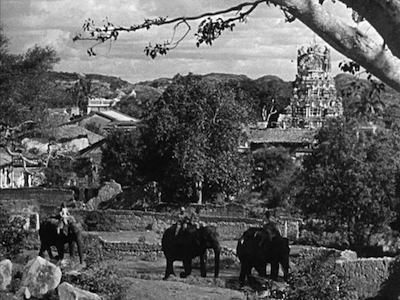
Any mystery of why the Kordas picked a particular twelve-year-old Indian boy to star in their 1937 Rudyard Kipling adaptation Elephant Boy (82 minutes) is cleared up the moment Sabu steps onto screen. The film begins--and indeed, opens the latest Eclipse boxed set from Criterion, modestly titled Sabu!--with the wide-eyed child addressing the audience directly, explaining to one and all the nature of the story they are about to see. He is in character as Toomai, a would-be elephant hunter with a history remarkably similar to Sabu's own, but for as scripted as the words he says may be, they sound like the gospel truth coming out of the boy's mouth.

Indeed, the youngster's personal history is remarkably similar to how Toomai's is depicted in John Collier's screenplay. The son of an elephant driver is orphaned on a hunt, later to be taken under the wing of a rich British colonialist. Though Sabu's personal trajectory would see him starring in several films for Alexander Korda, Toomai's was different. He dreamed of being a hunter, and his particular affinity for elephants leads to him proving himself where otherwise the small fry had been doubted. Toomai and his pet bull, along with his old man (W.E. Holloway), join the hunting party of a wealthy white hunter named Petersen (Walter Hudd, Major Barbara [review], The Importance of Being Earnest). The expedition embarks on a particular dismal season when elephants are scarce and tigers are plenty. Though the rest of the party doubt Toomai's ability, he is the only one who can control his pet, and together they find where its distant relatives have disappeared to, thus saving the day.


Elephant Boy is entertaining, if slight. It gears toward the young, as do most of Sabu's early features. Most boys dream at some point of wilderness life and communing with animals, and so the eager wish fulfillment has a resonance even if the times have changed drastically. Zoltan Korda co-directed the picture with Robert Flaherty, whom film buffs will recognize as the director of Nanook of the North, which is generally considered to be the template for documentary filmmaking. Unsurprisingly, the startling footage of Indian life and particularly the remarkable scenes with the wildlife is mostly Flaherty's doing, giving Elephant Boy a pleasing authenticity that would not have been possible back at Denham Studios. Directing children and animals is supposed to be the hardest thing a director can undertake; in Elephant Boy, both look easy.

This left Zoltan Korda (The Four Feathers [review]) to direct the narrative scenes, bringing a traditional British storytelling veneer to the simplistic plotlines. For the most part, the joint effort is seamless, with only a few instances of a jarring disparity between the two styles (editor Charles Crichton should probably get a special mention here; he began his career as an editor in the 1930s and ended it as a director, helming his last feature, A Fish Called Wanda, in 1988). Naturally, deeper issues of colonialism are left for others to contend with. Instead, Elephant Boy's main themes are moral determination and a dedication to duty. Hunting is presented as a noble profession (the elephant hunt is more like a cattle drive, there is no violent slaughter), and Toomai's dreams eventually come to. Presumably so did Sabu's, though he may not have been aware these particular adventures were his dreams until the picture business came calling.


Elephant Boy was followed in pretty rapid succession by several more Sabu vehicles with the Kordas, including the magical 1940 classic The Thief of Bagdad [review]. This Michael Powell feature fell between the next two movies in Sabu! - Eclipse Series 30, 1938's Drums and Sabu's other Kipling adaptation and probably his best-known film, The Jungle Book, released in 1942. You can read about those two color adventures here.


This disc was provided by the Criterion Collection for purposes of review.