Showing posts with label Sabu. Show all posts

Sunday, December 4, 2011

SABU!: THE DRUM/JUNGLE BOOK - ECLIPSE SERIES 30

This is the second part of a two-part review of the Sabu! boxed set; read the first part here.


Sabu's sophomore feature was a more stodgy affair than the first, and it also saw him relegated to more of a supporting role next to British star Roger Livesey (I Know Where I'm Going, The League of Gentlemen [review]). Following just a year after the success of Elephant Boy, The Drum (1938; 98 minutes) was Zoltan Korda's first adaptation of an A.E.W. Mason novel, a precursor to the more artistically successful The Four Feathers [review], the epic adventure that would follow immediately after. (Interesting side not, Livesey played the role of Harry as a child in the second film version of The Four Feathers in 1921; he was not in Korda's remake.)

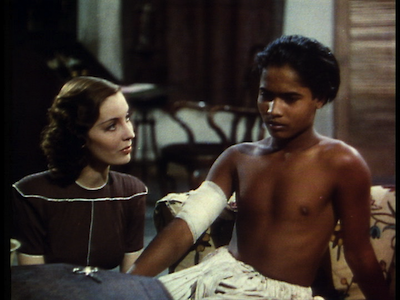
Set in India at a time of political upheaval, The Drum features Livesey as the enterprising Captain Carruthers and Sabu as Prince Azim, a naïve but earnest young ruler who befriends the colonialists. He is particularly fond of a bratty young drummer (Desmond Tester) in the British Army band and of Carruthers' kindly wife (Valerie Hobson, Contraband [review]). When Azim's uncle, the appropriately named Prince Ghul (Raymond Massey in brownface), kills the boy's father, the child prince must go into hiding, biding his time until the British can overthrow Ghul and put him back in power.
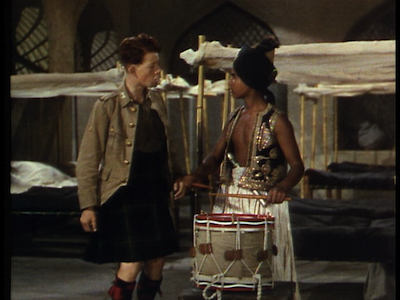


Okay, am I the only one who thinks of the The Lion King [review] here? Is that bad of me?

To be fair, it's a pretty common plot, and The Drum obviously appropriated it first--though it's disappointing in execution here because the embattled prince isn't so much passive as he is incompetent. Sabu isn't nearly as comfortable onscreen in The Drum as he was in Elephant Boy; his "serious" acting features a lot of squinty eyes and pursed lips. He is best when joking with Carruthers or the drummer boy, and the way Azim kowtows to the white men who taught him to be "civilized" leaves a somewhat sour aftertaste. Far more interesting, actually, is the villainous Ghul, who, like Skar in The Lion King (sorry!), is not entirely wrong. There is something rotten in India, and some question as to the rightful heir's ability to rule. Unlike Skar, however, Ghul also has an element of nobility. His designs on the throne aren't entirely selfish. Korda and screenwriter Lajos Biro's attempts to ridicule Indian beliefs and customs backfire. Ghul ends up looking like a defender of his country's ethnic traditions, refusing to accept the British charges of barbarism.


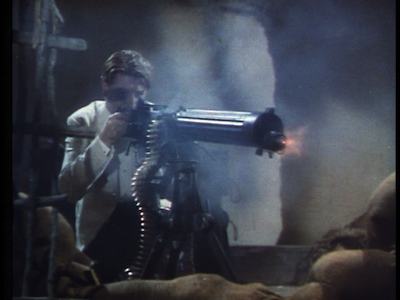
Two positive things about The Drum: (1) Georges Perinal and Osmond Borradile's Technicolor photography is lovely and vivacious (even if this print is a little faded and beat up). The sets and the costumes have an exotic opulence that must have been thrilling to see in the late 1930s, and still has charm now. (2) The climactic battle is impressively staged and daring in complexity. The crowd scenes before and during are huge, and Korda doesn't show a heavy hand in dictating how the throngs behave. The old tag line for the film boasted a cast of 3,000, and the authenticity of the mob goes a long way to make that claim appear to be true. Plus, Roger Livesey is surprisingly badass manning a Gatling gun.


Next up for Sabu was the Michael Powell-directed, Korda-produced The Thief of Bagdad [review] in 1940 before rejoining Zoltan in 1942 for their second version of a Rudyard Kipling story. Jungle Book (106 Minutes) is Sabu's most enduring work, as well as the most famous live-action version of the classic adventure tale--and with good reason. Sabu has not only matured as a man and an actor, developing into a physically agile performer, but Korda's film, as shot by W. Howard Greene and Jack Okey, is a visual marvel. The team creates a thriving Technicolor jungle, filled with lush plant life, exotic animals, and the remnants of man's beautiful folly.


Sabu plays Mowgli, a boy lost to the wilds after a tiger attack leaves his father dead. Adopted by wolves as a toddler, he returns as a teen to rejoin his village, much to the delight of his mother (Rosemary De Camp) and the suspicion of the town swindler, Buldeo (Joseph Calleia), who also serves as the storyteller whose own tale frames Mowgli's.

Mowgli adapts to village life, learning English and the baffling ways of society. Money holds little interest for him, though it buys him a knife to hunt the tiger, Shere Khan, who has vowed to kill him since he was a baby. He also takes a shine to Buldeo's daughter (Patricia O'Rourke), giving the man all the more reason to hate the jungle boy. Worse, Mowgli leads the girl to a grand treasure, only to leave it where it has remained hidden for decades rather than succumb to the evil that jewels and gold inspire. (It's ironic, given most Western iconography, that a snake warns the boy away rather than leading him into temptation.) This sets up Jungle Book's climax and sets up the foundation for its theme of man's greed and superstition being his downfall.


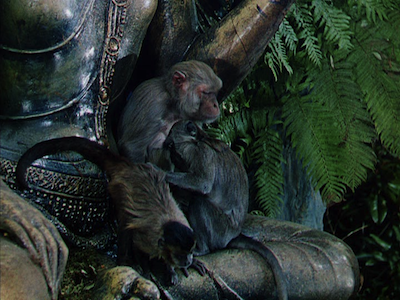
The story of Jungle Book is familiar to most people, though again we must invoke Disney, as the common memory often goes back to their animated version. In that, Mowgli cavorts with talking animals and the human world is mostly out of it. Many of the same characters are here--the snake Kaa, the panther Bagheera, and the bear Baloo--and Korda anthropomorphizes them, though not to the same degree. Mowgli is said to be able to speak all animal languages, and as we go deeper into his world, we begin to hear their voices as he does. Most of the time, the animals we see are real, including the predatory cats and elephants and the monkeys. In other understandable cases, they are puppets or props, though the only distracting effects are the rubbery snakes. In all fairness, the snakes tend to get bigger acting parts than the furrier animals, so some sacrifice had to be made for narrative demands.

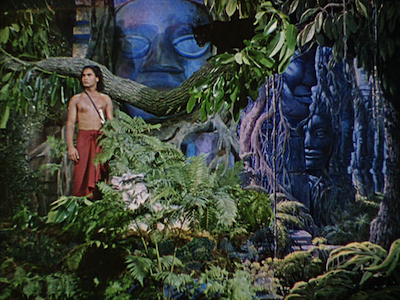
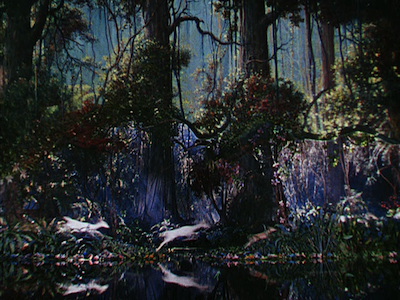
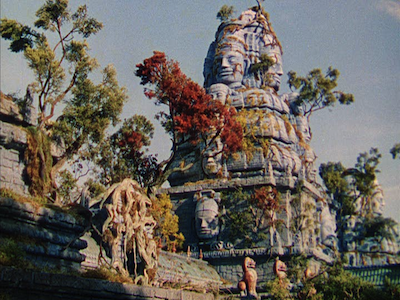
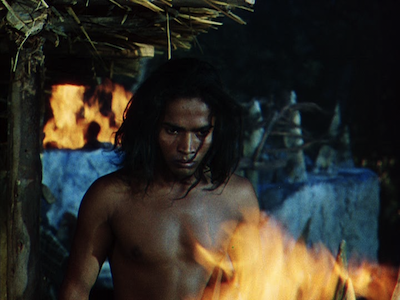
More impressive than the animal wrangling, though, are the sets. Korda uses a combination of matte paintings and physical sets to bring to life a colorful jungle setting. There are plants with fiery red leaves and giant blue statues and light tumbling through the trees that takes on astonishing purple hues. Sabu runs through each attractive set piece as a free spirit, utterly convincing as the wild boy who swings on vines and howls at the moon. Indeed, while the trained British actors come off as overly mannered and comical through most of the movie, acting down to the material, Sabu is perfectly comfortable in his chosen environment.


All three of Sabu's first movies with Zoltan Korda are now part of Criterion's Sabu - Eclipse Series 30 boxed set. I'd like to believe that Elephant Boy and particularly Jungle Book could still stoke the imagination of young viewers. Despite our technological advances, one assumes the untamed forests still hold some sway over our basic human instincts. This set would make a nice companion with the other Criterion younger viewer titles, namely Albert Lamorisse's The Red Balloon [review] and White Mane [review], and Bill Mason's Paddle to the Sea[review], all of which feature children interacting with the wonders of the natural world in exciting, yet vastly different, ways.


This disc was provided by the Criterion Collection for purposes of review.

Tuesday, November 29, 2011

SABU!: ELEPHANT BOY - ECLIPSE SERIES 30


Any mystery of why the Kordas picked a particular twelve-year-old Indian boy to star in their 1937 Rudyard Kipling adaptation Elephant Boy (82 minutes) is cleared up the moment Sabu steps onto screen. The film begins--and indeed, opens the latest Eclipse boxed set from Criterion, modestly titled Sabu!--with the wide-eyed child addressing the audience directly, explaining to one and all the nature of the story they are about to see. He is in character as Toomai, a would-be elephant hunter with a history remarkably similar to Sabu's own, but for as scripted as the words he says may be, they sound like the gospel truth coming out of the boy's mouth.

Indeed, the youngster's personal history is remarkably similar to how Toomai's is depicted in John Collier's screenplay. The son of an elephant driver is orphaned on a hunt, later to be taken under the wing of a rich British colonialist. Though Sabu's personal trajectory would see him starring in several films for Alexander Korda, Toomai's was different. He dreamed of being a hunter, and his particular affinity for elephants leads to him proving himself where otherwise the small fry had been doubted. Toomai and his pet bull, along with his old man (W.E. Holloway), join the hunting party of a wealthy white hunter named Petersen (Walter Hudd, Major Barbara [review], The Importance of Being Earnest). The expedition embarks on a particular dismal season when elephants are scarce and tigers are plenty. Though the rest of the party doubt Toomai's ability, he is the only one who can control his pet, and together they find where its distant relatives have disappeared to, thus saving the day.


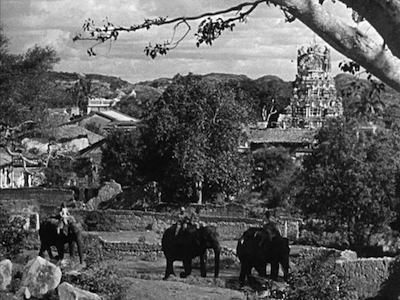
Elephant Boy is entertaining, if slight. It gears toward the young, as do most of Sabu's early features. Most boys dream at some point of wilderness life and communing with animals, and so the eager wish fulfillment has a resonance even if the times have changed drastically. Zoltan Korda co-directed the picture with Robert Flaherty, whom film buffs will recognize as the director of Nanook of the North, which is generally considered to be the template for documentary filmmaking. Unsurprisingly, the startling footage of Indian life and particularly the remarkable scenes with the wildlife is mostly Flaherty's doing, giving Elephant Boy a pleasing authenticity that would not have been possible back at Denham Studios. Directing children and animals is supposed to be the hardest thing a director can undertake; in Elephant Boy, both look easy.

This left Zoltan Korda (The Four Feathers [review]) to direct the narrative scenes, bringing a traditional British storytelling veneer to the simplistic plotlines. For the most part, the joint effort is seamless, with only a few instances of a jarring disparity between the two styles (editor Charles Crichton should probably get a special mention here; he began his career as an editor in the 1930s and ended it as a director, helming his last feature, A Fish Called Wanda, in 1988). Naturally, deeper issues of colonialism are left for others to contend with. Instead, Elephant Boy's main themes are moral determination and a dedication to duty. Hunting is presented as a noble profession (the elephant hunt is more like a cattle drive, there is no violent slaughter), and Toomai's dreams eventually come to. Presumably so did Sabu's, though he may not have been aware these particular adventures were his dreams until the picture business came calling.


Elephant Boy was followed in pretty rapid succession by several more Sabu vehicles with the Kordas, including the magical 1940 classic The Thief of Bagdad [review]. This Michael Powell feature fell between the next two movies in Sabu! - Eclipse Series 30, 1938's Drums and Sabu's other Kipling adaptation and probably his best-known film, The Jungle Book, released in 1942. You can read about those two color adventures here.


This disc was provided by the Criterion Collection for purposes of review.


Wednesday, May 21, 2008

THE THIEF OF BAGDAD - #431


Storytelling is a commodity.

To make a movie is to take a story, confine it in a box--be it rectangle or square--and use it to buy your way into people's lives. It's probably why we get so passionate about the films we love, we've agreed to trade a part of ourselves to make room for them.

In the world created in the 1940 Thief of Bagdad remake, stories are very important. They can be used to save someone's life or to condemn it. The film itself is like a storybook, containing many tales under one cover, some with positive moral lessons and some with truly negative outcomes. The blind man Ahmad (John Justin) uses verse to attract alms and spins a longer yarn about his life as a King to bide his time and buy himself some time in his enemy's home. Within his story, there are other stories, and he is even listening to one when his usurper, Jaffar (Conrad Veidt), catches him unaware. Actually, Jaffar uses a story to set his trap and then uses another to close it. The tale of Ahmad's grandfather traveling out among his subjects to learn more about them is manipulated to convince Ahmad to do the same, and then Jaffar's fib branding the monarch a madman seals his fate. Ironically, in between the two, Ahmad sits down to hear a story about himself and how the toppling of his tyranny has been foretold in prophecy. All these narratives have been his undoing.


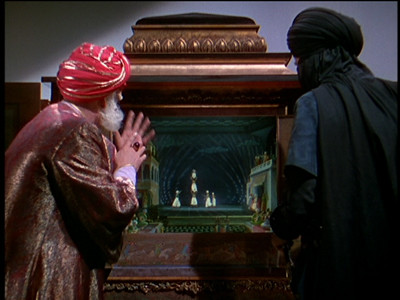
The Thief of Bagdad is like a cinematic version of a framed photo of a man holding a framed photo--the very same photo that is in the larger frame. And in that photo, another man and another photo, and on and on. In the movie, the Sultan of Basra (Miles Malleson), a collector of toys, has a replica theatre that contains miniature puppets that perform for him exactly the same way every time he opens the tiny doors. Though, in the movie, these aren't puppets, but real acrobats, and what we see is a miniature film within the film. Like the photo in the photo, the story inside the story, this is a movie in a movie.

Though The Thief of Bagdad is directed by three men, most forget to mention Ludwig Berger and Tim Whelan, and the picture is commonly credited to Michael Powell as director and to producer Alexander Korda as the lord and master. Powell, who would go on from here to begin a long-lasting and joyous collaboration with writer Emeric Pressburger, seemed to have a particular fascination with the fabric of story. In plenty of his other movies, the larger narrative contains smaller ones, be it David Niven accounting for his life on a Stairway to Heaven or the ballet company gripped by personal drama finally putting on their production of The Red Shoes. Thus, making a movie that uses as its source One Thousand and One Nights (a.k.a. Arabian Nights), the granddaddy of all story-within-a-story narratives, makes perfect sense for Powell. It's also notable that it marked his shift from realistic movies like The Edge of the World and darker espionage thrillers like Contraband to more fanciful fare, the type of movies that, alongside Thief of Bagdad, would earn him and Pressburger the title of "Walt Disney for adults." Of course, Michael Powell is largely believed to have mainly shot the scenes with Conrad Veidt, and he came on along with Whelan after Berger had fallen out of favor with Korda, so it's hard to say how much of the fantastic imagery here is down to him. I suppose that's a story for another time....


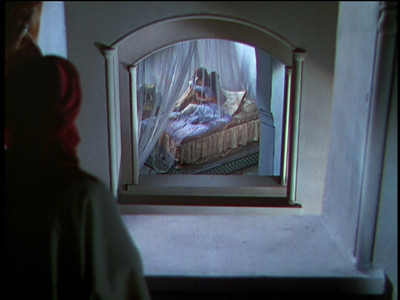
In addition to the performers inside the Sultan's toy theatre, there are many instances when one character spies the actions of another through a frame. This works in tandem with the eye motif, which Michael Powell is often credited with introducing into The Thief of Bagdad. It begins with the zoom on the eye painted on the hull of a boat at the start of the picture, and comes up again in both how Jaffar performs his magic and the poetic injustice visited on Ahmad when he is blinded. Multiple times, characters are instructed to look with their eyes or are asked why their eyes are closed. When parted, Ahmad and his Princess (June Duprez) long to look upon one another again, and the difference in worldviews between the twisted Jaffar and the romantic Ahmad is summed up in how they view the object of their desire. The Princess is all Jaffar can see because he can't have her, and though Jaffar insists that when her lover regains his eyesight, Ahmad will see that there are plenty of women all over the world, when the King can see again, he only has eyes for one special lady. Even the little thief Abu (played by Sabu) is told that the key to miracles is seeing the world with the eyes of a child. It's a proper metaphor for the new mythology of moviemaking. The magician uses his eyes to perform his magic, his audience uses theirs to see it. It's a back-and-forth between filmmaker and viewer, here seen as a glorious positive--even if much later in his career Powell would question what we are all looking at in his controversial Peeping Tom.


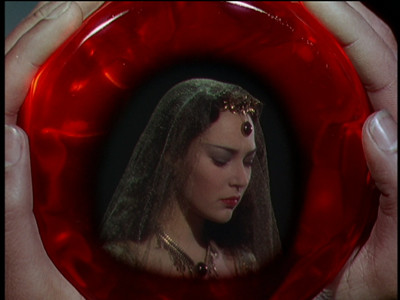
This eye imagery is probably best represented by the All Seeing Eye, a jewel that Abu steals from a sacred temple, where it has rested for 2000 years. Through this jewel, he is able to find the lost Ahmad, and Ahmad is able to look across the world at his Princess. When the jewel is shattered, it becomes Abu's passage into a realm of miracles. Shattering the eye destroys the collective blindness that afflicts modern society and keeps its denizens from seeing magic. It is also cinema shattering the bonds of centuries of storytelling convention, forging the way for something new and different. You won't just hear or read about carpets flying, you will see them!

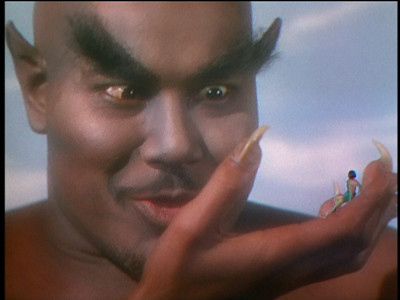
Once Ahmad's account of his past--his betrayal by Jaffar, falling in love, Abu being turned into a dog, the Princess falling into a deep trance--catches up with his present, the movie shifts out of campfire mode and remains in the present, moving forward along one line for the duration of the movie. For its second half, Thief of Bagdad becomes everything it was meant to be, its own dazzling story. This is an adventure picture, after all, meant to give moviegoers some thrills and show off the special effects technology being developed at the time. Some of those effects look quaint today, now that we are more familiar with bluescreen and CGI has replaced models and puppets with 3-D constructs. It's not that hard to peer past the veil of fantasy when tiny Abu shares the screen with the giant Djinni (Rex Ingram), yet even jaded viewers should be able to see how playfully this engages the notion of movie illusion. It's almost better that it looks fake, and to get too critical only proves that the All Seeing Eye has ruined our sense of childlike wonder. Why settle for the false nostalgia of billion-dollar retreads of old cartoons and toy lines when you can have the real thing?*

Besides, it's not all bad. The effect of the Sultan riding a horse across the sky still looks pretty good, and one can't help but be awed by the massive, colorful sets and the beautiful matte painting backdrops. This wasn't some cheap production, but an ambitious Technicolor undertaking. The new Criterion transfer of the picture shows every beautiful detail, restoring the bright hues and cleaning up each and every frame. There was probably a time in the past when no one thought movies this old would ever look this good again, but as with so much in The Thief of Bagdad, seeing is believing.


In addition to the new transfer, the Criterion Thief of Bagdad comes with two audio commentaries and a second disc entirely of extras. Of those, a half-hour program about the visual effects featuring special-effects legend Ray Harryhausen unravels the tricks the filmmakers used to create the magic in the movie, including pioneering the bluescreen process (there is a separate demonstration of how bluescreen works) and the employment of miniatures and perspective shots. There is a lot of great footage and photos from the set, though Harryhausen, even as he discusses the techniques, makes a good point about the destruction of illusion in our current need-to-know society. I have long felt that the one downside of the DVD age is that everything is explained to us, we always want to know how it's done rather than marveling at what was done. So, kudos to Mr. Harryhausen.


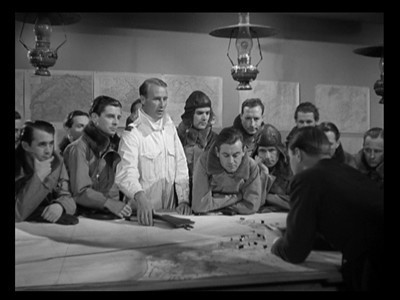
Alongside this documentary is a feature-length propaganda film from 1940, The Lion Has Wings, which couldn't be further from Thief of Bagdad in tone and subject. This was produced by Alexander Korda and made during a hiatus on Thief of Bagdad. It was partially directed by Michael Powell, and stars Ralph Richardson, Merle Oberon, and June Duprez--though roughly 2/3 of the movie is documentary footage. Even propaganda from the good guys is still propaganda, and so most of The Lion Has Wings comes off as stiffly preachy. The ever-present narration never lets us forget we're supposed to be learning something. The first twenty minutes is a rundown of the build-up to war and what England stands to lose if Hitler were to have his way, and then the rest of the movie is spent with the Royal Air Force. Real combat footage is interwoven with images of the homefront and a dramatization of the flight and ground crew's experience during bombing raids.

It's an interesting curiosity, but not much more than that, and certainly a comedown after The Thief of Bagdad.


* I should note, Indiana Jones and the Kingdom of the Crystal Skull manages to get the nostalgia thing right, and if you're eager to go see it this weekend, I'd recommend following it up with the Thief of Bagdad when it comes out on Tuesday. It will make for a good chaser to quench your swashbuckling thirst.