Showing posts with label Capra. Show all posts

Saturday, April 25, 2020

MR. SMITH GOES TO WASHINGTON - CRITERION CHANNEL

This review originally written as part of an overview of The Premiere Frank Capra Collection for DVDTalk.com in 2006. 


Perhaps the greatest Goliath you could have in a David and Goliath story is the government. For Frank Capra and screenwriter Sidney Buchman (Holiday [review]), if the United States is a democracy built for the people and by the people, then when it goes awry, it's up to the people to fix it. In 1939's Mr. Smith Goes to Washington, Jimmy Stewart plays Jefferson Smith, a leader of a Boy Scouts-like organization. When one of his state's senators dies suddenly, Smith is appointed to the vacant seat as a sort of political patsy, a puppet for the remaining senator, Joseph Paine (Claude Rains, Casablanca) and the true backroom mastermind, Jim Taylor (Edward Arnold), a kind of Karl Rove of his day.


Being a Capra movie, what no one figures on is Smith's down-home manner being a reservoir of true wisdom. Never before having been to Washington D.C., but being a history buff, he's awed by the city's monuments. His "aw shucks" demeanor is quickly pounced on by cynical reporters and his initial supporters all quickly turn from him, much like the story arc Mr. Deeds went through. Also like Deeds, Smith is a minor victim to the dual devotions of Jean Arthur. As Saunders, the ambitious political aide, she is set up as Smith's assistant in order to further the goals of her political party and secure herself a place in the Administration when Paine moves on to the White House. Naturally, she begins to see that Smith's uncommon patriotism is not a product of stupidity, but a genuine fount of emotion that modern politicians have long since forgotten. Her role will end up being the same as many of Capra's heroines: when Smith is beaten and ready to give up, it's Saunders who will give him the courage and the means to carry on. His faith in something greater gives her a new reason to believe, and she returns the favor.


Smith's near downfall comes when he uncovers the corruption of Paine and Taylor and attempts to expose it. They do a frame job on him to make him look corrupt himself, and Smith striking back is one of the most famous scenes in cinema history. Staging a one-man filibuster, Smith talks for a full day, giving everything he has in him to try to make his fellow senators see that they have lost their way. Stewart is remarkable in this scene, conveying the deterioration of body and voice while maintaining the resolve of Smith's spirit. While his brand of patriotism may seem strange to us in the '00s, when we would hear about the graft scandal the junior senator uncovers as everyday news, for the end of the '30s, at least in Capra's world, it's got a kind of quaint appeal. While earnestness and honest intentions can be a lesser artist's downfall, it's the fuel that runs Frank Capra's motor, making Mr. Smith Goes to Washington as inspirational today as it was nearly seventy years ago.


YOU CAN'T TAKE IT WITH YOU - CRITERION CHANNEL

This review originally written as part of an overview of The Premiere Frank Capra Collection for DVDTalk.com in 2006. 


1938's You Can't Take It With You was adapted from a popular play by George S. Kaufman and Moss Hart, who also brought us The Man Who Came to Dinner, A Gentleman's Agreement, and the Judy Garland version of A Star is Born. Their text provides Frank Capra and writer Robert Riskin with what was then their largest central cast to date. Jean Arthur returns to Capra's set as Alice, the most stable member of the eccentric Sycamore family. When she becomes engaged to Tony Kirby (Jimmy Stewart, another Capra mainstay), the son of a wealthy financier, the fun-loving, free-living Sycamore family comes face to face with the uptight Kirby family. The two clash over issues of class, finance, and social propriety, and the question of whether or not the two can coexist is integral to whether or not Tony and Alice can really get married.


It took me a little while to warm up to You Can't Take It With You. The Sycamore family was a tad too obnoxious to stomach at first, almost like the Addams Family but without any of the cool creepy stuff. I came around largely due to the performance of Lionel Barrymore as the clan patriarch, Grandpa Martin. He sets the tone for their crazy lifestyle. As a former businessman who left the life of high finance for a life of high relaxation, he can school the Kirby patriarch, A.P. (Edward Arnold, Man About Town) in the loneliness that is the product of living your life as a series of acquisitions and mergers. You Can't Take It With You is actually more about those two than it is about the love affair between Tony and Alice. Grandpa Martin is the quintessential Capra man, and he has to teach A.P. to live as the Sycamores do.

Once I got past the initial noisiness of the Sycamores (as well as the hypocrisy of their household: it's all right for them to do as they please as long as they have black servants making it all possible), I started to really enjoy You Can't Take It With You. The role of Tony seems tailor-made for Jimmy Stewart. The boy is caught between two worlds. He has the sort of dreams you can only pursue as a Sycamore, but the sense of responsibility you get saddled with when you try to be a Kirby. The scenes of him wooing Jean Arthur when they are on their own, away from both families, are funny and charming, and next to the clash of the two older men, Tony's wrestling with his own soul is the main attraction of You Can't Take It With You.


Saturday, April 11, 2020

MR. DEEDS GOES TO TOWN - CRITERION CHANNEL

This review originally written as part of an overview of The Premiere Frank Capra Collection for DVDTalk.com in 2006. 


Watch this and then remember that Adam Sandler remade it, and see if you don't suddenly favor capital punishment. The hubris!

In the original Mr. Deeds Goes to Town from 1936, and directed by Frank Capra, Gary Cooper is Mr. Deeds, a regular Joe from small-town America who has suddenly inherited an obscenely large fortune. A poet who writes homilies for postcards, he has never travelled outside the borders of his hometown in Vermont, and so when he's ferried to New York City to take care of business, Deeds is pretty far out of his element. His bodyguard Cobb (Lionel Stander, later famous as Max on "Hart to Hart") tries to steer him straight, and Deeds quickly sees his lawyers aren't as magnanimous as they pretend; yet, it's not going to be long before Deeds finds himself in trouble. He's got more good sense than the whole of the city, but he grows weary of their snarky assessment of this situation. Things also heat up considerably when his nightly exploits start showing up in the paper and he is given the cruel nickname "Cinderella Man." Little does he know that Mary, the woman he is falling in love with, is really Babe Bennett, the reporter who is sticking it to him. Played by Jean Arthur, who would become a Capra regular, Babe/Mary is the counterweight to Deeds' conscience. As his moral fortitude drops, hers goes up, inspired by the example he sets.


Eventually, Deeds can't stand two-faced city life any longer, and he decides to give all of his money away. He establishes a program to buy farms for out-of-work farmers and before he knows it, potential candidates are lined up around the block; at the same time, his lawyers have gotten him arrested as possibly insane. He must be crazy to give up that much money, right? Broken up over Mary's betrayal, Deeds refuses to defend himself, and the bad guys almost win. It's only when Mary and all of the farmers whom he has tried to pull out of the ditch stand up for him does he find a reason to believe again and stand up for himself.


Once again, the handling of the material is amazingly smart, and Capra really makes the movie work by his expert casting. Gary Cooper has a gentle presence that plays well against his considerable size. His Mr. Deeds not only physically towers over his persecutors, but he mentally towers over them, as well. The forces of greed are no match for the basic belief in what is right for everyone.


Sunday, August 18, 2019

THE MIRACLE WOMAN - CRITERION CHANNEL

This review was originally written for DVDTalk.com in 2014.


The 1931 drama The Miracle Woman is the kind of movie that few folks besides Frank Capra could pull off. It's a film that manages to simultaneously be a sincere portrayal of faith while maintaining a healthy skepticism in regards to human nature. While other directors might find a hard time striking a balance between these two themes, their own personal interests or agenda causing them to lean heavily one way or the other, Capra deftly works between them without ever seeming like he's pushing a message.

Barbara Stanwyck stars in The Miracle Woman as Florence Fallon, the daughter of a preacher who is being run out of his church by the congregation he devoted his life to because they prefer a younger, flashier style of clergy. When the old man dies the day he is meant to give his final sermon, Florence delivers a blistering lecture instead. Bob Hornsby (Sam Hardy, King Kong), a con man passing through town, happens to catch the performance. Impressed by Florence's guts and her knowledge of the Bible, he takes advantage of her lost belief to convince her to join him in running a fake revival scam. Florence soon becomes a popular traveling preacher who reaches a huge audience by broadcasting moral lessons on the radio.


One person who hears her message is an aviator who was blinded while serving his country. John (David Manners, Dracula) is about to throw himself out the window and commit suicide when Florence's voice calls him back from the ledge. He goes to one of her revival meetings, a circus-like spectacle that even includes live lions on stage, and ends up meeting Florence by volunteering to join her in the lion's den. A friendship develops, and then romance, as John's natural goodness reminds Florence that she once believed in providence, too. The only thing standing between them being together is Bob, who isn't keen on seeing his meal ticket run off and get married. It's one thing for Florence to make others believe in her message, but a whole other thing if she starts believing it herself.


The script for The Miracle Woman is by Jo Swerling (The Pride of the Yankees [review], Lifeboat [review]), working from a play by John Meehan and Robert Riskin. It's nicely paced, cutting time between the exaggerated world of Florence's operation, including swinging backstage parties run by Bob, and the isolated quiet of John's apartment. The relationship between John and Florence progresses naturally, with the blind man offering her a respite from her troubles. Stanwyck does quite a job here, managing to keep the bluster of her performances and her diva-like attitude off-stage from overshadowing the more honest emotions of Florence's true character.


The big finish that brings down Florence's invented church plays just as well as the angry sermon she delivers at the start in the very real one, and though the film's closing scene is a bit sappy, Capra otherwise maintains the earnestness of the narrative without ever straining. The Miracle Woman both shows respect for true believers and pity for how their beliefs can sometimes be taken advantage of. Hardy's onscreen villain may be a bully and a brute, but the real evil in Capra's tale is how people seeking answers and solace often end up juked by the very system they've gone to for help.


LADIES OF LEISURE - CRITERION CHANNEL

This review was originally written for DVDTalk.com in 2013.


An early effort from director Frank Capra, Ladies of Leisure was adapted by Capra and Jo Swerling in 1930 from a popular play. Barbara Stanwyck leads a fine cast, including comedic supporting actors Lowell Sherman and Marie Provost, playing a prissy playboy and a sassy gal pal, respectively.

Stanwyck stars as Kay Arnold, a professional party girl who is rescued from a bad night by amateur party pooper Jerry Strong (Ralph Graves). Jerry is the son of a wealthy railroad man who is trying to buck the family business and become a painter. He hires Kay to be his model with the goal of capturing the hopeful look he saw on her face the night he picked her up. For Kay, this is a stroke of good luck, as steady employment will keep her out of trouble, but the streetwise gal has a hard time replicating the naive optimism Jerry is looking for. Plus, she feels increasingly hopeless as she begins to fall for the artist. He's already engaged to a woman more fitting his social standing.


A pre-code picture, Ladies of Leisure tackles some fairly scandalous subjects. Kay's initial career is basically being a paid escort, though the script frames both her and her roommate Dot (Prevost) as modern independents looking to get by on their own. One of the more fascinating scenes comes mid-movie when, hoping to catch Jerry's attention, Kay attempts to prove she's capable of more domestic duties, donning an apron to fry some eggs and play the wife. His failure to notice her efforts is heartbreaking. The actress was an expert at playing women with moxy whose gumption often masked true vulnerability. Kay is basically an early version of the grifter Stanwyck later portrayed in The Lady Eve [review], though without Preston Sturges' whip-smart writing.


Ladies of Leisure is an imperfect affair. Pacing is a big problem. Long chunks of the movie are dragged down by an awkward stiffness. Capra's direction seems stuck somewhere between the traditional stage and silent pictures, he hasn't yet mastered the art of the talkies. Luckily, there is plenty of comic relief from Prevost and Sherman that gooses proceedings back to life. There are also some surprisingly dark twists in the final act, when Kay is convinced that she really is bad for Jerry and makes increasingly drastic choices to free him from her and then liberate herself from her own bad decisions. There is an excellent tension building to the finale, even if the very end feels tacked on rather than organic.


Sunday, June 19, 2016

HERE COMES MR. JORDAN - #819


Films about the afterlife and how hapless shmoes interact with divinity seem to have had their heyday in the 1940s, when inventive filmmakers dreamed up new visions of heaven and wrestled with the concept of second chances. Perhaps it was the post-Depression, wartime anxiety at work, launching Frank Capra’s It’s a Wonderful Life [review] and Powell and Pressburger’s exquisite A Matter of Life and Death into the zeitgeist. Both were released in 1946, but five years prior Alexander Hall (Let’s Do It Again [review] was leading the way by introducing us all to Mr. Jordan.

Here Comes Mr. Jordan is the story of Joe Pendleton, a random renaissance man played by Robert Montgomery (Lady in the Lake, Ride the Pink Horse). I say random because Joe’s vocational hobbies don’t have much rhyme or reason. A boxer on the way to being the champ, Joe is also a pilot and a saxophone player. It’s because he insists on flying himself to his next match that Joe ends up in a tailspin that shuffles him off to the other side, lucky sax in tow. It’s there that Joe meets Mr. Jordan (Claude Rains, Casablanca, Notorious [review]), a sort of stand-in for Saint Peter and the coordinator for souls flying off to their final destination. Quite literally. In this afterlife, one does not travel to heaven via the stairs, but on an airplane.


Turns out there was a mix-up and Joe was snatched too soon by an over-eager angel (longtime character actor Edward Everett Horton (Design for Living [review], It’s a Mad, Mad, Mad,Mad World). Joe was not meant to die that day, but the angel grabbed him before he could right his plane. More complications result from the fact that Joe’s body was cremated before he could be returned to it, and now the boxer is owed some 50 years of living. Mr. Jordan’s solution is to find him a new body, replacing him for someone else newly deceased. None of the options please Joe, however, he wants someone as fit as he was.

Mr. Jordan eventually plays on the boxer’s sense of right and decency, convincing him to take over for a rich man whose wife and trusted aide have conspired to kill him. By stepping into Farnsworth’s shoes, he can rescue poor Betty (Evelyn Keyes, The Lady in Question [review], Hell’s Half Acre) and her father, whom Farnsworth and his cronies have framed for lost millions. Joe quickly falls for the girl, and tries to change Farnsworth’s image, while also hoping to resume his boxing career, two destinies that are seemingly at odds with one another.


Destiny is an important factor of Here Comes Mr. Jordan. If a man is fated for a certain life, how can he maintain that track when the circumstances change unexpectedly? Even in Farnsworth’s body, Joe knows that he is Joe, though only he--and us--sees himself as Robert Montgomery. No one else can see Mr. Jordan, either, leading to some expected humor about the crazy tycoon talking to himself. Mr. Jordan serves as a bit of a guide, leading Joe to make the right decisions, culminating in a surprising ending that gives the man a little bit of everything, while also giving him peace. Without spoiling too much, imagine a life where you know you are not you. It’s not exactly a fix for the injury done against Joe by cutting short his existence.

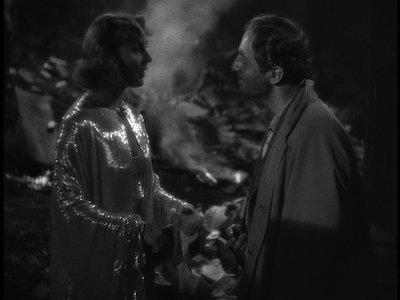
Hall’s vision of paradise--which it should be noted was initiated by writer Harry Segall in his play Heaven Can Wait, which Here Comes Mr. Jordan is a loose adaptation of--is rather simple. Smoke on the ground, an empty horizon--though, I suppose that’s actually purgatory, we never go all the way to heaven proper. It’s a calm place, and Jordan himself remains calm throughout, never caught off guard or swayed, a soothing presence meant to ease the anxiety that apparently follows us from life to death. Rains is a perfect choice for the role. His even-handed charm can be as inviting when he’s a good guy as it is unnerving when he’s a bad guy. In fact, in a later film, he would play the flipside of Mr. Jordan, serving as the devil giving Paul Muni another go-around in 1946’s Angel on my Shoulder, this time from an actual Harry Segall screenplay. Claude Rains clearly sees the thin line between good and evil and can perform equally well on either.


The actor’s cool demeanor serves as a nice foil to Robert Montgomery’s chatty palooka. It’s funny, Montgomery is an actor I enjoy, though I never find him convincing. Not in the way Cary Grant or Jimmy Stewart can always be themselves and yet also make me believe in their characters; Montgomery always strikes me as someone who is putting it on, rather than getting absorbed in it. It makes no matter here, though, as Joe is all forward energy, and Hall aims for a comic tone that is just a step or two shy of screwball, a perfect spot for Montgomery to operate in.

The movie itself is similar: charming, if sometimes a little threadbare or even rushed, particularly at the end, when the explanation for why Joe suddenly can’t be champ practically contradicts certain exposition that came earlier. There’s a convenience to the new rules that would be off-putting if the finale wasn’t so satisfying. Here Comes Jordan was such a hit that it would later inspire a sequel in 1947’s Down to Earth, replacing Montgomery for Rita Hayworth and Rains for Roland Culver (and with Hall once again behind the camera). Not having seen it, I can’t say if Hall makes as good with his second chance as Joe Pendleton does with his, but then, I guess that’s just another of life’s little mysteries I’ll get to eventually solve before moving over to the next world myself. (No, seriously, what if I literally die after watching it?!)


Note: This disc was provided by the Criterion Collection for purposes of review.

Tuesday, November 11, 2014

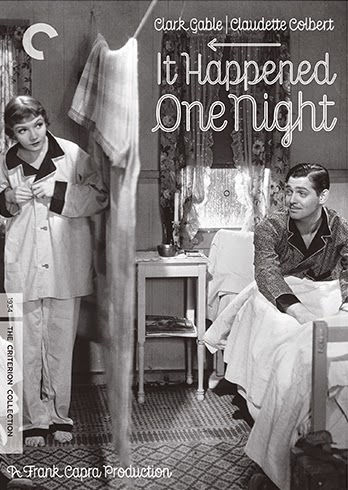
IT HAPPENED ONE NIGHT - #736

Cobbled together with excerpts from my review of The Premiere Frank Capra Collection:


"Of or evocative of the movies of Frank Capra, often promoting the positive social effects of individual acts of courage." - the definition of "Capraesque," as stated by the American Heritage Dictionary

"[Frank Capra] made you pay for those happy endings." - Jimmy Stewart

I find that most -esques are misunderstood and misused as time wears on, so I was surprised to do a quick Google search on "Capraesque" and find the above definition at the top of the list. I would say that, based on some of the director's most successful and beloved, it's a relatively accurate summation of what makes a Frank Capra movie tick. Usually, when I see the tag bandied about, the intention is to suggest that a movie is overly optimistic, that it shows a particularly cheery view of life where someone triumphs and learns a moral message. This particular shading is based primarily on It's A Wonderful Life [review], and it has some basis in truth. It's just not the whole enchilada.

You impressions might be different, though, if you stick with Capra films from his pre-WWII period. It's a Wonderful Life was released in 1946, but all of its important components were starting to be designed as early as 1932, when the director helmed American Madness, part of a string of movies at Columbia Pictures that would embody the true definition of Capraesque.

The more nuanced explanation of what that descriptive entails is as follows: in a Frank Capra movie, there is a clear distinction between the little man and the big man. Any big man who crosses over to try to lend a helping hand to the little man will often be scorned as crazy. Usually, the enemies of such social upheaval are the powers that be in business, the moneymakers who have no concern for the well-being of the common populace, not so long as their coffers are still being lined. When the hero goes up against these paragons of business, it's not just an economic battle, but one of common sense vs. a world gone mad. When the do-gooder is on the brink of absolute ruin, he discovers that his efforts have touched more people than he could ever have dreamed, and his friends and those who have clasped their needy mitts in his helping hand rally to rescue him from destruction.

That is probably the true message of a Capraesque movie, from American Madness onward. No man is poor that has friends. Many of the famous Capra characters say as much. In American Madness, Walter Huston's banker argues for extending loans to those in need because they are decent people who will help the greater good in return, and the message is locked right in the title of You Can't Take It With You. But perhaps Gary Cooper sums it up best as the eponymous Mr. Deeds in Mr. Deeds Goes to Town. As he looks over the New York skyline, lost deep in the romance of the city and Jean Arthur, he wonders what a great world it might be if folks everywhere just remembered to like each other. In Capra's way of things, the mob is its own worst enemy as well as the greatest agent of change. It's all a matter of choice. It could just as easily go bad, and it's up to an individual dreamer to be the catalyst for it going right.

That's actually where most modern storytellers who tilt at the windmill of Capraesque go wrong. They mistake Capra's belief in the power of the individual for a simplistic worldview. Frank Capra didn't trade in blind optimism. His characters don't stupidly grin through the rumbling as the walls tumble around them. Because in Capra's movies, the walls do indeed tumble, and the threat of failure is a real and heavy one. His heroes are often struck down as low as they can possibly go. Huston contemplates suicide, Mr. Deeds would rather be declared insane than deal any further with a savage, heartbreaking existence. To put them up against any less would be false bravado. We can only tell who you can count on by how they fare life when it's hit the absolute bottom.


And then there's It Happened One Night, released in 1934.

The movie responsible for Bugs Bunny! Friz Freleng has noted on several occasions that the fast-talking manner of the rascally rabbit is based on Clark Gable's performance in this picture, right down to how he eats a carrot. This is a fitting development, as It Happened One Night is often cited as setting the standard of screwball comedy.

Claudette Colbert plays Ellie Andrews, an heiress who has eloped with a rich aviator. When her father (Walter Connolly, Twentieth Century) vehemently disapproves, she runs away, starting an interstate search stretching from Miami to New York. On her bus ride, she meets Peter Warne (Gable), a tough-as-nails, take-no-crap reporter who begins the picture quitting his job during a drunken phone call. Realizing who Ellie is and seeing she has no idea how to function in the real world away from daddy's money, he attaches himself to her and promises to get her to her husband if he can write the exclusive story. Their many high-speed arguments are delightful, and the pair handle the razor sharp dialogue with aplomb. They also get the emotion right, and filmmakers and actors are still trying to replicate the way Peter and Ellie go from hating everything about each other to being absolutely in love.

In It Happened One Night, the social element isn't nearly as prevalent. The ills of Depression-era America do show up, particularly when the couple donates the last of their money to a starving mother and child on the bus, but this is more of a private revolution. Ellie is going to have to learn to be a real person, to care about what happens around her, something even her father will push her towards. He'd rather see her follow her heart than hook up with some oily flyboy. Capra and Riskin play it smart, avoiding one-dimensional characters. Peter believes in the common good, but he's also not above being self-serving, and though Ellie is out of touch, she has a heart. Being able to capture multiple dimensions is why Capra and Riskin's work together still endures.


Included in this edition is the 1997's Frank Capra's American Dream. Ron Howard narrates this feature-length documentary about the filmmaker made for the American Movie Classics cable channel. It features a host of critics, colleagues, and contemporary actors and directors discussing their love of Capra's movies. The roster of directors alone is impressive: Martin Scorsese, Robert Altman, Oliver Stone, Arthur Hiller, John Milius, Amy Heckerling, and many more.

The documentary traces Capra's life from a young Italian immigrant growing up in California to his early days as a director, the films he made for Columbia, his service in WWII making films for the Army, the post-war success, and his twilight years. Where Frank Capra's American Dream succeeds tremendously is in rooting out the various events that influenced the director's world view, how an incredibly complex person came to make movies about such complex ideals. In many ways, his heroes were cast in his own image: a man who fought on despite self-doubt and personal failure, who wasn't sure he believed in what he was fighting for but had to see it all the way through. It's a fitting capper for the Premiere Frank Capra Collection, bringing the definition of "Capraesque" all the way to the front as not just an genre aesthetic, but one man's personal storytelling philosophy.


Sunday, November 14, 2010

MY MAN GODFREY - #114

"The only difference between a derelict and a man is a job."


I recently did an interview with a film student who was working on a project about how the current economic troubles in the U.S. and around the world were effecting cinema. It was hard to come up with titles for contemporary fictional films that had addressed the situation directly except for Up in the Air [review]. Hollywood has not yet pulled on its big boy pants and gotten relevant to the times. Not like in the Great Depression, when movies by the likes of Frank Capra and Preston Sturges regularly looked at America as it was in the here and now of the moment.

This hadn't come to mind when I chose to re-watch Gregory La Cava's 1936 comedy My Man Godfrey. I had picked it for this week's feature because I had seen someone else mention the title and realized I hadn't viewed it in a long time. My Man Godfrey would make for a light afternoon matinee. What with me stuck behind a deadline and a little hungover, why not laugh a little?


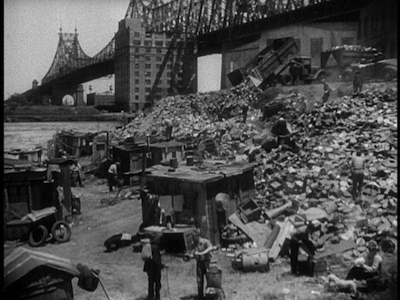
My Man Godfrey opens at the city dump. Two socialite sisters, Cornelia and Irene (Gail Patrick and Carole Lombard), are on a scavenger hunt. One of the items on the list is a "forgotten man," the euphemism for the homeless and displaced. Cornelia goes up to Godfrey (William Powell) and offers him $5 to go back to the party with her and help her win the hunt. Godfrey is rightly offended by this, and he tells Cornelia off. When he quizzes the friendlier, flightier sister, Irene explains the nature of the hunt to him. He agrees to go back with her, if only to beat Cornelia in the game. The hunters are all congregating in a hotel ballroom, and when Godfrey sees the madness and the decadence, he gives the entire party a piece of his mind. There is clearly something different and unexpected about this particular forgotten man: he's remembered to retain his dignity.

Feeling bad for dragging Godfrey into this vapid insanity, Irene attempts to make it up to him by offering this displaced fellow a job as the Bullock family butler. ("Do you butle?" she asks him.) He takes it, because a job is a job. Irene even gives him money to buy a new suit. He shows up the next day cleanly shaven and newly dressed, only to find the Bullocks in a state of disrepair following their extensive partying the night before. Mother Bullock, Angelica (Alice Brady), sees pixies in her room, Cornelia is a holy terror, and Irene barely recognizes the man she hired--though once she does, she declares him her protégé and says she will guide him in life. It will be just like the way her mother guides the young Spanish pianist (Mischa Auer) who is always around. Oh, and Irene is also falling in love with her new manservant.


It's enough to make a butler run screaming. Apparently, it did the last guy, and many before him. (Actually, the last guy also stole from them, though given later events in the movie, it's possible Cornelia framed him.) The only one in the Bullock family who seems to have his head on straight is the father (gravel-voiced character actor Eugene Pallette), and he spends most of his time chasing behind his wife and daughters and paying off their bills. He insists they are going to cause him to go broke, but they think he's fooling. He's not.

Meanwhile, Godfrey comes into his own as a butler. He masterfully glides through the chaos, finding his purpose through honest work. As he does, his story begins to emerge. He is not so much the down-on-his-luck moneyman that we suspect, he is the son of a wealthy Boston family who dropped out of society when he got a divorce. It was a rash, selfish decision, and his hooking up with the lost souls who ended up sleeping in the garbage heap for a real reason shows him how rash and selfish it was. One of his old Boston pals, Tommy Gray (Alan Mowbray), spots him at the Bullocks, and after Tommy agrees to keep his secret, they start to hatch some plans for how to rectify Godfrey's place in life.


My Man Godfrey was written by Morrie Ryskind, one of the Marx Bros.' writers, and Eric Hatch, one of the scribes on the Topper screenplay, and it was based on a novel by Hatch. It's a compact story, despite spanning a lot of time within its fictional world. In a lot of ways, the narrative progresses off screen. The scenes the writers and La Cava choose to show stand alone as individual comedic situations, and the actual plot is artfully tucked in between as connective tissue. You almost don't notice there is a story at all, the way these characters bat each other around is so funny. My Man Godfrey is full of witty dialogue and quotable lines.


William Powell is marvelous as Godfrey. He starts the movie with a hint of menace, but that turns out to be a defense mechanism. Godfrey softens as he regains his confidence. The actor is able to deliver an erudite joke with natural ease, lacing the words with amusement or withering disdain depending on what is called for. He can also be genuinely nice, something that is particularly evident in his rapport with Carole Lombard. Though they had been a real-life married couple, Powell and Lombard had divorced by the time My Man Godfrey went into production, but if there was any animosity between them, it doesn't follow them onscreen. Lombard is a brilliant comedic performer. She manages to make Irene as ridiculous as she needs to be, but you never get the feeling that she is ridiculing the character to do so.

That's because the whole of My Man Godfrey is made with compassion. Yes, it's a screwball comedy and a light romance with an ending that drops an out-of-leftfield solution on us. More importantly, though, La Cava has crafted a movie that is sensitive to what is happening all around, and it addresses the situation in a way that manages to keep the levity without forcing a message or condescending to the people whose lives it's meant to uplift. Five years before Sullivan's Travels [review] and Preston Sturges torpedoed the pomposity of socially conscious motion pictures and vindicated the effectiveness of popular entertainment, La Cava made the perfect example of how to do both. My Man Godfrey is poignant and touching, but it's also very funny and as breezy as they come. The film reminds us to put ourselves in the shoes of our fellow man, regardless of whether they live in a penthouse or in a cardboard box. Everyone has their problems, and it's just a small shift that can put us on one side or the other of the social dividing line. Going from upstairs to downstairs is just a quick tumble.


This is also why Up in the Air worked. Jason Reitman's movie isn't so much about the social condition or economic pitfalls as it is about the people it depicts. Characters living a believable life in a world that is recognizable as our own is far more effective than a contrived object lesson. The message is that there is no message, you just have to live and be human. One shudders to think what might happen were someone to decide to remake My Man Godfrey today (please, don't ever let Adam Sandler read my blog), but it really is a movie that speaks to our times. It may have felt very specific when all of these fine folks got together to make it, but what they came up with is timeless and thus eternally relevant.


Thursday, February 18, 2010

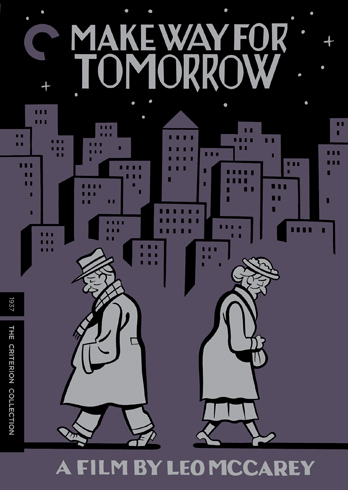
MAKE WAY FOR TOMORROW - #505


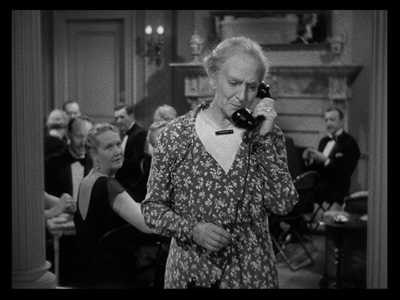
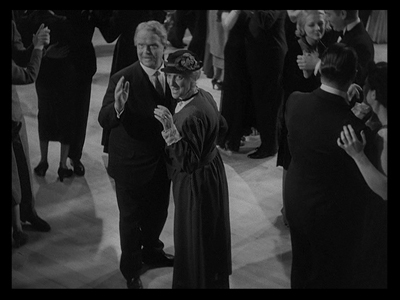
The 1937 film Make Way for Tomorrow is the story of Ma and Pa Cooper, an elderly couple who have been together for fifty years. They now find themselves as victims of their time, and Leo McCarey's sweet drama is also very much a product of that time. It reflects the economic state of the world the Coopers had aged into. Its title has an ironic double meaning: it's a hopeful looking ahead at change, but it can also be barked out like an order, telling the older people to get out of the way. Nowhere in the movie is this more sharply felt than when Ma and Pa step out on the dancefloor to waltz, only for the music to change to something faster they can't step to.

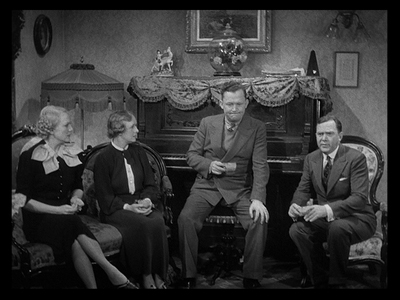
Barkley Cooper (Victor Moore) and his wife Lucy (Beulah Bondi) had five children together, and they summon the four of them that still live nearby to their childhood home to tell them that the bank is foreclosing on the house. Though they were given six months to vacate, they've waited until the last minute to tell anyone. The good son, George (Thomas Mitchell), realizes that any plans that can be made on the fly won't be ideal, they will have to split the old folks up. He will take his mother to live with his family, a three-hour drive, and his sister, the cold shrew Cora (Elisabeth Risdon), will put up their father. The plan is for the other sister, Nellie (Minna Gombell), to reunite both parents at her home in three months, something her husband (Porter Hall) quickly puts the kibosh on.


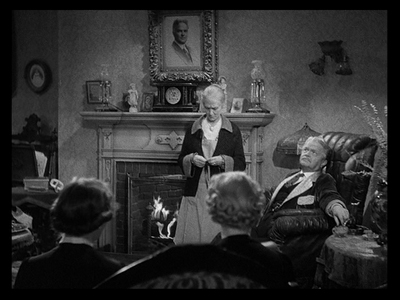
Living apart is hard on both the parents and the children. Ma is in the way in George's apartment, having to share a room with their teenaged daughter Rhoda (Barbara Read) and encroaching on how George's wife Anita (Fay Bainter) runs her household. Pa gets sick while out looking for a job, and he doesn't much like Cora's care any more than she likes giving it. Something else is going to have to be done.

Make Way for Tomorrow is a much beloved film. The DVD has testimonies from filmmakers Peter Bogdanovich and Bertrand Tavernier. Roger Ebert recently wrote about it in his Great Movies column, noting how much heart it had and how tough it was. He rightly points out that were this a movie made today, there is no way it wouldn't get stuck with a clichéd happy ending. To be honest, though, for the first 2/3 of the film, I couldn't see what all the fuss was about. I didn't dislike it, it was charming in a quaint kind of way. It moved at a slow amble, and people spoke pleasantly to one another even if the subtext was harsh. Everything about the movie was just so damned reasonable. Sure, the kids were begrudging in their charity and maybe didn't come up with the best plans for helping Ma and Pa out; at the same time, the old folks are kind of annoying.


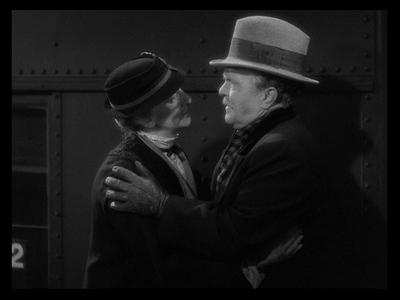
It's only in the third act that everything starts to make sense, when we see at last why everyone is so brittle. Cora decides to use her father's chest cold as an excuse to ship him off to sunnier climes. He'll stay with the absent sister out in California. Knowing she can't go with him, Ma nobly makes a plan to check into an old folk's home, but only on the condition that her husband not be told. George accepts, but he feels like a heel doing it. On the day when Pa is meant to leave, he and Cora meet in New York City for a few final hours together. They are on their own, free of their children, and they start to reminisce. Fifty years prior they had come to New York on their honeymoon. Could maybe some of the old places they visited still be there?


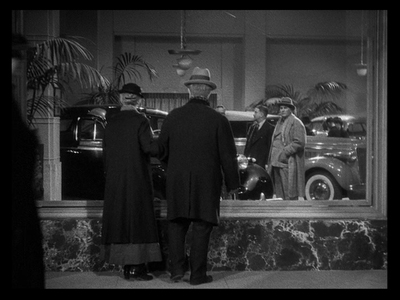
Once the Coopers are back together, Make Way for Tomorrow takes a lovely turn. The spark that has been lacking in the earlier part of the movie was intentionally left out. It's because there is no spark when Ma and Pa are apart. Together, though, oh! What charming people! They are still romantic, still impressed with what makes the other one tick, and comfortable in the way they get along together. It's not just the audience that sees how wonderful their love is, but all of New York City. An oily car salesman gives them a ride, but he has no ill will when he discovers they are broke. The old hotel they stayed at as newlyweds rolls out the red carpet when they hear that guests of such a distinguished age have returned. All the things about this wonderful pair that their offspring could not see are obvious to everyone else. You'd have to be a pretty tough customer not to have tears in your eyes when the bandleader sees that Ma and Pa are lost in his up-tempo rhythms. The part I didn't tell you up above is that he stops the faster number and goes back to a waltz to give these aged lovers more time to enjoy each other's company.


As mawkish as this all may sound, Make Way for Tomorrow stays far away from obvious melodramatic tugs or soppy sentiment. Leo McCarey, working from a screenplay by Viña Delmar (The Awful Truth), who sourced it from a novel and a play, put their faith in the material and in their audience to understand that fifty years of personal history is a long time. It would be easy to mine their story for the easy emotional peaks, but personalities are so much more interesting than plot. Of course, it helps when you have actors as insightful and empathetic as Victor Moore and Beulah Bondi. Moore had been acting in movies since 1915, and Bondi was playing a part well ahead of her years; she would act well into the 1970s, and is maybe best known as Ma Bailey in It's a Wonderful Life. Both actors pull way back for their performances here, giving themselves over to the effects of aging, moving slow, speaking softly, but never slipping into caricature. How fun it is to see Ma Cooper eventually cut loose and have a couple drinks!

Make Way for Tomorrow is a portrait of America as it was still finding its way out of the Depression. On one side, the Cooper children are doing all right and finding prosperity again, but on the other is their parents, part of an older generation that never quite found their way back to the way things were. Part of the kindness the old people find in New York is likely down to people having sympathy for them and also being impressed that they have survived this long. Leo McCarey avoids visual flash in the same way his actors avoid histrionic displays of emotion. These are dark times he is depicting, and though he isn't exactly predicting the Italian Neorealists, he does try to show the world as it was and not how Hollywood dreamed it to be. He also avoids copping out at the ending. A cheerful conclusion would have seemed hollow when there were no easy answers waiting for any moviegoers outside the theatre. It's just like how Jason Reitman left us hanging at the end of Up in the Air, one of the few movies to portray the financial hardships of contemporary times. To say it's all going to be okay would be disingenuous.


It would also probably relegate both movies to the scrap heap. Had Make Way for Tomorrow ended with money raining from the sky, I doubt we'd be talking about it today, much less watching it in a Criterion edition. Hell, this movie even makes fun of those kind of movies, the way Ma Cooper describes the predictable genre picture she saw with her granddaughter. Honesty is what resonates through the ages, what makes a story timeless and universal. I find Leo McCarey's film more hopeful because it shows us two people who can make the best of the worst times, who are resolute, and who never let go of what matters, even if they have to say goodbye to it.


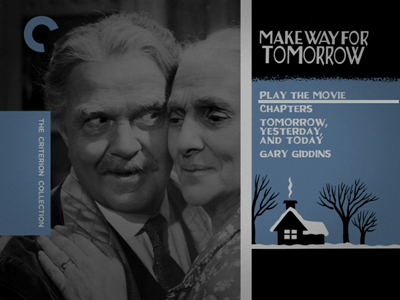
As always, Criterion has put together a great package, and the best part is that Make Way for Tomorrow has multiple new illustrations by one of my favorite cartoonists, Seth. His comic book It's a Good Life, If You Don't Weaken is all about nostalgia for things lost, and recent projects like Clyde Fans and George Sprott: (1894-1975) deal with the effects of age and reconciling the life one has lived. This makes him a perfect choice to capture the charm and emotional beauty of Make Way for Tomorrow.



For a full rundown on the special features, read the full article at DVD Talk.