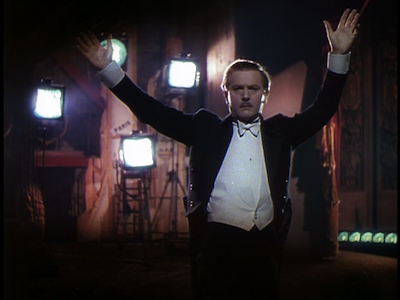
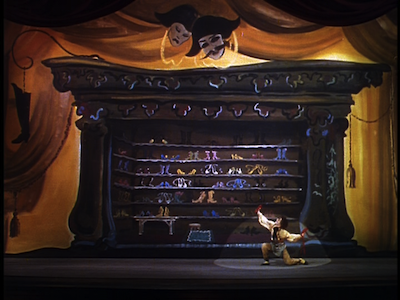
Late in Ingrid Bergman: In Her Own Words, when director Stig Björkman is highlighting one of the actress' final films, Autumn Sonata [review], he holds on a silent close-up from the movie. It’s a scene where Ingrid Bergman stares directly into the camera, letting an emotional beat wash over her, engaging with the audience in a way that lets us see exactly what she is feeling. It's a great moment of punctuation for the documentary, because throughout Ingrid Bergman: In Her Own Words, the performer's children have noted that her lifelong relationship with cameras, both as the subject and the operator, stemmed from the fact that her father--who died when the Swedish-born star was very young, leaving her an orphan--was a professional photographer. She learned to live by looking at a camera, and she learned to love by the way it looked at her.
Stitching together news and interview footage with film clips, personal photos, and home movies, Björkman has crafted an intimate portrait of an enduring personality, getting beyond the superficial press image or even the standard tribute. Granted access to an extensive collection of artifacts left behind by Bergman, and with the aid of her four children, all of whom share their own memories of their mother, Björkman shows us the star from earliest childhood, tracking her moves from Swedish cinema to Hollywood, and through scandal and triumph. Narrated by Alicia Vikander (Ex Machina), who reads from Bergman's diaries and letters to three of her closest friends, the images are enhanced by the subject's own private thoughts. It's the things she maybe wouldn't have shared with interviewers or her family that prove most revealing. For those who have seen Bergman's onscreen work, be it her romantic roles in movies like Casablanca and Notorious [review] or her more artful, emotional work with second husband Roberto Rossellini, the secret to Ingrid Bergman’s craft is made clear: even if she often gave more to cinema than she did her day-to-day existence, she was as thoughtful and tender in here real life as she was in her invented ones.
Bergman also possessed an incredible strength, as evinced by her weathering the public scorn following her leaving her first husband for Rossellini. It seems inconceivable that a private individual would be denounced on the floor of Congress as a bad example of morality, but that's just what happened. Through it all, Bergman was resilient, her characteristic charm never wavering. Perhaps her long fascination and association with Joan of Arc gave her some insight into martyrdom. Whatever gave her purpose, Bergman offered no apologies.
Then again, Ingrid Bergman: In Her Own Words is careful not to draw obvious connections between movie roles and true events, the way a director might otherwise if this were a dramatic biopic--though Bergman's loves and travels would definitely make for a solid narrative, were someone willing to try. No inference is drawn, for instance, from her choice to star in a light comedy about infidelity like Stanley Donen's Indiscreet [review], despite it being very easy to make a claim that it served as a defiant middle finger to her critics. Rather, Björkman lets the work exist on its own. He's more concerned with his subject’s wandering spirit and how her choices affected those around her. Having been given the appropriate time to deal with things, her children are surprisingly generous, admitting they were as enchanted with her as much as the moviegoing public. Which may be the greatest revelation of all: Ingrid Bergman was no manufactured icon, the woman we fell in love with in the movies was who Ingrid Bergman really was. At times aloof and unknowable, but always seductive, always interesting to watch, and always leading with her heart.
Bonus materials on the Criterion Blu-ray of Ingrid Bergman: In Her Own Words give us extra glimpses into her life and artistry. Deleted scenes and further excerpts from Bergman’s own home movies, shot by the Ingrid herself on 8mm, add to our knowledge of the star’s life. Perhaps more illuminating for film fans are the two bits from early Swedish films. The outtakes from her 1936 romance On the Sunny Side show her natural charisma. Even more telling, though, is her brief appearance as an extra in the 1932 movie Landskamp, her screen debut. Even as a silent background player, Ingrid Bergman stands out, her eyes finding the camera, and engaging with her public. She’s the only one in the group that you’d ever think would end up being a star, and probably the only one there that even dared to dream it.
This disc was provided by the Criterion Collection for purpose of review.
Jacques Demy’s take on the big American musical, 1967’s The Young Girls of Rochefort, is pure joy. From the first frame to the last, it’s packed with smiles and passion and a giddy sense of its own fun.
Set in a seaside town on a carnival weekend, The Young Girls of Rochefort puts aside the operatic stylings of The Umbrellas of Cherbourg [review] in favor of something more akin to Stanley Donen, director of Singin' in the Rain and Funny Face [review]. In case there was any doubt, Demy even imports Gene Kelly, Donen’s former partner and one of the most accomplished hoofers in Hollywood, to participate in this ambitious lark. Real-life sisters Catherine Deneuve and Françoise Dorléac play Delphine and Solange, twins with big dreams. Delphine is a dancer, Solange a composer, and the two get by teaching the children of Rochefort their craft. The pair are planning to move to Paris, however, as soon as the celebrations are over. Solange already has a line on a possible job. The man who runs the local music store, Simon Dame (Michel Piccoli, Belle de jour [review]), has promised to arrange for an introduction to Andy Miller (Kelly), a famous American pianist whom Monsieur Dame went to school with.
Little does Dame know that Miller is in town, and the foreigner has already run into Solange without realizing it. Andy and Solange are instantly struck by Cupid’s arrow, only to be separated, unsure if they’ll ever meet again. Just about everyone in The Young Girls of Rochefort has a romantic double out there waiting for him or her to find. Dame imagines that Solange is his, but only because he doesn’t realize that the lover who jilted him a decade before, and whom he still pines for today, is her mother. Dame thinks Yvonne (Danielle Darrieux, Mayerling [review], The Earrings of Madame De.... [review]) is in Mexico and has no idea she is running a café nearby.
As for Delphine, she must extract herself from the affections of a skeezy gallery owner (Jacques Riberolles). By coincidence, he has a painting hanging in his salon that looks exactly like Delphine. It’s by a soldier (Jacques Perrin, Z [review]) whom she has never met, it’s his image of his romantic ideal. He goes to Yvonne’s for french fries, but he’s never met her daughters; the gallery owner refuses to introduce Delphine to the painter, precisely because he knows how it will end up. (The painter himself is a kind of symbol: a romantic dreamer whose visions are mostly in abstract, solidifying for this one portrait to capture something real. Demy works in much the same way, using dreamy and knowingly false backdrops to create something profoundly emotional.)
Meanwhile, a pair of carnies (George Charkiris and Grover Dale) appeal to the sisters to perform the sideshow for their traveling motorcycle dealership (yeah, I don’t know either) because their exotic dancers have skipped off with some sailors. And then there is also a little bit of business about...a sadistic killer who hacked up an old chorus dancer named Lola?!
If it sounds like a lot of plot, that’s because it is. But Demy choreographs all of these relationships with the same precision as he does the big dance numbers. In terms of story, The Young Girls of Rochefort is about how love is fated, and so it relies on coincidence and chance opportunities. Turn one corner, meet the man of your dreams; turn the other, miss him forever. For much of the movie, many of the characters go without ever meeting one another, and they are both deaf and blind to the stray mentions or cursory sights that would actually bring them to the one they seek. One character sees the painting of Delphine’s doppelganger but then can’t remember where he saw her face when he meets her for real; Dame hears Andy playing Solange’s music, but he can’t quite place the melody. Only the bad guy who would have Delphine for his own makes the right connection. It seems blind optimism causes literal blindness.
Not that we’re ever all that worried that true love won’t find anyone in the end. Even so, it’s pretty amazing watching Demy arrange the players for the final scenes, contriving for paths to cross and throwing in a few more near misses just to keep us guessing a little. The carnies and their jive have given us a little bit of that old “we’re going to put on a show!” hucksterism, and now that the sisters have had a taste of success, it’s time for their dreams to come true. Demy even outfits Deneuve and Dorléac in spangly red dresses reminiscent of Jane Russell and Marilyn Monroe’s showgirl outfits in Gentlemen Prefer Blondes. Michel Legrand also pulls out his biggest show stopper for the scene. The other numbers are catchy but more notable for the composer’s swirling rhythms and melodic filigrees; in this one, he goes big.
Amusingly, it’s one of the less complicated performances in terms of dancing. Deneuve and Dorléac are confined to a small space, and though they work it with panache, their moves are geared more to the stage than the screen. Demy’s most complicated dance material is reserved for the street scenes, where tourists and shoppers move in unison around the different characters, serving as the chorus to their romantic travails. It’s all quite impressive. Demy isn’t messing around. And neither is Gene Kelly. His level of talent and expertise is evident every time he joins in the fun. His every tiny gesture is graceful, and Andy’s ubiquitous grin seems less a character choice and more the performer being tickled by being part of this grand foreign production. (It must have seemed simultaneously ambitious and naïve to the cinema veteran.) The best dance sequence in the entire film is another twofer, when Andy and Solange are reunited. The dancers are transfixed on one another, making love with each step; Françoise Dorléac is quite literally swept off her feet.
The Young Girls of Rochefort has some of the same candy-coated pastels as The Umbrellas of Cherbourg, particularly in the colorful dresses worn by Deneuve and Dorléac, and in the matching outfits you can spot on the various couples sashaying up and down the sidewalks. Demy has kept his art department intact for both films. Jacqueline Moreau is in charge of costumes, and Bernard Evein is the production designer. They are as essential to the Jacques Demy magic as the man himself. Likewise, Jean Rabier returns for his third time as Demy’s cinematographer. Though, Rochefort is a long way away from the Bay of Angels [review].
The sum total of all of these people working together is a substantially breezy entertainment that, despite basically coming at the end of the era of classic movie musicals, recalls the best of them. This is really Demy at his peak, the bliss of The Young Girls of Rochefort making a nice complement to the melancholy of The Umbrellas of Cherbourg. It’s these two movies that have cemented his legacy, and the ones that most often get revisited. All it takes is that initial spin of Rochefort to understand why: it’s impossible not to feel better after having watched it.
By the way, I reviewed The Young Girls of Rochefort once before in my write-up of a Catherine Deneuve festival for the Portland Mercury. You can read that here. While you're at it, I looked at five of the actress' lesser films that were released as a DVD set back in 2008.
This disc was provided by Criterion for purpose of review.
There is a mutual appreciation society between New York indie icon Jim Jarmusch and quirky Finnish filmmaker Aki Kaurismäki, and that spiritual and creative connection has never been more evident in any of the Kaurismäki films I have seen than it is in his 1992 effort La vie de bohème (The Bohemian Life). Like the early works of his Aki's New York compatriot, it's a lazy comedy drawn in warm tones, inhabited by genial losers, and depicting a pocket of society just around the corner from the norm. Based on work by writer Henri Murger that also served as the inspiration for La Bohème (and thus all the iterations that followed), La vie de bohème also owes a little something to the tradition of similarly minded efforts featuring ex-pat artists and writers and the bungled romances that plague them, such as Ernst Lubitsch's A Design for Living [review] or even Stanley Donen and Gene Kelly's An American in Paris [review].
La vie de bohème is quintessentially Kaurismäki, however, and unmistakably European. The trio at the heart of the film are Marcel (André Wilms), a struggling playwright; Schaunard (Kari Väänänen), a loutish musician; and Rodolfo (Matti Pellonpää), a refugee from the Soviet bloc making his way in Paris as a painter. Marcel is being evicted from his apartment, and Schaunard is moving into it, and after a night of drinking where the writer shares a glass or two (or five) with Rodolfo, the three become fast friends. Kaurismäki's script details their various schemes to stay afloat, including Marcel's taking over a burgeoning fashion magazine (his publisher is played by Samuel Fuller, a mentor to Jarmsuch, as well) and Rodolfo bilking a naïve art collector (Jean-Pierre Léaud, who is a dynamo in both of his scenes). In the midst of this, Rodolfo has a romance with another immigrant, Mimi (Evelyne Didi), gets deported, and then comes back. He is, arguably, the driving force of the narrative. If nothing else, he serves as some kind of conscience, the guy that, were he to do better, could change everyone's fates. In particular, he holds to some stringent ideals that adversely affect Mimi. His old-fashioned views on the relationship between men and women are as impractical as his chosen lifestyle. It's up to Mimi, as well as Marcel's girlfriend/secretary Musette (Christine Murillo), to provide the voice of reason, worrying about such pesky things as food, rent, and delivering on promises.
Kaurismäki has a good time with the classic story, infusing it with his own kooky sense of humor while also having fun with the conventions of nineteenth-century dramatic novels. Naming Rodfolfo's dog after Baudelaire will give you some indication of the reverence (or lack thereof) the auteur holds for classic authors. La vie de bohème goes from silly to melodramatic parody before finally settling into a fairly dark finale. The artists of the piece have spent the movie trying to dodge all responsibility, including the results of their own actions (or inaction). Inevitably, this is an unsustainable practice, and Rodolfo is forced to face his own selfishness when his bad habits lead to him being very much alone.
The cast of La vie de bohème is populated with Kaurismäki regulars, all of whom click well together and have little problem balancing the absurdity of most of the script with its all-important moments of realness. Pellonpää plays a similar straight-man role to his one as the manager in the Leningrad Cowboys movies [review], while Wilms' trademark earnestness, seen most recently in Kaurismäki's Le Havre, makes him a rather delightful con man. His scene where he escapes from a thug by distracting a cop with a quickly improvised story is something straight out of a 1930s comedy. One gets the sense that Marcel's writing is likewise a feint, or at the very least relatable only to himself. We are spared hearing any of his prose. When it comes to the boys' art, Kaurismäki reserves his savage humor for Schaunard, who plays a song that is a weird hybrid of John Cage and German noise and industrial. It unsurprisingly sends both Mimi and Musette running out of the room.
Fans of early 1990s indie cinema will appreciate La vie de bohème's casual pacing. The movie is in no real hurry and is as content as its characters with letting the rest of the world move on as it stays settled. Timo Salminen, who is Kaurismäki's go-to director of photography, shoots the movie in black-and-white, and will inevitably draw comparisons to similar work by Tom DiCillo (Stranger than Paradise [review]) and Robby Müller (Down by Law). There is a clean look to everything, however, that separates it from its grainier cousins. For all the squalor the layabout artists indulge in, there is a shabby beauty to how their lives look on film that is reflective of the everyday experience they attempt to capture in their own work. When they bother to do it, that is.
My current frontrunner for the best movie of 2013 is Richard Linklater's Before Midnight [review], an emotionally turbulent, challenging movie about a long-tem couple who unexpectedly find themselves at a crossroads where they are questioning whether or not their relationship is worth continuing. It's a film that earns all of the feelings in engenders. Not unlike its spiritual predecessor, Roberto Rossellini's 1954 movie Journey to Italy(a.k.a. Voyage to Italy).
The director's crowning collaboration with Ingrid Bergman could serve as a sort of omen: their relationship would eventually disintegrate for good. Here, though, we find the pair perfectly in sync. Bergman plays Katherine Joyce, an upper-class wife of a British businessman. Alex (George Sanders) has recently inherited some property from his uncle, some land and a fancy home in Naples. Alex and Katherine have gone to Italy to sell it, and while they are away, do a little vacationing. Alex is a workaholic and it's hard to get him out of the office, which may explain why, now that Katherine has managed to get some alone time with him, they realize they don't know each other at all.
Ennui and jealousy make for a nasty combination. Husband and wife are bored with each other and the decades-long conversation they've been having. Yet, as is usually the case in such situations, they don't want anyone else being bored by their spouse, that is their right alone. And so it is that Alex begins to resent a dead poet whose verse has outlined Katherine's Italian itinerary. Though this kind of suspicion angers Katherine, she becomes guilty of it herself when they happen to run into a woman Alex has known previously. She is on a group vacation with some friends, and Alex pays the ladies in the traveling party extra attention when they are all out having drinks. Katherine says that she never knew that her hubby was so interested in women. Translation: why aren't you that interested in me?
After a few snippy arguments, the pair goes their separate ways to finish out the trip. Alex goes to Capri to catch up with his friend, while Katherine stays behind in Naples to continue to tour the historical spots and look at the ancient relics. She also spends her time drinking in the local color and observing the people. I was reminded a bit of Sofia Coppola's Lost in Translation [review]. Ingrid Bergman wandering about and soaking up the culture has echoes in how Scarlett Johansson spies on ceremonies and customs in Japan while her husband is off pursuing actresses; likewise, George Sanders is gruff and sarcastic, and while not as loveable as Bill Murray, his flirtations with familiar ladies in foreign lands is not that different than Bob Harris.
It all points to a long tradition in world cinema. Many directors have portrayed troubled marriages via wayward nights and heated conversation, be it Ingmar Bergman's prolonged breakdown in Scenes from a Marriage or Michelangelo Antonioni's sharply focused La notte. While plenty of folks lately have been invoking Godard's famous line about all you needing to make a movie is a girl and a gun, Rossellini and those who followed in his footsteps all do without the gun. The girl and a guy provide plenty of drama without firearms ever getting involved.
Perhaps it's because he loved her that Rossellini tips the scales a little in Ingrid Bergman's favor in this film. Katherine is given an internal monologue that, despite its vitriol, humanizes her to a greater degree than Alex. Couple that with her more demonstrable abilities to empathize with her fellow man, and she seems far less beastly than her husband. Alex's self-recrimination is born of failure and rejection, and the standards he nearly sacrifices to try to reclaim some of his wild oats are troubling--even to him. “Beastly” may not be the right word, actually. Alex is less likable, but he's no less human. Sanders is also an actor on par with Bergman, and despite the clash of wills, both performers manage to make the Joyces seem like a real couple. Despite their differences, despite the spite, they fit. It's evident anytime they are in the car, but particularly in their penultimate conversation, when it appears they will call it quits. (Again, automobiles make for a regular staging ground for arguments. The Before Midnight disagreement begins in a car, also while the couple are on vacation; and let's not forget the hot-tempered, cold-blooded exchanges between Audrey Hepburn and Albert Finney in Stanley Donen's exceptional Two for the Road.)
As a conclusion to this cycle of films, the trio of Ingrid Bergman vehicles sometimes known as “The Solitude Trilogy,” Rossellini brings it all back around to Stromboli [review]. He does so aesthetically by his incorporation of real locations and real people to the drama, and how her new surroundings affect his leading lady. He also connects it back to their initial collaboration in how he handles the ending. The fate of the Joyces' conjugal union is decided by a religious epiphany, by a miracle--though in this case, not one that happens to Ingrid Bergman. Rather, it happens in her vicinity and threatens to swallow her. It is a human volcano, rather than the literal one in Stromboli; the people who move against her confirm her truth by trying to sweep her away a la Europe '51 [review]. There's a directness to how the director handles it in Journey to Italy that makes it more powerful than the endings of its predecessors. In Journey, the actions of the characters take over, and there is no need for further explanation. The intense feelings that power their decisions speak for themselves.
Journey to Italy plays Saturday, July 6, at 8:45pm, again on Sunday, July 7, at 8pm, and finally on Monday, July 8, at 7pm, as part of the NW Film Center's presentation of "The Solitude Trilogy." View the full schedule here.
Ah, it's that time of year where I start running behind, isn't it?
Well, here are the reviews for other movies from April...
IN THEATRES...
* The Angels' Share, a heartwarming Ken Loach dramedy about a whisky heist. Let me in on that action!
* The Place Beyond the Pines, an unwieldy family story from the director of Blue Valentine. Are literary pretensions and a strong cast enough to overcome a director's indulgences?
* Room 237, like a collapsing wormhole of internet crazy, a tape loop of nonsense about Stanley Kubrick's The Shining.
* To the Wonder, the latest from Terrence Malick is beautiful and emotionally provocative.
* Trance, wherein Danny Boyle uses Rosario Dawson's private parts to try to hypnotize you into believing that he's not just pulling the same old bullshit.
My Oregonian columns...
* April 5: two festivals come to town: the Polyester Pulp series of 1970s crime films and the disjointed Beer and Music Fest. Plus, Thale, a creepy Scandinavian folk tale turned into a creepy modern movie.
* April 12: the environmental documentary Trashed, featuring the very serious face of Jeremy Irons; Elliott Gould and Christopher Plummer in weird and grisly The Silent Partner; and, hey, another environmental disaster in the schlocky 100 Degress Below Zero.
* April 19: Two recent French films, Women on the Sixth Floor and Tomboy, and two 1950s classics, The Little Fugitive and Imitation of Life.
* April 26: Emily Mortimer in the historical drama Leonie, an indie debut called Everything Went Down, and Peter Gabriel in concert.
ON BD/DVD...
* 28 Hotel Rooms, an indie romance with an interesting story structure.
* The Devil and Miss Jones, a delightful class comedy from 1941, starring the wonderful Jean Arthur.
* Hemingway & Gellhorn, literary legacies desecrated, good actors embarrassing themselves, and a myriad of other reasons why this is one of the worst movies I've seen in a long time.
* A Message to Garcia, a poor presentation of an otherwise decent early Barbara Stanwyck vehicle.
* Not Fade Away, a rock 'n' roll drama from Sopranos-creator David Chace.
* The Sun Shines Bright, John Ford's friendly portrait of a Kentucky judge and his community ca. 1905. If you can look past some of the troublesome racial elements, the film actually has a surprising message of unity.
* Tatsumi, the animated biography of influential manga creator Yoshihiro Tatsumi
My reviews for non-Criterion movies written in the first month of 2013.
IN THEATRES...
* 56 Up, another seven years in the life of Michael Apted's groundbreaking documentary series.
* Amour, Michael Haneke's drama of old age. Reserved and emotionally powerful.
* Barbara, an enthralling German drama about one woman exiled to the country in East Germany, ca. 1980.
* Gangster Squad. The low-bar for 2013 has been set. Here's your challenge, movie industry: don't do worse than this.
* Hansel & Gretel: Witch Hunter. I'm a sucker for Gemma Arterton so I went to see her as Gretel, and now I'm a sucker for this movie.
* The Impossible, a good movie about surviving a tsunami, despite the ethnic whitewash.
* The Last Stand, teaming Arnold Schwarzenegger with awesome director Jee-woon Kim. It's not as good as his Korean movies, but it's better than most Arnie movies.
* Mama, starring recent Golden Globe winner Jessica Chastain. She had a whole week to enjoy her win before this stinker hit.
* Rust and Bone, Marion Cotillard in a dark drama from the director of A Prophet.
* The Good Doctor, the director who gave us Kisses returns with an ethically curious medical drama with Orlando Bloom.
* Indiscreet, the Stanley Donen romance film reteaming Cary Grant and Ingrid Bergman appears to be geting better with age.
* A Man Vanishes, Shohei Imamura's 1967 breakthrough. In addition to the main film, there are also five documentaries the Japanese director made in the years leading up to Vengeance is Mine.
A round-up of my reviews for non-Criterion movies in the past month.
IN THEATRES...
* The Conspirator, Robert Redford has some questions about Lincoln's assassination. Asked and answered!
* Hanna, the feisty action picture starring a young female lead to see right now.
* Meek's Cutoff, Michelle Williams and fellow pioneers get lost on the Oregon Trail. So lost, they end up someplace where it's not even raining. Directed by Kelly Reichardt.
* Miral, Julian Schnabel's fascinating yet muddled look at the history of a string of Palestinian women in Israel in the latter half of the 20th Century. Starring Freida Pinto.
* Stake Land, a derivative but totally entertaining vampire-killing road trip.
* Super, in which James Gunn takes on the whole "real world crimefighter" thing, and his hero gets upstaged by a little girl.
* Your Highness: Oooh! Oooh! I got one. "Puff, puff, pass--emphasis on the pass."
In addition to my regular movie reviews, check out my contribution to the Portland Mercury, in which I pick a few movies to go along with the a recent week-long booking of Full Metal Jacket. (Longer reviews of two of the movies mentioned: The Strange One and Paths of Glory.)
* Arabeseque, Stanley Donen tries to recapture the magic of his previous success and fails. With Gregory Peck and Sophia Loren.
* The Incredibles, Pixar's killer superhero adventure gets the Blu-Ray treatment.
* Ingrid Bergman in Sweden, three films from the homeland, before the iconic actress went to Hollywood.
* Leaving, an absolutely ordinary, and thus boring, infidelity drama with Kristin Scott Thomas.
* No One Knows About Persian Cats, noble in its ambitions, not quite as successful in its final execution, a rock 'n' roll movie from Iran and Bahman Ghobadi.
* The Paranoids, a quirky dramedy from Argentina. An intriguing character study made all the better by its awesome lead actor.
* The Perfume of the Lady in Black, a chilly, pretty entry in the "blonde woman goes mad" genre of psychological horror. From 1974.
* Ricky, Francois Ozon's version of a family movie. Those crazy French! (Also, check out my capsule review of his most recent film, Potiche.)
* The Scent of Green Papaya, the perennial art house film from the early '90s is gorgeous on Blu-Ray. A romantic cinematic poem.
* Summer in Genoa, a movie from Michael Winterbottom, starring Colin Firth as a widower father trying to lead his family back to normalcy.
* The Vanquished, an early triptych by Michelangelo Antonioni.
[The main body of this review as originally published February 2008.]
"Sixsmith wrings sweat from his handkerchief. 'I saw Charade with my niece at an art-house cinema last year. Was that Hitchcock? She strong-arms me into seeing these things, to prevent me from growing "square." I rather enjoyed it, but my niece said Audrey Hepburn was a "bubblehead." Delicious word.'
'Charade's the one where the plot swings on the stamps?'
'A contrived puzzle, yes, but all thrillers would wither without contrivance.'"
I have to admit, I didn't like Charade the first time I saw it. Advance expectation is a killer of many a good film, and I originally watched the 1963 movie as part of my crawl through the Audrey Hepburn filmography. Being the oft-delayed coupling of Ms Hepburn and Mr. Cary Grant, I went in expecting a lighthearted romantic comedy--which is what I got, at least for half of Charade. The other half, as it turned out, was a Hithcockian thriller with a dark, even violent streak. In my mind, the two clashed in ways I couldn't quite reconcile. Who got all this blood in my peanut butter?
The screenplay for Charade, written by Peter Stone, is a study in incongruities. Mrs. Regina Lampert (Hepburn) and Mr. Peter Joshua (Grant) meet at a mountain resort, trade a few cynical retorts about love and their failed marriages, and essentially start a flirtation in a manner classic to the genre. Like two superheroes meeting for the first time who have to fight before they get along, two lovers in romantic comedies begin swapping acid before they swap spit, and the pleasure comes from watching their defenses crumble. For quite a while, the first words Reggie and Peter exchange were my answering machine's outgoing message. "I already know an awful lot of people and until one of them dies I couldn't possibly meet anyone else." "Well, if anyone goes on the critical list, let me know."
Upon returning to Paris, however, romance is not in the air, mystery is. Regina discovers her apartment empty except for a French police inspector (Jacques Marin). He informs her that her husband sold all of their furniture, absconded with the $250,000 he got for it, and then got himself thrown off a train. The money did not get thrown with him, and it is presumed stolen or missing. When three cartoonish crooks (James Coburn, George Kennedy, and Ned Glass) show up for the late Mr. Lampert's funeral, it becomes clear that it's the latter. In fact, not only are these guys looking for it, but so is the C.I.A. An agent by the name of Bartholomew (Walter Matthau) tells Reggie that her husband was not who he said he was, and that the $250,000 was actually stolen from the U.S. government by the dead man and his army buddies back in WWII. The bad guys will kill her to find it, and the U.S. will basically put her on the hook for it if she doesn't find the dough and return it. There are an awful lot of rocks to get caught between when the world is one big hard place.
Enter Cary Grant to save the day, right? Well, kind of. While Peter does offer to lend a hand, he may not be who he says he is. In fact, he may not be multiple people he says he is. So, while he romances Regina, we never know whose side he's really on, nor if he's the one responsible for all the bodies that are starting to pile up around them.
There is much for fans of classic romance to catch the vapors over in Charade. Audrey Hepburn and Cary Grant have a marvelous natural rapport, and the scenes where they just clown around with each other are priceless. Director Stanley Donen has a graceful comic touch, and he gives his stars ample opportunity to do what they do best. A walk along the Seine, with its self-referential jokes about An American in Paris [review], which starred Donen's former creative partner Gene Kelly, is a wonderful display of comedic timing. As soon as Peter responds to one thread of conversation, Reggie switches to another, leaving the befuddled man to constantly catch up. The self-effacing charm that always served Cary Grant is well honed at this point, and the actor not only weathers jokes about his age, but requested them in order not to look like an old lecher chasing a young gamine through the City of Lights. These get some of the best laughs in the movie. (If only someone had taken the air out of Gary Cooper's tires in the same way before he courted the young actress in Love in the Afternoon.)
Yet, there is also some squeamish violence to contend with in the plot. Despite Lampert's old army buddies being overdrawn caricatures--Coburn the boorish Texan, Glass a nebbish, Kennedy a one-handed monster--when they go to work, Donen doesn't soften any of their blows. When they confront Reggie alone, there is a real feeling of sexual threat, and when they engage in fisticuffs with Peter, the violence is deadly. A rooftop tussle with the hook-handed Kennedy leaves a big, bleeding gash on Peter's back, and when the crooks start getting themselves killed, the manner of the murders is uniformly gruesome, escalating to James Coburn being trussed up with a clear plastic bag over his head, the death grimace of his suffocation visible through the Ziploc.
The sweet stuff was so sweet and the bitter business so bitter, I couldn't make sense of why Donen and Stone had chose to put them together in this way. Was it just the changing times, a need to update and compete? Probably not. Though change was a-coming, the censorship boards had not yet gone completely lax, and the violent turnaround of American movies was a couple of years off. While Charade was maybe testing those waters, it wasn't done out of competition, but a deeper thematic concern.
Charade is a tapestry of lies that extends beyond assumed identities and crime. In this narrative, relationships have also become charades. The Lamperts are in an empty marriage that is only saved from divorce by the husband's untimely death. As it turns out, the wife didn't know her husband at all, and what she is discovering is that love is not as simple as it once was. Can we really know anybody? Is courtship anything more than donning a mask to convince the person we desire that we are someone to be desired, as well?
Even beyond that, though, moviemaking is a charade. For decades, the audience had been conditioned to view thrillers and romantic comedies alike without considering that any real-life equivalent of these fictions would carry with it real-life consequences. In a manner that could be just as startling as anything coming out of 1960s France and the British Kitchen Sink school, or still to come with the young turks of new American cinema, Stanley Donen was exposing the false bottom of the Hollywood technique. Realizing this gives new meaning to the climactic showdown, where the real killer chases Reggie into a traditional theatre and finds himself on the business end of a trapdoor. There is nothing under the stage, you see, the boards these players tread are not rock solid, and their actions are not to be believed. It's like the fake-out with the water pistol in the opening scenes, but played out for 114 minutes
This was the crucial logic that I missed in the cloud of my initial expectations for Charade, a mist that had to be cleared for me to see the film for what it really was. Once I figured out the reason for the juxtaposition of love and violence, comedy and crime, I could see the greater meaning the filmmakers were trying to convey. Charade is not a subversion of silver-screen romance, but an affirmation of it. Love isn't knowing exactly what you are getting, but extending a level of trust that tells the other person that he or she is worth the risk of being lied to. When the bullets are flying, Peter extends his hand to Reggie, and she asks why she should place his faith in him. He tells her there is no logical reason on Earth for her to do so, and he's right, there isn't. Thankfully, emotion is eschewing logic to follow instinct, and it means all the more that Reggie is able to love again when there is no good explanation for it. She simply follows her heart, and the charade dissolves.
Criterion has brought Charade to the Blu-Ray format with a new high-definition digital transfer, 1080p, at the original 1.85:1 aspect ratio. The restoration is impressive. Colors are excellent, with realistic skin tones and vibrant hues (pay special attention to the reds to see what I mean.) Their is a pleasant, natural grain to the overall image texture. It can sometimes make the picture look a little soft, especially in extreme close-ups, but not so you'd notice once you are caught up in the story. What is the most remarkable is the depth of field. Details are clear in complicated close quarters like the hotel rooms, and there is tremendous clarity when Cary Grant and George Kennedy are fighting on the rooftops. You can see the whole city behind them, and the neon signs glow with real electricity. In the subway, you can see the shine on the wall tiles contrasted with the texture of the cement floor. I have seen three or four different versions of Charade, and I swear, it's never looked like this.
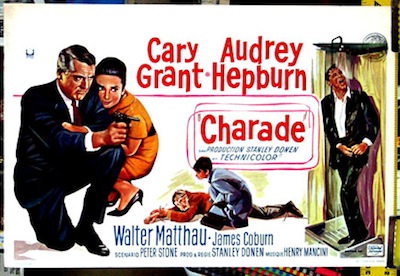
The BD of Charade comes in a similar package to the previous DVD releases, though with an improved cover image with a vintage movie poster design. The booklet inside is likely the same as the 2nd edition, reprinting the Bruce Eder essay that has been part of the deal since Criterion's first 1999 release. (I never did purchase the upgrade from a couple of years ago, so I am guessing a little.)
Also carried over is the excellent commentary with Stanley Donen and screenwriter Peter Stone. I love listening to Stanley Donen. He's just such a bright guy--in every sense of the word.
The original theatrical trailer is also included.
Missing from previous editions is the section showcasing the filmography of Stanley Donen, which was basically a text-based, illustrated biography. (The 1999 disc had a similar feature for Peter Stone that I believe was dropped from the later reissue.)
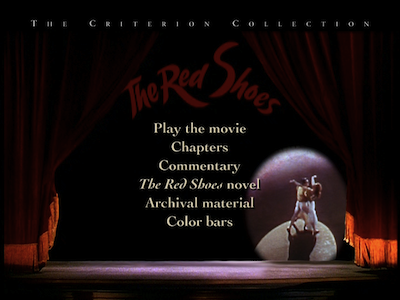
Criterion's reissue of The Red Shoes, Michael Powell and Emeric Pressburger's enchanting 1948 fairy tale, is due to be released in July. It's going to sport the newly restored print of the film that we've been hearing about for quite some time now. Spearheaded by Red Shoes-fanatic Martin Scorsese with the UCLA Film Archive, the movie was given a frame by frame scrubbing and has been one of the most hotly talked-about revivals since the new version premiered last year. A few places around the world have been lucky enough to host this spruced-up Red Shoes theatrically, and as of May 21, you can count Portland, Oregon, among them.
I wrote a bit about Cinema 21 in my review of Ran last month. The stalwart little theatre is a Portland landmark. I've been seeing movies there since I moved to town in 1994. Cinema 21 hosts first-run indies and art house, as well as being the main stop for revival pictures. It's because of Cinema 21 that I saw many a classic movie for the first time. One of the most mind-blowing experiences I had there was catching Powell and Pressburger's A Matter of Life and Death in the mid '90s. It was my first film from the Archers (as they are collectively known), and I was not at all prepared for the marvelous imagination this movie had to offer. At the time, it was not available on VHS and as DVD fans know, it took forever to get a digital release, so it was many years before I would ever see it again.
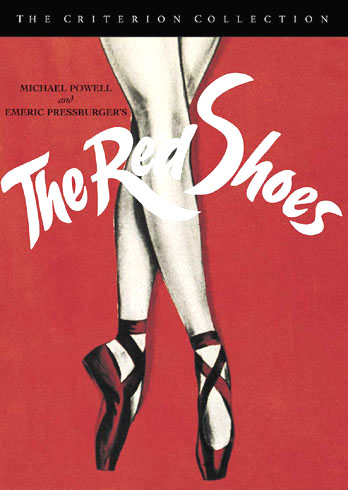
The original 1999 DVD cover.
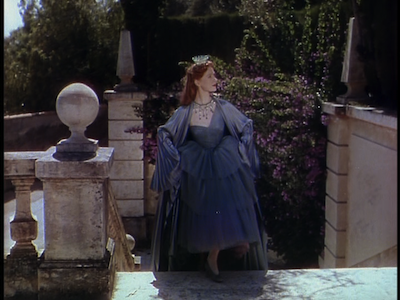
The press screening for The Red Shoes was not my first experience with this particular film, but it might as well have been. The restored transfer is everything they claim it to be, making it seem like a whole other film. The Red Shoes looks newly minted, as if it was struck from a fresh batch of Technicolor cooked up in a lab just yesterday. The image is flawless, and the color is so vivid, it's practically a living entity. The range of pigments and the level of detail is simply astonishing. Moira Shearer's red hair looks like a swath of velvet wrapped around a tiny flame, and how did I not know before that she has freckles on her collarbone? I feel like I am finally getting to see what previously only cinematographer Jack Cardiff saw, that I have been ushered through a door into his mind's eye to bathe in everything he imagined.
For those unfamiliar, The Red Shoes is the story of an international ballet company run with an iron artistic hand by the headstrong and demanding Boris Lermontov (Anton Walbrook). On a stop in London, he meets a young dancer named Victoria Page (Shearer) whose spirit and pluck earn her a spot in his Corps. The talent seeker also hires a college-age composer named Julian Craster (Marius Goring) to be a deputy conductor after the prodigy storms into his office claiming Lermontov's latest ballet plagiarized his work. Once under Lermontov's wing, the two neophytes soon find their expression encouraged. He assigns Julian to write the score of a ballet based on Hans Christian Andersen's The Red Shoes, and Victoria will play the girl who wanted so badly to dance, she wore a pair of magic slippers that cursed her to keep dancing until she died.
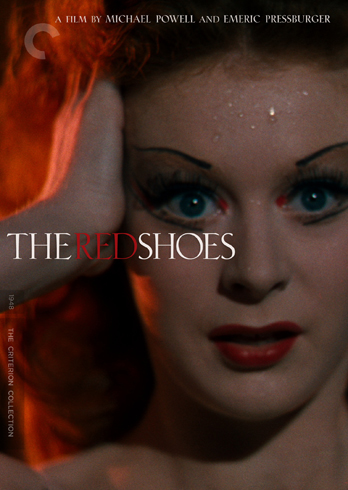
The 2010 DVD cover.
Midway through the film, the ballet is performed in full. It's the movie's most famous scene. Three years before Gene Kelly and Stanley Donen ended An American in Paris [review] with an original ballet, the Archers dropped a complete dance into the center of their backstage romance picture. It was choreographed by Robert Helpmann with music by the Royal Philharmonic, and it features world-famous dancer Leonide Massine backing up first-time movie actress Shearer, then a member of the Sadler's Wells Ballet. There were apparently 53 dancers in total, and the fifteen-minute sequence took six weeks to film. The staging wasn't a direct "shoot a live performance" set-up, the approach was more like a fantasy sequence set inside the performance. Swathed in paintings by Hein Heckroth, the production vibes toward the surreal, with special effects bringing stage conventions to life. When Julian is instructing Victoria on how to hear his music, he suggests she imagine the things that are happening in the story and make it a transformative experience. What Powell and Pressburger show us is what Victoria has imagined and by doing so they transform their film into something magical.
This ballet is no mere trifle, however. It is not a show-off exercise dropped into the center of the melodrama just for the sake of it. The story that Powell and Pressburger craft runs parallel to the themes of the dance. The push and pull between the triangle of Lermontov, Victoria, and Julian is represented in the Andersen adaptation. Lermontov is the shoemaker insisting that his ballerina perform, Julian is the lover who tries to pull her off the stage, and Victoria is the girl caught up in her dreams and desires and having no clear idea how to get out. The Red Shoes is about the passion of creation, the urges that compel artists to make art. What must one sacrifice to fulfill their dreams? Must art be all? It can be a joyful experience--the backstage material showing the collaboration and camaraderie of the company is some of the best stuff in the movie--but it can also be hard work that requires severe tunnel vision to get through.
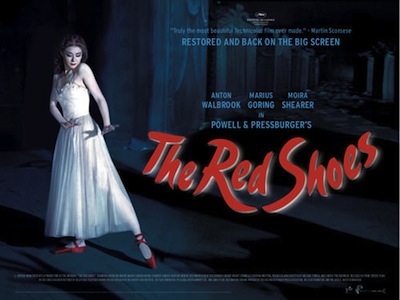
The 2010 theatrical reissue poster.
In a way, the characters all represent types, but I'd say only Marius Goring plays his as such. Julian is kind of a big baby, petulant like a schoolboy, and the actor doesn't bring much nuance to what is sort of the romantic lead. A romance develops between the music maker and his muse, and as it blossoms, it also exposes the fact that maybe Lermontov is in love with Victoria, too. It's never expressed outright, but the way Anton Walbrook looks at Moira Shearer, the way he reacts to the revelation that she has fallen in love, extends beyond a Svengali losing his puppet. As the woman torn between the two, Shearer displays both a strength of purpose but also a fragility. Her resolve to be a dancer is challenged by her feelings as a woman. The Red Shoes is one of those wonderful movies where the invention actually works: the fictional artists are creating real, believable art, and the woman whom everyone is supposed to fall in love with woos the audience to love her, as well. (In fact, check my tweet from immediately after leaving the screening.)
It's funny how years and multiple viewings can change one's perception, though. Boris Lermontov is generally considered the villain in the love triangle. He's the one who, in the fairy tale, would curse the girl to dance and never stop. (In the original story, they have to lop off her feet with an axe to disconnect her from the shoes; in the ballet and the movie that hosts it, Victoria's ending is still dire, though not as gory or gruesome.) Most fairy tales are fairly straightforward in their morality, and again, even here, the characters practically fall into stereotype. Or so a fairly surface reading of The Red Shoes might have you believe.
Maybe it's my more advanced age, maybe it's the fact that I've worked in a creative industry for a while now, but I found Boris Lermontov to be a far more sympathetic character than Julian Craster this time around. As things heat up within the love triangle, Boris asks Victoria if she would ever ask Julian to give up his métier, if she would ever want him to abandon music for her. When she says no, she would not, Boris then asks why she would permit Julian to ask it of her. It's a crucial question, and one that reflects badly on the young Romeo. His motivations are selfish. He wants her to be with him and no one else, to do nothing except inspire his melodies. Lermontov, sure, wants Victoria to be his and to dance at his company, but that does not require her to sacrifice who she is--nor would he ever want her to. What she means to him is entirely rooted in the talent that powers her. He knows to give up on her gifts would be to give up who she is, and then she would not be the woman he cares about.
It's wonderful to see how expertly Powell and Pressburger intertwine the drama of life with the drama of artistic expression. The Red Shoes is as inspiring as it is inspired. Cinematically, it melds so many things--fairy tales and dance and operatic melodrama--but it does so within the 1.37:1 frame. It molds these older arts into the newer one, making a movie that is as much about being a movie as it is anything else. It couldn't be done in any other form, and to now be able to see it in a way that is comparable to its debut more than 60 years ago is an astonishing treat. If you can go out and catch in the theatre now, you owe yourself to do so. You can still buy the DVD when it comes out. You're going to want to see it again anyway. And then again, and again. You're never going to want to take these red shoes off....
Author of prose novels and comic books like Cut My Hair, It Girl & the Atomics, You Have Killed Me, and 12 Reasons Why I Love Her. Jamie's most recent novel is the serialized book Bobby Pins and Mary Janes, and his most recent graphic novels are the sci-fi romance A Boy and a Girl with Natalie Nourigat; Madame Frankenstein with Megan Levens; and the weird crime comic Archer Coe & the Thousand Natural Shocks with Dan Christensen. He also co-created Lady Killer with Joëlle Jones.


 and Funny Face [


 . Michel Legrand also pulls out his biggest show stopper for the scene. The other numbers are catchy but more notable for the composer’s swirling rhythms and melodic filigrees; in this one, he goes big.


 .)
.)


 by David Mitchell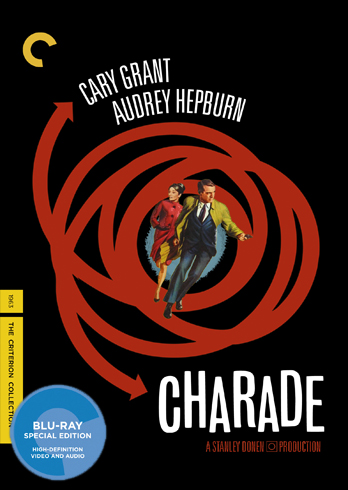
 .)
.) 
 in the mid '90s. It was my first film from the Archers (as they are collectively known), and I was not at all prepared for the marvelous imagination this movie had to offer. At the time, it was not available on VHS and as DVD fans know, it took forever to get a digital release, so it was many years before I would ever see it again.