I just found this older review of The Crimson Kimono posted to my Confessions of a Pop Fan blog in 2005. Follow this linkand you'll also find a review of Samuel Fuller's Underworld U.S.A., a quick take on The Naked Kiss, and a bunch of broken images. (You can't have it all!)
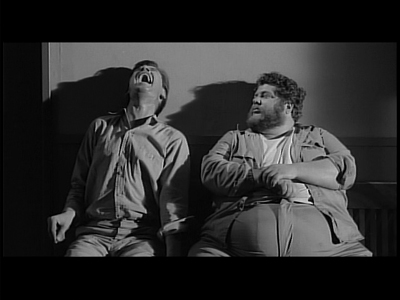
The Crimson Kimono (1959), a cop drama set in Los Angeles. Fuller opens on a fictional Main Street, zooming through its seedy blocks to a strip club where Sugar Torch is just getting off the stage. She heads back to her dressing room, but someone is inside with a gun. She tries to run, but Sugar is shot down in the middle of the street. Enter our detectives, Charlie and Joe, played by Glen Corbett and James Shigeta. Charlie is your average white meathead, and Joe is a Japanese American with a touch more sensitivity. They’ve been friends since they were in the same unit in the Korean War. Fuller makes several visual side notes about the war, including showing memorials for other Asians who served in the armed forces and a sly revelation of an Army propaganda sign on the streets of Little Tokyo (which pops up again in the background of Underworld, U.S.A.). In fact, Fuller shows a surprising sensitivity for race in this film, using real locations, Asian actors, and shining a spotlight on the friendship between the detectives and the questions of racism and interracial romance that come between them. In fact, he is so interested in this side trip, he pretty much lets the murder case drop for most of the final reel of the film. You see, the key witness is a young painter named Chris (Victoria Shaw), and Charlie falls for her pretty hard. Joe does, too, and the guy can’t help but lure her away just by being much more well-versed in the sorts of things an artist would be interested in. He doesn’t want to act on it, but the two can’t resist, and when the pair finally reveals their feelings to Charlie, Joe misinterprets the various reactions that follow as racism. Everything becomes wrapped up in Joe figuring out he’s wrong.
The murder does get solved. The plot is tied around the participants in creating a geisha-themed stage act for Sugar Torch, which is where the titular crimson kimono comes from. The hunt for the killer culminates in a chase through a parade in Little Tokyo, and its resolution directly relates to Joe’s getting his head straight. Fuller is always fun. He’s not interested in subtlety. Even when Joe talks about the way his artist father delicately painted cobwebs, Fuller hits you over the head with the poetry. But that’s the point of his movies. The audience straps itself in and rides with him. Unfortunately, the print the NW Film Center acquired was of inconsistent quality, and it was often badly spliced--not a good thing when you consider that Fuller’s editing here was rivaling Seijun Suzuki for jump cutting. Still, nothing bad enough to really mar the experience.
This review originally written for DVDTalk.com in 2014.
Samuel Fuller has a history of progressive, charged films about social issues, including multiple films about race. Shock Corridor [review] famously upended the debate by having an African American in a mental institution who believed himself to be a high-ranking member of the KKK, while his controversial later movie White Dog [review] was about a canine trained exclusively to kill black men.
Before both, however, came The Crimson Kimono, a two-fisted crime movie just on the other side of the film noir movement. Written and directed by Fuller, The Crimson Kimono stars Glenn Corbett and James Shigeta as two Los Angeles police detectives working the Little Tokyo beat. Charlie is white, and Joe is American-born Japanese, and their partnership was first forged in combat during World War II. (A veteran himself, Fuller shows his respect for the troops with insert shots of L.A. memorials for the Asian American soldiers that served--a short pause in the action but not out of place amongst other gritty shots of the Southern California streets.) The pair catches a case that will take them deep into the back alleys of their jurisdiction. A Caucasian stripper is chased out of a nightclub and shot on the sidewalk, and the one possible lead to the shooter's identity is a painting of the woman in traditional Japanese garb. It is signed "Chris."
Chris is short for Christine, not Christopher. Victoria Shaw plays the painter, the only one who can identify the mysterious Hansel that art directed the portrait, a promo for an act that the dead woman was putting together. Both Charlie and Joe fall for Chris (and who can blame them?), but things only get dicey when she also falls for Joe. The murder plot takes a backseat to the romantic melodrama. Fuller spends a long time on Joe and Chris talking about art and music and Joe's family. While any interracial relationship on film in 1959 would have been surprising, what makes The Crimson Kimono really interesting is that the one doubting the viability of their getting together is Joe, and it's not even because he's Japanese. At least not at first. Joe's initial misgivings come from not wanting to hurt Charlie. Only as the truth comes out does it become more about prejudice, though it's a prejudice that many argue exists only in Joe's perception. All the white folks are fine with it!
The Los Angeles that Fuller depicts in The Crimson Kimono looks like some kind of fantasyland. One can imagine James Ellroy chortling while watching this idyllic image of harmony in the City of Angels. It's as if Fuller were daring people to make a better world by putting up his own example on the movie screen. He even goes out of his way to include plot elements that require the characters to differentiate between Chinese, Japanese, and Korean players in the drama. There is no sidebar racist to contradict and demand no one cares, they all look alike. Fuller's Asian community is a smaller melting pot inside the greater national melting pot.
Not that The Crimson Kimono is some kind of Stanley Kramer-style message picture. Fuller is far more stealthy than that. All of these added elements are merely part of the usual rough-and-tumble pulp story the director was known for. What makes his films so politically interesting is that whatever was being explored, be it Communist subversives in Pickup on South Street [review] or the "fallen woman" scenario of The Naked Kiss [review], it was always a natural part of the narrative. For as unnatural as his storytelling generally was, the rawness was a reflection of the world around him. To Fuller, these were people with specific problems and concerns, and it just made sense to include everything that made their lives what they were. It wasn't subtext, there is nothing "sub" about The Crimson Kimono, it's all just text.
A rough and tumble western as only Samuel Fuller could make, 1957’s Forty Guns is the most macho feminist cowboy picture you’re likely to see. Opening with a visual manifesto--three men in their plodding wagon overtaken by a storm of horses, led by a black-clad woman astride a pure white beast--it’s clear from the start that a storm is coming, and it’s not going to be any dude marshalling its fury.
The three men are the Bonell brothers, law enforcement heading into Cochise County to arrest an outlaw wanted for federal robbery. Their eldest, Griff (Barry Sullivan), is a legendary gunslinger, known for his propensity to critically wound rather than kill. He’s also a fellow who’ll stay out of a fight if it isn’t his. So, when he reluctantly picks up a pistol to avenge his friend and stop the ornery Brock Drummond (John Ericson) from shooting up the town, you know it means something. Not just to him, but also to Drummond’s sister, Jessica (Barbara Stanwyck), the woman in black--or “the high riding woman with a whip,” as the movie’s ballad dubs her. Jessica runs the area with her forty-man army, and with the previous sheriff dead, she sees an opportunity to reinforce her regime by pinning the tin star to Griff’s chest.
Naturally, he isn’t having it, and so begins a sexual-tension standoff that drives the rest of the movie. The chemistry between Griff and Jessica is instant, and born of mutual respect, even if Griff is a bit too straight-arrow to admit it--or to accept his own infamy. Fuller’s script for Forty Guns is full of sharp innuendo, equating guns and power to sex and manhood. It’s not just knowing puns about “cleaning guns” or choosing the right stock, either; in the first showdown between Griff and Brock, there’s a clear visual commentary going on, as Joseph Biroc’s camera cuts between tight shots on Griff’s righteous, determined eyes and Brock’s limp pistol, drooping by his side, never to be fired. One is a man, and the other...well, not so much.
Fuller had something to prove with Forty Guns. He had seen how westerns discounted the female characters, and he wanted to upend that cart and all the horse apples inside of it. It’s important that no one ever questions Jessica’s ability to lead, or even suggests it’s strange that she’s the boss--outside that ballad, which concludes by wondering if there is any man strong enough to get her to come down off that high horse. (Not to be all spoilery, but the nature of that lyric does lead to the Forty Guns’ single bum note.) Jessica’s undoing is because of a man, but it’s a family tie, not a romantic one. Both she and Griff are challenged by their younger brothers. The middle Bonell, Wes (Gene Barry), has been Griff’s second for his entire career, but neither of them want their youngest, Chico (Robert Dix), to follow in their footsteps. In terms of western mythology, Fuller has put Forty Guns at the tail end of the gunslinger life. The situation the Bonells find themselves in is indicative of the changing times, and Fuller structures his script to encompass three generations. There are the aging lawmen, the nearly blind sheriff that Brock guns down (Hank Worden) and the marshall Ned Logan (Dean Jagger) that sees himself as Jessica’s #2, both of whom don’t want to give up the ghost just yet; there are the middle-aged veterans, Wes and Griff, who see an end to their wild adventures as society shifts towards civility; and then there are Brock and Chico, eager to make their marks, blind to the oncoming obsolescence of their would-be profession.
It’s quite a switch-up. In any other western, you’d have the put-upon damsel begging the hero to lay his weapons to rest and give her some notice. In Forty Guns, it’s Logan who confesses that it’s love that motivates him to run off Griff and put things back to the way they were. It’s a scene that, thanks to Jagger’s performance, can be viewed both as sympathetic and pathetic. What are we to make of an old-time frontiersman who pleads, “Jessica, I’m a man. I’ve a man’s feelings. You can’t buy what I feel”? John Wane would never be so vulnerable. #notallcowboys
But Forty Guns is a western where a woman owns everything. And has more of everything. She has more land and hombres in her employ than any would-be rival, and the biggest dinner table around so she can feed them all at the same time. (What a power move, forcing Griff to pass his message across twenty other men just to deliver it to her!) Perhaps her respect for and attraction to Griff comes from the fact that not only does he not need anything from her, he is not intimidated by her strength. In their first real scene together, she lets him drink her whiskey while she susses him out, and it ends with neither having given up any ground.
For two people like Griff and Jessica, however, it will take an act of God for them to give in to their desires, which is exactly what Fuller delivers. In an astounding tornado scene, the pair end up huddling together behind a brick wall, their backs to the wind, hoping the structure won’t fall before the danger passes. Once the wind has blown itself out, so too has their resistance.
There would have been no better choice for this film than Barbara Stanwyck. She had spent her career playing tough women who managed to maintain their femininity in a world that demanded she could not be both. Think of her turn as the con artist in The Lady Eve [review], the sexy femme fatale who still is a woman and able to feel and be. Stanwyck also pulled cowpoke duty for the Criterion Collection once before in Anthony Mann’s The Furies [review]. She has a commanding presence here, presiding over the men folk as she does, often astride that white horse, which the actress rode herself. No stunt doubles. Fuller uses low angles to give Jessica her proper place as commander, the landscape tilting to accommodate her. (Fuller is far less inclined to pay homage to the mountains and prairies than John Ford, probably convinced that man would end up besting Mother Nature in the end.) The result is more regal than sinister. As a villain, Jessica is never truly evil, she only appears to be doing what she thinks she has to do, and her fall comes from a different necessity.
Were we to call anyone a villain, it should be Brock, who could have commandeered a film of his own. He’s a real mean son of a bitch, with nary a glimmer of moral ambiguity. His betrayal of the sister who tried everything she could to help him could be what drives Jessica to the choice she makes at the end, casting her final scene as some kind of plea for relief rather than a surrender. Griff works as a foil for Brock. He is as unyielding, but he sees nuance in the life he’s lived and accepts the consequences. His confidence is earned. To my eye, Fuller isn’t really condemning the macho lifestyle here--that lip-licking, knowing look the gunmaker’s daughter (Eve Brent) gives Wes when he’s getting things done is no different than how Fuller and his camera look at Griff--he understands the need for decisive action. His ideal is more balanced. It allows for Jessica to have equal power, and for the intelligent, peaceful option to be considered first. Hence, when Brock forces Griff’s hand, Griff sees his worst sin as finally losing control. (Again, it takes a tornado....)
If Jessica’s final decision comes a little too quick, we might forgive it, since Forty Guns is a movie where everything happens quickly. At a lean 80 minutes, Samuel Fuller’s edits are as decisive as his characters’ actions or the violence that results from them. You only have the space between the guy reaching for his gun and his firing it to make your move. Besides, since the very last shot is a long one, we don’t really see what happens. For all we know, this could be the western equivalent of the end of The Graduate [review]. Then again, Fuller fans know he’s got a heart as soft as his gumption is tough, so most likely, we’re looking at some kind of happily ever after.
There is a mutual appreciation society between New York indie icon Jim Jarmusch and quirky Finnish filmmaker Aki Kaurismäki, and that spiritual and creative connection has never been more evident in any of the Kaurismäki films I have seen than it is in his 1992 effort La vie de bohème (The Bohemian Life). Like the early works of his Aki's New York compatriot, it's a lazy comedy drawn in warm tones, inhabited by genial losers, and depicting a pocket of society just around the corner from the norm. Based on work by writer Henri Murger that also served as the inspiration for La Bohème (and thus all the iterations that followed), La vie de bohème also owes a little something to the tradition of similarly minded efforts featuring ex-pat artists and writers and the bungled romances that plague them, such as Ernst Lubitsch's A Design for Living [review] or even Stanley Donen and Gene Kelly's An American in Paris [review].
La vie de bohème is quintessentially Kaurismäki, however, and unmistakably European. The trio at the heart of the film are Marcel (André Wilms), a struggling playwright; Schaunard (Kari Väänänen), a loutish musician; and Rodolfo (Matti Pellonpää), a refugee from the Soviet bloc making his way in Paris as a painter. Marcel is being evicted from his apartment, and Schaunard is moving into it, and after a night of drinking where the writer shares a glass or two (or five) with Rodolfo, the three become fast friends. Kaurismäki's script details their various schemes to stay afloat, including Marcel's taking over a burgeoning fashion magazine (his publisher is played by Samuel Fuller, a mentor to Jarmsuch, as well) and Rodolfo bilking a naïve art collector (Jean-Pierre Léaud, who is a dynamo in both of his scenes). In the midst of this, Rodolfo has a romance with another immigrant, Mimi (Evelyne Didi), gets deported, and then comes back. He is, arguably, the driving force of the narrative. If nothing else, he serves as some kind of conscience, the guy that, were he to do better, could change everyone's fates. In particular, he holds to some stringent ideals that adversely affect Mimi. His old-fashioned views on the relationship between men and women are as impractical as his chosen lifestyle. It's up to Mimi, as well as Marcel's girlfriend/secretary Musette (Christine Murillo), to provide the voice of reason, worrying about such pesky things as food, rent, and delivering on promises.
Kaurismäki has a good time with the classic story, infusing it with his own kooky sense of humor while also having fun with the conventions of nineteenth-century dramatic novels. Naming Rodfolfo's dog after Baudelaire will give you some indication of the reverence (or lack thereof) the auteur holds for classic authors. La vie de bohème goes from silly to melodramatic parody before finally settling into a fairly dark finale. The artists of the piece have spent the movie trying to dodge all responsibility, including the results of their own actions (or inaction). Inevitably, this is an unsustainable practice, and Rodolfo is forced to face his own selfishness when his bad habits lead to him being very much alone.
The cast of La vie de bohème is populated with Kaurismäki regulars, all of whom click well together and have little problem balancing the absurdity of most of the script with its all-important moments of realness. Pellonpää plays a similar straight-man role to his one as the manager in the Leningrad Cowboys movies [review], while Wilms' trademark earnestness, seen most recently in Kaurismäki's Le Havre, makes him a rather delightful con man. His scene where he escapes from a thug by distracting a cop with a quickly improvised story is something straight out of a 1930s comedy. One gets the sense that Marcel's writing is likewise a feint, or at the very least relatable only to himself. We are spared hearing any of his prose. When it comes to the boys' art, Kaurismäki reserves his savage humor for Schaunard, who plays a song that is a weird hybrid of John Cage and German noise and industrial. It unsurprisingly sends both Mimi and Musette running out of the room.
Fans of early 1990s indie cinema will appreciate La vie de bohème's casual pacing. The movie is in no real hurry and is as content as its characters with letting the rest of the world move on as it stays settled. Timo Salminen, who is Kaurismäki's go-to director of photography, shoots the movie in black-and-white, and will inevitably draw comparisons to similar work by Tom DiCillo (Stranger than Paradise [review]) and Robby Müller (Down by Law). There is a clean look to everything, however, that separates it from its grainier cousins. For all the squalor the layabout artists indulge in, there is a shabby beauty to how their lives look on film that is reflective of the everyday experience they attempt to capture in their own work. When they bother to do it, that is.
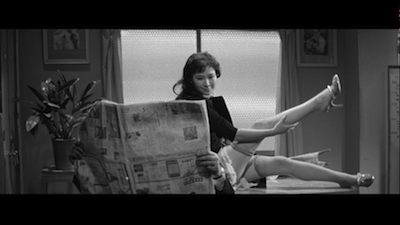
As 2012 comes to a close, this trio of reviews of Seijun Suzuki movies actually catches me up for the weeks I missed in November. This marks four full years of providing one new review to this blog a week. That's a lot of writing and a lot of movies.
I picked Take Aim at the Police Van from the Eclipse Nikkatsu Noir set because it was the only remaining Suzuki film in my collection that I had not yet watched. It's interesting that my viewing over the past two days has gone in reverse chronological order. I am not sure why Criterion decided to number Tokyo Drifter [review] and Branded to Kill [review] the way they did, but with this 1960 mystery/drama thrown in, the effect for me was to see Suzuki's style get more normal as I progressed.
Coming some six years before Tokyo Drifter, Take Aim at the Police Van is a more conventional genre exercise than the director's later films. It begins with a violent attack on a prison transport van. Suzuki builds tension by having road-sign warnings repeat over and over, moving faster and making the viewer nervous with all their cries of "Caution!" It also doesn't help that we know that up ahead a sniper is waiting. When the van approaches his hillside vantage point, he opens fire, killing two of the prisoners. It was a concentrated attack.
The guard on that run, Daijiro Tamon (Michitaro Mizushima), is held responsible for the assault, and he is put on six months leave. Rather than stay at home and sulk, Tamon decides to look into what really happened all on his own, thus transforming himself into a traditional fictional investigator, doggedly pursuing his goals despite the warnings and the dangers. Suzuki and scriptwriter Shinichi Sekizawa see Tamon as belonging to a western tradition, and even make reference to Ellery Queen and other mystery writers who concocted similar stories with equally committed characters. Tamon begins his case by finding one of the shooting survivors, a low-level crook named Goro (Shoichi Ozawa) who was due to be released on bail the day of the incident. Goro's behavior during the attack makes Tamon think he knows something.
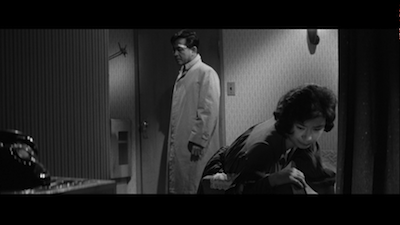
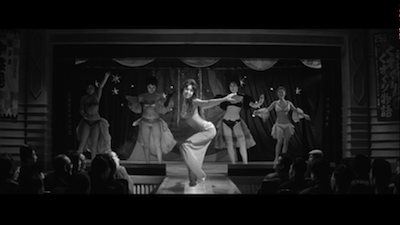
Naturally, pulling on this first thread causes many others to unravel. Tamon follows Goro out of town, where the mistress of one of the dead prisoners and Tsunako, the girl who bailed Goro out (Mari Shiraki), are working as strippers in an illicit brothel. Their involvement leads the prison guard to a human trafficking ring with ties to a mysterious, possibly fictitious big boss named Akiba. More people end up dead, some thought dead end up alive, and Tamon maybe has a thing for one of the possible suspects (Misako Watanabe). Yuko's father runs the "talent agency" that books the girls, and she's taken charge of the business since her old man got sick. She also knows archery, which is interesting since the dead stripper was shot in the heart with an arrow!
Take Aim at the Police Van takes a tried-and-true approach to building its mystery. For every answer Tamon finds, he also uncovers a few more questions. More players join the story, and the cast builds to the point where he doesn't really know who is going to pop out from which shadow next. Mizushima plays the role pretty straight. He's always looking forward, rarely indulging in sentiment or any emotion that might alter his course. He's an older man, and seeing him tangled up with so many young girls creates an amusing incongruity. Tamon is no white knight, but he will get the job done.
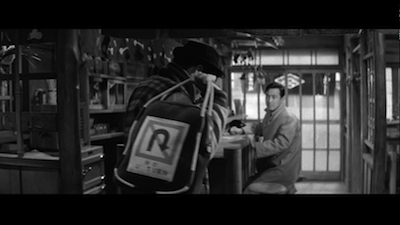
By the time we get to the climax, just about any of the crooks could be Akiba. Tamon has formed an uneasy alliance with Yuko, particularly after the two of them are nearly burned alive in a gasoline truck by the sniper, and he also takes a liking to Tsunako and wants to get her out of whatever trouble Goro might have gotten her into. Motor vehicles and motorways prove dangerous throughout the film. There is a chase on a cliffside highway and later Tamon is nearly run down by coordinated vehicles coming from two different directions. Goro also humorously provides the movie with its second roadside omen: he has a backpack that says "No U-Turns." There is no turning around, there is only forging ahead.
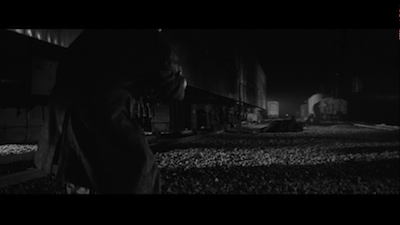
It makes for a sublime kismet, then, that the final shootout in Take Aim at the Police Van goes down in a trainyard. Buses and cars are unpredictable. They crash and they roll, and their course is subject to human control. Trains follow a track. They are reliable and they are sturdy. Their destination can't be changed easily. For some, this will be fatal; for others, salvation. Trains are also the industry of an older generation, one that Tamon can identify with. And perhaps that is why he is as reliable and as dedicated, as well. The young hoods have their flashy cars, but he identifies with the rails, getting the job done and never deviating from the predestined route.
And one from the archives, part of a group of reviews I did for my old column "Can You Picture That?" on OniPress.com. This one was reviewed alongside Onibaba, and that portion was reprinted here.
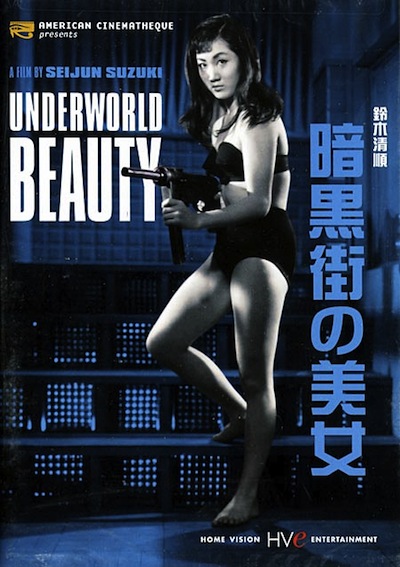
Underworld Beauty (1958): Speaking of cover art, I initially thought that Seijun Suzuki's 1958 yakuza movie, Underworld Beauty, would be a perfect companion to Onibaba. A beautiful woman dramatically posing with a machine gun! Yes! Only the cover art is entirely misleading. Akiko (Mari Shiraki) never picks up a gun inUnderworld Beauty. I was fooled by marketing!
Thankfully, Underworld Beauty is an entertaining film even without a pretty young thing shooting up the bad boys. Released by Home Vision Entertainment along with a spate of other Suzuki films, Underworld Beauty hints a little bit at the scattershot editing style that, a decade later, got Suzuki fired and branded "incomprehensible" (the way sometimes the story jumps from point A to point C pales next to the supersonic speed Branded to Kill travels at). Overall, though, it's a pretty straightforward crime picture with a cynical edge reminiscent of Sam Fuller.
The plot is simple: Miyamoto has spent three years in prison. In that time, he has managed to keep his mouth shut, giving up neither his yakuza bosses nor the hiding place of the jewels he stole. Feeling guilty about his partner, Mihara, who was partially crippled in the heist, he decides to work through his old boss and sell the diamonds, giving the money to his friend. Only someone attempts to steal the stones at the sale, and Mihara ends up swallowing the jewels before leaping off a building to escape. In the wake of his death, Miyamoto and Akiko go up against the yakuza and Akiko's effete, mannequin-manufacturing boyfriend, working through a maze of double-crosses to establish ownership of the three shiny jewels.
What sets Underworld Beauty apart from standard crime films of the period is the clash of the old school gangster (Miyamoto) and the wild-child, idealistic teenager (Akiko). It's never more clear than when the dark-suited hoods step into the bossa-nova rock-and-roll nightclub filled with kids dressed in light colors. The crooks are like brick walls, while the teenagers are much more petite. At one point, one of the bad guys shoves the fresh-faced bartender away from the bar and he practically launches into the air. Thus, the central conflict becomes whether or not Akiko can step up and act maturely. Can she and Miyamoto find common ground, and will it carry them through the classic crime-doesn't-pay ending? (Side note: It's interesting to compare the rather milquetoast version of a rock club in Underworld Beauty to the seedier nightclub in Akira Kurosawa's High and Low [review] five years later. The former is definitely the bobby-soxer '50s version we see in a lot of period entertainment, whereas the latter's sweaty opium den vibe showed the false innocence was already crumbling.)
It's hard to believe I'm only been about three months since I got my Blu-Ray player. I definitely jumped in with both feet, even if I'm trying to be cautious about going overboard with upgrading my entire collection. I'm a boy on a budget, after all.
So, when I say that the new Criterion reissues of their Samuel Fuller titles, Shock Corridor and The Naked Kiss, are absolutely worth it, you can trust that this is something I mean wholeheartedly. Even if you aren't partaking of the new format yet, judging by the new transfers and all-around quality of the packaging, I am sure the standard DVD re-releases are also worth the cash. Being #18 and #19 in terms of spine numbers means both of these films were pretty early in the catalogue's existence. The original release date of the first barebones editions was 1998. Grand strides have been made in the art of film restoration, and you can see the journey in every cleaned-up frame. Both movies look astonishing. The pristine high-definition transfers are free of blemish, and they show the balanced black-and-white photography as never before. Given how much these flicks have been kicked around through the years, with various dubious DVD releases, it's wonderful to have definitive releases that get them exactly right.
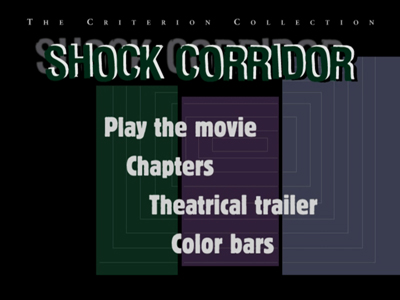
I reviewed both of the Fuller movies not that long ago, prior to the announcement of these upgrades. It hasn't been quite enough time for me to develop profound new insights into the films, so you can read those reviews in the archives (Shock Corridorhere, The Naked Kisshere). That doesn't mean there isn't plenty to talk about here. These releases are more than just new transfers, but a full overhaul. You can tell that right away when you see the spiffy new covers. Comics artist Daniel Clowes, perhaps best known in film circles as the author of the original Ghost World comics (he also wrote the screenplay for the Zwigoff adaptation, rumored to be a future Criterion addition) and as the illustrator who did the poster for Todd Solondz's Happiness, has contributed new designs to both of the Fuller films. His artwork extends beyond the covers, and into the interior booklets, the disc art, and even the nifty animated menus. Clowes gets Fuller's twisted poppiness to the letter.
Criterion has also added several bonus features that make these Blu-Rays worth the price of admission. I'm particularly excited to report that Shock Corridor now comes with the 1996 documentary The Typewriter, the Rifle and the Movie Camera, a 55-minute profile of Fuller directed by Adam Simon and featuring commentary by Tim Robbins, Martin Scorsese, Jim Jarmusch, and Quentin Tarantino. I first saw this documentary on IFC back in the 1990s, before I had seen most of Fuller's films, if in fact I had seen any. It gave me a long list of movies to seek out, some of which I am still looking for. (Hey, China Gate is on Netflix Instant!) Now that I've seen a good selection of them, it's all the more effective when Robbins and Tarantino go into Fuller's storage garage and sift through his memorabilia; now I actually know what it is they are finding!
More invigorating, though, is the footage of Fuller talking. What a raconteur this guy was! The title refers to his three careers: reporter, soldier (Fuller fought in WWII), and filmmaker. Each phase is covered, all brought to life by Fuller's vivid anecdotes. As Scorsese points out, Fuller tells stories the same way he makes films--there is no difference between what comes out of his mouth and what he puts on the screen. If you like how Sam makes movies, you'll love listening to him. (Side note: Too bad Criterion couldn't also resurrect Tigrero, the documentary about the motion picture that fell apart on Sam, and that ultimately provided some of the color footage for Shock Corridor.)
The bulk of the supplements on The Naked Kiss seize on the concept of Fuller as storyteller and run with it. Three different archival television programs are almost entirely single-camera jobs. Fuller is interviewed in all of them, but they are really more like monologues. The earliest is a 1967 episode of the French television show Cinéastes de notre temps, and it's nearly half-an-hour of vintage Sam. Flanked by the Eiffel Tower, the director lays out a lot of his technique and what excites him about motion pictures. One explanation of a particularly complicated set-up will have you rushing to your Pick-Up On South Street discs to see what he is talking about. [review]
Another French program is a short segment from Cinéma cinemas. Shot in 1987, it's simply Fuller going through a collection of famous photographs and talking about what he remembers. Some pre-date his movie career, including pictures from his wartime service, and others come from the publicity archives of many of his films. His life and history is also a good part of the 1983 episode of The South Bank Show, a BBC program that devoted an installment to the director. About half-an-hour of the full episode is excerpted here. Most of it, again, is Sam, but there is a small portion with Wim Wenders sharing his thoughts about Fuller.
Both BDs also have the original theatrical trailers, and each has nearly half-an-hour of a 2007 interview with actress Constance Towers, who was in both Shock Corridor and The Naked Kiss. She talks in-depth (nearly half an hour on each) about working with Sam and his balls-out production process, and the segments are specific to their particular disc. The interview on The Naked Kiss also includes her sharing more about her background. The story of the girl from Whitefish, Montana, making it in film is a classic Hollywood tale unto itself.
I'm a big Samuel Fuller fan, so these new releases would have likely been a must-have regardless, but seeing as how the Criterion Collection has gone all out in terms of improving them, it's a double-dip I have no residual qualms for indulging in.
Also out this month on Blu-Ray, and alas another film I covered last year, is Byron Haskin's Robinson Crusoe on Mars [original review]. Released in 1964 (the same year as The Naked Kiss), it's a Technicolor wonder--one that definitely seems more charming on second viewing. That could be down to the stunning presentation, I don't know. The original Criterion disc, released just over three years ago, was no slouch in the technical department, but the Blu-Ray shows just how dazzling a movie like this one can be in high-definition.
Though the unschooled might have previously had occasion to sniff at the special effects as being simplistic compared to the complicated pixel-by-pixel build-ups we get today, seeing Robinson Crusoe on Mars in this capacity would shut just about anyone up. The colors are remarkably vibrant, and the added clarity allows every tiny detail to be seen like never before. You'd have to be a hardcore cynic not to be awed by how incredibly complete Haskin's invented world is. The suits, the gadgets, the rockets, even the surface of the red planet--this is a craftsmen's delight. Even if, like me, you weren't immediately in love with Robinson Crusoe on Mars the first time around, the Blu-Ray warrants a second look.
For those wondering, the supplements on this edition are exactly the same as on the standard DVD, as is the packaging. The excellent Bill Sienkiewicz artwork is still intact. It's another thing all of these reissues have in common besides their original theatrical release dates: comic book illustrations. They are movies that capture the imagination, even if they do so in totally different, nearly opposite ways, and capturing the imagination is something a good comic artist knows a thing two about him or herself.
The Naked Kiss and Robinson Crusoe on Mars were provided by the Criterion Collection for purposes of review. Shock Corridor was reviewed in conjunction with DVD Talk, and you can read the full article here.
I decided I wanted to do a little homework before my planned second excursion to Scorsese's Shutter Island. Marty has said that Samuel Fuller's Shock Corridor, along with Jacques Tourneur's Out of the Past, was a movie he showed his cast before starting filming. When I first heard that, it seemed like a choice so obvious, I couldn't believe I hadn't thought of the comparison before. Both films involve a murder investigation in an insane asylum, and the prolonged exposure to mental illness threatens to cause the investigator to become slightly unhinged. Scorsese's film is a genre buster, about as blunt in its attacks on the senses as Samuel Fuller ever was. Yet, watching Fuller's 1963 movie again, I am struck by how much more dangerous and subversive it is. Fuller may swing a club at you, but it's only so that while your focus is on the bigger instrument, he can sneak in with the knife in his other hand.
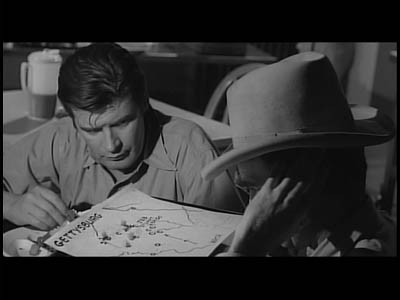
Fuller was a triple threat on Shock Corridor. He wrote, directed, and produced. It's almost too bad he didn't cast himself as one of the patients, too. I'd have loved to see him wandering the halls, chomping on his cigar. He could have played a guy who believed he was a moviemaker, stuck in the hospital trying to get the inmates to hit their marks. In Fuller's stead, the main character of the movie is, after a fashion, choreographing his own drama. Peter Breck plays Johnny Barrett, a newspaper reporter who has taken a crash course in mental illness in hopes of convincing the courts that he is crazy. He wants to get committed so he can find out who killed a patient in the hospital. Like a demented game of Clue, he will keep asking, "Who killed Sloan in the kitchen with a knife?" If he can find the killer, Johnny is convinced he can get a Pulitzer.
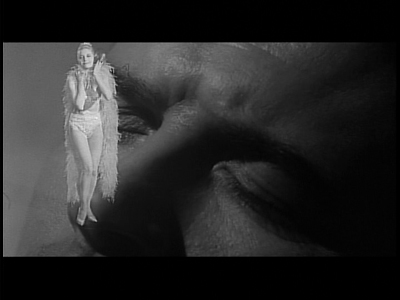
Johnny pretends that he is a fetishist in love with his sister. The role of his sis' is filled by Johnny's girlfriend, Cathy, a stripper played by Constance Towers, who was also in Fuller's The Naked Kiss. Cathy sees the oncoming train before anyone else. Johnny and his editor (William Zuckert) only envision the accolades, they don't imagine any possible pitfalls. Cathy may sell her body for a song, but Johnny is going to sell his mind for prestige. Once inside, he must find the three men who witnessed Sloan being knifed. He will befriend each of them, linger about until they have an episode of lucidity, and then find out what they saw.
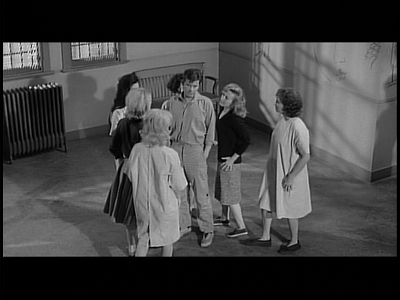
The interior of the mental hospital may be off-balance, but Fuller isn't using the setting for exploitative means. On the contrary, the facility in Shock Corridor is meant to be a microcosm of the outside world. Fuller saw the whole of society as participants in a collective madness, and each of Johnny's witnesses will expose not just a clue in Sloan's killing, but also one of the symptoms of the public illness.
The first man, Stuart (James Best), has been incarcerated since he returned home from the Korean War. There, he was captured by the enemy, and the Russians indoctrinated him into Communism. As Stuart tells Johnny, all while growing up, he was served hate for breakfast and ignorance for supper, and the Reds were the first to offer him someplace where he belonged. It's only when another American reminded Stuart of the Communist atrocities that he rejected his new philosophy. Too late, though, to keep him from being branded a Red. He suffered a psychotic break, retreating into a delusion where he was a Confederate general. It's a meaningful choice. He is embracing a despicable point of view that was not only once commonplace in American life, but that many also believe to have been unfairly vilified. (Let's not forget some people sport the Confederate flag to this day.) It's the same way some people felt about Communism, and if his family and countrymen weren't going to accept Stuart's ideas, he would retreat deep down into theirs.
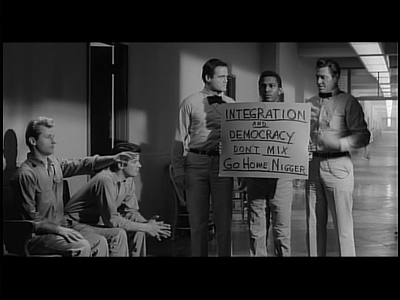
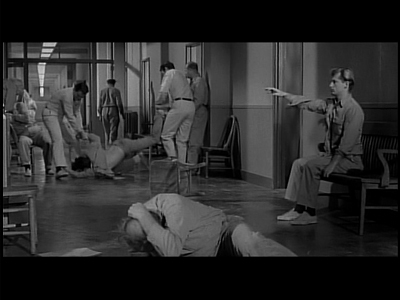
The second man is Trent (Hari Rhodes). Trent was the first black student admitted into a white Southern college as part of desegregation. The pressure to succeed in the face of the hate and persecution heaped upon him caused Trent to snap. In the hospital, he believes he is a Klansman. He steals pillowcases to make hoods, and he chases other black patients in the hallways shouting, "There's one of 'em now! Let's get 'im before he marries my daughter!" Like Stuart, something in Trent's subconscious decided if he couldn't beat the enemy, he would join them. As Fuller saw it, racism was a contagious disease that preyed on the minds of otherwise smart individuals.*
The third man is Dr. Menkin (Paul Dubov), who at one time was a nuclear scientist working in the arms and space races. Slowly, Menkin realized that he was part of a system of institutionalized death. Everything they were doing in the name of "science" was really just to kill the other guy faster than he could kill us. Rather than face the continued horror, Menkin regressed to the mentality of a six-year-old. A child knows no death, only happiness. In that state, Menkin can no longer destroy, he can only create. He spends his days drawing.
Menkin is the one who finally tells Johnny the identity of the killer, but it's also at the same time that Johnny loses his mind. While they had been talking, Menkin was drawing Johnny's portrait, and when the doctor shows the journalist his work, Johnny freaks out. Whatever is on that paper is something he doesn't recognize. Menkin says he has only drawn what he has seen. Symbolically, then, Johnny is being made to face all the wrong that he has accepted in the world. Worse, by going along with the patient's delusions in order to serve his own selfish goals, he has even been a participant. He's no better than the man who is always there, sitting silently with his arm raised in a kind of Nazi salute. This is the man Johnny can--and will--become. Ironically, just when Johnny is ready to speak up, his voice starts giving out on him. A mental block shuts him down at the most inopportune times.
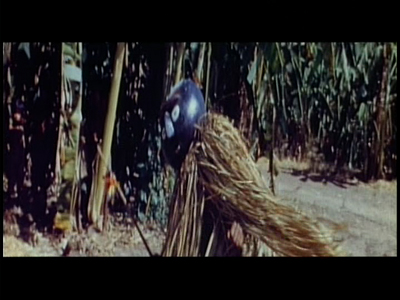
Fuller made a rather smart choice to not visually portray the madness on screen. We never look through the eyes of the insane. There are no fish-eye lenses, nor leering hallucinations. Everything is through Johnny's eyes, the only exceptions being color sequences that show us dreams that Trent and Stuart are describing, some of it footage from an unfinished movie Fuller wanted to shoot in the Amazon (later described in the documentary Tigrero). These are more strange because of their reality, and more richly realized than the black-and-white of the Shock Corridor. Stuart sees Buddha and a world that keeps moving forward, Trent sees cruel rites of passage.
Otherwise, any hallucinations we experience are Johnny's. Specifically, we see his strange dreams about Cathy. Does he really have a touch of the perversion that he pretends to suffer from? It seems to me that Fuller is using cinematic representations of women to make further commentary on societal imbalance. At the time he was making these low-budget productions, a little sex was good for getting your movie on the drive-in circuit. By making Cathy a stripper, Fuller seems to be relenting, but "I Want Somebody to Love," the sad song she sings during her bump and grind, works in opposition to the vulgar dance she performs [watch it on YouTube]. Johnny claims some kind of moral opposition to her chosen field, but he only ever fantasizes about her wearing her showgirl outfit. As punishment, Fuller humorously has Johnny attacked by a gang of feral nymphomaniacs in the hospital. It's like he's saying, "You wanted sex, here's more than you can handle." It's no coincidence either that the killer stabbed Sloan because Sloan knew he had been taking sexual advantage of the patients.
The director saves his biggest portrayal of madness for when Johnny finally goes over the edge. In a famous sequence, he floods the hallways of his hospital, creating a storm inside the building to match the storm inside the reporter's brain. It's Shakespearian in execution. Lear raged against the squall when his grip on reality was slipping, and water is significant in Hamlet, as well. The Danish Prince also feigned mental illness to solve a murder, and his lover was collateral damage. The doctors in Shock Corridor replicate the elements to batter their patients into some kind of complacency. They lock them in bathtubs and call it hydrotherapy, and shock treatment is like being struck by lightning.
I don't recall any direct visual parallels between Shock Corridor and Shutter Island. The isolation of the setting is a gimme in any story of this type, and the fact that Scorsese's hospital was surrounded by water is more coincidence than anything. (Really, Dennis Lehane chose the island setting for his novel to make his detective even more isolated.) Where they converge thematically, however, is rather profound. Both Leonardo Dicaprio's character in Shutter and Peter Breck in Shock eventually have to atone for failing to act. At some point they stood back and went along because it meant they didn't have to change. They turned their back on the truth and then turned around again to pursue it in hopes of some kind of personal gain. Johnny Barrett finally speaks, but it comes at a price, and Fuller's movie stands as a fearful warning, even more than three decades later: if you wait too long to do what's right, it could be too late. The cost is going to be high. When sane men stand amongst insanity and do nothing, the madness wins out.
* One interesting racial element that was in Dennis Lehane's Shutter Island novel that Scorsese did not use in his movie was the racist prison warden, who at one point tells the story's protagonist, Teddy, via a measured rant laced with the N-word, that it's all the people who can be labeled with that word that is bringing the country down. He notes that just because Teddy is white doesn't mean he's not one of "them," as well. Teddy then uses that racism as leverage with some orderlies, basically asking them, "Who are you gonna serve?"
Author of prose novels and comic books like Cut My Hair, It Girl & the Atomics, You Have Killed Me, and 12 Reasons Why I Love Her. Jamie's most recent novel is the serialized book Bobby Pins and Mary Janes, and his most recent graphic novels are the sci-fi romance A Boy and a Girl with Natalie Nourigat; Madame Frankenstein with Megan Levens; and the weird crime comic Archer Coe & the Thousand Natural Shocks with Dan Christensen.





 comics (he also wrote the screenplay for the
  , rumored to be a future Criterion addition) and as the illustrator who did
  , has contributed new designs to both of the Fuller films. His artwork extends beyond the covers, and into the interior booklets, the disc art, and even the nifty animated menus. Clowes gets Fuller's twisted poppiness to the letter.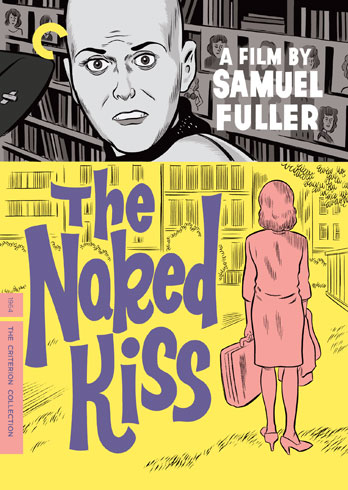
 , the documentary about the motion picture that fell apart on Sam, and that ultimately provided some of the color footage for Shock Corridor.)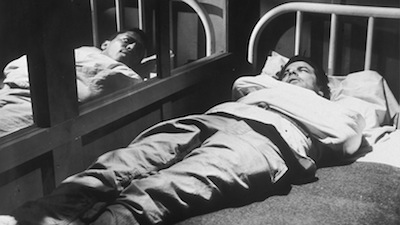


 , was a movie he showed his cast before starting filming. When I first heard that, it seemed like a choice so obvious, I couldn't believe I hadn't thought of the comparison before. Both films involve a murder investigation in an insane asylum, and the prolonged exposure to mental illness threatens to cause the investigator to become slightly unhinged. Scorsese's film is a genre buster, about as blunt in its attacks on the senses as Samuel Fuller ever was. Yet, watching Fuller's 1963 movie again, I am struck by how much more dangerous and subversive it is. Fuller may swing a club at you, but it's only so that while your focus is on the bigger instrument, he can sneak in with the knife in his other hand.
 , he will keep asking, "Who killed Sloan in the kitchen with a knife?" If he can find the killer, Johnny is convinced he can get a Pulitzer.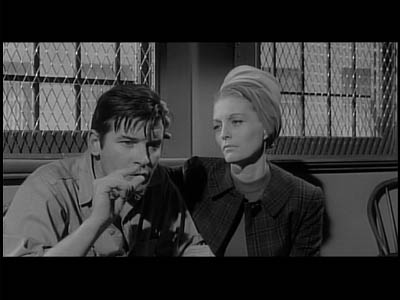

 to make his detective even more isolated.) Where they converge thematically, however, is rather profound. Both Leonardo Dicaprio's character in Shutter and Peter Breck in Shock eventually have to atone for failing to act. At some point they stood back and went along because it meant they didn't have to change. They turned their back on the truth and then turned around again to pursue it in hopes of some kind of personal gain. Johnny Barrett finally speaks, but it comes at a price, and Fuller's movie stands as a fearful warning, even more than three decades later: if you wait too long to do what's right, it could be too late. The cost is going to be high. When sane men stand amongst insanity and do nothing, the madness wins out.