Showing posts with label audrey hepburn. Show all posts

Tuesday, September 21, 2021

SABRINA - CRITERION CHANNEL

This review was originally written in 2008 for DVDTalk.com.


Audrey Hepburn's second film was the first of hers I saw, though if I recall I watched Sabrina for Humphrey Bogart, whom had become a bit of an obsession by then. I was also starting to learn a little something about director Billy Wilder through a blooming interest in film noir, so it was an unexpected twist in my movie-going plot that these two gentlemen would be upstaged by the gamine up in the tree of this romantic comedy.


Sabrina (Hepburn) is the chauffeur's daughter, a gawky teen who hides in the bushes spying on David Larrabee (William Holden), the youngest and the wildest son of the rich Larrabee family. By contrast, David's older brother, Linus (Bogart), is all stuffed shirts and responsibility. He runs the family company and is more likely to race through numbers and statistics than he is to race the roadster that David is so fond of. Ironically, it's only Linus that notices Sabrina, finding her in the throes of a dramatic suicide over David's cluelessness. Sure, Linus doesn't realize that this silly kid is being serious, but at least he knows her name.


All of this takes place on the eve of Sabrina's departure for Paris, where she will spend two years at a cooking school learning all about soufflés while also learning all the ways of the world that a girl can only acquire in France. She returns to Long Island a sophisticated seductress, ready to claim David as her own. The one wrinkle: Linus has promised David to the daughter of a sugar cane magnate so the Larrabees can get their hands on all the sugar they need for a new plastic compound they are pioneering. Seeing the thrice-married David about to go off message yet again, Linus runs interference, pretending to entertain his baby brother's fickle yearnings while keeping Sabrina occupied. Of course, no numbers or charts can prepare him for Cupid's arrow, and a legitimate love affair blooms in the unlikeliest of places.


Bogart is at his hound-dog best in this picture. Put the man in a tailored suit and take him out of the rough-and-tumble urban and wilderness environments he is better known for, and he actually cuts quite a dashing figure as an aging Prince Charming. Sure, there is a disparity in the years between him and Audrey Hepburn, but it doesn't seem nearly as pronounced as the age gap between her and some of her other leading men. (Wilder would pair her with Gary Cooper in Love in the Afternoon three years later, and it's never quite right; the pair are loving in two entirely different afternoons.) Perhaps it's Bogart's subtle vulnerability that makes it work. His Linus is a lonely man who may know plastics and even how to negotiate social mores as if they were boardroom gambits, but whom has ignored his heart as a result. Just as much as Sabrina needs to be rescued from that cad David, Linus needs someone to rescue him from himself. If there is a bit of a fatherly air to his schooling of the ingénue, the ingénue must also play mother to a boy who is still emotionally underdeveloped. Just look at the scene where Linus tries to dress up in his old college sweater: it's like he's swapped places with Sabrina, trying to look young much in the same way she's trying to appear grown up.


Audrey Hepburn is as delightful as can be in the film. To her acting credit, she is almost capable of entirely conquering her own natural glamour to make the teenaged Sabrina appear gawky and naïve. This also allows her to pull off the character's return from Paris, where she must first look like a little girl playing dress up only to reveal she truly is sophisticated in spite of herself. As romances go, one couldn't ask for a smarter director than Billy Wilder, who realizes that when falling in love, the reactions we show to one another aren't nearly as telling as the ones we think no one sees. When the David-Sabrina-Linus triangle begins, we can chart the various emotional upheavals on the dancefloor by the way a character's face changes amidst the turn of a slow dance. Thus, an unsuspecting Sabrina can enter a spin out of love and come around to face us again in love.


As with most Billy Wilder movies, Sabrina moves at a brisk pace, teasing the viewer along in ways that are never obvious or manipulative, even when we should be able to see the romantic outcome a mile off. Wilder co-wrote the screenplay with Ernest Lehman and Samuel Taylor, who originally wrote Sabrina as a stageplay, and he knows where all the pieces go. The director has an inherent storytelling instinct for when the narrative can be diverted into a humorous aside and when it needs to get down to serious business. At its core, Sabrina is a Cinderella story, but the fun twist is that the husband she's going to meet at the ball is not the one she expects, and as the audience, we get to go along for the ride as Sabrina figures it all out.


Friday, August 2, 2013

SIDELINE: MORE REVIEWS FOR 7/13

The rest of my reviews from July...


IN THEATRES...

* Iceberg Slim: Portrait of a Pimp, an interesting man overcomes the conflicting message of the commentary his profilers give him, proving personality always wins.

* I'm So Excited, a light-hearted trifle from Pedro Almodovar. As Duran Duran once said, "doesn't have to be serious."

* Only God Forgives. Hey, Gosling, hurry up with my damn croissants.

* Pacific Rim is here to save your summer.

* Red 2, the old men need some Viagra, but the ladies have a good time anyway.

* The Wolverine, just the kind of do-over we were hoping for. Go get 'em, bub!


My Oregonian columns...

* July 5: The Chinese drama Beijing Flickers and the documentary A Girl and a Gun, alongside Rossellni's "Solitude Trilogy"

* July 12: Augustine, a historical drama; Survival Prayer, a meditative documentary; and V/H/S/2, a total piece of crap.

* July 19: A documentary on Big Star, a tribute to Les Blank, and the Serbian gay rights comedy The Parade.

* July 26: Hava Nagila: The Movie traces the history of the famous song; Men in Suits looks at the actors who dress as our favorite movie creatures; and the not-so-fantastic Fantastic World of Juan Orol is a biopic of the Mexican Ed Wood.

* August 2: Get In Bed With Ulysses and let James Joyce put you to sleep; or look at dramas based on real life, the human trafficking story Eden and James Cromwell in Still Mine. 

ON BD/DVD...

* The Extraordinary Adventures of Adele Blanc-Sec, Luc Besson's botched adaptation of the beloved Jacques Tardi comic book.


* Foolish Wives, the silent classic from Erich von Stroheim, newly mastered in HD.

* In Another Country, a romantic triptych teaming French actress Isabelle Huppert with South Korean director Hong Sang-soo.

 * Mayerling, the 1957 television production with Audrey Hepburn, long thought to be lost, finds its way into the world at last.

* Niagara, featuring Marilyn Monroe's sole turn as a femme fatale.

* Summer and Smoke, a minor adaptation of Tennessee Williams distinguished by a fantastic performance from Geraldine Page.

* Twixt, Francis Ford Coppola's mess of a vampire movie. 

* Wuthering Heights, Andrea Arnold's stripped down take on Emily Brontë.


Thursday, December 1, 2011

SIDELINE: MORE REVIEWS FOR 10-11/11

Wow, I have been so out of it in November, I never even posted a list of movies I reviewed in October! My apologies for being drag-ass this past month, it's been a weird time. I am getting on track, though, and hope to catch up through December.

In the meantime, my non-Criterion movies...


IN THEATRES...

* The Big Year, it's called birding, not birdwatching, and it's awful either way. Wilson, Black, Martin--the new comedy nightmare team.

* The Black Power Mixtape 1967-1975, a documentary showing a certain portion of history through a different lens.

* The Descendants, George Clooney starring in a new film from Alexander Payne.

* The Ides of March, a political drama from he-that-can-do-no-wrong, George Clooney. Starring Ryan Gosling.

* Into the Abyss, Werner Herzog's documentary on the death penalty in Texas. Very human, very scary.

* J. Edgar, Clint Eastwood continues his trend of almost delivering in this biopic with Leonardo DiCaprio as the legendary lawman.

* Like Crazy, love a la modern cinema verite. Starring Anton Yelchin and Felicity Jones.

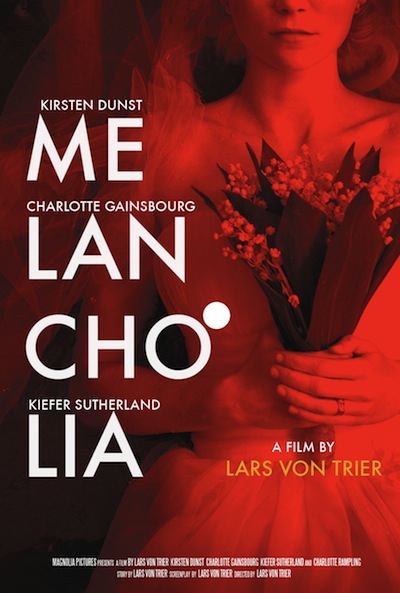
* Melancholia, Kirsten Dunst at the end of the world, courtesy of Lars von Trier.


* The Mill and the Cross, Rutger Hauer stars as Pieter Bruegel preparing his painting The Procession to Calvary in Lech Majewski's deconstruction of the masterpiece.

* Restless, Gus Van Sant's latest attempt to go back to high school. Insert words "emo" and "twee" now.

* The Rum Diary, Bruce Robinson returns to moviemaking for a somewhat disappointing Hunter S. Thompson movie with Johnny Depp.

* The Skin I Live In, the disturbing new horror drama from Pedro Almodovar.

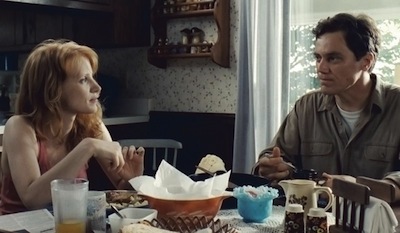
* Take Shelter, the movie where Michael Shannon goes crazy and the world seemingly follows his lead.


ON DVD/BD...

* Bad Teacher: Unrated Edition, a superb cast can't prevent this from being one of the least funny movies you'll see this (or any) year.

* Beats, Rhymes & Life: The Travels of a Tribe Called Quest, the story about the influential rap group is also the best music documentary in a long, long time.

* Bellflower, the cult indie strikes me as empty for all the wrong reasons.


* Bored to Death: The Complete Second Season, the continuing adventures of Jason Schwarztman as the pulpy, humorous avatar of author Jonathan Ames.

* Buster Keaton - Short Films Collection: 1920-1923, 19 comedy gems on three discs.

* Cape Fear, Scorsese's potent remake with Robert De Niro and Nick Nolte.

* Dumbo: The 70th Anniversary Edition, the stellar new upgrade for the little elephant that could.

* Great Italian Directors Collection, a boxed set of three films, including the first by Antonioni, a mid-60s Monicelli, and the anthology film Boccaccio '70.

* His Way, a breezy documentary about music promoter/movie producer Jerry Weintraub.


* I'm a Cyborg, But Thats OK, an inconsistent oddity from Park Chan-wook.

* Miss Nobody, an indie black comedy starring Leslie Bibb.

* My Fair Lady, another Audrey Hepburn movie comes to Blu-Ray. (What is that? Three now? Hurry up, Hollywood!)

* Rare Exports: A Christmas Tale, a black action comedy. The true Santa Claus returns!

* Rescue Me: The Sixth Season and the Last Season, the fire fighter bromance ends.

* Tomorrow is Forever, a post-war snooze with Orson Welles and Claudette Colbert doing their best to be mellow in all the drama.

* True Adolescents, a surprising indie comedy starring Mark Duplass as the cliche 30s rocker on his last legs.

* Water for Elephants, a film even a pachyderm would endeavor to forget.

* The White Bus, a short film written by the recently deceased Shelagh Delaney and directed by Lindsay Anderson.


Lindsay Anderson directing

Saturday, October 1, 2011

SIDELINE: MORE REVIEWS FOR 9/11

A round-up of non-Criterion reviews I wrote this past month:


IN THEATRES...

* 50/50, as unserious as cancer. Or as serious as cancer. Kind of both. Great work from Joseph Gordon-Levitt, Seth Rogen, and an all-around solid cast.

* Attack the Block, the ultimate summer movie shows up just in time for fall. (Unless you were lucky enough to get it in your town earlier, of course...)

* Contagion, in which Steven Soderbergh makes sure you'll never touch yourself again. On the face. ON THE FACE!!! But seriously, this movie is awesome.

* Drive, the best movie Paul Schrader never made. Ryan Gosling stars, all Alain Delon-like, in this violent tour-de-force by Nicolas Winding Refn.

* Gainsbourg: A Heroic Life, a biopic of Serge Gainsbourg from French cartoonist Joan Sfarr. It can't quite sustain its inventiveness, but I liked it all the same.


* Higher Ground, actress Vera Farmiga tackles feminism and faith in her directorial debut.

* The Lion King 3D, an old favorite shown in a bad new light.

* Moneyball, a surprisingly deep drama about the inner workings of baseball. (Note: One of the screenwriters was Aaron Sorkin. Did you know that?)

* Shut Up Little Man! An Audio Misadventure, a fascinating, thought-provoking look at one of the most infamous pre-internet viral sensations.

* Straw Dogs, a competent but pointless remake. Rod Lurie is no Sam Peckinpah. (Hey, I reviewed the original once, too.)

Portland was lucky enough to have Cinema 21 showing the original 3D version of Alfred Hitchcock's Dial M for Murder for a limited engagement. To go along with it, the Portland Mercury asked me to pick some other Hitch films for home viewing, and I did so by taking a tour of his trailers. Read the column online here.

ON DVD/BD...

* Boccaccio '70, four Italian film directors team for a 1962 anthology film telling individual stories of modern romance.


* Breakfast at Tiffany's, the quintessential Audrey Hepburn film is now on Blu-Ray.

* Hung: The Complete Second Season, Thomas Jane returns as everyone's favorite lovelorn hustler.

* If a Tree Falls: A Story of the Earth Liberation Front, a thought-provoking documentary about controversial radicalism.

* The Inspector General, this whitebread Danny Kaye musical is only offensive in how unfunny it is.

* One Minute to Zero, Robert Mitchum makes love to Ann Blyth and hits the snooze button in this Korean War drama.

* Road to Nowhere, Monte Hellman returns to the director's chair for a disjointed potboiler.

Sunday, September 19, 2010

CHARADE Revisited on Blu-Ray - #57

[The main body of this review as originally published February 2008.]

"Sixsmith wrings sweat from his handkerchief. 'I saw Charade with my niece at an art-house cinema last year. Was that Hitchcock? She strong-arms me into seeing these things, to prevent me from growing "square." I rather enjoyed it, but my niece said Audrey Hepburn was a "bubblehead." Delicious word.'

'
Charade's the one where the plot swings on the stamps?'

'A contrived puzzle, yes, but all thrillers would wither without contrivance.'
"

- from Cloud Atlas by David Mitchell


I have to admit, I didn't like Charade the first time I saw it. Advance expectation is a killer of many a good film, and I originally watched the 1963 movie as part of my crawl through the Audrey Hepburn filmography. Being the oft-delayed coupling of Ms Hepburn and Mr. Cary Grant, I went in expecting a lighthearted romantic comedy--which is what I got, at least for half of Charade. The other half, as it turned out, was a Hithcockian thriller with a dark, even violent streak. In my mind, the two clashed in ways I couldn't quite reconcile. Who got all this blood in my peanut butter?

The screenplay for Charade, written by Peter Stone, is a study in incongruities. Mrs. Regina Lampert (Hepburn) and Mr. Peter Joshua (Grant) meet at a mountain resort, trade a few cynical retorts about love and their failed marriages, and essentially start a flirtation in a manner classic to the genre. Like two superheroes meeting for the first time who have to fight before they get along, two lovers in romantic comedies begin swapping acid before they swap spit, and the pleasure comes from watching their defenses crumble. For quite a while, the first words Reggie and Peter exchange were my answering machine's outgoing message. "I already know an awful lot of people and until one of them dies I couldn't possibly meet anyone else." "Well, if anyone goes on the critical list, let me know."

Upon returning to Paris, however, romance is not in the air, mystery is. Regina discovers her apartment empty except for a French police inspector (Jacques Marin). He informs her that her husband sold all of their furniture, absconded with the $250,000 he got for it, and then got himself thrown off a train. The money did not get thrown with him, and it is presumed stolen or missing. When three cartoonish crooks (James Coburn, George Kennedy, and Ned Glass) show up for the late Mr. Lampert's funeral, it becomes clear that it's the latter. In fact, not only are these guys looking for it, but so is the C.I.A. An agent by the name of Bartholomew (Walter Matthau) tells Reggie that her husband was not who he said he was, and that the $250,000 was actually stolen from the U.S. government by the dead man and his army buddies back in WWII. The bad guys will kill her to find it, and the U.S. will basically put her on the hook for it if she doesn't find the dough and return it. There are an awful lot of rocks to get caught between when the world is one big hard place.

Enter Cary Grant to save the day, right? Well, kind of. While Peter does offer to lend a hand, he may not be who he says he is. In fact, he may not be multiple people he says he is. So, while he romances Regina, we never know whose side he's really on, nor if he's the one responsible for all the bodies that are starting to pile up around them.

There is much for fans of classic romance to catch the vapors over in Charade. Audrey Hepburn and Cary Grant have a marvelous natural rapport, and the scenes where they just clown around with each other are priceless. Director Stanley Donen has a graceful comic touch, and he gives his stars ample opportunity to do what they do best. A walk along the Seine, with its self-referential jokes about An American in Paris [review], which starred Donen's former creative partner Gene Kelly, is a wonderful display of comedic timing. As soon as Peter responds to one thread of conversation, Reggie switches to another, leaving the befuddled man to constantly catch up. The self-effacing charm that always served Cary Grant is well honed at this point, and the actor not only weathers jokes about his age, but requested them in order not to look like an old lecher chasing a young gamine through the City of Lights. These get some of the best laughs in the movie. (If only someone had taken the air out of Gary Cooper's tires in the same way before he courted the young actress in Love in the Afternoon.)

Yet, there is also some squeamish violence to contend with in the plot. Despite Lampert's old army buddies being overdrawn caricatures--Coburn the boorish Texan, Glass a nebbish, Kennedy a one-handed monster--when they go to work, Donen doesn't soften any of their blows. When they confront Reggie alone, there is a real feeling of sexual threat, and when they engage in fisticuffs with Peter, the violence is deadly. A rooftop tussle with the hook-handed Kennedy leaves a big, bleeding gash on Peter's back, and when the crooks start getting themselves killed, the manner of the murders is uniformly gruesome, escalating to James Coburn being trussed up with a clear plastic bag over his head, the death grimace of his suffocation visible through the Ziploc.

The sweet stuff was so sweet and the bitter business so bitter, I couldn't make sense of why Donen and Stone had chose to put them together in this way. Was it just the changing times, a need to update and compete? Probably not. Though change was a-coming, the censorship boards had not yet gone completely lax, and the violent turnaround of American movies was a couple of years off. While Charade was maybe testing those waters, it wasn't done out of competition, but a deeper thematic concern.

Charade is a tapestry of lies that extends beyond assumed identities and crime. In this narrative, relationships have also become charades. The Lamperts are in an empty marriage that is only saved from divorce by the husband's untimely death. As it turns out, the wife didn't know her husband at all, and what she is discovering is that love is not as simple as it once was. Can we really know anybody? Is courtship anything more than donning a mask to convince the person we desire that we are someone to be desired, as well?

Even beyond that, though, moviemaking is a charade. For decades, the audience had been conditioned to view thrillers and romantic comedies alike without considering that any real-life equivalent of these fictions would carry with it real-life consequences. In a manner that could be just as startling as anything coming out of 1960s France and the British Kitchen Sink school, or still to come with the young turks of new American cinema, Stanley Donen was exposing the false bottom of the Hollywood technique. Realizing this gives new meaning to the climactic showdown, where the real killer chases Reggie into a traditional theatre and finds himself on the business end of a trapdoor. There is nothing under the stage, you see, the boards these players tread are not rock solid, and their actions are not to be believed. It's like the fake-out with the water pistol in the opening scenes, but played out for 114 minutes

This was the crucial logic that I missed in the cloud of my initial expectations for Charade, a mist that had to be cleared for me to see the film for what it really was. Once I figured out the reason for the juxtaposition of love and violence, comedy and crime, I could see the greater meaning the filmmakers were trying to convey. Charade is not a subversion of silver-screen romance, but an affirmation of it. Love isn't knowing exactly what you are getting, but extending a level of trust that tells the other person that he or she is worth the risk of being lied to. When the bullets are flying, Peter extends his hand to Reggie, and she asks why she should place his faith in him. He tells her there is no logical reason on Earth for her to do so, and he's right, there isn't. Thankfully, emotion is eschewing logic to follow instinct, and it means all the more that Reggie is able to love again when there is no good explanation for it. She simply follows her heart, and the charade dissolves.


Criterion has brought Charade to the Blu-Ray format with a new high-definition digital transfer, 1080p, at the original 1.85:1 aspect ratio. The restoration is impressive. Colors are excellent, with realistic skin tones and vibrant hues (pay special attention to the reds to see what I mean.) Their is a pleasant, natural grain to the overall image texture. It can sometimes make the picture look a little soft, especially in extreme close-ups, but not so you'd notice once you are caught up in the story. What is the most remarkable is the depth of field. Details are clear in complicated close quarters like the hotel rooms, and there is tremendous clarity when Cary Grant and George Kennedy are fighting on the rooftops. You can see the whole city behind them, and the neon signs glow with real electricity. In the subway, you can see the shine on the wall tiles contrasted with the texture of the cement floor. I have seen three or four different versions of Charade, and I swear, it's never looked like this.

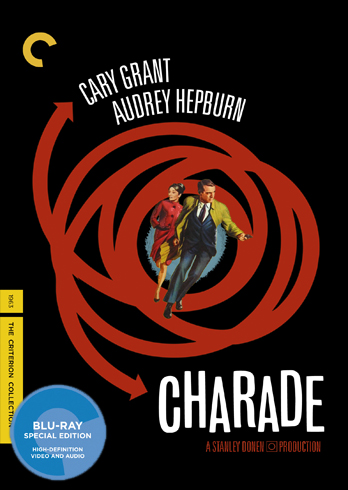
The BD of Charade comes in a similar package to the previous DVD releases, though with an improved cover image with a vintage movie poster design. The booklet inside is likely the same as the 2nd edition, reprinting the Bruce Eder essay that has been part of the deal since Criterion's first 1999 release. (I never did purchase the upgrade from a couple of years ago, so I am guessing a little.)

Also carried over is the excellent commentary with Stanley Donen and screenwriter Peter Stone. I love listening to Stanley Donen. He's just such a bright guy--in every sense of the word.

The original theatrical trailer is also included.

Missing from previous editions is the section showcasing the filmography of Stanley Donen, which was basically a text-based, illustrated biography. (The 1999 disc had a similar feature for Peter Stone that I believe was dropped from the later reissue.)


For a full rundown on the special features, read the full review at DVDTalk.

Tuesday, July 13, 2010

BLACK NARCISSUS - #93

"There's something in the atmosphere that makes everything seem exaggerated."
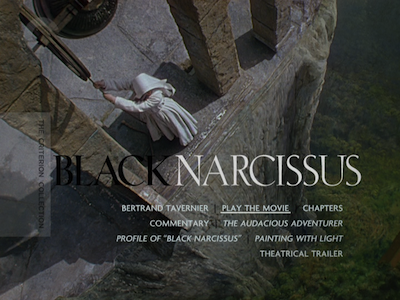


Criterion is about to re-release two of its earliest Michael Powell and Emeric Pressburger DVDs, and while the much vaunted restoration of The Red Shoes is gobbling up most of the press clippings [read my review of the theatrical print here; the DVD review here], I sincerely hope Black Narcissus won't get overlooked. Because despite the lack of pre-publicity for this particular restoration, the new DVD transfer for Black Narcissus is astounding. The storybook Technicolor has such marvelous hues and textures, it's like the Archers--alongside cinematographer Jack Cardiff--have invented a world as illusory and new as James Cameron's Avatar [review], only they did it more than 60 years ago and with a completely different spiritual message. To have a DVD that finally shows us the natural pigments and the level of detail intended by the filmmakers is a great boon.
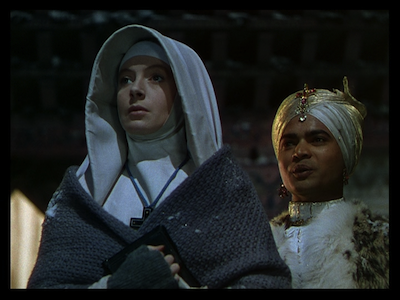
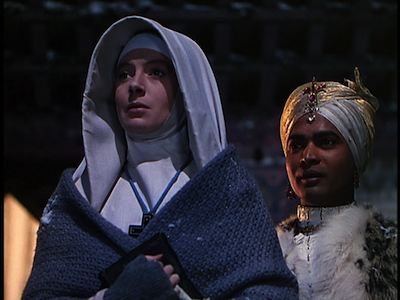


Compare the above: top image is 2010, bottom image 2000


Released in 1947, Black Narcissus is based a novel by English author Rumer Godden, who is maybe best known for The River, her memoir about spending time in India as a child (later made into a film by Jean Renoir). For Black Narcissus, she takes readers high into the Himalayas to tell a story of an order of nuns assigned to a temple 8,000 feet in the air. They have been invited by the local ruler, a peacock they refer to as the Old General (Eamond Knight), though there is some doubt that it's the best place for a convent. A group of monks tried to set up shop the year before and barely made it through a couple of months.

The nun put in charge of this new cloister is Sister Clodagh (Deborah Kerr), and it will be her first leadership assignment. Accompanying her are four other sisters: Philippa (Flora Robson), chosen for her gardening skills; Briony (Judith Furse), who is strong and experienced in medicine; Blanche, a.k.a. Sister Honey (Jenny Laird), popular for her kindness; and the troubled Sister Ruth (Kathleen Byron), who needs a change of pace to get her head in order. The mountain castle is the wrong place for it, however; none of the women are prepared for the way the new environs will change their lives.

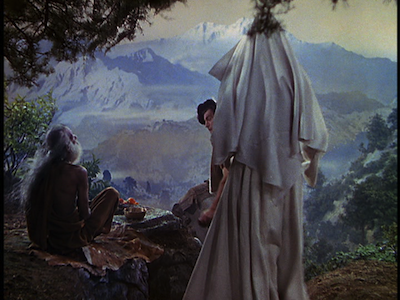


Top: 2010, bottom: 2000


The Old General's castle--which, ironically, is where he used to keep his harem--sits above a valley, and the nunnery will serve the village below, providing a school and health clinic for the locals. The people lead simple lives, most of them work in agriculture. On one side of their moral spectrum, they have a holy man who occupies a high point near the castle, where he sits and meditates day in and day out; on the other end is the only Westerner in the area, a man named Dean (David Farrar). Mr. Dean is the one who tried to warn the sisters away, but if they are going to be there, he is going to give them a hand when he can--sometimes whether they like it or not. He's not afraid to tweak their piety for a laugh.

A story like Black Narcissus will usually go one of three ways: the nuns can either change the people they have come to help (bringing the heathen salvation/taming the savages), or the people can inspire a change in the missionaries instead. The mawkish third option is that both might happen. Powell and Pressburger go for a fourth option, choosing instead to make the locals only a small part of the story. The natives of the area are a product of their environment, and it's the environment that will change the nuns. The sisters have come from an order that believes hard work is the way to salvation. Toil distracts the mind from earthly things, leaving more brainspace for God. The culture clash is more mystical than social, as emphasized by the Archers layering Western religious music over Eastern religious imagery. The mountain retreat is isolated and magical, like a version of the fabled Xanadu, and in its nest, the nuns will surrender to their interior desire. Isolation creates distraction rather than fostering peace. Philippa, for instance, plants flowers instead of vegetables, choosing beauty over nourishment.


For Sister Clodagh, this new space brings back memories, and we see flashbacks to her life in Ireland before joining the faith. She dreams of a past that is equal parts hurt and nostalgia, and though we only see snippets of what happened, we sense that any happiness in the events are short lived. One of the flashbacks even ends with Clodagh disappearing into darkness, swallowed by the sky, an image that prefigures the final shot of Black Narcissus, when the castle disappears into the clouds.
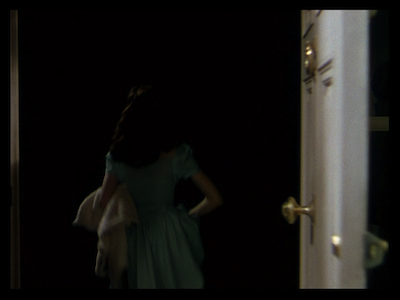


Whatever is eating at Clodagh, it isn't helped by the presence of Dean. The rugged man of the wilderness is a most masculine figure, and his magnetism is irresistible to both Clodagh and Ruth. This central triangle forms the crux of the movie's plot. By comparison, the side story of the local girl (Jean Simmons) that Dean might have romanced and the Young General (Sabu) who stirs things up with his fancy clothes and perfumes almost seems like an afterthought. There are themes here reminiscent of the Audrey Hepburn drama The Nun's Story, in that a religious woman sent to a remote outpost has her faith challenged and her heart stirred by the man of action she meets there. Unlike that film, however, Black Narcissus offers us two examples of how different believers deal with temptation. Clodagh resists and grows stronger, whereas Ruth gives in and loses her way.

And I mean that literally. From the get-go, Ruth is presented as the one out of sorts. She belittles the village children and is so pale and sweaty, she looks like she is going to die in her habit. Her lust is presented as a literal fever, one that only increases the longer she is in the mountains. Dean shows her an early kindness, and that's all she needs to fixate on him. The fact that she's covered in blood when it happens--an early introduction of a red color scheme associated with the character--should be an indication of what kind of figure she will come to represent. Black Narcissus is a romance cross-bred with a horror film, and its melodrama has as much in common with the histrionics of Hitchcock's Rebecca [review] as it does any of Douglas Sirk's soapy tearjerkers. The women are from an order where the nuns renew their vows every year, and Ruth doesn't re-up when her time is through. Instead, she puts on a dress and make-up smuggled from the city thinking that she will be able to stay with Dean. When he refuses, she blames Clodagh for stealing him and goes after her rival.
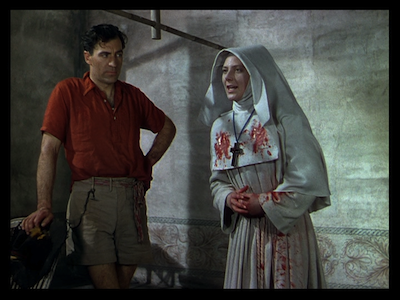


There are intimations that the wind and the altitude have infected Ruth's sanity. There is also an understated element of magic at work. A young child's death has turned the villagers against the nuns, believing the medicine they gave her to be responsible. When Ruth goes over the brink, the local men are playing their drums, holding a ritualistic vigil...but for whom? Earlier in Black Narcissus, they did the same thing when the Old General was on his deathbed, and they only stopped when he died. At the time, the noise got on Ruth's nerves. Is it now compelling her to have this psychotic break?
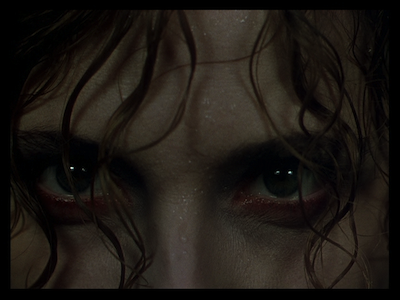


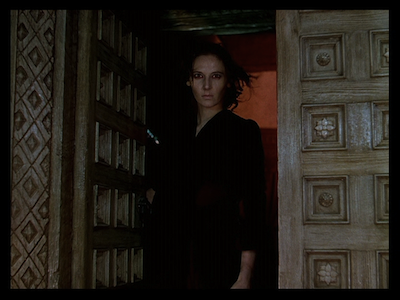
When Ruth gets dressed up for her new freedom, both her frock and her lipstick are red. She also lets her fiery hair out from under her white habit--and it's probably worth noting that Clodagh has red hair, too, making them twins after a fashion. The more deranged Ruth gets, the more red her eyes get, culminating in a close-up that shoes them rimmed with crimson and shining with insanity. She also passes out when Dean rejects her, and the shot is framed from her point of view as the entire screen goes blood red. The filmmakers use red for all its various connotations: passion, heat, life. Color is almost like an added element of nature in this opera; it signals change, hence the colorful transformations of the season. Red marks Ruth's change, but her final metamorphosis comes when she finds Clodagh alone and unprotected. Ruth is so drenched in humidity and sweat, her dress and her hair have turned as black as the shadow that surrounds her. As black as the shadow that devoured Clodagh in flashback.


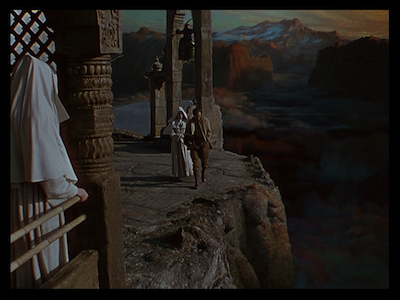
The visual design of Black Narcissus is as beautiful as any the Archers ever created, rivaling even their stage-based dramas The Red Shoes and Tales of Hoffman. The vast landscapes they dream up and invent on the backlots of Pinewood Studios are glorious in their detail and realism. Using every tool at their disposal, including trompe l'oeil matte paintings, they create distance and depth. The seclusion of the nunnery is made very real by the magnitude of the mountains that surround them and the terrifying drop that awaits them at the edge of their property. When Clodagh stands at the bell tower, the cliffside goes all the way down into the valley, but we can't even see the bottom. We're too high, and there are too many obscuring clouds. It's an illusion as believable as any of the CGI cities Christopher Nolan builds in Inception [review coming Thursday]. The mind boggles at what the Archers might have done with computers at their disposal. The digital age is certainly being kind to them, as the gorgeous image quality of this DVD will attest.


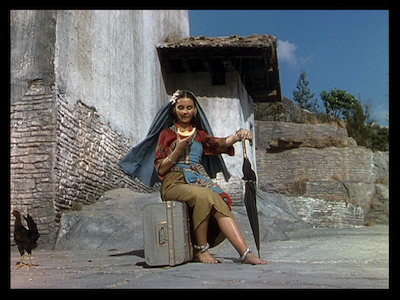
Of course, in a movie of this kind, color is not just part of the background, but also part of the politics. Black Narcissus walks a fine, antiquated line between treating different ethnicities with respect and slipping into racial clichés. Seeing Jean Simmons and Esmond Knight in brown face is a little hard to get used to, and the script never quite gets past treating the villagers as "the other." Dean's description of the locals at the start of the picture is respectful, but he's typically colonialist in action. Yet, there are subtle moments where prejudiced points of view are satirized and even ridiculed. When Ruth, for instance, insists "they all look alike," there is an undertone that makes her seem ridiculous, even if no one ever comes out and says it. Even more subversive is seeing the nuns teaching the children English using symbols of imperialism. Namely, a chart of weapons! In the sly smile of the young translator Joseph Anthony (Eddie Whaley Jr.) are the early sparkles of revolution.



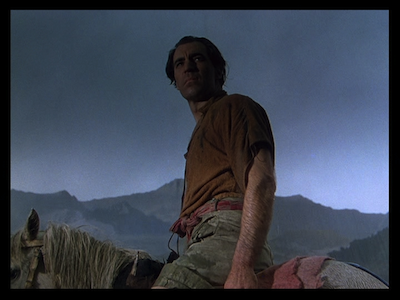
That said, for everything that is below the surface, the most memorable undercurrent will be the unrealized romance between Mr. Dean and Sister Clodagh. In typical movie fashion, the two are at odds from the start, trading barbs that are at turns humorous and rueful. Dean can't stand Clodagh's being clueless, she can't stand his rough manner and carousing. Yet, the stronger she grows and the more he reveals himself as capable and empathetic, the closer they become. There are some smoldering looks between them, and some heartbreaking ones, as well. Like socially restrained lovers in a Merchant Ivory picture or an Edith Wharton novel, they can't act on their feelings, and so it's all in the tone of their voice and eye contact. David Farrar, who was also in the Archers' production The Small Back Room [review], is charming and funny, but he also has an earthy gravitas. His best moments are not when he is playing the rake, but when he is having to choke on the emotion he doesn't want to admit is there.

If I had to choose, I'd say this movie has my favorite Deborah Kerr performance. I like her as Sister Clodagh even more than I do in An Affair to Remember [review] or The Innocents. There is a weird thing about art in that restrictions are often the key to inspiring the artist to stretch. Throughout Black Narcissus, Kerr is locked in her nun's habit. It leaves her with only her most essential tools: her face and her voice. Clodagh is a woman who is trying to maintain a holy image, who is always trying to look as if she is together. That in itself is easy enough, but the emphasis here should be on the word "trying." There is always more informing what she does than what we can see, and Kerr fantastically brings the nun's internal conflict to life. Her past and the things she denies are always with her. There is visible doubt in her eyes, a tremor in her voice. For as subtle as this all is, Kerr is also able to sell the more exaggerated dramatics of the final act.
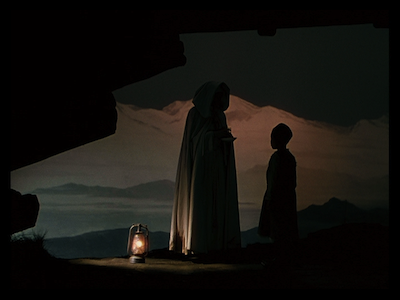


Perhaps it's the quiet of the earlier bits that lends credibility to the louder technique of the later ones. It certainly sets the stage for an effective finale. Powell and Pressburger have paved the way for an exit that passes us back through the veil. We depart from the magic of the mountains back into the real world, having taken a journey with their characters to someplace beyond what is familiar. We can hit stop on the DVD and return to our normal lives, but as David Farrar's last look into the camera suggests, we will probably be forever changed by what happened on this altogether unreal plane.


In addition to the new transfer for Black Narcissus, which was overseen by Jack Cardiff and Michael Powell's widow, the renowned film editor Thelma Schoonmaker Powell, Criterion offers up several new extras to make a new purchase worthwhile, whether you go with the standard-definition reissue or the new Blu-Ray. I believe a couple of the extras come from a French DVD edition of Black Narcissus. They both feature filmmaker Bertrand Tavernier, who is a fan of the film. He provided an introduction to the picture and also shares his thoughts of the movie and Michael Powell in a featurette entitled "The Audacious Adventurer."

Another new extra is a short documentary called "Profile of Black Narcissus," which takes a look at the picture as a whole while also covering some of the same ground and using some of the same source material as a holdover from Criterion's 2000 DVD, the Jack Cardiff tribute "Painting with Light." Also leftover from before is the excellent audio commentary featuring Powell and his biggest fan, Martin Scorsese.


This disc was provided by the Criterion Collection for purposes of review.

Friday, November 20, 2009

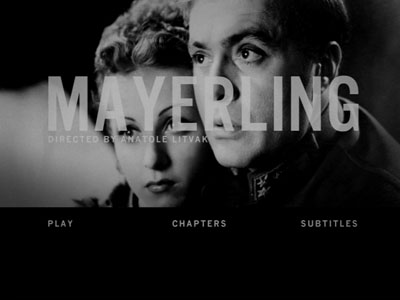
MAYERLING - ESSENTIAL ART HOUSE


Well, I guess it just goes to show, you're never as smart as you think. Here's what I knew about Mayerling: that it showed up regularly on lists of Audrey Hepburn movies as a 1957 television production the actress starred in opposite her then husband, Mel Ferrer. I had always hoped this show would one day surface, being pretty much the only significant television appearance Hepburn made in the first half of her career. I didn't know anything about the story, much less that it was based on a true event and that there were a bunch of other film versions of the tale. All were based on what is known as the "The Mayerling Incident," an 1889 scandal involving the murder-suicide of Crown Prince Rudolf of Austria and his lover, Baroness Maria Vetsera. Live and learn.

Anatole Litvak directed that Hepburn performance, twenty years after he helmed the story for the first time in this French production, realeased here as part of Criterion's Essential Art House line and which also happens to be the first dramatization of the affair. Made in 1936, Mayerling stars Charles Boyer as Rudolf and Danielle Darrieux as Maria. The two would also reunite later as the stars of Max Ophuls' The Earrings of Madame de..., a far more successful coupling as far as I'm concerned. There is nothing wrong with Litvak's Mayerling, per se, it's just that this arch costume drama is the product of a different time. A somewhat dispassionate, reserved time.


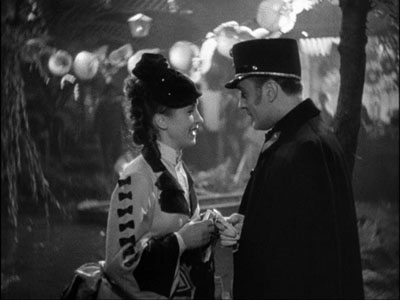
The story follows the outline of many a tragedy. The young Archduke Rudolf first goes astray by entertaining rogue political ideas. He is friends with Szeps (Rene Bergeron), a rabble-rousing newspaper editor known to be part of anti-monarchy protests. Rudolf is quickly put into line and pushed into an arranged, loveless marriage. The years pass, and Rudolf lets most of them go by drinking and partying with his buddies and loose-moraled gypsies. The party boy image is a front, however, and Rudolf yearns for an anonymous life and true love. He finds both when he runs into Maria Vetsera, who at first doesn't realize who this handsome soldier is. When they find each other again, they begin a secret affair, one that eventually becomes public. When the pope turns down Rudolf's request for a marriage annulment so he can be with Maria, the prince reaches the end of the line. Told by his father (Jean Dax), to get rid of Maria, Rudolf resorts to drastic measures. They go on an overnight trip to Mayerling, never to return.

The screenplay for Mayerling was adapted by Joseph Kessel (the novel Belle de jour) and Irma Von Cube (Johnny Belinda) from a novel by Claude Anet. The spicy historical details, and I am sure more than a few embellishments are all there, though I imagine the 1930s production code kept the filmmakers from going too far with what really went on. References to whores and lewd carryings on make it slightly more risqué than had it been a Hollywood production, but the folks in California also knew clever ways of getting more scandalous points across without saying everything outright. There are moments when I thought maybe I was supposed to infer more than what was being shown--like, were Rudolf and Szeps gay lovers, in addition to political radicals?--but also thought that could have been my modern eye spying things that weren't really there.


Litvak stages Mayerling as a grand spectacle, including nights out at the ballet and fancy-dress balls. The evening at the theatre, when Rudolf and Maria see each other for the first time after their chance meeting, is put together wonderfully. Litvak moves up and down and in and out of the various boxes, using a modified upstairs-downstairs technique to indicate the levels of the class structure in the royal court. His camera flies on the wings of gossip, mostly lead by the Archduke's cousin, and the whispered plans for future rendezvous provides Mayerling with its only real heat. Except for their final outing together--and we know how that one ends--most of the lovers' meetings look to be ridiculously chaste. Though, one has to wonder why army officers weren't more careful back in the day when they took their mistresses out for drinks. Rudolf getting caught out by his men, as well as Maria's brother, is remarkably similar to Lord Nelson being discovered boozing with Lady Hamilton in Alexander Korda's That Hamilton Woman.

Though we are apparently to believe that Maria Vetsera is a ripe seventeen, Danielle Darrieux and, indeed, the whole movie comes off as much older than that. Mayerling is really too mature. It needs a touch of Romeo & Juliet adolescent angst to give this star-crossed love affair a little more oomph. Even Rudolf's quickly jettisoned political rebellion could have been cranked higher. For a guy doing his best to piss off his father, he cordially stays out of the old man's face. There is little to signal that these two are passionate or dramatic enough to want to take their own lives. It's a development that comes out of nowhere, and seeing Boyer's shaky determination in the final scenes made me wonder where this kind of emotion had been in the preceding 90 minutes. Even the atmosphere out at Mayerling is different--more desolate and remote, with the lovers playing hide and seek on a late foggy night.


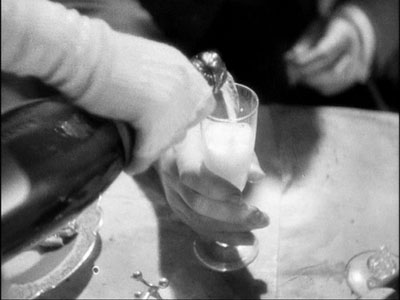
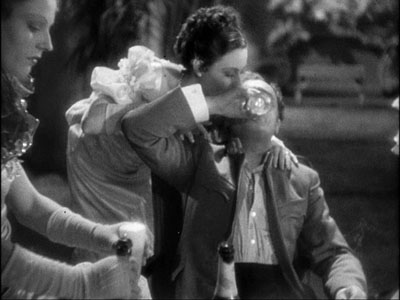
Anatole Litvak would eventually leave France and enjoy a fairly successful career in Hollywood, including directing the jazz film Blues in the Night, the desperate noir The Long Night, and another historical drama, Anastasia with Ingrid Bergman. Mayerling definitely shows a style in development. He understands that a costume piece like Mayerling has alternating demands, with wide shots needing to be employed to show the big set pieces and extreme close-ups necessary for the extreme emotions. He also finds ways to get his camera moving, regularly starting tight on a specific thing and moving back to reveal the whole scene. There is a particularly memorable use of this technique in the middle of the movie, when Rudolf has been drowning his sorrows during Maria's absence. We have heard that the Prince has been out carousing, and Litvak takes us into the decadence by starting on a champagne bottle and then zooming out as it's poured, showing the drunk royal in his cups amongst his courtesans. So, despite some slowness in the overall narrative, it's clear that this filmmaker is just starting to get warmed up.
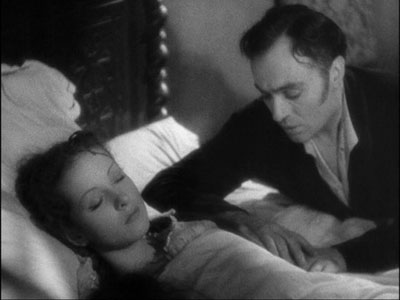


This does make me wonder, though, is there a more definitive version of Mayerling out there? There are multiple films of the story, including one with Omar Sharif and Catherine Deneuve, and even interpretations off the screen--a ballet, a German opera, a Japanese musical, and a manga, of all thngs. What say you readers? What do you recommend?

By the way, in researching this article, I discovered that a 9-minute clip of the Audrey Hepburn/Mel Ferrer production is now online and that we may actually see this surface in the future. Info here, and the clip itself:


Sunday, November 30, 2008

SIDELINE: MORE REVIEWS FOR 11/08

In addition to those reviews, here are some other movies I was able to scare up reviews for in the past month:

IN THEATRES...

* Synecdoche, New York, the directorial debut of Charlie Kaufman. The writer of Adaptation achieves his goals, but that doesn't mean the movie is necessarily good.

ON DVD...

* Looney Tunes: Golden Collection, Vol. 6, an amazing new set of some of the greatest cartoons of all time. Includes a war-themed disc and a disc of one-offs and special creations.

* Love Songs, an annoying "21st-Century Umbrellas of Cherbourg." Barf!

* Paris, Je T'aime, a re-release of the two-disc version of one of my favorite movies of recent memory.

* Popeye the Sailor: 1941-1943, vol. 3, the third set in the Popeye series takes us into the war years and a shift in production companies.

* Roberto Rossellini 2-Disc Collection (Director's Series), a double dose of the Neorealist from the filmmaker's 1950s oeuvre.

* Roman Holiday - The Centennial Collection and Sabrina - The Centennial Collection, Audrey Hepburn's first two films get a major DVD upgrade.

Sunday, February 17, 2008

CHARADE - #57

[Update: This review has an updated version here, covering the Blu-Ray release from September, 2010.]

"Sixsmith wrings sweat from his handkerchief. 'I saw Charade with my niece at an art-house cinema last year. Was that Hitchcock? She strong-arms me into seeing these things, to prevent me from growing "square." I rather enjoyed it, but my niece said Audrey Hepburn was a "bubblehead." Delicious word.'

'
Charade's the one where the plot swings on the stamps?'

'A contrived puzzle, yes, but all thrillers would wither without contrivance.'
"

- from Cloud Atlas by David Mitchell


I have to admit, I didn't like Charade the first time I saw it. Advance expectation is a killer of many a good film, and I originally watched the 1963 movie as part of my crawl through the Audrey Hepburn filmography. Being the oft-delayed coupling of Ms Hepburn and Mr. Cary Grant, I went in expecting a lighthearted romantic comedy--which is what I got, at least for half of Charade. The other half, as it turned out, was a Hithcockian thriller with a dark, even violent streak. In my mind, the two clashed in ways I couldn’t quite reconcile. Who got all this blood in my peanut butter?

The screenplay for Charade, written by Peter Stone, is a study in incongruities. Mrs. Regina Lampert (Hepburn) and Mr. Peter Joshua (Grant) meet at a mountain resort, trade a few cynical retorts about love and their failed marriages, and essentially start a flirtation in a manner classic to the genre. Like two superheroes meeting for the first time who have to fight before they get along, two lovers in romantic comedies begin swapping acid before they swap spit, and the pleasure comes from watching their defenses crumble. For quite a while, the first words Reggie and Peter exchange were my answering machine's outgoing message. "I already know an awful lot of people and until one of them dies I couldn't possibly meet anyone else." "Well, if anyone goes on the critical list, let me know."

Upon returning to Paris, however, romance is not in the air, mystery is. Regina discovers her apartment empty except for a French police inspector (Jacques Marin). He informs her that her husband sold all of their furniture, absconded with the $250,000 he got for it, and then got himself thrown off a train. The money did not get thrown with him, and it is presumed stolen or missing. When three cartoonish crooks (James Coburn, George Kennedy, and Ned Glass) show up for the late Mr. Lampert's funeral, it becomes clear that it's the latter. In fact, not only are these guys looking for it, but so is the C.I.A. An agent by the name of Bartholomew (Walter Matthau) tells Reggie that her husband was not who he said he was, and that the $250,000 was actually stolen from the U.S. government by the dead man and his army buddies back in WWII. The bad guys will kill her to find it, and the U.S. will basically put her on the hook for it if she doesn't find the dough and return it. There are an awful lot of rocks to get caught between when the world is one big hard place.

Enter Cary Grant to save the day, right? Well, kind of. While Peter does offer to lend a hand, he may not be who he says he is. In fact, he may not be multiple people he says he is. So, while he romances Regina, we never know whose side he's really on, nor if he's the one responsible for all the bodies that are starting to pile up around them.


There is much for fans of classic romance to catch the vapors over in Charade. Audrey Hepburn and Cary Grant have a marvelous natural rapport, and the scenes where they just clown around with each other are priceless. Director Stanley Donen has a graceful comic touch, and he gives his stars ample opportunity to do what they do best. A walk along the Seine, with its self-referential jokes about An American in Paris, which starred Donen's former creative partner Gene Kelly, is a wonderful display of comedic timing. As soon as Peter responds to one thread of conversation, Reggie switches to another, leaving the befuddled man to constantly catch up. The self-effacing charm that always served Cary Grant is well honed at this point, and the actor not only weathers jokes about his age, but requested them in order not to look like an old lecher chasing a young gamine through the City of Lights. These get some of the best laughs in the movie. (If only someone had taken the air out of Gary Cooper's tires in the same way before he courted the young actress in Love in the Afternoon.)

Yet, there is also some squeamish violence to contend with in the plot. Despite Lampert's old army buddies being overdrawn caricatures--Coburn the boorish Texan, Glass a nebbish, Kennedy a one-handed monster--when they go to work, Donen doesn't soften any of their blows. When they confront Reggie alone, there is a real feeling of sexual threat, and when they engage in fisticuffs with Peter, the violence is deadly. A rooftop tussle with the hook-handed Kennedy leaves a big, bleeding gash on Peter's back, and when the crooks start getting themselves killed, the manner of the murders is uniformly gruesome, escalating to James Coburn being trussed up with a clear plastic bag over his head, the death grimace of his suffocation visible through the Ziploc.

The sweet stuff was so sweet and the bitter business so bitter, I couldn't make sense of why Donen and Stone had chose to put them together in this way. Was it just the changing times, a need to update and compete? Probably not. Though change was a-coming, the censorship boards had not yet gone completely lax, and the violent turnaround of American movies was a couple of years off. While Charade was maybe testing those waters, it wasn't done out of competition, but a deeper thematic concern.

Charade is a tapestry of lies that extends beyond assumed identities and crime. In this narrative, relationships have also become charades. The Lamperts are in an empty marriage that is only saved from divorce by the husband's untimely death. As it turns out, the wife didn't know her husband at all, and what she is discovering is that love is not as simple as it once was. Can we really know anybody? Is courtship anything more than donning a mask to convince the person we desire that we are someone to be desired, as well?


Even beyond that, though, moviemaking is a charade. For decades, the audience had been conditioned to view thrillers and romantic comedies alike without considering that any real-life equivalent of these fictions would carry with it real-life consequences. In a manner that could be just as startling as anything coming out of 1960s France and the British Kitchen Sink school, or still to come with the young turks of new American cinema, Stanley Donen was exposing the false bottom of the Hollywood technique. Realizing this gives new meaning to the climactic showdown, where the real killer chases Reggie into a traditional theatre and finds himself on the business end of a trapdoor. There is nothing under the stage, you see, the boards these players tread are not rock solid, and their actions are not to be believed. It's like the fake-out with the water pistol in the opening scenes, but played out for 114 minutes

This was the crucial logic that I missed in the cloud of my initial expectations for Charade, a mist that had to be cleared for me to see the film for what it really was. Once I figured out the reason for the juxtaposition of love and violence, comedy and crime, I could see the greater meaning the filmmakers were trying to convey. Charade is not a subversion of silver-screen romance, but an affirmation of it. Love isn't knowing exactly what you are getting, but extending a level of trust that tells the other person that he or she is worth the risk of being lied to. When the bullets are flying, Peter extends his hand to Reggie, and she asks why she should place his faith in him. He tells her there is no logical reason on Earth for her to do so, and he's right, there isn't. Thankfully, emotion is eschewing logic to follow instinct, and it means all the more that Reggie is able to love again when there is no good explanation for it. She simply follows her heart, and the charade dissolves.


Some eagle-eyed readers may note that, no, I have not yet upgraded to the more state-of-the-art reissue of this disc, but still have the 1999 version. If you're looking that close at my screengrabs, however, maybe you should wander on over to my portfolio of comic book artists drawing Audrey Hepburn and peep that instead. (Either that, or put your money where your mouth is and buy it off my wish list, smart guy!)