Showing posts with label lubitsch. Show all posts

Sunday, January 24, 2016

GILDA - #795


A friend of mine once proposed a game. Pick three classical Hollywood actresses that, when combined, form your perfect woman. My answer? Audrey Hepburn, Lauren Bacall, and...Rita Hayworth. (Note: We played it with men, too.)

There’s a pretty good chance that Rita Hayworth was my first femme fatale.

I’m not sure what first drew me to Gilda. My memory suggests I saw a clip of her famous onscreen arrival in some documentary about cinema, or maybe I saw a photo from the film in a book about film noir. I had an image of Jane Greer on my bedroom wall, photocopied from one of those books, a year or two before I ever saw Out of thePast. It’s also possible I found Gilda completely by accident, one of those odd movies I discovered by scouring the TV guide every week, studying every station that was known to show old films, and programming my VCR accordingly. For years I’d cart those VHS tapes around, 3 movies per, recorded at SLP.


Regardless, it was a significant moment. My sudden obsession with Hayworth was not like my fascination with Marilyn Monroe, which was fueled by the industry behind her persona; nor would it be like my discovery of Audrey Hepburn, who was never a sexpot or dangerous, but was more of an aspirational Cinderella, someone to emulate more than desire. Bacall came as part of the Bogie & Bacall package, and I wanted to be him in as much as I wanted to deserve her. Rita Hayworth felt like my own discovery. Surely no one else knew about her. Otherwise they’d all be talking about her! (Fittingly, my next Hayworth score was Cover Girl, a movie of a much different kind, and a quick lesson that she wasn’t always “bad.”)


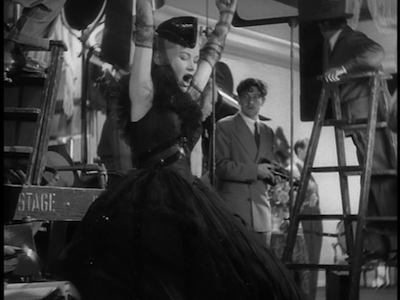
Despite its Hayes Code-inspired “crime doesn’t pay ending,” Gilda still manages to be a fairly salacious movie, working with the imposed restrictions as a positive rather than a negative. Rita stripping off one elbow-length glove in the big “striptease” scene is the greatest argument for censorship you’ll ever see. It’s sexy and sensual and suggestive in a way a more explicit version would have never been. Because it’s also about character, and in context, it’s a spectacle that can be viewed as more sad that seductive.

Which is the real trick of Charles Vidor’s 1946 noir drama. Gilda is a bundle of conflicted emotions. It’s a film where the characters all insist that they make their own luck, but then proceed to consistently act against their best interests. Loyalty can be bought, but grudges are never forgotten. The past is something to be shed, yet it’s always present. “I was born last night,” Glenn Ford’s Johnny Farrell tells his new boss, Balin Mundson (George Macready, Paths of Glory [review]), moments after the man saves him from being robbed. Balin then invites him to leave his low-rent gambling for something more high-class--namely, Galin’s casino--and a chance to make himself over. Of course, this is not true, there is no tabula rasa or hard reboot. Both men bring baggage with them. World War II may have just ended, but another more personal war is about to begin. And it has Nazis, too!


What Johnny isn’t prepared for is Balin taking a wife, and for that wife to be Gilda (Hayworth), the woman who broke Johnny’s heart, unmooring him, and leading him to wander to Buenos Aires, where this action all takes place. A woman coming between two men who have a friendship or partnership of some kind is an old trope, but it very nearly transcends gender here. (Balin, at one point, says, “My wife does not come under the category of women.”) It’s a triangle where each person wants to be favored over the other, while also wishing, in a weird way, that the other two will choose each other so the odd man out can watch. Balin, in particular, looks longingly at Johnny while practically pushing him and Gilda together. Love and hate are interchangeable, and a relationship is a deal to be made. “Do you want me to like him?” Gilda queries, not long before she declares “Let’s hate her!” in sympathy of Johnny’s terrible past.


Of course, the woman she is willing to hate is herself. She has made a bad deal, and now she is a kept woman for a man who is incapable of love and sees her as an object. What gives the famous song-and-dance scene its undercurrent of sadness is it’s Gilda acting out in the only way that brings her approval. In our introduction to the character, she gives a private performance to her husband and lover; in the nightclub, she does it for anyone who will watch, riling up the men in the crowd, but more importantly, getting a rise out of Johnny who, deep down, does not want to share her. The song she sings, “Put the Blame on Mame,” has an ironic, almost meta slant, celebrating the misdeeds of famous femme fatales who caused elemental shifts in the world around them, including starting a deadly fire. The irony is that Gilda doesn’t really cause all that much trouble herself, her efforts are thwarted by men who are too caught up in being angry to actually do much about it.


Johnny is a weird character. He takes the existential noir code a bit too far. Midway through Gilda, when Balin is believed dead, Johnny steps into his shoes, entering into a faux marriage with Gilda that puts him in the role of protector. Rather than be with her because he loves and desires her, however, he is doing it to preserve their commitments to Balin. Johnny will make Gilda the dutiful wife she never was for her husband. Johnny will guard the man’s “things.” He is honoring his pact with the dead man, staying faithful because that’s what Balin paid him for.

Despite my undying love for this film, I can admit it’s a bit lopsided. Both Macready and Ford give fairly one-note performances. Johnny can be a bit of an uptight bore, to such a degree that when he finally unclenches--almost quite literally--in the final scene, it feels like a relief, like we can relax ourselves. His hunched shoulders and ours drop simultaneously. Which might be why that ending works despite seeming a bit tacked on. It’s a rather bright conclusion for a noir, but Gilda is kind of a bright noir in general. The casino setting means just about everything is lit up, and what shadows there are exist to hide dirty, ugly things (those Nazis!). Johnny starts in the darkness, it’s where Balin rescues him from. The cinematography here is by Rudolph Maté, who also shot Hitchcock’s Foreign Correspondent [review] and Lubitsch’s To Be or Not to Be [review]. Though perhaps more apropos to this, he shot Alexander Korda’s That Hamilton Woman [review], another film about a love triangle and denied emotions, though one where the separation of  the lovers is due to other circumstances than any personal kinks. Still, compare Maté’s use of big set pieces there to his work here.


Gilda needs these big stages because all the better to showcase Hayworth. One could say she is as much the film’s object as she is Balin’s, she is there for the audience to watch alongside the men in her film. Yet, one could never consider Hayworth to be a passive performer or remotely contained. The moxie she gives Gilda makes her male co-stars appear all the more dull, they can’t measure up. Hayworth is fierce and bold here, with only hints of the world-weary pallor she would put to good use in later films like The Lady From Shanghai. She would revisit this fierceness in 1953 in Miss Sadie Thompson [review], which treads some of the same ground as Gilda, except with an older and more steady Hayworth at the center of the screen.

But, as they say, there’s still nothing like the first time. Gilda wasn’t Hayworth’s film debut, but it often feels like it. At least for my film-going experience, it was when she arrived, and with such spectacular style, she made sure I’d never let her go.


Thursday, January 30, 2014

LA VIE DE BOHEME - #693


There is a mutual appreciation society between New York indie icon Jim Jarmusch and quirky Finnish filmmaker Aki Kaurismäki, and that spiritual and creative connection has never been more evident in any of the Kaurismäki films I have seen than it is in his 1992 effort La vie de bohème (The Bohemian Life). Like the early works of his Aki's New York compatriot, it's a lazy comedy drawn in warm tones, inhabited by genial losers, and depicting a pocket of society just around the corner from the norm. Based on work by writer Henri Murger that also served as the inspiration for La Bohème (and thus all the iterations that followed), La vie de bohème also owes a little something to the tradition of similarly minded efforts featuring ex-pat artists and writers and the bungled romances that plague them, such as Ernst Lubitsch's A Design for Living [review] or even Stanley Donen and Gene Kelly's An American in Paris [review].


La vie de bohème is quintessentially Kaurismäki, however, and unmistakably European. The trio at the heart of the film are Marcel (André Wilms), a struggling playwright; Schaunard (Kari Väänänen), a loutish musician; and Rodolfo (Matti Pellonpää), a refugee from the Soviet bloc making his way in Paris as a painter. Marcel is being evicted from his apartment, and Schaunard is moving into it, and after a night of drinking where the writer shares a glass or two (or five) with Rodolfo, the three become fast friends. Kaurismäki's script details their various schemes to stay afloat, including Marcel's taking over a burgeoning fashion magazine (his publisher is played by Samuel Fuller, a mentor to Jarmsuch, as well) and Rodolfo bilking a naïve art collector (Jean-Pierre Léaud, who is a dynamo in both of his scenes). In the midst of this, Rodolfo has a romance with another immigrant, Mimi (Evelyne Didi), gets deported, and then comes back. He is, arguably, the driving force of the narrative. If nothing else, he serves as some kind of conscience, the guy that, were he to do better, could change everyone's fates. In particular, he holds to some stringent ideals that adversely affect Mimi. His old-fashioned views on the relationship between men and women are as impractical as his chosen lifestyle. It's up to Mimi, as well as Marcel's girlfriend/secretary Musette (Christine Murillo), to provide the voice of reason, worrying about such pesky things as food, rent, and delivering on promises.


Kaurismäki has a good time with the classic story, infusing it with his own kooky sense of humor while also having fun with the conventions of nineteenth-century dramatic novels. Naming Rodfolfo's dog after Baudelaire will give you some indication of the reverence (or lack thereof) the auteur holds for classic authors. La vie de bohème goes from silly to melodramatic parody before finally settling into a fairly dark finale. The artists of the piece have spent the movie trying to dodge all responsibility, including the results of their own actions (or inaction). Inevitably, this is an unsustainable practice, and Rodolfo is forced to face his own selfishness when his bad habits lead to him being very much alone.


The cast of La vie de bohème is populated with Kaurismäki regulars, all of whom click well together and have little problem balancing the absurdity of most of the script with its all-important moments of realness. Pellonpää plays a similar straight-man role to his one as the manager in the Leningrad Cowboys movies [review], while Wilms' trademark earnestness, seen most recently in Kaurismäki's Le Havre, makes him a rather delightful con man. His scene where he escapes from a thug by distracting a cop with a quickly improvised story is something straight out of a 1930s comedy. One gets the sense that Marcel's writing is likewise a feint, or at the very least relatable only to himself. We are spared hearing any of his prose. When it comes to the boys' art, Kaurismäki reserves his savage humor for Schaunard, who plays a song that is a weird hybrid of John Cage and German noise and industrial. It unsurprisingly sends both Mimi and Musette running out of the room.


Fans of early 1990s indie cinema will appreciate La vie de bohème's casual pacing. The movie is in no real hurry and is as content as its characters with letting the rest of the world move on as it stays settled. Timo Salminen, who is Kaurismäki's go-to director of photography, shoots the movie in black-and-white, and will inevitably draw comparisons to similar work by Tom DiCillo (Stranger than Paradise [review]) and Robby Müller (Down by Law). There is a clean look to everything, however, that separates it from its grainier cousins. For all the squalor the layabout artists indulge in, there is a shabby beauty to how their lives look on film that is reflective of the everyday experience they attempt to capture in their own work. When they bother to do it, that is.


For a complete rundown on the special features, read the full review at DVD Talk


Tuesday, September 3, 2013

TO BE OR NOT TO BE (Blu-ray) - #670


Comedy can be serious business, particularly when it is making light of dark subjects. When Mel Brooks made The Producers in 1967, two decades after World War II, he met resistance from people who didn't think Hitler and his Nazis should be the subject of satire. Brooks saw it a different way: he was depowering the evildoers by making them the object of ridicule. They rule by terror, but it's hard to be terrorized when you're laughing.


Of course, Brooks was not the first one to have this idea. Ernst Lubitsch wanted to achieve a similar outcome with his 1942 motion picture To Be or Not to Be. Made while the war was at its height, To Be or Not to Be was seen by some of lacking in taste. "Too soon" as the sensitive and humorless often cry. Lubitsch wanted to vilify the Fuhrer by undermining his villainy. You can't beat us because we refuse to be beaten. (Years later, Mel Brooks would close the circle by starring in a remake of To Be or Not to Be.)


Jack Benny and Carole Lombard star in To Be or Not to Be as Joseph and Maria Tura, Poland's top stage actors. At the start of the film, they are set to open a new play dramatizing life within the Gestapo. Political pressures and Germany's invasion of Poland put the kibosh on the show. Instead, the troupe carries on with their production of Hamlet.

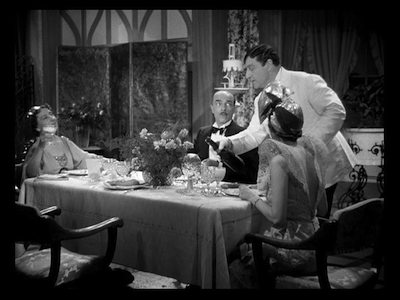
The title, To Be or Not to Be, is, of course, a reference to Hamlet's best-known soliloquy. It's significant to the story because Maria has deemed the start of the speech as a cue to an admirer to visit her backstage. The smitten fan is a pilot named Sobinski (played by a young Robert Stack). It also poses the existential question that ultimately leads the theatre company into helping out the Resistance: to be or not to be a hero, to be or not a passive victim. The opportunity comes when Sobinski returns to Poland from combat, hoping to stop a Nazi spy (Stanley Ridges) carrying sensitive information. When Sobinski is outfoxed by his quarry and Maria inadvertently put in a sensitive situation, her husband and their co-workers try to help out. First they pose as Gestapo officials in hopes of intercepting the intel, and then Joseph poses as the actual spy so he can use the connection to get everyone out of the country. Unsurprisingly, each ruse is subject to unforeseen complications, and before they know it, they are in so deep, one of the actors even ends up pretending to be Hitler himself.


Lubitsch's script, which he co-wrote with Edwin Justus Mayer (The Buccaneer), smartly valued story over shtick, and so the tightly plotted narrative allows for as much drama and suspense as it does jokes; indeed, the trick of To Be or Not to Be is how Lubitsch takes his very straightforward scenarios and finds the humor within them, injecting each moment with wit and letting character flaws disrupt everyone's efforts. The Nazis consistently trip themselves up by being more concerned with appearance and perception than anything else, and Joseph gets himself and his friends in further trouble due to jealousy. Comedy grows out of selfish behavior and a distorted sense of self-awareness.


Jack Benny is incredible as Joseph. He is at his most droll here, and rather than fall back on his famous persona, he puts his trust in the material. There's no need to spice up the lines, the writing is perfect as is. Carole Lombard is also very funny, as well as beguiling. She often provides the emotional pull in the film, either by being in danger herself or by being the first to realize how wrong something may be going. Also of note are Felix Bressart and Tom Dugan as the theatrical troupe's regular character actors/support team. Like many a Shakespearean side duo, they serve as added comic relief, their commentary on the happenings providing insight and laughs in equal measure. Dugan is the one who disguises himself as Hitler, but it's Bressart's Greenberg who makes the ultimate sacrifice--and thus gets the starring role he always hoped for.

While there are plenty of laughs, Lubitsch never loses sight of the tragedy going on all around these characters. A montage of post-invasion destruction reminds us of who the German army's major targets were, and the lingering threat, as well as the SS's callow participation in it, means the potential consequence is never dulled. Lubitsch's gamble pays off: as audiences, we are invested precisely because we are enjoying ourselves. These merry men and woman make us laugh, and so we care about what happens to them. We like them, and we want to keep on liking them, and by logical extension, we hate anyone that would make the laughter stop.


For a complete rundown on the special features, read the full review at DVD Talk. Images here were taken from an earlier standard-definition DVD and were not taken from the Blu-Ray under review.


Sunday, July 8, 2012

DESIGN FOR LIVING (Blu-Ray) - #592


The first scene of Ernst Lubitsch’s 1933 romantic comedy Design for Living is so perfectly composed, it tells you everything you need to know about the film’s trio of main characters and their relationship to one another before any of them even speak. A blonde woman enters a train car to find two men asleep, shoulder to shoulder, heads back, leaning in. She is amused by their pose, and, sitting across from them, she pulls out a sketchpad to draw them. When she is done sketching, she goes to sleep, too. She puts her feet up on the bench between the two men, her decidedly feminine shoes nestled between their masculine frames. One of them drops his hand in his slumber, and it rests on her ankle. The other fellow leans in closer. Here we have a classic love triangle.

The girl is Gilda Farrell, a commercial illustrator played by the delightful Miriam Hopkins (Trouble in Paradise, Virginia City). The men are painter George Curtis (Gary Cooper, Pride of the Yankees [review], High Noon [review]) and playwright Tom Chambers (Fredric March, Nothing Sacred [review], The Best Years of Our Lives), two not entirely successful Americans living in a flop in Paris. Gilda is American, as well, but unlike the boys, has a successful career. Banter comes naturally, as does romance. On two consecutive days, Gilda has a date with each man. As she explains it, George makes her feel all heated from head to toe; Tom’s fires start stoking down at her feet and work their way up to her head. Both men fulfill something different for her (in a sense, one is brawn, the other brains), and so she proposes that she not choose between them, or ask them to sacrifice their friendship. Instead, she will date them both simultaneously.


Design for Living is based on a play by Noël Coward, and adapted for the screen by Ben Hecht (Notorious [review], His Girl Friday). Lubitsch helmed the production before the Hayes Code, and so Design for Living maintains a surprising frankness. Coward created three intelligent characters who choose an unconventional method for cohabitation, and rather than shying away from it or moralizing, he lets the love story play out. The dialogue is witty and biting, establishing believable connections between all three participants. The tone is erudite, the jokes snappy and clever, and the overall philosophy progressive. Gilda is an example of early feminism in cinema: she has her own income, and thus her independence. When she suggests the open relationship, she states quite clearly that if she were a man, she’d be allowed to sample as many partners as she liked without having to settle. Why shouldn’t a lady be afforded the same luxury?

In fact, the pact between the triangle is referred to as a “gentleman’s agreement,” though the terminology will prove troublesome. The three swear off sex. Not even kissing is allowed. Instead, Gilda will put her energy into helping the men’s careers, judging their work with a harsh critical eye until they are good enough to sell. In more conventional terms, a sort of domestic partnership is created, with the three living together, honoring the pact, keeping each other honest. Thomas is the first one to have success, with his play being picked up for a production to London. (In another example of pre-Code frankness, Gilda connects Tom with a gay producer; if his sexuality weren’t evident in his decidedly non-caricatured flamboyance, Gilda’s crack that he’d like the script because it’s “a woman’s play” is an amusing tip-off.) This leaves Gilda and George alone, with no buffer between them. As Gilda says, moments before giving in to her sexual impulse, “It’s true we have a gentleman’s agreement, but unfortunately, I am no gentleman.”


This, of course, brings complications. There is a back and forth of temptation. Gilda really does love both of them, and there is no choosing one or the other for her. Thomas’ return from London, where he finds his old friends living in luxury following George’s blossoming as a painter--in fact, George is out of town--turns into a tough display of feelings and then a randy expression of lust. Thomas’ old typewriter serves as a rather effective visual metaphor for their mutual sex drive: only Gilda can ring his bell.

Miriam Hopkins is wonderful in this scene, as she is in the entire movie. She is confident and charismatic, feisty with a cutting tongue, and also perfectly feminine. She doesn’t sacrifice beauty or glamour for career, and her nurturing of the two manchildren in her care even supports more “traditional” interpretations of male-female relations. The only thing she has to give up is sex, but that’s not to have a life denied women, it’s to have the life they all three pursue in the face of conflicting social mores. Hopkins provides Design for Living’s center, and the others all orbit around her. March and Cooper make an excellent comic team, perfectly cast in their opposing yet complementary roles. March is droll and a little smarmy, while the towering Cooper is clumsy and blunt. Their expertly timed back-and-forth absolutely sells the completeness of their friendship.


A friendship that Gilda ultimately won’t sacrifice. She leaves them rather than destroy their bond, and she ends up marrying her old boss. True domestic bliss is not to be had, however, as sublimating her will to be the dutiful wife is not in Gilda’s nature. It’s rather sly; Design for Living validates and promotes equality amongst the sexes by removing the sex. Which isn’t to say that man and woman can’t have a physical relationship and the woman not be allowed to be herself within it--Gilda could have had that with either of her suitors--because where the characters end up ultimately lends support to monogamy, as well. The three lovers here are pursuing something imperfect, but possibly more pure. A Platonic ideal, perhaps. An artistic existence. Artists tend to live outside of the norm, after all, dedicating themselves to their work in a way that is usually beyond the understanding of their friends and family. It’s that creative exuberance that Gilda is afraid to extinguish, just as much as she is afraid of destroying the men’s friendship. “Stay an artist,” she tells George when she’s leaving him. “That’s important. In fact, the most important thing.”
Gilda can’t be an artist with a man who would be her boss. She can only be who she is with men who see her as a peer.

With as much as can be read into Design for Living, its true achievement is that it’s never didactic. Though I’ve been pulling subtext up by the roots for this essay, Lubitsch is careful to make sure that it always remains exactly what it is: subtext. The up-top is important above all: the relationship and the interaction of the characters. Design for Living is a facile romantic comedy, full of hilarious one-liners and even funnier escalating, conversational jokes. One need never pause from the laughing to think about all that’s going on. The laughter on its own is enough. This, surely, is the quality that Preston Sturges wanted us to remember when he namedropped his fellow director in Sullivan’s Travels [review]. John L. Sullivan wanted to create motion pictures that mattered, and had he known Lubitsch’s work, he’d not have had to travel so far to discover that all you had to do was leave the audience smiling, and that mattered enough.


It’s amazing to think that the first time I saw Design for Living, it was buried on a cut-rate Gary Cooper boxed set, given little fanfare next to some of his historical adventure pictures. Thank goodness Criterion saw fit to rescue it and give the film its own release. The Blu-Ray restoration looks fantastic. While not all lines and scratches could be whisked away, the high-definition resolution is otherwise flawless, light years away from the banged-up, dark transfer on the old disc. If I recall, that one had a soundtrack full of hiss, as well. Criterion’s uncompressed mono has nary a crackle. 

Also of note on this disc is the inclusion of a two-minute sequence Lubitsch contributed to the anthology film If I Had a Million in 1932. “The Clerk” stars Charles Laughton as, well, a clerk who receives a check for a million dollars. While merely just a gag piece, the comedic business here is flawlessly executed, working a slow-build to lull the audience into a comfortable spot before hitting them with a rather simple, silly, and effective punchline. Even at such a short running time, Ernst Lubitsch manages to say it all!


For further reading, please visit Kim Morgan's site and her piece on Design for Living (also included in full in the disc's booklet). It should be noted that I took some of the images here from Sunset Gun.

Wednesday, November 24, 2010

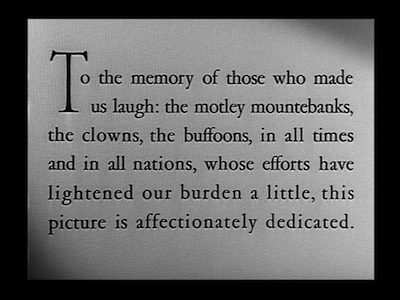
SULLIVAN'S TRAVELS - #118

"There's a lot to be said for making people laugh. Did you know that that's all some people have? It isn't much, but it's better than nothing in this cockeyed caravan."


So, it seems I am developing a bit of a theme here.

It occurred to me when I wrote my piece on My Man Godfrey [review] a couple of weeks ago that if I dug through all my reviews, I probably reference Sullivan's Travels more than any other movie. The message in Preston Sturges' script had a profound effect on me. He reminds us all that, whatever else our intentions, always entertain. That is the primary objective.

I considered making Sullivan's Travels my next choice, but then Modern Times [review] came in, and though the Chaplin picture postponed my taking my kajillionth look at Sturges, it actually added to the overall exploration that has distinguished the movies I've watched this November. Even better, the delay means Sullivan's Travels lands right when we're all preparing for Thanksgiving, and despite the big swamp of family dysfunction the holiday has come to signify for most of us, the adventures of one John L. Sullivan will remind us that maybe we really should take a moment to be thankful for what he have in these troubled times.


Sturges made Sullivan's Travels in 1941, when America was still recovering from the Great Depression and WWII wasn't yet our concern. (The film premiered in January of '42, and so was in the can well before Pearl Harbor.) This meant Hollywood had several years of wrestling with the modern condition, including a host of message pictures. (If only Sturges knew the kind of propaganda Tinsel Town had waiting right around the corner!) Apparently having had his fill of the self-importance of these movies, the writer/director decided to give his moviemaking peers the what for. So, he created the character of John L. Sullivan (played by Joel McCrea), a movie director known for light comedies like Ants in the Pants of 1939, but who wants to embiggen his image by making a serious movie about the American poor: O Brother, Where Art Thou?

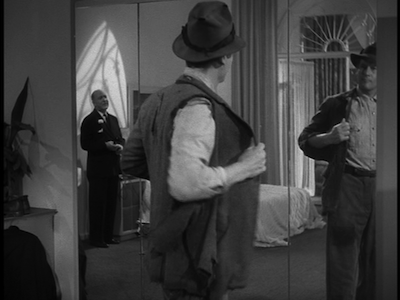
Unsurprisingly, this isn't good news to the ears of the studio head. They'd rather their cash cow keep milking the teats that make them money. They taunt Sullivan for being raised a rich boy. How can a man who has never had to struggle possibly make a movie about struggle? It's a fair point that backfires: Sullivan decides to dress up as a tramp and go on the road, armed with only a single thin dime, and learn about life amongst the impoverished. Naturally, this is a worse idea than sinking their money into his serious artistic endeavors, but they are forced to go along with the plan. They try to send along a marketing crew, led by Sturges perennial William Demarest, to keep tabs on the golden boy, but Sullivan makes a deal with the publicity platoon to get 'em off his back. He also shrugs off his servants, including the haughty butler (Robert Greig) who dismantles his boss' desire to caricature the poor with the utmost of skill. Sullivan will not be deterred.


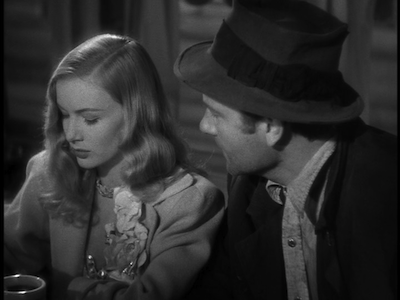
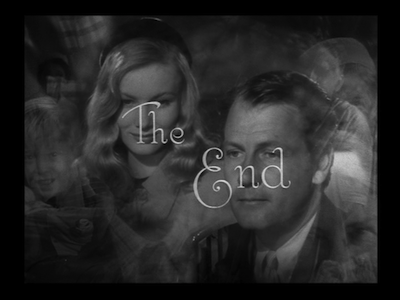
Except when he is. Over and over, too. For the first half of the movie, every road Sullivan takes out of Hollywood ends up taking him right back to where he started. On one such boomerang, he meets "the girl." I never realized we don't ever get a name for her, but she's played by Veronica Lake, so I will call her Veronica Lake. Veronica is on her way out of Hollywood, finally deciding her career as an actress isn't going to happen. Thinking Sullivan to be a bum, she buys him breakfast. When he asks how he can repay her, she asks if he can recommend her to Lubitsch. Oh, if she only knew!


Of course, she does find out eventually, and seeing that Sullivan is entirely helpless in the real world, Veronica insists on going along with him. She's a spunky beauty with a bit of a smart mouth, a perfect sparring partner for the wisecracking know-it-all. In fact, up until this point, Sullivan's Travels has mostly distinguished itself as a vehicle for Sturges' whipsmart dialogue; however, when Veronica learns Sullivan's secret, we also learn what a wily writer Preston Sturges is. He has spent this early part of the movie distracting us, making us think that for all his noble intentions, Sullivan will never burst out of his bubble and start to really see true poverty and strife.

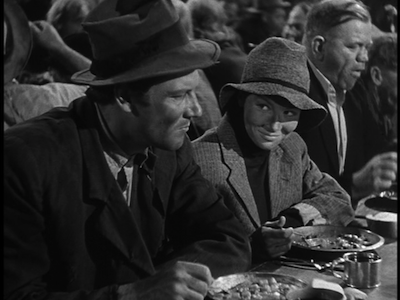
The movie takes a sharp turn here. Sturges crafts an elegant montage that begins with Sullivan and the girl walking through a shantytown and ends with them finally losing their nerve when they are reduced to foraging for food in a garbage can. They've seen how real it can get, and they've had enough. Right there, without breaking his stride, Sturges has buried his message smack dab in the center of our good time. We were laughing at Sullivan, but suddenly we find ourselves feeling with him.


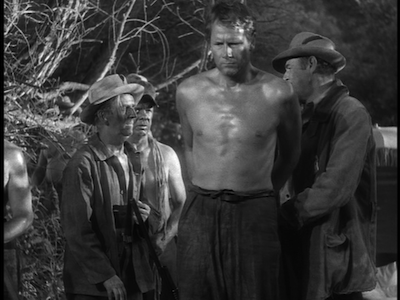
Sturges isn't done with us yet, though. His story has yet another turn to take. (Long before post-modernism, Sturges even had his character be conscious of the need for that twist. As a filmmaker, Sullivan is always aware of the structure of his own narrative, however accidental it may be.) On his last night out, Sullivan takes $1,000 in $5 bills and goes back to the streets to hand the money out to the poor and homeless. Being an optimistic man, but also a realist, Sturges sees the danger that Sullivan does not: a selfish hobo (Georges Renavent) hits Sullivan over the head and takes the money. Another turn of fate follows, and not only does everyone believe Sullivan was murdered, but he ends up on a chain gang to boot, unable to prove who he really is.


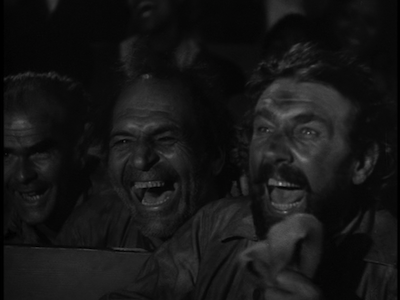
It's in this final twist that Sturges serves us with his real message. Having hit rock bottom, Sullivan's faith in himself and creativity is restored by the moving image. More precisely, by a Pluto cartoon. It turns out that on Sundays the gang boss takes his prisoners to the local African American church to watch movies with the congregation. I know some people bristle at the early slapstick scenes where the black cook is reduced to a racial stereotype, but one should consider the far more important and substantial image of the black preacher and his church. They open up their doors to the cast-off men of the chain gang, and the pastor reminds his group that they must not judge the criminals because everyone is equal before God. Think about what a powerful statement that is: here is a man who could not have been further marginalized by American society acting as the reminder that we aren't all so different from one another.

Sullivan doesn't hear any of this, though. His reminder is Pluto. As the cartoon plays on the screen in front of him, Sullivan is more interested in the reaction of the people around him. Everyone is laughing. It doesn't matter who they are, prisoner or guard, preacher or parishioner, white or black, they all forget their troubles and their differences and unite in the common bond of entertainment. There are no movies more important than the ones that transport people from their everyday lives. It's what the butler told him: poor folks don't care about seeing movies about living in poverty, they know exactly what that's like. Give them something that makes them feel good, and they'll turn out in droves.


The message of Sullivan's Travels isn't manipulative. There isn't a manipulative bone in Preston Sturges' body. That doesn't mean he doesn't lead us where he needs to go, but like My Man Godfrey and Modern Times, this movie informs our souls without ever alerting us to the fact that we're being taught a lesson. In his most important move yet, the final scenes of Sullivan's Travels, the character's rescue and redemption (this is a light comedy, you can't call that a spoiler) put this theory into practice. Think about how you feel at the end of Sullivan's Travels. Don't you feel good? Are you smiling? Didn't Preston Sturges prove his point?


Sullivan isn't wrong. The intention of any artistic endeavor, be it heavy or light, is to show us the life we didn't live. Fiction is meant to transport us, to show us a different point of view. With this movie, Preston Sturges is reminding his fellow entertainers to remember why they do what they do. He's also reminding his audience why it matters. We need to be like John L. Sullivan in that church and pause to take a look around, to really see what the world around us is like and empathize with the people we share it with. Otherwise, what's the point? Why even share the communal experience of going to the movies at all?

Even further, though, we need to empathize because though that fellow over there's problems may not be yours, it doesn't mean you can't have some understanding of them. Is there any personal divide so wide that we can't find a way to traverse it? If we watch a Charlie Chaplin or an Ernst Lubitsch film, we don't laugh as Republicans and Democrats, we just laugh. We should solve our problems in the same manner. Beyond rhetoric, we're just citizens trying to make our way. If one of us is going hungry or is hurting because he doesn't have health care or depressed because she can't love who she wants to love, then what good is it that any of us is satiated, healthy, or cared for. In the dark of the movie theater, we all laugh and cry the same, and so, too, should we go forth in life.

Happy Thanksgiving, one and all.


Saturday, July 31, 2010

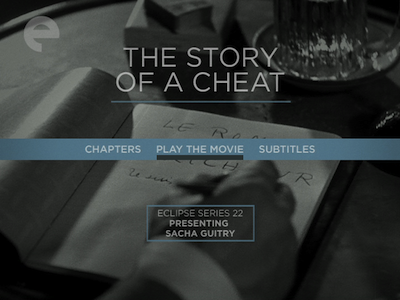
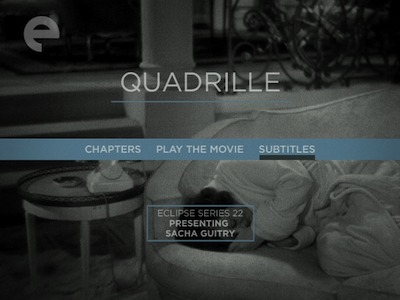
PRESENTING SACHA GUITRY - ECLIPSE SERIES 22


Sacha Guitry is why I like Criterion's Eclipse Series. Him specifically, but also what he represents in general. He now sits alongside Raymond Bernard [review], Larisa Shepitko [review 1, 2], and Hiroshi Shimizu [review] as filmmakers that I wouldn't have known about had Criterion not started their little boutique line. Eclipse is dedicated to highlighting films and filmmakers that may not have the name recognition to lead a big release, but whom could benefit from the rediscovery made possible by an affordable midline package.

Presenting Sacha Guitry is the 22nd Eclipse set, and it features four films from the acclaimed playwright turned cinematic auteur. According to the liner notes in the lead film, Guitry was the king of the Paris stage in the 1920s, and he dismissed film as a go-nowhere art form, limited by rickety technology and not capable of the poetry of live theatre. Once sound came into play, however, Guitry saw the error of his ways and, as they say, if you can't beat them, join them. After a couple of misfires, he landed on what would become his signature film.


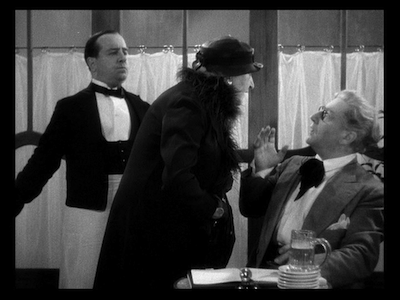
The Story of a Cheat (81 minutes) was made in 1936, and Guitry wrote, directed, and starred as the adult version of his title character, known simply as the Cheat (or, in French, tricheur). As a child (and played by Serge Grave), the Cheat's first crime was to steal a few coins from the till of his family's store so he could buy some marbles. When he was caught, his punishment was to go without supper--on the night the eleven other people in his family were to accidentally eat a batch of poison mushrooms. The Cheat's dishonesty was rewarded, an ironic lesson in moral consequence.

As he grew older, Cheat got work as a bellboy, and then a soldier, and then a croupier in Monaco. In each, he tried to be honest, but wherever he went, the people he met tried to pull him into some kind of crime. He is almost implicated in the assassination of Czar Nicholas II, seduced by a pretty hotel thief (Rosine Derean), and hypnotized by a lady gambler (Jacqueline Delubac) looking for a fix. In the latter case, his willingness to go along with the scheme leads to failure, and when he is punished for stealing anyway, he decides to give in and become a real card sharp. Thus begins a long and lucrative career, ended only by yet another moral revelation.


The narrative is simple enough, but as in all things, it's the telling that is key. In a fascinating twist, Sacha Guitry's spectacular film employs the mechanics of silent film while still embracing sound. The story is framed by the older Cheat (Guitry in white hair and make-up) writing his memoirs, and the entire run through past history is narrated in voiceover by the memoirist. Any dialogue is spoken by Guitry, it is only mouthed by the other actors. The only times we hear other performers speaking is in interludes back to the café where, in the film's present day, the Cheat is laying his story down. There, he has poignant and ironic encounters that match up with what is happening in his manuscript.

This clever device could grow tiresome under the wrong direction, but Guitry's execution is lively and playful. His camera is lithe and probing, taking cues from the narration, and the combination of words and pictures pushes the story forward at a jaunty pace. Guitry uses still images, dissolves, and montage to move swiftly through time, never letting the tale rest too long in one place. The Story of a Cheat maintains a humorous air, garnering quite a few laughs, and settling at a pleasant punchline that is cute without being trite.


The neophyte director's way with mis en scene and his agility with the camera is reminiscent of the work of his contemporary, Jean Renoir, and it's no surprise that he apparently had fans in Orson Welles, Francois Truffaut, and Alain Resnais. From the very start of The Story of a Cheat, as Guitry takes us on a tour of his set and introduces us to his crew, it is clear we are in the presence of a seasoned raconteur who has discovered a whole new way to deliver his party anecdotes. Why only tell a small group when you can share the story with thousands? Or millions!


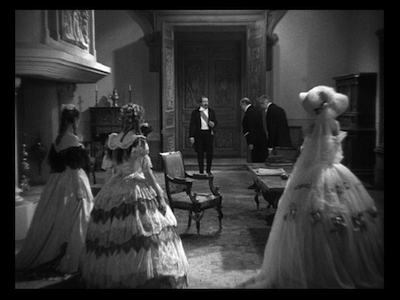
Clearly on a creative steak, Guitry followed this cinematic breakthrough with another formally ambitious film a year later. The Pearls of the Crown (1937; 105 minutes) is the technical opposite of Cheat. Instead of no dialogue, it has a veritable whirlwind of words. The story, which Guitry co-wrote with Christian-Jaque, begins with the question of how the crown of England got its three decorative pearls. Guitry, playing a writer named Jean Martin, is researching in his study when he finds the tale, and he begins to share it with his wife Jean (Jacqueline Delubac again; she was Guitry's wife off the set, too). At the same time, an assistant to the current King of England is telling the same story to his regent, while an aide to the Pope is explaining it to the religious leader in Italy.


What follows is a multi-lingual historical comedy, detailing the rivalries of France's Francois I, England's Henry VIII (Lynn Harding), and Italy's Pope Clement VII (Ermete Zacconi). Guitry, who plays Francois I himself, deftly jumps back and forth, creating an assured, fast-paced rhythm that links all three countries in both timelines. The story also travels across Europe and Asia as Clement sends a poor servant off on what is supposed to be a wild goose chase to find five identical pearls to match the two he already has. This leads to seven pearls in all, four of which end up on the Crown, the other three stolen by an English crook. The second half of the movie features the trio of storytellers converging in England before heading off in different directions, each to find one of the missing baubles.


Guitry plays a total of four roles in his film, including Napoleon III and a French aristocrat named Barras. Delubac also plays Marie Stuart, Queen of Scotland, and Josephine, the wife of Napoleon I (Emile Drain). There are a lot of pieces to this romp through history, yet Guitry's perception is so clear, one never gets lost in all the jumping around. The Pearls of the Crown also has a pervasive sense of whimsy, and so it's fun from start to finish. Even with all the pomp and circumstance of the historical settings, my favorite bit is in the modern context, when Jacqueline Delubac is confronted by one of the owners of the pearls, whom she has been following. As per her husband's instructions, she only responds to the man with adverbs. It's a scene that would be perfectly at home in a Preston Sturges movie.


Made the same year as The Pearls of the Crown, Désiré (1937; 97 minutes) is a comedy of the social classes, a farcical The Rules of the Game with the writer/director playing one of the members of the downstairs crew. Guitry stars as Désiré Tronchais, a new valet in the home of former actress Odette Cléry (Jacqueline Delubac). It's a place that could use a little shaking up. In the very funny opening scenes, the chambermaid (played by Arletty, who was also the Queen of Abyssinia under all that blackface in Pearls) lays out how perturbed she is by her boss, whose passive aggressive grousing the girl sees right through.

Désiré enters the scene as preparations are being made to go on holiday, but his scandalous past as a ladies man follows him. Odette is in a relationship with a government minister (Jacques Baumer), who will not marry her as long as he is in his position. A woman of propriety, Odette tries to dismiss Désiré when she learns he seduced his prior employer (Genevieve Vix), and only lets him stay after he swears he is not attracted to her. She swears likewise, but once they are at the country home where Odette and her man, Felix, spend every summer, the two start dreaming about one another. Loudly. Désiré is heard by the maid crying out for Odette in his sleep, and Felix hears Odette calling for Désiré. Avoidance, innuendo, and misunderstanding follows.


Compared to the other films, Désiré is fairly conventional, but it is so slickly made that it doesn't matter. The writing is ribald and witty, and Guitry's frank views of eroticism and romantic love make swell fodder for his up-ending of the social comedy. Here, the very act of being servile is its own emotional--and, at times, sexual--reward, and it pains Désiré to step out from his role as valet to instruct the woman who should be ordering him around. Delubac is delectable as the society lady, and Arletty is quite funny as the much looser maid. She plays her as if she just stepped in from singing in a saloon, emphasizing that when it comes down to it, these lower class folks are a lot more fun.


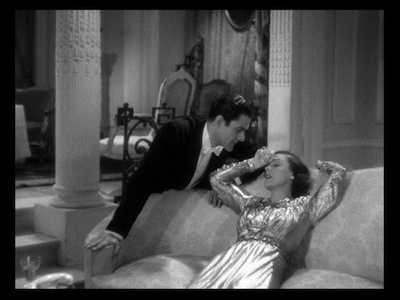
Désiré and the final film in the box, Quadrille (1938; 95 mins.), were both adapted by Guitry from his own stage plays, and Quadrille provides the cosmopolitan personality with a role that allows him to be his most sophisticated and droll. I haven't mentioned it yet, but Guitry's screen presence is quite winning, and he grows more assured with each film. Quadrille even provides him with a tremendous verbal sparring partner. Gaby Morlay (Le plaisir - review) plays Paulette Nanteuil, the long-term mistress of Guitry's newspaper editor Philippe. She is a stage actress, and as befitting the job, is flighty, but also loving and a bit of a scamp. When she meets American film actor Carl Herickson (George Grey), he asks her for her autograph, since she's the only one in the room that doesn't ask for his. She signs his paper “Claudine André,” who just so happens to be her best friend and a reporter who, at that moment, is upstairs waiting alongside Philippe to interview Carl. (Claudine is played by Jacqueline Delubac.)


From here, Quadrille transforms into either a farcical sex comedy or a cynical satire on romance. Or really, both. Carl seduces Paulette, Paulette confesses to Philippe, Philippe professes his love for Claudine, Claudine has already made a pass at Carl, etc. Deals are made, others are broken, and Guitry throws out some pretty sharp barbs about the nature of love and women and the whole shebang. The morning-after scene when Philippe finds Paulette in Carl's hotel room is a magnificent dance of words, as Paulette lobs up her manipulations and Philippe bats them away. It's all terribly civilized. Claudine is the most inscrutable of the cast, it's hard to figure what she's playing at most of the time. She starts off as the innocent bystander, but as the song once said, not that innocent.

Quadrille is a very talky movie, as is Désiré (Guitry gives himself some real mouthfuls in the latter). Yet, they don't show the dustiness of the stage. Guitry finds and takes advantage of every opportunity to move his camera. He builds comedic tension, for instance, by cutting back and forth between Claudine and Philippe waiting for Carl and Carl hopping, skipping, and jumping in their direction. Not long after, he turns the conceited actor's very act of undressing into a sight gag, panning the camera back and forth across the hotel room to follow his discarded clothes.


Front to back, Presenting Sacha Guitry - Eclipse Series 22 is energized with mirth. These are tremendously light-hearted movies that, though never shallow, never let the deeper themes and ideas tug at the smiles Sacha Guitry is so intent on putting on his audience's faces. The tone of these pictures reminds me of another Eclipse Box, the eighth: Lubitsch Musicals [review 1, 2, 3. Both Sacha Guitry and Ernst Lubitsch come from a stage background, and both enjoy life and the scoundrels that humans can be when pursuing happiness and love. They are easy movies to watch, you'll likely tear through the sets in no time at all. The only complaint I have is that there isn't more.


For a full rundown on the special features, read the full review at DVDTalk.