Showing posts with label sirk. Show all posts

Wednesday, January 12, 2022

NIAGARA - CRITERION CHANNEL

This review was originally written for DVDTalk.com in 2013.
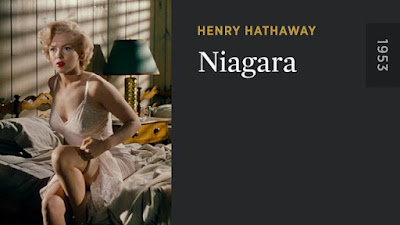


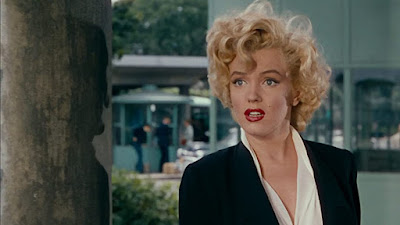
Marilyn Monroe was rarely cast as anything but the sympathetic or comedic love interest, but based on the evidence in Niagara, she could have had a whole other career as a femme fatale. In fact, her performance here stands alongside another of her off-model films, Roy Ward Baker's Don't Bother to Knock, released a year prior, as two of her most interesting. If for nothing else, because the frightened, twitchy woman she becomes in each is unlike the persona she came to develop immediately after in Gentlemen Prefer Blondes and How to Marry a Millionaire. Whereas her nervous condition in Knock has more mystery--part of the film's main plot is finding out why she is the way she is--Niagara provides her with more of an arc. She goes from confident and devious to hunted and afraid. I'd be curious as to how differently her work might have played sixty years ago, when there was at least still a smidgen of an unknown quantity to the actress; now, Marilyn is so intrinsic to pop culture, we forgive and forget even as she commits her crimes, meaning we feel sorry for her despite the fact that she's getting what she deserves.


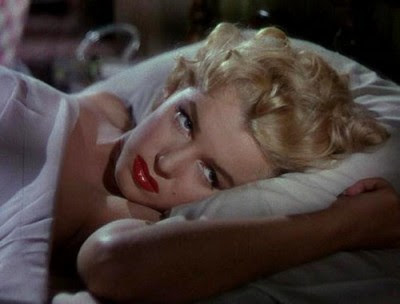
For Niagara, Marilyn plays Rose Loomis, who has gone to the famous water resort on a second honeymoon with her husband George (Joseph Cotten, Shadow of a Doubt). He has just been discharged from an army hospital, where he was sent for battle fatigue. His mental maladies are still with him, however; Niagara opens with him wandering in the mist by the falls in the early morning. When he returns home, his wife pretends to be asleep. She has had enough of George and is making plans to get rid of him. He suspects this to be the case, though given his neurotic manner, most think it's just paranoia.


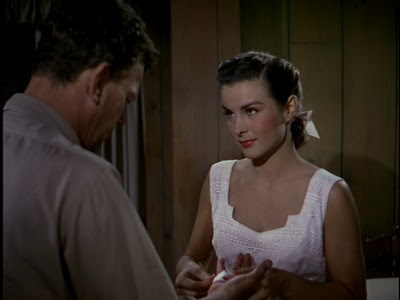
The story of the Loomises is juxtaposed with that of the Cutlers, a couple on their first honeymoon, albeit a belated one. Ray (Max Showalter, Sixteen Candles [review]) has gotten a job in the shredded wheat factory on the American side of the falls; he has taken his wife to the Canadian side to celebrate. Whereas Ray is all golly-gee enthusiasm, Polly (Jean Peters, Pickup on South Street [review]) is more calm and reserved. Through a combination of nosey snooping and empathy, Polly becomes embroiled with the Loomis drama. She also gets the movie's best lines, revealing a sense of humor that can equally be aimed at others ("She sure got herself an armful of groceries") and at herself ("For a dress like that, you've got to start laying plans when you're about thirteen").


Niagara is directed by Henry Hathaway, who was known early on for westerns and then later, particularly in the years before Niagara, for directing definitive film noir like Kiss of Death and The Dark Corner. Though often lumped in the noir category, Niagara is something slightly different. Its setting and intense romantic storyline have much in common with gothic romance, while its colorful artifice has an element of the women's melodrama, looking not dissimilar to Leave Her to Heaven [review], but also being in line with the soap operas of Douglas Sirk and Jean Negulesco.


Cotten makes for a convincing brooder, and his dark passions only become more exaggerated and desperate as the movie progresses. He and Monroe are emotional counterweights. When she is up, Cotten is down, and vice versa. This leaves Peters to be the center. Her suspicions regularly give way to complicity, but she never gives in to her more scandalous impulses. Hathaway uses the setting as an environmental engine, the constant beating of the water churning up all the extreme feelings, driving both character and plot. It's fitting that the movie's most violent action is committed higher up. When Rose Loomis flees from her husband, and effectively her own errors in judgment, she runs up a bell tower, as if trying to climb away from the big hole in the earth and the torrents of water that would otherwise drive them under. Hathaway and director of photography Joseph MacDonald (Bigger Than Life [review]) set the camera up high, peering down from the uppermost point in the tower, the shadows of husband and wife exaggerated like they are posing for a Saul Bass poster. It's the most artful shot in the movie, fueled by the inherent grotesqueness of the incident it portrays.

There is, of course, only one direction George Loomis can go after that. The film can only end in the falls, George can only be ground down by irresistible urges. It makes for a nail-biting finale, one that is surprisingly cynical, but that admirably stays true to the dark places where Niagara began.


Sunday, March 29, 2020

LEAVE HER TO HEAVEN - #1020

Of all the seven deadly sins, jealousy is the most deadly.”


It’s ironic, I suppose, that I became positively obsessed with Gene Tierney the first time I saw Leave Her To Heaven. I tracked down every film I could at the time, which meant following a lot of the Fox reissue series from the DVD era. It was a good mini label, often using A&E and AMC programming as extras, and they numbered the spines. Someone was paying attention to the Criterion obsessives.

Why I say it’s ironic is because Tierney’s character Ellen is obsession personified. Driven by jealousy, she fixates on her husband, determined to share him with no one else. Not his brother, nor her sister, nor eventually even their own child. Ellen is so alluring and so attentive, he’s blind to it far longer than he should be, ignoring all warnings. And, of course, as a film fan, I was glued to her every move.


Leave Her To Heaven is considered a hybrid of film noir and the “women’s picture,” as perhaps best personified by Douglas Sirk. Like many classic movies, I sought out Leave Her To Heaven  based on a Martin Scorsese recommendation. My purism rejected the notion of a Technicolor noir, but resistance was futile. I ultimately had to see it and sample this cinematic Reese’s peanut butter cup. You got my noir in your melodrama!

When it comes down to it, though, Leave Her To Heaven has few noir trappings. It’s set in a rural domain, it’s mostly in sunlight, and it’s far more romantic than fatalist. It’s actually more of an upending of the “bad husband gaslighting his wife” movies, like Fritz Lang’s Secret Beyond the Door [review], Max Ophuls’ Caught [review], or Sirk’s own Sleep, My Love [review]. Director John M. Stahl--working from a screenplay by Jo Swerling, adapting a novel by Ben Ames--instead has the wife slowly undermining her husband’s faith in himself, ironically chipping away at his love rather than securing her position as the only thing in his life. (Fun aside: Stahl directed versions of both Imitation of Life and Magnificent Obsession before Sirk’s more famous remakes [review of both versions of Magnificent Obsession].)


Cornel Wilde plays the husband, novelist Richard Harland. Criterion viewers will know him for The Naked Prey [review], his triumphant directorial/starring vehicle, but he doesn’t fare as well here. He’s a bit of a weak link, failing to be charming or seductive. Honesty, his rap is so bad, down to quoting his own book, I have cause to wonder if Ellen picks Richard because he’s a bit dim and thus easily manipulated. Likewise, most of the supporting cast is fairly mediocre, giving more room for Tierney to control the frame. Her only competition is from her Dragonwyck co-star Vincent Price, who here plays her jilted lover, but who really gets to shine as the district attorney in the courtroom scenes that occupy Leave Her to Heaven’s final act. Price manages to distinguish himself because his character is the only one as driven as Ellen. His passion in front of a jury is blazing.


But then, he also doesn’t have to compete directly with Tierney. It also helps that he’s hot in ways that she’s cool, creating a balance between them. Tierney’s take on Ellen is sculpted out of ice and steel. The key to her villainy--and, arguably, to her sexiness--is how together she is. It’s not just that Ellen would never have a hair out of place, but that she rarely has an emotion out of place. She might seethe when she sees some competition for Richard’s affection, but the wheels immediately start turning on how to get the advantage back. Her best moment is that iconic scene on the lake, the one that is highlighted on the Criterion Leave Her to Heaven cover. In that segment, we see her coldly seize an opportunity and then course correct in order to cover her tracks when it appears she might get caught.


Leave Her to Heaven was shot by Leon Shamroy, the cinematographer of Elizabeth Taylor’s Cleopatra, but it’s worth noting that there is also a Technicolor director, Natalie Kalmus. The colors here are phenomenal. Tierney in particular stands out for her gorgeous clothes, like the baby blue swimsuit and nightgown that she wears for a couple of her worst deeds--a color that the internet tells me should resemble “trust, loyalty, wisdom, confidence, intelligence, faith, truth, and heaven.” I doubt this is a choice that was made without consideration. All of Leave Her to Heaven has an almost unreal pastel look to it, arguably Stahl’s replacement for the shadowy confines of noir. In his world, evil is bright and pink and has shiny red lips.


This disc provided by the Criterion Collection for purposes of review.

Saturday, November 23, 2019

NOW, VOYAGER - #1004


What separates a drama from a melodrama?

This is something I basically knew from context--what movies get painted with that brush, or when it’s appropriate to tell someone to stop being “melodramatic”--but I never really stopped to look up its full meaning until trying to figure out where to start writing about Now, Voyager, a 1942 Bette Davis vehicle directed by Irving Rapper.

A melodrama is a story that purposely operates with heightened emotions and exaggerated situations and characters in order to provoke an equal response from the audience.

So, big swaths of feeling splashed across the screen at maximum volume. More or less.


If one was looking for a textbook example of melodrama, they’d need to look no further than Now, Voyager, a film where a cross word can literally drive the life out of an old woman. Now, Voyager swings from the depths of depression to the heights of romance, back down to heartbreak and ultimately its quietest concession: acceptance. Its theme is one of independence. Hardly anyone in Now, Voyager is allowed to choose their own fate, no matter how hard they try.

Davis stars as Charlotte, the result of a late-in-life pregnancy. Her widowed mother (Gladys Cooper, Rebecca [review]) has held on to Charlotte as her final companion, somehow trying to correct the mistake of her birth by keeping her close, stifling her social growth, and demanding her constant loyalty and companionship as payment for her inconvenient existence. Charlotte is bookish and shy, and she spends her time in her room carving elaborate ivory boxes. The isolation has started to take its toll, however, cursing her with all kinds of nervous ailments, and at the start of the picture, she is being looked over by Dr. Jaquith (Claude Rains, Notorious [review]), a soft-pedaling psychologist who believes he can bring Charlotte out of her shell. He separates her from her mother and takes her to his wellness resort, helping Charlotte to find herself and ultimately sending her on a world cruise so she can experience how life is lived.


It’s there that she meets Jerry (Paul Henreid, Night Train to Munich [review]), an architect and father of two stuck in a loveless marriage. He and Charlotte hit it off, primarily because neither is aware of the history of the other. Charlotte in particular blossoms, at first playing an invented character before fully stepping into the role she was always meant to play--sophisticated, charming, warm, and dare I say...sexual? Naturally, their romance can only last as long as the cruise, and when they land in the states, they must go their separate ways. Jerry is far too proper to betray his wife fully, and Charlotte would never ask him to. (Note: Both Henreid and Rains starred in Casablanca the same year Now, Voyager was released.)


Naturally, their paths will cross again, most importantly when Jerry puts his own daughter (Janis Wilson) into Jaquith’s care. Charlotte sees herself in the young girl and decides to try to help her the way she herself was helped. She can be the mother neither of them ever had.

Location is crucial to Now, Voyager. Both as visuals and metaphor. Charlotte is stifled by polite society. Though she lives in a massive three-story house, its interiors appear cramped. There is never anywhere to go. The production designer packs every inch of the place so that no figure ever stands alone, there is always something next to them. This makes the fresh air and open spaces of Jaqueth’s health farm all the more freeing. Charlotte isn’t just away from the damning eyes of her mother, but she can stretch and breathe and find herself at the source of all life. This is a common trope of melodrama, from Douglas Sirk to Todd Haynes, and also of noir, which plays in a melodramatic shadow all to itself. Civilization makes us forget our humanity. Is noir a kind of sibling to melodrama, then, with the latter’s crimes being of the heart?


If the countryside is freeing, then the vast ocean is even moreso. No land in sight, no connections to their regular lives--Jerry and Charlotte have found a reprieve from all that hounds them. The joke is always that you can do anything in international waters; Now, Voyager amends that. You can also be anyone.

Henreid’s Jerry is a romantic dream. He’s attentive and genuinely interested; he’ll lead the way, but step back when necessary; he will sacrifice his happiness for familial duty. He is less compelling on his own; Rapper lets Charlotte define him by how she surrenders to him. It’s a careful balance. His love for her gives her confidence, but as Now, Voyager progresses, Charlotte makes her own choices--something she would not be able to do if they could truly be together. That would have meant trading her subservience to her mother to serving a man. The denial means that Charlotte has to work to make her own happiness.


Bettie Davis is, of course, incredible. Her beauty is unconventional in a lot of ways, and so it never really feels as thought she is “dressing down” when she plays a spinster or introvert, like they are having to hide who she truly is. It’s not about the hair and wardrobe anyway, it’s about how she carries herself. In the early scenes, Charlotte is closed and bitter; in later scenes, it’s almost like she’s shed her skin and become something new. She could be wearing the same outfit on both sides, it wouldn’t matter, because the acting.

In all honesty, Now, Voyager is successful as a whole in much the same way as its lead actress, in that it has its own level of confidence and it never apologizes. There is much that could be considered overwrought or even silly were Rapper’s presentation not so assured. He hits the big notes with vigor, and yet understands the lows with the same measure. Thus, we get a surprising ending to the picture that holds its ground, giving audiences what makes sense over what is obvious, the camera panning toward the sky as Davis delivers two of the most memorable final lines of romantic cinema, redefining just exactly where these lovers are voyaging to, but finding comfort and love there all the same.


This disc was provided by the Criterion Collection for purposes of review.

Saturday, August 31, 2019

CRAIG'S WIFE - CRITERION CHANNEL

People who live to themselves -- are generally left to themselves.”


What a splendid little film Craig’s Wife is. The 1936 film from Dorothy Arzner is a bit of Trojan Horse, parading as a domestic drama, but smuggling elements of a paranoid thriller.

The Craigs are a wealthy married couple living a seemingly normal upper-middle-class life. Walter Craig (John Boles, Stella Dallas) loves Harriet (Rosalind Russell, Gypsy [review], The Women)--but by some accounts, too much. He is blind to her true nature. And it’s not really like she hides it. The maids are nervous around her, lest an inexact dusting cause wrath; Walter’s aunt (Alma Kruger, His Girl Friday [review]) only lives with them so she can keep an eye on things; and when Harriet and her niece, Ethel (Dorothy Wilson, The Milky Way), are on the train back from visiting Ethel’s dying mother, not only does Harriet lie about the woman’s health, but basically lays out her mercenary philosophy. Walter was a step up for her, a chance for independence and a place in society. All she has to do now is wait for him to pass on. That’s why she’s so exact about the house: it’s her future.


Harriet is a bit of a snake in the grass, but she’s a snake who’s in charge of the landscaping. The façade of her life with Walter, one created largely for him, is one she orchestrates entirely. In her mind, people are a means to an end, and any excess number of them should be trimmed. This, of course, means she also trusts no one. Not Ethel’s fiancé, whom she secretly seeks to isolate, and certainly not her husband, whom she thinks is being hit on by everything in a skirt--including the aging widow next door (Billie Burke, The Wizard of Oz). When her snooping causes her to discover Walter might actually be a suspect in a double death, Harriet pulls everything in closer. Never mind the portentous nature of the truth, which might signal to her that these next two days will be her downfall, with everything and everyone converging against her. Walter wasn’t involved, he couldn’t be. The tragedy was a murder/suicide perpetrated by a husband on his cheating wife
.
Described as it is above, Craig’s Wife has all the ingredients of a cheap B-movie or even a television soap opera, but as Arzner presents it, it is neither of these things. It’s an animal unto itself, a tad similar to trapped women pictures like Fritz Lang’s Secret Beyond the Door [review] or Douglas Sirk’s Sleep, My Love [review], but with the roles reversed. The woman traps herself. If this were Rebecca [review], Harriet would be her own Mrs. Danvers. In terms of drama, Arzner leans away from suspicious shadows and jump scares. There isn’t even a hint of danger or violence. Human emotion is enough. Like a Eugene O’Neill play, their conversations are their own undoing.


Rosalind Russell by far runs away with this picture. Her performance is as flawless and calculated as Harriet aspires to be. She can snap from rigid to tender in a second, and had we not seen her reveal her true colors in other scenes, we’d certainly fall for her routine. Like any villain, you have to like her, at least a little bit, and Craig’s Wife leaves enough room for sympathy so that in the end, you can ‘t help but feel happy for her when she gets exactly what she wished for, and sorry for her in that it’s exactly what she deserved.


Saturday, January 20, 2018

WRITTEN ON THE WIND - #96


Dorothy Malone died this past week. A repeat performer in Douglas Sirk films of the 1950s, she was probably best known for her Oscar-winning turn in Peyton Place, or for her memorable scene as a bookseller in The Big Sleep [review]. Lauren Bacall, her co-star in Howard Hawks’ Chandler adaptation, was also her castmate in one of those Sirk releases, 1956’s Written on theWind--a textbook case where the supporting role is much juicier than the lead. Malone runs away with the picture.


The melodrama, shot from a script by George Zuckerman, centers on a wealthy Texas oil family. The Hadley’s are so rich, the town they live in was named after them. The company is run by patriarch Jasper (Robert Keith), a widower whose two children have not turned out as expected. Spoiled by their wealth, both Kyle (Robert Stack, To Be Or Not To Be [review) and Marylee (Malone) have taken more of an interest in liquor than oil and prefer carousing to work. Their best friend since childhood, Mitch Wayne (Rock Hudson, Magnificent Obsession [review]), provides the only steadiness. He grew up with the Hadleys as a favor between fathers: Mr. Hadley hoped having a poor friend would keep Kyle grounded, and old man Wayne (Harry Shannon) believed it would provide Mitch with opportunities he never had.

The film starts with an engrossing flash-forward before jumping back a year, to when Mitch met Lucy (Bacall), the secretary to the head of the advertising agency that promotes Hadley Oil. Mitch tries to use Lucy as a lure to rein in Kyle, who has flown to New York on a bender--literally piloting his private plane--in search of his favorite steak sandwich. The scheme works, but it backfires at the same time. Lucy does get Kyle to straighten up, but Mitch himself has also fallen in love with her. His own plot causes him to lose the bride to his much more outgoing friend. After a quick trip to Miami, Kyle and Lucy are wed.


Upon their return to Texas, Mitch must stifle his feelings for Lucy while also fending off the advances of Marylee. The Hadley girl has loved Mitch her whole life, but he sees her as only a sister. Much of Marylee’s acting out is to try to get Mitch to pay attention to her. As we see in a spectacular barroom brawl, Kyle is ineffective in defending the family honor, it requires a bit more muscle. Dorothy Malone gets to show range here, from explicit seduction to pouty outbursts to genuine romantic despair. While Stack is a bit more exaggerated, Kyle’s daddy issues are also a bit underwritten; not so with Marylee’s hang-ups. She makes direct moves for Mitch’s affections, some of which likely pushed the strictures of the production code, but she also lays her feelings bare as necessary.


Not that Kyle’s predicament is all that innocent, either. After a year of sobriety, he goes off the wagon when his doctor leads him to believe he is unable to have kids. Here Sirk and Zuckerman’s drama takes on Tennessee Williams-level depths. Kyle has always had his manhood threatened by Mitch, and now he believes it to have a literal/physical manifestation. On the night in question, the one we entered the film on, the whole world adopts Kyle’s anger and anxieties, the Texas wind whipping up to a frenzy.


As is Douglas Sirk’s signature, Written on the Wind is colorful and emotional. His exquisite staging and remarkable sense of framing creates room for the actors to perform, but also the space for the drama to explode. You can tell how the relationships are faring by where the actor appears within the shot, like when Hudson is visible in a mirror that separates the newlyweds, Stack and Bacall. The four lovers are in a dangerous tango where two of the dancers are moving faster than the others--as symbolized in their flashy red and yellow sports cars. The script often swerves and kicks up dirt in much the same way the speedsters do. Written on the Wind may be Sirk’s tightest, most efficient narrative, rivaled only by Tarnished Angels, released a year after Written on the Wind, and also starring Hudson, Stack, and Malone, its black-and-white aerial theatrics providing a more knuckle-dusted sibling to its predecessor.


If there is any flaw to Written on the Wind, it’s maybe that it’s a couple of scenes too long. Sirk should have ended where he came in. While the final sequences do offer Marylee redemption--and Malone, naturally, handles the moment well--it cools everything down a bit too much. But so it goes...a classic doesn’t need to be perfect, and Written on the Wind is definitely one.


Sunday, May 14, 2017

GOOD MORNING - #84

Please note: the images here are taken from the 2000 standard definition DVD and not the newly released 2017 Blu-ray under review.


Yasujiro Ozu’s light 1959 comedy GoodMorning was one of my first Criterion blind buys. Spotted in a now-closed used record store in Portland, I snatched it up on sight, knowing if I didn’t, it would be gone before I could ever go back to grab it. Such was the rarity of seeing Criterion discs in second-hand bins back in the day--all too unusual, you had to act.

Luckily I had rolled the dice on a pretty safe bet. Good Morning is brimming with joy, even as it maintains Ozu’s usual unassuming attitude. Set in a Tokyo suburb, this genial film tells the stories of several neighboring families. Linked mostly by their young sons, these individual units are subject to gossip, misunderstanding, and judgment--negative foibles hidden just below a very positive surface. You know, the way clans and communities do. When you boil it down, Good Morning is about family, just like most of Ozu’s oeuvre. In this case, not just family by blood, but the community you build.

Oh, and it has fart jokes. To be more exact, one running fart joke that carries through the whole movie. And I don’t care what you think, I love fart jokes. And poop jokes. Especially when a fart joke becomes a poop joke. Which it does here, to hilarious effect.


Though the four boys connect all the houses--including the misunderstood hipster couple with the television and the single English tutor who provide the kids refuge--the central duo of older brother Minoru (Koji Shidara) and younger brother Isamu (Masahiko Shimazu, Late Autumn [review]) end up driving most of the movie. They get the most screen time with their private protest against their supposedly stingy mother (Kuniko Miyake, star of many Ozu films, including Early Summer and Tokyo Story [review]) and her refusal to buy them a TV of their own. Mother Hiyashi is more frugal than stingy, it’s up to her to keep the house on budget, but this is also not the only time in Good Morning that she is accused of financial malfeasance. Another driving storyline is the issue of the missing dues from the local women’s organization. The ladies have varying theories of who made off with the cash, and even though it gets an amicable resolution, the way the situation is concluded splinters off into its own conspiracy theories and gossipy tributaries. There’s not much to do throughout the day, it seems, but get in each other’s business. It’s all innocent and meaningless until it isn’t. Such little things, they make a big difference.


In addition to these kinds of family dynamics, Ozu regularly explored the differences between generations in his movies, and Good Morning is no exception. Here, the aforementioned television is the most prominent example of how times are changing, and the director is certainly seizing upon the cultural shifts occurring at the end of the decade. The kids learning English, the progressive neighbors with posters for French films on their walls (and not just any French film, but Louis Malle’s The Lovers [review]), the nervous patriarchs set adrift in a changing economic landscape--these are all signs of the time. Prescient ones, too. Dad is worried about maintaining employment long enough to have a solid retirement, kids are worried about watching sumo wrestling in the living room. A more judgmental director (like, say, Douglas Sirk in All That HeavenAllows) would be concerned for how this younger generation was going to rot its brain--indeed, one of the older men in Good Morning expresses such a fear--but Ozu seems to take no stance. He is amused by the rebellious youngsters staging their own revolution, but also empathetic to the parents who need to keep things together. If Ozu is siding with anyone, it’s probably the middle generation, like the tutor or the boys’ aunt, both of whom bridge the divide. Is it any surprise, then, that they end up having a little romance?


What may be more interesting here, though, is how Ozu is adopting modern techniques to tell this modern story, particularly since Good Morning is an update of his 1932 silent film I Was Born, But...--which was previously available in the Eclipse set Silent Ozu: Three Family Comedies [review], but is also included in full as an extra on this Good Morning upgrade. Shot in vibrant Technicolor by Yushun Atsuta, Good Morning has a look not dissimilar to television’s nascent genre, the sitcom, a comparison further backed by the episodic nature of Good Morning’s narrative and the jazzy lounge score that keeps the action moving. (Toshiro Mayuzumi was a prolific composer for Japanese movies, working also with Naruse, Imamura, and Kurahara.) Not to mention how all the complicated imbroglios have really simple explanations, the discoveries of which only lead to more complications. It’s almost a shame there wasn’t a spin-off so we could have watched all the kids grow up on a weekly basis.


Fans of Good Morning should be pleased with this new 4K restoration. The colors are gorgeous, and the image quality pristine. Given the gap between this release and the original DVD, Criterion had a lot of new technology to put to use in making Good Morning look good, and the results are stupendous. In addition to  I Was Born, But..., fans of silent film will also appreciate the inclusion of the short A Straightforward Boy, a 1929 effort from Yasujiro Ozu, presented here incomplete, in its only existing form. One of the first efforts of the director to create comedy using children, it’s an amusing trifle about kidnappers being stymied by a child who never quite realizes he’s being kidnapped, and proving too much to handle in the process.


This disc provided by the Criterion Collection for purposes of review.


Sunday, January 22, 2017

FOX AND HIS FRIENDS - #851


In 1975, the writer/director Rainer Werner Fassbinder applied his finely honed sense of Sirkian melodrama to Fox and His Friends, a small story that encompasses class, ambition, and, at its root, a need to be loved. Fassbinder himself played the lovably dopey Fox, a one-time carnie whose continual insistence that he’d win the lottery finally comes true, cashing him in for 500,000 deutschmarks on the same day his boss and lover was sent to jail for tax evasion. Ironic, as one of the men gets money from the government, the other is busted for not putting his in.

That day, Fox also meets Max (Karlheinz Böhm, Peeping Tom), a wealthy antiques dealer. The two size each other up in at a public restroom in a silent scene full of secret gestures, meaningful looks, and a test or two. It’s masterfully choreographed, almost like something out of Bresson’s Pickpocket. Max has come along at just the right moment, introducing his new lover to a social group befitting his newfound riches. Max’s friends are disdainful at first, seeing their coupling as lewd and Fox himself as a rube. He also has a bit of a rough allure--a bad boy, if you will--so soon one of the men gives in to his lust. Eugen (Peter Chatel, The Merchant of Four Seasons) takes Fox home, and the former con man has no trouble seducing and dominating his conquest. It’s only after the fling becomes something serious that the dynamic changes.


Eugen’s family is going broke. Their bookbinding business is heading for bankruptcy, and the son sees only one way to bail his judgmental father out. He asks Fox to loan them some money, with promises of equity when the loan is paid off. As audience members, we see almost immediately that not all is as it seems with this plan, but poor trusting Fox, so eager to be accepted, and so afraid that Eugen will think he’s stupid, signs the deal without admitting he doesn’t truly understand it. It’s the final shift of power, the con man becomes the conned, making Eugen free to criticize and humiliate his lower-class boyfriend all he wants. His most insidious habit is how he corrects Fox’s etiquette. “If you’re looking for the dessert fork,” he begins, seeing Fox eating a pastry with his hands, and then ends by pointing out that it’s on the left of his plate. He couches his recriminations with a sharp dig, giving the pretense that he’s repeating something Fox already knows. Self-aware mansplaining. (It reminds me of Michael Sheen’s equally infuriating “um, actually” behavior toward Rachel McAdams in Midnight in Paris [review].)


Fox and His Friends is pleasantly simple, with big emotions but few dramatic sweeps to match. Fassbinder approaches everything gently, including his own performance. Rather than play Fox in broad strokes, he goes low-key. Fox is not very bright and surprisingly naïve, but not in a way that inspires laughter from the audience. Instead, as Eugen chips away at Fox’s swagger and reveals the kind-hearted simpleton underneath, we only gain more empathy for the well-meaning bumbler. We wish he’d do better, and would smack him upside the head if we could, but outside of some ostentatious purchases that bite him on the ass later, most of his financial loss comes from wanting to please his lover. His generosity is genuine, and also equal opportunity. One of their worst quarrels occurs when Eugen objects to Fox giving a loan to Klaus (Karl Scheydt, The American Soldier), his carnie boss, when he is released from jail. How hypocritical that Eugen’s anger is because he believes Fox will never see that money again. Fox trusts Klaus will pay him back, and regardless of that, you have to help your friends. Their other terrible fight comes in Morocco, when they look to pick up another man. It’s a strange and nuanced disagreement, hinging on a dual offense: Fox being hurt that he’s not enough, and also disgusted that Eugen doesn’t act with more authority in making it happen. You want this, so be a man and take it.


The only characters that the director goes big with are Fox’s belligerent, alcoholic sister (Christiane Maybach) and Fox’s friends at the gay bar, who come with their best “girl, please” sashay. Even more than 40 years later, Fassbinder’s depiction of the gay lifestyle still feels surprisingly fresh. That’s because rather than making Fox and Friends a movie about being homosexual, it’s just a movie with homosexuals in it. In fact, Fox and Friends is completely lacking in heterosexual expression. The only straight couple we see is Eugen’s parents, and they are past the demonstrative stage of their relationship.

But it’s not just the culture that Fassbinder treats matter of factly, it’s the whole of the film. He and cinematographer Michael Ballhaus (Broadcast News [review], The Last Temptation of Christ) don’t aim for the bright Technicolor of the 1950s pictures Fassbinder emulates; rather, they take a rather unadorned approach, something that brings to mind the Dardennes more than it does Sirk. It gives everything the feeling of real life, of actual existences observed. What happens to the characters never happens because of their sexuality, nor are they being punished for it when things go wrong. When LGBTQ advocates talk about representation in cinema and other entertainment, Fox and His Friends is just the kind of thing they mean: a movie where they just exist like anyone else. Fassbinder pointed the way forever ago, it’s time more started following his direction.


This disc was provided by the Criterion Collection for purposes of review.

Sunday, September 25, 2016

VALLEY OF THE DOLLS - #835


There is a pargraph in Glenn Kenny’s essay in the booklet accompanying Criterion’s release of Valley of the Dolls where he posits that simple adjectives, either good or bad, don’t quite fit when talking about the 1967 phenomenon. An enduring cult classic, it embodies many things, and takes on its own image well before many in its continually renewing audience even get a chance to see it. It’s infamous, it’s campy, it’s scandalous--all things that are true, all things that don’t quite hit on what a strange little creature this film really is.


Adapted from a best-selling novel by Jacqueline Susann, whose name became synonymous with outrageous stories about ambitious, liberated women, Valley of the Dolls is a culmination of many story traditions and the evolution of the same. It updates the 1950s concept of the “women’s picture,” as well as the career girl movie. It’s essentially a showbiz version of The Best of Everything, but with an added frankness about the sex, booze, and drugs that previously only went on way behind the screen. And then there is that showbiz thing itself--Valley of the Dolls is also an update of the Tinsel Town and Broadway dramas, a bit A Star is Born, a bit All AboutEve. There is a touch of the musical, especially with Dory Previn’s off-kilter songs (written with her philandering husband Andre, and more than hinting at Dory’s own personal drama), as well as a smidgen of horror films (the asylum, the nightmarish empty streets in the final New York scenes). Director Mark Robson, who also helmed Peyton Place and edited the original Cat People, and screenwriters Helen Deutsch (Lili [review]) and Dorothy Kingsley (Kiss MeKate) combine their knowledge of all these genres and subjects with Susann’s narrative to create a fresh 1960s perspective. Thus we get former child star Patty Duke popping pills, and Sharon Tate seemingly commenting on her own blonde bombshell image, and pop-art redoes of the fashion shoots from Funny Face [review].


The plot of Valley of the Dolls is nothing new. Anne Welles (Barbara Parkins, a star on the PeytonPlace TV series), a privileged college girl from New England, travels to the big city in hopes of escaping the conventional married life laid out for her. She gets a job as a secretary for an entertainment lawyer, and on her first day, gets a quick lesson in backstage politics, when her own innocent comment to an aging theatre star (Susan Hayward, I Married a Witch [review]) gets the new ingénue in the show fired. Duke plays the young starlet, Neely O’Hara, and Tate plays chorus girl Jennifer North, who is on hand at the rehearsal to witness the injustice (and suffer her own, given that her body is a topic of discussion). The lives of these three women quickly become entwined, both socially and professionally, as each sees different career paths open for them.

In these criss-crossing stories, Dolls explores different notions of hard work and fate. Jennifer is lucky enough to be born blonde and bosomy, and so easily snags a husband (a nightclub singer played by Tony Scotti). She knows she has little talent, and the work she’ll eventually turn to in order to help pay the bills relies on her assets. (As is the nature of these kinds of stories, someone must have a fatal illness, and that ends up being her man.) In one of the more comical scenes--and also for the time, more progressively honest--the young Jennifer, chastised and shamed by her forever-unseen mother, starts her nightly breast exercises to keep them perky before saying forget it, let them droop.


I note that it’s the “young Jennifer” because Valley of the Dolls follows all of its characters over a course of a couple of years, so these women do age--though not necessarily physically, there is no notable old-age makeup, which only sharpens the biting commentary that comes ¾ of the way through. When her addiction to sleeping pills (nicknamed “dolls”) gets the better of her, Neely is told she’s been replaced by a new, younger actress, she’s looking too old. “I’m only 26!” she declares. It seems ageism is imprinted in Hollywood’s DNA. Neely’s on-set tantrums are modeled after Judy Garland, but they also have echoes of Marilyn Monroe, who was cut from her final, unfinished picture because she couldn’t make it to set in performance condition. Duke makes the most of her meaty role, easily the best in the movie, playing the lush life to the hilt. She also gets the movie’s most memorable and campiest scene, a final bathroom showdown with Susan Hayward’s Helen Lawson, the diva who would have ruined her. (As in George Cukor’s TheWomen, much happens in the bathroom.)


That climactic clash between Duke and Hayward is actually indicative of the light touch Robson took to most of this. Sure, heavy things happen, but the movie itself rarely feels heavy in its telling, even when the women have to make tough choices. It’s also telling how little backstabbing the core trio does to one another. Outside of a third act boyfriend grab when Neely is heading for her ultimate downfall, these ladies aren’t vying for the same slices of pie. At the same time, the kindness they attempt to show one another is often rebuffed. Friendship buckles under selfishness.


Even so, they are more emotionally mature than their male counterparts. The men in Valley of the Dolls are childish philanderers with fragile egos. Both of Neely’s husbands resent her success and her inability (unwillingness) to cater to their needs, while Jennifer’s spouse is the opposite, resenting having to be the breadwinner. Though, not even he is in control of his own destiny: besides his illness, his sister (Lee Grant, Mulholland Dr.) manages his floundering career, holding the purse strings and telling him what to do. The one guy doing for himself, Barbara’s on-again/off-again paramour (Paul Burke, TV’s Naked City), is no picnic either: he has commitment issues. Gone is the Sirkian man of the land, there is no Rock Hudson to swoop in and make things better. So absent is this figure in this newly liberated lifestyle, actually, that the end of Valley of the Dolls takes the back-to-nature element of Sirk’s All thatHeaven Allows and gives it to Barbara, who gets out of the rat race single, free, and whole.


Amongst the extras on the new Valley of the Dolls Blu-ray, for those who can’t quite get at why they like the movie, or what its strange machinations add up to, the wonderful film critic Kim Morgan provides a video essay in which she digs into the progressive subtext and the subversive genre tropes, embracing the criticism of the source material as “trash” and balancing it against the more “serious” but comparable literature of the day. Interesting to hear that Harlan Ellison removed himself from scripting duties when he felt the ending of Susann’s novel had been compromised. That Harlan, always with his shoulder against the grain.

Jacqueline Susann at a book signing.

Morgan tackles and makes a case for the more aspirational aspects of the story, and how the women take over the traditionally male roles and suffer for it, which also leads us to an interesting question to ponder: just why do we enjoy such tragic movie-star movies? Is there a self-loathing that runs through Hollywood, where they indulge in these cautionary tales about the price of stardom, or are they merely tapping into a mean streak that connects all moviegoers? We won’t ever be the next big crooner or the face of a national ad campaign, and so we like to watch our idols fail. If not us, then not them either, and none of it is what it’s cracked up to be anyway.


Comics fans also take note, the exclusive cover here is by Phil Noto. Those unfamiliar with Noto should check out his website. Or maybe his amazing run on Black Widow for Marvel Comics.

This disc was provided by the Criterion Collection for purposes of review.