Showing posts with label monte hellman. Show all posts

Wednesday, September 11, 2019

RIDE IN THE WHIRLWIND - #735


Made immediately after The Shooting in 1966 [review], Monte Hellman’s second western, Ride in the Whirlwind, lacks the existential poetry of his previous effort, but it searches for the same dread. This time around, the movie not only stars Jack Nicholson, but he also wrote the script.

For Ride in the Whirlwind, the star adopts the role of Wes, a world-weary cowboy traveling cross-country with two of his friends. Their journey starts with a predictive portent: a man has been hanged along their trail. Yet, the trio ignores the warnings, as well as all the other suspicious signs, when they come upon a cabin that’s been staked out by a gang of five gunslingers. They are hospitable to the strangers, most especially their one-eyed leader Blind Dick (Harry Dean Stanton), who offers them food and shelter, but underneath all the politeness is an obvious eagerness for the visitors to move along. They don’t. Not even when introduced to a convalescing man who is said to have fallen on his knife. You can’t get more obvious than that.


Things go from questionable to terrible the next morning when a posse chasing Dick’s gang arrives. They open fire on the cabin from the hills, and Wes and company are caught in between, having spent the night sleeping with the horses. It’s an ingenious set-up. The innocent riders are trapped, susceptible to bullets from either side, and with no way to distinguish themselves from the bad guys. Blocked from any easy escape, they are forced to head into difficult mountain terrain. One of their number (Tom Filer) is shot before he even makes it to his horse. Wes and Vern (Cameron Mitchell) have no choice but to flee on foot. Can they survive long enough to get beyond the violence and find horses to carry them to safety?


Ride in the Whirlwind is a tense 80 minutes. Even before the gunplay begins, there is palpable nervousness surrounding everything. Something bad will happen, it’s just a question of where it will come from, who will kick it off. The enclosed desert landscapes don’t provide much relief, with the horizon blocked off and a heavy wind consistently pushing against everyone and everything. Most film crews would shut down in such conditions, but Hellman makes the most of it. There is a punishing inevitability at work, Wes and Vern can only get so far.

The final third of the film is set on a small farm, run by an elderly farmer (George Mitchell) who is as tough as his life is hard. He lives alone with his wife (Katherine Squire) and his daughter, Abigail (Millie Perkins, returning from The Shooting). Vern and Wes take them hostage, with plans to steal their horses come nightfall. The presence of the young woman adds another layer of tension to the movie. The famer is afraid the men will harm her, and she seems intrigued by them herself. It’s perhaps the best example of Hellman’s technique of withheld release. Just as we waited for Dick and the outlaws to reveal their true nature back at the first cabin, we wonder here how this fearful anticipation will pay off, if our “heroes” will take further advantage.


Because at this point in Ride in the Whirlwind, we are unsure of how much we should continue to lend our sympathies to Wes and Vern. Though we believe them to have been wronged, we don’t know them all that well when the attack happens. This means we aren’t clear of how good they really are, of how close the line has been when they cross it. They continue to insist they aren’t criminals even as they eat the family’s food and rationalize they are justified in stealing their only horses. Nicholson’s script doesn’t make it any easier by holding back info on both Dick’s gang and the men chasing them--referred to throughout as vigilantes. This means the “good guys” aren’t the law, they are some other form of justice. If they are justice at all.


As a viewer, this puts us in the position of wondering what we would do in a similar situation. Would we surrender and hope the “law” buys our story, or do we resort to whatever it takes to survive, effectively becoming exactly what our persecutors believe us to be? It’s a moral quandary that retains its relevance. Ride in the Whirlwind’s allegory is illustrative of all manner of prejudice, and can be applied to class, race, or what have you.

Hellman doesn’t leave his audience with many answers. There are no winners in Ride in the Whirlwind. And if there is any fault in the film, it’s that maybe there should be. It doesn’t feel like enough pays off to give the movie’s end much impact. Unless that’s the point, to not feel a sense of triumph or success, just measured relief.


Tuesday, September 10, 2019

THE SHOOTING - #734


Everything is mysterious about Monte Hellman’s 1966 western The Shooting.

Gashade, played by everyman tough guy Warren Oates (Bring Me the Head of Alfredo Garcia [review]), is a former bounty hunter looking to make an honest living. He returns to his mining camp to find his brother gone and his friend Leland (B.J. Merholz) dead. The only remaining miner, the simpleminded Coley (Will Hutchins), explains that the two other men went into town, only to come back in a hurry. An incident there left someone dead, perhaps a child, and Gashade’s brother accused of the murder. The brother left again, but the next day someone shot Leland. There’s no clue as to whom.


There is also no explanation for who has been following Gashade--he felt a presence on the trail--or whether it’s the woman who appears in the camp next. She never gives her name, but she’s played by Millie Perkins, who many will recognize for having played Anne Frank in The Diary of Anne Frank. The woman wants to hire Gashade to take her to the next town, but once on the road, it’s clear she has other intentions. She tries to lead the trio off the route to follow the trail of a horseman--or perhaps horsemen, the tracks keep changing--ahead of them. Oh, and she has her own shadow, another man following behind.

He turns out to be a mean gunslinger named Billy Spear (Jack Nicholson, who also produced the picture). Billy’s been keeping an eye on things, and like so much else, it’s never fully explained why. What is his relation to the woman? He claims he is being paid, but Gashade senses something more.


What transpires is a long trek across the desert, as the woman’s bullheadedness and Billy’s misplaced self-confidence lead them all into dangerous territory. Food is in short supply, water is dwindling, and horses are dying. Gashade tries to keep them on pace, and then tries to keep the peace, but there is only so much he can do. He is forced to work with what is immediately apparent, and the prospects become more dire the longer the sun shines.


The Shooting is a minimalist western. Hellman uses the expansive desert and the ambiguous script--written by Adrien Joyce, a.k.a. Carole Eastman, the writer of Five Easy Pieces [review]--to create a nigh-surreal landscape where the lack of reference points leaves his characters exposed. The absence of explanation throughout The Shooting not only keeps you guessing as to what is happening, but also on what exactly Joyce and Hellman mean. Is this a feminist revenge picture, and we are meant to root for the woman to catch up to her quarry? Is it a treatise on violence, rendering the standard shoot-’em-up as a Beckett-like trek through emptiness? Is Oates the last of a dying breed, a good man in a bad world?


It’s kind of all of these things and none of them. Though uncredited, Roger Corman was the executive producer of The Shooting, and it would be easy to see it this western as simply what happens when a couple of young filmmakers take advantage of his indie studio system and spend three weeks playing around with horses and pistols. On that front, The Shooting works rather well. The narrative never pauses long enough to allow for boredom, and the performances are uniformly solid. Hutchins in particular is effective, playing Coley so he is both infuriating and empathetic. You want to throttle him for his dumb innocence, but can’t help but feel for him when his good nature gets taken advantage of. By contrast, Oates is a rock, always looking for the right move, never giving up an inch of intellectual superiority even when forced to go against his own self-interests. There is a classic morality play weaving through here, noirish in construction: the righteous man caught up in the machinations of a femme fatale and her sadistic boyfriend.


In those terms, The Shooting comes to a grand existential conclusion. The consequences suffered aren’t just those of the murder that kicked the whole thing off, but of the frontier lifestyle in general. Gashade is dogged by his past greed, and what lies ahead is directly related to those sins. There’s a clichĂ© that I could attach to this that would give it all way, but like Gashade, you best just get to where it’s all going and find out for yourself.


Saturday, October 1, 2011

SIDELINE: MORE REVIEWS FOR 9/11

A round-up of non-Criterion reviews I wrote this past month:


IN THEATRES...

* 50/50, as unserious as cancer. Or as serious as cancer. Kind of both. Great work from Joseph Gordon-Levitt, Seth Rogen, and an all-around solid cast.

* Attack the Block, the ultimate summer movie shows up just in time for fall. (Unless you were lucky enough to get it in your town earlier, of course...)

* Contagion, in which Steven Soderbergh makes sure you'll never touch yourself again. On the face. ON THE FACE!!! But seriously, this movie is awesome.

* Drive, the best movie Paul Schrader never made. Ryan Gosling stars, all Alain Delon-like, in this violent tour-de-force by Nicolas Winding Refn.

* Gainsbourg: A Heroic Life, a biopic of Serge Gainsbourg from French cartoonist Joan Sfarr. It can't quite sustain its inventiveness, but I liked it all the same.


* Higher Ground, actress Vera Farmiga tackles feminism and faith in her directorial debut.

* The Lion King 3D, an old favorite shown in a bad new light.

* Moneyball, a surprisingly deep drama about the inner workings of baseball. (Note: One of the screenwriters was Aaron Sorkin. Did you know that?)

* Shut Up Little Man! An Audio Misadventure, a fascinating, thought-provoking look at one of the most infamous pre-internet viral sensations.

* Straw Dogs, a competent but pointless remake. Rod Lurie is no Sam Peckinpah. (Hey, I reviewed the original once, too.)

Portland was lucky enough to have Cinema 21 showing the original 3D version of Alfred Hitchcock's Dial M for Murder for a limited engagement. To go along with it, the Portland Mercury asked me to pick some other Hitch films for home viewing, and I did so by taking a tour of his trailers. Read the column online here.

ON DVD/BD...

* Boccaccio '70, four Italian film directors team for a 1962 anthology film telling individual stories of modern romance.


* Breakfast at Tiffany's, the quintessential Audrey Hepburn film is now on Blu-Ray.

* Hung: The Complete Second Season, Thomas Jane returns as everyone's favorite lovelorn hustler.

* If a Tree Falls: A Story of the Earth Liberation Front, a thought-provoking documentary about controversial radicalism.

* The Inspector General, this whitebread Danny Kaye musical is only offensive in how unfunny it is.

* One Minute to Zero, Robert Mitchum makes love to Ann Blyth and hits the snooze button in this Korean War drama.

* Road to Nowhere, Monte Hellman returns to the director's chair for a disjointed potboiler.

Wednesday, December 19, 2007

TWO-LANE BLACKTOP - #414


B-movies and genre pictures are quite often more than they seem. Sure, most of them are exactly what they seem, and I've seen plenty that others have claimed have carried some heavy message only to discover that someone misread nonsense for wisdom. When it's working, though, when the cast and crew understand what kind of Trojan Horse they're loading into the projector, it can be truly magical.

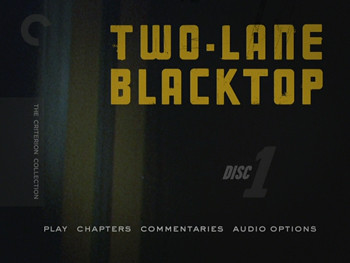
Monte Hellman's 1971 road race movie Two-Lane Blacktop, just released on a double-disc DVD by the Criterion Collection, can be watched as a film about a trio of guys with no roots looking for kicks on the open highway, and on that alone, it's an enjoyable flick. That's the beauty of the stealth genre picture, it has very real pleasures right on the surface. It's up to the individual to find any more in it, and in the case of Two-Lane Blacktop, whatever it is you find is also up to interpretation.

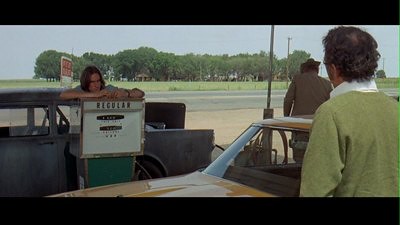
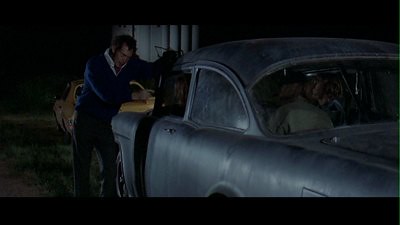
Hellman and screenwriter Rudy Wurlitzer (Walker) take a Spartan approach to their cast list. The characters have identifiers in place of names. Folk singer James Taylor is "The Driver," while Dennis Wilson, drummer for the Beach Boys and one-time misguided associate of Charles Manson, is "The Mechanic." They roam the country in a tricked-out 1955 Chevy, drag racing for money and thrills. They say very little, and when they do speak, it's usually about the car and the road. On their way through the Southwest, they keep getting buzzed by a 1970 Pontiac GTO (the cars get credits, too). It's driven by Peckinpah-mainstay Warren Oates, named only for the car himself. "GTO" is the opposite of the Chevy duo. He likes to chat up a storm, bending the ears of the hitchhikers he regularly picks up off the side of the road. What he says isn't always the God's honest truth, and his stories will change from one airing to the next. To hear him tell it, it's the Chevy that keeps landing on his tail, not the other way around.

Eventually, these two cars end up on a race to Washington D.C. The loser surrenders his pink slip and the car it represents. Along the way, they change positions in the race about as often as they pass the only other passenger, a nameless "Girl" (Laurie Bird), between their vehicles. Their attention seems to rarely be on the contest, anyway. The Chevy can't resist shorter races (sometimes compelled by financial concerns), whereas GTO's ever-changing ride-alongs trace a nature trail along America's weird underbelly.


Which, arguably, is what Two-Lane Blacktop is really about: the state of the American frontier. With Manifest Destiny all played out, modern day cowboys no longer have any territory left to explore. Instead, they shoot back and forth across the map looking for something to do. No roots, no responsibilities, just keep moving. The Chevy duo has only their thrills to look forward to. The very fact that they have nothing else--no family, no past, at least as far as we know--is probably what put them on the road. GTO, as unreliable a narrator as he is, makes several mentions of a past he is trying to escape. Was he really a TV producer that lost his mind and burned rubber in search of a way to make an outlaw automobile film on his own? If so, one suspects he is a stand-in for Monte Hellman, standing out in the wilderness along Route 66 making a subversive movie about a paved-over pioneer trail.

You can actually see the feeling of wild abandon. Though the film is full of many wonderful compositions, the camera regularly breaks free to shoot what it wants to shoot, either enjoying the unpredictability of a large crowd (was that extra in the Texas Panhandle scene supposed to clip Laurie Bird when she goes running like that?) or in capturing information in untraditional ways, like ambling away from a café table to look out the window at incoming characters, defying convention in such a way to show us what we need to see without having to cut. He also sets up deep frames, taking in the full horizon, and with some semblance of life going on in every corner of it.

At another juncture, however, GTO tells a traveling Texan (Bill Keller) that he used to be a test pilot that flew jets, and he switched to cars because he needed something to ground him. He also tells the Girl that he needs to find the end of the road before he jumps right off it and goes into orbit; contrary to that, the Chevy duo see no end to the highway. The only real threat is the loss or destruction of their vehicle, something they get close to as an unexpected result of their race with GTO. Out of cash, they have to put their tools up as their stake in a wager, and for the first time, the Mechanic and the Driver get testy with one another. The tools keep the engine running, and without them, the machine could fail.

It’s just one of many flip-flops Hellman and Wurlitzer pull in Two-Lane Blacktop. A lot is backwards on their racetrack. It must be significant, for instance, that the old man drives the newer car, trying to make a claim to being part of the present and not a relic of the past. The two younger men, however, drive an older car, placing themselves within a tradition that was over before they even knew what it was. If you consider it that way, it almost seems inevitable that these entities would eventually collide, coming together only to repel one another, two magnetic forces that both attract and repulse.

Where they end up is entirely up to you. They both stick to their original routes, but what they find there is the personal riddle that each viewer brings to the picture. Like the mysterious ending of Easy Rider, this movie's closest cousin, there is no denouement that puts Two-Lane Blacktop into perspective. Unlike Easy Rider, there is no heavy-handed, self-conscious symbolism to sort through, either. The way I see it, the racers continue on, stuck in gear, happy in being doomed to participate in the eternal struggle. Your mileage may vary, though, and that could be Monte Hellman's ultimate statement about the freedom we all seek. Like the open highway, this movie and what it means to you--and life itself--is only limited by the amount of fuel you're willing to expend getting there.

For technical specs and special features, read the full article at DVD Talk.