Showing posts with label guillermo del toro. Show all posts

Saturday, May 22, 2021

NIGHTMARE ALLEY - #1078


Illegal acts of human cruelty.


That’s the reason the local sheriff gives when he shuts the carnival sideshow down. He’s specifically acting on a tip that the carnival has a “geek,” a human who will bite the head off a live chicken or eat whatever filth is tossed his way. But the cop might as well be talking about everyone in the troupe, and all the things they do to each other. And wait until hear hears about what happens when that kind of energy is sent out into the real world. 


Nightmare Alley is a story of double-crosses fueled by petty jealousy, and the price of ambition when funded by emotional pain. Tyrone Power stars in this freaky noir as Stanton Carlisle, a hustler who picks up tricks for the sideshow mentalist Zeena (Joan Blondell) and her alcoholic partner Pete Krumbein (Ian Keith). After an accident involving moonshine and some potential jail time threatened by that same local sheriff, Stan reveals who he is to everyone in ways both intentional and unintended. He ends up being forced into a marriage with Molly (Coleen Gray), the carnival ingenue, but not before they have both learned Zeena and Pete’s system. It’s enough to break out of the rural confidence racket and go legit in big city nightclubs doing the blindfold act, where Molly tips Stan off using a verbal code so he can make the audience think he’s reading their minds.


I love the names in this movie. Stanton Carlisle just sounds like the name of a crook trying to be fancy. And then there’s Krumbein. Anyone else hear Nelson Muntz getting upset that Marge Simpson called him a “Crumbum”? And we haven’t even met Lilith yet, the psychoanalyst played by Helen Walker that inspires Stan to expand his racket to more personal cons involving seances and spiritualism. What his encounter with the confident professional ultimately shows him is that everyone is on the take. Shakedown artists work in fancy offices, too. And Liliths have a reputation for a reason.


Released in 1947, Nightmare Alley held a strange reputation for a while. Edmund Goulding’s film was one of those lost classics that one could read about in books but never find on video shelves. It was infamous for its bleak outlook, especially its shocking ending. Amongst film noir scholars, it was considered particularly weird, the rare noir that wasn’t all bullets and concrete, but just as cynical in the way it trades on mental games and “the other side.” When I finally saw Nightmare Alley, it was via a bootleg at my local arty video store. They had a copy someone had taped off of AMC. Same story with Billy Wilder’s Ace in the Hole [review]. True cult favorites left to languish even as their status amongst cineastes grew.


Even watching it via a faded and low-resolution tape, the genius of Nightmare Alley was not lost on me. Tyrone Power grafts steely determinism onto a fragile ego, inventing an incredible noir anti-hero, a fast thinker whose brain also had whatever the mental equivalent to a glass jaw might be. One hit, and he shatters. The actor is electric onscreen, possibly never better. Perhaps a veteran actor like Power understood too well the veil between performance and reality, how Stan was much better at reading other people’s cards rather than his own.


Cards are important in Nightmare Alley. Not just the ones that Stan and Molly use in their act, where diners write down the questions that open them to Stan’s fleecing, but tarot carts. Zeena does two readings in the movie, and each predicts the downfall of a man in her life. Being a noir, neither should be a spoiler, but I’ll let you guess. Just yesterday I watched Blondell as a side player to Barbara Stanwyck in Archie Mayo’s pre-code marriage drama Illicit, and despite there being fifteen years between the two movies, she was probably even more vibrant in this one than in the earlier role. Blondell makes Zeena a formidable woman, remorseful for her past sins, but unafraid of challenging Stan when he wrongs her. She steals the show from both the other actresses, who don’t quite have the chops she does. Then again, maybe Goulding and writer Jules Furthman are doing it on purpose, reducing the women that Stan ostensibly betrays Zeena for, by making Molly a nervous sap and Lilith calculated and unemotional. (Side note: Criterion includes tarot cards representing the main characters in their new edition, which also boasts a transfer that isn’t just light years ahead of the bootleg I rented once upon a time but also the Fox DVD from the ’00s.)


I make no secret of Nightmare Alley’s influence on my Archer Coe book series. There are nods to it in various names used in the comics, just as there is a major tip of the hat to Orson Welles. When wanting to find a way to do a private detective comic that wasn’t your standard riff on Chandler, Cain, or Hammett, it came to mind to make the character a stage hypnotist instead, someone whom people in trouble might ask into their lives and share their intimate secrets with in order to get help. Of course, the big difference is that Archer Coe is a former bad man trying to make good, and Stanton Carlisle is just plain bad. 


Should I let the man’s soul be lost forever, or should I stake my own to save it?


The change of routine and setting is freeing. Nightmare Alley doesn’t fall back on typical noir tricks. There is no gunplay or bag of money (though there is an envelope). The traditional hand of fate in most noir is now tied to mysticism, karma, and according to Molly, Stan is also tempting the hand of God. The charlatan’s problem is he wants to be a denier, but deep down he’s a believer. The hubris that will bring on the Godsmack is in trying to kid himself and Molly that there’s something good in his thieving, that he’s helping the people he harms. We know he knows it’s a trick, but he also knows the consequences of messing around with people’s memories of their lost loved ones, and like the criminal who pulls the heist even after one of the crew falls off, he chooses to ignore it.


Reassessing that in noir terms and examining how Lilith dresses him down in the final act, Stan is your typical genre screw-up but ultimately victim of memory. In this case, the memories he exploits causes the past he’s tried to disregard to catch up with him. The tuxedoed high society performer is exposed as a carnie in a wife beater. Maybe if he had taken the time to get an answer to some of his earlier questions regarding how a man could drop so low, Stan would have been wiser. It’s that damn hubris again. It was never going to happen to him. 


One final sidenote, in addition to the fine package Criterion has put together with the old show poster design, interviews, and porting over Fox’s critical commentary, they also commissioned a new essay from the incomparable Kim Morgan. It’s no coincidence that Kim is also the co-writer of the upcoming remake of Nightmare Alley with director Guillermo Del Toro. Just take a look at the cast – Bradley Cooper as Stanton, Cate Blanchett as Lilith, Toni Collette as Zeena – and this new version has a chance to be something. Look for Nightmare Alley later this year!


This disc provided by the Criterion Collection for purposes of review.


Sunday, March 19, 2017

CANOA: A SHAMEFUL MEMORY - #862


Released in 1976, Canoa: A Shameful Memory is considered a milestone of Mexican cinema, influencing future filmmakers (Guillermo del Toro and Alfonso Cuarón both appear in supplements on this new release) and setting a standard for the local industry to follow. Felipe Casals’ innovative, probing docudrama is equal parts Costa-Gavras and Francesco Rosi. It's dramatic and real and maybe a little long in the tooth, but fascinating all the same. Also, relevant to our times--and like most older films that maintain their bite, I might add, sadly so.

Based on a real-life incident from the mid-1960s, Canoa is essentially a story of small-town hysteria and political bullying. Taking place in the rural village that gives the film its name, Canoa centers around one night, including the preamble and the aftermath, when a terrible crime occurs. The catalyst is the arrival of a handful of university workers visiting the region to hike in its hills. They get off the bus at the start a torrential rainstorm, the severity of which prevents them from traveling further before sunrise. Word of the strangers spreads quickly, especially when they are refused shelter by the town sheriff and the local priest (Enrique Lucero)--a miniature dictator who has been squeezing the town dry for years. His anti-communist rhetoric, combined with his acute paranoia, misleads his congregation into believing the group are activist students who have come to undermine the Catholic church. As tails of their intentions become exaggerated, a mob forms and does what a mob does, ending in several murders.


Casals crafts Canoa: A Shameful Memory like a faux documentary, complete with an off-screen narrator and an on-screen witness (Salvador Sánchez). The latter is the most compelling part of the film. A worker from Canoa, the witness gives us the inside dope on town politics, speaking directly to the camera, as much a tour guide as an interview subject. His self-aware, glib cynicism colors the whole of the picture. He speaks with both the benefit of hindsight and distance. Granted, no one asks where he was on the night in question, and we aren’t entirely sure of where he fits in all of this. Not that it matters. He is the outside observer, disgusted yet not surprised. Even in the film's denouement, he already sees the powers that be turning tragedy into opportunity.


This witness basically sets the tone for Canoa. The movie is both real and unreal, an accurate depiction of events and yet a fictional re-creation of the same. We have access to closed-room machinations with the priest and his flunkies, a narrative conceit unavailable in a true documentary, not to mention an artful POV shot that reminds us that the minister is the shadowy villain behind the whole thing, the noirish lighting shaking off the cinematic grit that otherwise marks the picture. When it comes down to it, most of Canoa’s visuals conform more to the standards of fictional drama than any verité aesthetics. We also see Cazals push the limits of his budget in some of the performances, particularly the university workers, whose expositional scenes in the city are amateurish and contrived. Canoa’s fundamental cinematic constraints are showing.

The one exception is the violence that comes in the final act, when the mob comes for the unsuspecting visitors, breaking down the door of the meager shelter they found. Here Casals pulls no punches, embracing the terrible events in all their lifelike horror. The attack is vicious and bloody, and the brutality of it is appropriately unsettling. By the time the townspeople come for the outsiders, the truth of their visit is no longer important. In fact, to their minds, the boys’ explanation for coming this way is exactly something lying communists would say to save their skins. The violence is drawn-out and cruel, and Canoa doesn't shy away from some of the harsher details. As shown here, the hive mind succumbs to its most primitive impulses, trading its humanity for self-preservation.


But is it self-preservation? Is it even self-serving? They think so, but if we reconsider the info we got at the start of Canoa, these farmers make no real money, and what little they have is siphoned off by the clergy and funneled to its political cronies, sometimes as a trade-off for delivering such basic conveniences as electricity and telephones, other times for delivering nothing at all, the price of an empty promise. That the priest distracts from this thievery by inspiring a fear of the "other" should be all too familiar. Ignore my hand in your pocket, because that other guy is going to steal what I want before I do. And then pay me to "protect" you. Or show me how strong you are by protecting yourselves, you freeloaders!

So, despite showing its age in filmmaking, Canoa: A Shameful Memory remains as potent as ever. Swap its decades-old setting for a current one, wherever xenophobia and oppressive rhetoric holds sway, and you’ll find a cautionary tale for our era. One would have hoped that in these "enlightened" times we would be better, that Canoa would be considered fantasy rather than realism, and that such prejudices would have been rooted out--if not in the 1960s then at the end of the Cold War--but if the first few months of 2017 have shown us anything, we haven't really evolved much at all, and we’re getting busy creating a few new shameful memories of our own.


This disc proved by the Criterion Collection for purposes of review.


Friday, October 21, 2016

PAN'S LABYRINTH - #838


Back when the original fairy tales were being written, folks like the Brothers Grimm had a lot more faith in kids than we do now. Their stories were dark and sinister, with grotesque imagery and real moral lessons. They knew that kids like to be scared, and they aren't the big sissies that we pretend they are now, neutralizing the older stories to make them safer.

Though he hasn't necessarily made Pan's Labyrinth for children, writer/director Guillermo del Toro (Hellboy I & II [review]; Pacific Rim [review]) definitely seems to have gone back to find that ancient well of inspiration. His original story is as dark and twisted, and thus just as magical, as the classic tales. He has made a scary and wondrous fantasy film seen through the eyes of a child, and it should by turns enchant and frighten any adult who sees it.


Pan's Labyrinth has more in common with del Toro's smaller budget ghost story The Devil's Backbone than it does his big effects Hollywood films. Shot entirely in Spanish, it takes place at a rural outpost at the tail end of the Spanish Civil War. Franco is in power, and his troops are stamping down the last of the resistance. Ofelia (Ivana Baquero) lost her father in the war, and her mother, Carmen (Ariadna Gil, Belle Epoque), has remarried a sadistic solider, Captain Vidal (Sergi López, Dirty Pretty Things). Carmen is pregnant with Vidal's child, and they are going to his isolated base camp so she can give birth near him. There, Vidal is tangling with a band of guerillas that is hiding in the mountains, and he's ruling the nearby village with an iron fist.

For Ofelia, a girl who loves old books with fantastic stories, her new home is a blessing and a curse. She is not fond of the man her mother wants her to call "father," but she is immediately intrigued by the old stone labyrinth in the forest behind Vidal's fort. Though the dutiful maid Mercedes (Maribel Verdú, Y tu mamá también [review]) warns her not to go inside, Ofelia is lured their by a small fairy. There, she meets the faun Pan (Doug Jones, the body of Hellboy's fish man, Abe Sapien). He tells her that she is a long lost princess who has finally come to return to her kingdom. All she has to do is complete three magical tasks. He gives her a magic book whose blank pages will reveal her missions to her when she is alone.


Her tasks aren't simple, and they have real consequences when not done right--both in the magical realm and the real world. Naturally, when Ofelia sneaks off to battle a magic toad, she is going to get in trouble for disappearing, especially when she returns covered in mud and toad spit. The pregnancy is making Carmen sick, and so insubordination isn't going to be tolerated. Vidal is not a reasonable man, and he doesn't like when things get beyond his control. His outbursts when fighting the resistance get more and more violent, and he cares less about Carmen's health than he does the birth of his son. If she dies, that's just collateral damage, and woe to Ofelia if that happens.

del Toro gives his audience two different worlds in Pan's Labyrinth. First is the brutal backdrop of the Civil War. He doesn't shy away from the killing that keeps the wheels of battle turning, and there are many gruesome scenes that will make even the most iron-stomached gore junkies cringe. The second world is Ofelia's fantasy kingdom. The adults never see what the young girl is going through, and part of the experience of Pan's Labyrinth is questioning whether Ofelia is really witnessing magic or if these scenarios are just the escape hatch she goes through to get away from her cruel stepfather. Either way, her fantasies bite back. Pan almost plays as a doppelganger for Vidal when he loses his temper over the girl's mistakes. Survival on either side of the reality line also requires sacrifice, and Ofelia is going to learn some real lessons about what that means.


Regardless of which explanation you choose to believe, the spell of Pan's Labyrinth is irresistible. Guillermo del Toro has written a multi-layered tale that will scare you, delight you, and keep you precariously poised on the edge of your seat. You'll cringe, but you won't want to look away lest you miss a frame of his gorgeously crafted alternate dimension. For the two hours that Pan's Labyrinth runs, the director reminds adults of what it's like to believe so thoroughly in your own imagination that anything is possible, while also reminding us that real heroism is fraught with human error and bought at a real price. Like the titular labyrinth, any adventure has a lot of twists and turns on its way to fulfillment. Sometimes the turns may be wrong and in others they are triumphantly right, but there's always something worth discovering just around the corner.


In addition to its beautiful new transfer, Criterion has built up its release of Pan's Labyrinth with plenty of extras. Of note to any who were intrigued of the talk of fairy tales and childhood above is a lengthy discussion between del Toro and writer Cornelia Funke on that very topic. There is also a new interview with Doug Jones, as well as the majority of extras from the movie's original DVD release.

You should also take not of the excellent Becky Cloonan cover art. Full disclosure, Becky currently works with me over at DC's Young Animal, where she does covers for Shade, the Changing Girl, but I wrote about her original horror comics ages ago on my old blog. She's a unique talent, and you can check out more of her work at her website.


Parts of this review were taken from my original review of Pan's Labyrinth when it was released theatrically.

The Blu-ray was provided by the Criterion Collection for purposes of review.

Friday, August 2, 2013

SIDELINE: MORE REVIEWS FOR 7/13

The rest of my reviews from July...


IN THEATRES...

Iceberg Slim: Portrait of a Pimp, an interesting man overcomes the conflicting message of the commentary his profilers give him, proving personality always wins.

I'm So Excited, a light-hearted trifle from Pedro Almodovar. As Duran Duran once said, "doesn't have to be serious."

Only God Forgives. Hey, Gosling, hurry up with my damn croissants.

* Pacific Rim is here to save your summer.

Red 2, the old men need some Viagra, but the ladies have a good time anyway.

The Wolverine, just the kind of do-over we were hoping for. Go get 'em, bub!


My Oregonian columns...

* July 5: The Chinese drama Beijing Flickers and the documentary A Girl and a Gun, alongside Rossellni's "Solitude Trilogy"

* July 12: Augustine, a historical drama; Survival Prayer, a meditative documentary; and V/H/S/2, a total piece of crap.

* July 19: A documentary on Big Star, a tribute to Les Blank, and the Serbian gay rights comedy The Parade.

* July 26Hava Nagila: The Movie traces the history of the famous song; Men in Suits looks at the actors who dress as our favorite movie creatures; and the not-so-fantastic Fantastic World of Juan Orol is a biopic of the Mexican Ed Wood.

* August 2: Get In Bed With Ulysses and let James Joyce put you to sleep; or look at dramas based on real life, the human trafficking story Eden and James Cromwell in Still Mine. 

ON BD/DVD...

* The Extraordinary Adventures of Adele Blanc-Sec, Luc Besson's botched adaptation of the beloved Jacques Tardi comic book.


Foolish Wives, the silent classic from Erich von Stroheim, newly mastered in HD.

In Another Country, a romantic triptych teaming French actress Isabelle Huppert with South Korean director Hong Sang-soo.

 * Mayerling, the 1957 television production with Audrey Hepburn, long thought to be lost, finds its way into the world at last.

* Niagara, featuring Marilyn Monroe's sole turn as a femme fatale.

* Summer and Smoke, a minor adaptation of Tennessee Williams distinguished by a fantastic performance from Geraldine Page.

Twixt, Francis Ford Coppola's mess of a vampire movie. 

Wuthering Heights, Andrea Arnold's stripped down take on Emily Brontë.


Saturday, December 11, 2010

CRONOS - #551


Guillermo del Toro's 1993 debut, Cronos, is a loopy tale from the dark side. It's a macabre horror story, but more from the "spooky yarn for a rainy night" school than the nubile gore and splatter that passes for fright fests most of the time these days. Shot in Mexico on a $2 million budget, it fits neatly into a tradition of first-timers injecting their low-grade genre pictures with every meaningful aspiration they can muster. Think back to the heydays of Roger Corman, when young directors would cut their teeth on his cheap backlot, or more recently, Sam Raimi. Guillermo del Toro is practically an institution now, thanks to movies like Pan's Labyrinth [review] and the Hellboy franchise [review of II], but this is where it all got started.


Cronos begins much like a storybook, evoking the horror fiction that del Toro draws his inspiration from. We are told that centuries prior, an alchemist experimenting with terrible secrets stumbled onto something extraordinary, building a device called the Cronos. Two-hundred years later, that same alchemist was killed in a freak accident. No one could explain how he was still alive, and the Cronos gadget was nowhere to be found.

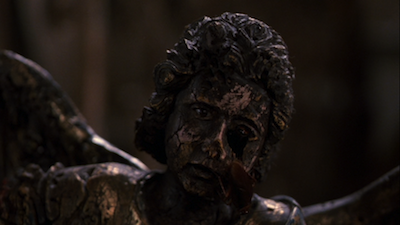
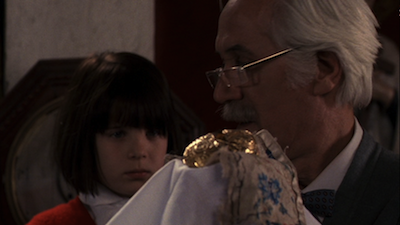
Jump ahead in time further, and a junkie spots a statue of an archangel in a second-hand shop in Mexico. Knowing there is a man who will pay for such a piece of information, the junkie rushes to a pay phone, but not before alerting the store's owner to the importance of the damaged sculpture. The old shopkeeper, Jesús Gris (Federico Luppi), and his granddaughter Aurora (Tamara Shanath) unwrap the curio, and in cleaning out the cockroaches that are living inside it, find a small metal egg. Jesús turns a dial on the golden object, and spider legs emerge, clamp down on his hand, and a stinger stabs into his palm. The old man has no idea what he has stumbled on.


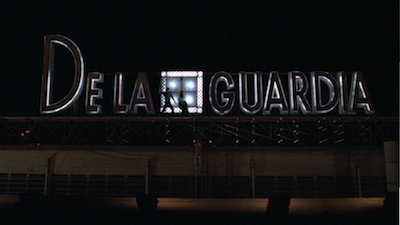
The man who sent the junkie does, however. De la Guardia (Claudio Brook) is a fellow of many riches, but health is not one of them. He has been buying every angel statue he can find hoping to locate the missing Cronos so he can use it to beat the many ailments that plague him. When he gets a tip, he sends his gorilla-like nephew, Angel (del Toro-regular Ron Perlman) to buy it. He has the alchemist's book of instructions about the Cronos, including a sketch of what the right statue looks like. Angel buys this one like always, but even though it finally matches the drawing, the true treasure is already gone.

Long story short, the Cronos is a tool that grants eternal life, but one that must constantly be maintained. I won't explain exactly how it works, there are some details best left to your own discovery for your first viewing, but in simple terms, it drinks your blood and then you are possessed of a need to replace that blood, creating an endless flow of life force. This is why Cronos is sometimes labeled as a vampire movie, though Jesús Gris is as far afield from Dracula and Nosferatu as the "zombies" in 28 Days Later are from the zombies in The Walking Dead. There are no bats, no fangs, nothing of the kind. Rather, the hunger is a more basic human desire for immortality. The Cronos preys on our longing for eternal life (which at some level is just a desire to be important and/or not forgotten; to matter). De la Guardia is trying to outrun his failing body, but he is flummoxed by this new competitor in the race. The Cronos immediately starts to make Jesús younger and more fit. He doesn't want to give that up.


Cronos is an inventive, literate psychological fairy tale, except one that turns the fairy tale convention upside down by making it about two old men rather than the folly of innocence. Though there is an element of that, too; the lesson learned here is for the innocent, the little girl who silently observes. The granddaughter, though she does not speak, is a constant presence, serving as a conscience for her grandfather, who literally holds temptation in his hands. The things children see that adults cannot is one of the many thematic threads that run through all of Guillermo del Toro's Spanish language movies, though in The Devil's Backbone and particularly Pan's Labyrinth, the youngsters step into the shoes of the protagonist rather than simply watching. In del Toro's world, a child can process the unbelievable in a way adult's cannot simply because they still believe. Besides, worrying about living forever must seem awfully ridiculous to someone who isn't even ten years old.


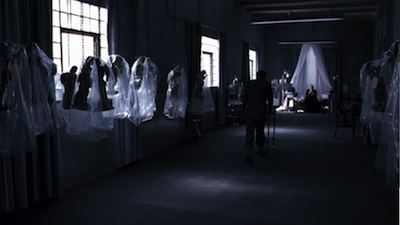
Not everything in Cronos works. Some of del Toro's writing is a little too on the nose. Perlman's character being named Angel might have been fodder for some amusing irony had the angel statues he is collecting for his uncle not made the symbolism obvious. Worse is the first time you hear the full name "Jesús Gris" spoken out loud. I think I actually groaned. Sometimes del Toro overdoes his visual symbolism, too. Clocks appear here and there throughout the movie, reinforcing the importance of time, sometimes in a good way, sometimes it's too much. The man in the clock costume at the New Year's Party is a neat idea, but the violent climax in front of a big clock face doesn't just fail on a textual level, the set looks cheap.


I'm willing to forgive the big set piece not looking so great, though, because del Toro puts his money where it counts. The make-up for the various states of Jesús' metamorphosis is fantastic, with the right touches of gore and gristle to make it believable, stomach churning, and even a little funny. Even better is the Cronos device itself. The old school effects on the machine are flawless, with the rudimentary toy-like mechanics of the object being perfect for a contraption that is over 400 years old. It moves and clicks and whirrs, and in an ingenious move, del Toro takes us inside the device, showing us its tiny gears and other, shall we say, parts from the inside. Letting us see the miniature interior up close this way makes it seem giant, as befitting its truly awesome powers. The hand-made props also appear more otherworldly than more contemporary computer effects usually do, as if this thing were the product of another fearsome dimension.

Federico Luppi is good as Jesús. He underplays the role rather than going over the top with it, and that makes his transformation all the stronger. It also keeps some of the more grotesque elements from being comical when they shouldn't be (licking blood off a bathroom floor) and adds to the black comedy when its pertinent (the corpse in the backwards suit). The villains are a little too cartoony to be truly menacing, but the Cronos provides its own menace, so the movie does have a dark flavor when required.


These are humble beginnings, to be sure, but Cronos definitely points the way for the Guillermo del Toro that is to come. Even with its rough edges, Cronos is thoroughly entertaining and surprisingly thought provoking. As with any truly good horror story, it makes us question what we would do in such a situation. Every adult character here has his own selfish goals, even if the selfishness emerges unexpectedly. If we were in the same situation as Jesús, would we not take advantage? Is the way he stubbornly wants to hold on to the Cronos for himself any better than De La Guardia's obsessive by-any-means-necessary search for it? I would say no, which is why Jesús' redemption comes with such a high penalty.


Taking us further back to del Toro's beginnings is the inclusion of the director's early short, Geometria. This six-and-a-half-minute film was begun in 1987, when the director was in his early 20s, but never completed to del Toro's satisfaction until it was unearthed for this DVD release. He cleaned it up, dubbing the soundtrack into Italian doing all the voices himself, as his homage to Lucio Fulci and Mario Bava. The blood-and-guts short subject features a teenager calling on a demon, essentially because he hates his homework. And, well, you know what happens when you waste a demon's time, don't you?


Also of note for del Toro fans is a short featurette called Welcome to Bleak House. This is a video tour of the scare master's work space, a second home away from home where he stores his toys, trinkets, art, and books. The whole place is set up as a museum/work environment, with hidden rooms, a screening area, and an art space. Collectors and fanatics will definitely drool over a lot of the stuff here, and after watching it, del Toro's brief connection with a Disney reboot its Haunted Mansion franchise makes a lot more sense.


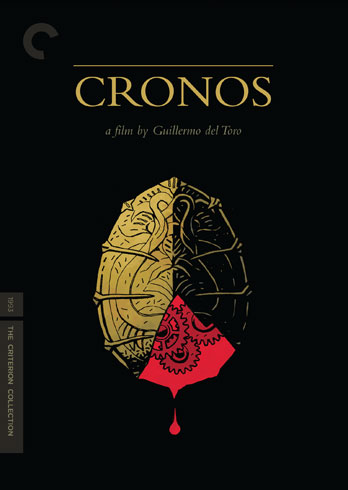
The Criterion Cronos package, which is available on both regular DVD and Blu-Ray, is filled out by two commentaries, various interviews, and a stills gallery and a booklet with some of del Torro's early notes for the movie. Hellboy fans will also be excited to see that the comic book's creator, Mike Mignola, did the cover illustration, as well as a two-part illustration for the interior book. Actually, it's four parts, because the inside works in conjunction with the cover, and even the art on the surface of the disc brings you in closer, showing us the exposed Cronos and its hiding place inside the heavenly statuary. It's like opening a treasure and digging down deep into the chest. Fantastic.


This disc was provided by the Criterion Collection for purposes of review.

Monday, December 6, 2010

SIDELINE: Criterion Event - CRONOS at Amoeba, Hollywood

Hey, all. I only received my copy of Guillermo del Toro's Cronos today, and so my review isn't ready yet. In the meantime, I want to make sure any readers in Southern California know there is a special release event going on at the Hollywood location of Amoeba Records in conjunction with a screening of the film.


Full details are here.

Guillermo del Toro In Person at Amoeba Music Hollywood Celebrating the Criterion Collection DVD/BD Release of CRONOS

Tuesday, December 7th at 5pm – Amoeba Music - 6400 Sunset Blvd. - Hollywood

Special Screening of CRONOS & Never-Before-Seen GDT Short GEOMETRIA, Immediately Following Signing

8:00 PM - Los Angeles Film School - 6363 Sunset Boulevard


Director, writer and producer Guillermo del Toro (Devil's Backbone, Hellboy, Pan's Labyrinth) visits Amoeba to celebrate and sign the release of the Criterion Collection editions of CRONOS, his celebrated feature debut, followed by a special screening of the movie along with his never-before-seen horror short film, Geometria, at the Los Angeles Film School.


And don't forget to check out Ryan Gallagher's interview with del Toro over at the Criterion Cast to read about what the director is up to.

I'm also working on a review of the awesome BBS: America Lost and Found Blu-Ray collection. Expect that and Cronos in the coming week.