Showing posts with label merchant ivory. Show all posts

Wednesday, October 10, 2018

ENCHANTED APRIL - FILMSTRUCK

This review was originally written for DVDTalk.com in May 2009. It's being reprinted unedited with its original jokes intact...just because.


Of course, the obvious snarky question is why Enchanted April didn't come out on DVD until May, and I'd say the snarky answer would involve something to the effect that it felt like the 93-minute movie took a month to watch, so being a month late would just be par for the course.

Truth is, Enchanted April fans have waited much longer than that for the movie to come to disc in North America. Despite having won two Golden Globes in 1993 and getting nominated for multiple Oscars, this Mike Newell-helmed picture has not been on DVD before now. When I worked at a video store a couple of years ago, it was one of the most regularly requested titles amongst the customers. Perhaps this delay has built up too much expectation in me, given me too long to inflate my perceived appreciation of Enchanted April in my mind. I know I saw it during its theatrical run, and then at least once more on home video a couple of years later, but I'd wager it's been more than a decade since I last sat through it. The movie has gotten older, I've gotten older, and we've grown apart.


Enchanted April is a period piece set in the 1920s. It is the story of four British women and the Italian castle that provides them with a bucolic getaway for what is to be a month of no socializing, no husbands, nothing but the sea, the air, and the trees. The trip is initially organized by two bored housewives, Lottie Wilkins (Josie Lawrence), the wife of a gastronomically self-satisfied London-based solicitor (Alfred Molina), and Rose Arbuthnot (Miranda Richardson), who is married to a man (Jim Broadbent) who writes scandalous novels under an assumed name. To offset the costs of their holiday, the two advertise for vacation mates, eventually scoring a stuffy older woman (Joan Plowright) and a much-desired flapper (Polly Walker). As a little wrinkle of irony, the flapper, Lady Caroline, is trying to get out of town to escape the lecherous men who pursue her, and one of them is Mr. Arbuthnot. Uh-oh! Trouble's a-comin'!

Except, no, there will be no trouble. None at all. Rather, there will just be a month of relaxation and rehabilitation in the country, a month of quietly rediscovering oneself, and eventually of rekindling love. It's also a month of sheer boredom, a slow burn that never catches flame.

Enchanted April, even back when it seemed good, always came off as a bit of a sub-par take on Merchant Ivory territory. Written by Peter Barnes (the one-time much sharper writer of the satirically daring The Ruling Class) from a 1922 novel by Elizabeth von Arnim, the movie details the kind of humdrum, repressed lives that many a James Ivory character has so expertly burst in his many great movies, and given that Enchanted April originally hit the Cineplex somewhere in between Howard's End [review] and Remains of the Day, it tied many of us over in terms of satisfying our yen for costume drama. Peter Barnes is no Ruth Prawer Jhabvala, however, and I doubt Ms. von Arnim is in the same league as Henry James. Likewise, Mike Newell is certainly no James Ivory; rather, he is the director of such middle-ground material as Mona Lisa Smile and Love in the Time of Cholera. His best-known movie (not counting his time at Hogwarts) is Four Weddings and a Funeral, another film that may not have aged well. After Enchanted April, I'm a little scared to find out.


It's not that Enchanted April is simply god-awful. It has some truly lovely locations, and I rather appreciated its use of multiple points-of-view, giving each lady her own voiceover in order to chronicle her inner thoughts. Polly Walker is as alluring as her part demands, affecting ennui and managing to be irresistibly attractive while doing so, and Miranda Richardson gives a subtle and nuanced performance that brings far more to the material than the filmmakers could have possibly hoped for. Looking out at the sea, pondering her life, she says more with her face than any of Barnes' dry narration ever could. The actress was really the only thing that kept me watching to the closing credits.

The problem is that Enchanted April takes its dispassionate stance far too seriously. The women are all supposed to change, transformed by their new surroundings, their blood once again boiled by the shining Italian sun--and yet, even as they change, the movie remains bloodless. Lots of light, but no heat and so no boiling. I didn't find the changes to be believable, instead they just came off as predictable, relying on audience expectation that the metamorphoses must happen rather than making the effort to inspire similar feelings within everyone watching. This is Merchant Ivory by the numbers, a costume drama going through the motions. The end result is that Enchanted April turns into a dreary pit stop rather than a life-changing experience. Rather than being the good thing we were waiting for to transport us to a better place and time, it's just more impetus to keep looking.


Saturday, October 4, 2014

MAURICE - THE MERCHANT IVORY COLLECTION


It’s kind of funny that I first saw James Ivory’s 1987 adaptation of E.M. Forster’s Maurice back in my college days, because rewatching the movie some 20 years later, I realize that Maurice somewhat illustrates what was my father’s worst nightmare at the time. In the early 1900s, young Maurice (James Wilby) went to Oxford where he was exposed to radical ways of thinking that made him doubt his religion while also opening up his understanding about his own sexuality, leading to clandestine dalliances with one of his school chums (Hugh Grant) and basically allowing Maurice to embrace his dormant homosexuality.

It’s like all the liberal education bogeymen that haunt conservatives have crawled out from under the dormitory beds.


Of course, to blame Oxford for transforming Maurice is to miss the truth of Forster’s story. At one point, when arguing with his mother about his changing opinions, Maurice defends himself by basically saying, “This is who I am. I am not my father, I am me. I was made this way.” Though dear ol’ mum has no idea that her child is queer, the coded language of the exchange could not be more clear, or more potent. Despite the progress made in the century since Forster published his then-controversial book (homosexual acts were illegal in England, as illustrated by the arrest of another of Maurice’s classmates), or even since Ivory’s film was released, well ahead of the indie revolution of the 1990s that helped give queer cinema a new platform, opponents of gay marriage and the regular appearance on our Facebook timelines of stories about kids coming out to intolerant parents have sadly allowed Maurice to remain contemporaneously relevant and not just a document of a certain period of history.


But then, good stories never lose their punch, and Ivory and co-writer Kit Hesketh-Harvey find the essential emotion in Forster’s tale of a naïve, upper-middle class student having his eyes and heart opened to the world. Maurice is both sensitive and insightful, finding the universality of coming-of-age coming-out stories and detailing how internal shame and external prejudice affect the individuals who suffer from them. Maurice and Clive (Grant) find friendship and then love in college, but family demands and social persecution push them apart. While Clive gives in and gets married, Maurice struggles to maintain his secret life, while also carrying the torch for his first romance. Eventually, he finds affection with one of Clive’s groundskeepers, Alec Scudder (Rupert Graves), but that also has its own complications.


One thing that is both timeless and universal in Maurice’s difficult early adulthood, and one that most adolescents can relate to be they straight or gay or whatever, is feeling like an outsider. Maurice’s most palpable and familiar trait is the air of the different. Be it religion, class, or social mores, Maurice is always on the outside. Because he doesn’t fit in what might be considered the most elemental of manly roles, he ends up finding comfort in little else. Unable to accept himself, he rejects religion, education, and the more humiliating aspects of societal expectation. Not apologizing to his headmaster for sneaking off with his lover allows Maurice a rebellion only he understands. He’d rather draw an invisible line and be tossed from school than reject what he’s found. Naturally, this position is hard to maintain, but one that Maurice must find the strength to carry on with, because the more he gives in to expectation and tries to get along, the more he struggles and the less happy he becomes. Things flip when he exploits another for his desire, indulging with the servant Scudder...though there is some question of who is exploiting whom. Forster has quite keenly observed that the oppressed can easily become the oppressor, and they can also be taken advantage of for the same.


Maurice also illustrates how certain hokum has always held sway and may never go away. Ben Kingsley shows up for a couple of scenes playing a hypnotist Maurice hires to divest him of his forbidden desires. This has about as much success as religious groups who think that homosexuality is something that can be cured through rehabilitation and prayer. Attempts to repress one’s true feelings tend to only give added strength to their triggers.

Such a delicate story requires a delicate touch, and Ivory is well suited for it. I’ve noted in the past that part of the Merchant Ivory appeal is a near absence of style, and Maurice shows the team at their most Masterpiece Theatre-like. There is little to distinguish this film from any variety of BBC literary dramas, except maybe the sexy love scenes between Grant and Wilby and Wilby and Graves. It’s certainly not the kind of thing one expects to see in a TV miniseries based on Austen or Dickens. There’s something normalizing, however, by approaching these couplings with the same even keel as Ivory and cinematographer Pierre Lhomme approach everything else. Theirs is nearly invisible cinema. There are no sweeping pans or emphatic zooms to underline emotion. Rather, Ivory allows for character and setting to maintain the spotlight. A meeting in the woods, or ducking from a rainstorm--these are tropes from romance novels, but also just the stuff of life and circumstance. When it comes to describing the films of Merchant Ivory, “plain” is not pejorative. Much in the same way an author might use clear language to make sure there is no confusion amongst his readership, Ivory leaves the flourishes to happen within the scene, even as he encourages his performers to adopt a like-minded restraint. Seeing a young Hugh Grant be dashing without mugging for the camera is a good reminder of why we all actually liked seeing him in movies once upon a time.


While this poise and reserve means James Ivory is considered by some to be the most quintessentially British of directors, the truth is that he’s an American who actually grew up and went to college in Oregon, from whence I currently hail. This connection is what prompted me to give Maurice a spin, as on Friday, October 10, Ivory will be appearing at the Hollywood Theatre in Portland to present Maurice as part of the Mid Century Oregon Genius series.

It’s a rare appearance, and to go along with this screening, Ivory has also chosen to air his rarely seen 1977 film Autobiography of a Princess, starring James Mason and available on Criterion’s OOP Heat and Dust DVD. The filmmaker selected Princess as complement to Oregon-native James Blue’s The Olive Trees of Justice showing later the same day and followed by a panel discussion focusing on Blue’s filmography.

For details on all of these showings, visit the Hollywood Theatre website.


Saturday, August 16, 2014

REDUX: THE DARJEELING LIMITED - #540

This is my second write-up of Wes Anderson's The Darjeeling Limited. You can read my older review here. What is below isn't actually a legit review, or even a finished piece. These are my rough notes for an introduction I made last night before a screening of the movie, complete with "Hotel Chevalier," as part of the NW Film Center's "Wes's World: Wes Anderson and his Influences" festival. It features some old ideas cribbed from my previous write-up, and some new ones based on my re-watching the film. The piece is still a bit ragged, as it was just meant to act as a guide for while I talked, so there are likely some typos; each time you encounter one, imagine me saying...


The Darjeeling Limited has become the default Wes Anderson movie that no one cares about. You bring it up, everyone’s got an opinion about it.

To me, it’s one of the more interesting and challenging of his movies. It’s a eulogy for the Anderson movies that came before it, ending one phase of his career and setting the stage for the next.

As Marc Mohan said last week introducing The Life Aquatic with Steve Zissou [review], the filmography of Wes Anderson is almost like one giant film, the way Susan Sontag described the 1960s work of Jean-Luc Godard. It’s all connected, and if not literally one volume to the next, it’s at least a shared universe. Thus, there are treads and characters that connect: to all of his other movies. You have Max Fischer, Richie Tenenbaum, maybe a little Eli Cash.

You have Steve Zissou, being left behind, almost like a phantom. To my way of thinking, the bit part Bill Murray plays here is actually their father, whose passing has prompted the journey the three brothers at the center of the movie are taking.


In essence, the father figure is dead. It’s time to move on in search of the next thing. This makes for one of the more emotionally raw of Anderson’s films. It wears its heart on its sleeve.

Which means it gets personal in ways Anderson movies haven’t before. There are three writers behind this: Wes Anderson, his filmmaking compatriot Roman Coppola, and actor Jason Schwartzman, who is also Roman’s cousin. Each writer has created an avatar for himself in the three brothers in the movie, and infused their mannerisms and fetishes with coded symbolism.

In fact, the whole movie, like much of Anderson’s work, has kind of a secret code that you have to break. The filmmaker is often accused of being precious, but every detail matters. He is precious in that he is like a little kid trying to build what he sees in his imagination, and he cares deeply about getting it right.


Owen Wilson plays Francis, the eldest, and he serves as a stand-in for Wes Anderson. Francis is the beleaguered ringleader, unappreciated and beaten-up--which was probably how Wes felt following the tepid reception to The Life Aquatic. Like his creator, Francis also wants to get it right. He wants to contain the chaos, but finds he can’t. You can’t manufacture a spiritual journey. He tells his brothers to “say yes to everything,” but then hands them an itinerary.

Jason Schwartzman plays Jack, and in doing so represents himself: the arty romantic looking to stake a claim.


I’m glad they are including the prologue of “Hotel Chevalier” because Darjeeling is really incomplete without it. Particularly in regards to Jack. He is essentially Max Fischer looking to be grow up and be taken seriously, stuck in a fugue at a time where the fictions he has created have become too real and have overtaken him.

Look around his hotel room, you’ll see he has essentially built himself a replica of his childhood bedroom, a la Edward Appleby, the dead romantic figure in Rushmore. [review] There are toy cars, art pieces, and objects that are important to him. He’s locked away, indulging in books and movies.


He’s watching Billy Wilder’s Stalag 17 on the TV. In that film, William Holden’s character is like the Max Fischer of the POW camps: he has the whole place wired. He built a racetrack and runs mice on them. He has a telescope for looking at the women in the neighbor camp. He is both separate and apart.

You also might spot a Nancy Mitford book on his bed. It’s a twofer, one of my favorites, the combined The Pursuit of Love and Love in a Cold Climate. Mitford is a bit like F. Scott Fitzgerald as a woman, known for beautiful prose and writing thinly veiled fictions about her and her sisters; Jack does the same about him and his brothers. No matter how much he claims it’s all made up.


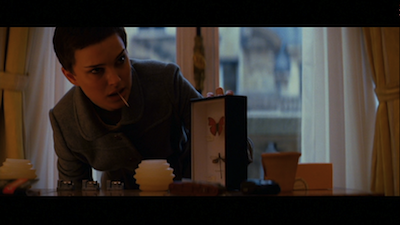
Things go wonky for Jack in his exile when that his estranged lover--played by Natalie Portman--shows up unannounced and invades his space. Bad for him, lucky for us, in that it’s easily the sexiest a Wes Anderson movie has ever gotten. But Natalie Portman also utters the first of many portents in Darjeeling: “Don’t you think it’s time you go home?” He can’t escape his past any more than he can escape her.

“Hotel Chevalier” ends with a song by Peter Sarstedt, “Where Do You Go To My Lovely,” which is the most Wes Anderson of songs. It’s all references--Marlene Dietrich, the Rolling Stones--using these superficial details to get into a lover’s head. There’s something so self-conscious about it, it’s hard not to think Anderson is toying with us. “Where Do You Go To” becomes Jack’s love theme.


Finally, we have the most complex character to decode: Roman Coppola, as represented by Adrien Brody. Peter is also trying to establish himself as his own man, and his real-life parallel maybe has the most to overcome in that regard. Roman Coppola is a film director himself, he made a movie called CQ many years back--about, surprise, a young filmmaker trying to avoid turning into a hack. His resume also includes a lot of second unit work for his famous father: Francis Ford Coppola.

Francis Coppola one of the more influential titans of the 1970s. He was surely an influence on Wes Anderson. The Conversation, the Godfather films [review], Apocalypse Now.

Keep that in mind when you observe Adrien Brody in Darjeeling: he is the one who keeps stealing his dead father’s clothes for himself. He wears the old man’s glasses, so as a metaphor is looking through his eyes, despite it being a different prescription than his own. As the offspring of a famous man, it’s hard to establish your own vision.


This carries over into the theme of fathers. I think it’s Peter, Brody’s character, who gives the best evidence that Bill Murray is their dead dad. Watch how he looks at the Bill Murray in that first scene, both when he passes him, and once he’s on the train.

Peter is also dealing with his own issues: he could the next Royal Tenenbaum or Steve Zissou. His wife is pregnant, and he is running away. Sadly, later, he’ll be the one who fails in saving another child. Not a good omen.

The fact that Wes Anderson is trading some of his daddy issues to focus on mommy issues is kind of fascinating. Anjelica Huston as the mother in both Tenenbaums [review] and Zissou was still invested in what the men were doing, she’s the one who takes care of things, even reluctantly. Not this time. For the first time in Anderson, the mother has abandoned her post. (Not counting the late Mrs. Fischer.) Maybe in that sense the German women on the train are supposed to make us think of Hitchcock’s The Lady Vanishes. [review] She can’t help but get out of there, and you can’t blame her. She’s had enough.


Extending the Coppola comparison, for a second, and sticking with fathers and mothers: there is a journey here akin to Apocalypse Now. In looking for their mom, the boys are seeking the rogue who has gone native.

There is also Hearts of Darkness, the documentary about the making of that film, where we see it was Roman Coppola’s mother, Eleanor, who kept the movie--and his father--on track when Francis Ford’s mad boyish adventure went off the tracks.

Also in Apocalypse Now, there is the threat of a tiger attack, which we have repeated here. Francis Ford Coppola himself was referencing William Blake: “Tyger Tyger, burning bright, / In the forests of the night; / What immortal hand or eye, / Could frame thy fearful symmetry?

This maybe wasn’t intentional on Anderson’s, but if you were here for Shawn Levy’s introduction to Rushmore, these things extend back whether it’s planned or not. Shawn quoted Borges stating that artists create their own precedents, even if by osmosis or coincidence. And one of the major reasons for this series is to make these connections, we want to see how the themes all lock together.


I was struck watching this last night, actually, that the train porter serves as a kind of father figure, immediately usurping Owen Wilson’s authority the moment they step on his train. If we want to go a little silly, then that means Jack/Jason Schwartzman sleeping with the porter’s girlfriend has some Oedipal overtones. Not to mention Natalie Portman and Anjelica Huston have matching haircuts.

But that may be going to far. It’s still worth considering, thought, that Owen Wilson’s Francis might want to take over for his dad, but what we end up seeing is that he’s just like his mother. All his habits are from her. I like the line he says, “Did I raise us...kind of?” She won’t validate him, he’s hoping his brothers will.

Moving on from that...


The other important film connection to make here is to India. India provides Wes Anderson an opportunity. Where I think Darjeeling provides a bridge between the two phases of Anderson’s career is he steps outside of his own uncanny valley in away he hasn’t before. It’s his first time away from an entirely curated world.

We left the city in Steve Zissou, sure, but Zissou still lived in an imaginary landscape, one that he could control, it was his Life Aquatic.

In Darjeeling, while the characters still bear a stylistic connection to the Anderson aesthetic, they have been moved into a world that is beyond their control, where they don’t fit. While cinematically, it’s the India that the director saw in early Merchant-Ivory movies and Satyajit Ray, it still resembles something other than Anderson’s common landscape. The Darjeeling Limited both as narrative and as process is an adventure of displacement.

As I mentioned, Francis is trying to manufacture and manicure the spiritual experience, but it’s way to controlled for a legitimate epiphany. To the point that to have a real experience, the boys have to be thrown off the train and see life as it’s really being lived, away from the conveniences of privileged travel. It makes me think a little of Lost In Translation, [review] and Scarlett Johansson leaving the hotel where she’s been hiding and viewing Japanese life as an observant witness. (A film, of course, made by Roman Coppola’s extremely talented little sister.)

These guys are presented with a real awakening moment out at the river and in the remote village, but of course, they kind of miss it. Anderson makes the connection for them, he goes from one funeral back to another, letting us see the events prior to burying their father, but these guys are dense. They immediately fall back into their old tricks once they return to the city, and have no choice but to go back out again and finish what they started.


After this, we would see Anderson retreat back into his own environment, and even take it to new extremes. Moonrise Kingdom [review] and to a greater extent Grand Budapest Hotel [review] has moved him even further from reality. There is a kind of magical realism, a cinematic illusion a la Georges Méliès, that has taken over his material. It’s actually hinted at in this movie with the very obviously fake tiger. There’s a part of him that wants the illusion to appear as illusion

I don’t know if the poor reaction to Darjeeling inspired it, but there is almost a sense that Anderson decided to take his ball and go home. If we didn’t want him stepping out into a recognizable world, then he wasn’t going to. He would create his own. I imagine him sitting in his studio listening to the Beach Boys’ “In My Room” and dreaming up this new fantasy life, untethered and unrestricted. It’s what’s made his latest films so fresh, but what also makes The Darjeeling Limited so effective. As they say, you have to leave before you can come back.


Sunday, January 12, 2014

LATE RAY - ECLIPSE SERIES 40


By the time master Indian filmmaker Satyajit Ray made his 1984 film The Home and the World, he had been directing movies for nearly thirty years. This film, and the others that make up the trio of movies in the 40th Eclipse Series boxed set Late Ray, show the confidence of all those years of experience, even if maybe the passion in the story doesn't come through with the same kind of vivacity as it might have previously.

Based on a novel by Rabindranath Tagore, who also provided the story for Ray's movie Charulata twenty years prior, The Home and the World is a drama set in a wealthy household at the turn of the 20th Century, a time of political and social change. Nikhil (Victor Banerjee) has opened his home to his college friend, Sandip (Soumitra Chatterjee, who had worked with Ray since being Apu in his famous Apu Trilogy), the leader of a movement to expel the British occupiers through individual economic sanctions; namely, banning foreign goods and only buying Indian products. Nikhil agrees in theory, but sees the potential damage these boycotts could do to the poor merchants who work in his jurisdiction by limiting their options and also the religious strife it would cause between wealthier Hindu activists and their Muslim neighbors.


Caught between these two points of view is Bimala (Swatilekha Chatterjee), Nikhil's wife, who prior to Sandip's arrival has lived according to a tradition where a wife does not leave the house once she has taken her marriage vows. Nikhil has always encouraged his spouse to live free, and her friendship with Sandip inspires her to finally venture outdoors, even if only to see him. She finds the allure of this impassioned speaker irresistible, and the opportunistic politician takes advantage of her innocence. This love triangle is the driving force of The Home and the World, setting up its essential conflicts. The steady, thoughtful, and progressive Nikhil must contend with the more reckless--and ultimately self-serving--Sandip, with Bimala bouncing in between, trying to parse the truth from the compelling fictions.


The Home and the World has some interesting ideas to wrestle with, but Ray's telling is fairly dry. The sexless romance lacks the sense of stifled desire that allows other period pieces of this nature, such as Scorsese's Age of Innocence or James Ivory's The Remains of the Day, to overcome the lack of physical heat. There isn't much draw here. Perhaps the problem is that Sandip isn't that compelling a scoundrel. His flaws are far too obvious. Nikhil's arc is much more fascinating, particularly once the pacifist has to take up arms to fix his friend's mistakes.

On the upside, Ray's attention to details, including period sets and costumes, is excellent, and his steady narrative presentation manages to keep the film moving forward, even as some of the interpersonal drama grows repetitious. You may want to tackle this one over a couple of sittings. It took me three nights to finally finish it off myself.


Much better is 1989's An Enemy of the People. Health concerns forced Ray to lessen the scope of his production, and it makes for a more succinct, incisive drama. Five years passed in between the The Home and the World and An Enemy of the People because the filmmaker was recovering from a heart attack he suffered near the end of The Home's production. For this follow-up, Ray once again turned to an older text, this time updating it for a modern context. An Enemy of the People is an adaptation of the 1882 Henrik Ibsen play of the same name, transplanted to India and modernized.

Soumitra Chatterjee returns as Dr. Ashoke Gupta, a mild-mannered medical practitioner concerned about the increase of jaundice and hepatitis amongst the local population of his Bengali residence. These are diseases not common to the area, and he believes that an introduction of new contaminants to the water supply is responsible. Further investigation bears this out. Most troubling, though, is the pollution's connection to the town's Hindu temple. The holy water the worshipers partake in is infected, as well.


It's this last bit that causes Gupta the most trouble. The temple has become a tourist attraction and pilgrimage destination, and the city leaders who profit from this influx of travelers do not want to see its reputation damaged. Dr. Gupta's younger brother Nisith (Dhritiman Chatterjee) takes a hard stand against his sibling, getting both the temple and the local newspapers involved, stirring up religious fervor to stifle the doc's health warnings.


The theatrical origins of An Enemy of the People is still quite evident in Ray's production. Most of the action takes place on three different sets, with each scene clearly demarcated by the shift in between. Enemy is a talking-heads movie, with bits of clumsy exposition here and there to orient the viewer to who is who. There is also some character shorthand, with the costume designer in particular typecasting through wardrobe. Nisith, for instance, dresses in Western-style clothes that make him look like a villain in a British drama; the morally weak newspaper editor wears a sweater vest and big glasses, the stereotype of a milquetoast liberal. These decisions mean much of Enemy comes off as starchy, but the source material and the cast largely overcome this problem. Soumitra Chatterjee is especially good in the lead, playing a man overtaken by his ideals and ill-equipped to apply them in the real world. His belief in the rightness of things means he can be taken advantage of and betrayed with surprising ease. It's a testament to Ibsen's initial premise that the issues he raised still applied to India over a hundred years later, and could easily be adopted to our own culture today. It was apparently Ray who added the religious element to the story, which makes it even more potent to a modern society that, maddeningly, still has to contend with religious obstinacy blocking the way of scientific advancement and common sense practices.


Also quite good is Mamata Shanker as Gupta's daughter. She represents the younger generation and is the sort of atypical progressive female that Ibsen was known for. Her character has some of the most nuanced story points in the screenplay, and her decisions are effectively juxtaposed with the more old-fashioned beliefs of her mother (Ruma Guha Thakurta).


There is also a bit of a clash of old values and new skepticism integral to Ray's final film, and the best of the set, 1991's The Stranger. The auteur, as per usual, wrote and directed and composed the music, though he did so from his sick bed, an impressive fact to consider. The Stranger is as solid a film as you're likely to find, constructed skillfully and featuring finely tuned performances. It sags at times, mostly when we get a song or dance number, but it seems fitting that a revered filmmaker's final effort should speak with such clarity about identity and what is and is not knowable.

Utpal Dutt plays Manamohan Mitra, the stranger of the title, a world traveler who gave in to his self-described wanderlust 35 years ago and left Calcutta to see the world. He has now returned, much to the surprise of his only living relative, his niece Anila (Mamata Shankar). She is sceptical of his true identity, but willing to take the risk; her husband, Sudhindra (Dipankar Day), is not so open-minded. He thinks this is a scam. The returning uncle's willing acceptance of their doubt does little to assuage it. (In this, he is maybe similar to Sandip in The Home and the World, in that the man puts his own contradictions front and center. Compare, for instance, Sandip's addiction to European cigarettes.)


The Stranger is basically a series of challenges as different people confront Manamohan and try to challenge his story. His deft dismissal of these disputes could be interpreted as proof that he is who he says he is, or just further confirmation that he's a skilled con man. The situation grows more complicated and suspicious when it's realized that there is a long unclaimed inheritance at stake in addition to whatever personal connections Manamohan will reclaim. Dutt is a shrewd actor, never really tipping his hand. You'll likely only lean one way or the other when the weary nomad begins to grow tired of the endless interrogation. Even then, you might find yourself still waiting for him to pull the rug out and contradict whatever it is you'd decided.

There is a fascinating psychology at work in The Stranger, though it's not necessarily that of the stranger himself. He remains a bit of a cipher even up until the end. Rather, Ray has figured out that the really interesting story here is how others react to the man, and he concocts scenarios where we can see a broad range of personalities interacting with Manamohan. In one case, it is an actor intrigued by the backstory; in another, it's a lawyer used to dealing with cynical con men.


In the end, the filmmaker is using The Stranger to affirm his belief in the human spirit and in the benefits of trusting and accepting one another. It serves as a fitting coda to a career, and also is a remarkable example of an artist remaining sharp even in his final days. It's so easy to get hung up on the first declaration of an individual voice, to embrace what is fresh and new, but there is something far more rewarding in a mature work by a seasoned professional who has refined those earlier impulses into a far deeper, more meaningful expression.

In the year following The Stranger, Satyajit Ray received an honorary lifetime achievement Oscar, and then shortly after that, passed away. The Stranger is a respectable final statement, going along with that last seal of approval from Ray's peers and admirers. It is a tale of a man whose years only exist in the stories he tells. What we know of the artist, we know through his work, and the work of Satyajit Ray carries on even though the man is gone.


For a complete rundown on the special features, read the full review at DVD Talk

Tuesday, October 5, 2010

THE DARJEELING LIMITED - #540

"Well, you've got your diamonds
And you've got your pretty clothes
And the chauffeur drives your car
You let everybody know

But don't play with me,
'cause you're playing with fire
"


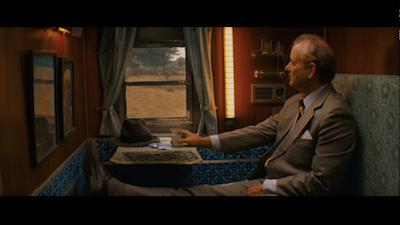
The Darjeeling Limited opens with a fake out. Bill Murray, playing an unnamed business man, is running to catch a train somewhere in India. The camera is with him as he runs, but suddenly, another figure enters the screen--Peter Whitman, one of the three Whitman brothers. He's running to catch the train, as well. He passes the man, doing a double-take, almost like he knows him, before leaving him behind; Mr. Business will have to catch the next one. For a moment, though, we thought the movie was about him, or would at least feature him prominently, but it does neither--at least not in any way we know. He is seen one more time in a later montage, part of a roll call of the film's other tangential characters, a reconnecting to the collective unconsciousness of the narrative, and in that instance, we will see him at rest. But why is he there?
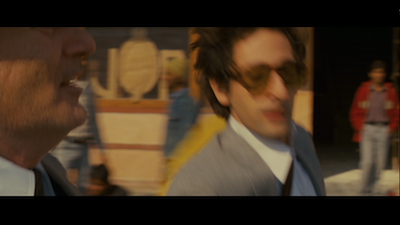


It would be easy to get hung up on Bill Murray. In the scheme of The Darjeeling Limited, he is a small thing, and part of the film's greater meaning relies on the Western habit of getting hung up on small things. Granted, his existence nags at us through most of the picture. I've seen it three times now and I still keep waiting for it to be revealed he's actually the father of the Whitman boys, the man whose death has sent them out on their journey of healing and spiritual discovery. It's a ghost chasing the train, and the children pass him by the way children are supposed to, already farther ahead of their parents than even they know.

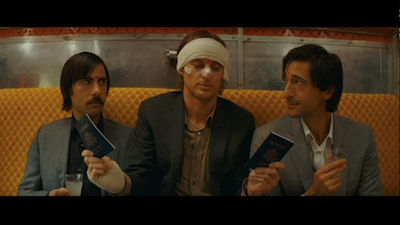
The other guys are waiting for Peter on the train. There is the eldest brother, Francis (Owen Wilson), and the younger sibling, Jack (Jason Schwartzman); that means Peter (Adrien Brody) is the middle child. It's been a year since their father's funeral, and that long since any of them have seen each other. Much has happened. From having watched the film's prequel Hotel Chevalier, available here as it was on the earlier Fox DVD, we know Jack has been in exile in Paris, where he recently was visited by a toxic lover he'd do better to forget. We will find out shortly that Peter is expecting a child in six weeks, a responsibility he is not ready for. Francis arrives bandaged and bruised, apparently having been in some auto accident. He is a successful business man, it would seem, and he has brought an assistant (Wally Wolodarsky) who will keep the boys informed of their itinerary and keep the trip moving. Francis has planned everything.
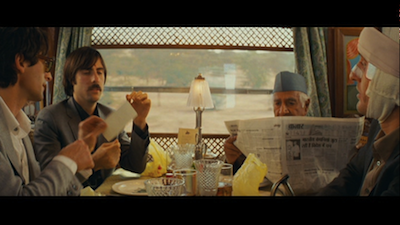


On the surface, these plans are exactly what Francis tells his brothers they are: they are on a spiritual journey, seeking to renew their familial bond and heal their wayward souls. Secretly, Francis is also hoping to find their mother (Anjelica Huston), who he has learned is living as a nun in the Himalayas. There are clearly unresolved issues here, and Francis may be the only one who wants this reunion.

The Darjeeling Limited is the fifth full-length feature from writer/director Wes Anderson, who here shares script credit with Schwartzman and Roman Coppola, a filmmaker in his own right. (He has directed many music videos, behind-the-scenes featurettes, and his own film, CQ, as well as serving as second-unit director on many of his father Francis Ford Coppola's movies. Jason Schwartzman is his cousin.) It has been said that the Whitman brothers each represent one of the scribes, which makes sense the more you know about this group. Anderson's movies have always been personal, but The Darjeeling Limited is his most naked effort. It's also in contention as his most misunderstood. The movie received a chilly reception when it came out in 2007, and it is due a critical reevaluation--something this splendid Criterion 2-disc reissue should make rather convenient. (More on this new package down at the bottom.)
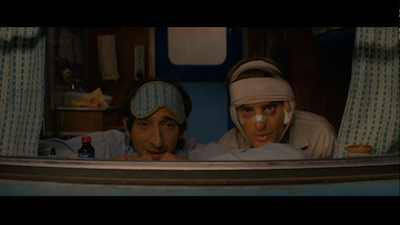


The title of the film comes from the train the Whitmans are riding. Though the ultimate destination will be the nunnery where their mother is holed up, there will be many stops along the way where the boys will attempt to have premeditated mystical experiences. It's a misguided effort, however, you can't plan for epiphanies. Francis is an overbearing control freak who seeks to even put a rope around chaos. He has mapped out key ashrams and brought along peacock feathers for a ritual intended to unburden them of the maladies that weigh upon their souls. Unsurprisingly, Jack and Peter can't follow instructions and it all goes wrong.

Much of the trip is spent with the brothers at each other's throats. Old resentments come up, new ones emerge. Peter, for instance, is taking charge of their late father's belongings, which rankles Francis' need to have everything locked down. Jack is pining for his girlfriend (Natalie Portman), and he creates a parallel situation by having a quickie with a stewardess on the train (Amara Karan), ignorant of the fact that she is dating the chief steward (Waris Ahluwalia). The boys are all getting blitzed on over-the-counter medicines, taking advantage of more lax prescription laws in India. They argue and even have a fist fight and make nuisances of themselves as they overanalyze every little detail of their lives. Francis wanted his brothers to get on the same page, but they haven't even agreed on the same book.

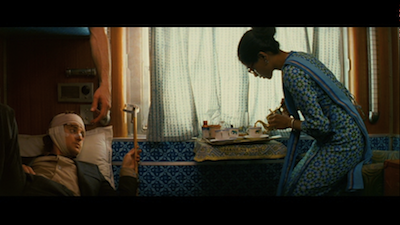


All of Wes Anderson's movies have shared themes and affectations, and after his previous film, The Life Aquatic with Steve Zissou [review], there was a fear he might become stagnant. The Darjeeling Limited is his attempt to avoid that. In this movie, Anderson seems to be undergoing his own transformation, tackling this potential problem head on and also addressing one of his main narrative concerns, the theme of letting go of the preciousness that at first defines and then smothers individualism. When seriously considering The Darjeeling Limited, it starts to feel like the previous films were playtime, a bunch of kids putting on a show, and this one shows a director growing up for real. Thus, the father figure, a very important component of Anderson's oeuvre, is already out of the equation, and the usually dependable mother has given up on her responsibilities. There is nothing left for the children to hide behind. Rebellious quirks like drug taking and kleptomania are neither cute nor romantic, nor is playing with exotic and dangerous things like poisonous snakes; these things now have an actual effect, they take a toll.
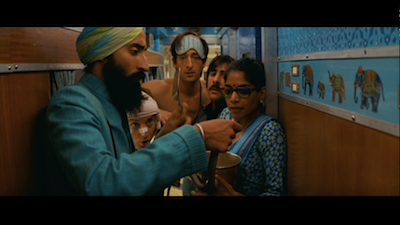


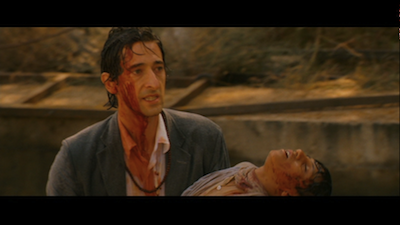
In this case, the snake is the first infraction of several that cause the Whitmans to be kicked off the train in the middle of nowhere. This is arguably the best thing that could have happened to them, as it finally wrenches control from their hands. They are somewhere they did not plan to be with no exit strategy. As the idiom goes, it's about to get real. When morning comes, the guys witness another trio of brothers: three local children trying to cross a river. An accident occurs, and one of the children dies. Fittingly, it's the one Peter tries to rescue. "I couldn't save mine," he says plainly, even as blood rushes down his face and he cradles the dead boy in his arms. Metaphorically, Peter is being faced with his own future and the son he is considering abandoning before he is even born. It's a heartbreaking moment that Brody plays with an intense, yet understated, gravitas. His numbed reaction speaks volumes; in this case, doing so little means so much.


The event actually inspires a different kind of letting go. In a very literal sense, the Whitmans all toss aside their luggage to jump in the river--luggage that was once owned by their father and even bears his initials. In any road trip, the physical baggage characters bring with them is merely a stand-in for their emotional baggage. It's also important to note that just before the accident, the computer printer Francis uses to make his laminated itineraries falls and breaks--yet another sign that the comfortable world of modern convenience is no longer valid. They must discard the superfluous before they can realize what is important. The aftermath of the tragedy is the first time the trio is genuinely quiet. Words fail them.

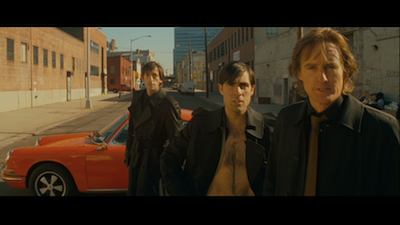
Anderson chooses to drop a flashback in here, and he couldn't have timed it better. He cuts from the child's funeral to the Whitman boys in the back of a limo on the way to the funeral for their father. The scene is already in progress when we enter, and the first line of dialogue is "I can't believe you just said that." We are back to the siblings in a quarrel, engaging in more of their ill-conceived plans. Peter demands they stop and pick up their father's roadster from the repair shop. It's not fixed, but they try to take it anyway. It's these guys in a nutshell--always trying to push a car out on the road even though it has no battery. It's crucial, however, that the failure of this plan unites them. Compare the shot of them ready to fight the truck driver in the middle of the street to them together at the funeral, and then think of this again later when they finally regain their common ground just before leaving India.
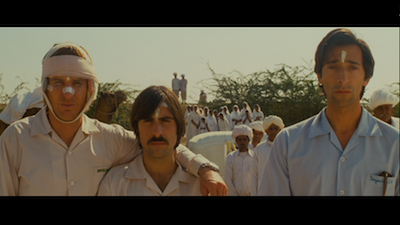


Prior to this departure, the most connected moment the brothers have in the movie--I prefer the word "connected" to "spiritual," honestly--is when they are communing with their mother. It's another scene where silence is important, even if we aren't sure that dear ol' ma isn't conning them to get out of answering their accusations. She suggests they sit quietly and just feel what they are feeling, their faces and their energy will communicate what words cannot. Anderson sets the camera in the center of their circle, and it pans around, face to face, chronicling their changing expressions. This exercise causes not just contentment, but the ability to reach out to the world beyond. It reconnects them to everyone else. Anderson cuts to one of his famous "dollhouse shots," the aforementioned train montage. The camera now pans across a long string of cars. There is no exterior, and we see everyone inside. We see the people the Whitmans have encountered on their way here, we see Peter's pregnant wife, and we see Bill Murray and Jack's girlfriend again. It's also the scene that uses the Rolling Stones song "Play With Fire," the opening lines of which I quote at the start of this article. Those six lyrics succinctly sum up so much of what this movie is about. Consider Mick Jagger to still be in his role as the tempter from "Sympathy for the Devil," and the mystical implications of the tune become far more flammable. "Your material world is easy, but the world I offer, a place where you let your emotions run free, is the one where you actually risk something." Hence, the caboose of the train houses the specter of death--the man-eating tiger that lurks outside the nunnery walls.


It's important to consider the music in any Wes Anderson movie. He picks his songs carefully, and they tend to enhance the meaning of the action. Elsewhere in the film for instance, the Kinks song "Strangers" contains the powerful statement, "I've killed my world and I've killed my time." The Kinks are another British Invasion-era rock group that plays an important part in the Anderson's prior filmography, but Anderson's previous use of the Stones still has tremendous dramatic resonance. A couple of their tunes provide the soundtrack for the revealing moment between Margot and Richie in The Royal Tenenbaums [review]. Arguably, the band is as important to Anderson's work as to Martin Scorsese's--though the two filmmakers gravitate to very different facets of the Stones catalogue.

I've argued before (and I'm certainly not the only one to do so) that Wes Anderson's output should be considered as one continuous thread, each film informing the other, as he builds on his themes and his unique vocabulary. Perhaps it is the familiarity of Anderson's coded visual language that makes it easy for some to dismiss it. Particularly in The Darjeeling Limited, the way Anderson's style so languorously hangs off his players makes it seem like he is phoning it in. Yet, I find when I try to put together the pieces and assign each Darjeeling character his place in the lexicon, it is not so easy. The emotions are more complex. They don't fit inside the picture frames as easily as the Tenenbaum children fit on their wall of accomplishments.
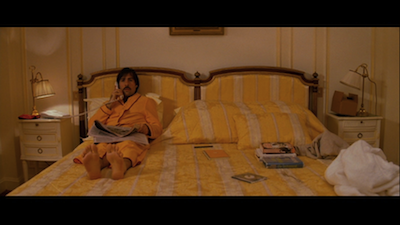


Jason Schwartzman in particular could be seen as playing his Anderson avatar all over again, returning to his career defining Rushmore role [review] and bringing Max Fisher into adulthood. If Jack is Max, he still invents stories, still struggles with unattainable love, but he has less self-belief. Again, the details are important, which might be why its so disconcerting in Hotel Chevalier when the first thing Natalie Portman does upon invading Jack's space is to rearrange his things. Everything has been put in the spots where Jack intended them to reside; he is an Anderson character through and through, he is establishing his own environment. It's why whenever he makes an important move, Jack cues up Peter Sarstedt's "Where Do You Go To (My Lovely)" on his iPod. He is scoring the film of his life.


Likewise, the stories he writes are all about him, even though he denies it. On one hand, he is chasing something (the book on his bed in Hotel Chevalier is the marvelous twofer of Nancy Mitford's The Pursuit of Love & Love in a Cold Climate: Two Novels, and there is more in those stories apropos to this situation than just the titles); on the other, he accepts impermanence. His own novel is called Invisible Ink: this book too shall pass. Schwartzman, like Brody, plays it smart. Less important is the confidence of his actions (at times, he is very reasonable), or how gutsy he is at being needy; the true stuff is in what he doesn't say. Watch Schwartzman when Jack isn't actively engaged. The actor's longing looks at the horizon could be Jack seeking an escape, or more likely, looking to see if his past will catch up with him. He is Max looking for that remote-controlled plane to re-enter his airspace. The downed pilot of The Little Prince watching the stars for some kind of rescue.

Despite this reliving the past, more should be said about how much Wes Anderson has pushed himself out of his comfort zone for The Darjeeling Limited. He has left the familiar terrain of his previous inventions and gone in search of reality. Rushmore existed in an imaginary place where rich and poor are divided like an S.E. Hinton novel--or a clichéd inner city movie, something Max might turn into a stage play. In The Life Aquatic, Anderson sort of pretended to go out into the big, wide world, but it was still a fantasy world. For The Darjeeling Limited, he has gone someplace foreign to him, one that resists his molding it. The Whitmans think they can wander through India being who they are, relying on their white American privilege, but the country doesn't embrace them in this way. Francis sits down to get a shoeshine, and the shoeshine boy steals his $3,000 shoe.
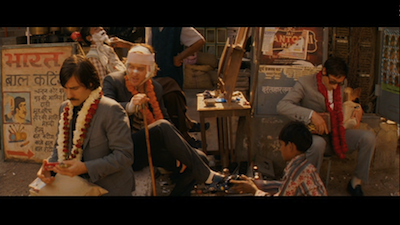


You could actually consider that an extended metaphor for storytelling itself. An author may want to control where the muse takes him or her, but the muse does as it pleases. This bears more weight when we stop and think about Francis as the stand-in for Anderson, as well as considering further the history of Owen Wilson's roles in previous Anderson productions. (Remember, he co-wrote Bottle Rocket [review], Rushmore, and The Royal Tenenbaums.) In Bottle Rocket, he establishes himself as the leader and schemer who imposes his self-belief on the others. He gets beat up for it, though not to the degree of which he is mangled in The Darjeeling Limited. This would mean the toll for setting the narrative has increased. (Note, too, Francis' initial explanation of how he crashed his car has echoes of Eli Cash plowing into the Tenenbaum home.) Perhaps this is also why Wilson's performance is the most mannered--he is mimicking the director.
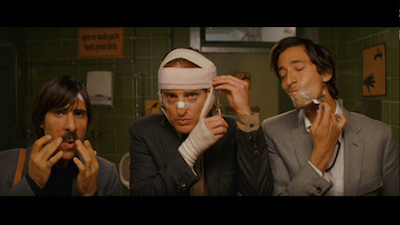


This leaves Adrien Brody to be the stand-in for Roman Coppola, and both are newbies in the Anderson universe. Peter at times could be seen as more of an observer than a participant, sometimes even an outsider--he is not part of the regular routine, and when he takes action, it can be disruptive. Given Coppola's famous father, whose footsteps the son has followed in, it makes the fact that his avatar clings so closely to the dead man's things all the more revealing. The stolen prescription sunglasses, then, is a symbol for borrowed perception, of taking the patriarch's way of seeing as his own. Francis' jealousy, then, may be Anderson's (a stretch, to be sure, but let it have its moment). He wishes to be part of the cinematic lineage. He even has his character adopt the elder Coppola's first name!
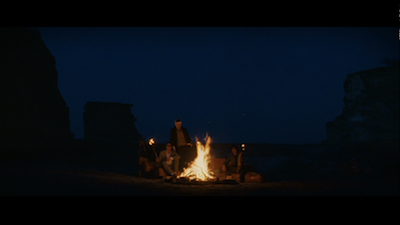


The lack of audience and critical response to The Darjeeling Limited is damning in its own way. (I'm not a big fan of mob rating, but Rotten Tomatoes currently has it at a so-so 68%.) I've long believed that audiences resist growing with their favorite artists. They are too enamored with the first time they encountered whatever entertainment that artist has offered, and so resist when the creator goes too far from that initial spark and seek to put him or her back in the original box, seizing on anything that is repetitious as somehow actionable even as they insist the artist deliver more of the same. (At this point, dismissing The Darjeeling Limited is such a knee-jerk reaction, it tends to cause me to discount the person who has it with the same unqualified reflexiveness unless they can offer a considered response.) If The Darjeeling Limited is the end of a cycle, it's one that ends as it began. Bottle Rocket was a road trip, too. We have come full circle.
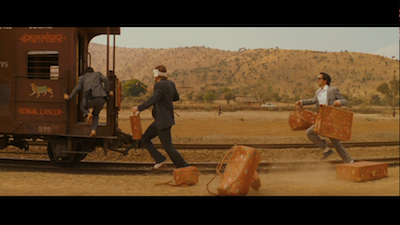


So have the Whitmans. By the end of The Darjeeling Limited, they are one, instead of three. Anderson has unified his characters, and they now wish on a single peacock feather. This is followed by them once again having to chase a train, though this time it isn't Peter on his own, and catching it requires another discarding. Calling back to the tossing aside of the luggage at the river, the boys are going to have to shed that baggage for real. Once they do, they surrender themselves and accept each other for who they are. Their flaws may be annoying, but hey, that's the way they are made. Embrace the imperfection.

It makes for an ending that satisfies on all levels--intellectually, philosophically, emotionally, and dammit, even spiritually. In the past, Wes Anderson has been criticized for not going deep enough. In The Darjeeling Limited, he dives down as far as he can go, and by having worked for the treasure, the one he returns with is one he deserves and, thus, all the shinier.
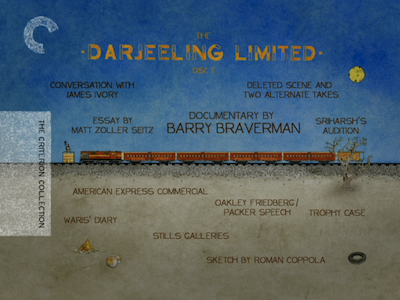


This is the second edition of The Darjeeling Limited, though the first to be on the Criterion label and also the first to also be available on Blu-Ray. For fans of Criterion's previous top-shelf treatment of the Anderson filmography, this is long-awaited good news. The double-disc package doesn't disappoint. From the cover art and interior design by Eric Anderson through the homespun nature of some of the extras (visiting mothers shot photos in the galleries, Roman Coppola makes an affectionate short about his writing partners), this fits right in with the other four discs in the catalogue.

Amongst the bounty of extras, aficionados will likely be most intrigued by the audio commentary featuring Anderson, Schwartzman, and Coppola (something I'll explore later, now that I've worked through my own theories on the film), as well as a 20-minute conversation between Wes and James Ivory about Indian movies and the music in The Darjeeling Limited, much of which was lifted from Merchant Ivory productions and Satyajit Ray films. We also get the full American Express commercial starring Anderson (as well as Schwartzman and Coppola, too), and a trio of deleted scenes/alternate takes.
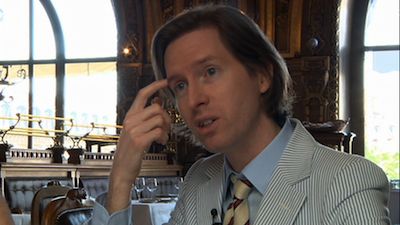


My favorite extra, though, is the video essay by Matt Zoller Seitz, who made that marvelous series dissecting Wes Anderson's style back in 2009 (still online starting here). I wish there was a way that all five of those had been put on here, as well, but Seitz's Darjeeling Limited-specific segment created for this disc is still fascinating and insightful. And he probably only uses about half as many words as I did to say twice as much.
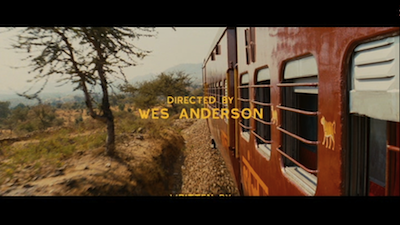


Watch the trailer for The Darjeeling Limited.


This disc was provided by the Criterion Collection for purposes of review.