Showing posts with label Olivier Assayas. Show all posts

Friday, January 21, 2022

LES VAMPIRES - CRITERION CHANNEL

This review was originally written for DVDTalk.com in 2012.
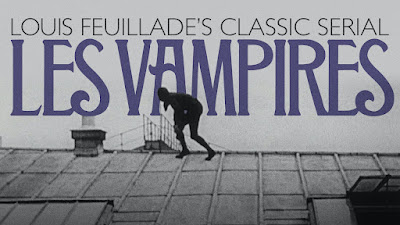


Long before there were "comic book movies," and indeed, some time before comic books really became what they are today, French filmmaker Louis Feuillade was making silent film serials that predicted the best of true comic book storytelling. His films Fantomas and Judex [the 1916 version, not to be confused with this] told stories of masked figures getting involved in impossible adventures; silver-screen epics broken into episodes, released over a period of time, with each new chapter escalating the peril. These lengthy soap operas were pulp fiction for the cinema set.


In addition to those films, Feuillade also made Les Vampires, a ten-part movie released over the course of 1915 and 1916. Now considered one of the crowning achievements of early moviemaking, Les Vampires is a salacious crime picture, full of twists and turns and a deliciously freeform sense of storytelling. It can be rickety at times--there is definitely a downside to the "anything can happen" ethos--but it's also addictive, each segment ending on a note that makes us want to know what will happen next. Feuillade is anything if not a master of cliffhangers.
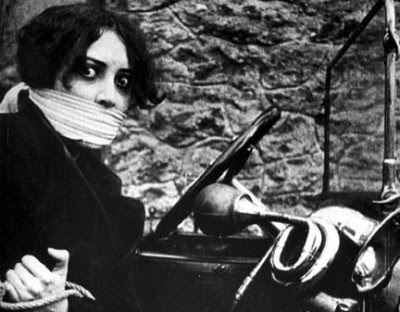


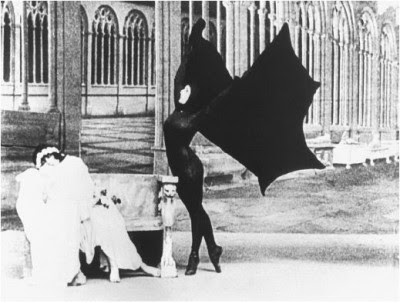
The hero of Les Vampires is Philipe Guérande (Édouard Mathé), a reporter for Paris' leading newspaper. Guérande has been working a long-term assignment, trying to expose the inner workings of an underground criminal organization that goes by the name "Les Vampires." These are ordinary hoodlums who use masks and secret identities to pull all manner of crimes. They are not the supernatural bloodsuckers the name implies--sorry, no Draculas here--but they do employ extraordinary techniques and deadly gadgets to get their work done. Feuillade also flirts with Stoker-like imagery. For instance, one segment involves a ballet dancer to whom Guérande is engaged. She is dancing in a production that dramatizes the sordid lives of the Vampires, and thus puts her in their cross-hairs. Her costume, based on one of the actual villains of the piece, looks every bit like a bat-winged succubus, and her murder is carried out in a particularly macabre fashion. Feuillade was giving the horror fans a knowing wink. These evildoers have taken on this name for a reason.


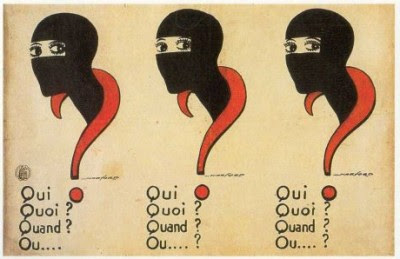
Of all the varied elements of Les Vampires, the facet that has found a permanent place in pop culture is Irma Vep. The name is an anagram for "vampire," and she is both a cabaret performer and the top lady crook in the Vampires organization. Played by one-named actress Musidora, Irma Vep came to embody the image of the vamp, a particular kind of femme fatale--though vamping also means to play up certain seductive traits, to exaggerate one's own sense of desirability, much as Musidora does in the film. Her black body suit, the one mimicked by the ballerina, would inspire many larger-than-life ladies that followed, fictional and otherwise, and the character would be paid homage in other movies, on album covers, and, of course, comic books. (Most notable, Olivier Assayas' Irma Vep with Maggie Cheung [review].)


Despite the revered critical status that Les Vampires has acquired over the last century, it's necessary to note that it is an imperfect effort. The lengthiness of the film, which on one hand makes it such a fascinating cinematic endeavor, can also be its downfall. Individual sequences feel drawn out, with the acting in particular overemphasizing things that the audience is likely to grasp much quicker than Feuillade apparently anticipated. The performance style in Les Vampires often veers very close to the cliché that comes to mind when many think of silent film. Édouard Mathé in particular is exceedingly demonstrative and seems to be mugging for the camera, displaying the kind of exaggerated pantomime that his better contemporaries learned to avoid.


That said, there is still so much to like about Les Vampires, it's easy to ignore its faults and just go with it. The ridiculous scrapes that Guérande finds himself in pile on one after the other. Each new chapter brings more colorful characters, as well as regular visits from the comic relief, the silly but charmed Mazamette (Marvel Lévesque), with his seemingly endless string of children and the equally endless string of jobs to pay for them. He is like the Wimpy to Guérande's Popeye. And, of course, the true appeal of Les Vampires is the cliffhanger stylings, the way Feuillade teases out the suspense, leading the viewer through the pretzel-like plot with both confidence and, despite the aforementioned laboriousness, an invigorating spontaneity. There is always a sense of discovery at work in this tale, and the fun is in sticking around to see how it all pans out. Will the rival gang ever get the upper hand and take out the Vampires? Will Guérande ever expose the full story? And what of Irma Vep...? Hit the next button, go to the next chapter, it's the only way to get your answers!


Sunday, April 25, 2021

IRMA VEP - #1074


Irma Vep is very much a movie of its moment. Released in 1996, Olivier Assayas’ freeform metafictional experiment captures the intersection of independent film, the old guard that inspired it, and the very hip Hong Kong cinema that was just finding its way into the international mainstream.


The story centers around a past-sell-by-date French film director (played by New Wave-legend Jean-Pierre Léaud), who has been tasked with remaking the silent film Les vampires, an epic-length crime serial that, lest you get it twisted, did not feature actual bloodsucking monsters. Rather, the Vampires of the title are an organization wreaking havoc upon Paris circa 1915. The face of this criminal revolution is a femme fatale named Irma Vep. I can likely do no better at describing her as I did in my 2012 write-up of Louis Feuillade’s original:


“Of all the varied elements of Les vampires, the facet that has found a permanent place in pop culture is Irma Vep. The name is an anagram for ‘vampire,’ and she is both a cabaret performer and the top lady crook in the Vampires organization. Played by one-named actress Musidora, Irma Vep came to embody the image of the vamp, a particular kind of femme fatale--though vamping also means to play up certain seductive traits, to exaggerate one's own sense of desirability, much as Musidora does in the film. Her black body suit…would inspire many larger-than-life ladies that followed, fictional and otherwise, and the character would be paid homage in other movies, on album covers, and, of course, comic books.”


1915


1996


Léaud sees no purchase in casting a French woman in the Irma Vep role, as it would be impossible to replace Musidora, so he looks outward and finds Maggie Cheung, who at that point had starred in a couple of Wong Kar-Wai movies, but was also known for parts in action flicks and superpowered genre pieces like The Heroic Trio, a scene of which is featured here. Cheung is playing herself amongst a fictional film crew, a stranger in a strange land, a Hong Kong native who speaks no French, and one of the only people of color on the set.


What Assayas unravels here is a narrative of the difficulties of making a movie, and the pull between art and commerce. Staff complains because Léaud’s character is a tyrant that doesn’t have it anymore, yet they treat their own positions very much like a job. They decry American movies like Batman Returns while doing a remake of what is very much a superhero/villain ancestor, fiddling over the details of their particular fiefdom. All the while not really noticing their lead actress or engaging with her. In the opening scenes, she is very much an object to be talked around, the language barrier used to emphasize she is a necessary nuisance, as if she is somehow to blame for their woes because her role in a prior film production went overtime and caused delays. You almost hope that 90 minutes later she’ll reveal she spoke French all along. 


Assayas gets to have his cake and eat it too with Irma Vep, paying homage to past masters while dissecting and satirizing them, using their innovations to see if he can make something new while also shielding himself with nostalgia. Modern viewers have the added layer of knowing that he would marry Cheung two years later and so Irma Vep celebrating her beauty and abilities is almost like an elaborate love letter*. For her part, we see Cheung in a way we don’t get to that often: completely free to be natural, playing herself with little guard or obvious technique. 


The real breakthrough for the character of Maggie is when she puts on her vinyl costume and runs around as Irma, engaging in free expression. It allows her to find the soul in what her director sees as soulless, to find herself within the symbol of Irma Vep. (And soundtracked by Sonic Youth, no less.) This is what all the artists seek, what Assayas sought, what the French New Wave pursued, what the indie scene of the times was after: space to just be. Irma Vep is at its best when it eschews convention and structure and simply is. The lack of freedom in the fictional project crushes the onscreen director; whereas the unmooring in Irma Vep liberates the real-world auteur. 


There is an inherent irony to there being so much drama on-set while making a film that everyone says is bereft of the same. Assayas is having a grand old time satirizing the self-involved French film scene and the ability of its participants to puff it up and deflate it all in the same breath. One of the more pointed scenes takes aim at the critics and journalists obsessed with intellectualizing the “poetry” of John Woo while complaining filmmakers like Léaud have ruined cinema precisely because they intellectualize everything. All the while, he’s another that ignores Maggie and what she has to say, she’s merely there to reflect his own ideas. 


Which makes it fitting that Maggie Cheung has the ultimate revenge, appearing by herself in the closing, fully in character, the belief that she has something more and better to go to after this. Of all the cast and crew, she’s the one who had a real experience and thus can climb out of the mess they’ve made.


Irma Vep has aged better than I expected. I didn’t rate it much back in the day, it seemed slight. I guess years of seeing creative endeavors get sloppy myself has increased my ability to access what Olivier Assayas has put together. Now I find Irma Vep hilarious and sad and exciting. Like Maggie Cheung, the viewer can stand apart from it all and just let it happen, and thrill at the prospect of rising above.


* Similarly, check the second disc of the Criterion edition of Irma Vep for the short Man Yuk: A Portrait of Maggie Cheung that Olivier Assayas put together a year later. It’s a collage tribute to his love, with the fact that it’s completely silent indicating that Assayas maybe was closer to his made-up filmmaker in Irma Vep than was immediately apparent.


Note: This disc provided by the Criterion Collection for purposes of review.

Monday, February 18, 2019

LA VERITE - #960


1960’s La vérité is a cracking courtroom drama. Directed by Henri Georges-Clouzot (Diabolique [review]) and starring Brigitte Bardot (Contempt [review]), La vérité builds itself around the testimonies in the case of one Gilbert Tellier (Sami Frey, Band of Outsiders [review]), a music student and up-and-coming orchestra conductor, now deceased. The timeline bounces from the witness box to flashbacks of the real events and back again, creating two narratives: the trial activity and the interpersonal drama that led to the homicide. These dual tracks put the audience in the position of the ultra-jury, our macro view allowing us to judge all the participants and all sides in a way the film’s characters cannot.


Clouzot’s jam-packed courtroom is a living, breathing entity. There are prosecutors and defense attorneys, reporters and jurors, judges and witnesses. In Clouzot’s view, they are all equally important, and how the mass functions creates a miniature society within the larger whole, a shadow community that will make sense of what happens out in the world. The lawyers on both sides--prosecutor Eparvier (Paul Meurisse, Army of Shadows [review]) and defense attorney Guéri (Charles Vanel, the 1934 Les misérables [review])--have their roles and their relationships. The prosecution is stern, the defense disruptive and irreverent. We clock their machinations, and weigh the impact it has on others, including the victim’s mother.


But above all of them--quite literally, she is housed directly over her defense team--is the accused, Dominque Marceau, played with a remarkable emotional breadth by Bardot. Dominque is not contesting the fact that she killed Tellier, the only question is what drove her. Was this a premeditated slaying or a crime of passion? Though witnesses to their tumultuous, unhealthy love affair only really know what parts they were personally privy to, Clouzot’s camera is not bound by their words. The flashbacks form one linear narrative of a provincial girl who loses herself to the temptations of Paris, attracting the attention of many men, but only giving her full self to one. Yet, as the prosecution paints Dominique out to be a cruel hussy destroying a sensitive artist, we see how Tellier was jealous, possessive, and just as cruel himself.


In this day and age, there has been much debate over “victim shaming,” how women who have been victims of assault have their own lives put on trial, suggesting their own moral standards or life choices brought the attack on themselves. This tactic, as we see time and again, is wrong, excusing the criminal with facts that are irrelevant. It’s clear from La vérité that women have been subject to such double standards for a long time. Sure, Dominque is guilty, but is she less deserving of a defense because she is in touch with her sexuality? Her lawyer makes no bones about it: the answer is no. The compelling thing here, however, is that we also must reject the notion that Tellier deserved or asked to be killed. Life is not so clean-cut as that.


The fact that the woman in question is Brigitte Bardot makes it all the more interesting, since most audience members in 1960 came with their own preconceived notions of who she was. From the get-go, La vérité plays on her image as a sex symbol. With her hair up and wearing a black dress that essentially covers her from the neck on down, her first appearance in court still draws leers from the men in the gallery. Likewise, we are invited to gawk at her body in various scenes throughout La vérité. Is Clouzot merely seducing us alongside Tellier, or are we just as bad in demanding that the actress gives us a peek? After her sexy turn in And God Created Woman moviegoers expected to see more of Bardot than most other actresses, and I am sure studios were more than happy to oblige. One could even question if Clouzot is exposing her naked curves in service to the script...or the box office.


I’d like to think the former, because there is very little, if anything, in La vérité that the director has not considered through to the finest details, from the doodles on the defense lawyer’s legal pad to the posters on everyone’s bedroom walls to the layout of Tellier’s apartment building and how it allows Dominque to commit murder undetected (Panic Room-era David Fincher would nod in approval). As I mentioned, the courtroom is filled with spectators, and Clouzot regularly cuts to a wide shot just to remind us of what kind of circus Dominique is being subjected to. Yet, it’s those smaller details, the close-ups on observers and participants, that bring further life to the trial. There is never time to be bored, there is always something happening.


That also gives more evidence to Clouzot’s implication of the audience through decorative choices. As La vérité reaches its emotional crescendo, and Bardot is given an opportunity to tear into Monique’s breakdown, quieting the whole of the courtroom, I am sure that theatres showing La vérité in 1960 were also silent. The final outcome of the film, one could argue, is not the fault of the girl, but of a hypocritical society that fed on her shame and turned her pain into entertainment.

Fun Quiz: Which is more French, the ending of La vérité or the ending of yesterday’s review, Cold Water? Both rely on a note from a doomed young woman, but is one more romantically existential than the other?


This disc was provided by the Criterion Collection for purposes of review.

Sunday, February 17, 2019

COLD WATER - #944


You do stupid things when you’re young. Destructive things.

When I was 12 or 13, a couple of friends and I used to go to the high-rise apartment building behind where we lived and race through their hallways, like a suburban remake of Band of Outsiders [review], replacing the marbled floors of the Louvre for gaudy 1980s carpeting. Not all three of us on the same hallway, though, but each on a different floor. We’d climb the outside staircase on one side of the building, and pop open the locked doors on the top floor and two below it, each competitor positioned on his respective floor. On GO!, we’d start running and race to the exit onto the stairway on the other side. With each successive race, run over a matter of weeks, we’d increase the level of nuisance. We’d yell and knock on doors, and once, my friend Jimmy grabbed an abandoned bottle full of oil and some other fluids out of a garage, pissed in it, and then trailed it behind him as he ran, leaving a long stain on the carpet. This was probably the beginning of what would get us noticed, leading to the last straw.


Another time we discovered the management had repainted all the guardrails on the staircase and carved things into the gooey, still-drying paint, mostly using our fingers. It was after that incident, after we’d caused some real damage, that they started keeping an eye out for us, and on a subsequent race, men were waiting for us out on the stairs at the finish line side.

We were taken to the management office and told to sit tight, the police were coming. Not being a real priority crime, we were going to have to wait a while. The couple that ran the building started talking to us, curious why we did it. We copped to the racing, but denied everything else. Worse, we started moralizing on our own. “Why would anyone do such a thing?” we pondered. “How terrible!” Meanwhile, we were biting off our nails to get rid of the paint that was still lodged beneath them. By the time Johnny Law finally did show up, we had convinced our victims that we were innocent. The cops scoffed, seeing right through our ruse (we’d even offered to help clean up, an obvious sign of guilt), but with no one to press charges, we were let go.

Why would anyone do such a thing? It was an honest question to ask ourselves, since we had no answer to offer, no motivation. We were just young and bored, we felt misunderstood, and we needed to lash out at something.


These same unknowable impulses drive the kids in Olivier Assayas’ 1994 semi-memoir Cold Water, a teen drama set in 1970s France. Very little understanding is sought, less offered. At one point, when confronted by his girlfriend’s angry mother (Dominique Faysse, Irma Vep), the Assayas stand-in, Gilles (Cyprien Fouquet, in his only film appearance), tells the worried parent that her daughter runs away because she does not pay attention to her. It’s as good an explanation as any, and probably partially true. Yet, it’s also too simple to fully communicate the miasma of hormones and emotion that make adolescence so trying.


The girl in question is Christine, and she’s played by Virginie Ledoyen (The Beach, 8 Women). Christine is caught in a custody dispute between her parents, and if you asked her, she’d prefer to be with neither. After she gets caught shoplifting some records with Gilles, her father decides to send her to a mental hospital. It’s not the first time he’s done it, either. Though Christine plays it cool, again offering no hint of her true feelings, if she ran across those same cops who interrogated my friends and I (they did check under what was left of our nails, by the way), they’d see through her as easily as they saw through us. Christine is a troubled girl; while the solution is too extreme, she probably does need some kind of help.

Meanwhile, Gilles does not appear to have much reason for his teenage ennui. Outside of maybe trying to impress Christine--who at the start of Cold Water is just his friend--not much seems to fuel his delinquency. His parents have split, as well, but his father (László Szabó, Le petit soldat [review]; The Confession) seems like an all right guy, one who has been willing to give his son enough rope. But then...we all know how that cliché finishes, and dear ol’ dad is seeing how some clichés still hold truth. Gilles doesn’t seem to care about anything, not even the girl he is supposed to love; when she is caught and he is not, he just keeps running and never looks back, leaving Christine holding the bag for his theft. In fact, so lacking in purpose is Gilles’ rebellion, we never get any explanation or payoff for one of his most distressing crimes: he buys half-a-dozen sticks of dynamite and leaves them with his younger brother, teaching him how to attach the detonator and fuse. It’s like that saw blade scene in Richard Linklater’s Boyhood [review] in terms of audience panic. And just like in Boyhood, the perceived danger never manifests.


Much of the above occupies the first third of Cold Water, with the rest of the film hinging on an extended party scene in an abandoned house. Fueled by hash and 1970s rock-and-roll, the kids cut loose, trashing the house, and starting a bonfire. To compare to another Richard Linklater film, it’s like the kegger in Dazed & Confused [review], only the nostalgia has been replaced by apocalyptic anxiety. Even the songs on the soundtrack are darker cuts from Roxy Music, Nico, Bob Dylan, and Creedence Clearwater Revival. Assayas finds the sinister drive of “Around the Bend” so effective, he re-starts the song midway through, letting that opening riff work its magic twice (and I say that as someone who loathes Creedence). Gilles and Christine are reunited and dance to Leonard Cohen’s “Avalanche,” which isn’t exactly romantic. Rather, it has a push-and-pull, the narrator rejecting that someone has helped him, and even implies hurt. “Well I stepped into an avalanche / It covered up my soul.”


If the kids really did want attention, Assayas gives them plenty. Cold Water was shot by Denis Lenoir, who also lensed Assayas’ Carlos [review] and the Julianne Moore drama Still Alice [review]. His camera is patient, letting the moments unfold rather than forcing them. This gives the teens time to thrash and flail, and to discover their own mistakes. It’s hard to tell if Gilles sees any of his own errors at the end, or if he’s gotten what he wants. He certainly has let the avalanche cover him, and one can argue that avalanche does him a mitzvah by rolling over him and leaving him behind--itself racing from one stairwell to the next, across the floor of the Louvre, on to whatever finish line its heading for.


Sunday, October 22, 2017

PERSONAL SHOPPER - #899


If you still have doubts as to how good an actress Kristen Stewart is, just watch her emote in reaction to smart phone text conversations in Personal Shopper. Exchanging personal messages with an unknown individual, she both interacts with the phone and her environment, searching those around her for the potential correspondent. Panic, intrigue, fear, engagement, daring--she runs through these various emotions, delivering her side of a silent conversation--the only dialogue appearing on a small screen--through expression and gesture. It’s an intriguing performance, bringing to life a gripping directorial device, one that focuses the audience with the same intensity Stewart brings to the rest of the film.


“Focus” is a good word actually. As Maureen, Stewart’s focus is unwavering. Watch her as she tries on the clothes from her boss’ closet, rushing the mundane task of dressing, adding an urgency, this is something she’s not supposed to be doing. It’s a private moment enacted for the moviegoing public, but with zero regard for the camera. She’s forgotten she’s being watched, even if we have not, even if we remember that the person on the other side of the phone may actually be observing her somehow. It’s all about the action and ritual of getting dressed. This kind of energy is essential to Personal Shopper succeeding. Writer/director Olivia Assayas, who previously directed Stewart in Clouds of Sils Maria [review], hangs everything on his lead. She is in every scene, only off camera in rare instances. This is her movie to win or lose--and Kristen Stewart totally wins.

It’s hard to describe what kind of movie Personal Shopper is. It’s actually many things, free of being tied to one genre. Its most prominent trait is probably suspense. This is a suspenseful drama with supernatural twists and elements of crime. It’s a story of identity. It’s erotic. While there are multiple plots--Maureen’s two jobs, a spiritual medium and the titular shopping gig; the hunt for the ghost of her dead brother; the back-and-forth with the texter; the mystery that rivets us in the final portion of the picture--Assayas doesn’t put any one aspect in the driver’s seat. Rather, he invisibly toggles between each piece, properly treating them as a single whole the way a great novelist might. Strange, unexplainable things happen to Maureen, but they are as matter-of-fact and normal as her everyday life. It’s an impressive illusion. Personal Shopper never fails to feel real.


There are two central questions being asked throughout Personal Shopper. First, who does Maureen want to be? Second, are the outside forces she encounters benevolent or malevolent? The latter applies not just to the unseen (and sometimes seen) ghosts, but to everyone in her life. Is Kyra (Nora von Waldstätten), the socialite Maureen works for, considering Maureen’s interests at all? Is the designer who wants to see Maureen in her client’s clothes looking to screw her over? What is the invisible figure on the other side of the phone really after?


Assayas works with rhymes and parallels to create both tension and possibility. Maureen’s discovery of the Swedish painter Hilma af Klint, for instance, provides Maureen with an example of a concrete application for her connection to the afterlife. Klint claimed her abstract paintings were commissioned by wandering spirits--facts we learn from a documentary embedded in Personal Shopper, one of two movies inside the movie (the other is the re-enactment of a séance, which you should pay attention to, it gives you a few tools for interpreting things later). Klint is said to have rejected her artistic training and a normal creative path to go in this other direction, prefiguring the emergence of abstract painting and risking ridicule. Likewise, Maureen has seemingly given up part of her own identity to earn a paycheck. Necessity trumps desire. The job itself is assuming another identity. A personal shopper makes decisions for her client, chooses the clothes she wears, yet never really steps into her shoes, neither literally nor figuratively. Arguably, these acquisitions for Kyra are more tangible than the pursuit of apparitions. Note how when Maureen selects the items she’ll take from the shops, she holds them in her hands, tests their strength, be they jewels, belts, or what have you. These are things she can grasp, even if she must surrender them.


Yet, the job isn’t everything, Maureen is already a double. She had a twin brother, and both were born with a congenital heart defect that cost him his life when he was only 27 (that most portentous of ages). Maureen could also die from it, and the affliction is yet another presence that hangs over her. Will it assert itself or let her be? But it’s the lost brother, Lewis, that holds her back more than their shared bad heart. Maureen remains in Paris waiting for her departed sibling to fulfill a promise and send her a message from beyond the grave, releasing her from their bond, granting his blessing that she move on.

Except maybe that’s not the lesson she needs to hear. Or more specifically, maybe she shouldn’t be waiting for that validation. Most of her encounters, be it the odd conversation with Kyra’s lover or the awkward chat with the new boyfriend of Lewis’ ex, the message seems to be that Maureen needs to act for herself, to stop waiting for others to give her the go-ahead. The person texting her wants to know if she wants to be someone else, and she thinks she does, but one might glean from Personal Shopper’s cryptic ending that what Maureen really needs to be is herself. She needs to realize that when she’s choosing the clothes for Kyra, she’s choosing the ones she does because they are what she really wants to wear.


Assayas handles all the different elements of Personal Shopper with a clarity that transcends any of the narrative’s internal confusions. He and cinematographer York le Saux (Carlos [review]) shoot every different environment and situation with the same sense of normalcy. The images are beautiful, yet lacking in ostentation. Even the special effects shots in the haunted sequences are simply integrated, never overtaking the moment, presented at a scale equal to Maureen’s. Amazingly, those scenes are still spooky, just as some of the later set-ups create a palpable anxiety. The realism of the crime scene in the final quarter is unnerving, immediately putting us in the moment. Likewise, an arty choice in a climactic scene not only gives us further reason to potentially believe the ghostly aspects of the script, but also turns our expectation on its head rather than telegraph a coming turn.

Personal Shopper is moody and weird, and it’s best viewed with an open mind and total attention. You won’t know where it’s going from moment to moment, but that’s a good thing. Once all those moments are put together, it’s one of the most satisfying new movies in recent years--and one that rewards multiple viewings. The film’s mysteries have plenty more to offer than is evident on first glance, all of which play out and are revealed on Kristen Stewart’s face. Don’t stop watching her, because she’s watching everything else, purchasing these experiences for our benefit.


Sunday, August 20, 2017

LA POISON - #891


Sacha Guitry can sure make murderous fantasies feel playful and fun.

Plowing similar territory as Preston Sturges’ Unfaithfully Yours [review] and Pietro Germi’s Divorce Italian Style, the writer/director’s 1951 film La poison is a dark comedy about a married couple so sick of each other, they’d rather see the other dead than carry on with the charade. French superstar Michel Simon (L’Atalante [review], The Two of Us [review]) plays Paul Bracconier, a middle-aged husband in a small-town who has had enough of his wife of 30 years. She drinks three bottles of wine a day and is generally unpleasant to be around. Granted, Blandine (Germaine Reuver) is pretty sick of Paul, as well, and while he’s complaining to his priest and anyone who will listen, she’s buying enough rat poison to kill him seven times over. While Guitry’s sympathies clearly lie with Paul, from the looks of things, Blandine’s going to get him long before he gets her.


It’s certainly an amusing set-up, and one with enough comedy to build the whole script around, but luckily for us, Guitry goes deeper than that. La poison isn’t just about a married couple who are at each other’s throats, but it’s also about small-town gossip, religious and political hypocrisy, and one man’s hubris. Just as things are heating up at the Bracconier household, their neighbors are begging the same priest to whom Paul confessed to fake a miracle and drive tourism from Paris. Elsewhere, a defense lawyer (Jean Debucourt, The Golden Coach) is celebrating his 100th victory by crowing about his tenuous relationship with the concept of guilt. It’s his unique views about murder that provide Paul the morally grey justification to head his wife off at the pass--though as we’ll see, even the smartest barrister can’t save Paul from himself.

Michael Simon brings his usual gregariousness to the role. An enormous screen presence whose career spanned decades, from silent films through the Nouvelle Vague, Simon has a matter-of-fact way with the comedy of the situation. He can talk about killing his wife as if it was the most natural thing in the world, but he can also twist that same reasonable delivery into a dangerous self-satisfaction. It’s hard to tell whether to love or hate him in La poison’s finale. Part of you won’t blame him for his desires, even as his proclamations paint a far less appealing portrait than we’ve seen so far.


Guitry has fun with this, cutting away from Paul to show the reaction of others. In fact, the cutaway is his most common comedic tool. What goes on behind closed doors is often juxtaposed with what is going on outside of them. In their way, the other townspeople are accomplices to Paul’s crimes. Like the woman at the start of La poison who sits in the pharmacists examining other people’s prescriptions, they concern themselves more with the illness than the cure. They prefer the drama of the scandal to preventing the potential consequences. This is behavior that Guitry hardly sees as unique to rural communities; when Paul’s crime breaks wide, the filmmaker is indicting all of French society. Paul’s lawyer even puts a fine point on it: his job is secure as long as the press keeps promoting the crimes he defends and the public keeps eating them up.


Here, Guitry himself is a little guilty of having his cake and eating it, too, and I’m sure he’d be the first to admit it. In a meta sense, he is the biggest gossip of all, and takes the most joy in the deadly machinations of La poison. The joyous tone of the picture never gives way to a serious scolding, not even in the final scenes when he jumps between Paul’s testimony and the town’s impressionable children gleefully re-enacting what they’ve overheard from their parents--who themselves head off to Paul’s trial like tourists going to see a Broadway play. Other directors would use this old trick to shock us, to say look how horrifying this behavior and at who the resulting entertainment really corrupts. Not Guitry. He’s instead undercutting our own attraction to scandal and horror by noting how silly such base impulses can really be. In that sense, he’s not necessarily excusing Paul Bracconier, but implicating us in his creation and setting him up as the hero we deserve. I mean, aren’t we really rooting for him to get away with it?


In addition to a high-definition transfer, an interview with modern filmmaker Olivier Assayas, and a pair of documentaries about Guitry, this Blu-ray edition of La poison also boasts an original cover by renowned cartoonist/caricaturist Drew Friedman. If you don’t know Friedman’s work, seek it out, beginning with his books Old Jewish Comedians and Any Similarity to Persons Living or Dead is Purely Coincidental.


This disc provided by the Criterion Collection for purposes of review.

Monday, June 27, 2016

CLOUDS OF SILS MARIA - #822


My capsule review, from a festival appearance in February, 2015, of Clouds of Sils Maria:

Good, but muddled. A tighter grip on the sprawling script could have gone a long way. Such self-reflexiveness requires a rigorous editorial process, and much here is too obvious to fall anywhere but flat. Likewise, the jabs at Hollywood are too smug to qualify as satire.

But Juliette Binoche is sublime, and somehow Kristen Stewart continues to impress with each new role while Chloe Grace-Moretz only becomes less convincing the more she matures. Wouldn't have seen that switcheroo coming.


Sunday, October 2, 2011

CARLOS - #582


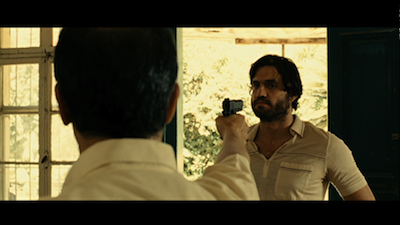
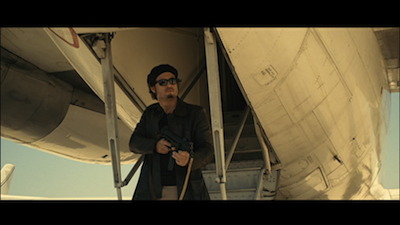
The man who would be codenamed Carlos, and nicknamed "The Jackal," was a Venezuelan-born son of Communists who, at the age of 21, joined the Popular Front for the Liberation of Palestine and became one of their most brutal enforcers. The 2010 biographical film Carlos by French director Olivier Assayas explores his life from his joining the PFLP in the early 1970s through his arrest by the French government in 1994. With a five-hour-plus running time, it is a filmmaking marathon. Its origin was on French TV, but it showed in North America as a multi-part special event screening at various theaters and was available on demand to cable TV subscribers before its eventual Criterion release.

Édgar Ramírez, previously seen as a CIA agent in The Bourne Identity and a revolutionary in Steven Soderbergh's Che [review], stars as Ilich Ramírez Sánchez, the ambitious young idealist who took the name Carlos as his wartime handle, fighting for the liberation of Palestine and the destruction of capitalist imperialism. As portrayed here, Carlos is impatient for action, ready to make a name for himself and strike a blow in the name of the almighty cause. He distinguishes himself as a dangerous man after an impulsive shooting of several French police officers. His fame as an international menace is then solidified when he leads a raid on an OPEC meeting in Austria, taking diplomats from around the world hostage. The mission doesn't go entirely as planned, and this has good and bad consequences. The head of the PFLP disowns him, but this frees Carlos to form his own group and start giving the orders himself.
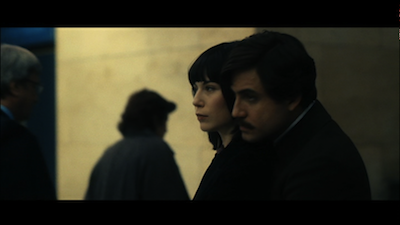


Assayas, whose films are as diverse as the quiet family drama Summer Hours [review] and the clumsy actioner Boarding Gate [review], co-wrote the script for Carlos with television writer Dan Franck. Each segment of Carlos begins with a disclaimer that the film has taken a fictional approach to the story, as much of what Carlos the Jackal really did is not entirely known. Certain connections have to be made for the sake of narrative structure. In terms of storytelling, the movie has a dry, historical approach, putting it in league with Che and The Baader Meinhof Complex [review], as well as, to a degree, the two Mesrine films [review part 1, review part 2]. This kind of docudrama seems to be an emerging genre, adopting a dispassionate approach that is almost apolitical in its just-the-facts approach. We are given very little background information on Carlos, and his mission is more of an abstract concept, there is no statement of intent. As the movie wears on, this seems to be part of Assayas' point: as he is unmoored from his idealistic safety zone, Carlos' activities seem to be less and less about the "struggle," and more about just maintaining his underground lifestyle. Alliances shift, and there really is no endgame. Whoever is on top is on top, and tomorrow it will be someone else.


This technique works for most of the movie. Assayas adopts the look and rhythm of the best 1970s American films, which is fitting given the period nature of the piece. The convoluted structure of the story is also akin to tangled espionage dramas that emerged as a result of the Cold War, with secret agents so deep in the field, they tend to forget what mission put them out there in the first place. Édgar Ramírez is good as Carlos, though he is missing a certain charisma that might make the terrorist more of a romantic figure, the way Benicio Del Toro gave a little extra something to Che Guevara just by virtue of his being Benicio Del Toro. Ramírez lacks the same commanding presence. Still, he brings a compelling complexity to the character. Carlos believed he had a death sentence hanging over his head, and he used it as an excuse to drink and chase skirts. You also have to admire the actor's commitment. He lets his appearance go to match his subject's weight gain over the years. This all may be a canny move by Assayas. Carlos is essentially a gangster picture, the story of a murderer who lives the life and damns the consequences, but at the same time, subverts the genre by never letting the Jackal be the seductive dog others might choose to portray.

Other characters go in and out of the story, including European operatives and various Arab allies. We see different plots carried out by Carlos and his men, most of which fail in some way or another. We also see him flounder at relationships, including a marriage to one of his own "soldiers" (Nora von Waldstätten). There is always a question of whether Carlos takes his threat level more serious than the rest of the world, if he exaggerates how much of a wanted man he really is; but then, his eventual takedown somewhat vindicates him.


Carlos is really only cast adrift when Carlos himself is. The final hour or so of the film, following the toppling of the Berlin Wall and the end of the Cold War, starts to drag. Frankly, it's because Carlos is not that interesting by this point. He has settled into the kind of bourgeois domestic lifestyle he otherwise decried. He even starts driving a Mercedes. Carlos drifts aimlessly from one country to the next, going to whomever will offer him political asylum. If in the first part of the film he is a decisive man of action, and in the second a delusional hothead, by the third he is not much at all. He teaches classes in guerilla theory in the Sudan, and postpones surgery for a swollen testicle to get liposuction on his love handles. In retrospect, he should probably be thankful to the French secret service for taking the time to come after him, because he's got nothing going on. In terms of the film's arc, Assayas should have sent them in 20 or 30 minutes sooner. It's almost like a backwards horror movie: instead of the boring bits lulling us into a place where we can be scared, Assayas shocks us first, and thus makes the boredom that follows all the more uncomfortable.


Even with that complaint, Carlos still stands as a brash triumph. One has to wonder if this kind of long-form filmmaking, if Che and Mesrine and Carlos, is cinema's reaction to the continued growth of cable television and all the can't-miss series from the past several years. Audiences are becoming more and more prepared to invest several hours in one storyline, and if they are willing to wait from week to week or devour them in one massive go on DVD, then maybe they'd be willing to sit in a theatre for six hours, too. It's an experience akin to spending an afternoon engrossed in a novel. You get so much more out of taking in so much at once. Carlos is certainly more engrossing and more informative than a generic, compact Hollywood biopic. It pays back on the investment you put into it.


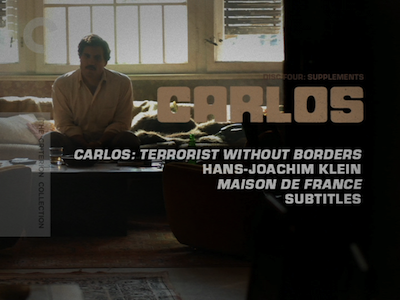
Criterion has released Carlos on DVD as a four-disc package (and separately as a Blu-ray). The discs come in a sturdy, thick case with an interior booklet. To compare this to Che again, if you own that DVD set, the company has used a similar approach to this political epic as they did that one. The three main discs separately house each chapter of the movie, as well as bonus features that look at the film's production; the fourth disc has a trio of supplements, including two lengthy documentaries that look at the real-life Carlos. These are fascinating as they reinforce Assayas' attention to detail and give some further perspective to how interesting his dramatic approach was.
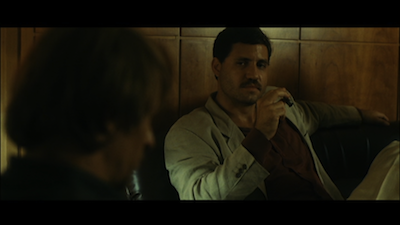

The hour-long Carlos: Terrorist Without Borders was made for French television (presumably in the 1990s) and covers the early life and career of Ilich Ramirez Sanchez, the man known as "Carlos." We peek in on his childhood and his early activist beginnings, and the archivists uncover rare photos and footage of the terrorist. Investigators and journalists give insight into the history, while associates like Hans-Joachim Klein sit for new interviews and give first-hand accounts. The other feature-length documentary, Mason de France (88 minutes), also gets to talk to colleagues of the Jackal, including his former lover, Madelina Kopp, and his wife at the time of filming.

Kopp was actually one of the motivating factors behind the Maison de France bombing, an incident not detailed in Carlos. While she and one of their other associates were in jail in Paris, Carlos ordered various terrorist attacks around Europe in protest of their incarceration and to influence their release. This particular bombing was at a French consulate in Berlin, and one person was left dead. The focus of this film is that victim, and the filmmakers talk to his friends and family in order to put a human face on the effects of terrorism. For those who might worry that Carlos glamorizes the killer and makes him an antihero, this documentary effectively lessens the glow of the dramatic construct. Ironically, Carlos' efforts to free Kopp got her sentence doubled.


This disc was provided by the Criterion Collection for purposes of review.