Sacha Guitry is why I like Criterion's Eclipse Series. Him specifically, but also what he represents in general. He now sits alongside Raymond Bernard [
review], Larisa Shepitko [review
1,
2], and Hiroshi Shimizu [
review] as filmmakers that I wouldn't have known about had Criterion not started their little boutique line. Eclipse is dedicated to highlighting films and filmmakers that may not have the name recognition to lead a big release, but whom could benefit from the rediscovery made possible by an affordable midline package.
Presenting Sacha Guitry is the 22nd Eclipse set, and it features four films from the acclaimed playwright turned cinematic auteur. According to the liner notes in the lead film, Guitry was the king of the Paris stage in the 1920s, and he dismissed film as a go-nowhere art form, limited by rickety technology and not capable of the poetry of live theatre. Once sound came into play, however, Guitry saw the error of his ways and, as they say, if you can't beat them, join them. After a couple of misfires, he landed on what would become his signature film.
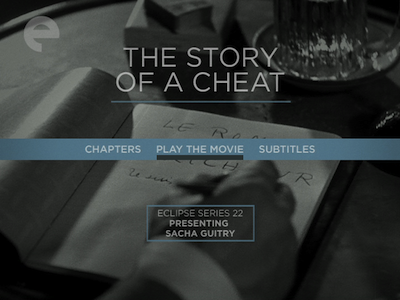
The Story of a Cheat (81 minutes) was made in 1936, and Guitry wrote, directed, and starred as the adult version of his title character, known simply as the Cheat (or, in French,
tricheur). As a child (and played by Serge Grave), the Cheat's first crime was to steal a few coins from the till of his family's store so he could buy some marbles. When he was caught, his punishment was to go without supper--on the night the eleven other people in his family were to accidentally eat a batch of poison mushrooms. The Cheat's dishonesty was rewarded, an ironic lesson in moral consequence.
As he grew older, Cheat got work as a bellboy, and then a soldier, and then a croupier in Monaco. In each, he tried to be honest, but wherever he went, the people he met tried to pull him into some kind of crime. He is almost implicated in the assassination of Czar Nicholas II, seduced by a pretty hotel thief (Rosine Derean), and hypnotized by a lady gambler (Jacqueline Delubac) looking for a fix. In the latter case, his willingness to go along with the scheme leads to failure, and when he is punished for stealing anyway, he decides to give in and become a real card sharp. Thus begins a long and lucrative career, ended only by yet another moral revelation.

The narrative is simple enough, but as in all things, it's the telling that is key. In a fascinating twist, Sacha Guitry's spectacular film employs the mechanics of silent film while still embracing sound. The story is framed by the older Cheat (Guitry in white hair and make-up) writing his memoirs, and the entire run through past history is narrated in voiceover by the memoirist. Any dialogue is spoken by Guitry, it is only mouthed by the other actors. The only times we hear other performers speaking is in interludes back to the café where, in the film's present day, the Cheat is laying his story down. There, he has poignant and ironic encounters that match up with what is happening in his manuscript.
This clever device could grow tiresome under the wrong direction, but Guitry's execution is lively and playful. His camera is lithe and probing, taking cues from the narration, and the combination of words and pictures pushes the story forward at a jaunty pace. Guitry uses still images, dissolves, and montage to move swiftly through time, never letting the tale rest too long in one place.
The Story of a Cheat maintains a humorous air, garnering quite a few laughs, and settling at a pleasant punchline that is cute without being trite.
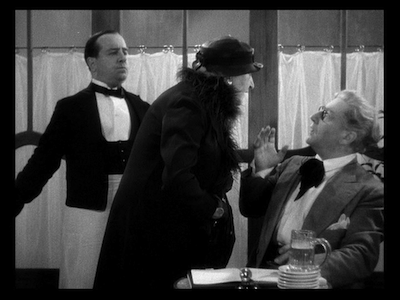
The neophyte director's way with mis en scene and his agility with the camera is reminiscent of the work of his contemporary, Jean Renoir, and it's no surprise that he apparently had fans in
Orson Welles,
Francois Truffaut, and
Alain Resnais. From the very start of
The Story of a Cheat, as Guitry takes us on a tour of his set and introduces us to his crew, it is clear we are in the presence of a seasoned raconteur who has discovered a whole new way to deliver his party anecdotes. Why only tell a small group when you can share the story with thousands? Or millions!
Clearly on a creative steak, Guitry followed this cinematic breakthrough with another formally ambitious film a year later.
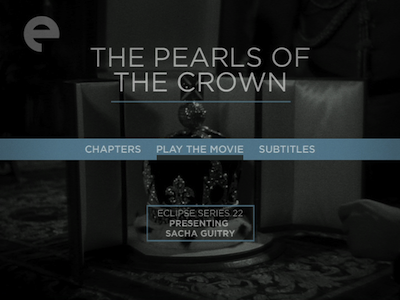
The Pearls of the Crown (1937; 105 minutes) is the technical opposite of
Cheat. Instead of no dialogue, it has a veritable whirlwind of words. The story, which Guitry co-wrote with Christian-Jaque, begins with the question of how the crown of England got its three decorative pearls. Guitry, playing a writer named Jean Martin, is researching in his study when he finds the tale, and he begins to share it with his wife Jean (Jacqueline Delubac again; she was Guitry's wife off the set, too). At the same time, an assistant to the current King of England is telling the same story to his regent, while an aide to the Pope is explaining it to the religious leader in Italy.
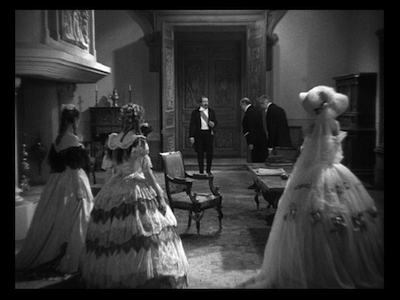
What follows is a multi-lingual historical comedy, detailing the rivalries of France's Francois I, England's Henry VIII (Lynn Harding), and Italy's Pope Clement VII (Ermete Zacconi). Guitry, who plays Francois I himself, deftly jumps back and forth, creating an assured, fast-paced rhythm that links all three countries in both timelines. The story also travels across Europe and Asia as Clement sends a poor servant off on what is supposed to be a wild goose chase to find five identical pearls to match the two he already has. This leads to seven pearls in all, four of which end up on the Crown, the other three stolen by an English crook. The second half of the movie features the trio of storytellers converging in England before heading off in different directions, each to find one of the missing baubles.

Guitry plays a total of four roles in his film, including Napoleon III and a French aristocrat named Barras. Delubac also plays Marie Stuart, Queen of Scotland, and Josephine, the wife of Napoleon I (Emile Drain). There are a lot of pieces to this romp through history, yet Guitry's perception is so clear, one never gets lost in all the jumping around.
The Pearls of the Crown also has a pervasive sense of whimsy, and so it's fun from start to finish. Even with all the pomp and circumstance of the historical settings, my favorite bit is in the modern context, when Jacqueline Delubac is confronted by one of the owners of the pearls, whom she has been following. As per her husband's instructions, she only responds to the man with adverbs. It's a scene that would be perfectly at home in a Preston Sturges movie.

Made the same year as
The Pearls of the Crown,
Désiré (1937; 97 minutes) is a comedy of the social classes, a farcical
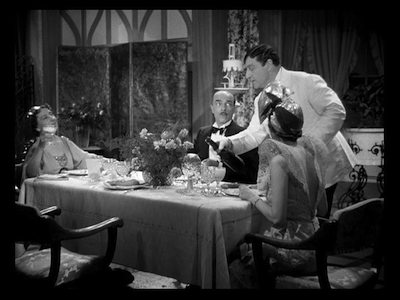
The Rules of the Game with the writer/director playing one of the members of the downstairs crew. Guitry stars as Désiré Tronchais, a new valet in the home of former actress Odette Cléry (Jacqueline Delubac). It's a place that could use a little shaking up. In the very funny opening scenes, the chambermaid (played by Arletty, who was also the Queen of Abyssinia under all that blackface in
Pearls) lays out how perturbed she is by her boss, whose passive aggressive grousing the girl sees right through.
Désiré enters the scene as preparations are being made to go on holiday, but his scandalous past as a ladies man follows him. Odette is in a relationship with a government minister (Jacques Baumer), who will not marry her as long as he is in his position. A woman of propriety, Odette tries to dismiss Désiré when she learns he seduced his prior employer (Genevieve Vix), and only lets him stay after he swears he is not attracted to her. She swears likewise, but once they are at the country home where Odette and her man, Felix, spend every summer, the two start dreaming about one another. Loudly. Désiré is heard by the maid crying out for Odette in his sleep, and Felix hears Odette calling for Désiré. Avoidance, innuendo, and misunderstanding follows.
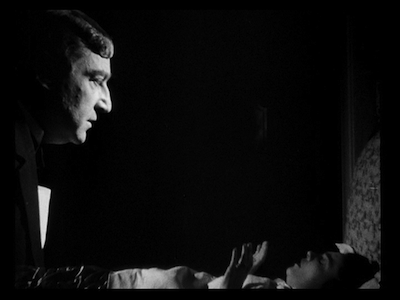
Compared to the other films,
Désiré is fairly conventional, but it is so slickly made that it doesn't matter. The writing is ribald and witty, and Guitry's frank views of eroticism and romantic love make swell fodder for his up-ending of the social comedy. Here, the very act of being servile is its own emotional--and, at times, sexual--reward, and it pains Désiré to step out from his role as valet to instruct the woman who should be ordering
him around. Delubac is delectable as the society lady, and Arletty is quite funny as the much looser maid. She plays her as if she just stepped in from singing in a saloon, emphasizing that when it comes down to it, these lower class folks are a lot more fun.
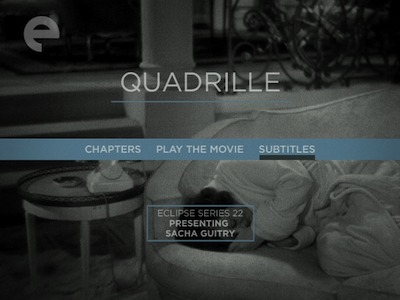
Désiré and the final film in the box,
Quadrille (1938; 95 mins.), were both adapted by Guitry from his own stage plays, and
Quadrille provides the cosmopolitan personality with a role that allows him to be his most sophisticated and droll. I haven't mentioned it yet, but Guitry's screen presence is quite winning, and he grows more assured with each film.
Quadrille even provides him with a tremendous verbal sparring partner. Gaby Morlay (
Le plaisir -
review) plays Paulette Nanteuil, the long-term mistress of Guitry's newspaper editor Philippe. She is a stage actress, and as befitting the job, is flighty, but also loving and a bit of a scamp. When she meets American film actor Carl Herickson (George Grey), he asks her for her autograph, since she's the only one in the room that doesn't ask for his. She signs his paper “Claudine André,” who just so happens to be her best friend and a reporter who, at that moment, is upstairs waiting alongside Philippe to interview Carl. (Claudine is played by Jacqueline Delubac.)
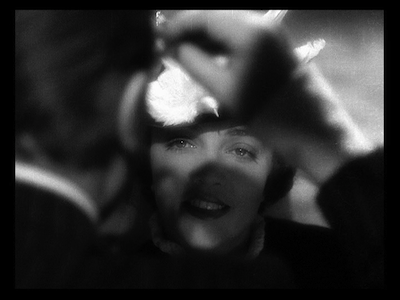
From here,
Quadrille transforms into either a farcical sex comedy or a cynical satire on romance. Or really, both. Carl seduces Paulette, Paulette confesses to Philippe, Philippe professes his love for Claudine, Claudine has already made a pass at Carl, etc. Deals are made, others are broken, and Guitry throws out some pretty sharp barbs about the nature of love and women and the whole shebang. The morning-after scene when Philippe finds Paulette in Carl's hotel room is a magnificent dance of words, as Paulette lobs up her manipulations and Philippe bats them away. It's all terribly civilized. Claudine is the most inscrutable of the cast, it's hard to figure what she's playing at most of the time. She starts off as the innocent bystander, but as the song once said, not that innocent.
Quadrille is a very talky movie, as is
Désiré (Guitry gives himself some real mouthfuls in the latter). Yet, they don't show the dustiness of the stage. Guitry finds and takes advantage of every opportunity to move his camera. He builds comedic tension, for instance, by cutting back and forth between Claudine and Philippe waiting for Carl and Carl hopping, skipping, and jumping in their direction. Not long after, he turns the conceited actor's very act of undressing into a sight gag, panning the camera back and forth across the hotel room to follow his discarded clothes.
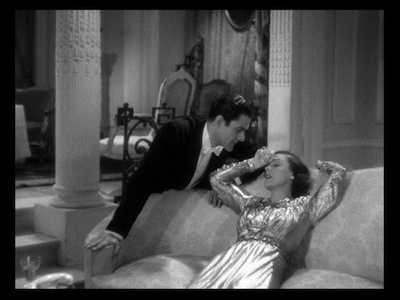
Front to back,
Presenting Sacha Guitry - Eclipse Series 22 is energized with mirth. These are tremendously light-hearted movies that, though never shallow, never let the deeper themes and ideas tug at the smiles Sacha Guitry is so intent on putting on his audience's faces. The tone of these pictures reminds me of another Eclipse Box, the eighth:
Lubitsch Musicals [review
1,
2,
3. Both Sacha Guitry and Ernst Lubitsch come from a stage background, and both enjoy life and the scoundrels that humans can be when pursuing happiness and love. They are easy movies to watch, you'll likely tear through the sets in no time at all. The only complaint I have is that there isn't more.
For a full rundown on the special features, read the full review at DVDTalk.