Showing posts with label clouzot. Show all posts

Saturday, February 23, 2019

...AND GOD CREATED WOMAN - #77


Following last week’s viewing of Clouzot’s La verité [review] and the questions it raised regarding how the director chose to use the image and reputation of his lead actress, Brigitte Bardot, it seemed like the right time to back up and take a look at the film that defined Bardot as an international sex symbol: 1956’s ...And God Created Woman.

Dubbed by the Criterion edition’s back cover hype as “a milestone in cinematic naughtiness,” ...And God Created Woman has little cause to be remembered beyond Bardot’s petulant performance and all the excuses the filmmakers find to get her undressed. ...And God Created Woman was the debut effort of writer/director Roger Vadim (Barbarella), who was married to Bardot at the time, and he misses no opportunity in exploiting his famous wife. Or wives. This was Vadim’s m.o., going from here to have both public and cinematic liaisons with Jane Fonda and Catherine Deneuve.


Truth be told, he needs these women to prop him up. Roger Vadim is not a good film director. He is pedestrian, at best. Most of ...And God Created Woman is shot straight-on, with little movement or composition. Vadim’s single trick is to sometimes use a mirror reflection as an extension of his leering camera eye. He probably would have had a better career as a pornographer, as the only thing he seems to know how to do exceptionally well is pose a naked body. So much so that in La verité Clouzot calls back to the first appearance of the nude Bardot in ...And God Created Woman--lounging on her stomach, derriere in full view--to show her character seducing the man she’d later kill.

Not that a more artful flourish could have done much for ...And God Created Woman’s script. This is standard melodrama, with Curd Jurgens (The Spy Who Loved Me) as a wealthy developer looking to buy a tiny family shipyard to secure all the land he needs to build a casino. The family doesn’t want to sell, however, and Jurgens locks horns with the eldest son (Jean-Louis Trintignant, (Trois Coleurs: Red [review], Amour [review]). Both, of course, are also involved with Bardot, whose Juliette likes flirting with the older man but genuinely cares for the younger. When Trintignant’s Michel proves to be a cad, Juliette marries his younger brother--predictably reigniting the others’ desire to have her.


If you were to make a parody of what a French film is supposed to be, whatever cliché comes to mind is most likely ...And God Created Woman. The gray morality play about a young woman with multiple lovers who is both lauded and punished for her sexuality would be sitcom fodder for years to come. Remember Rochelle, Rochelle? Too bad in reality ...And God Created Woman is more boring than laughable. Then again, this also gives credence to my theory that Clouzot was tearing apart such banal tropes in La verité, giving some agency back to the performer and the image that defined her. Skip ahead two years and just watch that far superior drama. Or, if you must, treat ...And God Created Woman as it seems intended, and just fast forward past the story to the naked bits.


For more Bardot and Vadim, check my review of The Brigitte Bardot Classic Collection.

Monday, February 18, 2019

LA VERITE - #960


1960’s La vérité is a cracking courtroom drama. Directed by Henri Georges-Clouzot (Diabolique [review]) and starring Brigitte Bardot (Contempt [review]), La vérité builds itself around the testimonies in the case of one Gilbert Tellier (Sami Frey, Band of Outsiders [review]), a music student and up-and-coming orchestra conductor, now deceased. The timeline bounces from the witness box to flashbacks of the real events and back again, creating two narratives: the trial activity and the interpersonal drama that led to the homicide. These dual tracks put the audience in the position of the ultra-jury, our macro view allowing us to judge all the participants and all sides in a way the film’s characters cannot.


Clouzot’s jam-packed courtroom is a living, breathing entity. There are prosecutors and defense attorneys, reporters and jurors, judges and witnesses. In Clouzot’s view, they are all equally important, and how the mass functions creates a miniature society within the larger whole, a shadow community that will make sense of what happens out in the world. The lawyers on both sides--prosecutor Eparvier (Paul Meurisse, Army of Shadows [review]) and defense attorney Guéri (Charles Vanel, the 1934 Les misérables [review])--have their roles and their relationships. The prosecution is stern, the defense disruptive and irreverent. We clock their machinations, and weigh the impact it has on others, including the victim’s mother.


But above all of them--quite literally, she is housed directly over her defense team--is the accused, Dominque Marceau, played with a remarkable emotional breadth by Bardot. Dominque is not contesting the fact that she killed Tellier, the only question is what drove her. Was this a premeditated slaying or a crime of passion? Though witnesses to their tumultuous, unhealthy love affair only really know what parts they were personally privy to, Clouzot’s camera is not bound by their words. The flashbacks form one linear narrative of a provincial girl who loses herself to the temptations of Paris, attracting the attention of many men, but only giving her full self to one. Yet, as the prosecution paints Dominique out to be a cruel hussy destroying a sensitive artist, we see how Tellier was jealous, possessive, and just as cruel himself.


In this day and age, there has been much debate over “victim shaming,” how women who have been victims of assault have their own lives put on trial, suggesting their own moral standards or life choices brought the attack on themselves. This tactic, as we see time and again, is wrong, excusing the criminal with facts that are irrelevant. It’s clear from La vérité that women have been subject to such double standards for a long time. Sure, Dominque is guilty, but is she less deserving of a defense because she is in touch with her sexuality? Her lawyer makes no bones about it: the answer is no. The compelling thing here, however, is that we also must reject the notion that Tellier deserved or asked to be killed. Life is not so clean-cut as that.


The fact that the woman in question is Brigitte Bardot makes it all the more interesting, since most audience members in 1960 came with their own preconceived notions of who she was. From the get-go, La vérité plays on her image as a sex symbol. With her hair up and wearing a black dress that essentially covers her from the neck on down, her first appearance in court still draws leers from the men in the gallery. Likewise, we are invited to gawk at her body in various scenes throughout La vérité. Is Clouzot merely seducing us alongside Tellier, or are we just as bad in demanding that the actress gives us a peek? After her sexy turn in And God Created Woman moviegoers expected to see more of Bardot than most other actresses, and I am sure studios were more than happy to oblige. One could even question if Clouzot is exposing her naked curves in service to the script...or the box office.


I’d like to think the former, because there is very little, if anything, in La vérité that the director has not considered through to the finest details, from the doodles on the defense lawyer’s legal pad to the posters on everyone’s bedroom walls to the layout of Tellier’s apartment building and how it allows Dominque to commit murder undetected (Panic Room-era David Fincher would nod in approval). As I mentioned, the courtroom is filled with spectators, and Clouzot regularly cuts to a wide shot just to remind us of what kind of circus Dominique is being subjected to. Yet, it’s those smaller details, the close-ups on observers and participants, that bring further life to the trial. There is never time to be bored, there is always something happening.


That also gives more evidence to Clouzot’s implication of the audience through decorative choices. As La vérité reaches its emotional crescendo, and Bardot is given an opportunity to tear into Monique’s breakdown, quieting the whole of the courtroom, I am sure that theatres showing La vérité in 1960 were also silent. The final outcome of the film, one could argue, is not the fault of the girl, but of a hypocritical society that fed on her shame and turned her pain into entertainment.

Fun Quiz: Which is more French, the ending of La vérité or the ending of yesterday’s review, Cold Water? Both rely on a note from a doomed young woman, but is one more romantically existential than the other?


This disc was provided by the Criterion Collection for purposes of review.

Monday, December 17, 2018

PANIQUE - #955


A small Parisian neighborhood. A carnival. A dead body. A local outcast. A young hustler. A conflicted femme fatale. Nosy neighbors.

These are the essential ingredients of Julien Duvivier’s 1946 French noir Panique. Season with romantic intentions, double-crosses, and even a little mystical mumbo jumbo, and you have the sort of emotional potboiler Fritz Lang liked to make with Edward G. Robinson and Joan Bennett. Here instead we have the great Michel Simon (L’Atalante [review], The Two of Us [review]) and Viviane Romance (Any Number Can Win) as, respectively, the older man who lives a life of intellectual isolation and the woman too loyal to her criminal boyfriend (Paul Bernard, Les Dames du Bois du Boulogne) for her own good. It’s a great set up, taken from a novel by Georges Simenon, and one Duvivier plans to milk for all the drama and intrigue he can.


Simon leads the picture as Monsieur Hire, a strange character, dismissive of his neighbors, but nice to children and awkward in courtship. His early contact with Alice (Romance) is borderline stalkerish. Hire is a man of many lives: he works under a different name, peddling astrology as if it were a science, and he has a past he abandoned when his wife ditched him for his best friend. Yet, the more we learn, the less shady he becomes, our suspicions replaced by sadness and even sympathy.

Alice is similarly charmed by Hire--though, initially, she only indulges him because he claims to have evidence implicating Alfred (Bernard) in the killing. Alice just spent three years in jail taking the rap for a robbery Alfred committed, and she’s not prepared to lose her lover just yet. Caught between these two unsavories, the unspoken question becomes: whose affection is more genuine? What does each man stand to gain from maintaining her love?


That nothing comes totally clear, that Duvivier allows for such gray motivations, is what keeps Panique so intriguing from start to finish. Viviane Romance plays Alice as sincerely conflicted all the way to the end, despite Alfred showing himself as having no nuance whatsoever. And how are we not to be drawn in by Michel Simon’s natural charisma, even as he does his best to tamp it down? There is no distinct moment in Panique when M. Hire is shown as being entirely good or sympathetic. When he confesses his greatest pain, he follows it by showing his guiltiest pleasure, the photos he takes of the downtrodden and indigent, a spectator in other people’s misery. In classic Beauty and the Beast fashion, he only presents his nobler intentions after making the basest of threats. Simon’s performance is like one long dare being leveled at the audience. Will you have the guts to side with a man who we know can be a real creep?


Panique is like a melding of American suspense pictures and Henri-Georges Clouzot’s morality plays, particularly the small-town poison-pen drama Le Corbeau. At times, you might also think of Hitchcock’s Rebecca (Hire taking Alice to his old house) or The Hunchback of Notre Dame (Panique’s desperate climax). Duvivier’s only true genre is melodrama, even if he sharpens it on crime-fiction tropes or winks at gothic traditions. His construction is artful, relying on shadowy actions and voyeuristic impulses--both ours and that of the extended cast--to keep the plot energized. There are even some visceral action scenes. You’ve never seen as savage a bumper car ride as you’ll see in Panique. And it’s no throwaway scene, either; the memory of these dangerous amusements will come flooding back in the final act when the mob leaps from the carnival rides and takes to the streets.


So Panique has a little bit of everything while always feeling like just one thing. There are no unnecessary digressions, no excess fat. Rather, the film is fine-tuned for maximum effect, ceaselessly entertaining and always surprising. That it comes immediately after the end of World War II, and was the first film that Duvivier made upon returning from Hollywood, it must have also had many personal overtones for the director, a parable of groupthink, collaboration, and individuality vs. the mob. In that, it is also like Le Corbeau in how it despises petty small-town gossip, but even more challenging for pushing us to root for a man who, under many other circumstances, might not deserve it. As with any good story, it’s as relevant as ever, though now the controversy and drama would never spill into the public square, it would just remain online--which, even after seeing how wrong things go in Panique, seems all the more barbaric.


This disc provided by the Criterion Collection for purposes of review.


Tuesday, July 1, 2014

JUDEX - #710


You’re just going to have to indulge outright that there is going to be some self-promotion in this one. It’s bound to happen from time to time. Happened before, will happen again. Sometimes the right paths just cross.

In this case, it’s some fortuitous coincidence that I just now watched the new Blu-ray of Georges Franju’s 1963 pulp homage Judex. This spiritual remake of Louis Feuillade’s 1916 silent cliffhanger features a mysterious, justice-minded magician (Channing Pollock) intent on making an ethically challenged rich man pay for his crimes. Its roots predate comic books, but Feuillade’s film, as well as his serials Fantomas and Les vampires [review], drew from and inspired the pulps, and then also inspired the comics industry as it blossomed to life. This Criterion edition even features a cover by artist Ronald Wimberly, himself channeling a little Eduardo Risso, bringing lurid life to Judex’s stonefaced crimefighter and his masked archnemesis.


This viewing also happens on the eve of Oni Press releasing a comic book of mine called Archer Coe and the Thousand Natural Shocks. It stars a hypnotist in a classic domino mask looking to stop a murder plot involving a wealthy banker and his emotionally distant wife. Created with artist Dan Christensen, Archer Coe and the Thousand Natural Shocks draws on a long tradition of stoic heroes working their tricks in the dark, from the Shadow to the Spirit to Mandrake the Magician. And yes, even to silent French cinema--or, in this case, 1960s French cinema. Even if it is just a startling coincidence. Though I had seen bits of Feuillade’s Judex while working in a video store, I wasn’t even aware of Franju’s until Criterion announced it was on its way. In my lead-up to Archer Coe, I was watching American noir like Edmund Goulding’s Nightmare Alley and Otto Preminger’s Laura; judging by the evidence, it’s almost like I tapped into some Jungian story space to draw directly from the Judex redo, as well.


The plot I’ve hinted at in the above is not much more complicated that what I’ve suggested. An oily banker (Michel Vitold) has started receiving threatening notes demanding he give up his fortune to the people he’s wronged or suffer the consequences. The threats are signed “Judex,” or “judge.” Believing himself untouchable, the banker refuses, only to fall down dead at the time his accuser appointed for him. The victim’s daughter Jacqueline (Edith Scob, also in Franju’s Eyes Without a Face and Assayas’ Summer Hours [review]) inherits his fortune, but when she discovers the less-than-savory ways in which daddy earned it, she rejects the money, giving Judex what he sought all along. Meanwhile, the banker’s would-be mistress Diana (Francine Bergé, Mr. Klein) wants the cash for herself and starts a plot to kill the girl and steal the riches.


Mimicking the serialized nature of the silent original, Franju maintains an episodic narrative, allowing for an ineffectual private detective (Jacques Jouanneau) to wander in and out of the story, and for Diana to try multiple plots that all go wrong As these occur, Judex lingers around, keeping watch over Jacqueline and manipulating other lives in hopes of bringing about justice. In terms of action, he’s far from Batman. Rather, he tends to be too late and not much of a fighter when he arrives on the scene. His only truly effective moment is early on when he first shows up wearing an elaborate bird’s mask at the banker’s party and performs magic tricks with doves. He appears there as a creepy specter bringing death to the condemned. It’s the closest you’ll ever get to having fun with this guy at a party.


Which turns out to be a major drawback for Franju’s film. For a movie that features both a wicked villainess in a black catsuit and a pretty circus acrobat (Sylva Koscina, Juliet of the Spirits) who randomly shows up to help out, Judex is decidedly unsexy. None of the relationships have much sizzle, nor does the action really ever take off. Instead, this is like a drawing room approximation of a lurid murder mystery: perfectly poised, artfully styled, but maybe too self-aware and too smart for its own good.


Luckily all of that stylization means Franju has a lot of good will to burn. He also makes a smart choice in his main villain. Francine Bergé is seductively evil, equally at home in a hipster’s dancehall outfit and a nun’s habit. If only the director had effectively let his femme fatale loose on his stuffed-shirt of a hero, Judex could have been a real hoot! (Imagine it in the hands of Henri-Georges Clouzot....)

Maybe I’ll have to resurrect Diana for one of the future adventures of Archer Coe.


In addition to the sparkling restoration of Judex, Criterion has included a bunch of bonus features on their dual-format release. Amongst those are a recent interview with Bergé, a biographical profile of Franju, and two of the director’s early shorts. One of those, the half-hour Le grand Méliès, pays tribute to the legendary cinematic innovator. Like Feuillade, Méliès was one of Franju’s heroes, and this mini-biopic both tells Méliès’ story and adopts some of his techniques. Featuring the filmmaker’s widow as herself, and their son Andre as his father, Le grand Méliès recreates the post-war years when the artist ran a toy shop in a train station (as seen in Scorsese’s Hugo), one of his magical stage shows, and his journey as an early cinema pioneer, culminating in making A Trip to the Moon. It’s a loving little doff of the cap from one director back through time to another.


This disc was provided by the Criterion Collection for purposes of review.


Tuesday, May 31, 2011

SIDELINE: MORE REVIEWS FOR 5/11

A round-up of my reviews for non-Criterion movies in the past month.


IN THEATRES...

* The Beaver, Jodie Foster directs Mel Gibson, who talks through a beaver puppet. Yes, it's pretty crazy.

* Bridesmaids, this Kristen Wiig-led comedy is a real winner. Funny and heartfelt. And next time someone asks if Bridesmaids is a chick version of The Hangover, ask them if that's a stupid person's version of a smart question.

* Cave of Forgotten Dreams, Werner Herzog's 3D documentary about the Chauvet Caves. My favorite movie of the year so far.

* Everything Must Go, in which Will Ferrell drinks some sad beer, channels Raymond Carver, and is pretty good at doing it.

* Hesher, Joseph Gordon-Levitt stars as the title character. Hit an open chord, take off your shirt, and be a teenage dirtbag, baby.

* Thor, another winner from Marvel. Kenneth Branagh's adaptation of the comic is mighty fun.

* True Legend, a disappointing new action flick from the awesome martial arts choreographer Yuen Woo-Ping. Lame story, too much CGI.


The NW Film Center in Portland also had a festival of twelve films starring Catherine Deneuve. I picked some of my favorites for the Portland Mercury. Read "The Two Faces of Deneuve."

I also wrote blurbs for older movies doing the revival rounds:

* Sergei Eisenstein's Battleship Potemkin
* Claude Lanzmann’s Shoah

ON DVD/BD...

* Araya, Margot Benacerraf's 1959 blending of fact and fiction on the salt marshes of Venezuela.

* Bananas!*, a documentary about the fight against Dole Fruit, accused of poisoning Nicaraguan workers in the 1970s.

* The Captive City, Robert Wise's by-numbers anti-crime PSA from the 1950s.


* Guy and Madeline on a Park Bench, an intriguing mash-up of classic indie cinema and classic movie musicals.

* Henri-Georges Clouzot's Inferno, a stupendous documentary sifting through the remains of the Diabolique-director's unfinished would-be masterpiece.

* Hold On!, Herman's Hermits come to America, join the space race, play some music, pitch some woo.

* The Misfits, John Huston directs Clark Gable and Marilyn Monroe in their final screen roles. Also stars Eli Wallach and Montgomery Clift, in a script by Arthur Miller.

* Not as a Stranger, starring Robert Mitchum as a doctor who can heal anything but his own bad impulses. Directed by Stanley Kramer.

* Shoeshine, a Neorealist classic from Vittorio De Sica, released 1946.

* The Unloved, Samantha Morton's softly rendered, heartfelt directorial debut.

Wednesday, May 18, 2011

DIABOLIQUE (Blu-Ray) - #35


I first saw Henri-Georges Clouzot's 1955 thriller Diabolique by accident. It must have been 1995 or thereabouts, back when I was editing a comic book called Triple-X. The creators, Arnold and Jacob Pander, kept referencing a movie called Diabolique as being an inspiration for the Eurotrash look of their futuristic revolutionaries. Intrigued, I went out and rented a copy of the film. When I was done, I was kind of confused. What did a black-and-white shocker about two women murdering the man who done them wrong have to do with hooded tricksters and underground newspapers?

Well, nothing, as it turns out. I had rented the wrong movie. They meant Danger: Diabolik, which my neighborhood Hollywood Video didn't have. Lucky for me, though, because I might not have otherwise found this Diabolique, or when I had, I might not have been able to go into it as a blank slate. It's a movie that is full of surprises, delivering both emotional suckerpunches and truly gruesome cinematic scares. If you haven't seen it and know nothing more about it, I kind of want to dissuade you from reading further. Just go get it. You'll thank me later.
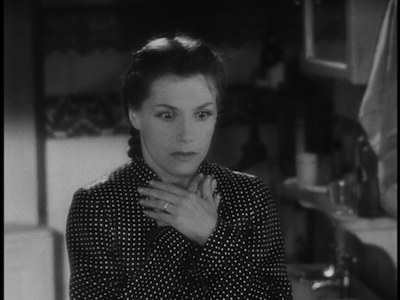


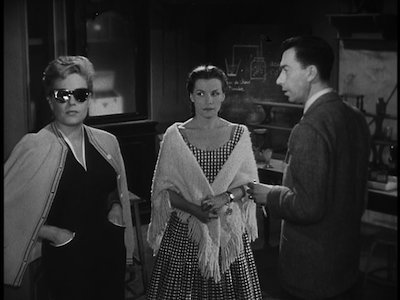
Diabolique is one hell of a genre picture, one that plays with the twisty conventions of a Hitchcock movie, wringing all of the horror out of the scandalous scenario it possibly can, while also building a movie full of pro-women proclamations and enough double-crosses to compete with the best film noir. The director's wife Vera Clouzot stars in Diabolique as Christina Delassalle, a language teacher whose dowery subsidizes the school run by her no-good husband Michel (Paul Meurisse). Michel is cheating on Christina with another teacher, the cynical blonde Nicole (Simone Signoret). The two women, the wife and the mistress, work side by side, giving them opportunity to compare notes. Both have plenty of reason to hate Michel. At the start of Diabolique, Nicole has to wear dark sunglasses because Michel has been smacking her around and she has a black eye. Oh, and did I mention that Christina is sickly with a heart condition? Yeah, if Michel survives this movie, he's got one hell of a career in politics ahead of him.
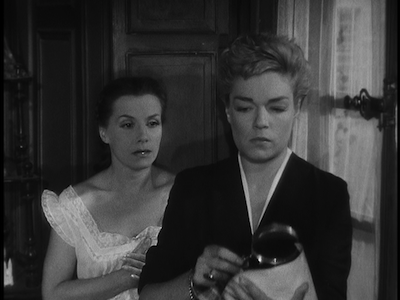
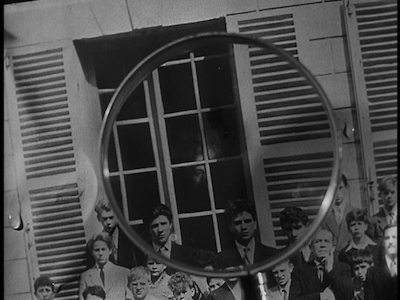


And surviving this movie will be his challenge. The ladies are looking to take the opportunity of a three-day weekend to enact a murder plot and take care of Michel once and for all. That's right, the sisters are going to do it for themselves, setting aside their differences to take care of the one thing that plagues them both. Their scheme involves poisoning and drowning--the rest, well, keep it schtum. The ladies play to type, with Christina being nervous and increasingly unhinged and Nicole being more calculating and determined. Both are excellent and they play off each other well, particularly as Christina's nerves start to affect Nicole. Simone Signoret, we know, is good at being in charge, but she's also excellent at falling apart.
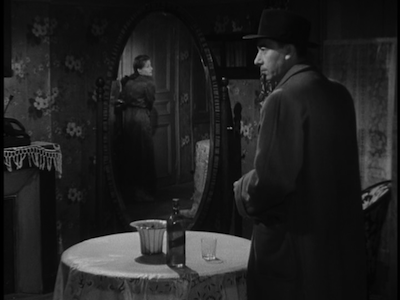


On the same track, Paul Meurisse plays a real convincing creep. He is sneering and snide and just nasty enough that he never really crosses over into caricature; Michel ends up being an honest-to-goodness villain. You'll be rooting for him to get what's coming his way. Diabolique's after-plot involves transporting the body for discovery in a place far from where the ladies have established their alibi--which is when things go weird. Clouzot employs every trick in the book to give his gals a fright. We even tread into some territory straight out of ghost stories. Whose face is that in the window in the class picture? Could it be...?

Diabolique is as tightly wound a film as you're likely to find. It's a remarkable thing watching all the pieces move into place, like observing the interior of a well-designed clock. Gears turn, springs stretch and contract, every element does its part to ring the hour. Clouzot shot on what looks like real sets, choosing interiors with lots of doors and intersecting corridors. He also puts silence to use, letting moments linger, the ambient noise of the surroundings adding to the suspense. The director never tips his hand to what is really going on, there is no winking to the audience, it all comes across with a very straight face. Just try not to get sucked in. Go on, try!


Diabolique was an early entry in the Criterion Collection, and the thirteen-year-old DVD was more than ready for an upgrade. The new high-definition transfer on the Blu-Ray is flat-out gorgeous. The overall image quality is crystal clear, with lovely renderings of black, white, and all the grays in between. Digital noise and scratches have been erased, making for a spotless viewing experience. No distractions here, you can just get caught up in the story, no tsk tsking at DVD glitches.

Amongst the trio of new extras on this disc, which consist mostly of critical commentary by admirers of the film, is an introduction to Diabolique by director Serge Bromberg. Bromberg is the director of the full-length documentary Henri-Georges Clouzot's Inferno, which I was also lucky enough to review on Blu-Ray recently. Though Bromberg's film doesn't dig too deep into Clouzot's earlier filmography, one can easily see how obsession and an attention to detail led to the influential director making such exacting motion pictures. L'enfer, the unfinished film unearthed in Henri-Georges Clouzot's Inferno, was a movie that tried to bring jealousy to life. It starred Romy Schneider as the object of these delusions, and it's a shame no one ever cast her and Simone Signoret to play daughter and mother. I can't be the only one to think they look alike!

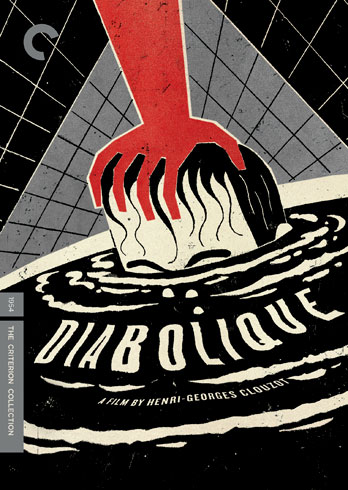
Special note should be made of the new packaging of Diabolique. Criterion contracted David Plunkett to provide the awesome illustrations for the cover of the case and also the cover of the interior booklet. The images cross simulated woodcut techniques with classic poster design to create pulpy illos that would be at home on any spinner rack selling dime novels. Check out more from Plunkett and Spur Design at their website.



This disc was provided by the Criterion Collection for purposes of review.

Screen captures are from the DVD, not the Blu-Ray.


Thursday, September 30, 2010

SIDELINE: MORE REVIEWS FOR 9/10

One piece of business: I broke my own philosophy and joined a club that would have me as a member...

Online Film Critics Society: Jamie S. Rich: "MEDIA AFFILIATION DVD Talk Criterion Confessions Confessions of a Pop Fan LOCATION Portland, OR ABOUT JAMIE Jamie S. Rich is a novelist ..."

So, yay that!

Now, on to the reviews:

IN THEATRES...


* Henri-Georges Clouzot's Inferno, the amazing tale of a film director and the movie that burned away. For two nights only at the NW Film Center!

* Howl, the story of the Allen Ginsberg poem, with James Franco as Ginsberg. Plus, cartoons.

* I'm Still Here, Joaquin Phoenix takes one to the face.

* Lebanon, a tense Israeli war movie that takes place entirely inside a tank. Trust me, you want to catch this one. It's riveting.

* Let Me In, an exercise in redundancy. I'm debating between "No thanks, I'd rather stay outside," and "Fine, but once you're in, stay in!"

* Machete, Robert Rodriguez's new movie is probably exactly what you think it is.

* The Social Network--Sorkin? Fincher? Me and this movie are totally friends.

* The Town, Ben Affleck has made the best Michael Mann movie this century. (Bring it, nerds!) Check out my friend Plastorm's review, too.

* Wall Street: Money Never Sleeps, though not as incisive as the original, it's pretty good...until Oliver Stone loses his erection. He needs movie viagra.

* A Woman, a Gun and a Noodle Shop, Zhang Yimou's flaccid remake of Blood Simple. And by "flaccid," I mean "limp." Like a noodle. Haw! Get it?

ON DVD/BD...

* Ajami, called the Israeli Pulp Fiction by some, its narrative acrobatics left me a little cold.

* Bored to Death: The Complete First Season, Jason Schwartzman is great in the Jonathan Ames-created TV show. Modern literary rom com mashed-up with the private detective genre.

* The Exploding Girl, a quiet peek into the life of one girl. Starring Zoe Kazan in a career-making performance.


* The Law, this late '50s genre-buster from Jules Dassin is wicked fun. Gina Lollobrigida can pull a knife on me any time.

* Leonard Cohen - Bird On a Wire, the "lost" chronicle of the bard's 1972 concert tour has been found, and it's essential viewing.

* None but the Lonely Heart, an edgy Cary Grant performance makes this Clifford Odets production.

* One Flew Over the Cuckoo's Nest - Collector's Edition, a very cool new packaging of an exceptional movie.

* The Secret in Their Eyes, the literary thriller took this year's Foreign Language Oscar for Argentina, and it's still good on DVD.

* Secretary, a sweet romance in weird kid's clothing. Maggie Gyllenhaal and James Spader are amazing, but this Blu-Ray reissue could have been better.

* Shirin, a fascinating experiment from Iranian director Abbas Kiarostami turns the moviegoing experience around on the audience.

* Soundtrack for a Revolution, a good but unfocused documentary about the music of the Civil Rights movement, with contemporary artists doing new versions of the old songs.