Thursday, January 20, 2011

BLU REDO - SHOCK CORRIDOR, THE NAKED KISS, and ROBINSON CRUSOE ON MARS


It's hard to believe I'm only been about three months since I got my Blu-Ray player. I definitely jumped in with both feet, even if I'm trying to be cautious about going overboard with upgrading my entire collection. I'm a boy on a budget, after all.

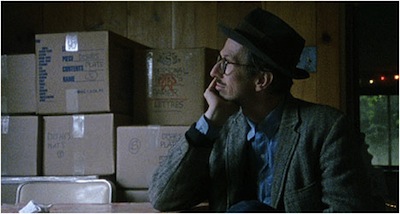
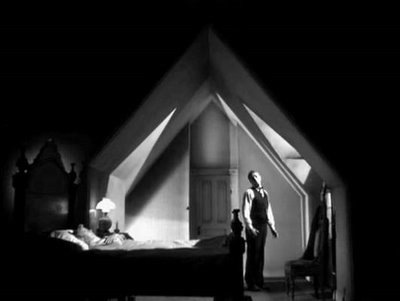
So, when I say that the new Criterion reissues of their Samuel Fuller titles, Shock Corridor and The Naked Kiss, are absolutely worth it, you can trust that this is something I mean wholeheartedly. Even if you aren't partaking of the new format yet, judging by the new transfers and all-around quality of the packaging, I am sure the standard DVD re-releases are also worth the cash. Being #18 and #19 in terms of spine numbers means both of these films were pretty early in the catalogue's existence. The original release date of the first barebones editions was 1998. Grand strides have been made in the art of film restoration, and you can see the journey in every cleaned-up frame. Both movies look astonishing. The pristine high-definition transfers are free of blemish, and they show the balanced black-and-white photography as never before. Given how much these flicks have been kicked around through the years, with various dubious DVD releases, it's wonderful to have definitive releases that get them exactly right.


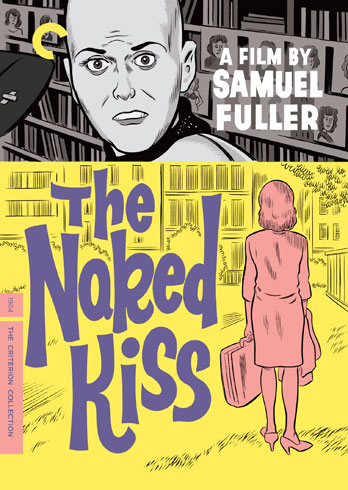
I reviewed both of the Fuller movies not that long ago, prior to the announcement of these upgrades. It hasn't been quite enough time for me to develop profound new insights into the films, so you can read those reviews in the archives (Shock Corridor here, The Naked Kiss here). That doesn't mean there isn't plenty to talk about here. These releases are more than just new transfers, but a full overhaul. You can tell that right away when you see the spiffy new covers. Comics artist Daniel Clowes, perhaps best known in film circles as the author of the original Ghost World comics (he also wrote the screenplay for the Zwigoff adaptation, rumored to be a future Criterion addition) and as the illustrator who did the poster for Todd Solondz's Happiness, has contributed new designs to both of the Fuller films. His artwork extends beyond the covers, and into the interior booklets, the disc art, and even the nifty animated menus. Clowes gets Fuller's twisted poppiness to the letter.


Criterion has also added several bonus features that make these Blu-Rays worth the price of admission. I'm particularly excited to report that Shock Corridor now comes with the 1996 documentary The Typewriter, the Rifle and the Movie Camera, a 55-minute profile of Fuller directed by Adam Simon and featuring commentary by Tim Robbins, Martin Scorsese, Jim Jarmusch, and Quentin Tarantino. I first saw this documentary on IFC back in the 1990s, before I had seen most of Fuller's films, if in fact I had seen any. It gave me a long list of movies to seek out, some of which I am still looking for. (Hey, China Gate is on Netflix Instant!) Now that I've seen a good selection of them, it's all the more effective when Robbins and Tarantino go into Fuller's storage garage and sift through his memorabilia; now I actually know what it is they are finding!

More invigorating, though, is the footage of Fuller talking. What a raconteur this guy was! The title refers to his three careers: reporter, soldier (Fuller fought in WWII), and filmmaker. Each phase is covered, all brought to life by Fuller's vivid anecdotes. As Scorsese points out, Fuller tells stories the same way he makes films--there is no difference between what comes out of his mouth and what he puts on the screen. If you like how Sam makes movies, you'll love listening to him. (Side note: Too bad Criterion couldn't also resurrect Tigrero, the documentary about the motion picture that fell apart on Sam, and that ultimately provided some of the color footage for Shock Corridor.)
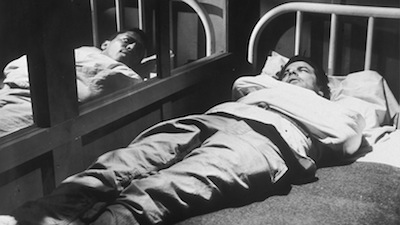


The bulk of the supplements on The Naked Kiss seize on the concept of Fuller as storyteller and run with it. Three different archival television programs are almost entirely single-camera jobs. Fuller is interviewed in all of them, but they are really more like monologues. The earliest is a 1967 episode of the French television show Cinéastes de notre temps, and it's nearly half-an-hour of vintage Sam. Flanked by the Eiffel Tower, the director lays out a lot of his technique and what excites him about motion pictures. One explanation of a particularly complicated set-up will have you rushing to your Pick-Up On South Street discs to see what he is talking about. [review]

Another French program is a short segment from Cinéma cinemas. Shot in 1987, it's simply Fuller going through a collection of famous photographs and talking about what he remembers. Some pre-date his movie career, including pictures from his wartime service, and others come from the publicity archives of many of his films. His life and history is also a good part of the 1983 episode of The South Bank Show, a BBC program that devoted an installment to the director. About half-an-hour of the full episode is excerpted here. Most of it, again, is Sam, but there is a small portion with Wim Wenders sharing his thoughts about Fuller.


Both BDs also have the original theatrical trailers, and each has nearly half-an-hour of a 2007 interview with actress Constance Towers, who was in both Shock Corridor and The Naked Kiss. She talks in-depth (nearly half an hour on each) about working with Sam and his balls-out production process, and the segments are specific to their particular disc. The interview on The Naked Kiss also includes her sharing more about her background. The story of the girl from Whitefish, Montana, making it in film is a classic Hollywood tale unto itself.

I'm a big Samuel Fuller fan, so these new releases would have likely been a must-have regardless, but seeing as how the Criterion Collection has gone all out in terms of improving them, it's a double-dip I have no residual qualms for indulging in.


Also out this month on Blu-Ray, and alas another film I covered last year, is Byron Haskin's Robinson Crusoe on Mars [original review]. Released in 1964 (the same year as The Naked Kiss), it's a Technicolor wonder--one that definitely seems more charming on second viewing. That could be down to the stunning presentation, I don't know. The original Criterion disc, released just over three years ago, was no slouch in the technical department, but the Blu-Ray shows just how dazzling a movie like this one can be in high-definition.

Though the unschooled might have previously had occasion to sniff at the special effects as being simplistic compared to the complicated pixel-by-pixel build-ups we get today, seeing Robinson Crusoe on Mars in this capacity would shut just about anyone up. The colors are remarkably vibrant, and the added clarity allows every tiny detail to be seen like never before. You'd have to be a hardcore cynic not to be awed by how incredibly complete Haskin's invented world is. The suits, the gadgets, the rockets, even the surface of the red planet--this is a craftsmen's delight. Even if, like me, you weren't immediately in love with Robinson Crusoe on Mars the first time around, the Blu-Ray warrants a second look.

For those wondering, the supplements on this edition are exactly the same as on the standard DVD, as is the packaging. The excellent Bill Sienkiewicz artwork is still intact. It's another thing all of these reissues have in common besides their original theatrical release dates: comic book illustrations. They are movies that capture the imagination, even if they do so in totally different, nearly opposite ways, and capturing the imagination is something a good comic artist knows a thing two about him or herself.

The Naked Kiss and Robinson Crusoe on Mars were provided by the Criterion Collection for purposes of review. Shock Corridor was reviewed in conjunction with DVD Talk, and you can read the full article here.

Tuesday, January 18, 2011

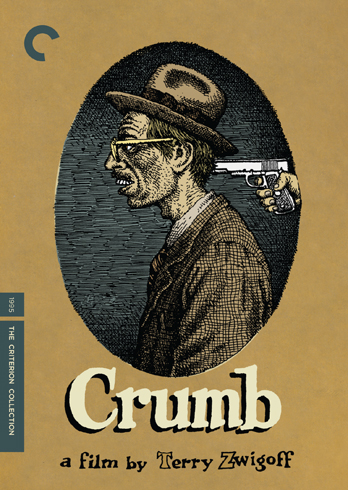
CRUMB (Blu-Ray) - #533

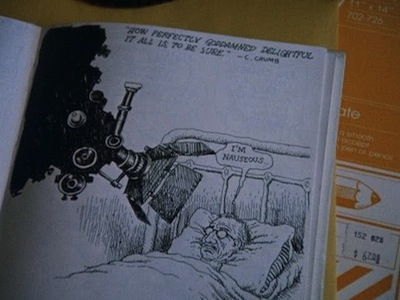
"How perfectly goddamned delightful it all is, to be sure."


There is so much loaded into the above statement by Charles Crumb, that one can't help but immediately seize on it. It is so packed with meaning and says a multitude of things with such poetic economy, Terry Zwigoff had to know immediately upon hearing it that it would serve as ideal punctuation for the epilogue of his 1995 documentary Crumb. What had started out as a film about legendary underground cartoonist Robert Crumb ended up not just a portrait of the artist as a middle-aged man, but of his family as well. The fact that Zwigoff composes the film with such attention to detail, and yet absent of even a whiff of judgment, has made it one of the most compelling documentaries of our times, as well as one of the most perceptive and illuminating examinations of both the perils and giddy joy of the creative life.


Though Charles Crumb is credited with the phrase, Robert Crumb is the one who shares it with Zwigoff, having scribbled it at the top of a drawing he made to illustrate the anxiety the filming process had been causing him. Robert and his wife Aline Kominsky were preparing to move to France at the time, a fitting end to the filmmaking schedule. Zwigoff had asked Robert if he would miss his family or otherwise felt bad about leaving them. The artist says no, he never sees Charles or his mother, and the interview session reminded him why. That quote was a favorite phrase of the older brother's, and he would say it to deflate any happiness his younger siblings might find in anything that struck their fancy. Imagine it said sarcastically. The underlying meaning is that what Robert liked was stupid and liking it made him an idiot.

And yet, it could also be the Crumb family motto, and it need not be as sardonic as all that. There is something strangely American in how off center this American clan is. Imagine Robert Crumb and his brothers standing on a hillside, the sun setting in the sky behind them, at the end of an old Hollywood movie. "How perfectly goddamned delightful it all is, to be sure," is suddenly "As God is my witness, I'll never be hungry again."


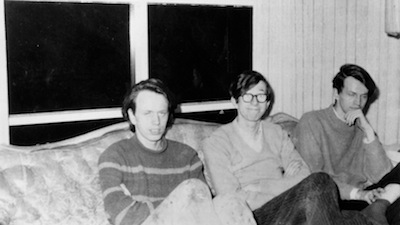
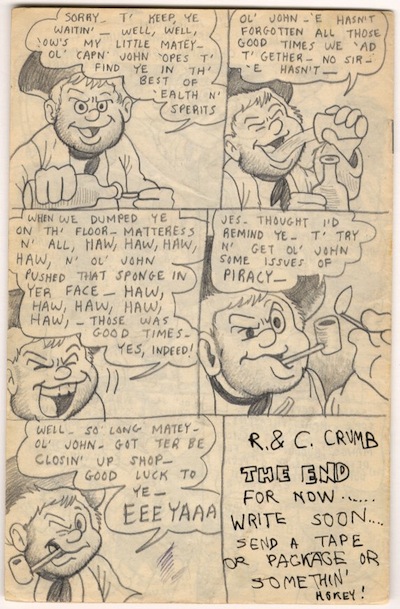
Crumb is a two-hour perusal of the Crumb family photo album. Though a good portion of it does chronicle R. Crumb's rise to infamy as a satirist and counter-culture cartoonist, the full image doesn't really come into frame without the other boys. Robert is the middle child, and the youngest is Maxon. (Two sisters refused to participate in the movie. Can't say I blame them, lord knows what was done to them in that household when they were young.) All three boys possess a natural ability for art, though it was Charles who literally forced them into comic books, particularly Robert, who saved the fruits of their labor all these years. He's got stacks of the fancy books he and Charles put together, trading story lines and ideas, developing their unique style. There is an obsessive-compulsive trait to both of their aesthetics: R. Crumb is known for his meticulous cross-hatching and immaculate ink lines, whereas Charles developed a "wrinkled" style. As he got older, everything he drew was decorated in endless loops.


A comic book page by the young Crumbs


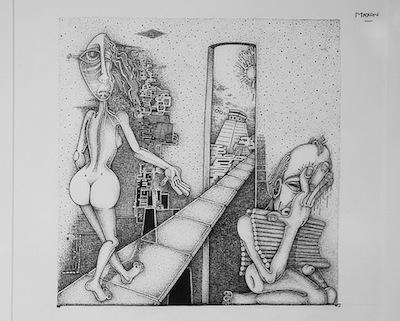
Maxon's story is slightly different. He started drawing when he was older, and the sudden release of passion resulted in an epileptic seizure. He is more of a fine artist now, but in his paintings, there is a consistent mechanical theme and also a vague obsession with undulating, melting lines, reminiscent of the clocks in Dali's "Persistence of Memory." At the time of filming, Maxon was living a pseudo-monastic life, begging for change in San Francisco. In Crumb's most discussed scene, which comes not long after Maxon has confessed to a misspent youth pulling women's pants down in public, the clearly deranged painter is meditating on a bed of nails while swallowing a chord that he will pass through his digestive track to clean it out. If Charles had the same cord, he would probably wrap it around himself like his beloved wrinkles; for Maxon, it's another undulating line.


Art by Maxon Crumb


Charles lived on the other side of the country. He never moved out of their childhood home, and he has turned into a recluse that never goes outside and only bathes once every six weeks. He's on medication for depression, and he admits to suicide attempts and previous homicidal thoughts. (The sad coda is he did kill himself not long after his interview was filmed.) There is some intimation that maybe Charles, who was a regular troublemaker as a youngster, turned inward to avoid even more dangerous impulses. Many of the comics he made when he was a teen riff on the Treasure Island story--but not because of the escape fantasy the adventure tale offered, but because Charles had become fixated on the young actor Bobby Driscoll, who starred in the 1950 movie version.
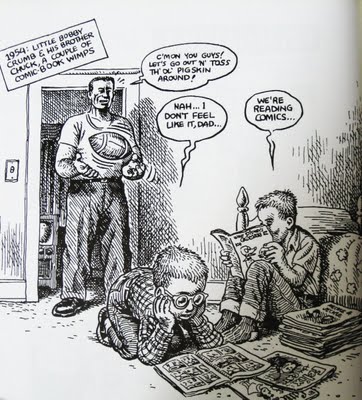
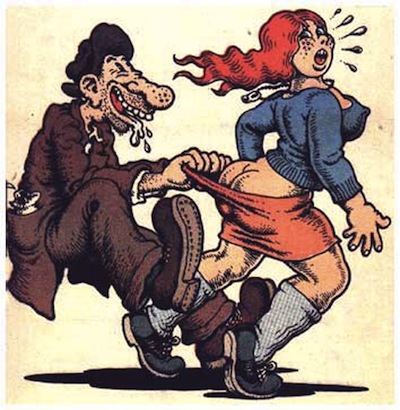
Robert Crumb listens to both his brothers indulgingly, laughing at their quirks, but never in a way that is mean-spirited. Robert has a habit of laughing at just about everything, including himself, though there is a lot of anger inside him. It ends up in his work, in his comic book adventures of Mr. Natural and Devil Girl and the sketches and one-offs he fills into notebook after notebook. One thing that Zwigoff succeeds at with smashing success in Crumb is relaying the subject and timbre of Crumb's comics to the audience. I had only a passing knowledge of the artist when I saw Crumb on its original theatrical release, but watching the film made me feel like I knew the work intimately. Zwigoff does this by just putting the camera lens up to the page and tracking the comic book panels as the artist tells the story behind them or sometimes even just reads the dialogue. The director also peers over the artist's soldier while he sketches in public. It's an unbelievable record of a craftsman at work. (Criterion also does a great job of giving us access to the work of all the artists, filling the interior booklet with efforts from all the brothers and even Robert's son Jesse, as well as giving us a full reproduction of a correspondence school's artist test Robert talks about in the film.)


R. Crumb's rendering of his childhood.


The comics of R. Crumb are known for their sexual deviancy and anarchic humor, and the creator makes no attempt to hide his fetishes. There is one hilarious scene where the artist poses for a layout in the porn magazine Leg Show, and the editor who set it up, who also happens to be a former girlfriend of Crumb's, hires models that fit his particular bill: thick legs, big butts, and a frame sturdy enough to give him a piggyback ride. In an effort to puzzle out R. Crumb's work, Zwigoff even gives some screen time to his critics. There are cases to be made for misogyny and racism in his comics, ones that Crumb ultimately seems to suggest are unfounded, but Zwigoff lets the detractors have their say all the same.


I think Crumb makes the strongest case for the value of his work himself when he says, essentially, these thoughts had to go somewhere, so why not channel them into art. If you consider what the other Crumb brothers got up to, the notion bears truth. Maybe if Maxon had put his peccadilloes onto more canvases, he wouldn't have gotten into legal hot water for harassing women. Maybe if Charles kept drawing, he'd have found a way to sort out the wrinkles in his own brain. Those are big what-ifs, their illnesses may have gotten the better of them either way, but you still have to wonder.

Because contrary to all the weirdness, Crumb does have some hope and normalcy. Both of Robert Crumb's children, Sophie and Jesse, were burgeoning artists at the time of filming, and Zwigoff shows the father sharing in his children's creations, offering advice and support. Somehow, this new generation appears to be turning out all right despite being a product of the same mad genius. As any creative person will tell you, making our art keeps us from losing our minds. Personally, if I get away from writing for more than a couple of days, my brain doesn't work right. In the case of the Crumbs, the family that draws together, stays sane together.


Visit the official R. Crumb website.

Thursday, January 13, 2011

KAGEMUSHA - #267

[Note: This is the longer companion to a short review of Kagemusha I wrote for the Portland Mercury. Look for it in this week's edition, or read it on their blog here.]


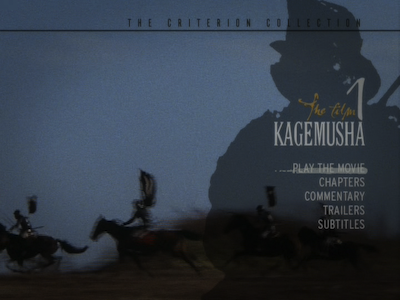
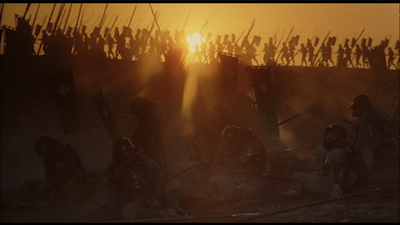
Kagemusha is not a young man's film. Released in 1980, it was made when Akira Kurosawa was 70. In the previous 15 years, he had only made two movies--the misunderstood Dodes'ka-den [review] and the Russian-financed Dersu Uzala. Kagemusha was financed in part by a deal with Suntory whiskey and American funding finagled by producers Francis Ford Coppola and George Lucas (there are worse ways to throw you weight around than convincing 20th Century Fox to give Akira Kurosawa some money). The Japanese legend had been in a kind of director's jail, and it's hard to say if the time away gave him a new perspective or if this is where he would end up all along. Because Kagemusha is a complex movie, one that is far less cavalier about swordplay and violence than its more famous predecessors.
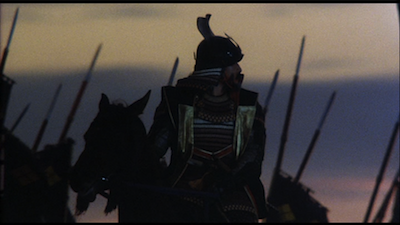
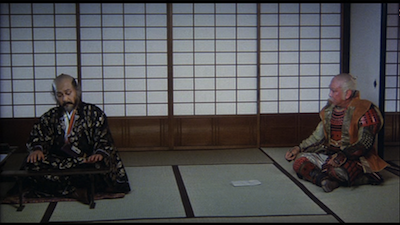
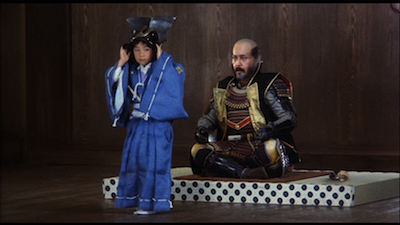
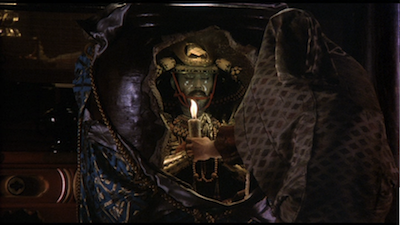
Set in the 16th Century during a time of civil war, Kagemusha is based on real events, but it is also its own fanciful thing. The title translates as "Shadow Warrior," and the script by Kurosawa and Masato Ide is an old man's version of the "Prince and the Pauper" fable. Japanese cinema mainstay Tatsuya Nakadai--he was Mifune's rival in Sanjuro [review] and Yojimbo [review], and also starred in movies like When a Woman Ascends the Stairs [review] and The Human Condition [review]--stars as Shingen Takeda, a warlord with a tenuous hold on Kyoto. He has been fending off two rivals, Nobunaga Oda (Daisuke Ryû) and Ieyasu Tokugawa (Masayuki Yui), both of whom would crush Shingen and take over Japan if given half the chance.

Nakadai also stars in the picture as his own double. At the start of Kagemusha, Shingen's brother Nobukado (Tsutomu Yamazaki) has brought him a thief who was due to be executed. The condemned criminal bears a startling resemblance to the ruler, and Nobukado believes he can prove useful as a decoy to fool his brother's enemies. The thief appears to be an unruly creature--his first order of business is asking why he's the one condemned to die when Shingen has stolen from and killed thousands in the name of "politics"--but his honesty also impresses his benefactor. They decide to keep him around.


Shortly after, Shingen is fatally shot. Before he dies, he informs his cabinet that they should hide his passing for three years while they secure their position against the others. Suddenly, the impostor is put in the seat of power for real. He's reluctant at first. Why should he give up his life for a society that rejected him? He eventually relents, deciding he should honor Shingen for sparing his life and actually stand for something. Slowly, he embraces the role of ruler, going from nervous puppet to self-deluded commander--a move that ultimately causes him to be knocked low by his own hubris. With the three years up, Shingen's former compatriots have no more need for the fake warlord, and they send the thief packing.

But who is the man now that he has given himself to be someone else's shadow? He had found a life in the palace walls, including bonding for real with Shingen's grandson--a relationship that didn't exist when the real Shingen was alive. The child almost blew the whole scheme, having sensed at once that this was not his grandfather. What tipped him off? The fact that the big man no longer scared him. It seems there was some truth to the crook's assertion that he was the better man than the more vaunted warrior.


It's a heartbreaking changeover, though. The shadow accepted his duty without any promise of reward. In shedding his self, he also shed his selfish concerns. Thus, when he is cast out by the people he served--the soldiers he once commanded throw rocks at him to drive him from the compound--he has nowhere to go, no one to be. Ironic, then, when he returns to watch "himself" be buried. When the final clash between the competing armies happens, he spies on the action from the weeds, a peeping tom on the field of battle rather than the powerful presence he had been in the last skirmish. That prior battle was also the point when he lost his way, he started to think he really was the person that the rest of them were scared of. Tatsuya Nakadai is remarkable. He is funny and warm to begin with, but then devastatingly hollow. In some ways, this feels like a dry run for his turn as Lord Ichimonji in Ran [review] five years later, but it's also its own thing. Ichimonji loses himself to madness in order to block out the horrors of the world crumbling around him, whereas the double is all too clear on how everything is going wrong.


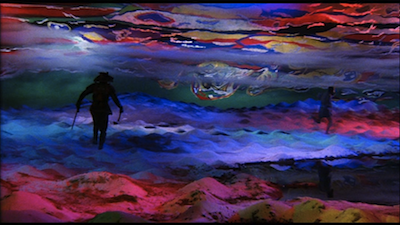
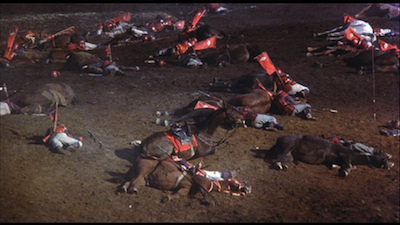
Akira Kurosawa constructed Kagemusha with a formalistic rigidity, which he then tears into with occasional explosions of color and surprising symbolism. In a gaudy dream sequence, the double is chased by his original on a painted background that looks like it was created by Van Gogh during a fit of color blindness. The epically staged war sequences are shot with an expressionistic design, abstracting them in a way that makes them beautiful and yet somehow all the more horrifying. When the pretty smoke clears, and Kurosawa shows us the carnage that lay just underneath, it's sickening to realize the excitement we, as viewers, allowed ourselves to feel. Perhaps knowing we might be immune to fake blood and dead soldiers, Kurosawa mostly focuses on the felled horses, some clinging to life, some fighting to get themselves out of the butchery all around them. This is man's cruelty: we just don't lay waste to ourselves, but to everything around us. The aftermath of the showdown looks like Hell on Earth. Life as we know it is gone.

That's when the thief comes stumbling out of the weeds. In this surreality, he is the only one left to mourn mankind and its folly. This should have been his victory, or even his failure. Instead, he has been removed. His only choice is to charge ahead, a futile final stand. The symbolism of the final shots is staggering: glory has been drowned, and its remnants wash away on a grotesque red tide.


This is the second time I have seen Kagemusha. The first time was when the DVD came out, and this time, it was on a movie screen. I don't think the difference in viewing experiences is why I rate it higher than I did prior. On my first viewing, I liked it fine, but it didn't strike me as heavy as it did the second time. That's possibly because there is a lot to keep straight in this movie. The political intrigue that fuels not just the civil war, but that also orchestrates the whole doppelganger scheme, can get pretty complicated. There are so many characters, it's kind of one of those "you can't tell the players without a program" situations. (Thankfully, Kurosawa helpfully introduces each character with a caption as they appear.) On the first time through, it can be hard to separate that part of the story from the richer personal drama, something I was able to do when giving it another look.

That said, the 35mm print I was lucky enough to watch this time around was marvelous. Any scratches or spots were few and far between, and the rich colors and dynamic sound were a pleasure to partake. Kagemusha is a film writ large to begin with, so actually seeing it in the large theatrical format is a real treat. I am not sure how extensively this print is currently touring the country, but Portland's fantastic independent theatre Cinema 21 has it for four days, January 14 to the 17th. This is the same place that gave us a big-screen Ran only a few months ago. I suppose it would be too much to ask that you guys keep working backward through the Kurosawa filmography? I'd love to come out and see Dersu Uzala in a couple of months if you do!


One final note: Those Suntory commercials, which were actually directed by Francis Ford Coppola, are included on the DVD, alongside a short documentary about Kurosawa's connection to the American filmmakers who helped him out. These commercials would later go on to inspire Sofia Coppola to use Suntory whiskey spots as the reason Bob Campbell (Bill Murray) goes to Tokyo in Lost in Translation [review].


Tuesday, January 11, 2011

ARMY OF SHADOWS revisted on Blu-Ray - #385

"I'd like viewers to come away from my films unsure whether they've understood them." - Jean-Pierre Melville


The reward of watching movies multiple times is being able to approach the material from different angles. This is my third format for seeing Jean-Pierre Melville's Army of Shadows--I first saw it in its theatrical re-release, then on DVD (my original thoughts are here), and now Blu-Ray--and this time, when I was watching, I paid attention to what a spooky movie Army of Shadows can be. That title, referring to the men who led the French Resistance in WWII, evokes the image of a spectral force, and the world Melville creates for them to go through is akin to a haunted realm, the place of the undead. It's moody and gray, quiet. We visit prison camps, occupied hotels, seaside hideaways, and in each place, normal life doesn't appear to be carrying on as always. The streets lack vibrancy, glimpses of the way things were are fleeting and far away.

And in this wartime limbo, the freedom fighters operate as a separate society, a hidden military. They work in secret, though their actions eventually go public. They seem to move in between the moments in which the rest go about their business--the rest being either their enemy or the citizens they hope to liberate. They are shades. They are other. Their multiple voiceovers speak in past tense, voices from beyond the grave.

Made in 1969, Army of Shadows is the story of the heroic struggle against the Nazis, who occupied France through most of the war. Lino Ventura (Touchez pas au grisbi [review]) plays Philippe Gerbier, one of the main players in this underground revolution. At the start of the movie, he's being taken to a camp for political undesirables. He is driven through rain, out to a remote locale, far from the world. One could argue this is the point where he is separated from reality as it had been known. He is sent to the limbo that precedes limbo, the waiting room for the halfway point. He plots an escape, but before he can make his break, his number is called and he's taken back to the city. Once he is among the SS, he slips always is if he were never really there. The spook has returned to his haunted country.

What follows is a series of "incidents" and "missions." Philippe gathers his troops. Amusingly, it's almost like a manicured Hollywood war team--a brute, a young man, an old man, a handsome guy, a woman who really has it together. They engage in a somber combat, their actions almost imperceptible. There is the gut-clenching pain of having to kill a traitor by hand, and the delivery of supplies through tightly guarded checkpoints, and even a trip to England to try to garner support. There the otherness is even reinforced: during an air raid, Philippe stumbles into a nightclub where British soldiers are dancing. The revelers don't even notice he is there. They barely notice the bombing. They have found an oasis from the war. This is another world: Philippe and his "Chief" (Paul Meurisse) go to see Gone with the Wind. To the boss, a signal that the war is over will be when his countrymen can also experience this cinema--itself another story of struggle and division (though about as far afield of Army of Shadows in terms of tone and style as you're likely to find).
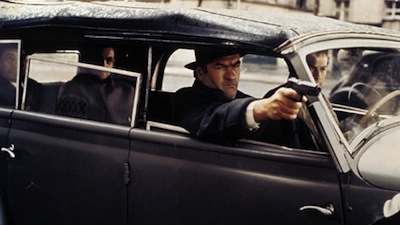

Melville plays with distance throughout Army of Shadows. Not only is the commonplace now far away, but these people who are working together are also separate, working under fake names, avoiding sharing details of their past lives. He creates formal compositions to mirror the exactitude of their planning. He foregrounds and backgrounds characters on the screen to indicate their current mood. For instance, when Jean-Francois (Jean-Pierre Cassel) decides to distance himself further, Melville puts him in the extreme foreground, away from the rest. The camera eye probes scenes, such as in the prison when Philippe passes around his cigarettes, and director of photography Pierre Lhomme circles with the packet, watching its journey. Melville also concocts an ironic ruse, showing Philippe working out of a talent agency, using theatrics as a front. All of these resistance fighters are performers themselves, they all have distinct roles to play.

Army of Shadows is essentially an espionage picture. It's not a war movie, even though it does involve the war. Rather, this is about the often unsung heroes, the ones who never got their due, who slowly pushed the rock up the mountain to try to make a difference. It's about tough choices and careful maneuvers. The narrative is multi-layered, complex to the point of abstraction. It's not an A to B to C plot in that each sequence suggests the next. Instead, Melville, who wrote the script from a novel by Joseph Kessel, focuses on the unexpected, the developments no one planned for.

Fittingly, then, it's the everyday things that cause the most trouble. For instance, Mathilde (played by the great Simone Signoret) runs afoul of the Nazis because of a photo of her daughter she refuses to discard. Philippe also gets arrested because he's found having a meal in a restaurant that serves black market meat. It's almost like he forgot that this kind of place, sitting with others and having a meal, isn't for him anymore. It leads to Army of Shadow's most existential moment, where Philippe goes against his own self-belief and must question why everyone else knew what he would do better than he did. The Nazi guards at the prison cruelly line up their prisoners and tell them to run. If they can outrun the bullets, they will live to race death again. Philippe tells himself he will not go, but something else takes over. Fear? A survival instinct? Or maybe fate...?

Francois also makes an existential choice in the movie, but he does it in secret. He doesn't even tell his comrades. He lets himself get captured, and they think he's run off. It's a perfect example of the kind of heroism I've been trying to describe. Doing what you think is right for you, and for no other reward but being true to yourself. It's an act born of alienation, but turning that lonely dread to positive action, the kind of ideal existential expression that is often glossed over by those who misunderstand the philosophy. In Philippe's moment of crisis, Melville cuts away from him and shows the actual shadows passing on the wall, the flickering figures of the titular army. One could bring up Plato's Cave, or even return to the theatricality and the whole concept of "shadowplay." Instead, I think this brief image is as straightforward in its symbolism as it seems: our experience is fleeting and difficult, but if we stand away and look at the outline of who we are, we can truly see ourselves. The true army of shadows is the congress of man, inconsequential and disconnected, but marching forward nonetheless.


Criterion's 2007 DVD of Army of Shadows was one of their strongest entries in the SD format, earning high marks from me back when it was released. I'm pleased that the new HD transfer of the 2004 restoration actually improves somewhat on the original release. The changes are subtle, but they manifest in the clarity of detail and the rendering of the colors. This is a very soft movie, taking place in perpetually cloudy weather. The dour grays and blues and the hazy pallor that hangs over everything is chillier here. I wouldn't call it more pronounced, that seems counter-intuitive, but it does have a stronger overall emotional atmosphere.

You can really notice it in the scenes of nature. The opening shots of the rainstorm are striking for how much rain we see, whereas the nighttime escape on the beach later on reveals all sorts of color gradients in the water and the sky. There is more nuance to both surfaces, and our eyes can now track the changes. Later, walks in the park give us nice greens. The actors also benefit, with skin tones and the lines on their face bringing their expressions to the fore, an important thing in a movie where so much occurs in silence.

The original mono soundtrack is presented here in an uncompressed format, while there is also a second choice of stereo mix in DTS. I moved back and forth between them and didn't notice too much difference, though at times the stereo actually did sound more open, like there was a defined space between the two channels.


For a complete rundown on the special features, read the full review at DVDTalk.

Wednesday, January 5, 2011

WHEN A WOMAN ASCENDS THE STAIRS - #377


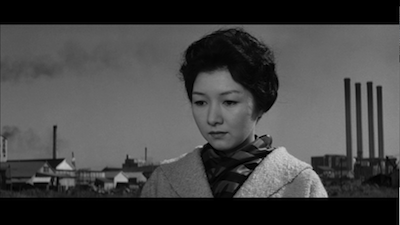
The news went around on Monday that beloved Japanese actress Hideko Takamine had died, having lived a full life. She was 86. Takamine appeared in a staggering number of movies--177, according to IMDB. Her first was in 1929, her last in 1979. I'll admit, I haven't seen most of them. My hat is off to anyone who has. I think I've only seen the ones released by Criterion, with the most memorable for me being Keisuke Kinoshita's Twenty-Four Eyes [review]. In that film, Takamine played a young schoolteacher whose modern ways clashed with the small-town values of the village where she was assigned a school house, and who struggles to take care of the children in her care. It's a performance that is full of heart. Children are supposed to fall in love with their teachers, and as viewers, we fall in love with Takamine.


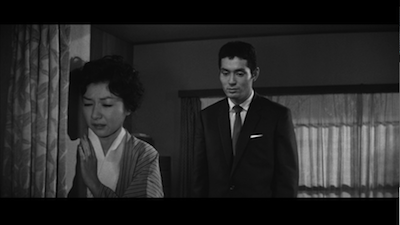
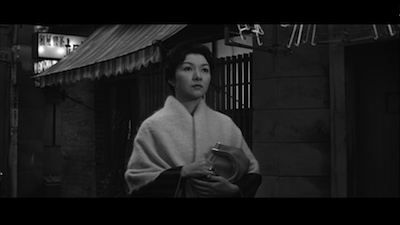
Hideko Takamine made quite a few movies with Mikio Naruse, including one of his most famous, the 1960 drama When A Woman Ascends the Stairs. As the only film in my library starring Takamine that I hadn't seen, it seemed appropriate to give it a look in honor of the actress' passing. When A Woman Ascends the Stairs is a sad film, though one that is never overly dramatic--even if some of its plot twists are straight soap opera. It also doesn't wallow. Takamine lends her character a plucky spirit that somehow spins all the bad events into a hopeful tapestry celebrating human resilience. The bar hostess Mama Keiko is a long way from the schoolteacher Hisako Oishi is terms of profession, but not in personality or allure. They are almost the same woman, especially as Oishi has seen a few things by the end of Twenty-Four Eyes. Both know heartbreak, but both have the strength to take care of themselves.

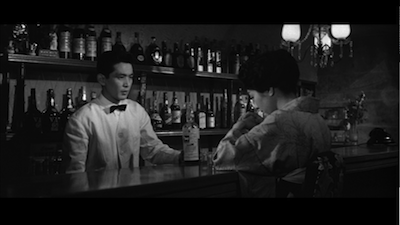
When A Woman Ascends the Stairs is set in the Ginza district, a post-War neighborhood where businessmen congregated to drink and carouse. There, the streets were lined with bars that featured women on staff as "hostesses." Their job was to entertain the customers and encourage them to buy drinks. Some extended their duties to after hours, either selling themselves one night at a time or becoming full-time mistresses.


As far as Keiko is concerned, that extra-curricular "duty" is for the lower-class hostesses. There are three tiers, as she describes it: the bottom resort to going home with clients, the middle take a train home, and the best hostesses can afford a cab. Or at least pretend they can afford it. It's common for women like Keiko to live beyond their means so as to foster the illusion that they are expensive prizes. Keiko's apartment is luxurious for a widow, but it goes with the profession. Her husband was hit by a truck not long after they were married, leaving his young bride to fend for herself. Keiko has been a hostess for five years, having been recruited by Komatsu (Tatsuya Nakadai, who also co-starred with Takamine in The Human Condition [review]) when she was a cashier. Komatsu is still her manager, taking care of accounts at the bar where Keiko oversees the other girls. Her position is why everyone calls her "Mama," including her clients, most of whom want to drink with a pretty woman and tell her about their day.


A pretty woman other than their wives, that is. Most of them are married, and most of them are in love with Keiko, though she knows they will never leave their families to give her the life she deserves. That is part of why she stays out of their reach, though one suspects from the get-go that she has more romantic tendencies than she lets on. Komatsu is in love with her, too, but he is either incapable or inept when it comes to showing it. Keiko really loves the banker Fujisaki (Masayuki Mori), one of the only men in her clientele who hasn't tried too hard to push her into something more (we see her refuse out-of-town trips, start-up money for her own bar, and even lunch dates). Not that he's really that good of a guy. I mean, Jesus, he's a banker!


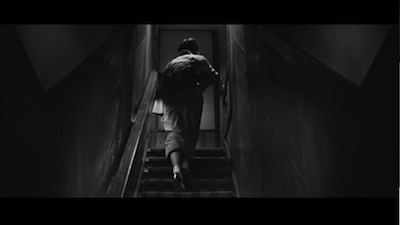
All of this works for Keiko, but it doesn't make her happy. The title When A Woman Ascends the Stairs refers to her nightly journey upstairs to the bar. It's a climb she dreads. She knows this occupation is beneath her, and she doesn't even like alcohol very much. It's a struggle every day to keep from compromising her values. Much of the ins and outs of life in the Ginza are explained to us by Keiko in voiceover. She is a thoughtful woman, prone to otherwise keep what is really going on to herself. She is also crafty, having learned how to dodge men's advances and to lie her way out of scrapes. The bulk of Naruse's movie, shot from a script by producer Ryuzo Kikushima (a regular contributor to Kurosawa films), focuses on the season when life decides to pile on Keiko. An ulcer, a failed business venture, needy family members, multiple proposals--it's more than a lady should be able to take.

Keiko holds on longer than most would. As an actress, Hideko Takamine brings an inner strength that informs Keiko's outer bearing. Back straight, chin-up, smile when appropriate--these are the traits of a good hostess. Your troubles are bundled inside your kimono, the bar is not the place to let them out. This demeanor deteriorates over the course of the story, even as Keiko does her best to avoid traps she sees others fall into. A protégé's desperate actions after she opens her own bar, only to spiral into debt, serve as a cautionary tale. Yet, superstition and plain old bad luck tear at Keiko. As she grows more weary, her mistakes become more grand.


In terms of performance, the most appropriate metaphor I can think of is that Takamine sees Keiko as a porcelain doll, and with each successive scene, invisible hands are chipping away at her painted exterior. Takamine proves exceptionally capable of showing the decline. She has a sweet face and a charming overbite, and though at first her seductive traits may not be obvious, it's an actress' job to be everything to everyone; thus, the role of a woman who morphs into the thing most desired by whomever is looking at her at any given time should be ideal for a performer. Likewise, an actress needs to still be herself when she steps off set, to leave the role behind. One assumes that Takamine's own experience, having been in the business for three decades by the time she made When a Woman Ascends the Stairs, gave her a special connection to Mama.

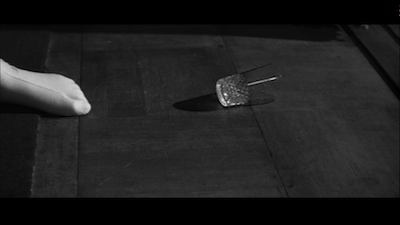
By the time When a Woman Ascends the Stairs is in its final reel, it's hard to imagine that it can go anywhere positive without selling itself out. We have seen so many things go bust by that point, and the movie has maintained such a sense of internal realism--Masao Tamai photographs Tokyo so that its neon looks gorgeous in black-and-white--it would be impossible to accept that events take too dramatic a turn. Thankfully, Naruse and Kikushima place enough faith in their actress and the level of trust she has earned from their audience in the preceding 105 minutes to know that it's really just reliant on her to pick herself up, dust herself off, and carry on. Even better, Takamine is so good at what she does, she not only makes us believe that Keiko will carry on, but when we hear her final words, the oft-spoken greeting she gives to all of her customers, we accept that she believes them as never before. And somehow, some way, that makes us feel good for her. We want Hideko Takamine to be okay, and she has assured us that, no matter what, she will be.


* Also look for Hideko Takamine in Tokyo Chorus (part of the Eclipse Silent Ozu box) [review].

Friday, December 31, 2010

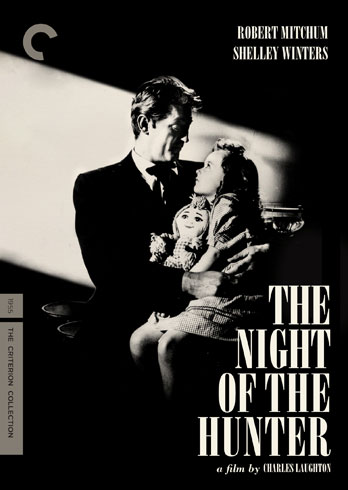
THE NIGHT OF THE HUNTER (Blu-Ray) - #541

"It's a hard world for little things."


A few weeks ago, while I was waiting for my copy of The Night of the Hunter to ship from Barnes & Noble, my friend Scott Morse watched his. Scott is a comic book artist, as well as a staff member at Pixar. Amongst other things, he designed the end titles for Ratatouille [review] and is one of the main design guys on Cars 2. (Also, these Criterion-themed posters and a comic book about Kurosawa.) Needless to say, Scott has his bonafides when it comes to animation. Thus, when he posted the following to his Twitter, I listened:

NIGHT OF THE HUNTER is a pretty spot-on reverse "princess" story. Studios, take note of the clarity. Drink down the Love and Hate.

THE NIGHT OF THE HUNTER is seriously cut from the same cloth as every Disney flick of the 50's. Iconic, clear, and elegantly shocking.


This is a fascinating theory, and one that absolutely bears out when you watch the movie. Charles Laughton's 1955 tale of menace is a contemporary fairy tale, staged like a children's play, shot like a film noir. From start to finish, it's a unique and daring film. James Agee's script flirts with innuendo, is suspicious of religion, and makes comedic hay of small-town mores. Laughton's direction is both arch and playful, employing film convention to create the safe and familiar, and then undercutting the same technique by deflating the comfortable air right out of its tires.


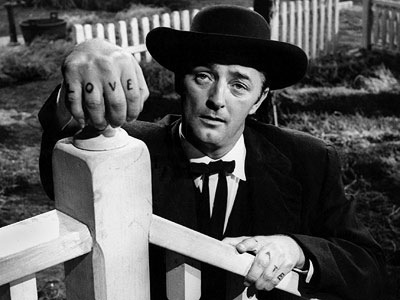
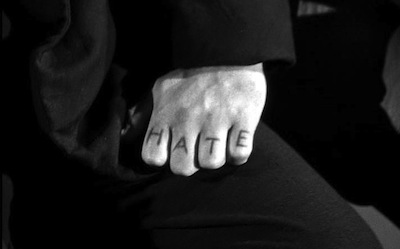
Robert Mitchum stars in the film. Preacher Harry Powell is one of his best-known roles. Though beloved by most of his fans as a hero with a hard jaw, he was a rebellious personality both on and off the screen. A few times in his career, the actor played a villain, revealing one hell of a mean streak. Harry Powell may wear a preacher's suit and hat, but this man has a twisted relationship with God. By his own admission, his version of Christianity is one he and the Supreme Being hammered out together. It's one easily explained, though. He wears his most prominent object lessons on his knuckles. On his left hand, he has tattooed the word HATE, one letter on each finger; on his right, LOVE. A man's hands are meant to work in tandem, but tangle the fingers together, and you'll find two objects at odds with one another. Every living soul is in a constant struggle between hate and love, between doing what is right and giving in to temptation.*


Every living soul except for Harry Powell, that is. Harry is a killer, though the extent of his crimes are just mysterious whispers at the start of The Night of the Hunter. He is pinched watching a burlesque show, but not for the phallic switchblade poking through his suit pocket, nor for the body we saw in an unspecified barn, but because he stole a car. He is sentenced to a month in the hoosegow, where his bunkmate is Ben Harper (Peter Graves). We met Harper when he got arrested. The Night of the Hunter is set in the Great Depression, and Harper killed two men and stole $10,000. Before he got nabbed, he gave the money to his young son John (Billy Chapin) and his even younger sister Pearl (Sally Jane Bruce) and made both of them swear not to tell where he stashed the cash. Ben Harper even goes to the gallows with the secret. The stolen bills are his children's future.

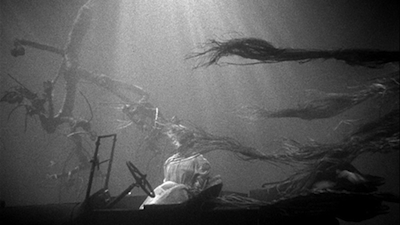
When Powell gets out of jail, he heads to the Harper homestead. There, he seduces Ben's widow (Shelley Winters), and once he is John and Pearl's stepdad, sets about trying to get them to give up the dough. When the woman gets wind of what Powell really married her for--apparently his rejection of her sex and subjugating her to his "religion" was not enough--the preacher murders her and dumps her body. It's a grizzly scene, but filmed to appear dreamy, almost idyllic. The widow Harper is dumped in the river in her Model-T Ford. The currents push her hair along with the underwater weeds, like the mythical Lady of the Lake, though her warning is darker than even that of legend.


With no one to protect them, John and Pearl go on the run. They take their father's rundown boat and set off down the Mississippi. Here, Laughton opens the door to the secret world of children. Most fiction for young readers has a quality of emphasizing the separateness of childhood. When you are small, the bigger world pays you no attention, and thus you can retreat into imagination. Disney films usually have a sense of this, too, though often, instead of kids, it's the parallel world of animals. Think about the cartoons where animals talk, and none of the humans can hear them. So it often seems to be when you are a child: you can talk, but the adults don't concern themselves with what you're saying.**

Tellingly, once the children are in the wilderness, human life fades away, and Laughton designs multiple shots that show the animal population that lives along the water. Spiders, rabbits, turtles, owls--the fugitive orphans and these woodland creatures exist in the same space, and the tiny humans pass unmolested. The animals don't shrink from them, either. This is the realm of fable. They are "other."


This is the most obvious element where the movie matches up to Morse's Disney theory, but there are many more touches throughout The Night of the Hunter that also work to remind us of classic animation. The children's journey is punctuated by songs, mostly schoolground tunes or religious hymns, but that serve to emphasize the emotional tenor of the scenes Laughton uses them in. The trek the kids go on is ostensibly a search for a home, having lost their own and, in a way, having had their identities erased. It's somewhere between Pinocchio, who is misguided by temptation, and Simba, whose birthright is threatened in The Lion King. (Or, even the exiled princesses, like Cinderella or Aurora in Sleeping Beauty.) Though Mitchum's performance as Powell can show him to be as sinister as Scar in the latter film, the more comical side is a bit like Prince John in Disney's foxy version of Robin Hood. The preacher can be petulant and downright whiney. He's a fascinating loon, often busting out dramatic gestures that recall Lon Chaney silent creepers. In one scene, after her meets the wrong end of a rifle, he runs away howling like Goofy tumbling off a cliffside. For as much as you might be scared of Powell, you also want to point and laugh.
Eventually, John and Pearl wash up on the riverbank near the home of a mother hen figure. Miz Cooper is played by legendary film actress Lillian Gish. She takes in strays and puts them to work in her garden, providing the structure and basic morals they otherwise lack. She is a kindly stepmother, not the wicked kind, and she even serves as a sort of narrative chorus. Cleverly, Agee and Laughton have one of her adopted girls make fun of how she talks to herself all the time, setting us up for the moral Miz Cooper will lay out at the end of the picture. She is both hard and soft, tough on her kids but caring. In contrast to Powell, her behavior is anything but erratic: this is someone the kids can count on. Her home is tidy and traditional; the town nearby is chaotic, lit with neon, full of temptation. Again, it brings to mind Pinocchio and the carnal delights that lead him from Gepetto. The lure of all this sin will call Miz Cooper's oldest charge, Ruby (Gloria Castilo), and Powell will trick her into revealing too much.


Gish is marvelous as the staunch caretaker. She and most of the older character actors really shine under Laughton's direction. Evelyn Garden is particularly good as the annoying busybody Icey Spoon (and she looks exactly like Madam Mim from The Sword in the Stone [review]. I have to admit, though, the child actors aren't that great. Five-year-old Sally Jane Bruce is extremely stiff, looking like she has barely enough attention span to remember what she is supposed to do. Ten-year-old Billy Chapin is quite a bit better, but his performance is actually hurt by Laughton's direction. He regularly isolates the boy for reaction shots, and the way he cuts the scenes doesn't quite connect the boy's expressions to what he is reacting to.

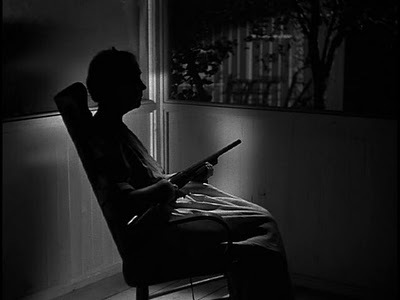
I know this could get me lynched, but I found Laughton's direction to be quite clumsy at other times, too. Some shots are too rigid, and the editing disjointed. Look at, for instance, Powell chasing the children up the cellar stairs. Mitchum appears to be parodying a horror movie ghoul, and it has the appropriate effect, being at once silly and menacing. Yet Laughton and editor Robert Golden don't give the moment its due. They shove a single side shot of this attack into the action, and it doesn't quite fit. For as short as the shot is, it's almost like they started it too early and cut it too soon, you can practically see the marks on either side of Mitchum's lunge. Likewise, for as lovely as those riverbank images of the forest animals can be, they always look like they've been arranged, they aren't natural. Obviously, there are shots throughout the movie that are meant to look like something out of a storybook (observe, for instance, the hangman's children asleep in his shack), and Laughton has done a good job composing them--but it's too good. The illusion bursts.


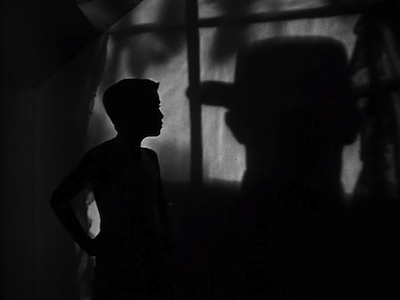
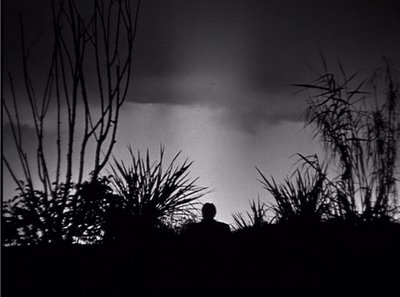
That said, when Laughton and cinematographer Stanley Cortez (who also worked with Orson Welles on The Magnificent Ambersons) are on target, they really are dead center of the bull's-eye. Laughton's use of silhouette and shadow is unmatched in its visual power. He can use light and dark to create both a sense of calm and of terror, and often in the same scene. When the children bed down in a barn, their appearing as shapes against a night sky is serene and lovely; when they awake to hear the approaching Powell singing his signature (and ironic) hymn, the vast horizon suddenly becomes unbearably huge and oppressive. The smaller silhouette in the distance is a threat, and though far away, the distance emphasizes the killer clergy's inescapable presence.

Smartly, as The Night of the Hunter winds down, so too does Laughton dial back the style. His approach has a more old-fashioned, family movie vibe in the last couple of scenes, including the amusing image of Miz Cooper leading her brood through the back alleys like a mother duck and her chicks. In these kinds of stories, the final chapter is when some kind of normalcy is restored, and the traditional Christmas scene Laughton and Agee have concocted is meant to be familiar and homey. No divisive shadows, no extreme angles or compositions, mostly just straight-on shots of Miz Cooper stirring her stew pot, musing on the plight of the wee ones as they move all around her. It's a reassuring finale, restoring the natural order, including letting us know that it's not God or His son that's gone all wrong, but the misguided people of the world that have twisted their positive message. Too much of the left hand, it would seem, and not enough of the right one.


Criterion's two-disc release of The Night of the Hunter, available on standard DVD and Blu-Ray, is an outstanding package. Put together in cahoots with the UCLA Film and Television Archive, the restored print is superb and the collection of extras is a treasure trove of quality supplements, including a clip of the Peter Grave and Shelley Winters giving a live television performance of a scene that ended up cut from the film.

If you're going to watch any extra, however, you must jump over to the second disc. It is devoted to the two-and-a-half-hour documentary Charles Laughton Directs "The Night of the Hunter." This film, put together by Robert Gitt, is a compilation of outtakes and alternate footage from an unprecedented library of dailies that Laughton kept for himself. Gitt uses the raw material to create a history of the production, as well as an alternate version, working through the story in the same narrative order, giving us a glimpse of how a movie is shaped as it is filmed. Deleted shots and flubs share the screen with experiments and rehearsals, as well as curios like Laughton reading from the Bible, author Davis Grubb's sketches he made for the director to show him how he saw his novel portrayed (these also get their own feature on disc 1), and even a scene with the original Uncle Birdie. Emmett Lynn was originally meant to play the old drunk, but Laughton thought his performance was too mannered and cliché. He recast the role with James Gleason--and rightly so judging by what we see here. Gleason nails it.


* Spike Lee would, of course, update this symbolism in Do The Right Thing (another Criterion release), giving Radio Raheem gold rings spelling out each word and likening the struggle of man to something more like a boxing match.


** If you're curious to further explore this secret world of children as portrayed on film, pairing The Night of the Hunter with another Criterion disc, Rene Clement's Forbidden Games, would be a great double-feature.


Thursday, December 30, 2010

SIDELINE: MORE REVIEWS FOR 12/10

Other movies I reviewed over the last month...


IN THEATRES...

* Black Swan, Darren Aronofsky's artfully chilling mind-bender.

* I Love You Phillip Morris isn't entirely loveable, but it's got its moments.

* Made in Dagenham, starring Sally Hawkins as feminist strike leader in 1960s England. A feel-good movie you don't have to feel bad for liking. Plus, a great soundtrack.

* Somewhere, Sofia Coppola's emotionally compelling fourth film goes in some new directions, but also hits a familiar stride.

* The Tempest, Julie Taymor injects a boring play with visual pleasures.

* Tiny Furniture, a whiny indie comedy about being bored with privileges in upper class New York. Writer/director/star Lena Dunham shows promise, but this one is tough to sit through.

* The Tourist, in which pretty people have a pretty boring vacation. And I type Florian Henckel von Donnersmarck as many times as I can.

* Tron: Legacy. In my top 3 worst movies of the year.

* True Grit, the Coen Bros. remake John Wayne and come up with a damned perfect movie.


ON DVD/BD...

* The Black Pirate, an entertaining silent adventure with Douglas Fairbanks. Relased in 1926, this is the oldest color film available on Blu-Ray.

* Franz Kafka's A Country Doctor and Other Fantastic Films by Koji Yamamura, a collection of experimental short films by the Japanese animator.

* LennoNYC, a marvelous documentary about John and Yoko and the Big Apple.

* Lost in Translation, Sofia Coppola's love story is a modern classic.

* The Mission, Roland Joffé's 1986 drama is kind of a stick in the mud despite fine performances from Robert DeNiro and Jeremy Irons as monks trying to bring Christianity to the rainforest.

* The Sicilian Girl, a true-story drama about a Mafia daughter going against the family. A smart movie with an amazing lead performance.

* Soul Kitchen, intense German director Faith Akin tries his hand at comedy, yielding mixed results.

* Walt & El Grupo, in which we go back to the vacation jokes: Walt Disney went to South America, and all I got was this lousy documentary.