Showing posts with label clement. Show all posts

Monday, October 27, 2014

SUNDAYS AND CYBELE - #728


Serge Bourguignon's Sundays and Cybèle, a 1962 drama that went on to win the Best Foreign Language Oscar the following year, is a unique movie. The only other film it brings to mind is René Clément's Forbidden Games, the tale of two young children living in hiding during World War II, only Sundays and Cybèle is set in peacetime and one of the children has been swapped out for an adult. Regardless, Clement’s remarkable film is excellent company to be in.

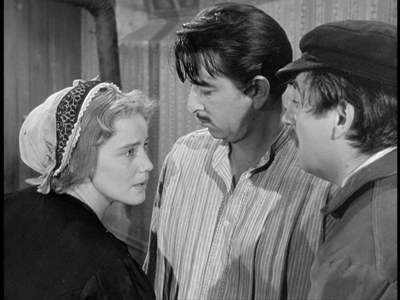
Hardy Krüger stars in Sundays and Cybèle as Pierre, a traumatized soldier who has returned from combat with no recollection of who he is and a vague feeling he did something terrible to earn this affliction (we know more than he does, having seen some of what went down in a stylized, dream-like flashback). Pierre lives in a remote French town with Madeleine (Nicole Courcel), a nurse who fell in love with him while he was in the hospital. She gives him a place to stay and tries to encourage his recovery, letting him spend his days in convalescence. He kills some time working for a local artist (Daniel Ivernel), wanders around looking for clues to his identity and trying not to be waylaid by his chronic vertigo.


Things change when Pierre meets Francoise (Patricia Gozzi) and her father at the train station one night while he’s waiting for Madeleine. The girl is being dropped off at a nunnery, and when Pierre finds out the father has no intention of returning to visit her, he decides to look after Francoise himself. The girl is allowed to leave the school every Sunday, and so she and the older men start meeting each week. Francoise’s mother is dead, so without this man posing as her dad, she'd have no one. She swears her love to Pierre and promises to marry him when she is eighteen. The one thing she won’t do, however, is tell him her real name. It’s a secret. The nuns have started calling her by a French name because they don’t like her birth name, which is Greek and has connotations that are not Christian. They rightly understand that names are power.

The subject of an adult and a child finding kinship in itself is not controversial (consider, for instance, Claude Berri’s The Two of Us [review]), but Sundays and Cybèle walks a provocative line. It makes no bones about the closeness of the twelve-year-old girl and her troubled thirty-year-old companion. While the two never cross the line into anything sexual, there is a physical affection between them. They are essentially playacting. They are two orphans playing house. How their friendship is interpreted depends on how they are observed. The act of watching is what Bourguignon is inviting us to partake in, and he crafts Sundays and Cybèle's visual language to emphasize this.


Pierre often appears encircled or framed by objects that draw our eye in his direction and isolate him simultaneously. At other times, he is observed from extreme vantage points, looking up or down. In one intriguing shot, we spy him from the side mirror of a passing vehicle. These images have the dual effect of encouraging us to consider a different way of viewing things, but also of containing him, as if bringing focus to his scattered thoughts. The shapes are often circular, reflecting Pierre's vertigo, but they are also an important clue to Pierre's past, repeating patterns buried in his subconscious. These things are indicative of the future, as well, the act of seeing through the circle intended to remind us of the crystal ball Francoise mentions belonging to her grandmother. When Pierre sees an actual fortuneteller mid-way through Sundays and Cybèle, she has little to say. Yet, he so believes in her powers, Pierre steals a magical dagger from her, believing it will provide access to another world.


Bourguignon offers up various conflicting visions of Pierre. The man who doesn’t even know himself contains multitudes. In one scene, he is like St. Francis of Assisi, innocent and kind, with birds perched on his shoulder and head. Of course, it's also ironic that Pierre is standing in a giant cage that he has built around himself, and that he will soon step out of, leaving the birds behind. Later, Madeleine will realize her own predicament, that she has also built an emotional trap with herself at the center, while walking around the studio where that and other cages have been kept. In her moment of epiphany, she is flanked by one such cage, as well as its shadow, the image blurring behind her, appearing like double vision. Like the two different Pierres.


Because for as benign and childlike as he can be, Pierre can also appear monstrous. In some of the nature scenes--trees and water both frighten him, the stuff of dark fairy tales--I am reminded of Boris Karloff playing Frankenstein's Monster. Pierre is almost too brutish, too unaware, the girl must teach him how to behave, her purity standing in relief to his--though her own innocence is balanced by the mature trappings she adopts as self-preservation. The scenes are strikingly familiar. They throw things in the water, she plays dead and let's him carry her, etc. Consider this in direct contrast to the man on the horse that Francoise imagines as a kind of romantic hero, capable of the chivalry she'd push Pierre toward, but that we fear he is not equipped for. Even when he takes the sorcerer's dagger at the carnival, when he walks away with it concealed under his jacket, Bourguignon places a knight's armor in the background, in our eyeline if not Pierre’s. The knight doesn't readily have a sword, but if he did, its size and sharpness would surely put Pierre's illicit dagger to shame.

Carrying on with this idea, Francoise abhors brutishness. She despises Pierre for hitting another child when he's jealous, and she is also frightened to see him in a drunken brawl, itself spurred on by his reacting with an open hand to a kiss from his ersatz girlfriend. The warrior frozen in the moment of his greatest shame and defeat can only react with force.


Both Krüger and Gozzi are exceptional performers. The tricky thing about their roles is that the are basically swapped. Krüger is playing, for lack of a better description, a kind of dimwitted manchild, a beast who needs taming; on the other hand, Gozzi is a kid who has had to grow up too fast. Hers is the more delicate balancing act, because she must also maintain a certain naïveté. Francoise is still manipulative and selfish, the way a child would be, even as she invents adult scenarios for the two of them. The young actress actually looks like a middle-school version of Juliette Binoche, and frankly, shares some of the talent, as well. Her ability to be so emotionally open is incredible, while Krüger ends up being equally impressive for his restraint. The actor makes Pierre's hurt and confusion visible without pushing toward Of Mice And Men territory. His difficulties seem genuine, and not an impression.

There is much debate from other people in the town over the appropriateness of the relationship between the man and the girl--though not all of it serious. Bourguignon creates quite a bit of comedy out of how the other townspeople observe them on their own Sundays out. Some, such as the couple who refer to Pierre as a "satyr," are rather nonchalant about the creep factor; others not so much. This will ultimately be the downfall of their union. If a magic spell is being cast, it can only last so long. Indeed, the film ends at Christmas, and shortly after Francoise has revealed her true name (spoiler: it's in the title). She writes it down on a piece of paper and puts it in a box and gives it to Pierre as a present--another act of magic. To know a spirit's true name is to possess that spirit, something you should keep in mind when you get to the final scene. (That I won't spoil.)


These differing points of view are meant to challenge our own perceptions of this relationship. That's the daring thing of Sundays and Cybèle, that Bourguignon would dare to confront what is "normal" and suggest that maybe the more disgusting implications of the pairing only exists because the common folks project those possibilities onto it. Because, really, aren't these just two people who need one another? Their bonding method is unsettling in its way, but no moreso than the sad fact that it's a shame that the world has only given us more reasons to be suspicious in the years since Sundays and Cybèle was first released. The movie’s central difficulties aren't easy to dismiss, but then, neither are all the other possibilities the script raises. Nor can one ignore the honesty of the emotions on display, which is what makes Sundays and Cybèle so genuinely intriguing.


For technical specs and special features, see the full article at DVDTalk.com.

Monday, December 31, 2012

PURPLE NOON (Blu-Ray) - #637

"Your genius lies within..."


For what is basically a crime thriller with a very average plot, Purple Noon (Plein soleil) is a film that happens almost entirely on the interior. Though René Clément's 1960 adaptation of Patricia Highsmith's novel The Talented Mr. Ripley has plenty of action--there are two murders and a meticulous flight from justice--all the important stuff happens behind Alain Delon's piercing blue eyes.

Delon stars as Tom Ripley. He was the first, ahead of Dennis Hopper, Matt Damon, and John Malkovich. He is arguably the best, at least for the iteration of the character this early in his criminal career, an empty vessel waiting to be filled, a chameleon looking for a new color palette to imitate. Delon plays the con man with a near absence of personality, alternating between a cold blankness and an almost childish petulance. For the early part of the film, when he carouses with his target, Philippe Greenleaf  (Maurice Ronet, The Fire Within [review]), they act like hormonal teenagers, giggling and pulling pranks and making nuisances of themselves. The seemingly homoerotic link between them is more predatory than sexual. Tom is already shadowing Philippe, sticking close to gather inspiration, his gaze recording information to mimic. To the unknowing eye, it looks like male one-upsmanship at its worst. When the pair pick up a tourist out on the town (played by Viviane Chantel), they paw her from both sides, hoping to secure her attention.


The caginess of Ripley's technique only becomes evident when cornered. Philippe confronts him, knowing the mooch is up to something, having seen Tom mimicking him in the mirror and finding his bank statements in Tom's things. Tom doesn't deny it. Instead, with a steely resolve, he tells Philippe what his plan is. Philippe is the perfect victim. He is perversely intrigued by the whole thing, and also so self-absorbed, he believes Tom would never do it. He's the invincible Greenleaf!

It's an odd twist I had never really considered before. Clément gives us an entirely unsympathetic murder victim, so that no one is sorry to see Philippe go. Ronet plays him as a bully. It's all there in the script by Clément and Paul Gégauff. Though Purple Noon is refreshingly lacking in psychobabble and explanations, that doesn't mean it's lacking in psychology. Philippe is the classic abusive boyfriend, lashing out at his fiancée and then immediately apologizing. Marge is played by Marie Laforét, and though she fights back, she always relents. No writer can watch Philippe toss her handwritten manuscript in the ocean and believe that she would ever take him back. And yet there she is. For his part, Tom lets Philippe be cruel to him because it's the rich kid's one true talent. Observing how he does it is essential.


Tom working his way up to kill Philippe makes up the first third of Purple Noon. The second third is his adopting Philippe's identity, forging documents and laying an elaborate trail that both establishes a new life and keeps shaking everyone else off the scent. The last third follows another murder, an unplanned slaying to keep from having the truth exposed. To cover that crime, Tom must kill Philippe again, making it appear that the killer has fled from justice and has committed suicide out of fear and guilt. This ends up being Tom's most masterful move, however: the new opportunity opens up the vault. He can take everything of Philippe's now, not just what he had on him in travel, but his full fortune...and also his romance.


In Purple Noon's creepiest scene, we learn that this is perhaps what Tom wanted all along. The ultimate theft, the ultimate assumption of roles: he will take Philippe's place with Marge. Here, the abusive triggers work to aid him. He whispers to Marge in her sleep, imitating the man she thinks she's lost, only to have her see the truth on awakening. Yet, this is the hidden key. Just as sure as the metal key in the cubbyhole by the door is how he got into her bedroom, this ruse will let him sneak into her affections. The delivery of harsh news, that Philippe never loved her, shows he can be as callous as she's used to, and then he provides her the comfort she seeks, mimicking the familiar pattern. Philippe never loved her, but Tom always has. Get the girl, get all the money, step into the dead man's shoes. A woman finally chooses him over Philippe, the tourist looks his way at last.

René Clément hasn't so much created a suspense thriller here or a whodunit as he has a "how will he do it." Ripley's success is, for the most part, a foregone conclusion, so we're intrigued to watch him lay out his pieces and then follow along as others, including a sharp police inspector (Erno Crisa), figure out where they all fit. Purple Noon is as colorful as a Hitchcock picture, but its view of mankind is as dark and cynical as a film noir. Clément has created something in between. Henri Decaë's lush color photography provides a bridge from the black-and-white of yesteryear (he shot more traditional French noirs like Elevator to the Gallows and Bob le flambeur) and the redefining of genre that was just around the corner (Le samourai and Le cercle rouge [review], both for director Jean-Pierre Melville, and both featuring Alain Delon). He uses primarily solid colors here, the Technicolor equivalent of light and shadow, creating shapes and angles. The most flamboyant use of patterns are on shirts that give Ripley away. The striped coat that Philippe catches him wearing becomes his disguise in his final gambit. On the flipside, a solid white shirt with Philippe's initials are what tips off their friend Freddy (Bull Kearns) to Ripley's scheme and leads to the second homicide. It's an omen Ripley doesn't pick up on: there's no coverage behind a blank canvas, you will be seen.


Friday, December 31, 2010

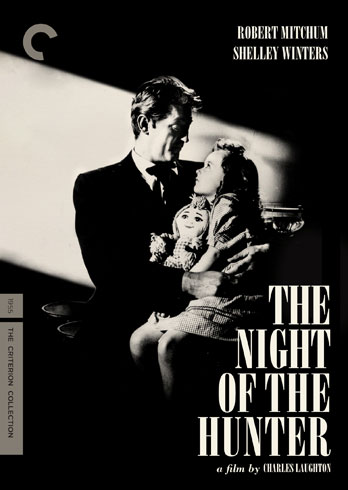
THE NIGHT OF THE HUNTER (Blu-Ray) - #541

"It's a hard world for little things."


A few weeks ago, while I was waiting for my copy of The Night of the Hunter to ship from Barnes & Noble, my friend Scott Morse watched his. Scott is a comic book artist, as well as a staff member at Pixar. Amongst other things, he designed the end titles for Ratatouille [review] and is one of the main design guys on Cars 2. (Also, these Criterion-themed posters and a comic book about Kurosawa.) Needless to say, Scott has his bonafides when it comes to animation. Thus, when he posted the following to his Twitter, I listened:

NIGHT OF THE HUNTER is a pretty spot-on reverse "princess" story. Studios, take note of the clarity. Drink down the Love and Hate.

THE NIGHT OF THE HUNTER is seriously cut from the same cloth as every Disney flick of the 50's. Iconic, clear, and elegantly shocking.


This is a fascinating theory, and one that absolutely bears out when you watch the movie. Charles Laughton's 1955 tale of menace is a contemporary fairy tale, staged like a children's play, shot like a film noir. From start to finish, it's a unique and daring film. James Agee's script flirts with innuendo, is suspicious of religion, and makes comedic hay of small-town mores. Laughton's direction is both arch and playful, employing film convention to create the safe and familiar, and then undercutting the same technique by deflating the comfortable air right out of its tires.


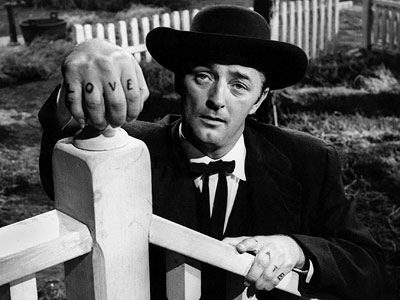
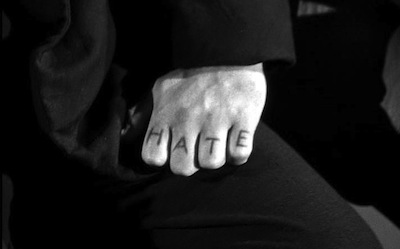
Robert Mitchum stars in the film. Preacher Harry Powell is one of his best-known roles. Though beloved by most of his fans as a hero with a hard jaw, he was a rebellious personality both on and off the screen. A few times in his career, the actor played a villain, revealing one hell of a mean streak. Harry Powell may wear a preacher's suit and hat, but this man has a twisted relationship with God. By his own admission, his version of Christianity is one he and the Supreme Being hammered out together. It's one easily explained, though. He wears his most prominent object lessons on his knuckles. On his left hand, he has tattooed the word HATE, one letter on each finger; on his right, LOVE. A man's hands are meant to work in tandem, but tangle the fingers together, and you'll find two objects at odds with one another. Every living soul is in a constant struggle between hate and love, between doing what is right and giving in to temptation.*


Every living soul except for Harry Powell, that is. Harry is a killer, though the extent of his crimes are just mysterious whispers at the start of The Night of the Hunter. He is pinched watching a burlesque show, but not for the phallic switchblade poking through his suit pocket, nor for the body we saw in an unspecified barn, but because he stole a car. He is sentenced to a month in the hoosegow, where his bunkmate is Ben Harper (Peter Graves). We met Harper when he got arrested. The Night of the Hunter is set in the Great Depression, and Harper killed two men and stole $10,000. Before he got nabbed, he gave the money to his young son John (Billy Chapin) and his even younger sister Pearl (Sally Jane Bruce) and made both of them swear not to tell where he stashed the cash. Ben Harper even goes to the gallows with the secret. The stolen bills are his children's future.

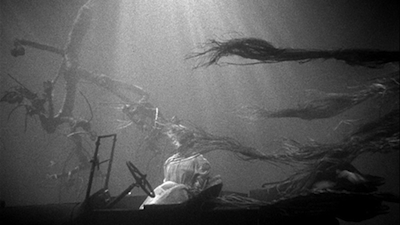
When Powell gets out of jail, he heads to the Harper homestead. There, he seduces Ben's widow (Shelley Winters), and once he is John and Pearl's stepdad, sets about trying to get them to give up the dough. When the woman gets wind of what Powell really married her for--apparently his rejection of her sex and subjugating her to his "religion" was not enough--the preacher murders her and dumps her body. It's a grizzly scene, but filmed to appear dreamy, almost idyllic. The widow Harper is dumped in the river in her Model-T Ford. The currents push her hair along with the underwater weeds, like the mythical Lady of the Lake, though her warning is darker than even that of legend.


With no one to protect them, John and Pearl go on the run. They take their father's rundown boat and set off down the Mississippi. Here, Laughton opens the door to the secret world of children. Most fiction for young readers has a quality of emphasizing the separateness of childhood. When you are small, the bigger world pays you no attention, and thus you can retreat into imagination. Disney films usually have a sense of this, too, though often, instead of kids, it's the parallel world of animals. Think about the cartoons where animals talk, and none of the humans can hear them. So it often seems to be when you are a child: you can talk, but the adults don't concern themselves with what you're saying.**

Tellingly, once the children are in the wilderness, human life fades away, and Laughton designs multiple shots that show the animal population that lives along the water. Spiders, rabbits, turtles, owls--the fugitive orphans and these woodland creatures exist in the same space, and the tiny humans pass unmolested. The animals don't shrink from them, either. This is the realm of fable. They are "other."


This is the most obvious element where the movie matches up to Morse's Disney theory, but there are many more touches throughout The Night of the Hunter that also work to remind us of classic animation. The children's journey is punctuated by songs, mostly schoolground tunes or religious hymns, but that serve to emphasize the emotional tenor of the scenes Laughton uses them in. The trek the kids go on is ostensibly a search for a home, having lost their own and, in a way, having had their identities erased. It's somewhere between Pinocchio, who is misguided by temptation, and Simba, whose birthright is threatened in The Lion King. (Or, even the exiled princesses, like Cinderella or Aurora in Sleeping Beauty.) Though Mitchum's performance as Powell can show him to be as sinister as Scar in the latter film, the more comical side is a bit like Prince John in Disney's foxy version of Robin Hood. The preacher can be petulant and downright whiney. He's a fascinating loon, often busting out dramatic gestures that recall Lon Chaney silent creepers. In one scene, after her meets the wrong end of a rifle, he runs away howling like Goofy tumbling off a cliffside. For as much as you might be scared of Powell, you also want to point and laugh.
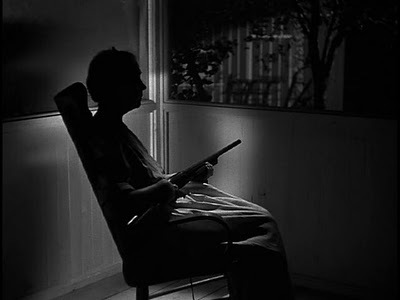
Eventually, John and Pearl wash up on the riverbank near the home of a mother hen figure. Miz Cooper is played by legendary film actress Lillian Gish. She takes in strays and puts them to work in her garden, providing the structure and basic morals they otherwise lack. She is a kindly stepmother, not the wicked kind, and she even serves as a sort of narrative chorus. Cleverly, Agee and Laughton have one of her adopted girls make fun of how she talks to herself all the time, setting us up for the moral Miz Cooper will lay out at the end of the picture. She is both hard and soft, tough on her kids but caring. In contrast to Powell, her behavior is anything but erratic: this is someone the kids can count on. Her home is tidy and traditional; the town nearby is chaotic, lit with neon, full of temptation. Again, it brings to mind Pinocchio and the carnal delights that lead him from Gepetto. The lure of all this sin will call Miz Cooper's oldest charge, Ruby (Gloria Castilo), and Powell will trick her into revealing too much.


Gish is marvelous as the staunch caretaker. She and most of the older character actors really shine under Laughton's direction. Evelyn Garden is particularly good as the annoying busybody Icey Spoon (and she looks exactly like Madam Mim from The Sword in the Stone [review]. I have to admit, though, the child actors aren't that great. Five-year-old Sally Jane Bruce is extremely stiff, looking like she has barely enough attention span to remember what she is supposed to do. Ten-year-old Billy Chapin is quite a bit better, but his performance is actually hurt by Laughton's direction. He regularly isolates the boy for reaction shots, and the way he cuts the scenes doesn't quite connect the boy's expressions to what he is reacting to.

I know this could get me lynched, but I found Laughton's direction to be quite clumsy at other times, too. Some shots are too rigid, and the editing disjointed. Look at, for instance, Powell chasing the children up the cellar stairs. Mitchum appears to be parodying a horror movie ghoul, and it has the appropriate effect, being at once silly and menacing. Yet Laughton and editor Robert Golden don't give the moment its due. They shove a single side shot of this attack into the action, and it doesn't quite fit. For as short as the shot is, it's almost like they started it too early and cut it too soon, you can practically see the marks on either side of Mitchum's lunge. Likewise, for as lovely as those riverbank images of the forest animals can be, they always look like they've been arranged, they aren't natural. Obviously, there are shots throughout the movie that are meant to look like something out of a storybook (observe, for instance, the hangman's children asleep in his shack), and Laughton has done a good job composing them--but it's too good. The illusion bursts.


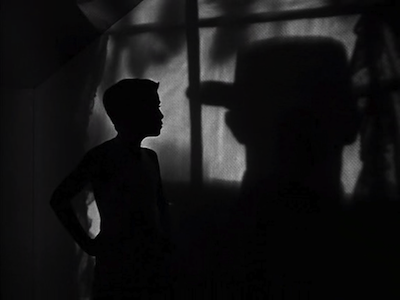
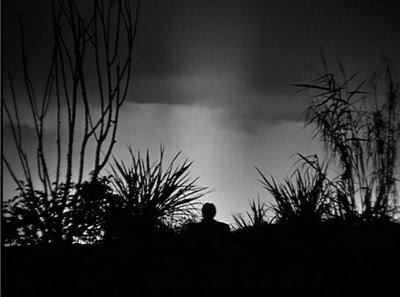
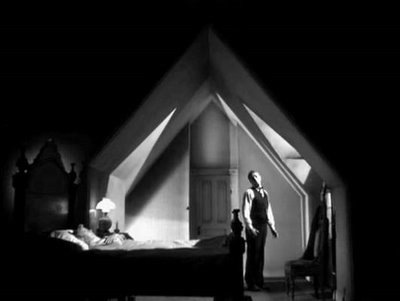
That said, when Laughton and cinematographer Stanley Cortez (who also worked with Orson Welles on The Magnificent Ambersons) are on target, they really are dead center of the bull's-eye. Laughton's use of silhouette and shadow is unmatched in its visual power. He can use light and dark to create both a sense of calm and of terror, and often in the same scene. When the children bed down in a barn, their appearing as shapes against a night sky is serene and lovely; when they awake to hear the approaching Powell singing his signature (and ironic) hymn, the vast horizon suddenly becomes unbearably huge and oppressive. The smaller silhouette in the distance is a threat, and though far away, the distance emphasizes the killer clergy's inescapable presence.

Smartly, as The Night of the Hunter winds down, so too does Laughton dial back the style. His approach has a more old-fashioned, family movie vibe in the last couple of scenes, including the amusing image of Miz Cooper leading her brood through the back alleys like a mother duck and her chicks. In these kinds of stories, the final chapter is when some kind of normalcy is restored, and the traditional Christmas scene Laughton and Agee have concocted is meant to be familiar and homey. No divisive shadows, no extreme angles or compositions, mostly just straight-on shots of Miz Cooper stirring her stew pot, musing on the plight of the wee ones as they move all around her. It's a reassuring finale, restoring the natural order, including letting us know that it's not God or His son that's gone all wrong, but the misguided people of the world that have twisted their positive message. Too much of the left hand, it would seem, and not enough of the right one.


Criterion's two-disc release of The Night of the Hunter, available on standard DVD and Blu-Ray, is an outstanding package. Put together in cahoots with the UCLA Film and Television Archive, the restored print is superb and the collection of extras is a treasure trove of quality supplements, including a clip of the Peter Grave and Shelley Winters giving a live television performance of a scene that ended up cut from the film.

If you're going to watch any extra, however, you must jump over to the second disc. It is devoted to the two-and-a-half-hour documentary Charles Laughton Directs "The Night of the Hunter." This film, put together by Robert Gitt, is a compilation of outtakes and alternate footage from an unprecedented library of dailies that Laughton kept for himself. Gitt uses the raw material to create a history of the production, as well as an alternate version, working through the story in the same narrative order, giving us a glimpse of how a movie is shaped as it is filmed. Deleted shots and flubs share the screen with experiments and rehearsals, as well as curios like Laughton reading from the Bible, author Davis Grubb's sketches he made for the director to show him how he saw his novel portrayed (these also get their own feature on disc 1), and even a scene with the original Uncle Birdie. Emmett Lynn was originally meant to play the old drunk, but Laughton thought his performance was too mannered and cliché. He recast the role with James Gleason--and rightly so judging by what we see here. Gleason nails it.


* Spike Lee would, of course, update this symbolism in Do The Right Thing (another Criterion release), giving Radio Raheem gold rings spelling out each word and likening the struggle of man to something more like a boxing match.


** If you're curious to further explore this secret world of children as portrayed on film, pairing The Night of the Hunter with another Criterion disc, Rene Clement's Forbidden Games, would be a great double-feature.


Wednesday, December 30, 2009

GERVAISE - ESSENTIAL ART HOUSE

"They were the only good things in my life. Maybe that's why they left."


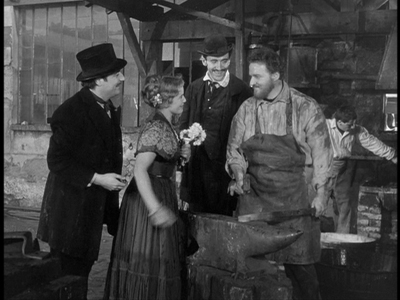
Réne Clément's 1956 historical drama Gervaise is an adaptation of Emile Zola's L'assommoir, part of the French author's multi-part character epic, Les Rougon-Macquart. The novel's title, L'assommoir, is said to be an old colloquialism that is roughly the equivalent of the American phrase "to get hammered." Apparently the focus of this chapter of Zola's narrative was alcoholism and the devastating effects it has on a family. The drinking is also there in Clément's film version, but the focus is more on the title character, Gervaise Marquart (Maria Schell), and how she gets hammered by life.
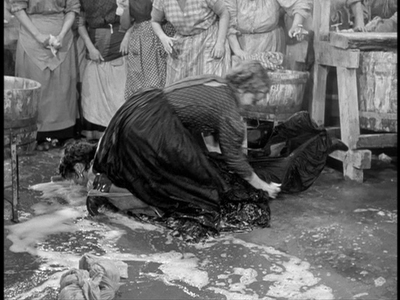
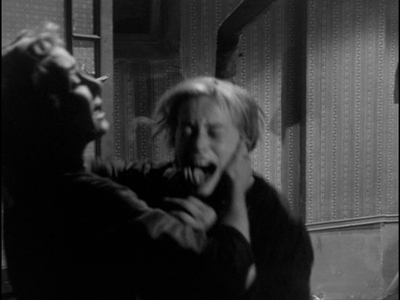
As Gervaise herself tells us in her hopeful opening narrative, she is the girl who shouldn't have expected very much. At the start of the picture, which takes place in the late 1800s, she is living with her common-law husband Lantier (Armand Mestral), who has taken her on despite her limp and given her two boys in the time they have been together. Too bad for her that Lantier is the kind of man no female deserves, and pretty soon he runs off with a loose woman who lives across the street. Gervaise's anger leads to her having a knockdown drag-out fight with that strumpet's sister, Virginie (Suzy Delair). Despite taking place in a giant public laundromat, it's a pretty dirty scuffle, ending with Virginie's bare ass being spanked with a paddle. The indignity is one she promises never to forget.


With Lantier out of the way, things start looking up for Gervaise. She marries a kindly roofer, Henri Coupeau (Francois Périer), despite the protests of his family. They have a daughter together, Nana (Chantal Gozzi), and they make plans for Gervaise to open her own launderette. This dream is nearly scuttled when Coupeau falls off a roof and Gervaise's insisting on taking care of him herself leaves them broke. The kindly blacksmith Goujet (Jacques Harden) loans her the downpayment for her lease, revealing his buried love for Gervaise and sparking an unacknowledged jealousy in her husband in the process. Once again things are looking up for Gervaise.


Of course, you can only look up so long before the sun burns your eyes, and that's when the blindside comes. Gervaise is one of those up-and-down melodramas where every step up the ladder the protagonist takes is followed by her being knocked back two more, all the way to the bottom and down to hell if the earth would just comply and open up. It's the sort of story that, when done poorly, compels the audience to throw up its hands and cry, "Enough! I give up!" When done well, however, as Gervaise most certainly is, it makes co-dependents of us all. Yes, Gervaise, we'll watch you get your hopes up, and we'll wait with wetted lips for them to get dashed on the rocks. Especially because we know each failure will be bigger than the last.

I think an essential component of any such movie succeeding is the strength of its lead. In this case, Maria Schell imbues Gervaise with a natural warmth and kindness that somehow makes us root for her even as we slowly begin to realize that she's not really that innocent of a victim. Or maybe "innocent" is the wrong word. It's more that she is less a victim of opportunistic men then she is her own bad choices. Whatever societal forces may be informing her misguided decisions, and the lack of education that leaves her without other tools, it becomes increasingly hard to reconcile the Gervaise that fought back against Virginie and whooped her ass with the Gervaise who allows a besotted Coupeau to let Lantier move in with them, and who is then manipulated in jumping between the beds of both men. We know she is capable of better, but she has latched onto bad luck as her own addiction. It's like she wouldn't know what to do without it. With her kind face and clear, expressive eyes, Schell reminds me a lot of Liv Ullmann, which is probably a major reason why I was drawn to her. She is an excellent actress in her own right, though, and later played both the love interest in Luchino Visconti's marvelous Le notti bianche and the immigrant frontier wife in Anthony Mann's version of Cimarron.


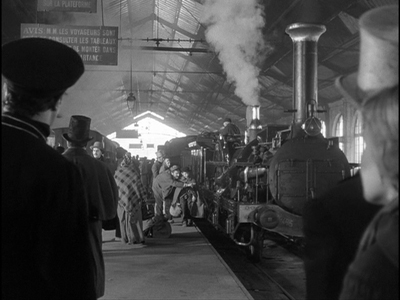
Symbolically, the blacksmith Goujet is Gervaise's conscience. He never fails to see what is really going on, and when she later tries to lie to him, she can't really do it. He also serves as the example of social change, and when he is sent to jail for organizing a strike to protest unfair wages, that's when things really go south for Gervaise. Without him there watching, she has no one to help her pick her drunken husband up off the street or ward off Virginie's machinations. As in Carné's La jour sa lève, work is what sets a man free. When Coupeau stops working, he disappears inside a wine bottle, whereas Goujet's taking Gervaise's eldest, Etienne (Christian Férez), under his wing offers the boy a way out of the squalor. Jacques Harden lends Goujet a rugged earthiness that would have made him right at home as the love interest in one of Douglas Sirk's movies from the same period. The scene when Gervaise goes to see him and Etienne off, and he doesn't see her standing there on the train platform--or quite possibly ignores her--is one of the most heartbreaking in the movie.


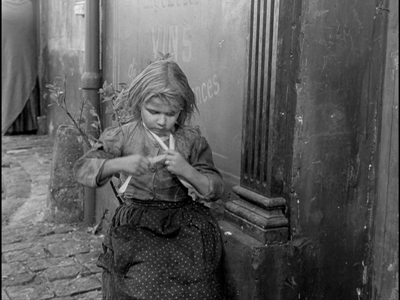
Its rival for saddest scene is the very end of the picture, when we see poor Nana heading on the road to ruin herself. René Clément had already proved himself an expert at portraying childish behavior and the hidden meanings behind it in Forbidden Games when he made Gervaise, and he turns Nana into a cautionary element that is integral to the narrative. If Etienne is an example of how a child can escape his surroundings with a little guidance, the blank sponge that is Nana soaks up all the nastiness, all the dirty laundry, that fills Gervaise's shop. Left to her own devices, the unbathed child wraps a ribbon in her hair and runs to an eager group of young boys. They turn to chase her the way a flock of birds shifts flight in mid-air. It's a creepy image all on its own, but knowing where that chase will lead her, it's all the more chilling. Nana is the star of another of Zola's novels, which has been adapted to film itself more than once, most notably by Jean Renoir in 1926.


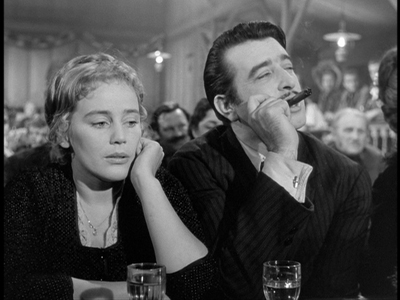
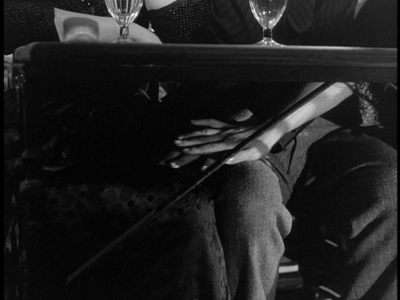
Observing behavior that is meant to remain unseen has always been Clément's strong suit. Be it the cons of Alain Delon in Purple Noon or the secret rituals the children undertake in Forbidden Games (which was written by Jean Aurenche and Pierre Bost, the same team on the script for Gervaise), Clément is attracted to the hidden actions and the pathology that underlines the things people do to themselves and one another. In a pivotal scene in Gervaise, his camera coyly pans down from up above the table where Gervaise, Lantier, and Virginie sit to look under the table at what is happening out of sight. One could almost call the drift of the camera "sprightly." It's a delicious moment, made all the better by Suzy Delair's relish for playing the villainess.
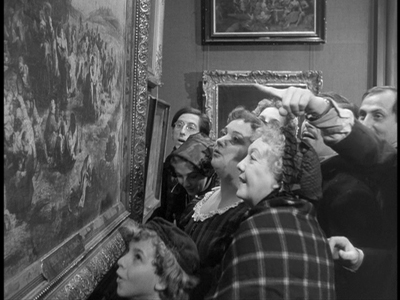
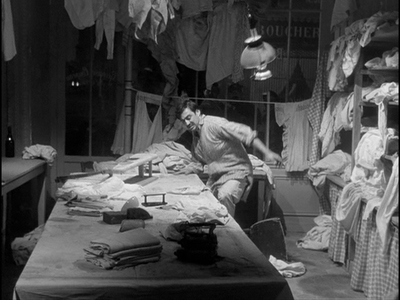

The same attention to detail is paid to all of Gervaise, and the director and his crew recreate 19th-century France with gritty accuracy. One of the most impressively realized sequences takes place on Gervaise and Coupeau's wedding day, when the working-class wedding party goes to the Louvre, many of them for their first and only time. They tour the museum, looking at the paintings, laughing at the ones with nudity, tracking mud through the institution's corridors. Clément shows us both the expanse of the galleries, but also the tight formation of the group, including ducking down to check out that dirty footwear.


Alongside Schell's charisma, such exacting focus on getting every inch of the movie right is crucial to our accepting the emotional histrionics of Gervaise. The movie never feels like a put-on, and it's most certainly never manipulative. By creating a believable world, René Clément also makes the story believable, even when we don't want to believe that our heroine is going to go the wrong way again. Real life is full of mistakes, and a movie's main character is allowed to make them, but the storytellers are not.


This disc was a Christmas present from my good friend and regular editor, the writer Maryanne Snell. What can I say, it was an Essential Art House Holiday. Many thanks, Maryanne!

Sunday, August 31, 2008

SIDELINE: MORE REVIEWS FOR 8/08

Given that I write more reviews than what you see here, below is a list of non-Criterion films I covered in the past month that may be of interest to Criterion fans.

IN THEATRES...

* Pineapple Express, a sprawling comedy reuniting Seth Rogen and James Franco under the tutelage of director David Gordon Green. It's a real departure for the director from his serious indie fare, and he drops all restraints.

* Vicky Cristina Barcelona, Woody Allen goes abroad for a scintillating romantic drama about passionate, pretty people.

ON DVD...

* The Anton Chekhov Collection, six discs with ten BBC adaptations of the master playwright's stage work.

* Blues in the Night, Anatole Litvak's lively 1941 picture attempting to bring jazz to Hollywood. Features director Elia Kazan in a supporting role.

* Delicatessen: Special Edition, a straight-up reissue of the Jean-Pierre Jeunet dark comedy from 1991.

* Derek, an illuminating documentary about pioneering queer filmmaker Derek Jarman.

* Extasis, featuring a young Javier Bardem in a Spanish thriller suitable for Tom Ripley.

* Joy House. Speaking of Tom Ripley, this film teams up Rene Clement and Alain Delon, the Purple Noon team, for a disappointing but interesting thriller released as a lacklustre DVD. With a very young, so very hot, Jane Fonda.

* Moontide, in which Jean Gabin washes ashore in Hollywood to find Ida Lupino, only to make a so-so thriller with her.

* Pete Kelly's Blues, a stiff Jack Webb vehicle elevated by appearances by Ella Fitzgerald and Peggy Lee.

* Road House, a mullet-free 1948 noir with fantastic performances by Ida Lupino and Richard Widmark. If you've seen the Swayze movie and not this one, you're what's wrong with with this country. 'm just sayin'.

* Satantango, Bela Tarr's seven-hour masterpiece is a riveting human tragedy. Not the greatest DVD in the world, but the movie transcends all.