Showing posts with label Roy Ward Baker. Show all posts

Wednesday, January 12, 2022

NIAGARA - CRITERION CHANNEL

This review was originally written for DVDTalk.com in 2013.
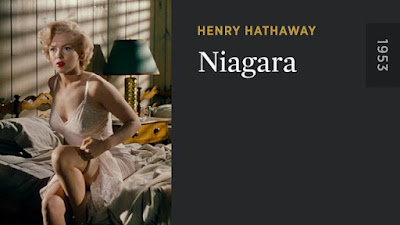


Marilyn Monroe was rarely cast as anything but the sympathetic or comedic love interest, but based on the evidence in Niagara, she could have had a whole other career as a femme fatale. In fact, her performance here stands alongside another of her off-model films, Roy Ward Baker's Don't Bother to Knock, released a year prior, as two of her most interesting. If for nothing else, because the frightened, twitchy woman she becomes in each is unlike the persona she came to develop immediately after in Gentlemen Prefer Blondes and How to Marry a Millionaire. Whereas her nervous condition in Knock has more mystery--part of the film's main plot is finding out why she is the way she is--Niagara provides her with more of an arc. She goes from confident and devious to hunted and afraid. I'd be curious as to how differently her work might have played sixty years ago, when there was at least still a smidgen of an unknown quantity to the actress; now, Marilyn is so intrinsic to pop culture, we forgive and forget even as she commits her crimes, meaning we feel sorry for her despite the fact that she's getting what she deserves.


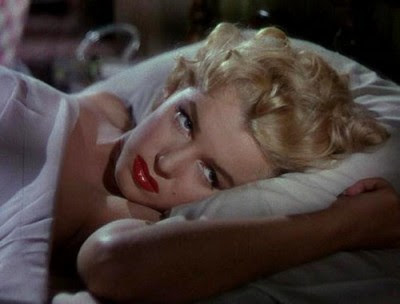
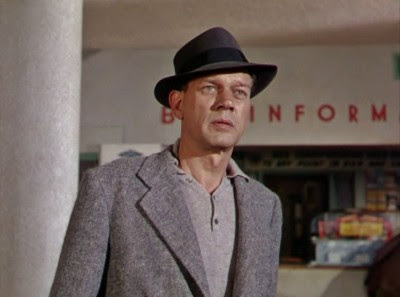
For Niagara, Marilyn plays Rose Loomis, who has gone to the famous water resort on a second honeymoon with her husband George (Joseph Cotten, Shadow of a Doubt). He has just been discharged from an army hospital, where he was sent for battle fatigue. His mental maladies are still with him, however; Niagara opens with him wandering in the mist by the falls in the early morning. When he returns home, his wife pretends to be asleep. She has had enough of George and is making plans to get rid of him. He suspects this to be the case, though given his neurotic manner, most think it's just paranoia.


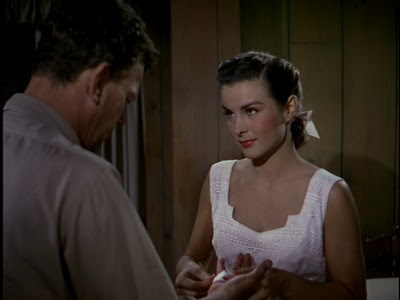
The story of the Loomises is juxtaposed with that of the Cutlers, a couple on their first honeymoon, albeit a belated one. Ray (Max Showalter, Sixteen Candles [review]) has gotten a job in the shredded wheat factory on the American side of the falls; he has taken his wife to the Canadian side to celebrate. Whereas Ray is all golly-gee enthusiasm, Polly (Jean Peters, Pickup on South Street [review]) is more calm and reserved. Through a combination of nosey snooping and empathy, Polly becomes embroiled with the Loomis drama. She also gets the movie's best lines, revealing a sense of humor that can equally be aimed at others ("She sure got herself an armful of groceries") and at herself ("For a dress like that, you've got to start laying plans when you're about thirteen").


Niagara is directed by Henry Hathaway, who was known early on for westerns and then later, particularly in the years before Niagara, for directing definitive film noir like Kiss of Death and The Dark Corner. Though often lumped in the noir category, Niagara is something slightly different. Its setting and intense romantic storyline have much in common with gothic romance, while its colorful artifice has an element of the women's melodrama, looking not dissimilar to Leave Her to Heaven [review], but also being in line with the soap operas of Douglas Sirk and Jean Negulesco.


Cotten makes for a convincing brooder, and his dark passions only become more exaggerated and desperate as the movie progresses. He and Monroe are emotional counterweights. When she is up, Cotten is down, and vice versa. This leaves Peters to be the center. Her suspicions regularly give way to complicity, but she never gives in to her more scandalous impulses. Hathaway uses the setting as an environmental engine, the constant beating of the water churning up all the extreme feelings, driving both character and plot. It's fitting that the movie's most violent action is committed higher up. When Rose Loomis flees from her husband, and effectively her own errors in judgment, she runs up a bell tower, as if trying to climb away from the big hole in the earth and the torrents of water that would otherwise drive them under. Hathaway and director of photography Joseph MacDonald (Bigger Than Life [review]) set the camera up high, peering down from the uppermost point in the tower, the shadows of husband and wife exaggerated like they are posing for a Saul Bass poster. It's the most artful shot in the movie, fueled by the inherent grotesqueness of the incident it portrays.
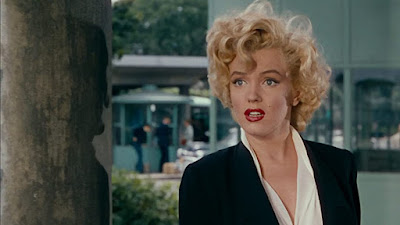

There is, of course, only one direction George Loomis can go after that. The film can only end in the falls, George can only be ground down by irresistible urges. It makes for a nail-biting finale, one that is surprisingly cynical, but that admirably stays true to the dark places where Niagara began.



Sunday, March 25, 2012

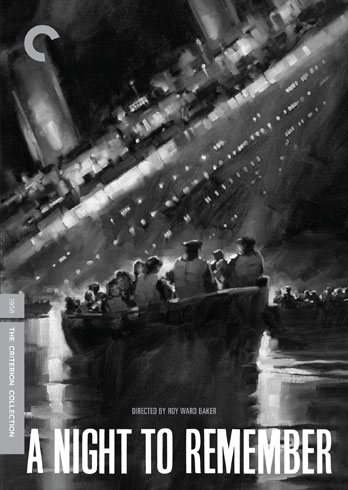
A NIGHT TO REMEMBER (Blu-Ray) - #7


There is much about the catastrophic sinking of the Titanic in 1912 that has entered into common knowledge. The Unsinkable Molly Brown, "women and children first," the band playing even as water spilled over the decks, the ship's designer and captain both maintaining their posts until the end--these are all things most people can recall about the historic event when prompted. Yet, they are just markers in a larger story, details that are required for any retelling, but merely the starting point, not the finishing touches.

Walter Lord's book A Night to Remember was the first definitive retelling of the tragedy. The author sought out Titanic survivors and interviewed them about what they saw. The 1958 film adaptation was a personal project for producer William MacQuitty. Even half a century later, many still considered it to be "too soon." On one of the supplements on the Criterion Blu-Ray, MacQuitty notes that shipping companies refused the use of their ocean liners for shooting because no one wanted their boat associated with the worst maritime disaster of the 20th Century. Undaunted, MacQuitty soldiered on.
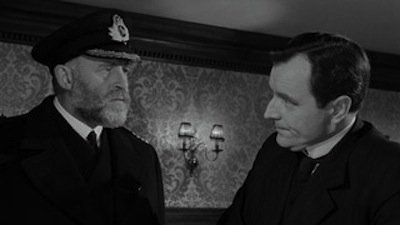

The eventual film version of A Night to Remember was a landmark of British cinema. The sober account of the ill-fated maiden voyage of the Titanic was eventually adapted by Eric Ambler and directed by Roy Ward Baker, whose other notable credit (at least for me) is the chilly Marilyn Monroe thriller Don't Bother to Knock. In that earlier motion picture, Baker works with claustrophobic spaces, confining his drama to the interiors of hotel rooms, to mimic a feeling of being trapped in one's own head. A Night to Remember has a similar trapped sensation, but the scope is massive. The passengers of the Titanic aren't just trapped on the doomed vessel, but the entire vast ocean.
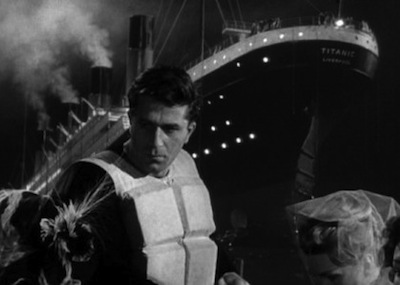
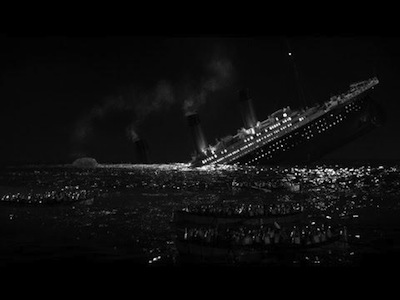
A Night to Remember is more docudrama than melodrama. The structural outline is simple: passengers gathering for launch, the early part of the voyage, and then the sinking. The latter element takes up most of the film, and to be honest, it isn't until the crisis is underway that A Night to Remember starts to warm up. The script moves between the classes, noting the difference in comforts and how this will eventually come into play when it's time to abandon ship. The fancy upstairs reserved for the wealthy upper classes, the less ostentatious second class, and, of course, steerage, with is full of poor immigrants in search of a better life rather than sailing for pleasure. We are also privy to the completely separate world of the ship's crew, of the people whose duty it is to keep the Titanic in operation. Even here, though, we can see similar divisions. There are officers and there are enlisted men, technical operators and grunts, and also servants. It is a society within a society. Indeed, early in A Night to Remember, someone likens the ship to a floating city; aptly, the boat operates as such.


Not that these lines are drawn sharply. The elegance of Baker's movie is that, except for a few instances, it eschews heavy dramatization in favor of letting the details of the situation speak for themselves. There is plenty going on in the story that provides a natural tension, such as the unceasing efforts of the communication officer to raise help, the filmmakers don't need to manufacture any added suspense. We know that more than half of the people on board the Titanic died, but A Night to Remember's anxiety is in wondering who will survive and how. The horror of the real events need not be overstated--the off-screen screams of unseen passengers cause genuine shivers--we know the outcome and have our own fears about being in a similar situation already in place. Just seeing all that water pouring into the cabins is enough to put me on edge.

The tone of the picture is very British, adhering to the "stiff upper lip" cliché. One should not mistake this for a lack of emotion or even coldness, however; on the contrary, Baker finds proper heartbreak within the reserved behavior. The scenes with the young family, when the father gathers up his wife and three children and takes them to the lifeboats, careful not to tip his hand as to the full breadth of the emergency or the likelihood of his being able to follow, are probably the most moving in the whole story. She knows the truth, even if he won't speak it. Likewise, the movie is not without humor. The baker getting drunk in his room provides consistent laughter without being crass. It alleviates the heaviness just enough so that we aren't weighed down.


It's not that I have a problem with taking the story the other way. On the contrary. I am actually on record as liking the James Cameron Titanic, which certainly goes for a far more histrionic level of Hollywood dramatics. I think it's good that we have both pictures. One balances out the other. One aspect Cameron's approach might have over Baker's is that, in Titanic, we do get to know and care about the characters more; in A Night to Remember, the focus figures get such a short time in the spotlight, it takes most of the effort we can give just to keep them straight. The one thing they both have in common, however, is that they are crowning technical achievements. Both Cameron and Baker were concerned with details, and A Night to Remember's special effects are astonishing for any era, not just 1958. Even with the heightened clarity of high definition, very few cracks show. MacQuitty's team has succeeded in creating a seamless illusion, jumping between models, sets, a real ship, and in the launch scenes, archival footage of the actual Titanic. There's never a clear demarcation between any of the elements. A Night to Remember is all of one piece, and thus is wholly convincing.

A Night to Remember was one of Criterion's earliest DVD releases, and though it's only been a little over a decade since that first edition, technology has moved light years since. The restored digital transfer and uncompressed soundtrack created for the Blu-Ray serve to further prove just how fantastic this new technology is for older films. The black-and-white photography looks flawless, and despite only being a mono audio track, the soundscape has a lot of depth. Criterion has further rounded out the package with video features focusing on the survivors of the Titanic, as well as a BBC documentary examining the science behind icebergs and another looking at the making of A Night to Remember, with extensive interviews with MacQuitty and author Walter Lord. (The latter feature, as well as the history-focused audio commentary, were also on the 1998 DVD.) It's an impressive presentation, and I am glad to have been able to experience the film again in this way. I'll confess, I wasn't that taken with A Night to Remember when I watched it previously, and so am pleased to have been so moved by it this second time around.


This disc was provided by the Criterion Collection for purposes of review.