Showing posts with label todd haynes. Show all posts

Thursday, January 20, 2022

BRIGHT STAR - CRITERION CHANNEL

 This review was originally written for DVDTalk.com in 2009.


As a moody, death-obsessed writer whose genius has yet to be recognized, Jane Campion's portrayal of poet John Keats in her new film Bright Star hit a little too close to home. Depressed, misunderstood, doomed romance--hey, John, I can identify. Just tell me how I can be lucky enough to get tuberculosis, and I'll follow you all the way down. Damn my parents and their stupid vaccinations!*


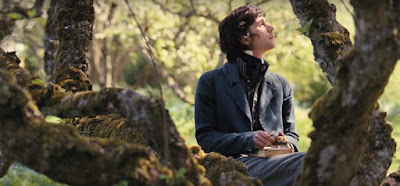
Bright Star isn't an all-encompassing biopic of the Romantic poet, but rather, it follows Keats over a couple of specific years, beginning in 1818 when the young writer met the love of his life and the tragic turn that soon followed. Keats is played by Ben Whishaw, who portrayed the antagonistic, on-trial version of Bob Dylan in Todd Haynes' I'm Not There (he was the one in black-and-white who wasn't Cate Blanchett) [review]. He's getting pretty good at this broody poet thing. Alternately cocky, self-loathing, and frightfully charismatic, he makes Keats a dark and dreamy apparition. Thus, it's no wonder that the pretty young seamstress, Fanny Brawne (Abbie Cornish, Elizabeth: The Golden Years [review]), is attracted to him, despite having no understanding of poetry and thinking that wit and smooth moves on the dancefloor are the two best traits in a man. Opposites do attract, though, and both the poet and the girl have an intensity to their personalities that somehow makes them a perfect match.


Not that everyone would agree. Socially, John Keats is a pauper. His books don't sell, and he has no viable prospects, so as a candidate for marriage, he doesn't lead the pack. He's also friends with another poet, Charles Armitage Brown (Paul Schneider, All the Real Girls and TV's Parks and Recreation), a crank who is protective of Keats' talent and also distrustful of women, especially girls he sees as flirty and frivolous. Fanny fits this category as far as he is concerned, and the two spare no opportunity to express their disdain for one another. Ironically, Charles is probably more along the lines of what Fanny expects of a male suitor, even if his humor is much darker and pointed than she would like. Paul Schneider, whose previously been best known for his David Gordon Green collaborations, gives the best performance of his career as the sardonic poet. I've never seen him so comfortable in his own skin and so at ease with his lines. His previous performances often relied on a quirky naturalism that is all but gone here, replaced by a more forceful presence. Some of the film's strongest scenes come as Brown is revealed to lack the moral purity that was so valued by the Romantics. He is not John Keats, and he knows it, and he can live with it as long as no one else points it out.
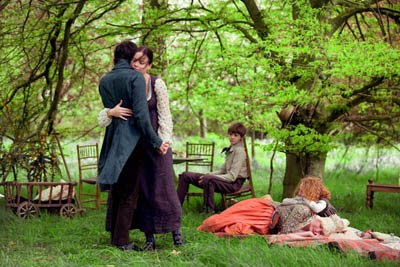


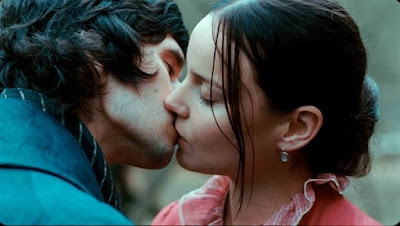
Campion, who also wrote the screenplay for Bright Star, establishes a fascinating social order in the movie. No one here is entirely well off, and though they are members of polite society, there is some funds-stretching going on. One trick is apparently moving house a lot, following the changing seasons in search of cheaper lodgings. This puts the Brawne family--Fanny's widowed mother and her two siblings--in the other half of the house where Charles Brown is renting and where he lets Keats stay for free. Being in such close proximity, the romance between the poet and his new muse, which previously has consisted largely of poetry lessons, misunderstandings, and a gentle touching of hands, can take full bloom. Soon it's kissing in the forest and touching the wall that separates their beds night after night, feeling the heat of love pass between. Fanny becomes entirely wrapped up in Keats, which can feel just as bad as it may feel good since he is prone to mood swings. If he writes a line about butterflies in a love letter, Fanny catches every butterfly she can and creates an oasis for them in her bedroom; when he selfishly ignores her, she demonstrates her ineptness at suicide. Abbie Cornish is very good as Fanny. The actress understands the melodrama of adolescent angst, and she manages to make it real without overdoing it. Her most enthralling moments, however, are when she lets herself be an empty vessel silently letting Keats fill her up.


There's something refreshing about seeing a romantic relationship on film that doesn't involve sex. It's not that Campion isn't comfortable with it--she did direct In the Cut, after all--it's that she is aware here, as she was in The Piano [review], that the greatest passion often lies somewhere beyond physical expression. Though there is no crossing over to the other side the way the characters did in The Piano, Bright Star is more intensely realized for it. Why not a love affair that involves reciting poetry and quickly stolen glances? Brown encourages Keats to bed the girl and get it over with, hoping it will cure his friend of his crush, but Keats won't even consider it. Perhaps he sees the consequences Brown fails to consider when he knocks up the maid, but I doubt it's anything as crass as all that. Poetically, to take their relationship further would spoil it. Campion sees Keats' life as one of extremes: the butterflies and the punctured veins, dazzling beauty and dark lows. She and cinematographer Greig Fraser capture both sides beautifully. They infuse the warm summer with color and light, and yet they shoot the snow of the chilled winters with as much clarity, letting each flake stand out under a dark sky. At the same time, there is a softness to everything, as if a very thin veil of muslin had been placed over the camera lens. This faint yet ever-present whiff of grey reminds us that there is a sadness that can't be escaped in this story. Bright Star is young love on a deadline.


John Keats' death at 25 is well known. He contracted tuberculosis, which also took his brother from him not long after he and Fanny Brawne had met. Keats foreshadows this regularly by talking about his own death even when he is healthy, something Campion never portrays as ironic or dramatic, but something Keats firmly believed. Any biopic that ends in such a way is always faced with the challenge of overcoming the audience's knowledge of the inevitable, and the fact that Bright Star doesn't worry about getting around that is both one of its greatest strengths but also its only weakness. The movie does drag a little at the tail end when the closeness of death is more obvious. Perhaps had Campion not let Whishaw be so earnest in his doom and gloom we might not feel it as heavily--which could have been a bad choice all on its own. As it stands, it's a small point, and the benefits of that choice far outweigh any of the failings.


When it comes down to it, Bright Star works because it inspires the viewer to take part in the tenderness and the sorrow. In explaining poetry to Fanny, John Keats likens the act of reading to jumping in a lake. You don't dive into the water just to do so, to go under and then get out; you jump in to experience the water, to be in it. So, too, must one linger on a poem, spending time within it, experiencing its language and images and not just reading it line by line. The same could be said of a biopic, that a good one lets you walk a mile or two in its subjects cinematic shoes. Jane Campion achieves just that with Bright Star, making us part of Fanny and John's world for two hours. To watch it is not to stand at a distance, but to step right into the middle of it and feel it all.


* 2022 Update: Jokes! I am totally pro-vaccines.

Sunday, August 1, 2021

HOME - CRITERION CHANNEL

This review was originally written for DVDTalk.com in 2010.


A tiny house sits on a grassy field next to a deserted stretch of unfinished French highway. As we will learn, the family that lives there moved to this remote location because their mother (venerable French actress Isabelle Huppert) has some kind of nervous condition and this is the only place where she feels safe. They've been there for some time, at one count possibly ten years. That's how long the unused pavement has been cutting through their front lawn. The movie Home is what happens when the builders finally come to finish the road and open it up to commuters.


The family dynamic is a mom, a dad, and three kids. The father, Michel (Olivier Gourmet, Mesrine: Public Enemy #1 [review]), is a good guy who keeps his family happy, going off to work every day to bring home the bacon but never letting the grind get him down. He and his wife, Marthe, get along well, and the family all plays together and enjoys each other's company. The eldest daughter, the worldly Judith (Adélaïde Leroux), even takes baths with her little brother Julien (Kacey Mottet Klein), and mom and dad hang out and splash in the tub, too. Judith is of age, and so is the only other adult in the house. She spends her days in a bikini, sunbathing while listening to death metal. She couldn't be more different than her little sister Marion (Madeleine Budd). Whereas Judith is a Lolita who has fully blossomed, Marion is like her mother to the extreme. She is anxious and concerned with germs. On the other hand, the boy Julien isn't concerned with anything. He's precocious and hyper and regularly indulged.


Ursula Meier's movie is a strange piece of work. Though she and her legion of screenwriters--there are five writing credits in addition to her own--take this solid foundation and erect a bizarre scenario on top, we are watching a parable without context. Home exists somewhere out of time, vaguely modern, but also vaguely apocalyptic. We never leave the confines of the house by the freeway, and dispatches from beyond sound almost alien. In a way, this could be a divergent off-ramp from Jean-Luc Godard's Weekend [review]. Reality is not as important as the message.


So, what is the message? I'm not sure there actually is one. As the cars begin to speed by their house, the family slowly loses its grip on its environment. They become more isolated, there is no exit onto their property. Dad parks the car across the four lanes, and they either have to dodge traffic to cross or crawl under through a sewer tunnel. Mother's illness begins to surface again as the noise and the movement get to her, Marion becomes obsessed with the effects of automobile exhaust, and Julien starts to go a little stir crazy. (In this, the movie is like Todd Haynes' Safe, only abstracted and with no cures offered.) Judith doesn't change her routine, her affectation of being unaffected remains intact, though she will eventually get in a passing car and go. Michel stays strong for everyone, but when he fails to get the family out, he becomes absorbed in his wife's psychosis and starts to go overboard in protecting her. Gourmet has the stand-out performance in Home, maybe because he gets the most to express. The good guy who loves to laugh with his children also gets his private moments--weary cigarettes stolen in the night, a quiet cry in his car, things that allow him to show some range. We get the sense that he signed on for something that has become more than he was expecting.


Home was shot by cinematographer Agnès Godard (35 Shots of Rum [review]), and she captures the bucolic setting beautifully. As the highway encroaches on everything, she lets the natural transformation of the locale take over rather than resorting to tricks to show it. What was once green and clean becomes grimy and cluttered, and Godard understands that photographing it in exactly the same way in both states says more than any lens filter or special lighting ever could.


The problem is, as much as the images speak for themselves, I don't feel the script has all that much to add. The story's isolation ends up being its Achilles heel, and its weirdness becomes something the viewer grows complacent with rather than continually intrigued by. Yes, we watch this family go through the things they go through, deteriorating under the strain of an environmental madness they can't control, ultimately to come out the other side in a rather obvious way--the predictability of the final shots is proportional to the creativity of the central concept--but to what end? Home builds and builds to a harrowing climax, only to flinch from it. Apparently, all that came before is easily solved. Marthe just needed a good nap.


I suppose I might have been fine with a shruggable conclusion had I not already lost interest half an hour before. I think I could sense the whole lot of nothing that was coming, and the more it was obvious that Meier was painting her movie into a narrative corner, the more I drifted away. There are actually outcomes that are more trite that could have caused an even bigger pile-up than this--yet, maybe then at least Home would have been a movie that would have been worth getting upset about. Instead, I'll trade one cliché for another: Home, a nice place to visit, wouldn't want to live there, one visit is enough.


Saturday, November 23, 2019

NOW, VOYAGER - #1004


What separates a drama from a melodrama?

This is something I basically knew from context--what movies get painted with that brush, or when it’s appropriate to tell someone to stop being “melodramatic”--but I never really stopped to look up its full meaning until trying to figure out where to start writing about Now, Voyager, a 1942 Bette Davis vehicle directed by Irving Rapper.

A melodrama is a story that purposely operates with heightened emotions and exaggerated situations and characters in order to provoke an equal response from the audience.

So, big swaths of feeling splashed across the screen at maximum volume. More or less.


If one was looking for a textbook example of melodrama, they’d need to look no further than Now, Voyager, a film where a cross word can literally drive the life out of an old woman. Now, Voyager swings from the depths of depression to the heights of romance, back down to heartbreak and ultimately its quietest concession: acceptance. Its theme is one of independence. Hardly anyone in Now, Voyager is allowed to choose their own fate, no matter how hard they try.

Davis stars as Charlotte, the result of a late-in-life pregnancy. Her widowed mother (Gladys Cooper, Rebecca [review]) has held on to Charlotte as her final companion, somehow trying to correct the mistake of her birth by keeping her close, stifling her social growth, and demanding her constant loyalty and companionship as payment for her inconvenient existence. Charlotte is bookish and shy, and she spends her time in her room carving elaborate ivory boxes. The isolation has started to take its toll, however, cursing her with all kinds of nervous ailments, and at the start of the picture, she is being looked over by Dr. Jaquith (Claude Rains, Notorious [review]), a soft-pedaling psychologist who believes he can bring Charlotte out of her shell. He separates her from her mother and takes her to his wellness resort, helping Charlotte to find herself and ultimately sending her on a world cruise so she can experience how life is lived.


It’s there that she meets Jerry (Paul Henreid, Night Train to Munich [review]), an architect and father of two stuck in a loveless marriage. He and Charlotte hit it off, primarily because neither is aware of the history of the other. Charlotte in particular blossoms, at first playing an invented character before fully stepping into the role she was always meant to play--sophisticated, charming, warm, and dare I say...sexual? Naturally, their romance can only last as long as the cruise, and when they land in the states, they must go their separate ways. Jerry is far too proper to betray his wife fully, and Charlotte would never ask him to. (Note: Both Henreid and Rains starred in Casablanca the same year Now, Voyager was released.)


Naturally, their paths will cross again, most importantly when Jerry puts his own daughter (Janis Wilson) into Jaquith’s care. Charlotte sees herself in the young girl and decides to try to help her the way she herself was helped. She can be the mother neither of them ever had.

Location is crucial to Now, Voyager. Both as visuals and metaphor. Charlotte is stifled by polite society. Though she lives in a massive three-story house, its interiors appear cramped. There is never anywhere to go. The production designer packs every inch of the place so that no figure ever stands alone, there is always something next to them. This makes the fresh air and open spaces of Jaqueth’s health farm all the more freeing. Charlotte isn’t just away from the damning eyes of her mother, but she can stretch and breathe and find herself at the source of all life. This is a common trope of melodrama, from Douglas Sirk to Todd Haynes, and also of noir, which plays in a melodramatic shadow all to itself. Civilization makes us forget our humanity. Is noir a kind of sibling to melodrama, then, with the latter’s crimes being of the heart?


If the countryside is freeing, then the vast ocean is even moreso. No land in sight, no connections to their regular lives--Jerry and Charlotte have found a reprieve from all that hounds them. The joke is always that you can do anything in international waters; Now, Voyager amends that. You can also be anyone.

Henreid’s Jerry is a romantic dream. He’s attentive and genuinely interested; he’ll lead the way, but step back when necessary; he will sacrifice his happiness for familial duty. He is less compelling on his own; Rapper lets Charlotte define him by how she surrenders to him. It’s a careful balance. His love for her gives her confidence, but as Now, Voyager progresses, Charlotte makes her own choices--something she would not be able to do if they could truly be together. That would have meant trading her subservience to her mother to serving a man. The denial means that Charlotte has to work to make her own happiness.


Bettie Davis is, of course, incredible. Her beauty is unconventional in a lot of ways, and so it never really feels as thought she is “dressing down” when she plays a spinster or introvert, like they are having to hide who she truly is. It’s not about the hair and wardrobe anyway, it’s about how she carries herself. In the early scenes, Charlotte is closed and bitter; in later scenes, it’s almost like she’s shed her skin and become something new. She could be wearing the same outfit on both sides, it wouldn’t matter, because the acting.

In all honesty, Now, Voyager is successful as a whole in much the same way as its lead actress, in that it has its own level of confidence and it never apologizes. There is much that could be considered overwrought or even silly were Rapper’s presentation not so assured. He hits the big notes with vigor, and yet understands the lows with the same measure. Thus, we get a surprising ending to the picture that holds its ground, giving audiences what makes sense over what is obvious, the camera panning toward the sky as Davis delivers two of the most memorable final lines of romantic cinema, redefining just exactly where these lovers are voyaging to, but finding comfort and love there all the same.


This disc was provided by the Criterion Collection for purposes of review.

Thursday, August 25, 2011

THE MAN WHO FELL TO EARTH - #304


I think it best that I make it official up front: I am not really a fan of Nicolas Roeg. This has altogether been confirmed upon my second viewing of The Man Who Fell to Earth, which is easily my least favorite of the handful of movies I've seen from the director. I first watched it eight or more years ago when I had the Anchor Bay DVD, and I recall not caring for it much, but I thought enough time had passed to give it another shot. Plus, this time I'd be seeing it in a theater, and being a different time and a different environment, you never know. Maybe I could get into The Man Who Fell to Earth. Changing one's place in the temporal and physical universe is certainly in keeping with the nature of Roeg's work, regardless.

Suffice to say, things did not go as planned. Being trapped in my seat for 139 minutes just made The Man Who Fell to Earth all the more excruciating. The story itself covers 40 or 50 years, which is how long it felt like while I was viewing it. Funny, though, as much as the characters age, the world doesn't change. Is The Man Who Fell to Earth a science fiction movie or a horror flick where the 1970s never end?


The main appeal of The Man Who Fell to Earth for me, then and now, is David Bowie. I am a fan, and this film seemed like the perfect vehicle for the rock legend. In fact, Roeg is banking on and toying with the singer's image in the movie. This story of a displaced genius from outer space--written by Paul Mayersberg from a novel by Walter Tevis--has parallels with Bowie's own rise, the resulting problems, and the eventual experimentation and reinvention. His flaming hair is the same shade of orange he famously wore as Ziggy Stardust, the stage persona he invented in the early 1970s. He is the star brought low--by his fame, his addictions, and a public that both adores and misunderstands what he is offering.

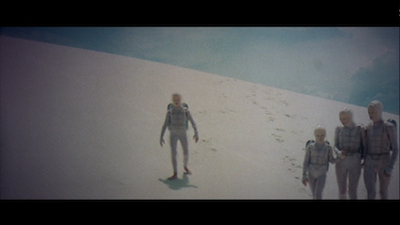
In the movie, Bowie plays Thomas Jerome Newton, a.k.a. Mr. Sussex, an inventor and entrepreneur whose globe-spanning corporation World Enterprises revolutionizes the modern world and how it interacts with technology and art. Or so we can surmise. Roeg is not concerned with such fussy details, the business end of things is more of a devise to establish Newton's primary mission. He is not a British ex-pat as his passport suggests, but an alien from another planet come to Earth in search of water. His homeworld is suffering a terrible drought. Only, now he is stranded, and he is using World Enterprises--abbreviated as WE, because, you know, he is us--as a platform to build a spaceship to get him back to his wife and kids.


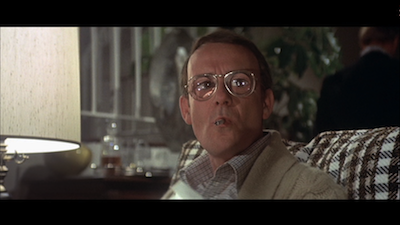
Newton amasses his fortune, aided by an opportunistic patent lawyer (Buck Henry in ludicrously thick glasses) and eventually a chemist (Rip Torn) who feels drawn to Newton's work despite of, or perhaps because of, its being cloaked in secrecy. As the years pass, however, Newton gets sucked into life on Earth. He moves to New Mexico and experiences America the Surreal, an antiquated landscape of dilapidated carnivals, rundown motels, and shit-kicking cops. He watches television to soak up knowledge, test drives religion, and eventually tries on domesticity, settling into a long-term relationship with alcoholic hotel maid Mary Lou (Candy Clark). She gets him hooked on gin, and when he drinks, Newton has visions of home and can peer through time to see the original frontiersmen. Who can also see him. So how is that a hallucination exactly?


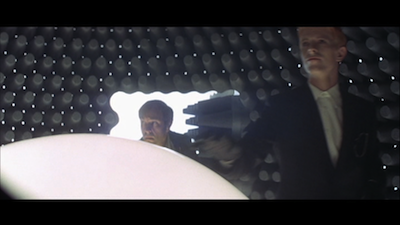
It may be silly to question the logic of a psychedelic free-for-all such as this, but I'd submit that's exactly the false apology that has allowed The Man Who Fell to Earth to garner its revered reputation. Nicolas Roeg's films suffer from the dual sins of "anything goes" and "good enough." No left turn is too sharp for him to take over the course of a narrative, yet he is also not patient enough to follow these impulses through. Many of the scenes in The Man Who Fell to Earth don't connect well with the scenes that surround them, and the film overall is visually sloppy. Roeg strikes me as a petulant adolescent who refuses to shave, much less comb his hair, because this is the style, man. The Man Who Fell to Earth presents an ugly, slapdash future, one that is as regressive as it is forward thinking. This may be part of the point--how else do you explain Rip Torn going to a record shop and buying vinyl even after David Bowie has introduced sound crystals to the world?--but Roeg never really sews any of it together. The clarity of his montage is regularly interrupted by indulgent auditions for future David Bowie album covers. Well, congratulations, sir, you managed to score two. (Low and Station to Station, for those keeping track.)


Sadly, good performers flounder under Roeg's direction. Buck Henry and Rip Torn are both okay, but they have both also done better. Sometimes a take is so clumsy, one might almost guess it's just the first one where the actors managed to finish without flubbing their lines. Bowie seems lost through most of it, and his clothes from sequence to sequence appear to match whatever phase he was going through at the time. (Mainly, the Thin White Duke alias adopted for Young Americans, which is actually one of the albums on display in that record store scene.) Then again, he might have also just been pouting because his own soundtrack was dismissed in favor of John Phillips from the Mamas and the Papas. I'd be pissed, too, if I were him.
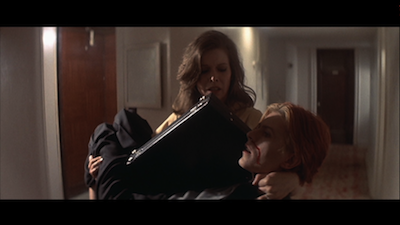
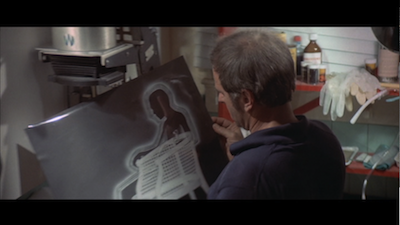
The only one who comes through looking her best is Candy Clark. Her motor-mouthed plain jane is right on the money, capturing the sort of shallow American figure that is more than willing to latch on to the empty dreams of others. The Mary Lou character is more complex than that, though, she seems less interested in what Newton can offer her than she is in taking care of him. Theirs is ultimately a co-dependent relationship, neither being good for the other, yet refusing to break it off. Even laboring under bad old-person make-up, Clark is able to inspire pity for Mary Lou. She is a well-meaning girl who is beyond her depth.


To be fair, there is much in The Man Who Fell to Earth's underlying political message that is extremely prescient. Media saturation, corporate dominance, a dangerous mistrust of new ideas--these are all issues that would become increasingly important since the movie's release in 1976. There is even a scene later in the film where a worker in the control room for a space launch ponders the needless expense laid out for space travel. Why spend money on exploring the cosmos, who cares? The only element of The Man Who Fell to Earth that seems politically regressive is Roeg's casting African American-actor Bernie Casey as the big-business government thug who takes Newton down. While putting a black man in a position of power, and making him the husband in a bi-racial marriage, was likely a daring move back then, Roeg's staging of Casey's scenes has caused this aspect of the film to age poorly. Instead of seeming progressive or even just normal, it comes off now as white fear that the black man is coming for his money and his women. Again, not Roeg's intention, but contexts change as decades pass.


I am sure my opinions about The Man Who Fell to Earth are going to be unpopular; my previous disappointment in Nicolas Roeg movies has usually garnered many clucking tongues and even harsher replies, no matter how open I've tried to be to the experience. (The one Roeg film I genuinely like is Performance; you can read my review here.) That's fine enough, I see Roeg as a provocateur who would likely relish such healthy debate. I also get that many delight in the head trip that midnight movies of this kind offer--though, if I want to see the David Bowie story turned into parable and fairy tale, I much prefer Todd Haynes' Velvet Goldmine. It can often be hard to get at why a movie like this works for some people and doesn't work for others, especially since The Man Who Fell to Earth's most pronounced quality is its ineffability. Roeg is intentionally teasing us, placing meaning just beyond the common grasp. Alas, I can only be compelled to reach so far before I withdraw my hand, and The Man Who Fell to Earth is just on the wrong side of that line.
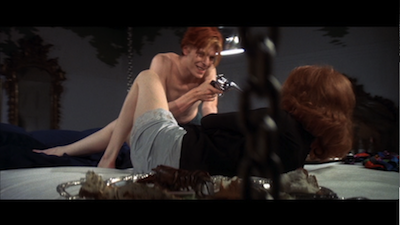


For those who might still be down for such an experience, it's worth noting that both the standard edition and the Criterion Blu-ray of The Man Who Fell to Earth are now out of print. You can still find copies used, sometimes even close to normal price, and you can watch the film on Amazon streaming. For Portland-based moviegoers, The Man Who Fell to Earth is playing at Cinema 21 from August 26 through September 1. Special thanks to the theater for hosting the screening I attended.


Wednesday, August 10, 2011

LIFE DURING WARTIME (Blu-Ray) - #574


"People can't help if they're monsters."

This one line could sum up the entirety of Todd Solondz's oeuvre--or at the very least, what I have seen. It is both his justification and his pitiable condemnation. In his most recent film, last year's Life During Wartime, this is the defense that Bill, played with a stoic empathy by the fantastic Ciaran Hinds, gives of his own poor choices. Bill is a child molester recently released from prison who has gone to Florida from New Jersey in search of his sons. He utters this particular philosophy in a bar where he is being cruised by a bitter older woman (Charlotte Rampling) who arguably could stand in for Solondz himself. She is angry and vicious and ultimately, self-loathing. The implication is that we are all capable of monstrous behavior, but we all also need love.

Or not love exactly. As explicitly stated in Life During Wartime, the greatest human virtue is forgiveness. In lieu of that, or possibly even preferred to it, there is also forgetfulness. That's the debate Solondz's characters have as they trudge through their weary existences: if we're incapable of doing both, is it better to forgive or forget? Forgiveness gives absolution to the offenders, but we still carry the pain they caused, and presumably, they still carry the shame of having caused it. And so, was it better for Bill's wife, Trish (a typically excellent Allison Janney), to tell their youngest children that he died rather than explain he was incarcerated for diddling little boys? Presumably not, judging by the anguish it causes little Timmy (Dylan Riley Snyder) when the truth comes out. Now he has something he can never forget. The past is always with us, regardless of the different people we may try, and even succeed, to become.


Life During Wartime is ostensibly a sequel to Solondz's breakout hit, 1998's creepoid indie darling Happiness. I am not a fan of the original, and I haven't seen it in over a decade, so many of the connectors here are lost on me. I only remember the larger brushstrokes of plot and the always obvious and large expressions of misanthropy and adolescent glee that defines Solondz. Much has been made of the director's decision to hire an entirely different cast to play the same characters, including replacing the triple-named Philip Seymour Hoffman with the equally named, but entirely different, Michael Kenneth Williams (best known as "Omar" from The Wire). Paul Reubens has replaced Jon Lovitz, Ally Sheedy has stepped in for Lara Flynn Boyle, Hinds has replaced character actor Dylan Baker, and so on--I'll leave you to piece it all together, as it's not the "who" that's really important. The greater meaning is one of sameness: we may change outwardly, but we are the same inside. No one person is any better or worse than another in the Solondz universe, even as we become different people in our own bodies. This change-up was either loved or loathed in Solondz's previous film Palindromes, and he gives a nod to the use of a similar device by Todd Haynes via an I'm Not There poster on one of the character's walls [review].
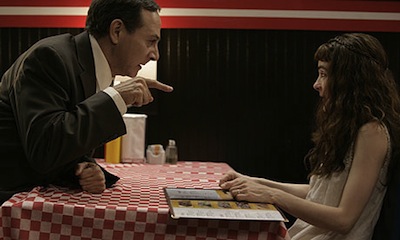
The new film picks up some time after 9/11, presumably during the Bush administration, though no specifics are given, only references to conflict and terrorism. Solondz's script bluntly satirizes American fearmongering and hysteria as he rejoins the story of the three sisters from Happiness. The poet Helen (Sheedy) has moved into more lucrative entertainment and moved to Los Angeles, and she is apparently dating Keanu Reeves. Trish is raising her kids on her own and is entering a new relationship with an older man (Michael Lerner), whom she finds exhilarating despite his being physically repulsive. And Joy (Shirley Henderson) has still been trying to make things work with Allen (Williams), though his bad habits have finally gotten the best of her. She has gone to Florida seeking the solace of family, though all she finds there are memories and literal ghosts (Reubens).


Bill's release from prison is poor timing for Trish. Though he only has contact with his eldest boy (Chris Marquette), the knowledge that he is still alive confuses Timmy right at the time when the younger child is supposed to become a man. We meet the kid as he is writing his Bar Mitzvah speech, and Life During Wartime climaxes with the celebration. In between, Solondz pokes lots of old wounds to create excuses to discuss his greater meaning--which to my eye is not so very great. I find his from-the-mouths-of-babes shock tactics to be utterly predictable and banal, and his filmmaking technique cheesy. He lights his interiors like sitcom sets, and his use of music sounds like an ironic appropriation of cues from Lifetime movies and Afternoon Specials. It's as if he wishes to mock these other things and suggest that his work is a knowing upgrade from the pabulum most of America swallows on a regular basis. The smugness is off-putting.

Others will disagree. (My good friend Christopher McQuain, for one.) I may not be the best person to weigh in on this film. I haven't liked any of Solondz's previous films, and in fact, I gave up on him completely after 2001's laughably shallow Storytelling. I never bothered with Palindromes, but I honestly tried to clear the way to have an open mind when Criterion announced they were releasing Life During Wartime. I will admit, some of the early scenes drew chuckles out of me, and the opening scene in particular--where a tender dinner date between Joy and Allen turns sad and then uncomfortably dark--made me think that maybe there was something to Solondz's regular gimmicks after all.
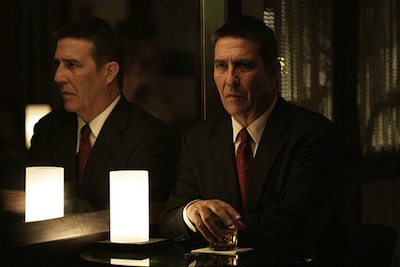

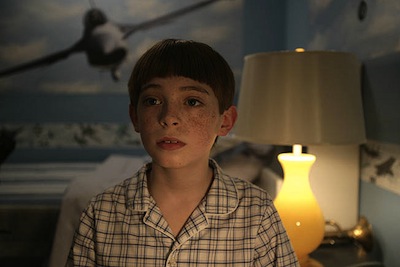
The film lost me as it wore on, however. Scenes exhibiting what seems to be genuine heart sometimes started to woo me back, but Solondz presents them with such a snide levity, he undercuts his own emotion. It's hard to tell if these are flashes of insight that the director can't sustain, or if he simply knows how to toy with his audience in such a way that he draws us in only to punish us for trusting such open displays of cliché. Though the artist would likely claim he speaks for the miscreants because he is one, I can't shake a lingering suspicion that he has contempt for both his audience and his characters, and for me, he's got to love at least one of those groups if he can't love both (forgive or forget, sir!). Effective portrayals of misanthropy require some kind of affection for the misanthrope, but it's difficult when the misanthrope is the artist himself. His films come off like the petty revenge of a kid who felt no one stuck up for him, and though Life During Wartime strikes me as being less venomous than prior efforts, it only makes me think there is worse to come, that by retreating to relive earlier successes, he is wooing back his previous admirers just to strike harder next time.

That said, if Solondz's films have been up your alley in the past, while Wartime may pale in comparison to its predecessor in terms of newness or originality, you will probably still enjoy it. Even for someone who didn't care for it like myself, Solondz has stacked the deck with a uniformly excellent cast, and they all perform to the best of their skills. Sheedy in particular takes charge of the film for her one full scene, reminding us what a loss it was for filmgoers when her career went stale.


Likewise, the presentation of Life During Wartime on Blu-Ray displays the usual technical excellence we have come to expect from Criterion. The widescreen image is immaculate, with gorgeous colors and the sharpest resolution. The 5.1 audio mix also makes great use of the full surround possibilities. Supplements on the disc includes a lengthy Q&A with Solondz and making-of documentary featuring the principle cast that should appeal to fans. The Q&A in particular is put together with questions submitted through Criterion's website, and the director is very open to engaging in the discussion. While his films may often come as one-way didacticism, the supplements are anything but.


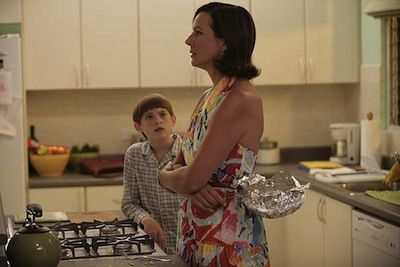
Please Note: The images used here are publicity stills, not screencaptures from the Blu-Ray.

This disc was provided by the Criterion Collection for purposes of review.


Monday, June 21, 2010

RED DESERT - #522

"It's never still...I can't look at the sea too long, otherwise I lose interest in what's happening here on land."


It's been maybe two years since I first saw Red Desert. It was shown in town as part of a festival of movies about how the environment was affecting individuals and often making them sick. I had never seen the film, it had long been out of print on DVD and I kept avoiding VHS copies thinking eventually someone would put out a quality re-release. Seeing it on a screen in a movie theatre was too good an opportunity to pass up. I even convinced a couple of friends to go with me. They weren't too happy with me by the end of it.

Part of their dissatisfaction likely came from the oblique nature of the movie. Michelangelo Antonioni's 1964 portrait of neuroses and malaise offers no explanations, it just plants the viewer down in the sticky mental muck and lets him or her untangle from the web. I would suspect, however, that most of their dissatisfaction came from the fact that what we watched was a horrible copy of the movie. I don't know if it was the old DVD projected or, as I suspected at the time, a digital file downloaded off the internet. Given the amount of pixilation and digital noise, it certainly wasn't a film print. It left me dissatisfied, too. Antonioni daring us to traverse his bleak cinematic landscape and find the meaning on the other side became too much to ask when also faced with a dark and murky image.


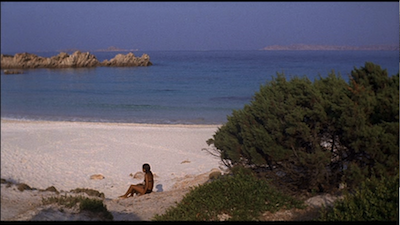
Oh, what a difference a good restoration makes! The newly minted transfer on the Criterion edition of Red Desert (Il deserto rosso) makes for an entirely different viewing experience. The widescreen image is crisply rendered, capturing the chilly aura of Antonioni and director of photography Carlo Di Palma's wasteland without sacrificing the heat of the bursts of color that occasionally dot the factory village where their story takes place. Midway through the film, when Monica Vitti spins a yarn about a little girl living alone on an island, the bright and beautiful interlude comes onto the television like the sun rising in the morning. The green of the foliage, the blue of the waters...it's just lovely.


Apparently the original title of Red Desert was actually Pale Blue and Green. These are the colors of nature, and by their nature, the most soothing stripes on the rainbow. They suggest order, rightness, and calm. Though the title has a basis within the narrative--Monica Vitti's character, Giuliana, is considering them both for the interior of her proposed ceramics store, a safe haven she is creating for herself--the phrase didn't have the effect on audiences the director felt was required. Red Desert was more evocative. It is incendiary and barren.

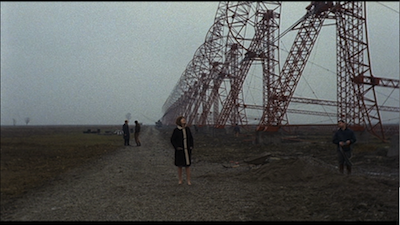
Giuliana is a wife and mother. She is married to Ugo (Carlo Chionetti), a manager at an industrial factory, and their boy (Valeria Bartoleschi) is of kindergarten age. The Italian town where they live is reliant on the manufacturing plants it is built around, but as with any aspect of progress, the move forward comes at a price. Not only is there strife within the citizenry (we are presented with the dual problems of a worker's strike as well as there not being enough able-bodied men around), but it also creates a tremendous burden on the local ecology. For every good thing these factories presumably make, they also dump waste into the environment. On one side of a tree line there are the bustling signs of creation, on the other destruction and decay.


This is Giuliana's problem, as well. She is a woman at odds with herself. She was in a car accident that nearly killed her, and despite some recuperation time in the hospital, she has never been quite right since. There is something just a little off about her. Monica Vitti, who also starred in Antonioni's breakthrough pictures L'avventura [full review] and L'eclisse, avoids playing Giuliana as "crazy," but instead portrays her as a bundle of raw neuroses. She has the appearance of never being comfortable where she is, but also not knowing where else to go. She chews her nails, hides in her hair, and at any time looks like she is either going to cry or fall asleep.

Giuliana is a woman out of sync with her surroundings. Reading about Antonioni's intentions with Red Desert (he co-wrote the script with Tonino Guerra), he's not suggesting that the toxic environment is responsible for Giuliana's illness, but instead an active symptom of it. The smokestacks, hazardous sludge, and industrial grays and browns of her village are like a living metaphor for the disconnect she feels. While her husband and even her son have adapted to modern life, Giuliana has not. In her is something more primal, a need to get back to a basic humanity--the pale blue and the green. (If this sounds familiar, it's because it was the inspiration for Todd Haynes' film Safe, starring another redhead, Julianne Moore.)
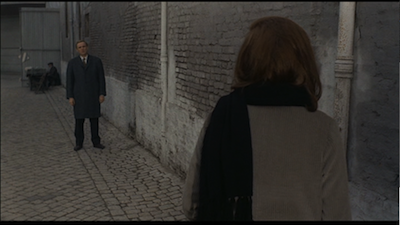


On a very basic level, Red Desert is the story of a love affair between Giuliana and a visiting business man who works with her husband. Corrado Zeller (Richard Harris, This Sporting Life [full review]) is a sort of nomad, traveling for work, following the money. He is out of sync, as well, but in a different manner. He is always moving and thus not tied down. He is like the water, whereas Giuliana is landlocked. Though Zeller will eventually express that he's not sure he's any better off for it, at least for a brief time, it at least makes him empathetic to Giuliana's problem. He settles long enough to hear her out, to listen to her complaints, and to seek out solutions.


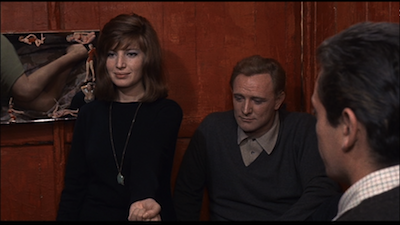
There's a bit of opportunism in Zeller's kindness, however; for as much as he is trying to fix the wing of the wounded bird, he also ends up playing the jilted lover. Possibly because they are both separate from the rest, there is a magnetism between them, and they desire to connect on a sensual level that Ugo and his friends can only play at. In a crucial scene midway through Red Desert, Ugo and Giuliana join another married couple, along with a single woman of loose morals (Rita Renoir) and Zeller in a dockside shack where they circle around the idea of an orgy, but they never descend upon one another. It turns into a lot of posturing, who is sitting beside whom, etc. The whole scenario is a sad display of privilege. The shack belongs to one of the other man's employees, and this group uses it for what they will without permission. It's as if they need to slum in order to feel a thrill. Tellingly, they end up tearing down the interior walls to stoke their fire. They are literally destroying the structure just to keep themselves warm!


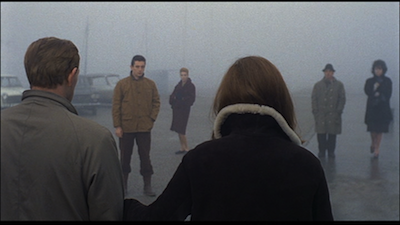
Events at this shack mark a point of no going back for Giuliana. Before the revelers depart, a ship comes to dock, sailing right up next to the house and startling her. (Does it, perhaps, remind her of the truck that nearly killed her?) That same ship also may be carrying a deadly contagion, and as the group flees possible infection, a heavy fog rolls in, separating Giuliana and Zeller from the others. It's a symbolic break, like the division between the factories and the land they are destroying. Giuliana is on one side of the malady, they are on the other.


Ships continue to appear throughout the rest of Red Desert, present in the background both visually and audibly, symbols of the escape Giuliana desires. The story she tells her son about the girl on the beach expresses this. (The girl's life has a true harmony. "Everything was singing.") She also tells Zeller a story about a woman she met in the hospital, who was there because she loved everything too much and thus could not accept that she must let any of it go. The natural flow of life continued onward, but she wanted to hold it back, to not change. Zeller correctly ascertains that Giuliana is speaking of herself, and this leads to a deeper understanding of what happened to her and also the greater meaning of Red Desert.


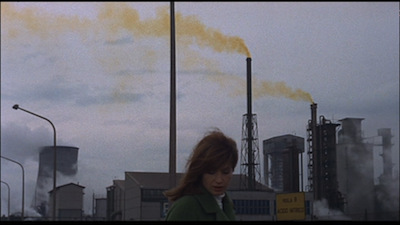
Though Antonioni appears to be painting with the same opaque brush throughout, anyone who understands paint knows there is no one color that is "white." There is no single, definitive "red." Antonioni's film is both narratively and visually complex. His sets are full of codes. Colors and shapes signal shifts in the psychological landscape as much as a torn-up field points out the side-effects of industry. When Giuliana finally makes a run for it, the hull of the ship she means to board is painted blood red--blood being both life and death and the confusion being which the ship offers. Shortly after, Giuliana sees yellow smoke belching from the stacks at her husband's workplace, and she tells her son it is poison. The color is another signal; the quarantine flag on the contaminated ship was also yellow. Yet, can we be sure the smoke is really yellow, or is that her perception? Did the sight of the red ship mark the border of her delusion, and she has now crossed over in the same way the fog drew a line between her and the "healthy" ones? There would be precedence for this, since Antonioni has already used sound as an outer expression of what is inside his heroine. Vittorio Gelmetti's electronic music for the film is unsettling, arising at times when Giuliana is the most discombobulated with the intention of drawing the viewer into her state of mind. Why shouldn't we be privy to her vision, as well?


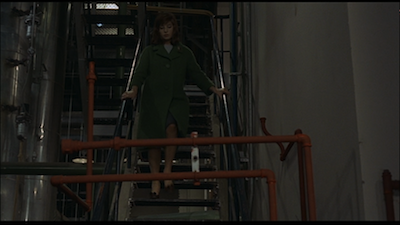
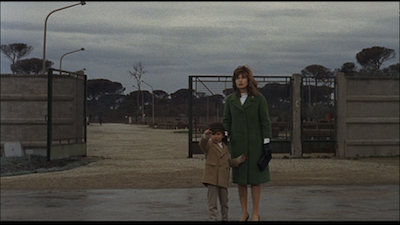
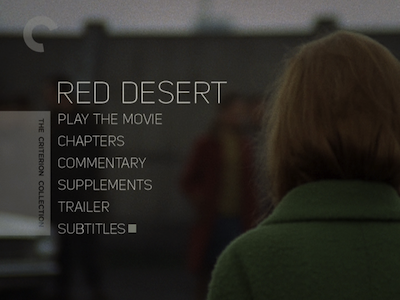
It is probably also fitting that Giuliana only wears her green coat at the beginning and the end of Red Desert, at the times when her psychoses are the most obvious to us yet when she is doing her best to mask them. It's as if she is wrapping herself in the warmth of nature. Of course, this is a subtle detail that is easy to miss when watching a bad version of the film. With a movie so finely tuned as this one, every detail has to be just right. What you see is the most important component, it provides all the subtext. If there is no difference between the green of Monica Vitti's coat, the red of her hair, and the gray of the sky, then it's all just pollution. Thus, I think even for devotees of Red Desert, this new DVD is going to be a real eye opener. Every detail of every frame is now visible, and as film fans, we can just sit back and let the movie work on us the way its makers intended.


For a full rundown on the special features, read the full review at DVDTalk.