This short review comes from my old column for OniPress.com, hence the link to the excellent Capote in Kansas. It was part of a larger piece that also looked at a bunch of Val Lewton-produced movies. It was posted in conjunction with Halloween 2005.
My first choice is one that should be interesting to Oni readers who tried this summer’s Capote in Kansas, because Truman Capote did some of the work on the screenplay. Released in 1961, The Innocents is Jack Clayton’s adaptation of the Henry James novel The Turn of the Screw. Keeping 19th-century England as its setting, The Innocents stars Deborah Kerr as Miss Giddens, a woman who has just started a career as a governess. Her first assignment is to take care of the orphaned siblings, Flora (Pamela Franklin) and Miles (Martin Stephens), on their uncle’s country estate. Before long, Miss Giddens realizes there is something strange about these children. They share odd secrets, enjoy a morbid sense of humor, and often wander the house unattended late at night. She also starts seeing apparitions -- the images of the groundskeeper and the preceding governess, who died as a result of an illicit tryst -- and Miss Giddens believes their malicious spirits are what have been compelling the children to act so strangely. As a result, the governess gets entangled in the age-old horror movie conundrum: is she going mad or is what she believes really happening?
The Innocents is heavy on gothic atmosphere. It uses the empty corridors and cold statues of the palatial mansion to cast a dark shadow over every event. Clayton establishes the creepiness from the first moment, with Flora singing the eerie melody that will become a motif in the film over a black screen before the 20th Century Fox logo even comes on. Everything starts in darkness. Once the logo has passed, it gives way to an amazing title sequence: Deborah Kerr’s clasped hands and her praying for the souls of the children. Kerr is wonderful throughout, playing her role with a heightened sense of dread and the anxiety of always being one step behind the action. Clayton makes the film even more tense by having everyone else in the house react to her with near indifference. They don’t disbelieve her, but they don’t actively support her, either. The audience always feels they know more than they are letting on. It all leads to a final confrontation with Miles that plays out in strange -- and dare I say, haunting -- ways. I shivered as the final title came onscreen.
Showing posts with label can you picture that?. Show all posts
Monday, September 22, 2014
Friday, December 30, 2011
NIKKATSU NOIR: TAKE AIM AT THE POLICE VAN - ECLIPSE SERIES 17

As 2012 comes to a close, this trio of reviews of Seijun Suzuki movies actually catches me up for the weeks I missed in November. This marks four full years of providing one new review to this blog a week. That's a lot of writing and a lot of movies.
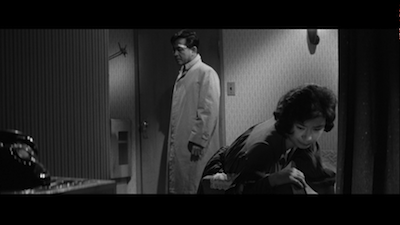
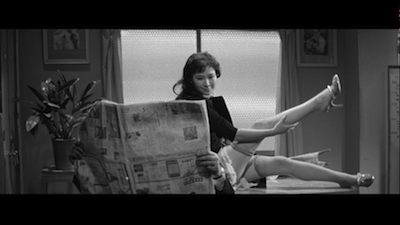
I picked Take Aim at the Police Van from the Eclipse Nikkatsu Noir set because it was the only remaining Suzuki film in my collection that I had not yet watched. It's interesting that my viewing over the past two days has gone in reverse chronological order. I am not sure why Criterion decided to number Tokyo Drifter [review] and Branded to Kill [review] the way they did, but with this 1960 mystery/drama thrown in, the effect for me was to see Suzuki's style get more normal as I progressed.

Coming some six years before Tokyo Drifter, Take Aim at the Police Van is a more conventional genre exercise than the director's later films. It begins with a violent attack on a prison transport van. Suzuki builds tension by having road-sign warnings repeat over and over, moving faster and making the viewer nervous with all their cries of "Caution!" It also doesn't help that we know that up ahead a sniper is waiting. When the van approaches his hillside vantage point, he opens fire, killing two of the prisoners. It was a concentrated attack.

The guard on that run, Daijiro Tamon (Michitaro Mizushima), is held responsible for the assault, and he is put on six months leave. Rather than stay at home and sulk, Tamon decides to look into what really happened all on his own, thus transforming himself into a traditional fictional investigator, doggedly pursuing his goals despite the warnings and the dangers. Suzuki and scriptwriter Shinichi Sekizawa see Tamon as belonging to a western tradition, and even make reference to Ellery Queen and other mystery writers who concocted similar stories with equally committed characters. Tamon begins his case by finding one of the shooting survivors, a low-level crook named Goro (Shoichi Ozawa) who was due to be released on bail the day of the incident. Goro's behavior during the attack makes Tamon think he knows something.

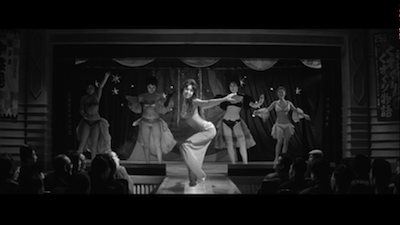
Naturally, pulling on this first thread causes many others to unravel. Tamon follows Goro out of town, where the mistress of one of the dead prisoners and Tsunako, the girl who bailed Goro out (Mari Shiraki), are working as strippers in an illicit brothel. Their involvement leads the prison guard to a human trafficking ring with ties to a mysterious, possibly fictitious big boss named Akiba. More people end up dead, some thought dead end up alive, and Tamon maybe has a thing for one of the possible suspects (Misako Watanabe). Yuko's father runs the "talent agency" that books the girls, and she's taken charge of the business since her old man got sick. She also knows archery, which is interesting since the dead stripper was shot in the heart with an arrow!

Take Aim at the Police Van takes a tried-and-true approach to building its mystery. For every answer Tamon finds, he also uncovers a few more questions. More players join the story, and the cast builds to the point where he doesn't really know who is going to pop out from which shadow next. Mizushima plays the role pretty straight. He's always looking forward, rarely indulging in sentiment or any emotion that might alter his course. He's an older man, and seeing him tangled up with so many young girls creates an amusing incongruity. Tamon is no white knight, but he will get the job done.

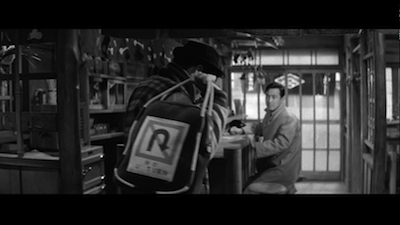
By the time we get to the climax, just about any of the crooks could be Akiba. Tamon has formed an uneasy alliance with Yuko, particularly after the two of them are nearly burned alive in a gasoline truck by the sniper, and he also takes a liking to Tsunako and wants to get her out of whatever trouble Goro might have gotten her into. Motor vehicles and motorways prove dangerous throughout the film. There is a chase on a cliffside highway and later Tamon is nearly run down by coordinated vehicles coming from two different directions. Goro also humorously provides the movie with its second roadside omen: he has a backpack that says "No U-Turns." There is no turning around, there is only forging ahead.

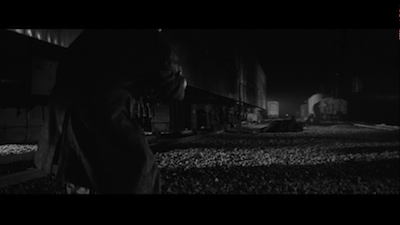
It makes for a sublime kismet, then, that the final shootout in Take Aim at the Police Van goes down in a trainyard. Buses and cars are unpredictable. They crash and they roll, and their course is subject to human control. Trains follow a track. They are reliable and they are sturdy. Their destination can't be changed easily. For some, this will be fatal; for others, salvation. Trains are also the industry of an older generation, one that Tamon can identify with. And perhaps that is why he is as reliable and as dedicated, as well. The young hoods have their flashy cars, but he identifies with the rails, getting the job done and never deviating from the predestined route.

BONUS SEIJUN SUZUKI REVIEWS:
* Detective Burea 2-3: Go to Hell Bastards! (1963)
* Tanuki Goten (Princess Raccoon) (2005)
And one from the archives, part of a group of reviews I did for my old column "Can You Picture That?" on OniPress.com. This one was reviewed alongside Onibaba, and that portion was reprinted here.
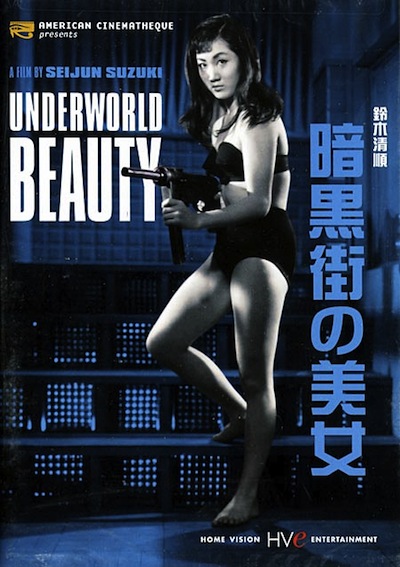
Underworld Beauty (1958): Speaking of cover art, I initially thought that Seijun Suzuki's 1958 yakuza movie, Underworld Beauty, would be a perfect companion to Onibaba. A beautiful woman dramatically posing with a machine gun! Yes! Only the cover art is entirely misleading. Akiko (Mari Shiraki) never picks up a gun inUnderworld Beauty. I was fooled by marketing!
Thankfully, Underworld Beauty is an entertaining film even without a pretty young thing shooting up the bad boys. Released by Home Vision Entertainment along with a spate of other Suzuki films, Underworld Beauty hints a little bit at the scattershot editing style that, a decade later, got Suzuki fired and branded "incomprehensible" (the way sometimes the story jumps from point A to point C pales next to the supersonic speed Branded to Kill travels at). Overall, though, it's a pretty straightforward crime picture with a cynical edge reminiscent of Sam Fuller.
The plot is simple: Miyamoto has spent three years in prison. In that time, he has managed to keep his mouth shut, giving up neither his yakuza bosses nor the hiding place of the jewels he stole. Feeling guilty about his partner, Mihara, who was partially crippled in the heist, he decides to work through his old boss and sell the diamonds, giving the money to his friend. Only someone attempts to steal the stones at the sale, and Mihara ends up swallowing the jewels before leaping off a building to escape. In the wake of his death, Miyamoto and Akiko go up against the yakuza and Akiko's effete, mannequin-manufacturing boyfriend, working through a maze of double-crosses to establish ownership of the three shiny jewels.
What sets Underworld Beauty apart from standard crime films of the period is the clash of the old school gangster (Miyamoto) and the wild-child, idealistic teenager (Akiko). It's never more clear than when the dark-suited hoods step into the bossa-nova rock-and-roll nightclub filled with kids dressed in light colors. The crooks are like brick walls, while the teenagers are much more petite. At one point, one of the bad guys shoves the fresh-faced bartender away from the bar and he practically launches into the air. Thus, the central conflict becomes whether or not Akiko can step up and act maturely. Can she and Miyamoto find common ground, and will it carry them through the classic crime-doesn't-pay ending? (Side note: It's interesting to compare the rather milquetoast version of a rock club in Underworld Beauty to the seedier nightclub in Akira Kurosawa's High and Low [review] five years later. The former is definitely the bobby-soxer '50s version we see in a lot of period entertainment, whereas the latter's sweaty opium den vibe showed the false innocence was already crumbling.)

Labels:
can you picture that?,
eclipse,
film noir,
fuller,
kaneto shindo,
kurosawa,
seijun suzuki
Saturday, September 10, 2011
BLAST FROM MY OWN PAST: LA BETE HUMAINE - #324/YOUNG MR. LINCOLN - #320 [capsule reviews]
I was hunting around for an old piece on Breakfast at Tiffany's and I stumbled on a collection of capsule reviews I wrote for my defunct OniPress.com DVD column back in February, 2006. I will one day hopefully do something more extensive about La bệte humaine and Young Mr. Lincoln both, but in the meantime, here are my first reactions from the pair's initial release:
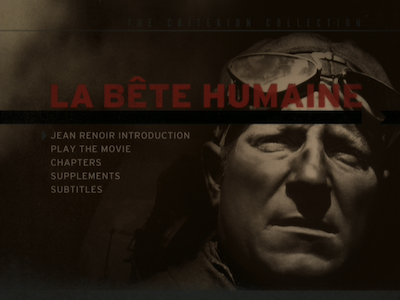
La bệte humaine: Jean Renoir made two films with Jean Gabin in 1938. The first was Grand Illusion and is an admitted classic; the second is La bệte humaine (The Human Beast), which sadly has been unavailable for quite some time. Based loosely on an Emile Zola novel, La bệte humaine is a precursor to film noir, with Gabin playing Jacques Lantier, a train conductor who gets cast as the replacement third point in a love triangle after his predecessor is murdered. Lantier is a man of machines, more in love with his locomotive than he’s ever been able to connect with a human. Part of it is that he has a congenital problem that makes him prone to madness and violent outbursts, something that doesn’t effect his interaction with his train. In fact, we see right from the opening shots that he is most free when riding the rails. La bệte humaine is perhaps Renoir’s most unabashed foray into genre filmmaking, a stylish thriller that could have just as easily been made by Hitchcock (though after likely punching up the humor and the threats). Like most Renoir, though, it’s a portrait of human foibles. He loves his characters for all their faults, and he shows them in exacting detail. Criterion has done a stellar restoration on this, as they have with all of their Renoir releases, and they’ve dug up a few vintage extras to round out the package. Most interesting is a television segment from the ’50s where Renoir is reunited with La bệte humaine’s femme fatale Simone Simon, and he gives a lesson on directing by remaking a scene from the film with her.
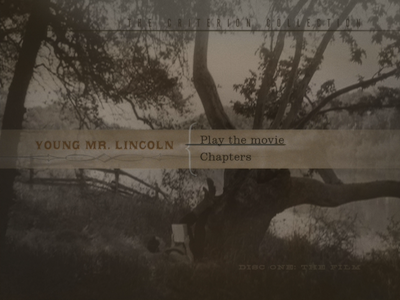
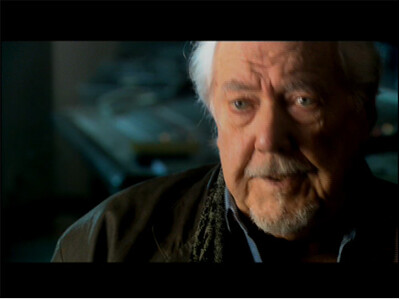
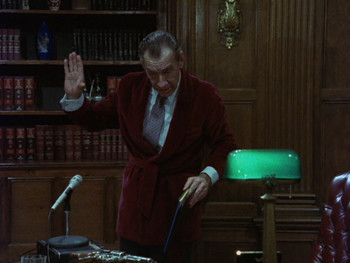
Young Mr. Lincoln The Criterion Collection offers a classic film from 1939, starring Henry Fonda and directed by John Ford. It’s hard to nail down what I liked best about this fantastic and charming movie, as every aspect of it worked in tandem to achieve the best motion pictures have to offer. Fonda is exceptional as Honest Abe, who at the time of the story is merely an up-and-coming lawyer in Illinois. His easy way with words matches his ambling gate step for step, as Fonda completely transforms himself into the tall and gentle legend (he’s given a little help by an excellent make-up team, providing the actor with a fake nose that blends smoothly with his recognizable facial features). Ford matches Fonda with gorgeous photography. His stunning vistas would draw away from the actor if handled by a less capable director. Here, they work in conjunction with Fonda’s performance to show how in tune Lincoln was with the American landscape. Criterion has done another excellent job restoring an old film, delivering exceptional picture and sound. There are also some informative extras, including various programs about Ford and Fonda. The 1975 interview with Fonda, who was then in his '70s, shows how vivacious of a personality he really was, and it’s worth it just for the anecdote about him and Jimmy Stewart drunkenly plotting to dig an underground tunnel into Greta Garbo’s house.
The other films I covered that month were Elia Kazan's Pinky
, Dave McKean's MirrorMask
, the Keira Knightley-led Pride & Prejudice
adaptation, and a Hollywood-based indie called The Young Unknowns
.
And it turns out I either lost that Breakfast at Tiffany's review or I am nuts and never wrote it. I was working on a new piece, anyway, now that the movie is on Blu-Ray.

La bệte humaine: Jean Renoir made two films with Jean Gabin in 1938. The first was Grand Illusion and is an admitted classic; the second is La bệte humaine (The Human Beast), which sadly has been unavailable for quite some time. Based loosely on an Emile Zola novel, La bệte humaine is a precursor to film noir, with Gabin playing Jacques Lantier, a train conductor who gets cast as the replacement third point in a love triangle after his predecessor is murdered. Lantier is a man of machines, more in love with his locomotive than he’s ever been able to connect with a human. Part of it is that he has a congenital problem that makes him prone to madness and violent outbursts, something that doesn’t effect his interaction with his train. In fact, we see right from the opening shots that he is most free when riding the rails. La bệte humaine is perhaps Renoir’s most unabashed foray into genre filmmaking, a stylish thriller that could have just as easily been made by Hitchcock (though after likely punching up the humor and the threats). Like most Renoir, though, it’s a portrait of human foibles. He loves his characters for all their faults, and he shows them in exacting detail. Criterion has done a stellar restoration on this, as they have with all of their Renoir releases, and they’ve dug up a few vintage extras to round out the package. Most interesting is a television segment from the ’50s where Renoir is reunited with La bệte humaine’s femme fatale Simone Simon, and he gives a lesson on directing by remaking a scene from the film with her.

* * *
Young Mr. Lincoln The Criterion Collection offers a classic film from 1939, starring Henry Fonda and directed by John Ford. It’s hard to nail down what I liked best about this fantastic and charming movie, as every aspect of it worked in tandem to achieve the best motion pictures have to offer. Fonda is exceptional as Honest Abe, who at the time of the story is merely an up-and-coming lawyer in Illinois. His easy way with words matches his ambling gate step for step, as Fonda completely transforms himself into the tall and gentle legend (he’s given a little help by an excellent make-up team, providing the actor with a fake nose that blends smoothly with his recognizable facial features). Ford matches Fonda with gorgeous photography. His stunning vistas would draw away from the actor if handled by a less capable director. Here, they work in conjunction with Fonda’s performance to show how in tune Lincoln was with the American landscape. Criterion has done another excellent job restoring an old film, delivering exceptional picture and sound. There are also some informative extras, including various programs about Ford and Fonda. The 1975 interview with Fonda, who was then in his '70s, shows how vivacious of a personality he really was, and it’s worth it just for the anecdote about him and Jimmy Stewart drunkenly plotting to dig an underground tunnel into Greta Garbo’s house.

The other films I covered that month were Elia Kazan's Pinky
And it turns out I either lost that Breakfast at Tiffany's review or I am nuts and never wrote it. I was working on a new piece, anyway, now that the movie is on Blu-Ray.
Labels:
can you picture that?,
jean gabin,
john ford,
renoir
Tuesday, February 12, 2008
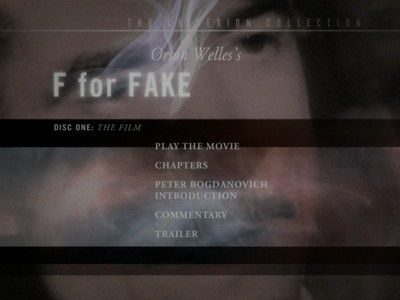
BLAST FROM MY OWN PAST: F FOR FAKE - #288
Originally published on April 28, 2005 as part of my now-defunct "Can You Picture That?" column, this represents the last of my reprint articles to archive on this site. From here on out, the material will be all new, either exclusive to this blog or cross-posted with DVD Talk. There has already been plenty of new content, easily spotted by the fact that there is no "originally published" date or "Blast..." title or in some cases even a link to an external source. I have kept my one new review a week schedule since Christmas, and plan to continue on with that from here on out.
In 2005, Image Comics released an anthology called Four-Letter Worlds
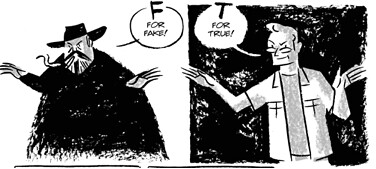
. In it, comics creators pick one of four themes. Each theme is a word with four letters in it, and within those themes, we all must pick another four-letter word and write a story about that word that pertains to our original choice. One of the themes was "Fate," and I chose to write a story based around the word "True." It was illustrated by Andi Watson, and its full title was "(T For) True."
On page 3, there is a panel where Orson Welles, dressed in his magician's cape and hat, announces, "F for Fake!" The image and the phrase are from Welles' 1972 film of the same name, F For Fake, released as a double-disc Criterion DVD this past Tuesday. F For Fake is a bit of a legendary cult film, plagued by poor distribution like most of Welles' later movies. I had never seen it, just always heard about it. I'm not sure it had ever been made available on video.
And yet, here I was writing a tribute to it: a movie I had never seen, released the year I was born, inspiring an autobiographical short story in comic book format. Given Welles' penchant for storytelling in all its forms, I could see him liking that idea. In fact, this versatility was probably what drew me to him as a teenager. After being exposed to his first two films, Citizen Kane
and The Magnificent Ambersons, I read Frank Brady's biography Citizen Welles
, and I was entranced by this man who had devoted his life to the telling of tales in whatever venue he could insert himself in. There were even strange parallels between his childhood and that of Amory Blaine, the hero of F. Scott Fitzgerald's first novel, This Side of Paradise
, which I had also recently discovered.
So, something about this long-absent movie about the art of confidence and the confidence of art lodged itself in my brain. In addition to "(T For) True," there is a scene in my second novel, The Everlasting
, where a character uses an F For Fake postcard to tell an unfaithful lover to get lost. I was positioning myself next to Orson, just as I had done in the short story. In the panel next to the one where Andi drew him, a caricature of me appears, shouting, "T for True!"
The comics story was put to bed before Criterion officially announced the release of their DVD version (the rumors had been around for a while). Additionally, Andi and I had finished when I sat down to watch the 1988 documentary With Orson Welles: A Life in Film, a long interview with Welles where he discusses each of his films. It was sent to me by fellow Welles fan Ande Parks, author of Oni's Union Station and Capote In Kansas. As I watched it, I realized I had seen it before, probably when it first aired on one of the Turner cable channels. The timing would have been just about right. Much to my horror, though, when I got to the F For Fake section, the explanation of the film and the scenes they showed looked eerily familiar. I had, without knowing it, stolen them wholesale for my story, down to the winking revelation at the end. I was mortified.
Shortly after this, I had coffee with Matt Fraction, who was breezing through Portland. When I wasn't marveling at the abuse he was perpetrating on his rather ample lion's mane, we discussed our writing. Fraction has a story in Four-Letter Worlds, as well (he tackled "Fate" lock, stock, and smoking barrel). I explained to him what I had discovered, and he in turn told me that what I had done was not uncommon. Nabokov possibly did it with Lolita
even. It's called "cryptomnesia." You take something in, forget you have done so, and then dig it out of your subconscious and think it is original--even when a part of you is claiming to have done it as homage.
This all made the DVD release of F For Fake even more exciting. How far had I gone in replicating Welles' cinematic practical joke?
Well, as it turns out. My tale is not an out-and-out theft as I feared, but the homage as intended, a tribute to a great premise. Whereas I dug into my own past to craft an autobiography of my love affair with fiction and its place in my life, Welles used F For Fake to look at a greater concept of art. If all art is a replication of something out of real life, then is a replication of art any less real? He uses two examples: Elmyr de Hory, a notorious forger of masterpieces by painters like Matisse and Modigliani, and Clifford Irving, who wrote Fake!
, a biography of Elmyr, before going on to trick the world into believing he had collaborated with Howard Hughes on the recluse aviator's memoir. In a style that craftily blends documentary with re-enactments, Welles tells us the story of both men, and compares it to his own great hoax, the radio broadcast of The War of the Worlds that caused people to run from UFOs that weren't actually in the sky, and the history his then paramour, Oja Kodar, had with Picasso and her grandfather, another of the great art forgers. Like my beloved Holly Golightly in Breakfast at Tiffany's
, they are all phonies, but they're real phonies. (See also the fictionalized version of Irving's life, The Hoax.)
(Coincidentally, Andi Watson explored similar ideas of real vs. fake in his graphic novel Geisha, about an android artist hired to forge a Vermeer. His heroine, Jomi, faces accusations that her own art can't be real, since she herself is synthetic. Yet, in a world of plastic surgery and drugs that make us feel ways other than what comes natural, who is more false?)
F For Fake is an enchanting, fun flick. As far as Welles' movies are concerned, it is probably his most playful film. He clearly had a blast in the editing room, even shooting some of his own scenes there, using the monitor to remind us that we are watching a movie, which is itself a forgery of reality. Fiction and truth are manipulated with the same tools. Welles takes interview footage that, by its nature, has an air of authenticity, and twists it to meet his demands. Reaction shots are taken out of context, often frozen for comical effect, and used to create doubt about whatever truth is being told. Elmyr gives Irving an eye roll, Irving looks skeptically at Elmyr, wondering if he believes his own self-crafted legend.
Amidst all of this intercutting, Welles takes center stage as a storyteller. He is almost like a boorish party guest that won't let his host tell his own tales, he always has to break in and give his own embellishment. Yet, the effect is utterly charming and releases each anecdote from the bondage of its teller. Like the art forgeries and the great masterpieces in museums across the world, they belong to all. The reality is in the eye of the beholder, in the voice of the teller.
In the end, Welles' ultimate trick is to one-up his audience. We've believed his promise to tell us the truth, and we are willing to accept that all the way to the end. Like the magician who has gotten us on board with a well-executed illusion, Welles pulls a bait-and-switch. As we thrill to the rush of tales about art forgery and the long con, he slips us a mickey: a fake tale with true players, and we swallow it whole. As he unveils his own chicanery, he uses the visual metaphor of a magician levitating a man, covering him in a sheet, and then pulling off the sheet to reveal, much to his delight and ours, that the man isn't floating in mid-air--because he isn't even there.
I am sure that after the film was released, Welles was consistently asked to debunk F For Fake. Part of the fun is keeping people on their toes. In my story, I note that the script harbors a lie and promise to never reveal what it is. If you ask me, the best answer you will likely get is, "Who knows? Maybe the lie is when I tell you there's a lie in the story. Maybe every word of it is true. Because if the lie is saying there is a lie, then that is true, too." However, for those of us who want to go beyond the film, who want to know if Elmyr de Hory and Clifford Irving really did what F For Fake says they did, Criterion has given us a second disc with documentaries on both men, as well as one on Welles. To tantalize us a little bit more, there is also the 1972 press conference where Howard Hughes denounced Irving--though he does it by phone, which Welles suggests in the movie means we can't ever know for sure if it was really Hughes or not. If Orson is messing with us, we don't care. His greatest feat of magic is convincing us we want to be duped. Over and over again.
DEVIOUS, TRUCULENT, & UNRELIABLE
In 2005, Image Comics released an anthology called Four-Letter Worlds
On page 3, there is a panel where Orson Welles, dressed in his magician's cape and hat, announces, "F for Fake!" The image and the phrase are from Welles' 1972 film of the same name, F For Fake, released as a double-disc Criterion DVD this past Tuesday. F For Fake is a bit of a legendary cult film, plagued by poor distribution like most of Welles' later movies. I had never seen it, just always heard about it. I'm not sure it had ever been made available on video.
And yet, here I was writing a tribute to it: a movie I had never seen, released the year I was born, inspiring an autobiographical short story in comic book format. Given Welles' penchant for storytelling in all its forms, I could see him liking that idea. In fact, this versatility was probably what drew me to him as a teenager. After being exposed to his first two films, Citizen Kane
So, something about this long-absent movie about the art of confidence and the confidence of art lodged itself in my brain. In addition to "(T For) True," there is a scene in my second novel, The Everlasting

The comics story was put to bed before Criterion officially announced the release of their DVD version (the rumors had been around for a while). Additionally, Andi and I had finished when I sat down to watch the 1988 documentary With Orson Welles: A Life in Film, a long interview with Welles where he discusses each of his films. It was sent to me by fellow Welles fan Ande Parks, author of Oni's Union Station and Capote In Kansas. As I watched it, I realized I had seen it before, probably when it first aired on one of the Turner cable channels. The timing would have been just about right. Much to my horror, though, when I got to the F For Fake section, the explanation of the film and the scenes they showed looked eerily familiar. I had, without knowing it, stolen them wholesale for my story, down to the winking revelation at the end. I was mortified.
Shortly after this, I had coffee with Matt Fraction, who was breezing through Portland. When I wasn't marveling at the abuse he was perpetrating on his rather ample lion's mane, we discussed our writing. Fraction has a story in Four-Letter Worlds, as well (he tackled "Fate" lock, stock, and smoking barrel). I explained to him what I had discovered, and he in turn told me that what I had done was not uncommon. Nabokov possibly did it with Lolita
This all made the DVD release of F For Fake even more exciting. How far had I gone in replicating Welles' cinematic practical joke?

Well, as it turns out. My tale is not an out-and-out theft as I feared, but the homage as intended, a tribute to a great premise. Whereas I dug into my own past to craft an autobiography of my love affair with fiction and its place in my life, Welles used F For Fake to look at a greater concept of art. If all art is a replication of something out of real life, then is a replication of art any less real? He uses two examples: Elmyr de Hory, a notorious forger of masterpieces by painters like Matisse and Modigliani, and Clifford Irving, who wrote Fake!
(Coincidentally, Andi Watson explored similar ideas of real vs. fake in his graphic novel Geisha, about an android artist hired to forge a Vermeer. His heroine, Jomi, faces accusations that her own art can't be real, since she herself is synthetic. Yet, in a world of plastic surgery and drugs that make us feel ways other than what comes natural, who is more false?)
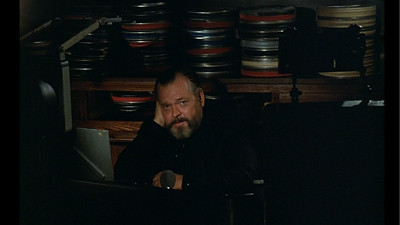
F For Fake is an enchanting, fun flick. As far as Welles' movies are concerned, it is probably his most playful film. He clearly had a blast in the editing room, even shooting some of his own scenes there, using the monitor to remind us that we are watching a movie, which is itself a forgery of reality. Fiction and truth are manipulated with the same tools. Welles takes interview footage that, by its nature, has an air of authenticity, and twists it to meet his demands. Reaction shots are taken out of context, often frozen for comical effect, and used to create doubt about whatever truth is being told. Elmyr gives Irving an eye roll, Irving looks skeptically at Elmyr, wondering if he believes his own self-crafted legend.
Amidst all of this intercutting, Welles takes center stage as a storyteller. He is almost like a boorish party guest that won't let his host tell his own tales, he always has to break in and give his own embellishment. Yet, the effect is utterly charming and releases each anecdote from the bondage of its teller. Like the art forgeries and the great masterpieces in museums across the world, they belong to all. The reality is in the eye of the beholder, in the voice of the teller.
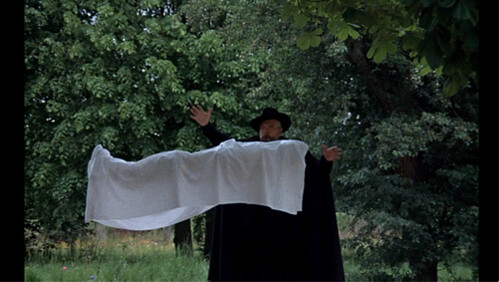
In the end, Welles' ultimate trick is to one-up his audience. We've believed his promise to tell us the truth, and we are willing to accept that all the way to the end. Like the magician who has gotten us on board with a well-executed illusion, Welles pulls a bait-and-switch. As we thrill to the rush of tales about art forgery and the long con, he slips us a mickey: a fake tale with true players, and we swallow it whole. As he unveils his own chicanery, he uses the visual metaphor of a magician levitating a man, covering him in a sheet, and then pulling off the sheet to reveal, much to his delight and ours, that the man isn't floating in mid-air--because he isn't even there.
I am sure that after the film was released, Welles was consistently asked to debunk F For Fake. Part of the fun is keeping people on their toes. In my story, I note that the script harbors a lie and promise to never reveal what it is. If you ask me, the best answer you will likely get is, "Who knows? Maybe the lie is when I tell you there's a lie in the story. Maybe every word of it is true. Because if the lie is saying there is a lie, then that is true, too." However, for those of us who want to go beyond the film, who want to know if Elmyr de Hory and Clifford Irving really did what F For Fake says they did, Criterion has given us a second disc with documentaries on both men, as well as one on Welles. To tantalize us a little bit more, there is also the 1972 press conference where Howard Hughes denounced Irving--though he does it by phone, which Welles suggests in the movie means we can't ever know for sure if it was really Hughes or not. If Orson is messing with us, we don't care. His greatest feat of magic is convincing us we want to be duped. Over and over again.
Thursday, January 31, 2008
BLAST: ROBERT ALTMAN - SECRET HONOR (#257), TANNER' 88 (#258), SHORT CUTS (#265)
From the now defunct "Can You Picture That?" column, November 30, 2004, a tribute to Robert Altman for the Oni Press website. It was written before Altman passed away.
In the documentary A Decade Under the Influence
, when the top directors of the '70s were running through their list of directors that had the most impact on them, Robert Altman said, "The filmmakers who influenced me the most, I don't know their names, because I would go and see a film and hate it, and I'd say, 'I've got to remember never to do anything like that again.'" I am not sure there is a better way to sum up this chaotic filmmaker, whose output is often as frustrating and disappointing as it is exciting. For nearly four decades, he has always been out on the furthest ledge, pushing his skills in an effort to push the film medium. When he fails, he fails spectacularly, and in some ways, it may be that sort of daredevil approach that allows him to soar so high when it works. (See also: Spike Lee.)
Over the last two months, there has been an outpouring of Altman films on DVD. There doesn't seem to be any real reason for it. No milestone has been hit, or a sudden rediscovery of the man's work as part of a zeitgeist in film culture. Just a happy coincidence, it seems.
That said, it's likely no coincidence that Criterion timed two of their Altman packages to land in October, just in time for the election. Both Secret Honor and Tanner '88 are from two decades ago, but their political bite has not been dulled by the passage of time; on the contrary, the points are sharpened by the discovery of how little progress we have made.
Secret Honor was a one-man play that Altman saw in 1984 and decided to commit to film. The stage production starred Philip Baker Hall as President Richard Nixon, alone in a room, trying to write some strange version of a memoir by dictating his thoughts into a microphone. Over the course of the night, he becomes unhinged, disappearing down a vortex of madness, speaking tangentially, exposing his own insecurities. Altman saw no real need to monkey with what was working, and so stuck with Hall and created a confined set that he could prowl around in. The only major addition he made was a bank of video monitors, playing up Nixon's self-obsession and metaphorically representing his fractured personality. He lets Hall loose and then tries to make the camera keep up with the bravura performance.
I'm sad to say it's not hard to see our current commander in chief heading in the same direction. There is the same single-minded need to be right, and the same paranoia and feeling that if you aren't with him, you're against him. There is a lesson here, the exposure of a certain mentality that can shatter when its own self-belief is challenged.
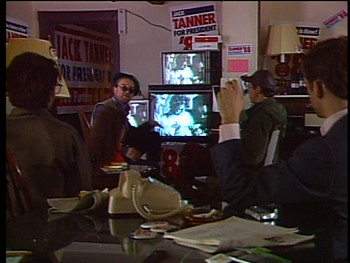
By contrast, Tanner '88 isn't nearly as heavy. This influential satire is a mockumentary that originally aired as an early HBO television series. Scripted by Doonesbury's Garry Trudeau, Tanner '88 follows fictional Presidential candidate Jack Tanner (Michael Murphy) on the campaign trail. While his foibles and the fumbles of his staff end up grist for Altman's comedic mill, Jack Tanner stands in contrast to the Nixon of Secret Honor. Tanner is attempting to regain the hope that Nixon's betrayal dashed on the rocks. He may be clumsy, but he's sincere, something that is becoming increasingly rare in today's political climate. Altman and Trudeau saw the trends developing in how the media portrayed a candidate. The politics of personality were starting to take over as the Presidential hopefuls were becoming more savvy to how to portray themselves in front of cameras. Hell, the numerous real-life participants in Tanner '88, which was shot on the actual campaign trail, is testament to that.
Tanner '88 paved the way for Steven Soderbergh's K Street
, another HBO mockumentary series that aired last year and showed how the lines between fiction and fact in our current age of instant news has been obscured even further. Apparently, Altman and Trudeau saw a similar opportunity in today's media, as well, and gathered the principal players from Tanner '88 back together for a new series, Tanner on Tanner
. To further drive the point home, Tanner's daughter (Cynthia Nixon) has become a documentary filmmaker who is putting together a piece on her father's Presidential aspirations. In one already famous scene, the young Tanner crosses paths with one of John Kerry's daughters at the Democratic National Convention, and the young Kerry is making her own film about her father's real campaign. Life and art have no distinguishable beginning and end.
Tanner on Tanner is now also available on DVD, after having initially aired on the Sundance Channel. Sundance also re-ran the original series, and Criterion has included the new introductions that were made for that marathon, featuring the characters reflecting back on what happened sixteen years ago. There is also a fascinating conversation between Altman and Trudeau, reminiscing about how far out on the edge the project was at the time.
If you're tired of politics and you want something a little lighter, Columbia/Tri-Star has released Atman's 1974 comedy California Split
. Elliott Gould plays a motormouth gambler who sucks George Segal into his on-the-fly life after they are mistaken for a pair of grifters at an old-folks' poker house. Gould is a magnetic personality who always has the inside info and a new line on a big score. Segal can't help but follow him. He makes everything sound so exciting!
And it is exciting, at least for a little while. One scrape follows another, leaving the men physically battered, broke, and in search of another shot at a big win. Altman shoots it all in a loose style, letting his actors wander and explore. The characters are freewheeling, and when they careen out of control, Altman let's the movie go out of control, as well. The gambling life is a manic one, full of exhilarating highs and debilitating lows, and the audience is let in on what it must be like, experiencing the hearty laughs when it's all going well, and feeling a little sick when it drops back down.
While California Split is one of Altman's lesser-known works, Short Cuts is easily one of his most famous. Released in 1993, it received much acclaim and was a surprise success. Not even Elliot Gould's California Split character would have bet that a three-hour film with a huge ensemble cast and an interweaving narrative based on several Raymond Carver short stories would have been a hit. Too bad, because the long shot paid off.
So, it's been a strange oversight that Short Cuts hasn't been on DVD until now. Criterion has remedied that, delivering their best Altman package: a double-disc set chock full of extras, housed in a swanky slip case alongside a reprint of the Carver story collection that inspired it all.
After a decade, Short Cuts still stands out as something fresh and compelling. Altman had spent the '80s in somewhat of an exile, as the previous decade of creativity that had been forged by single-minded directors gave way to the giant Hollywood spectacle. The Player
(1992) put him back in the public eye, and Short Cuts was his bold follow-up. Returning to the ensemble casting that had become his '70s signature, and turning Carver's prose into an interconnected symphony of lives of disquiet and desperation, Altman exposed a Los Angeles full of people who lived very different lives, but who had all gotten lost on the path to the same destination: human attachment.
The cast reads like a who's who of the brightest of early '90s cinema: Tim Robbins, Frances MacDormand, Peter Gallagher, Jennifer Jason Leigh, Robert Downey Jr., Madeleine Stowe, Matthew Modine. It's also probably the first place most of us saw Julianne Moore--and we see a lot of her. She has an emotionally raw scene where she exposes herself, both physically and mentally, confessing to an infidelity while wandering the room pantsless. It's a dual nakedness, a case where director and actress are fearless together.
Moore's only competition for snatching the defining moment of Short Cuts is Jack Lemmon. His virtuoso monologue is the center of the film, encapsulating the themes of disconnectedness in one speech. His story is tragic for how pitiful it is. Caught by his wife having sex with her sister, his whole life fell apart. He has spent thirty years wishing someone would just listen to his side of the story. If someone would only communicate with him, he'd be understood, and he'd have it all back. Or so he thought. It all comes spilling out of him, but in the end, he feels no more in touch, and he simply walks away.
In the decade since Short Cuts, Altman has continued to traverse all over the map. His John Grisham adaptation, The Gingerbread Man
, failed to find an audience, and Dr. T & The Women was universally panned; yet, he got Oscar nominations for Gosford Park
, made the charming character piece Cookie's Fortune
, and experimented with blending fiction and reality once more in last year's The Company
. By all accounts, he is the same old Altman, and this recent spate of re-releases should hopefully be a mere taste of what is to come.

A CASE FOR ALTMAN
In the documentary A Decade Under the Influence
Over the last two months, there has been an outpouring of Altman films on DVD. There doesn't seem to be any real reason for it. No milestone has been hit, or a sudden rediscovery of the man's work as part of a zeitgeist in film culture. Just a happy coincidence, it seems.
That said, it's likely no coincidence that Criterion timed two of their Altman packages to land in October, just in time for the election. Both Secret Honor and Tanner '88 are from two decades ago, but their political bite has not been dulled by the passage of time; on the contrary, the points are sharpened by the discovery of how little progress we have made.

Secret Honor was a one-man play that Altman saw in 1984 and decided to commit to film. The stage production starred Philip Baker Hall as President Richard Nixon, alone in a room, trying to write some strange version of a memoir by dictating his thoughts into a microphone. Over the course of the night, he becomes unhinged, disappearing down a vortex of madness, speaking tangentially, exposing his own insecurities. Altman saw no real need to monkey with what was working, and so stuck with Hall and created a confined set that he could prowl around in. The only major addition he made was a bank of video monitors, playing up Nixon's self-obsession and metaphorically representing his fractured personality. He lets Hall loose and then tries to make the camera keep up with the bravura performance.
I'm sad to say it's not hard to see our current commander in chief heading in the same direction. There is the same single-minded need to be right, and the same paranoia and feeling that if you aren't with him, you're against him. There is a lesson here, the exposure of a certain mentality that can shatter when its own self-belief is challenged.
By contrast, Tanner '88 isn't nearly as heavy. This influential satire is a mockumentary that originally aired as an early HBO television series. Scripted by Doonesbury's Garry Trudeau, Tanner '88 follows fictional Presidential candidate Jack Tanner (Michael Murphy) on the campaign trail. While his foibles and the fumbles of his staff end up grist for Altman's comedic mill, Jack Tanner stands in contrast to the Nixon of Secret Honor. Tanner is attempting to regain the hope that Nixon's betrayal dashed on the rocks. He may be clumsy, but he's sincere, something that is becoming increasingly rare in today's political climate. Altman and Trudeau saw the trends developing in how the media portrayed a candidate. The politics of personality were starting to take over as the Presidential hopefuls were becoming more savvy to how to portray themselves in front of cameras. Hell, the numerous real-life participants in Tanner '88, which was shot on the actual campaign trail, is testament to that.
Tanner '88 paved the way for Steven Soderbergh's K Street
Tanner on Tanner is now also available on DVD, after having initially aired on the Sundance Channel. Sundance also re-ran the original series, and Criterion has included the new introductions that were made for that marathon, featuring the characters reflecting back on what happened sixteen years ago. There is also a fascinating conversation between Altman and Trudeau, reminiscing about how far out on the edge the project was at the time.

If you're tired of politics and you want something a little lighter, Columbia/Tri-Star has released Atman's 1974 comedy California Split
And it is exciting, at least for a little while. One scrape follows another, leaving the men physically battered, broke, and in search of another shot at a big win. Altman shoots it all in a loose style, letting his actors wander and explore. The characters are freewheeling, and when they careen out of control, Altman let's the movie go out of control, as well. The gambling life is a manic one, full of exhilarating highs and debilitating lows, and the audience is let in on what it must be like, experiencing the hearty laughs when it's all going well, and feeling a little sick when it drops back down.
While California Split is one of Altman's lesser-known works, Short Cuts is easily one of his most famous. Released in 1993, it received much acclaim and was a surprise success. Not even Elliot Gould's California Split character would have bet that a three-hour film with a huge ensemble cast and an interweaving narrative based on several Raymond Carver short stories would have been a hit. Too bad, because the long shot paid off.
So, it's been a strange oversight that Short Cuts hasn't been on DVD until now. Criterion has remedied that, delivering their best Altman package: a double-disc set chock full of extras, housed in a swanky slip case alongside a reprint of the Carver story collection that inspired it all.

After a decade, Short Cuts still stands out as something fresh and compelling. Altman had spent the '80s in somewhat of an exile, as the previous decade of creativity that had been forged by single-minded directors gave way to the giant Hollywood spectacle. The Player
The cast reads like a who's who of the brightest of early '90s cinema: Tim Robbins, Frances MacDormand, Peter Gallagher, Jennifer Jason Leigh, Robert Downey Jr., Madeleine Stowe, Matthew Modine. It's also probably the first place most of us saw Julianne Moore--and we see a lot of her. She has an emotionally raw scene where she exposes herself, both physically and mentally, confessing to an infidelity while wandering the room pantsless. It's a dual nakedness, a case where director and actress are fearless together.
Moore's only competition for snatching the defining moment of Short Cuts is Jack Lemmon. His virtuoso monologue is the center of the film, encapsulating the themes of disconnectedness in one speech. His story is tragic for how pitiful it is. Caught by his wife having sex with her sister, his whole life fell apart. He has spent thirty years wishing someone would just listen to his side of the story. If someone would only communicate with him, he'd be understood, and he'd have it all back. Or so he thought. It all comes spilling out of him, but in the end, he feels no more in touch, and he simply walks away.
In the decade since Short Cuts, Altman has continued to traverse all over the map. His John Grisham adaptation, The Gingerbread Man

Labels:
altman,
can you picture that?,
other reviews
Tuesday, January 22, 2008
BLAST FROM MY OWN PAST: HOWARDS END - THE MERCHANT IVORY COLLECTION
From the now defunct "Can You Picture That?" column, May 31, 2005, not long after Ismail Merchant had died. Its original home was the Oni Press website, hence the references to comic books at the end.
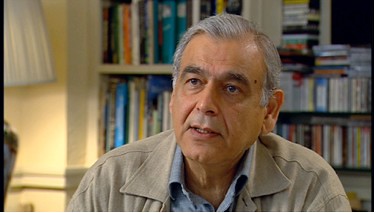
My original plan for this month's column was to review a couple of recently released classic westerns that were off the genre's beaten trail, but that all changed when I read that Ismail Merchant had died this past Thursday. Merchant was half of the Merchant Ivory team. For more than forty years, he produced and James Ivory directed a string of literary films that redefined how we looked at costume dramas, casting aside the stuffy reputation period films had earned and making a whole new generation fall in love with prissy dramas about manners and repressed passion. They also opened the door for films about India and even imported some of Satyajit Ray's body of work to English-speaking countries.
It's nearly unheard of for such a long working relationship to exist in any creative business, much less film. Factor in that they have also worked all this time with the writer Ruth Prawer Jhabvala, and it becomes even more clear that these were folks of a singular vision. By sticking together, they created a mark of quality that they consistently improved upon and refined, from early efforts like Shakespeare Wallah in the mid-'60s and on to now, with two films on their way through production (The White Countess
came out late in 2005, but had not been released at the time of the original writing). It's quite a legacy, and thankfully, one that's being preserved for the digital age.
In 2003, the Criterion Collection started a boutique label: The Merchant Ivory Collection. I reviewed one of their earliest releases, Quartet, in the second edition of this very column. Amongst the wave of titles from this past February was one of Merchant Ivory's best films, 1992's Howards End, starring Anthony Hopkins, Emma Thompson, and Helena Bonham Carter. The two-disc set has been sitting on the rack next to my television for three months now, perpetually one of the next in line to be watched. In honor of Ismail Merchant's passing, it went to the top of the pile.
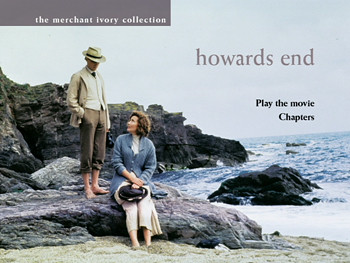
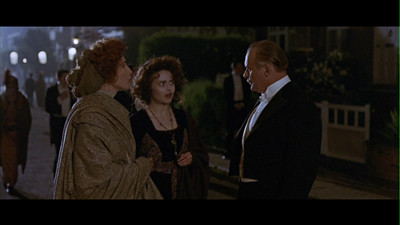
Howards End is a perfect reminder of why Merchant Ivory are so good. In the wake of a scandal of misunderstanding, two women befriend one another. From her death bed, Ruth Wilcox (Vanessa Redgrave) sees a kindred spirit in the spinsterish Margaret Schlegel (Thompson). So much so that she ends up trying to leave Margaret her family home, the lush and extravagant Howards End. Her widower, Henry (Hopkins at his twitchy best), and his selfish children head off this request, but the lives of the Wilcoxes and the Schlegels become entwined anyway. Margaret eventually marries Henry, which puts off her sister, Helen (Bonham Carter). Helen didn't really need another reason to dislike the Wilcox clan after her botched engagement to the youngest son. When further scandals--both past and present--are discovered in relation to a lower class couple Helen has befriended, things are strained further, setting up the main threads of a complex family drama. Howards End was adapted by Jhabvala from E.M. Forster's 1910 novel, and the story's construction is seamless, weaving amongst the various characters and teasing out the large connections between them. Though seemingly covering ground the filmmakers had tread before, Howards End bristles with a clarity and energy that crackled like never before. The script, costumes, sets, performances--everything is in sync.
The new DVD, like all the releases in the collection, has a pristine picture quality and a bundle of extras. There are four documentaries, two new and two old. One of the older ones is especially essential for anyone looking to take a crash course in the career of Ismail Merchant. The Wandering Company was put together in 1984 to celebrate the 20th anniversary of the Merchant Ivory partnership. While some of it is a little hammy, it's the best available glimpse of how the two men went about creating their movies. The portrait it paints of Merchant is particularly fascinating: he lives his life at the largest proportions, but those who care about him see through the ruse, spotting the generous, gregarious man underneath. Here, clearly, was someone obsessed with filmmaking, who kept his crew together often through sheer force of will and by tugging all sorts of hidden purse strings. He was an irascible penny pincher, one who approached his role as producer almost like a swashbuckler, pulling through by the skin of his smiling teeth and the lint in his pocket. Merchant needed the reserved Ivory to balance him out as much as Ivory needed his forceful personality to get the job done. In a contemporary interview, the effect of such a long relationship is obvious. Like a married couple, they correct one another, tell the same stories completely differently, and finish each other's sentences.
In honor of Ismail Merchant's life, take some time with Howards End or any of the other movies he made with James Ivory. There are even several Merchant directed himself, including the most recent entries in the Merchant Ivory Collection: In Custody and The Courtesans of Bombay . His final film helming the camera was 2001's The Mystic Masseur
, continuing his long tradition of bringing Indian themes to the screen. Comics fans may also enjoy The Wild Party
, a 1975 movie based on the same poem that Art Spiegelman adapted to graphic form in 1994 after completing Maus
.
In the past several years, the Merchant Ivory films have been a little out of vogue. DVD is giving their back catalogue a second lease on life, so that even if part of the team is gone, their legacy continues.

ISMAIL MERCHANT (1936-2005)
My original plan for this month's column was to review a couple of recently released classic westerns that were off the genre's beaten trail, but that all changed when I read that Ismail Merchant had died this past Thursday. Merchant was half of the Merchant Ivory team. For more than forty years, he produced and James Ivory directed a string of literary films that redefined how we looked at costume dramas, casting aside the stuffy reputation period films had earned and making a whole new generation fall in love with prissy dramas about manners and repressed passion. They also opened the door for films about India and even imported some of Satyajit Ray's body of work to English-speaking countries.
It's nearly unheard of for such a long working relationship to exist in any creative business, much less film. Factor in that they have also worked all this time with the writer Ruth Prawer Jhabvala, and it becomes even more clear that these were folks of a singular vision. By sticking together, they created a mark of quality that they consistently improved upon and refined, from early efforts like Shakespeare Wallah in the mid-'60s and on to now, with two films on their way through production (The White Countess

In 2003, the Criterion Collection started a boutique label: The Merchant Ivory Collection. I reviewed one of their earliest releases, Quartet, in the second edition of this very column. Amongst the wave of titles from this past February was one of Merchant Ivory's best films, 1992's Howards End, starring Anthony Hopkins, Emma Thompson, and Helena Bonham Carter. The two-disc set has been sitting on the rack next to my television for three months now, perpetually one of the next in line to be watched. In honor of Ismail Merchant's passing, it went to the top of the pile.
Howards End is a perfect reminder of why Merchant Ivory are so good. In the wake of a scandal of misunderstanding, two women befriend one another. From her death bed, Ruth Wilcox (Vanessa Redgrave) sees a kindred spirit in the spinsterish Margaret Schlegel (Thompson). So much so that she ends up trying to leave Margaret her family home, the lush and extravagant Howards End. Her widower, Henry (Hopkins at his twitchy best), and his selfish children head off this request, but the lives of the Wilcoxes and the Schlegels become entwined anyway. Margaret eventually marries Henry, which puts off her sister, Helen (Bonham Carter). Helen didn't really need another reason to dislike the Wilcox clan after her botched engagement to the youngest son. When further scandals--both past and present--are discovered in relation to a lower class couple Helen has befriended, things are strained further, setting up the main threads of a complex family drama. Howards End was adapted by Jhabvala from E.M. Forster's 1910 novel, and the story's construction is seamless, weaving amongst the various characters and teasing out the large connections between them. Though seemingly covering ground the filmmakers had tread before, Howards End bristles with a clarity and energy that crackled like never before. The script, costumes, sets, performances--everything is in sync.
The new DVD, like all the releases in the collection, has a pristine picture quality and a bundle of extras. There are four documentaries, two new and two old. One of the older ones is especially essential for anyone looking to take a crash course in the career of Ismail Merchant. The Wandering Company was put together in 1984 to celebrate the 20th anniversary of the Merchant Ivory partnership. While some of it is a little hammy, it's the best available glimpse of how the two men went about creating their movies. The portrait it paints of Merchant is particularly fascinating: he lives his life at the largest proportions, but those who care about him see through the ruse, spotting the generous, gregarious man underneath. Here, clearly, was someone obsessed with filmmaking, who kept his crew together often through sheer force of will and by tugging all sorts of hidden purse strings. He was an irascible penny pincher, one who approached his role as producer almost like a swashbuckler, pulling through by the skin of his smiling teeth and the lint in his pocket. Merchant needed the reserved Ivory to balance him out as much as Ivory needed his forceful personality to get the job done. In a contemporary interview, the effect of such a long relationship is obvious. Like a married couple, they correct one another, tell the same stories completely differently, and finish each other's sentences.

In honor of Ismail Merchant's life, take some time with Howards End or any of the other movies he made with James Ivory. There are even several Merchant directed himself, including the most recent entries in the Merchant Ivory Collection: In Custody and The Courtesans of Bombay . His final film helming the camera was 2001's The Mystic Masseur
In the past several years, the Merchant Ivory films have been a little out of vogue. DVD is giving their back catalogue a second lease on life, so that even if part of the team is gone, their legacy continues.
Subscribe to:
Posts (Atom)