Saturday, October 1, 2011

SIDELINE: MORE REVIEWS FOR 9/11

A round-up of non-Criterion reviews I wrote this past month:


IN THEATRES...

* 50/50, as unserious as cancer. Or as serious as cancer. Kind of both. Great work from Joseph Gordon-Levitt, Seth Rogen, and an all-around solid cast.

* Attack the Block, the ultimate summer movie shows up just in time for fall. (Unless you were lucky enough to get it in your town earlier, of course...)

* Contagion, in which Steven Soderbergh makes sure you'll never touch yourself again. On the face. ON THE FACE!!! But seriously, this movie is awesome.

* Drive, the best movie Paul Schrader never made. Ryan Gosling stars, all Alain Delon-like, in this violent tour-de-force by Nicolas Winding Refn.

* Gainsbourg: A Heroic Life, a biopic of Serge Gainsbourg from French cartoonist Joan Sfarr. It can't quite sustain its inventiveness, but I liked it all the same.


* Higher Ground, actress Vera Farmiga tackles feminism and faith in her directorial debut.

* The Lion King 3D, an old favorite shown in a bad new light.

* Moneyball, a surprisingly deep drama about the inner workings of baseball. (Note: One of the screenwriters was Aaron Sorkin. Did you know that?)

* Shut Up Little Man! An Audio Misadventure, a fascinating, thought-provoking look at one of the most infamous pre-internet viral sensations.

* Straw Dogs, a competent but pointless remake. Rod Lurie is no Sam Peckinpah. (Hey, I reviewed the original once, too.)

Portland was lucky enough to have Cinema 21 showing the original 3D version of Alfred Hitchcock's Dial M for Murder for a limited engagement. To go along with it, the Portland Mercury asked me to pick some other Hitch films for home viewing, and I did so by taking a tour of his trailers. Read the column online here.

ON DVD/BD...

* Boccaccio '70, four Italian film directors team for a 1962 anthology film telling individual stories of modern romance.


* Breakfast at Tiffany's, the quintessential Audrey Hepburn film is now on Blu-Ray.

* Hung: The Complete Second Season, Thomas Jane returns as everyone's favorite lovelorn hustler.

* If a Tree Falls: A Story of the Earth Liberation Front, a thought-provoking documentary about controversial radicalism.

* The Inspector General, this whitebread Danny Kaye musical is only offensive in how unfunny it is.

* One Minute to Zero, Robert Mitchum makes love to Ann Blyth and hits the snooze button in this Korean War drama.

* Road to Nowhere, Monte Hellman returns to the director's chair for a disjointed potboiler.

Friday, September 30, 2011

READER MEET AUTHOR: SPELL CHECKERS VOL. 2 SIGNING - TONIGHT!

Time for some self-promotion. I have a new comic out, and if you're in the Portland, OR, area, we are doing a signing tonight to celebrate.


Spell Checkers, vol. 2: Sons of a Preacher Man went on sale this past Wednesday. If you're unfamiliar with the title, don't worry, it's easy to catch up on it, and you can really read any of the two volumes on their own, they are connected but mostly episodic (if that makes sense).

The basic pitch was: Mean Girls meets The Craft, rude humor and magic. For a little primer, you can hear my audio commentary for the first scenes and read the pages over at Stumptown Trade Review. Check it out here.

You'll want to open up one window with the pages and another with the audio and read along with my babbling. Hear the creative process at work, unvarnished and unfocused!

Myself and both artists on the book, Joëlle Jones and Nicolas Hitori de will be at Bridge City Comics promoting the release this evening.


Click on the image for the full press release.

If you need more incentive to come, I just found out that Nico will have a limited number of these prints on hand:


Come on. You know you wanna.

Wednesday, September 28, 2011

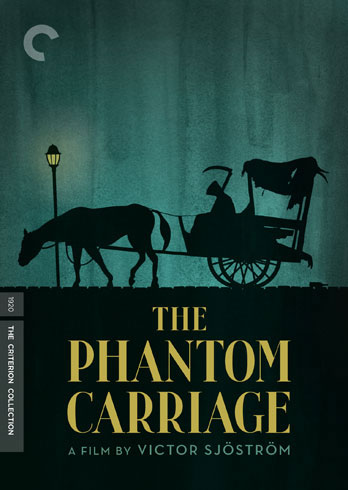
THE PHANTOM CARRIAGE (Blu-Ray) - #579


Superstition can be an impressive plot motivator, and when tied to a ghost story, even better.

Victor Sjöström's 1921 silent film The Phantom Carriage is a spooky morality play. A campfire parable that is to the Swedish chill what Dickens' A Christmas Carol was to English winters or It's a Wonderful Life [review] to the American can-do spirit in difficult times. Sjöström is best known for playing the professor obsessed with his own mortality in Ingmar Bergman's seminal 1957 film Wild Strawberries, and this picture--which he wrote, directed, and starred in--makes Bergman's casting choice all the more brilliant. Beyond the influence of Sjöström's work on his own, Bergman gave the veteran filmmaker a chance to sew up the thematic threads begun in his own cinematic efforts.

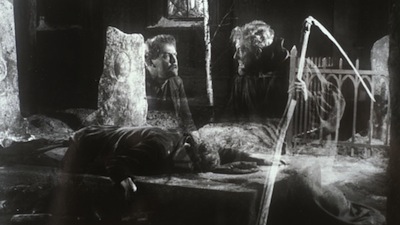
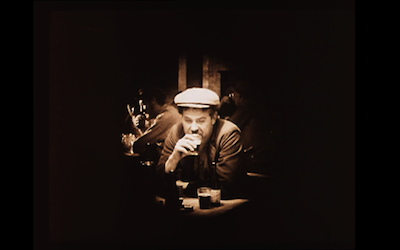
The Phantom Carriage is set on New Year's Eve. As a good-hearted nurse in the Salvation Army, Sister Edit (Astrid Holm), nears death from pneumonia, she asks to see David Holm (Sjöström) so that she may make one last attempt to save his soul. As Edit's friends and colleagues reluctantly look for him, David is drinking in a graveyard with a couple of other degenerates. He tells them the story of his pal Georges (Tore Svennberg), a fellow boozer who cleans up his act every December 31st because he's afraid to die before the New Year is rung in. Georges believes that the last person to die before midnight is cursed to drive Death's spectral caravan for the next twelve months. Unsurprisingly, Georges has been missing since the previous turn of the calendar. Wherever could he be? Mwuahhaha!


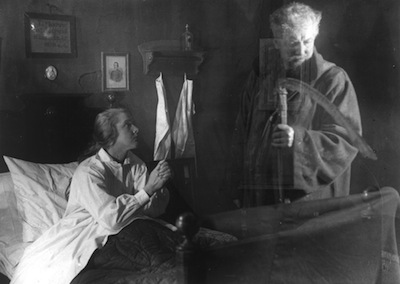
When David is finally found, he refuses to visit Edit. Afraid that this act of human callousness can never be undone, his drinking buddies try to force him to go. Their fight ends up with David dead, and the Phantom Carriage comes to pick him up just as the clock hits 12:00. Georges and David are surprised to be reunited in this way, and before Georges can step down and give David the reins to the chariot of Hell, he decides to take him on a tour of his previous wrongdoing so that he might clear his soul of its excess baggage. Through a series of flashbacks and visitations, we learn David's twisted history, including his year-long torment of Edit, who never gave up on him, the first ward of her charitable outpost. Injury to insult, David is the one that infected Edit in the first place. He also tormented his wife (Hilda Borgström) to the point where she is not sure she can carry on with living. In one particularly effective scene, Mrs. Holm tries to lock her husband in the pantry, only to have him break through the door with an axe. Fans of Kubrick's The Shining will quickly see that Ingmar Bergman was not the only one inspired by The Phantom Carriage.

Sjöström, who based his script on a novel by Selma Lagerlöf, has put together an effective, oftentimes unnerving silent horror film. Though there is a moral to David's night of terror, it is not necessarily governed by any particular morality. Sure, Christianity is often evoked, but it's more or less just window dressing for the larger supernatural narrative. David is a bad, bad man no matter what code of ethics you subscribe to, and his horrible fate is more of a human punishment than a divine one. The tour that Georges takes him on is not necessary, he could just take off the grim reaper costumer and be done with it, but he wants his cohort to understand both the awfulness that awaits him and also his own role within that never-ending, gruesome cycle.

The Phantom Carriage is staged on realistic sets, with Sjöström emphasizing the impoverished conditions and how the difficulties of this kind of life can lead to unwise solutions and easy escapes. This is expertly contrasted with the more fantastical elements of Lagerlöf's tale. Sjöström creates a dark, gothic landscape where mists and shadows can believably disperse to reveal unbelievable creatures. Particularly inspired is a short tour of a night's work riding alongside Georges, as he gathers the spirit of a man who shot himself and another who drowned. Sjöström and cinematographer Julius Jaenzon use double-exposure photography to imprint a translucent ghostly stagecoach over the scenes. Georges takes the Phantom Carriage across the water...and then under it. It's an impressive use of early photographic techniques.


But then, we've also seen those kinds of special effects employed elsewhere, and as with any era's innovations, they don't stand the test of time on technical skill alone. There has to be some human element to create a lasting appeal. For the many hats he wears, and as anyone who has previously seen Wild Strawberries already knows, Victor Sjöström is best in front of the camera. He is a tremendous actor, one who is capable of astonishing cinematic emotion. His performance lends an authenticity to David's rollercoaster life: from temptation to reconciliation, disappointment to malice, and then ending at a point of true redemption. Sjöström sells each with equal vitality. Though, I must admit, the most surprising was what a fearsome villain he makes in The Phantom Carriage. It makes me curious to find out if he ever played a bad guy again.

Though set on New Year's Eve, Criterion's The Phantom Carriage is smartly timed to arrive just in time for Halloween. I would happily place it with other Halloween classics, such as the Bela Lugosi Dracula or Robert Wise's The Haunting, or this year alongside the forthcoming home release of Kuroneko [review], as part of my holiday viewing. It's also one you could put on the TV and play as background at a Halloween party, if that's your thing. Of course, only after you've screened it yourself, alone in a darkened room, just you, Death's emissary...and your soul.

Mwuahaha, take two.


For a complete rundown on the special features, read the full review at DVD Talk.

Sunday, September 25, 2011

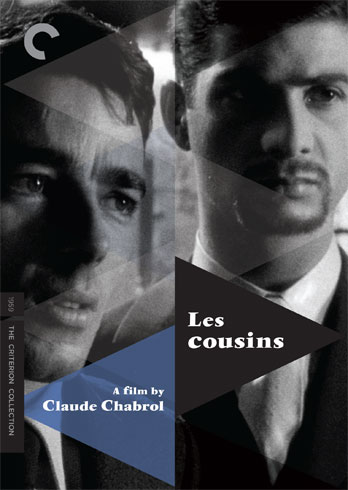
LES COUSINS (Blu-Ray) - #581


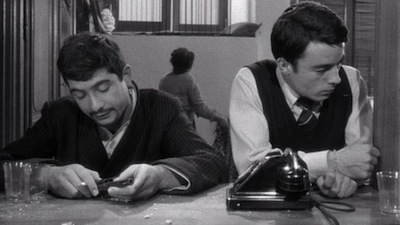
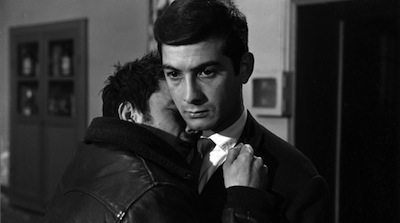
For his 1958 debut, Le beau Serge [review], Nouvelle Vague pioneer Claude Chabrol told the story of a man moving back to his provincial hometown after many years in the city; for the follow-up, Les cousins, Chabrol flipped things around, including changing the role "types" for his two lead actors. This time, Gérard Blain plays Charles, a mama's boy from the country moving to Paris to study law. In town, he will live with his cousin, the brash and outgoing Paul (Jean-Claude Brialy). One of their friends doubts their relations because they look nothing alike, and Charles defends this as saying they are cousins, not twins. Yet, the divide between the two blood relatives could not be wider.

It's funny when you first see Paul, you know exactly what kind of character he is. His Van Dyke and European poncho is practically the uniform for parodies of the sort of pretentious, privileged douchebag Brialy is portraying. It's a case of the more things change, the more they stay the same, I guess, that Chabrol's visual short cuts still have cultural significance. Paul is a selfish partyboy, living in his uncle's flat surrounded by the old man's trophies and trinkets, symbols of a life well lived (and all shot with loving attention to detail by cameraman Henri Decaë, who also photographed Le beau Serge as well as films for Malle, Truffaut, and Melville). Not the life Paul is living, mind you, he is on a different path. He drinks and cavorts more than he studies, and his friends represent the social register for degenerates, from the older hustler Clovis (Claude Cerval, The Lovers [review]) to the slut Francoise (Stéphane Audran, The Discreet Charm of the Bourgeoisie [review]) all the way to the bottom of the heap and the hopelessly emo Philippe (Jean-Pierre Moulin). They drink and they gamble and they carouse, and generally make a spectacle of themselves.


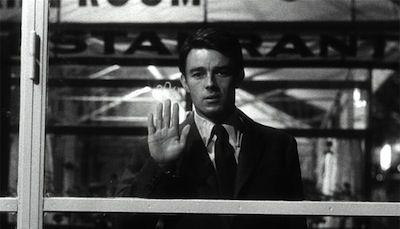
This is the life that Charles is immediately introduced to, and the one he never really fits. Gérard Blaine, who was fiery and charismatic in Le beau Serge, withdraws here. Charles is thoughtful and insecure, with a stoic streak that allows him to mask his anxieties and disappointment. (One is easily reminded of James Dean watching Blaine do his thing.) It's love at first sight for Charles when he sees Florence (Juliette Mayniel, Eyes Without a Face), a girl with a past but whom Charles sees with fresh eyes. He is enamored of her, he can't even bring himself to recite a poem he wrote in her honor. Florence is drawn to his innocence, but Clovis and Paul manipulate her into Paul's bed instead. The girl moves in with the two cousins; rather than have his nose rubbed into his romantic failures, Charles buries it in his books. (The advice of a sagely bookseller, actually, played by Guy Decomble, who would soon play the French teacher in The 400 Blows.)

The portion of Les cousins where the three of them live together recalled for me, in a way, Jean-Pierre Melville's adaptation of Les enfants terribles [review]. In fact, quite a bit of the basic behavior Chabrol assigns to his characters seems inspired by the Cocteau play. Paul regularly engages in self-serving gameplay, taking little seriously and concocting scenarios where he can push others into servicing his whims. In my head, Jean-Claude Brialy is usually dapper and collected, the kind of handsome ladies man he played in Godard's A Woman is a Woman. He is more of a force of nature here. Like the cliché about the shark, he is never at rest, always moving. Clovis, who resents him as much as he likes him, acts as the devil on his shoulder, offering a bit of contrast. Paul does what he does for his own amusement, but Clovis cons and cajoles for spite and thievery. There is a great shot at one of the parties, it happens very quickly, when you see Clovis robbing Paul's secret stash--something we instinctively knew he would do the moment Chabrol showed us that hiding spot in the first act, when the pair were convincing one of Paul's conquests (Geneviève Cluny) to get an abortion. Even in that, the difference between the two men is obvious: Paul is trying to weasel his way out of trouble, whereas Clovis likes the taste of other people's misery.


It's a little disappointing, then, that Chabrol circumvents the expectation of these narrative seeds, and Clovis' demonic personality doesn't have much reward. At the very least, we might assume Paul would completely switch over to Clovis' particular dark side or overtake the master. The sad fact is, there isn't much narrative payoff at all in Les cousins, except for maybe a nod to an old Chekhov aphorism. The ending of the film isn't entirely satisfying. I see the dramatic irony that Chabrol is going for, but it doesn't land with any significant force. The final scene only reinforces the roles everyone plays rather than showing any change. Charles is a perpetual victim, Paul is the thoughtless predator.

I don't know whether to call it the "sophomore jinx," or if perhaps emptiness is exactly what Chabrol is going for. Paul strives for a meaningless world. This is a guy to whom romance is a joke and who recites Wagner arias while wearing military garb. It's all fair game to him, so perhaps Chabrol intended the real tragedy of the finale of Les cousins to be that so much was destroyed with such little consideration. Rather than death by a thousand cuts, it's death by one triviality. Jean-Luc Godard called Les Cousins "a deeply hollow and therefore profound film," and I suppose it could be that this lack of any meaningful center is what makes Les cousins so intriguing. Even as I react against its contrivances, I find myself considering putting it back in my player and watching it again.


Claude Chabrol


For a complete rundown on the special features, read the full review at DVD Talk.


Thursday, September 22, 2011

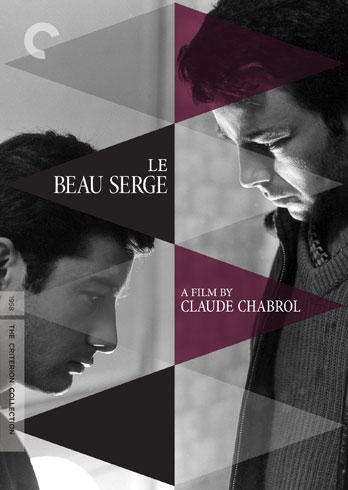
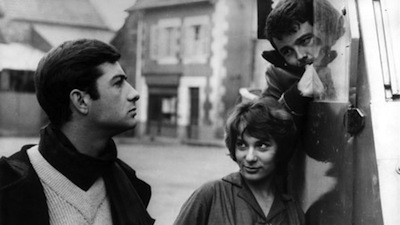
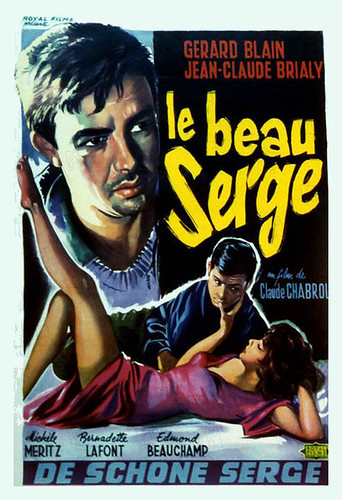
LE BEAU SERGE (Blu-Ray) - #580


There could probably be plenty of debate about what is considered the first "Nouvelle Vague" motion picture in terms of content or the definition of a style, but when it comes to getting cameras rolling, there is no arguing that Claude Chabrol was the first to break out of the Cahiers da cinema editorial offices and put something on the screen. Le beau Serge was released in 1958, and fittingly, this drama has themes of revisiting the past, of checking the point of origin and seeing how much things have changed. Chabrol could be making a movie about his hometown of Sardent, or he could be making an allegory about the art of cinema: I loved these movies once, but now I've grown past them, so how do I return to the medium I adore and make it work for who I am now.

Jean-Claude Brialy stars in the film as Francois, a man who finds himself back in the small town where he grew up thanks to a tubercular condition. He hopes that by getting some rest away from the city, he can clear up the spot on his lungs. He immediately finds that the place he knew as a child, for as much as it is the same on the surface, is very much changed. Or perhaps it's him, perhaps it's the eyes of an adult that show him his neighbors in a whole new light. When he mentions grown women he doesn't recall from his youth, his guide reminds him that they were young girls when he saw them last, and he cared nothing for young girls.


He did care about his friend Serge, though. Everyone cares about Serge. The title of the film translates as "handsome Serge," and there is something about this dark, charismatic man (played by Gérard Blain) that makes him the center of attention. Chabrol toys with our perceptions on first meeting him. He and his father-in-law and drinking buddy, the old man Glomaud (Edmond Beauchamp), are spied on the opposite side of the bus from where Francois disembarked. Emile Delpierre's music has a sinister surge, suggesting that these men lurking there are a threat. It's like a cue out of Shadow of a Doubt, announcing the arrival of a dark presence. And, in a way, that's what those two rummies are.

Serge has taken a wife and taken to drinking since Francois left. He is the small town boy who didn't go anywhere, stuck in the expected job, facing zero prospects. He is as excited to see Francois as Francois is to see him, but he also recoils. He is ashamed of his drinking. Serge is also broken. He married Yvonne (Michelle Méritz) because she was pregnant, but the child was born with birth defects. It is now dead and spoken of in hushed gasps. I may be wrong, but there is possibly some suggestion that it was the product of incest, that maybe it wasn't even Serge's baby. There is certainly something creepy going on, the community is shown as being incredibly insular. It's almost like the backwoods society in some horror movies, complete with the failing priest (Claude Cerval) who knows everyone's sins. Serge has cheated on his wife with her sister Marie (Bernadette Lafont), and there is gossip that Glomaud isn't actually Marie's father. Marie displays some lasting interest in Serge's activities, but she is also quick to jump in bed with Francois, who it turns out is quite the pussyhound.

Though, I have to say, despite his much discussed way with the ladies, I am not sure the incestuous relationships within this small group only consist of opposite sex couplings. There is plenty that one can read into the friendship between Francois and Serge. Francois immediately insists himself back into Serge's life, and he is determined to "save" him from the demon wine and his shrewish wife. Serge plays hard to get and moody, alternately embracing his old friend and toying with him. I wouldn't shoot down a theory that he drinks to obliterate his homosexual guilt and to ease a broken heart over Francois having left him. When he gets blotto and goes wandering the graveyard looking for Francois when Francois is with Marie, it's not because his best friend is screwing a woman he screwed, it's jealousy that Francois is with a woman at all. Or really, anyone that isn't him. Later, tables flip and Serge and Marie team up to manipulate Francois. It's all rather messy.


Visually, Chabrol sees a duality in Sardent, one as simultaneously divided and interlinked as the two men. He and photographer Henri Decaë establish a sense of place when they shoot the town, using some of its cramped quarters to their advantage, but letting our unfamiliarity with the area work in their favor, as well. There is something labyrinthine about its streets, and we are unsure of the distance between, say, Serge's house and Francois' hotel, where Serge often drinks. With the wilderness and farmlands surrounding the burg, there is also a feeling of a greater expanse. Marie's house is farther away--30 yards faster if one journeys through the graveyard--but far enough that they can outdistance Serge, just as the small town is big enough for Serge and Glomaud to disappear on one of their benders. Small enough for everyone to know each other's business--including what Francois got up to when he went away--but also able to keep secrets.

I don't recall us ever finding out what kind of work Francois did on his own. Brialy is cool and collected, and he gives off an aura of success. We get the idea that he was probably always the one that did well, and Serge was always kind of the screw-up. Blain is excellent as the capricious drunk. His eyes have a consistent hint of menace, his smile is mocking, and when he cries, it sounds like laughter. Francois' determination to rescue his friend turns into a kind of holy mission, particularly when he digs in his heels after even the priest tells him to get lost. It's a mission that exists in the abstract, however, until Francois is forced to get real about what is really going on. Yvonne and Serge are expecting a second baby, and despite fears that it will be deformed, as well, she carries it to term. Only, on the night that she goes into labor, Serge is nowhere to be found.

Francois goes on a frenzied search for his friend. He refuses to let his child be born without him. He finds Serge drunk and passed out in the snow and drags him home, literally unthawing him. (And I swear, the way they look at each other, if ever they were going to kiss...) It's a transformative event for both of them, and a hopeful finish for Chabrol's debut. Le beau Serge is a bit of a hothouse flower, nurtured to life by a healthy diet of Faulkner and Tennessee Williams, with even a little Hitchcock in its more hysterical moments (particularly in the music). It's structurally loose, but tight in execution, firmly handled by the first-time auteur. It's a wonderful promise from the artist, and only a hint of what is to come.


This disc was provided by the Criterion Collection for purposes of review.

Wednesday, September 21, 2011

THE COMPLETE JEAN VIGO: A PROPOS DE NICE/TARIS/ZERO DE CONDUITE - #578


Jean Vigo is one of those interesting artistic figures whose reputation far exceeds his output. He's the kind of name that pops up on lists and scholarly surveys and inspires reactions of "What's the big deal?" He made only four films between 1929 and 1934, and two of them were under half an hour, another was less than an hour, and only his last, L'Atalante, reached what we would consider a more standard feature length. Again, that's barely anything compared to other equally revered filmmakers. So, what's the big deal?

This question is raised, and more than amply answered, in Criterion's The Complete Jean Vigo, a two-DVD set (or single Blu-Ray) collecting all of Vigo's efforts with a movie camera alongside some informative supplemental material. A big deal made of a small career that is a verrrrry big deal indeed.
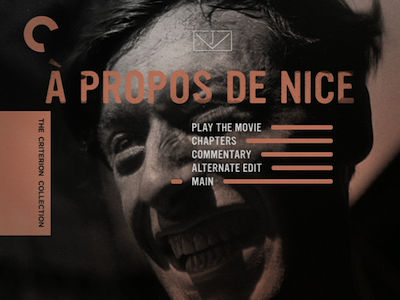


The lead films in the set are the two short subjects Vigo directed, the experimental and fun A propos de Nice (1930, 23 minutes, silent) and Taris (1931, 9 minutes, sound). Both appear to be frivolously produced, with A propos de Nice in particular coming off as a freshman artist being given a new tool and running wild with it. Vigo experiments with double exposure, fades, speed changes, and all manner of other tricks to explore the city of Nice. Most of the footage is shot on the street as documentary; it's in the editing and in some of the staged gags that Vigo draws out a kind of commentary, blending real-life footage with editorial invention. It can be quite funny, such as comparing some exaggerated citizens with similar looks found in nature, or exposing the lingering gaze of a man looking at a pretty girl by showing us what he really wants to see: her clothes disappearing and her silly undergarments exposed, and eventually her completely naked body. Stuffy art has the wind taken out of its sails by seeing a rain puddle gathered in the crotch of a lounging sculpted figure.

Yet, Vigo quickly upends these tricks and tricks his audience at the same time. How do we feel when that same playfulness gets serious and shows us the poor and the starving just around the corner from opulence and conspicuous consumption? It's fairly blunt in terms of social comment, but indicative of an emerging cinematic point of view. Few would take their debut effort into such territory. The effect of A propos de Nice is to equalize the common populace. They all share one city, they are of one people, and the one set being selfish and foolish is all the more so next to their neighbor's misery.



There is a similar equalizing in Taris, in which swimming champion Jean Taris gives a swimming lesson to the viewing audience. Again, Vigo uses experimental effects, including overlapping images, running the film in reverse, and some truly impressive underwater photography. If one wonders where Cocteau got some of his ideas for the many effects shots throughout the Orphic Trilogy, one need look no further. The playful camera work elevates what would otherwise be a standard promo piece for the swimmer, and the ending takes it one step further. Having completed his rather complicated lesson, Taris rises from the pool like some kind of divine being, has his clothes change before our eyes, and exits in a double-exposed shot where he appears to practically walk on water. The glint in his eye suggests, yes, anyone can swim this way, but not anyone can be Jean Taris. There is only one champ.
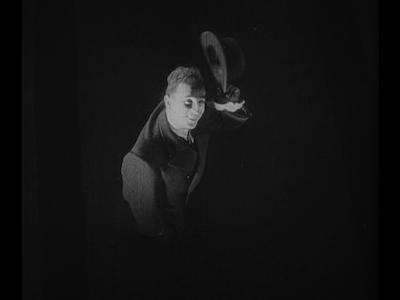


It was two years more before Vigo made the 44-minute film Zéro de conduite (Zero for Conduct) (1933), a whimsical, semi-autobiographical story of a rundown boarding school losing its tyrannical grip on its all-male student body. Returning from a break, the school has a new teacher--or as they call them, "monitors"-- the happy-go-lucky Huguet (Jean Dasté). He is a bit of a joker, and also a fairly competent physical comedian. Dasté glides through a playground scene, breaking into a scrum and grabbing the ball. He does a handstand on his desk to entertain his charges.

Huguet also turns a blind eye to the scheming of three of his students. Caussat, Colin, and Bruel are planning a special prank for the school's anniversary celebration. The girly Tabard (Gérard de Bédarieux) wants in on the act, but the other boys think he is a snitch. Only after Tabard stands up and curses after one of their teachers makes a dirty pass at him in class does he finally get accepted into the fold. The movie ends with their taking action, assaulting their headmasters from the rooftops in a scene that would later inspire Lindsay Anderson in crafting the ending of If.....
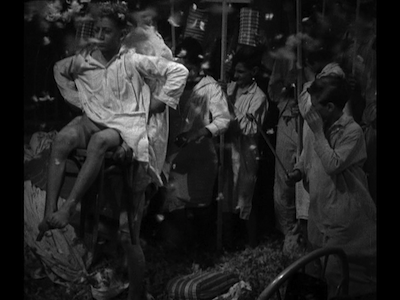


Vigo wrote the script for Zéro de conduite, as well as directing, and though there is a basic plot to the movie, it is structured episodically, like a series of Mack Sennett short subjects stitched together. The kids stage a succession of small rebellions on the way to their final operation. Vigo shoots them in such a way as to capture the magic of youth. An explosion of pillows creates a storm of feathers, and the boys ride through it in slow motion, buoyed by their own sense of immortality. The director also peppers Zéro de conduite with small touches of surrealism: the diminutive principal with the big beard (Delphin), for instance, whose reflection moves in the mirror independently. Or the boy performing a magic trick, where the ball disappearing is really just Vigo's manipulation behind the camera and in the editing room.

Zéro de conduite had trouble with the censors on its initial release due to its frankness regarding disciplinary issues and indiscretions in the school environment. That frankness is also why it still remains so vital after 80 years. It doesn't feel whitewashed, and the problems the boys go through remain relatable while their revenge still provides some wish fulfillment for all of us who ever were unhappy with the teachers and administrators at our school. I wrote a column a couple of months back tracing a link from Hal Ashby to Wes Anderson (and would have included Richard Ayoade's Submarine [review] if I could) and examining the coming-of-age subgenre where imaginative boys cope with the world by unleashing their vivid imaginations. Zéro de conduite has as much a place at the forefront of that tradition as it does with other boy's education movies like If...., The 400 Blows, and Young Törless. On their own, each of those is a pretty impressive legacy for one movie to provide a cornerstone to, but both of them...well, I did say Jean Vigo was a very big deal, didn't I?


L'Atalante has been reviewed separately. Read it here.

This disc was provided by the Criterion Collection for purposes of review.

Monday, September 19, 2011

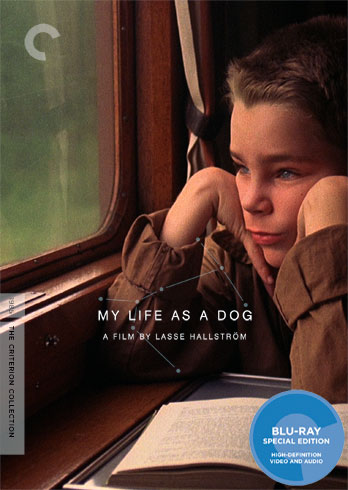
BLU-REDO: MY LIFE AS A DOG - #178/IF.... - #391

I was recently fortunate enough to review the Blu-Ray reissues of two older Criterion films, Lasse Hallström's My Life as a Dog and Lindsay Anderson's If.... While it was an absolute pleasure to revisit these two favorites, and the high-def presentations were suitably impressive, I was happy enough with my older essays on the movies to use them again. I did, however, update the technical specs, and if you would like to go over the full reviews, including my assessment of the audio/visual quality, click through on the covers to see my DVD Talk entries.


Original version


Original version

* *