Sunday, October 9, 2011

NIKKATSU NOIR: I AM WAITING - ECLIPSE SERIES 17


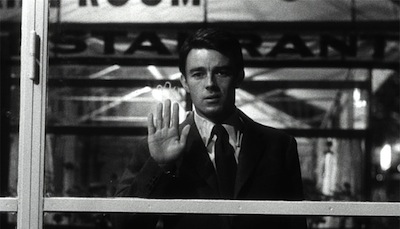
I enjoyed the recent Eclipse set The Warped World of Koreyoshi Kurahara [review] to such a degree that it only made sense to finally take the plastic off of my Nikkatsu Noir box and watch the Kurahara film included there. The 1957 crime drama I Am Waiting (Ore wa matteru ze) is actually the director's debut, predating the earliest film in Warped World by three years. For his first feature, it's impressively mature, showing an assured grasp of dramatic storytelling as well as the filmmaker's penchant for artistic daring.
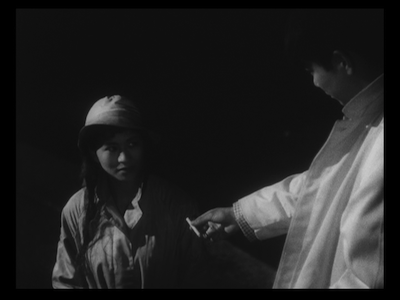


The story opens on a lonely late-night pier. A boy finds a girl standing at the edge of the water, and sensing she may do herself harm, invites her back to the pub he owns on the waterfront. He is Joji Shimaku (Yujiro Isihara), a former boxer who now runs this low-rent café while waiting for his brother to contact him and tell him their farm is set up in Brazil. She is Saeko (Mie Kitahara), a singer whose career has fallen on hard times. She ran out on a contract at a skeevy cabaret after clocking her gangster boss' grabby little brother (Ken Hatano) over the head. That she ran into Joji was good fortune for her. His bar is a place for people living on borrowed time. Everyone there is running from something and well on their way to something else. Joji stopped boxing after he killed a man in a bar fight. Another regular (Isamu Kosugi) is a doctor with a drinking problem who lost one too many patients on the operating table. The cook was once a chef on a cruise liner. This is a place where you end up, not where you begin.

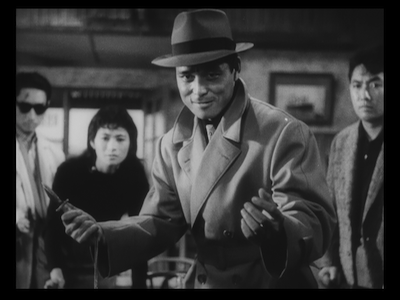
A relationship quietly blossoms between Joji and Saeko. She begins working as his waitress while they wait to here if she killed the man she attacked. Both of them slowly reveal their pasts, but the are tentative about their present. Neither feels comfortable settling down, and with good reason. Joji's plans to leave for South America flounder when he finds out that his brother never made it to his destination. When the gang boss Shibata (Hideaki Nitani) comes looking for Saeko, he arrives like an agent of fate, dictating the paths of these young romantics. As Joji digs into the mystery of his brother's disappearance, just how intertwined all of their histories really are becomes even more clear.
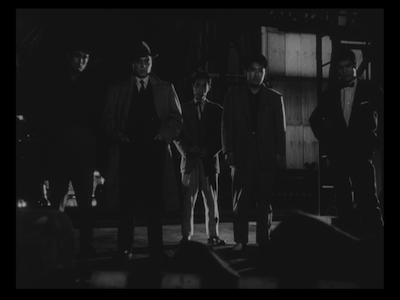


I Am Waiting takes place on dark, foggy side streets, down alleyways and along patches of river where most common people don't go. For a guy like Joji, it's a purgatory he would have never chosen for himself; for a predator like Shibata, it's a jungle of opportunity. As they make their way through other parts of the city, the regular people they run into--shopkeepers, waitresses, etc.--look at them with fear. Sure, Shibata's thugs are questionable characters, but it's also like Joji is cursed. His arrival, and the danger that surrounds him, is a bad omen. If you get stuck in the same plot he's stuck in, you might never get out.
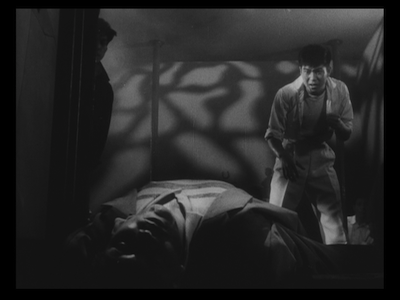


Music plays an important role in I Am Waiting. Masaru Sato delivers a score that brings to mind Ennio Morricone, both in its style (the whistling) and function (certain snippets act as almost humorous commentary). The bulk of the soundtrack is jazzy, leaning toward bossa nova in rhythm and percussion. It is self-consciously "criminal." The orchestration draws a contrast between two worlds. Prior to her career as a nightclub siren, Saeko was an opera singer. The brief performance we hear on the radio inspires a torrent of confession, and this juxtaposition of high and low art is meant to show how far she has fallen. Kurahara also makes Sato's music an important part of a trio of flashbacks that dot the film. In each, we see past violence, incidents that have had tremendous impact on the lives of the movie's characters. They are shot so that the sets look purposely fake, so that these memories appear almost impressionistic. There is no dialogue or sound effects, just the beat of the music.

This adds to the impact of the climactic fight in I Am Waiting. Kurahara does the opposite when Joji and Shibata have their showdown. There is no music, only the sound of their fists and their feet. The volume is turned up, and the director uses Shibata's cavernous nightclub to exaggerate the noises. Each footfall on the dancefloor, every sock to the jaw, echoes in the empty bar, leading up to a true "money shot," one almost as effective as Kubrick's in The Killing. As is common in these kinds of stories, the showdown represents decisive action for the protagonist. Once Koji started investigating his brother's death, he had chosen to stop waiting and take his life back; the brutal throwdown between himself and Shibata serves as a kind of absolution. The fighter took himself out of the ring for no good reason, and now he is putting himself back in for a particularly righteous one. The exile is over.
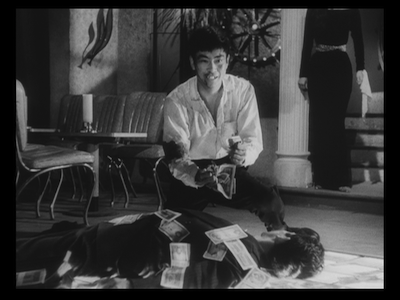


Yujiro Ishihara would later work with Kurahara on other features, including the irreverent romantic picture I Hate But Love. His turn in I Am Waiting comes just after his breakthrough in Crazed Fruit, and he's excellent as the brooding boxer. The actor perfectly embodies the indecisive, tortured soul of someone denying his own natural instincts and abilities. He is aided by Kurahara's almost dispassionate shooting style. The director and his cinematographer, Kurataro Takamura, use the drab, gray spaces wisely, letting the characters move within the static environments on their own, sometimes observing from a careful distance, even peering past other objects or over someone's shoulder to examine the action. There are early indicators of Kurahara's trademark god's eye view, but he mostly stays down on the ground here, walking with the mortals as they deal with their earthly concerns.

I Am Waiting is a smartly constructed, deeply emotional crime film. While film noir is often a debatable tag, and 1957 comes some time after the true period of American noir, I Am Waiting's portrayal of tortured souls trying to outrun a troubling past only to end up right in the middle of everything they intend to deny fits in with other classics of the genre. The long-reaching shadows of fate blanket everything, but one can learn to live in the darkness, provided they make the right choices. One cannot fight passively, nor can anyone love that way. As Joji learns, you can't wait for the world to realign itself once everything has gone wonky, you have to make it happen on your own.

Sunday, October 2, 2011

THE COMPLETE JEAN VIGO: L'ATALANTE - #578


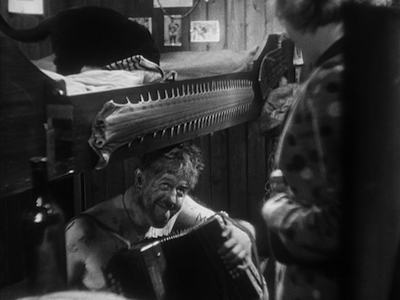
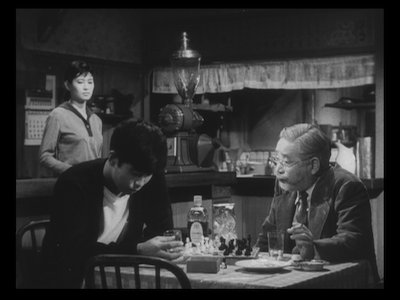
There is a scene in the last act of Jean Vigo's 1934 film L'Atalante where the old sailor Père Jules, played by legendary French actor Michel Simon, imagines he is playing a record by moving his fingers along the groove. Vigo lays in accordion music to match his movements, stopping and starting as he does, before pulling back to reveal that Jules has been tricked by his young bunkmate (Louis Lefebvre). The boy has been playing the accordion just out of frame. Angered by the prank, Jules admonishes the kid, telling him that he might laugh at such a flight of fancy, but is playing a record with your finger all that impossible? They don't understand how electricity works, or how music is sent across radio waves, so how can they rule anything out?


L'Atalante has a similar allure. It may not be obvious why this unassuming little film works so well, but it somehow enchants all the same. Perhaps it's Vigo's creation of this dual universe, of a world where dreams can sit side by side with hard reality, that is the secret to its success. We want to be enthralled under its spell, because maybe then we can believe that our own reality is worth it.

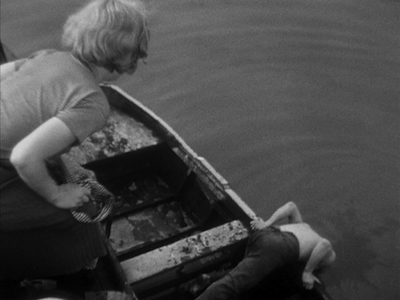
The story opens in a small town in rural France. A wedding ceremony has just concluded, joining local girl Juliette (the luminous Dita Parlo) with a boat captain named Jean (Jean Dasté). Jean is the skipper on a three-man barge that sails the French canals, delivering goods from port to port. Juliette has never left her birthplace prior to this honeymoon, and yet her married life is immediately on the move. More than that, the barge will be her conjugal home, always in motion, the background forever changing. It's going to be quite an adjustment for her. Indeed, it's going to be an adjustment for the whole crew. Yet, Juliette has always known that the water holds her fate: she believes if you stick your head below the surface, you will see the image of your true beloved. It's how she knew who Jean was before she even met him.


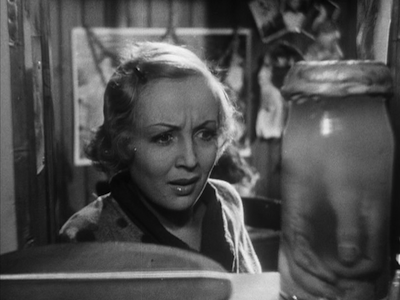
So, Juliette dreams of love, and she also dreams of seeing Paris. Eventually, the boat--which, like the movie, is named L'Atalante--will get her there. Strife amongst the workforce prevents her from enjoying it when they do, just one of the many disappointments the new bride will suffer. At the same time, she makes peace with Père Jules, who invites her into his cabin. There, the salty dog shows her the bizarre treasures he's gathered from around the world. Having never seen such wonders, Juliette is mesmerized. Some of the objects are simple, like a Chinese fan, others are more unique, like the jar holding the hands of Jules' best friend, now deceased. We will see this joy at such unexplainable sights two more times before L'Atalante is through: next at the port where Juliette meets a salesman (Gilles Margaritis) that is an expert at sleight-of-hand, and then the last time when Juliette finally sneaks off to Paris.

Each time, this happiness will be balanced by darkness. When Jean finds Juliette in the cabin of his second-in-command, he loses his temper. Enflamed by jealousy, he reveals a previously unseen violent streak. It shows up again when they meet the salesman, and also when he discovers Juliette has disappeared. Only that final time, he abandons Juliette to the city...and himself to despair.


L'Atalante is a deceptively simple romance. The basic story may lack complication, but the presentation has many layers and a balanced sense of its internal world. There are dualities throughout, be it above deck and below deck, sea and land, town and city. Both Jules and Jean have double natures, and both are capable of tenderness and violence alike--though, despite his warnings that he might strike, Jules never does, whereas Jean hides his anger until it's too late. This makes sense, though, when you notice that Jules has an ability to appreciate life's magic that Jean does not possess. Jules has been to all corners of the globe and seen many things, whereas it's possible Jean has only sailed up and down the same canals. When Juliette compels him to look into the water to test his love, he sees nothing, and his pretense otherwise doesn't fool her.

It's a very romantic trope, actually. Jean has to learn to see the world in the same way as his wife if he ever hopes to keep her. Juliette is too innocent for the common world, and she could be tempted away if not careful. To protect her properly, he has to be able to match the purity of her feeling toward him. It's the only way he will ever be worthy.


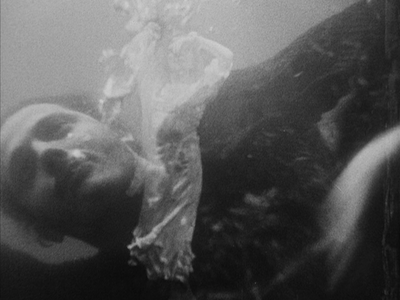
In his earlier short films [reviewed here], Jean Vigo experimented with camera effects and used a lot of tricks to create a feeling of wonder that he manages effortlessly without them in L'Atalante, his only full-length feature. The only visual technique he revisits is the underwater photography he showed in 1931's Taris, his portrait of a champion swimmer. His camera will have to go below surface once again to capture Jean's transformative moment, as the skipper literally must go deep in order to rise again as a new man.

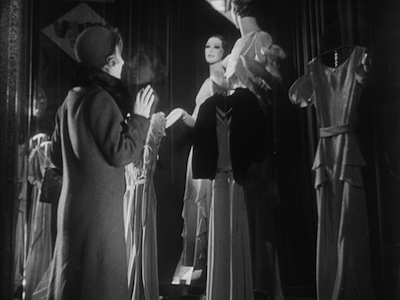
There are few other effects in L'Atalante; at the same time, Vigo creates a dynamic spatial relationship between his actors and his camera. In one memorable shot, Jean crawls across the deck of the barge, just like one of Père Jules' many cats, creeping up to the camera lens and then climbing over. There are many shots like this, where the director is so deep in the thick of things, it's almost as if the characters know he is there. The salesman, for instance, practically performs directly to the screen. This allows for intimate observances, be it Juliette's private fantasies while window shopping in Paris or our glimpse into their separate bedchambers when the newlyweds have rapturous dreams about one another, the fires of loneliness and desire stoked by their time apart.


It's finding these lyrical moments within the dirty confines of the everyday that sets Jean Vigo's work apart from his contemporaries, inspiring many filmmakers who came after. It's also a defining element in Simon's performance style, his combination of a very complete physical presence with a clownish demeanor. He's just as amazing in L'Atalante as he was in Jean Renoir's Boudou Saved From Drowning only a couple of years earlier, or as he would remain in The Two of Us [review] decades later. Jean Vigo, on the other hand, never made another film after L'Atalante. He died of sepsis just after L'Atalante was completed. Given the assured aesthetics of this debut, we can only speculate where he might have gone from here. Maybe even greater things, maybe he would have peaked just as he began. We can never know, we are only left with this one perfect vision, a dream that holds strong even in the here and now of the 21st Century.


This disc was provided by the Criterion Collection for purposes of review.

CARLOS - #582


The man who would be codenamed Carlos, and nicknamed "The Jackal," was a Venezuelan-born son of Communists who, at the age of 21, joined the Popular Front for the Liberation of Palestine and became one of their most brutal enforcers. The 2010 biographical film Carlos by French director Olivier Assayas explores his life from his joining the PFLP in the early 1970s through his arrest by the French government in 1994. With a five-hour-plus running time, it is a filmmaking marathon. Its origin was on French TV, but it showed in North America as a multi-part special event screening at various theaters and was available on demand to cable TV subscribers before its eventual Criterion release.

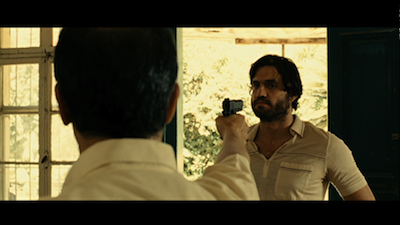
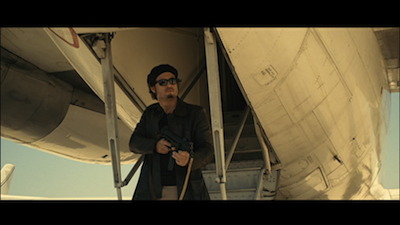
Édgar Ramírez, previously seen as a CIA agent in The Bourne Identity and a revolutionary in Steven Soderbergh's Che [review], stars as Ilich Ramírez Sánchez, the ambitious young idealist who took the name Carlos as his wartime handle, fighting for the liberation of Palestine and the destruction of capitalist imperialism. As portrayed here, Carlos is impatient for action, ready to make a name for himself and strike a blow in the name of the almighty cause. He distinguishes himself as a dangerous man after an impulsive shooting of several French police officers. His fame as an international menace is then solidified when he leads a raid on an OPEC meeting in Austria, taking diplomats from around the world hostage. The mission doesn't go entirely as planned, and this has good and bad consequences. The head of the PFLP disowns him, but this frees Carlos to form his own group and start giving the orders himself.
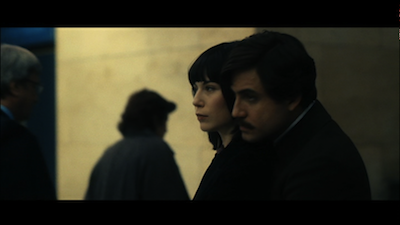


Assayas, whose films are as diverse as the quiet family drama Summer Hours [review] and the clumsy actioner Boarding Gate [review], co-wrote the script for Carlos with television writer Dan Franck. Each segment of Carlos begins with a disclaimer that the film has taken a fictional approach to the story, as much of what Carlos the Jackal really did is not entirely known. Certain connections have to be made for the sake of narrative structure. In terms of storytelling, the movie has a dry, historical approach, putting it in league with Che and The Baader Meinhof Complex [review], as well as, to a degree, the two Mesrine films [review part 1, review part 2]. This kind of docudrama seems to be an emerging genre, adopting a dispassionate approach that is almost apolitical in its just-the-facts approach. We are given very little background information on Carlos, and his mission is more of an abstract concept, there is no statement of intent. As the movie wears on, this seems to be part of Assayas' point: as he is unmoored from his idealistic safety zone, Carlos' activities seem to be less and less about the "struggle," and more about just maintaining his underground lifestyle. Alliances shift, and there really is no endgame. Whoever is on top is on top, and tomorrow it will be someone else.


This technique works for most of the movie. Assayas adopts the look and rhythm of the best 1970s American films, which is fitting given the period nature of the piece. The convoluted structure of the story is also akin to tangled espionage dramas that emerged as a result of the Cold War, with secret agents so deep in the field, they tend to forget what mission put them out there in the first place. Édgar Ramírez is good as Carlos, though he is missing a certain charisma that might make the terrorist more of a romantic figure, the way Benicio Del Toro gave a little extra something to Che Guevara just by virtue of his being Benicio Del Toro. Ramírez lacks the same commanding presence. Still, he brings a compelling complexity to the character. Carlos believed he had a death sentence hanging over his head, and he used it as an excuse to drink and chase skirts. You also have to admire the actor's commitment. He lets his appearance go to match his subject's weight gain over the years. This all may be a canny move by Assayas. Carlos is essentially a gangster picture, the story of a murderer who lives the life and damns the consequences, but at the same time, subverts the genre by never letting the Jackal be the seductive dog others might choose to portray.

Other characters go in and out of the story, including European operatives and various Arab allies. We see different plots carried out by Carlos and his men, most of which fail in some way or another. We also see him flounder at relationships, including a marriage to one of his own "soldiers" (Nora von Waldstätten). There is always a question of whether Carlos takes his threat level more serious than the rest of the world, if he exaggerates how much of a wanted man he really is; but then, his eventual takedown somewhat vindicates him.


Carlos is really only cast adrift when Carlos himself is. The final hour or so of the film, following the toppling of the Berlin Wall and the end of the Cold War, starts to drag. Frankly, it's because Carlos is not that interesting by this point. He has settled into the kind of bourgeois domestic lifestyle he otherwise decried. He even starts driving a Mercedes. Carlos drifts aimlessly from one country to the next, going to whomever will offer him political asylum. If in the first part of the film he is a decisive man of action, and in the second a delusional hothead, by the third he is not much at all. He teaches classes in guerilla theory in the Sudan, and postpones surgery for a swollen testicle to get liposuction on his love handles. In retrospect, he should probably be thankful to the French secret service for taking the time to come after him, because he's got nothing going on. In terms of the film's arc, Assayas should have sent them in 20 or 30 minutes sooner. It's almost like a backwards horror movie: instead of the boring bits lulling us into a place where we can be scared, Assayas shocks us first, and thus makes the boredom that follows all the more uncomfortable.


Even with that complaint, Carlos still stands as a brash triumph. One has to wonder if this kind of long-form filmmaking, if Che and Mesrine and Carlos, is cinema's reaction to the continued growth of cable television and all the can't-miss series from the past several years. Audiences are becoming more and more prepared to invest several hours in one storyline, and if they are willing to wait from week to week or devour them in one massive go on DVD, then maybe they'd be willing to sit in a theatre for six hours, too. It's an experience akin to spending an afternoon engrossed in a novel. You get so much more out of taking in so much at once. Carlos is certainly more engrossing and more informative than a generic, compact Hollywood biopic. It pays back on the investment you put into it.


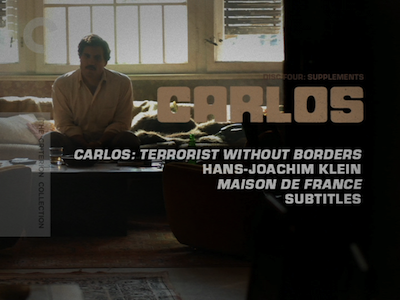
Criterion has released Carlos on DVD as a four-disc package (and separately as a Blu-ray). The discs come in a sturdy, thick case with an interior booklet. To compare this to Che again, if you own that DVD set, the company has used a similar approach to this political epic as they did that one. The three main discs separately house each chapter of the movie, as well as bonus features that look at the film's production; the fourth disc has a trio of supplements, including two lengthy documentaries that look at the real-life Carlos. These are fascinating as they reinforce Assayas' attention to detail and give some further perspective to how interesting his dramatic approach was.
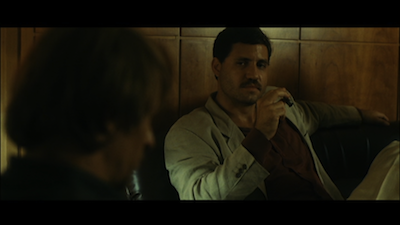
The hour-long Carlos: Terrorist Without Borders was made for French television (presumably in the 1990s) and covers the early life and career of Ilich Ramirez Sanchez, the man known as "Carlos." We peek in on his childhood and his early activist beginnings, and the archivists uncover rare photos and footage of the terrorist. Investigators and journalists give insight into the history, while associates like Hans-Joachim Klein sit for new interviews and give first-hand accounts. The other feature-length documentary, Mason de France (88 minutes), also gets to talk to colleagues of the Jackal, including his former lover, Madelina Kopp, and his wife at the time of filming.

Kopp was actually one of the motivating factors behind the Maison de France bombing, an incident not detailed in Carlos. While she and one of their other associates were in jail in Paris, Carlos ordered various terrorist attacks around Europe in protest of their incarceration and to influence their release. This particular bombing was at a French consulate in Berlin, and one person was left dead. The focus of this film is that victim, and the filmmakers talk to his friends and family in order to put a human face on the effects of terrorism. For those who might worry that Carlos glamorizes the killer and makes him an antihero, this documentary effectively lessens the glow of the dramatic construct. Ironically, Carlos' efforts to free Kopp got her sentence doubled.


This disc was provided by the Criterion Collection for purposes of review.

Saturday, October 1, 2011

SIDELINE: MORE REVIEWS FOR 9/11

A round-up of non-Criterion reviews I wrote this past month:


IN THEATRES...

* 50/50, as unserious as cancer. Or as serious as cancer. Kind of both. Great work from Joseph Gordon-Levitt, Seth Rogen, and an all-around solid cast.

* Attack the Block, the ultimate summer movie shows up just in time for fall. (Unless you were lucky enough to get it in your town earlier, of course...)

* Contagion, in which Steven Soderbergh makes sure you'll never touch yourself again. On the face. ON THE FACE!!! But seriously, this movie is awesome.

* Drive, the best movie Paul Schrader never made. Ryan Gosling stars, all Alain Delon-like, in this violent tour-de-force by Nicolas Winding Refn.

* Gainsbourg: A Heroic Life, a biopic of Serge Gainsbourg from French cartoonist Joan Sfarr. It can't quite sustain its inventiveness, but I liked it all the same.


* Higher Ground, actress Vera Farmiga tackles feminism and faith in her directorial debut.

* The Lion King 3D, an old favorite shown in a bad new light.

* Moneyball, a surprisingly deep drama about the inner workings of baseball. (Note: One of the screenwriters was Aaron Sorkin. Did you know that?)

* Shut Up Little Man! An Audio Misadventure, a fascinating, thought-provoking look at one of the most infamous pre-internet viral sensations.

* Straw Dogs, a competent but pointless remake. Rod Lurie is no Sam Peckinpah. (Hey, I reviewed the original once, too.)

Portland was lucky enough to have Cinema 21 showing the original 3D version of Alfred Hitchcock's Dial M for Murder for a limited engagement. To go along with it, the Portland Mercury asked me to pick some other Hitch films for home viewing, and I did so by taking a tour of his trailers. Read the column online here.

ON DVD/BD...

* Boccaccio '70, four Italian film directors team for a 1962 anthology film telling individual stories of modern romance.


* Breakfast at Tiffany's, the quintessential Audrey Hepburn film is now on Blu-Ray.

* Hung: The Complete Second Season, Thomas Jane returns as everyone's favorite lovelorn hustler.

* If a Tree Falls: A Story of the Earth Liberation Front, a thought-provoking documentary about controversial radicalism.

* The Inspector General, this whitebread Danny Kaye musical is only offensive in how unfunny it is.

* One Minute to Zero, Robert Mitchum makes love to Ann Blyth and hits the snooze button in this Korean War drama.

* Road to Nowhere, Monte Hellman returns to the director's chair for a disjointed potboiler.

Friday, September 30, 2011

READER MEET AUTHOR: SPELL CHECKERS VOL. 2 SIGNING - TONIGHT!

Time for some self-promotion. I have a new comic out, and if you're in the Portland, OR, area, we are doing a signing tonight to celebrate.


Spell Checkers, vol. 2: Sons of a Preacher Man went on sale this past Wednesday. If you're unfamiliar with the title, don't worry, it's easy to catch up on it, and you can really read any of the two volumes on their own, they are connected but mostly episodic (if that makes sense).

The basic pitch was: Mean Girls meets The Craft, rude humor and magic. For a little primer, you can hear my audio commentary for the first scenes and read the pages over at Stumptown Trade Review. Check it out here.

You'll want to open up one window with the pages and another with the audio and read along with my babbling. Hear the creative process at work, unvarnished and unfocused!

Myself and both artists on the book, Joëlle Jones and Nicolas Hitori de will be at Bridge City Comics promoting the release this evening.


Click on the image for the full press release.

If you need more incentive to come, I just found out that Nico will have a limited number of these prints on hand:


Come on. You know you wanna.

Wednesday, September 28, 2011

THE PHANTOM CARRIAGE (Blu-Ray) - #579


Superstition can be an impressive plot motivator, and when tied to a ghost story, even better.

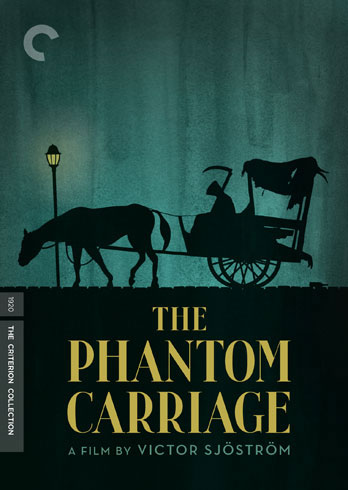
Victor Sjöström's 1921 silent film The Phantom Carriage is a spooky morality play. A campfire parable that is to the Swedish chill what Dickens' A Christmas Carol was to English winters or It's a Wonderful Life [review] to the American can-do spirit in difficult times. Sjöström is best known for playing the professor obsessed with his own mortality in Ingmar Bergman's seminal 1957 film Wild Strawberries, and this picture--which he wrote, directed, and starred in--makes Bergman's casting choice all the more brilliant. Beyond the influence of Sjöström's work on his own, Bergman gave the veteran filmmaker a chance to sew up the thematic threads begun in his own cinematic efforts.
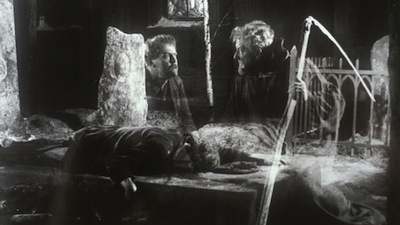
The Phantom Carriage is set on New Year's Eve. As a good-hearted nurse in the Salvation Army, Sister Edit (Astrid Holm), nears death from pneumonia, she asks to see David Holm (Sjöström) so that she may make one last attempt to save his soul. As Edit's friends and colleagues reluctantly look for him, David is drinking in a graveyard with a couple of other degenerates. He tells them the story of his pal Georges (Tore Svennberg), a fellow boozer who cleans up his act every December 31st because he's afraid to die before the New Year is rung in. Georges believes that the last person to die before midnight is cursed to drive Death's spectral caravan for the next twelve months. Unsurprisingly, Georges has been missing since the previous turn of the calendar. Wherever could he be? Mwuahhaha!


When David is finally found, he refuses to visit Edit. Afraid that this act of human callousness can never be undone, his drinking buddies try to force him to go. Their fight ends up with David dead, and the Phantom Carriage comes to pick him up just as the clock hits 12:00. Georges and David are surprised to be reunited in this way, and before Georges can step down and give David the reins to the chariot of Hell, he decides to take him on a tour of his previous wrongdoing so that he might clear his soul of its excess baggage. Through a series of flashbacks and visitations, we learn David's twisted history, including his year-long torment of Edit, who never gave up on him, the first ward of her charitable outpost. Injury to insult, David is the one that infected Edit in the first place. He also tormented his wife (Hilda Borgström) to the point where she is not sure she can carry on with living. In one particularly effective scene, Mrs. Holm tries to lock her husband in the pantry, only to have him break through the door with an axe. Fans of Kubrick's The Shining will quickly see that Ingmar Bergman was not the only one inspired by The Phantom Carriage.
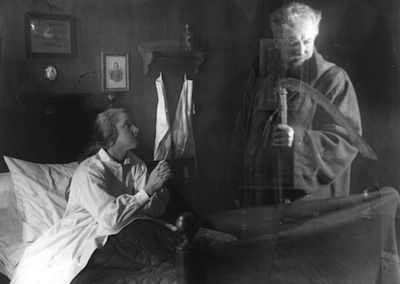
Sjöström, who based his script on a novel by Selma Lagerlöf, has put together an effective, oftentimes unnerving silent horror film. Though there is a moral to David's night of terror, it is not necessarily governed by any particular morality. Sure, Christianity is often evoked, but it's more or less just window dressing for the larger supernatural narrative. David is a bad, bad man no matter what code of ethics you subscribe to, and his horrible fate is more of a human punishment than a divine one. The tour that Georges takes him on is not necessary, he could just take off the grim reaper costumer and be done with it, but he wants his cohort to understand both the awfulness that awaits him and also his own role within that never-ending, gruesome cycle.

The Phantom Carriage is staged on realistic sets, with Sjöström emphasizing the impoverished conditions and how the difficulties of this kind of life can lead to unwise solutions and easy escapes. This is expertly contrasted with the more fantastical elements of Lagerlöf's tale. Sjöström creates a dark, gothic landscape where mists and shadows can believably disperse to reveal unbelievable creatures. Particularly inspired is a short tour of a night's work riding alongside Georges, as he gathers the spirit of a man who shot himself and another who drowned. Sjöström and cinematographer Julius Jaenzon use double-exposure photography to imprint a translucent ghostly stagecoach over the scenes. Georges takes the Phantom Carriage across the water...and then under it. It's an impressive use of early photographic techniques.


But then, we've also seen those kinds of special effects employed elsewhere, and as with any era's innovations, they don't stand the test of time on technical skill alone. There has to be some human element to create a lasting appeal. For the many hats he wears, and as anyone who has previously seen Wild Strawberries already knows, Victor Sjöström is best in front of the camera. He is a tremendous actor, one who is capable of astonishing cinematic emotion. His performance lends an authenticity to David's rollercoaster life: from temptation to reconciliation, disappointment to malice, and then ending at a point of true redemption. Sjöström sells each with equal vitality. Though, I must admit, the most surprising was what a fearsome villain he makes in The Phantom Carriage. It makes me curious to find out if he ever played a bad guy again.

Though set on New Year's Eve, Criterion's The Phantom Carriage is smartly timed to arrive just in time for Halloween. I would happily place it with other Halloween classics, such as the Bela Lugosi Dracula or Robert Wise's The Haunting, or this year alongside the forthcoming home release of Kuroneko [review], as part of my holiday viewing. It's also one you could put on the TV and play as background at a Halloween party, if that's your thing. Of course, only after you've screened it yourself, alone in a darkened room, just you, Death's emissary...and your soul.
Mwuahaha, take two.


For a complete rundown on the special features, read the full review at DVD Talk.

Sunday, September 25, 2011

LES COUSINS (Blu-Ray) - #581


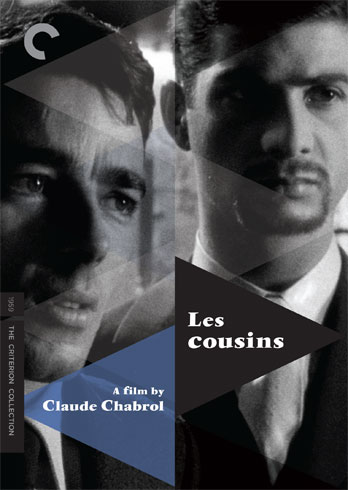
For his 1958 debut, Le beau Serge [review], Nouvelle Vague pioneer Claude Chabrol told the story of a man moving back to his provincial hometown after many years in the city; for the follow-up, Les cousins, Chabrol flipped things around, including changing the role "types" for his two lead actors. This time, Gérard Blain plays Charles, a mama's boy from the country moving to Paris to study law. In town, he will live with his cousin, the brash and outgoing Paul (Jean-Claude Brialy). One of their friends doubts their relations because they look nothing alike, and Charles defends this as saying they are cousins, not twins. Yet, the divide between the two blood relatives could not be wider.

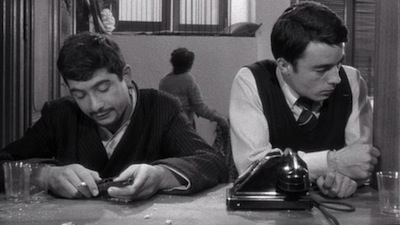
It's funny when you first see Paul, you know exactly what kind of character he is. His Van Dyke and European poncho is practically the uniform for parodies of the sort of pretentious, privileged douchebag Brialy is portraying. It's a case of the more things change, the more they stay the same, I guess, that Chabrol's visual short cuts still have cultural significance. Paul is a selfish partyboy, living in his uncle's flat surrounded by the old man's trophies and trinkets, symbols of a life well lived (and all shot with loving attention to detail by cameraman Henri Decaë, who also photographed Le beau Serge as well as films for Malle, Truffaut, and Melville). Not the life Paul is living, mind you, he is on a different path. He drinks and cavorts more than he studies, and his friends represent the social register for degenerates, from the older hustler Clovis (Claude Cerval, The Lovers [review]) to the slut Francoise (Stéphane Audran, The Discreet Charm of the Bourgeoisie [review]) all the way to the bottom of the heap and the hopelessly emo Philippe (Jean-Pierre Moulin). They drink and they gamble and they carouse, and generally make a spectacle of themselves.


This is the life that Charles is immediately introduced to, and the one he never really fits. Gérard Blaine, who was fiery and charismatic in Le beau Serge, withdraws here. Charles is thoughtful and insecure, with a stoic streak that allows him to mask his anxieties and disappointment. (One is easily reminded of James Dean watching Blaine do his thing.) It's love at first sight for Charles when he sees Florence (Juliette Mayniel, Eyes Without a Face), a girl with a past but whom Charles sees with fresh eyes. He is enamored of her, he can't even bring himself to recite a poem he wrote in her honor. Florence is drawn to his innocence, but Clovis and Paul manipulate her into Paul's bed instead. The girl moves in with the two cousins; rather than have his nose rubbed into his romantic failures, Charles buries it in his books. (The advice of a sagely bookseller, actually, played by Guy Decomble, who would soon play the French teacher in The 400 Blows.)

The portion of Les cousins where the three of them live together recalled for me, in a way, Jean-Pierre Melville's adaptation of Les enfants terribles [review]. In fact, quite a bit of the basic behavior Chabrol assigns to his characters seems inspired by the Cocteau play. Paul regularly engages in self-serving gameplay, taking little seriously and concocting scenarios where he can push others into servicing his whims. In my head, Jean-Claude Brialy is usually dapper and collected, the kind of handsome ladies man he played in Godard's A Woman is a Woman. He is more of a force of nature here. Like the cliché about the shark, he is never at rest, always moving. Clovis, who resents him as much as he likes him, acts as the devil on his shoulder, offering a bit of contrast. Paul does what he does for his own amusement, but Clovis cons and cajoles for spite and thievery. There is a great shot at one of the parties, it happens very quickly, when you see Clovis robbing Paul's secret stash--something we instinctively knew he would do the moment Chabrol showed us that hiding spot in the first act, when the pair were convincing one of Paul's conquests (Geneviève Cluny) to get an abortion. Even in that, the difference between the two men is obvious: Paul is trying to weasel his way out of trouble, whereas Clovis likes the taste of other people's misery.


It's a little disappointing, then, that Chabrol circumvents the expectation of these narrative seeds, and Clovis' demonic personality doesn't have much reward. At the very least, we might assume Paul would completely switch over to Clovis' particular dark side or overtake the master. The sad fact is, there isn't much narrative payoff at all in Les cousins, except for maybe a nod to an old Chekhov aphorism. The ending of the film isn't entirely satisfying. I see the dramatic irony that Chabrol is going for, but it doesn't land with any significant force. The final scene only reinforces the roles everyone plays rather than showing any change. Charles is a perpetual victim, Paul is the thoughtless predator.

I don't know whether to call it the "sophomore jinx," or if perhaps emptiness is exactly what Chabrol is going for. Paul strives for a meaningless world. This is a guy to whom romance is a joke and who recites Wagner arias while wearing military garb. It's all fair game to him, so perhaps Chabrol intended the real tragedy of the finale of Les cousins to be that so much was destroyed with such little consideration. Rather than death by a thousand cuts, it's death by one triviality. Jean-Luc Godard called Les Cousins "a deeply hollow and therefore profound film," and I suppose it could be that this lack of any meaningful center is what makes Les cousins so intriguing. Even as I react against its contrivances, I find myself considering putting it back in my player and watching it again.


Claude Chabrol


For a complete rundown on the special features, read the full review at DVD Talk.