Showing posts with label roeg. Show all posts

Monday, November 26, 2018

PERFORMANCE - FILMSTRUCK

This review was originally written for DVDTalk.com in 2007.


Chas is a brutal enforcer who is really good at his job. Played with a bluntly arched eyebrow by James Fox (recently seen as Mr. Salt in Tim Burton's Charlie & the Chocolate Factory), he works for a homosexual East London crime boss named Harry Flowers (Johnny Shannon). Chas is the guy Harry sends round when he wants to convince other people to his way of thinking, because Chas has a knack for getting his point across. When the thug goes against Harry's instructions and deals with a business matter in a personal way, though, he finds there are some situations he can't talk or shoot his way out of.

On the run, Chas overhears a conversation about a basement apartment that he can con his way into leasing. Things aren't as clear-cut once he is inside the house, however. It turns out that the landlord is a faded pop star named Turner, here played by Mick Jagger. Turner is a recluse, creating a pansexual hideaway with his drugged-up girlfriend Pherber (Anita Pallenberg, the real-life girlfriend to Mick's guitarist, Keith Richards) and a few other androgynous moppets. Before long, it's not clear who is running a con on whom, as Chas is suddenly on the same psychedelic trip as everyone else in the house, searching for Turner's "demon," the artistic muse that once drove him.


Performance was made in 1968 and held back for two years while Warner Bros. tried to figure out what to do with it. Co-directed by two first-time directors, Nicolas Roeg (Walkabout [review], also the D.P.) and writer Donald Cammell (The Argument), Performance is a classic of the trippy midnight movie genre. I'm not normally a fan of Roeg's, I find his weirdness to be meandering and pointless for the most part, but something about the collaboration with Cammell gave their artistic vision a laser-like precision. Performance is really the clash of several genres. Chas' gangster society has tints of kitchen sink drama while also playing with the conventions of classic British crime pictures. Cammell saw a kindred spirit between the swaggering street toughs of old films and the new outlaws of rock 'n' roll. Performance grows from the thesis that if you pushed these cultural rebels toward one another, you'd suddenly have mirror images in the center.

This is something that the directors make great visual use of. For a drug-fuelled movie of the late '60s (Pallenberg openly disperses chunks of magic mushrooms, and there is no mistaking those funny shaped cigarettes), they avoid the usual pictorial cliché of other hallucinogenic flicks. There are no lava lamps or fish-eye lenses. The surreal journey of Performance is an existential one, it's all about identity. The first act sets up a dicey world. Focusing entirely on Chas' brutal routine and flight from the same, it's edited in a choppy fashion, juxtaposing attacker and victim, and messing with time. This is said to be the uncredited work of editor Frank Mazzola, who would go on to make this his signature style and influence the entire video music genre in the process. In this outing, it keeps the action moving while putting the audience on shaky ground. The blood and the sex and the violence come like a rapid assault we are powerless to stop.


Yet, as Turner's introduction approaches in the story, the filmmakers are already inserting him in the mix, giving us quick tastes of what is to come, already breaking down any separation between gangster and idol. This melding begins in earnest once Chas is in Turner's home. Mirror images, double exposures, and other visual tricks are employed to start to suggest that Chas is Turner and Turner is Chas. They even engage in a bit of dress-up, most notably in the "Memo from Turner" music sequence where Chas' earlier drama with Harry is replayed with Jagger in the lead, instructing his underworld minions through song. Here Jagger moves from slinking panther to something more forceful, just as the events leading up to it show James Fox losing his edge and drifting in a narcotic haze.

Where both men end up is the subject of much debate and probably a matter of personal preference, but suffice to say there are curves on the path to complete fusion. Chas needs Turner's house to protect him from those that would do him harm, whereas Turner needs Chas' visceral lifestyle to break him out of the constipated mental funk that has arrested his creative process. Roeg and Cammell may end the movie by showing a lot of doors being closed, but from a plot standpoint, they leave many open to interpretation. Some of you out there may find the trickery maddening, but if you put yourself in Chas' shoes and let Performance slip you a mickey, you might find the experience...well, I wouldn't go so far as to say transformative, but how about inspiring?


Sunday, November 25, 2018

BAD TIMING - #303

Nicolas Roeg with Theresa Russell shooting Bad Timing.

Director Nicolas Roeg passed away yesterday. The filmmaker responsible for such films as Don’t Look Now [review], Insignificance [review], The Man Who Fell to Earth [review], and Walkabout [review] was 90 years old.

As you’ll see reading my previous pieces, Roeg and I did not always get along.  Prior to today, I would have said the only movie of his I enjoyed outright was Performance [review]. Even so, his death seemed like a good time to watch the one film of his in the Criterion Collection I hadn’t yet given a spin, and I’m sure glad I did. Bad Timing surprised me with its vigor and its incisiveness, and it perfectly showcases Nicolas Roeg’s sharp editorial eye. The 1980 feature is maybe his most grounded, but its boundaries create an excellent vehicle for Roeg to fully realize his fascination with fractured narratives.


Bad Timing is essentially a love story between two people who are horribly wrong for each other, but the kind of wrong that puts them on a collision course with doomed romance. Theresa Russell plays Milena, the sort of female character that once upon a time would have been dubbed a “free spirit.” This means she acts on every impulse, refusing to be tied down or restrained, less “manic pixie girl” than she is a grown woman demanding her own agency--while potentially being manic. This makes her the perfect sexual fantasy for someone like Dr. Alex Linden (Art Garfunkel), an academic who is drawn to her wildness but wishes to possess it, as well. As I said, they are all wrong.


Roeg, shooting from a script by Yale Udoff (Eve of Destruction), opens the movie in Vienna, on the night Milena overdoses, placing us in her ambulance alongside a concerned but strangely cold Alex. But we don’t stay with this present state for long; nor do we stay anywhere for long. Roeg and editor Tony Lawson (Barry Lyndon, Straw Dogs [review]) create a chopped-up but never choppy timeline of Milena and Alex’s relationship, jumping back and forth between the here and now and various points along their dalliance. While the current story progresses in what resembles a linear fashion, the past does not, and as the police get involved in figuring out what happened to bring Milena to the brink of death, they start to invade the memories, entering the scene of the crime, reimagining some of what went down. Harvey Keitel rounds out the main cast as Inspector Netusil, someone whom we can surmise becomes nearly as obsessed with this toxic love affair as the couple living it. We don’t really doubt him as one of the narrators, his intrusion on things he could not know is too brief; rather, he is the catalyst to undo lies and denial.


The trope of the ethically compromised professor and the wild child that so intrigues him is not a new one. My suspicion is it largely sticks around as a way for egghead writers to assert that brainiacs can be interesting, too. It can often be a gross paradigm, particularly when it’s a teacher and student, but luckily Roeg and Yudoff avoid that dynamic here (Milena is not a student, in other words). Some of the clichés still persist--particularly Alex’s hesitancy to act, and how that opens him to Milena’s manipulations--but they also sidestep any of the obvious backstory. There is no trauma or abuse that makes Milena behave the way she does; on the contrary, she simply is who she is, and the more we get to know her, the more we realize that despite her self-destructiveness, she is living her most honest life.


And the more we get to know Alex, the less we believe he is either rational or well meaning. There is a genuine power shift going on over the course of Bad Timing. We go from Milena being the girl who won’t take no for an answer, to Alex being the creep that won’t take no for an answer--and Milena is stuck not knowing what exactly a “yes” would mean. While at the end of the movie it’s clear whose side we should take, for most of Bad Timing, it’s tough to say whose contribution is the most combustible. The lovers share responsibility for the fire, but there is good fuel and there is bad fuel. I’d say our allegiance particularly swings toward the girl on their trip to Casablanca when Alex’s jealousy starts to take on a racist overtone--but then, the filmmakers are also guilty in this scene of making men of color the dangerous “other.” The camera eye offers a different point of view than could strictly be Alex’s, and based on what is shown, how the men are portrayed, it’s clear that the audience is expected to feel a threat, as well.

Which is too bad for a film that otherwise manages to create a rather progressive portrayal of male/female dynamics. I don’t know if Udoff structured his script in the same fashion as made it to the screen, but the decision to turn Bad Timing into a kind of “greatest hits” highlight reel of the relationship’s race to rock bottom means that we don’t get stuck in a standard him/her tennis match. And as the police investigation picks up heat, it lends more urgency to the love affair’s disintegration. Roeg avoids any overly symbolic montage, using camera tricks sparingly to move us from one scene to the next, zooming in on an object and then cutting to another scene, but never relying on a strict one-to-one ratio (for instance, when Alex looks at a pipe leaking steam, we don’t go to a tea pot whistling or the like). The editing is the most suggestive in the more intimate scenes, creating a collage of the lovers’ bodies rather than any strict depiction of sex--except maybe when the looking is intended to make us uncomfortable. The most effective moment, though, is in Alex and Milena’s emotional standoff at the university. Director of photography Anthony Richmond (Legally Blonde) chooses to get tighter and tighter on their faces, while the backgrounds fall out of focus and turn into abstract patterns, reminiscent of the Klimt paintings shown in the opening credits. It’s a simple, yet effective, way to show how these two, when they are truly together, inhabit their own world.


Sad to say here is another spot where Roeg missteps, using a terrible piano instrumental to score the scene. It feels mawkish and out of place. Also, what is up with the on-the-nose employment of the Who’s “Who Are You”--not once, but twice--when Alex is trying to uncover someone’s identity? Is this where the CSI producers got the idea?

Luckily for Roeg, his cast is so talented that they can bring Bad Timing back to Earth from just about anything. Who knew Art Garfunkel, the quiet one in Simon and Garfunkel, could be so focused and not just intense, but menacing? In Carnal Knowledge, he is more a foil to Jack Nicholson than a full presence. Not so in Bad Timing. Garfunkel’s performance isn’t showy, but all the better for it. He needs to stand firm against his co-star’s energetic onslaught. Theresa Russell gives the performance of a lifetime, fully possessing Milena, embracing all her flaws while making sure she’s more than just a collection of foibles and male perceptions. She is alternately sexy, infuriating, inspiring, and sad. Just like we all are. Just like love can be. More importantly, though, is how present and alert she is. For as much as Alex, in his capacity as a “research psychoanalyst,” police witness, and man possessed, is always keeping his eye on her, Milena’s gaze is the one that is laser focused. It feels at times predatory or self-serving, but also protective. Too bad she can’t see what Alex will become...or is that part of the fun for her?


It’s all rather intoxicating. Bad Timing has a lot to sift through, but it never feels that the director is obfuscating for no reason. His feints and sleights of hand are there to intrigue...and to reveal. So, cheers to you, Mr. Roeg. I am glad we could part on such kind words, given our own contentious relationship as storyteller and armchair critic. May you rest in peace, wherever you’ve chosen to go.


Thursday, July 19, 2018

MIDNIGHT COWBOY - #925


Midnight Cowboy is a movie about identity and denial, but it’s primarily a movie about failed expectations, how those first two things being in confusion fosters false hope for people looking for a way out. For a way to be themselves. From Joe Buck’s first hustle in New York--he expected to be paid, she expected a younger man to see her obvious beauty (provided she’s not a con woman looking to hustle him back)--to the finale and the trip to Florida, nothing turns out as the characters would choose to believe.

Released in 1969, Midnight Cowboy caused quite a stir. Its frank views of homosexuality and New York street life earned it the first ever X-rating. It’s hard to see now what all the fuss was about, this movie is surprisingly tame by today’s standards, but even as the controversy dims, the actual character drama remains as sharp as ever. Written by one-time blacklisted screenwriter Waldo Salt (Blast of Silence [review], Serpico) and helmed by British director John Schlesinger (Billy Liar [review], Sunday Bloody Sunday), Midnight Cowboy is a film that dares to be human, making no apologies for its characters’ foibles--something that always scandalizes those who might otherwise be inclined to look at those who are different as “less than.”


Though essentially a New York story, Midnight Cowboy not only ends in Florida, but it starts in Texas. That’s where the dumb-but-handsome Joe Buck (Jon Voight, Coming Home) hails from. He is heading to the Big Apple to make his way in the world, but also to bury some bad memories. His life comes to us in a series of increasingly surreal flashbacks, including being exposed to sex at an early age, abandonment, and later, assault and arrest. When he arrives at his destination, decked out in a fancy western shirt, fringe jacket, and hat, he looks more like a movie serial version of a cowboy than a legit frontiersman and, as he soon discovers, has chosen to present himself in a way that appeals more to gay men than the wealthy women he hoped to bed. After a series of mishaps and downright screw-ups, Joe Buck has no bucks. He’s broke. The resultant desperation leads him back to “Ratso” Rizzo (Dustin Hoffman, The Graduate [review]; Tootsie [review]), the grifter who screwed him the most. Probably fearing a beating from the big guy more than displaying any real contrition or compassion, Ratso helps him out. They start pulling cons together, making quite a pair--the short and sickly dark-haired Ratso, with his club foot and rodent-like vocal patterns, and the deceptively squeaky-clean beefcake Joe Buck. No reason to look twice when they walk down the road, not at all!


Modern audiences will have an easy time seeing through this partnership. There is a lot more going on below the surface, past the mutual parasitism and bickering. Ratso’s constant railing against homosexuals suggests a man who protests too much, and while Joe Buck’s confusion about his own sexuality is likely for real, his new friend draws out some kind of empathy. The two men alternately take care of one another. When Ratso’s street smarts prove poor medicine for his failing health, Joe Buck becomes caretaker. Sure, if you wanted to, you could see it as just two men finding a mutual benefit with one another in rough times, but that’s ignoring a lot of signs and signals.


But again, let’s talk about expectations. What is it that Joe and Ratso expect from each other? It’s easy to see what Joe wants from each of his johns, and also how they in turn can’t allow themselves to follow through--be it Bob Balaban’s young student who becomes ill after going down on Joe in a movie theater (and seems to want a beating), or the older man (Barnard Hughes) that can’t even get that far (and gets a beating). It’s also clear how Brenda Vacarro’s party girl Shirley expects Joe to be an animal in bed and ravish her, only to have to take matters into her own hands and savage him instead. We also see how Ratso dreams of a better life where he is healthy and respected, and Joe is his best friend. (My favorite detail is how Ratso is so beloved by old women in those dreams. And how he is celebrated for his the cooking Joe previously criticized harshly.)


The expectation of Joe and Ratso as friends, however, is not so obvious. It takes a bit more reading between the lines. If you watch, you’ll note that their big arguments come when one slights the other--Ratso making fun of Joe’s clothes, Joe denigrating him for the winter coat Ratso stole for him--the way would-be lovers might react when they aren’t getting the proper notice from their respective objects of desire. There’s a lot of hurt and self-recrimination in there, especially in Ratso, who tears himself down by proxy. Credit where it’s due to Hoffman, who makes the oily little creep so easy to empathize with. The look on his face in the scene where he stands across the street and watches Joe try to pull a job in a women-only hotel is heartbreaking. There’s a real sense of relief when it doesn’t work out and Joe is tossed out the door. Ratso grabs him and runs him away from danger, his turn to be the protector.

As integral as they are to Midnight Cowboy, especially as they give Richardson the means to make explicit all the things that can’t be said, the pervasive dream sequences are a little dated. The psychedelic quick cuts predate Nicholas Roeg, and are about as effective, looking more ragged than controlled. (Also, shades of Ken Russell’s Tommy, particularly in Ratso’s Florida fantasy.) Though, full disclosure, I am primed not to like dream sequences, even when they are daydreams. And as a crutch, some of Joe Buck’s exhumed memories seem a little convenient and obvious. More effective to me are Richardson and cameraman Adam Holender’s on-the-street shots of New York--oh, that famous image of Joe Buck walking in the crowd, his hat high above all others!--and the way editor Hugh A. Robertson assembles the images, working with the singer Harry Nilsson, composerJohn Barry, and harmonica player Toots Thielemans’ music in a way that also prefigures MTV. The montage creates a dizzying effect akin to being a rube in the big city.


Which is what we are. Rubes. Our “innocent” laughter as the naïve Joe Buck that wanders onto 42nd Street at the start feels a little mean spirited and even dirty at the end, as we watch that same innocence drain from his eyes. And here is where Voight shines as an actor, because even as it’s clear that those eyes have seen too much, the actor also communicates that for all the distance he has traveled, the cowboy is still as lost as he ever was.


Sunday, October 8, 2017

DON'T LOOK NOW - #745


What surprised me the most when the film came to an end was how much I cared about the main characters of Don’t Look Now. In the final moments of Nicolas Roeg’s 1973 supernatural drama, a rapid montage of Donald Sutherland and Julie Christie as the movie’s central couple quickly summarizes all that we have seen over the previous 109 or so minutes, and I was strangely moved. For a movie I didn’t really enjoy, I shouldn’t have had that much of a connection, but turns out, I did.

Credit is likely due to Sutherland and Christie, who excel as John and Laura, a British couple on a working holiday in Venice, where the memory of their recently drowned young daughter haunts them. As far as Laura is concerned, quite literally, too. After a clairvoyant blind woman tells her that she has seen the lost child in their midst, and that the girl is happy, Laura is both freed of her grief and newly obsessed with the loss. John, on the other hand, is weighed down further by this revelation--both from worrying over his wife’s alleged delusions and the warning from the psychic that Venice will harm him somehow.


And so it is that eventually we realize that this is a couple who is not really together, but moving in separate directions, divided by emotions that should otherwise bind them. Tragedy can have this effect, though. Grief is personal, and though the husband and wife are processing the same events, they do so from two different vantage points. John literally pulled his daughter’s body from the water, while Laura only witnessed the aftermath. And though they both wonder “what if?” in relation to their kids going out to play that day, John has the added regret of being the one who encouraged them to venture outside. Thus, it’s even more resonant when they hear of their young son having an accident back at school in England, which serves to pull them further apart, both literally and figuratively, and kick off Don’t Look Now’s final movement.


Roeg’s nimble visual touch serves him well here. The swift cutting he and editor Graeme Clifford (McCabe & Mrs. Miller [review]) employ to toggle between the two characters, as well as past and present, serves to keep the viewer disoriented, often almost like we are opening and closing one eye at a time, back and forth, getting two skewed versions of the same picture. Sutherland flourishes in this oddness, his congested delivery transforming his character’s sadness into a kind of wet, physical symptom he can’t dislodge. He is a man trapped in a narrative he can’t seize control of--which is ironic, since we are led to believe he is a little psychic, too, but yet he can’t sense his own impending doom.


Don’t Look Now is based on a story by Daphne Du Maurier, a favorite of Hitchcock, whose Rebecca [review], Jamaica Inn, and The Birds all draw from her source material. Unlike Hitchcock, though, Roeg doesn’t manage to extract much suspense out of the writer’s tale. Even as Roeg uses the criss-crossing Venice canals and roadways to get John lost, he doesn’t manage to create much sense of peril. I can’t believe I am saying this, but I actually wonder how much better Brian De Palma might have handled Allan Scott and Chris Bryant’s script. The mistaken-identity ending could only be more De Palma-esque if either Sutherland or Christie woke up in bed, having dreamt the whole thing. (Note: Composer Pino Donaggio also scored De Palma’s Dressed to Kill [review] and Blow Out, but his work here is often too erudite, and tends to detract rather than add, most notably the cheesy classicisms of orchestration during the infamous sex scene. Despite all the visible flesh, one must assume that Donaggio and Roeg don’t want us to find it even remotely erotic.)

Perhaps, though, I am looking at this all wrong, and not examining how Don’t Look Now appropriates the cumulative effects of grief. If we go back to my opening statement, despite not being particularly engrossed or engaged, I still somehow found myself having an emotional reaction at the finish, one of sadness and pity for a couple I had come to...not really identify with or like, but get used to? In his own weird way, Roeg managed my experience, massaging my sentiments, and got me exactly where he needed me to be. Now the question becomes whether I’ve become attached enough to want to revisit John and Laura and see if, knowing what I know now, feeling what I feel, Don’t Look Now plays any differently. It’s not something I’m compelled to do immediately, but maybe one day....


Thursday, August 25, 2011

THE MAN WHO FELL TO EARTH - #304


I think it best that I make it official up front: I am not really a fan of Nicolas Roeg. This has altogether been confirmed upon my second viewing of The Man Who Fell to Earth, which is easily my least favorite of the handful of movies I've seen from the director. I first watched it eight or more years ago when I had the Anchor Bay DVD, and I recall not caring for it much, but I thought enough time had passed to give it another shot. Plus, this time I'd be seeing it in a theater, and being a different time and a different environment, you never know. Maybe I could get into The Man Who Fell to Earth. Changing one's place in the temporal and physical universe is certainly in keeping with the nature of Roeg's work, regardless.

Suffice to say, things did not go as planned. Being trapped in my seat for 139 minutes just made The Man Who Fell to Earth all the more excruciating. The story itself covers 40 or 50 years, which is how long it felt like while I was viewing it. Funny, though, as much as the characters age, the world doesn't change. Is The Man Who Fell to Earth a science fiction movie or a horror flick where the 1970s never end?


The main appeal of The Man Who Fell to Earth for me, then and now, is David Bowie. I am a fan, and this film seemed like the perfect vehicle for the rock legend. In fact, Roeg is banking on and toying with the singer's image in the movie. This story of a displaced genius from outer space--written by Paul Mayersberg from a novel by Walter Tevis--has parallels with Bowie's own rise, the resulting problems, and the eventual experimentation and reinvention. His flaming hair is the same shade of orange he famously wore as Ziggy Stardust, the stage persona he invented in the early 1970s. He is the star brought low--by his fame, his addictions, and a public that both adores and misunderstands what he is offering.

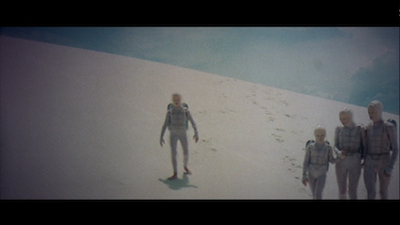
In the movie, Bowie plays Thomas Jerome Newton, a.k.a. Mr. Sussex, an inventor and entrepreneur whose globe-spanning corporation World Enterprises revolutionizes the modern world and how it interacts with technology and art. Or so we can surmise. Roeg is not concerned with such fussy details, the business end of things is more of a devise to establish Newton's primary mission. He is not a British ex-pat as his passport suggests, but an alien from another planet come to Earth in search of water. His homeworld is suffering a terrible drought. Only, now he is stranded, and he is using World Enterprises--abbreviated as WE, because, you know, he is us--as a platform to build a spaceship to get him back to his wife and kids.


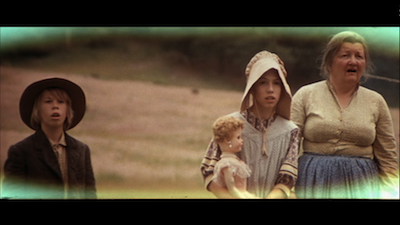
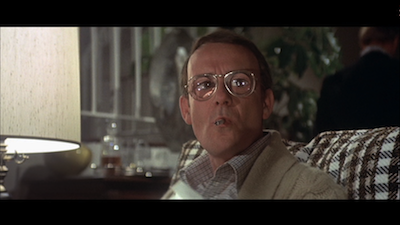
Newton amasses his fortune, aided by an opportunistic patent lawyer (Buck Henry in ludicrously thick glasses) and eventually a chemist (Rip Torn) who feels drawn to Newton's work despite of, or perhaps because of, its being cloaked in secrecy. As the years pass, however, Newton gets sucked into life on Earth. He moves to New Mexico and experiences America the Surreal, an antiquated landscape of dilapidated carnivals, rundown motels, and shit-kicking cops. He watches television to soak up knowledge, test drives religion, and eventually tries on domesticity, settling into a long-term relationship with alcoholic hotel maid Mary Lou (Candy Clark). She gets him hooked on gin, and when he drinks, Newton has visions of home and can peer through time to see the original frontiersmen. Who can also see him. So how is that a hallucination exactly?


It may be silly to question the logic of a psychedelic free-for-all such as this, but I'd submit that's exactly the false apology that has allowed The Man Who Fell to Earth to garner its revered reputation. Nicolas Roeg's films suffer from the dual sins of "anything goes" and "good enough." No left turn is too sharp for him to take over the course of a narrative, yet he is also not patient enough to follow these impulses through. Many of the scenes in The Man Who Fell to Earth don't connect well with the scenes that surround them, and the film overall is visually sloppy. Roeg strikes me as a petulant adolescent who refuses to shave, much less comb his hair, because this is the style, man. The Man Who Fell to Earth presents an ugly, slapdash future, one that is as regressive as it is forward thinking. This may be part of the point--how else do you explain Rip Torn going to a record shop and buying vinyl even after David Bowie has introduced sound crystals to the world?--but Roeg never really sews any of it together. The clarity of his montage is regularly interrupted by indulgent auditions for future David Bowie album covers. Well, congratulations, sir, you managed to score two. (Low and Station to Station, for those keeping track.)


Sadly, good performers flounder under Roeg's direction. Buck Henry and Rip Torn are both okay, but they have both also done better. Sometimes a take is so clumsy, one might almost guess it's just the first one where the actors managed to finish without flubbing their lines. Bowie seems lost through most of it, and his clothes from sequence to sequence appear to match whatever phase he was going through at the time. (Mainly, the Thin White Duke alias adopted for Young Americans, which is actually one of the albums on display in that record store scene.) Then again, he might have also just been pouting because his own soundtrack was dismissed in favor of John Phillips from the Mamas and the Papas. I'd be pissed, too, if I were him.
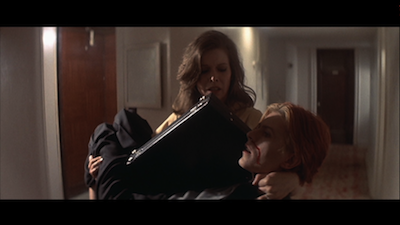
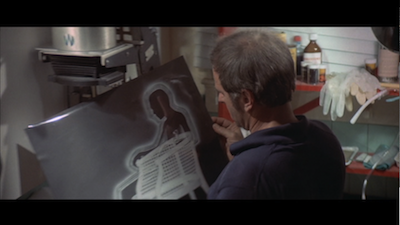
The only one who comes through looking her best is Candy Clark. Her motor-mouthed plain jane is right on the money, capturing the sort of shallow American figure that is more than willing to latch on to the empty dreams of others. The Mary Lou character is more complex than that, though, she seems less interested in what Newton can offer her than she is in taking care of him. Theirs is ultimately a co-dependent relationship, neither being good for the other, yet refusing to break it off. Even laboring under bad old-person make-up, Clark is able to inspire pity for Mary Lou. She is a well-meaning girl who is beyond her depth.


To be fair, there is much in The Man Who Fell to Earth's underlying political message that is extremely prescient. Media saturation, corporate dominance, a dangerous mistrust of new ideas--these are all issues that would become increasingly important since the movie's release in 1976. There is even a scene later in the film where a worker in the control room for a space launch ponders the needless expense laid out for space travel. Why spend money on exploring the cosmos, who cares? The only element of The Man Who Fell to Earth that seems politically regressive is Roeg's casting African American-actor Bernie Casey as the big-business government thug who takes Newton down. While putting a black man in a position of power, and making him the husband in a bi-racial marriage, was likely a daring move back then, Roeg's staging of Casey's scenes has caused this aspect of the film to age poorly. Instead of seeming progressive or even just normal, it comes off now as white fear that the black man is coming for his money and his women. Again, not Roeg's intention, but contexts change as decades pass.


I am sure my opinions about The Man Who Fell to Earth are going to be unpopular; my previous disappointment in Nicolas Roeg movies has usually garnered many clucking tongues and even harsher replies, no matter how open I've tried to be to the experience. (The one Roeg film I genuinely like is Performance; you can read my review here.) That's fine enough, I see Roeg as a provocateur who would likely relish such healthy debate. I also get that many delight in the head trip that midnight movies of this kind offer--though, if I want to see the David Bowie story turned into parable and fairy tale, I much prefer Todd Haynes' Velvet Goldmine. It can often be hard to get at why a movie like this works for some people and doesn't work for others, especially since The Man Who Fell to Earth's most pronounced quality is its ineffability. Roeg is intentionally teasing us, placing meaning just beyond the common grasp. Alas, I can only be compelled to reach so far before I withdraw my hand, and The Man Who Fell to Earth is just on the wrong side of that line.
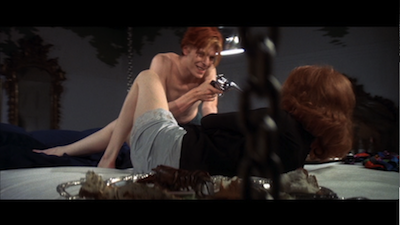


For those who might still be down for such an experience, it's worth noting that both the standard edition and the Criterion Blu-ray of The Man Who Fell to Earth are now out of print. You can still find copies used, sometimes even close to normal price, and you can watch the film on Amazon streaming. For Portland-based moviegoers, The Man Who Fell to Earth is playing at Cinema 21 from August 26 through September 1. Special thanks to the theater for hosting the screening I attended.
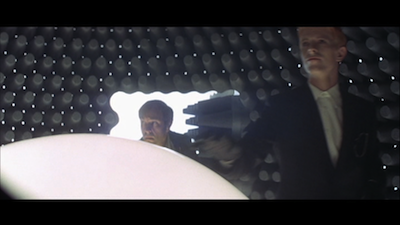


Sunday, June 5, 2011

INSIGNIFICANCE (Blu-Ray) - #566


Taking place over one whirlwind night in New York City in 1954, Insignificance draws together four iconic personalities from the period to pose a historical "what if." Represented are brains, beauty, brawn, and barbarism, and all the ways they may clash. We also see the effects of early fame culture and the consequence of technological advancement--all within the space of a few short hours.

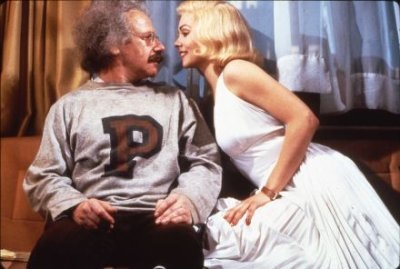
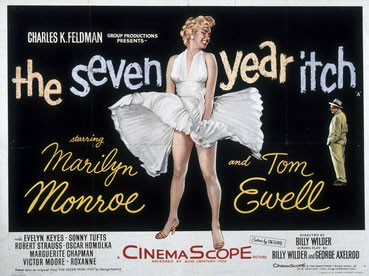
The core of the movie kicks off when Marilyn Monroe, here referred to only as "The Actress" and played by Theresa Russell, leaves the set of The Seven Year Itch and goes to visit "The Professor" in his hotel. The scientist is Albert Einstein (Michael Emil), and he is in town to attend a peace conference but is also expected to testify before HUAC. Just before Monroe's arrival, the Professor was being bullied by "The Senator," a.k.a. Joseph McCarthy, and played by Tony Curtis, who seems to be using a trick or two gleaned from his co-star Burt Lancaster's performance in The Sweet Smell of Success. What the Senator wants is for the Professor to go ahead and own-up to being a Communist, and in doing so, denounce Soviet ideals and their weapons program. The way he sees it, if the world's most revered mind backs this cause, the collective American mind will, as well.


The Actress has sought out the Professor in hopes of picking his brain and getting to know who he is. (This bit of whimsy is entirely plausible, Monroe was known to be fascinated by intelligent men.) The best scene in the movie is when she sets out to prove to the befuddled thinker that she knows the Theory of Relativity. Using toy trains, balloons, and flash lights, she rushes around his hotel room demonstrating the principles of his hypotheses. When she is done, the Professor applauds the performance, but the Actress sadly admits that she wishes she actually understood the principles she just related, she knows the words but not their full meaning. It's one of the central thematic concerns of Insignificance: what we know and how we know it, and when we really know nothing at all. The flipside here is that Einstein never really figures out how to get to know Marilyn, his interpersonal skills stop at the preconceived divide between men and women and something he once learned from a Cary Grant film. Remove the sex or keep it in, she'd be fine with either, but he doesn't know how to just sit and be with someone.

Insignificance is directed by Nicolas Roeg (Walkabout [review]) from a script by playwright Terry Johnson. It was released in 1985, and like many films of that era, I know it from having been championed on the old Siskel and Ebert show, but this is my first time seeing it. Honestly, I am about as befuddled by it as Einstein is of having a gorgeous blonde knocking on his door in the middle of the night. The execution of the material comes off as slapdash at times, with Roeg overly complicating the storytelling in ways that only call attention to the fact that the script isn't all that complex. Conversations are frequently splintered with flashbacks to events from everyone's childhoods, as well as images of the aftermath of Hiroshima and Nagasaki that haunt Einstein. Roeg also jumps around the city, keeping us up to date on the activities of the Senator and the final member of his imagined quartet.


Gary Busey plays "The Baseball Player," a stand-in for Joe DiMaggio, who was Marilyn Monroe's husband. DiMaggio was notoriously jealous, and there are plenty of anecdotes about him losing his cool, including getting angry about the endless retakes and all the gawkers on the set of The Seven Year Itch during the famous scene when Monroe has her skirt blown over her head while standing on a subway grating. (Russell wears this recognizable dress for the entire movie.) The Player eventually ends up tracking the Actress to the hotel room, and convinced that the Professor is a psychiatrist taking advantage, muscles his way in. This forces a confrontation between husband and wife, with the Professor playing a kind of referee.

Next to the interactions between the Professor and the Actress, the stuff with the ball player is the most compelling and honest. It's also when Roeg drops most of his showy editing and let's the scenes play themselves out. Johnson's dialogue is solid, and the actors handle his words deftly and with great aplomb. Busey is surprisingly understated and nervy, and Emil gives the Professor certain absent-minded peculiarities but mostly stays earthbound. Russell has the most difficult performance. There was no one else like Marilyn Monroe, and her breathy speaking voice is familiar to just about everybody. Russell manages to find an impressive level of imitation without every slipping too far into caricature, and she gives Monroe the deserved respect, treating her feelings and desires as genuine rather than the foolish preening of a mixed-up diva. Only Tony Curtis flubs it a little. His rat-a-tat patter is occasionally too cartoony, and his mannerisms border on shtick. J.J. Hunsecker would not approve.


Nicolas Roeg's work often strikes me as far less considered than what most of his supporters give him credit for. I find a lot of his stylistic flourishes to be unnecessary to the actual storytelling, the sort of thing that other directors might shoot because they can, but then cut out in the editing stage. Here, the intrusion of flashbacks and visions seems ramshackle, with many of the sequences--particularly the ones with Theresa Russell writhing around in pain--going on too long. Worse, the information these collages are intended to impart--Einstein is distraught over the application of his discoveries, Monroe was sexualized at an early age, DiMaggio's dad was a jerk--are kind of obvious and come out just as well in the dialogue. Roeg uses silly sound effects, multi-angle cutting, and cheeseball zoom techniques to overtly underline and highlight stuff the audience should get just fine without the help. And what was up with all that Native American chanting and "elevator goes up, elevator goes down" nonsense? Even Jim Morrison would have blushed at such blatant appropriation of Native American imagery to create a pseudo-mystical subtext.

Insignificance as a whole, struck me as undercooked and cheaply produced. (No hyperbole, the musical score by Stanley Myers and Hans Zimmer is some of the worst I've ever heard, complete with awful anachronistic synthesizer selections.) There's a great idea at the core of Insignificance, and a lot of wonderfully realized scenes, but there is too much distraction and not enough nourishment. The Zabriskie Point-style ending blows up a lot of stuff, but it didn't really blow my mind. It's almost like Roeg was hoping to dazzle us with all the bright shiny things so we wouldn't really notice how the conclusion more or less implodes. Perhaps it played better in the Reagan era when Einstein's fears were still a worrisome part of our everyday lives, but now, insignificance is a word that just about covers it.
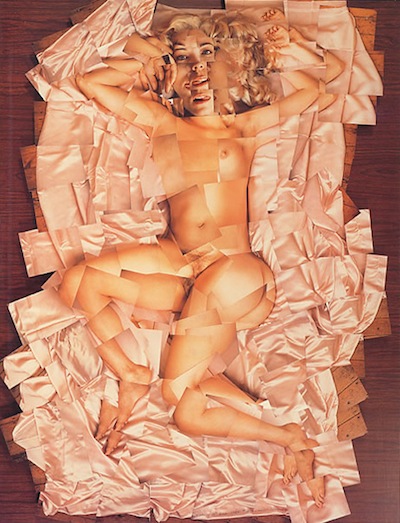

For a complete rundown on the special features, read the full review at DVDTalk.

Saturday, May 8, 2010

WALKABOUT - #10


Nicolas Roeg's 1971 film Walkabout is a highly regarded required taste. A slab of surreal young adult fiction, it is the story of two cultures coming together under strange and extraordinary circumstances.

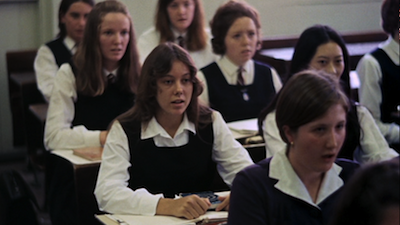
Roeg sets up his divide from the get-go. Set in Australia, the first scenes juxtapose the hustle and bustle of modern city life with the traditional native sounds of the country; namely, didgeridoo music plays over the top of scenes of traffic jams, marching soldiers, and schoolgirls engaging in vaguely erotic breathing exercises. We see our central characters within the montage. The girl (as she is called, and as played by Jenny Agutter) is amongst the girls getting voice lessons, and her little brother (Lucien John, a.k.a. Luc Roeg) is seen out in the streets, watching the parade. He walks through a park where the trees are as regimented and labeled as any other aspect of city living. Here, butcher shops sell kangaroo meat. Roeg is showing us how the more exotic aspects of the continent are being commodified.


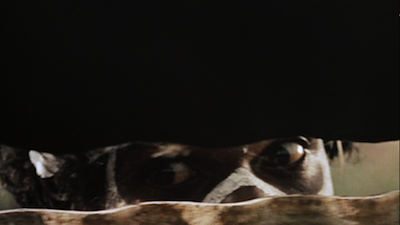
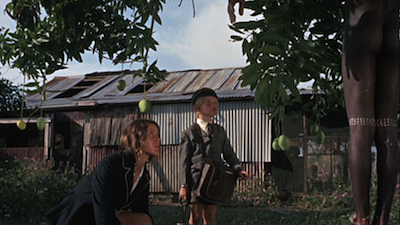
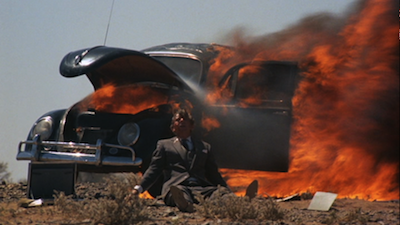
This, we can interpret, is the modern disease, and the end-stage of said disease is what is about to affect the brother and sister. Their father is a geologist of some kind, a man whose job is to dig into the earth and extract its guts. He drives his children out into the middle of the desert and then proceeds to set the car on fire and shoot himself in the head. Determined to keep her little brother from seeing this, the girl leads him away from the car and deep into the outback. They wander for a couple of days, barely surviving, before they meet an aboriginal boy (David Gulpilil). He is on "walkabout," a rite of passage where young men leave their tribes and survive on their skill and wits. He doesn't speak English, but certain fundamental rules of communication, when applied, hip him to the plight of these two strange children (both in their school uniforms). The boy knows where they need to go and how to stay alive getting there, and he begins to lead the white children back toward their version of civilization.


Walkabout is written by Edward Bond (one of the writers on Antonioni's Blow-Up), adapting a novel by James Vance Marshall. The final film is an odd mixture of travelogue, coming-of-age story, and strung-out post-60s psychedelia. Stylistically, it comes off as a bit of a mess. Roeg engages in showy aesthetic shifts (still photographs, a turning-page graphic, etc.), and the story is peppered with distracting non-sequiturs. Midway through the journey, we leave the wandering trio to watch a group of scientists preparing weather balloons. This brief detour looks like it was spliced in from a campy sex comedy. I suppose the leering Italians trying to make time with the blonde weather lady is meant to underscore the sexual awakening that is just under the surface of the relationship between the white girl and the aborigine boy. Likewise, the cutaway to the man who uses native people to make knock-offs of Aboriginal art is meant to show us the exploitation the colonial whites have engaged in since landing in Australia.
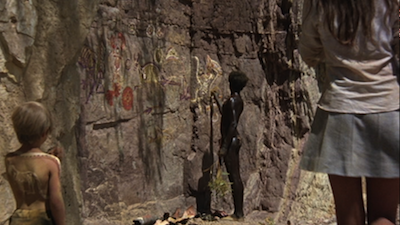

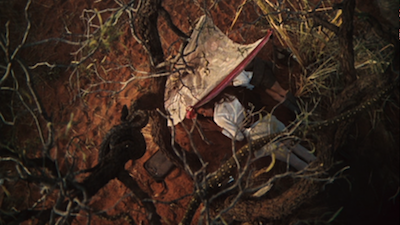
To me, these scenes are unwelcome interruptions, and their execution too bald to be effective. Roeg hammers all of his political messages pretty hard. There are, for instance, the shots of Gulpilil on the hunt cut together with a butcher slicing up slabs of meat, which are supposed to challenge our perceptions of hunting and cause us to think about where our food comes from. The boy kills to survive, it's no more brutal than what goes on every day in the city. Further on, we see him wrestle an animal with his bare hands, and it's almost playful. Moments later, white hunters come in and slaughter a herd with their rifles. They never even leave their jeep. Roeg, who acted as his own cinematographer, photographs the killing with the rawness of Vietnam news footage. On paper, it sounds good, but in practice, it seems all too easy. Perhaps it was effective and shocking forty years ago, but now it just comes off as clumsy.


Some of the heavy symbolism is forgivable, though, as it does seem like the core of Walkabout is aimed at a younger audience. Thus, seeing the young white boy playing at war games, shooting a pistol and mimicking the sounds of his miniature biplane, makes for an acceptable symbol of British aggression--especially as, at that same time, his sister is setting up a picnic and listening to an etiquette lesson. He is the more brutal aspects of colonialism, she is the imposition of "polite society." Later, when the siblings find a desert oasis, it transforms overnight into a forbidding dry patch full of snakes and insects. They are the chosen ones being cast from the Garden of Eden. (Perhaps the weirdest moment of the movie is when the little boy is seen in extreme close-up biting into a piece of fruit and declaring it tastes like meat.) It's not subtle, but it gets the point across without being insulting.


I think the main reason I object to the asides to the "adult world" so much is that the contained dreamscape of the three youths is so effective. Roeg and Bond construct their joint walkabout as a kind of magical journey. They aren't restrained by time. In one scene, they are dressed in normal clothes; in the next, they are stripped down and wearing detailed tribal make-up. These leaps add to the fantastical quality that blurs the edges of their reality. They find some common ground despite the barriers between them, and the visual language changes. Early on in the journey, the girl walks under a make-shift canopy, looking very much like a white tourist being led by her black servant. He is an "other" at that point, almost silly for not understanding their way of doing things; eventually, though, they begin to adopt his way of doing things. Admittedly, this could still be seen as cultural tourism, and I am not sure I am comfortable with Roeg visually contrasting Jenny Agutter swimming naked with images of nude aborigines beating on her father's burnt-out car. There are visual parallels here to scenes from other movies where less-evolved primates are freaked out by technology. This sequence even ends with the group leaving the car when the radio comes alive and scares them.

There is something exploitative about the way Roeg films Agutter. Even before we see her naked, she is shown in various states of undress and there are regular shots of her underwear, both on and off. She is presented in a sexualized manner throughout Walkabout, and though the actress was 18 or 19, the schoolgirl she plays is much younger. The story is intended to be an awakening for the girl, and one could interpret that there are unfortunate racial implications to the sexual aspects of it. It's as if Roeg keeps offering her up as forbidden fruit, the white woman serving as temptation for the black man. He doesn't really address the volatile politics connected to that, nor does the movie take any time with the cliché of its final scenes: that having experienced life with the black man, the white girl is now forever changed, forever dreaming of returning to the "wild."


I don't really think that Roeg is trying to play to those dangerous stereotypes so much as he is playing with them. Regardless, he must have been aware that they were there. Again, I would say he's dealing more with culture than race, and I certainly don't think he was being racist, he was instead using these things to challenge the status quo. Near the end of the journey, the trio find an abandoned home just on the edge of white civilization, and the girl starts to set up house. She is creating a domestic situation with her as the mother, the aborigine as the father, and her brother as the child. This, of course, isn't going to work. This is where the white hunters come in, and when Gulpilil returns to the house, outfitted in traditional tribal make-up and engaging in what I assume is a courtship dance, his reversion to his own cultural standards frightens the girl. She wanted him to move closer to her, effectively obliterating the middle ground, and as a result, forcing them both to retreat to what they are used to.


This is some pretty serious stuff, and that is why it's all the more frustrating that Walkabout has so much extraneous nonsense. The sidebars are all satirical jabs at white society, yet they take away from time that could be spent on the central relationships of the movie. Also, if you're going to isolate these characters and send them on a mythic journey, I just don't see the sense in breaking the spell. That should come at the end, when the kids get home, returning to bad manners and noisy congestion. The balloon would have only burst the once rather than slowly leaking throughout.


The new two-disc release of Walkabout is a much needed updating of one of the earliest Criterions. Now available as both a standard-definition release and Blu-ray, the new DVD transfer is immediately noticeable for its severe upgrade in quality. Created from a 35 mm interpositive and supervised by Nicolas Roeg, the 2010 picture is gorgeous. The image is clean, with crisp resolution and breathtaking colors. Part of the effectiveness of Roeg's "magical world" is his use of the real scenery and all of the things within it. He regularly turns his gaze from the children to look at a furry creature in the trees or examine a bug as it digs through the sand. He emphasizes how out of place the kids are by emphasizing how indifferent the natural world is to them. Life goes on, they are just passing through.


The only extra feature on the original disc was an audio commentary with Roeg and Jenny Agutter, and that is also available on this set. The second disc now also contains interviews with Agutter and Luc Roeg, as well as a full-length documentary about David Gulpilil, an important figure in Australian cinema. His work as an authentic Aboriginal actor was as important politically as it was artistically. (Criterion fans may also remember him from Peter Weir's The Last Wave.) One change of note to long-term collectors: the essay by Roger Ebert from the 1998 disc has been replaced by a piece from author Paul Ryan.


Watch the theatrical trailer.

This disc was provided by the Criterion Collection for purposes of review.