Showing posts with label cassavetes. Show all posts

Wednesday, May 12, 2021

TEMPEST - CRITERION CHANNEL

This review originally written for DVDTalk.com in 2007.


I remember seeing the trailer for Paul Mazursky's Tempest when I was ten years old and thinking it looked like a really weird movie. It was clearly too adult for me, and it showed me things from the grown-up world that I didn't understand. It made some kind of impression on me, however, because I've never forgotten it. It was always one of those films I meant to look up, and actually did a while back when I discovered the movies of John Cassavetes. All I knew was that he and Gena Rowlands were in it and that it must have some kind of relationship to Shakespeare, but I'll be damned if I could find the video anywhere.


Well, it's only taken me twenty-five years, but I've finally seen Tempest. I've finally been able to take a gander at what that trailer was all about...


...and I'm still perplexed.


Cassavetes plays Phillip Dimitrius, a world-famous architect in the middle of a mid-life crisis. When we are introduced to him, he is waking up on an unnamed Greek island where he lives with a dog, a girlfriend (a very young Susan Sarandon), his daughter (an even younger Molly Ringwald in her first film role), and the crazy goat herder Kalibanos (Raul Julia). They have been living alone in Phil's idea of paradise for a year now, eating feta cheese and building an outdoor theater for reasons that never really get explained. It may not matter, as it's been long enough that they've all got a little bit of Island Fever. Don't be surprised if someone breaks into a song and dance number. They've got no entertainment, nothing to do. Kalibanos even dances with his goats.


Through a series of well-structured flashbacks, we see Phil's life as it stood eighteen months prior. He's in business with a gangster (Vittorio Gassman), and together they're building a casino. It's a hollow endeavor for a once proud, creative man. Phil can't take it anymore. Only, just as he wants to get out, his wife Antonia (Rowlands) wants to go back into acting. He wants to break free, but she's looking to stay put. They've reached an impasse.


Then one day Phil sees Antonia making woo with the gangster, and suddenly things are far more clear-cut. He and his daughter, Miranda, head to Greece for a little summer vacation, and that's where they meet Aretha (Sarandon), a free-spirited singer who is working her way back to New York. When the summer ends, rather than send Miranda back home to her mother, the three of them--along with Aretha's dog, Nino--agree to go into hiding instead, finding their out-of-the-way island and the freaky shepherd who lives there. Time passes, and paradise has started to lose its charm a little. Only, Phil seems to be waiting for something. He talks of recurring dreams and apparently has a plan for the future, but he has yet to tell anyone else what it is.


It's always a treat to watch John Cassavetes and Gena Rowlands act together. In the independent movies they made together in the '60s and '70s, the husband and wife team developed a naturalistic acting style that delivered on all the promises of method acting and the Strasberg method. John directed more than he acted in those days, and so it's wonderful to see him take over the screen. He's a master with a subtle gesture, and he uses a distracted demeanor to bring a sense of vitality to Phil. Though he's very much in the scene, he often looks like his mind is elsewhere. He's walking and talking in the moment, but always dreaming of the future. Whether he and Gena are cooing at one another or having a heavy argument, they make every line seem spontaneous, like Mazursky snuck up to them in their home and secretly filmed what was really going on. If it's true that real-life lovers have no chemistry on screen, this pair is the exception that proves the rule.


Also fun to watch is Raul Julia, who may have been the perfect actor for Mazursky. The director has a pretty active cornball streak, and Julia is one of the best hams there ever was. Kalibanos is an outlandish character. He's lecherous and greedy and not very bright, more pitiable than sympathetic. Yet, Raul Julia is so likable, you adore him even when he plays unlikable.


So, what's my problem with Tempest? Well, it spends about two-hours building up to whatever Phil is planning for his island hideaway, and when his visions finally come to life, the remaining twenty minutes of the movie play more like a shortcut to the closing credits rather than a legitimate resolution.


Mazursky, along with Leon Capetanos, wrote a smart and complicated script that establishes a strong cast of characters and builds an intriguing scenario for them to inhabit, only to toss all that out and go for an easy wrap-up. Eventually, everything that Phil is running away from is going to catch up with him. That's inevitable. Rather than have it be a matter of convenience or lucky coincidence, Mazursky indulges in a little magical realism, suggesting that Phil somehow willed all of this, just as he also brings a storm to life in order to shipwreck everyone on his private chunk of rock. All of that plays fine, even hearkening back to the Shakespeare inspiration. If Phil is to be Prospero, then he is a wizard, after all.


Except now that everyone is gathered together, Mazursky stops short of confronting any of the issues. Though Phil greets the people he left behind with malice, all that anger and hatred melts away and everyone becomes friends again. Okay, maybe it's still magic at work, but nothing really communicates that. No one even acknowledges the quick change. Everyone accepts it as if it's absolutely normal, and that's that.


Except after such a lengthy build-up, after gathering so many dark clouds and priming us for a real storm of emotion, for Tempest to just drizzle out like that, it's not very satisfying. Back in 1982, at all of ten years old, my impression of the movie was an accurate one. This is a grown-up film that wrestles with issues that only make sense with age, but rather than deal with these issues in a real adult way, Paul Mazursky ducks out of the responsibility. Instead, he goes for a crowd-pleasing ending full of laughs and those cornball jokes he can't resist, and he lets the wind out of his own sails. There's a lot of huffing and puffing, but when Tempest is revealed as a house of straw, its coming down is more sad than impressive.


Sunday, February 2, 2020

EDGE OF THE CITY - CRITERION CHANNEL

This piece was originally written as part of a review of the boxed set The Sidney Poitier Collection back in 2009.


The cultural impact that Sidney Poitier had on cinema and society at large is indisputable. A dignified actor with a deep sense of social consciousness, he broke through racial barriers by choosing to play roles that shed the spotlight on intelligent black men--not perfect men, but men who lead their lives just like anyone else, with all the flaws that implies. Regardless of the role, Poitier refused to let any performance descend into racial clichés, and the example he created helped reshape the public perception of African Americans. It sounds frightfully simplistic, but such is the power of the moving image to shape the public perception. Roles in films like The Blackboard Jungle and The Defiant Ones forged Poitier's early reputation in the 1950s, and highly regarded turns in films like In the Heat of the Night [review], To Sir, With Love, and Guess Who's Coming To Dinner cemented his position as a cinematic icon in the 1960s. He would eventually direct, as well, and throughout his career, he would also accept the role of social activist. Still active to this day, he has been the Bahamian ambassador to Japan from 1997 to 2007, and he published the book Life Beyond Measure - Letters to my Great-Granddaughter in 2008.

The common theme of many of his films throughout his career remained the same: challenging the odds by trying to live life as it is meant to be. As his character says in 1957's Edge of the City, there are men and there are lower forms, and you can't let the lower forms push you into being anything less than the man that you are. (And given the respect Edge also pays to its female characters, one can assume he means "men" as in "humanity.")


Edge of the City was the directorial debut of Martin Ritt, a politically motivated artist with a passion and fury to match Poitier's. (Ritt is probably best known for Hud, The Spy Who Came in from the Cold [review], and Norma Rae.) It also features John Cassavetes in the co-starring role, adding to the film's legacy as an early spotlight for maverick film artists. (Cassavetes is the prototype for the cantankerous independent American director.) The film opens with Cassavetes' character, Axel North (née Nordmann), rolling in to New York City with only a little money and a dubious recommendation in his pocket. The name he drops at the rail yard is of a man in San Francisco, but it's enough to get him a job under the crooked foreman Charlie Malick (Jack Warden). Knowing that Axel is on the lam, Malick puts the screws to him. He also doesn't like it when Axel befriends Tommy "T.T." Tyler (Poitier), the only black foreman on the yard. As the two become close, Charlie gets more upset and eventually pushes for Axel's secrets to come out.

The core of the movie, which was written by Robert Alan Aurthur (All that Jazz [review]), is less about the past Axel is running from and more about how he learns to cope in the present. Tommy serves as a role model for the younger man. He's married and has a family, and his wife is an educated woman (Ruby Dee) who introduces Axel to an equally educated and socially active love interest (Kathleen Maguire). As Axel begins to trust Charlie, he is also given more strength to stand up for himself, to accept other people as they are, and accept whatever he may have done prior to NYC as something he can change. As far as male bonding goes, it's pretty healthy stuff. Cassavetes' twitchy method acting plays well against Poitier's upright performance, and Jack Warden rounds it out with smarmy menace. The climax where the two men must finally deal with this cranky thorn in their sides is maybe a little too On the Waterfront, but the gritty honesty of the writing up until that point allows Ritt to get away with it. A lot of the movie was shot on location, and so it has an on-the-street authenticity that prefigures French verite while also showing the influence of Jules Dassin's The Naked City [review].


Tuesday, January 29, 2019

MIKEY AND NICKY - #957


Mikey and Nicky is utterly and completely a film of the 1970s. It’s a portrait of people on the edge of society, people who have discarded morals and ethics for the post-1960s freedom the decade promised, Baby Boomers without responsibility embracing the shaggy aesthetics of a decade with no direction. Mikey and Nicky is in love with the mythical New York City that regular people probably abhorred, since they were poor and victimized by politics and crime, but a New York City that gave us Travis Bickle, punk rock, and, hell, Studio 54 and Basquiat.


Mikey and Nicky is a distinctly masculine movie made during a particularly masculine artistic era, and so all the more impressive that it’s helmed by the legendary Elaine May, a comedian turned filmmaker, who here wears her star John Cassavetes like a serial killer skin suit, adopting his style and technique but maintaining her external vision in order to completely deconstruct the kind of toxic masculinity that fueled and intrigued him. He’s a great artist in his own right, but it’s marvelous to consider how Cassavetes submits to May and lets her tear down the male construct he both praises and excoriates in his own movies. (And to be fair, we can’t discount Cassavetes’ collaborations with Gena Rowlands, and how he also gave the screen over to women; I don’t mean to paint him as a macho apologist.)

“Toxic masculinity”: it’s not a 1970s phrase, but one of the 2010s. But it’s worth considering Mikey and Nicky through a modern lens as it finally lands on Blu-ray, because it’s a movie that is timely and relevant in the #metoo era.


Story wise, this thing is pretty simple. Nicky (Cassavetes) is a small-time hood with a price on his head. Desperate to get out of town before he is whacked, he contacts his friend Mikey (Peter Falk) to come liberate him from the hotel where he’s holed up. What follows is a night of debauchery, confusion, and anger, as the two hash out their disagreements in the haze of stale sweat, staler cigarette smoke, and Mikey’s fear. Through their interactions, we begin to get a picture of who each man is. Nicky is a hard charger, living in the moment, and afraid to slow down; Mikey is a deeper soul, more attuned to his responsibility, but possessed of his own darkness.

For Nicky, all his sins are coming back to haunt him, and this atonement scares him. His toxicity is so pronounced, it’s literally eating him from the inside, his ulcers gnawing at his guts. Faced with his potential death, he knows he should make amends and do the right thing, but he can’t muster the courage. He nearly goes to his wife and kids to say goodbye, but he chickens out.


The best Nicky can do is visit his mother’s grave. He’s a mama’s boy. Mikey is a daddy’s boy. He holds on to the watch the old man gave him as a symbol of paternal approval. We could parse how this has formed these two gangsters: one nervous and delicate, the other more solid but also more coarse. Nicky is used to being doted on and getting his way. He treats women as if they owe him something, and really, both these guys treat the whole city that way, too. It’s a great example of white privilege to see them go into a black bar and expect to do as they please. It’s a tense scene, where May allows things to get real. This is a moment when the world does not regard these crooks as they regard themselves, and that could produce consequences. Here Nicky is an instigator, an unblinking prick, and Mikey the peacemaker.  Papa’s little man consistently taking care of the mother’s pride.

Just as their characters do, Cassavetes and Falk contrast one another as performers. May casts to type, to a degree.  Columbo inspires trust, whereas Cassavetes is the artist whose manic energy likely made squares nervous. Falk seems like he is the system, Cassavetes can only buck it. They are tremendous together, I could watch them for hours, just like I could watch Leonardo DiCaprio and Jonah Hill misbehave endlessly in Wolf of Wall Street [review]. You sympathize with Nicky because Peter Falk knows how to play the man getting hurt--the bruised feelings after they visit one of Nicky’s mistresses, the dismay at his broken watch--you feel for the guy, but yet you also you don’t want to stop watching Nicky’s antics, either.


Elaine May, who both wrote and directed Mikey and Nicky, is a sharp satirist, so even though “toxic masculinity” and “white privilege” weren’t in the parlance of 1976, she’s aware of the concepts and what exactly she’s digging into. Her skill as a humorist means she can empathize even as she criticizes. She kind of likes Mikey and Nicky, and she kind of feels sorry for them. Of course, she reserves her deepest sympathy for the women they visit, as well as her pity. This is nowhere more intense than the fallout from Mikey’s cruel joke on Nell (Carol Grace), his sometime lover, whom he belittles and curses. In her response, we feel how she is the dual victim of male desire and societal judgment. Carol Grace delivers real heartache, and so, of course, May has to upend that and dump it on Mikey. His support of Nicky’s crass manipulation earns him deep humiliation.

Elaine May at work

As the night wears on, when the men are left unto themselves, that’s when the real tea starts being spilled. Since this is a gangster movie, there has to be at least one double cross, and Mikey’s motivation may prove as murky as Nicky’s. Because what is revealed is they aren’t really close, they aren’t pals and are barely colleagues. Mikey challenges Nicky to prove he’s ever his friend when he’s not in trouble, citing real putdowns and slights. You can take the boys out of the playground, but you can’t take the playground out of the men.

Thus, when dawn comes, it’s not really a new day. It’s the end of the narrative, and a time of comeuppance. Did Mikey and Nicky learn anything? Probably not. Guys like that can only persevere...or die.

The only new day is for Mikey and Nicky itself, which looks amazing on this new 4K transfer. The picture is clear and precise without losing any of that ’70s New York grime. Well worth a fresh look now that it’s on Blu-ray.


This disc provided by the Criterion Collection for purposes of review.

Saturday, August 18, 2018

SMITHEREENS - #941


While 1970s American movies like Taxi Driver and Dog Day Afternoon gave us an indelible image of the grimy side of 1970s New York, it was the independent auteurs that followed that captured the more arty, anything-goes side of the city’s culture. Early Jarmusch, for instance, and even Martin Scorsese’s Big Apple follow-ups to Travis Bickle like The King of Comedy and After Hours.

Susan Seidelman is by far more in the Jarmusch camp. The New York of her 1982 feature debut Smithereens is the New York that gave us Basquiat and Madonna--with whom, of course, Seidelman would make Desperately Seeking Susan not too long after. Interesting people doing interesting things just for the sake of it, just because they thought New York was the place to be. New wave music and graffiti, striped skirts and checkered sunglasses, hustlers and poseurs--all of these are elements of Smithereens, and all make the film interesting, even if its story never quite finds the depth of its surroundings.


First-time film actress Susan Berman stars in Smithereens as Wren, a New Jersey ex-pat who is trying to blag her way into a rock-and-roll lifestyle. It’s never quite clear what Wren’s artistry encompasses, and likely she hasn’t figured it out yet either, but she plasters photocopies of her face around the city and pretty much barrels through anyone who gets in front of her. Forever the opportunist, she drags along fresh Montana-transplant Paul (Brad Rinn) to her night on the town when it’s clear he’ll pay the bills, but then drops him for Eric, a singer played by real life punk icon Richard Hell, as soon as he shows a passing interest and potentially something to gain. Wren spends the rest of Smithereens bouncing between the two, with only Paul being smart enough to know he’s being used, and the girl too blind to see that Eric will never take her to Los Angeles and let her manage his band.


Working with mostly an unprofessional cast*, Seidelman manages a kind of neorealism that is as much John Cassavetes as it is Jim Jarmusch--though I’d also compare this to Alison Anderson’s Border Radio [review]. This quality will  be a boon for viewers looking for an unvarnished time capsule, but might be a problem if you are seeking something with a bit more form. Seidelman is definitely working with the best of what she had available. Shot by Chirine El Khaden, who also worked a camera on the influential hip-hop movie Wild Style, Smithereens has the dirt and grime of a documentary--all of which comes through with a gritty clarity on the Criterion Blu-ray. We see such mythologized sights as the Peppermint Club, and most of the people hanging around are likely the real deal and not hired extras. Going from seedy movie theatres to Bohemian cafes, there is an undeniable authenticity to Smithereens. You could almost say you were there.


And you could also say you’ve spent a lifetime with its main character. Wren is a hard woman to like. Paul is entirely right: she is a self-serving loser with a bigger mouth than tangible qualities to offer. The only thing that makes her tolerable--as opposed to, say, Agnes Varda’s Vagabond protagonist, or countless loudmouth male sidekick characters like most anything Jason Lee played in the 1990s--is that Susan Berman understands the insecurity behind the bravado, and she can sell it when the façade drops. If only she was a tad more charismatic, I might have felt more inspired by the freeze-frame ending. Wren could have been more like Antoine Doinel on the beach at the end of The 400 Blows [review], suggesting a possible future; instead, she only appears startled by the irony of receiving unwanted attention after spending the whole movie trying to monopolize everyone’s time.


Much better is Seidelman’s initial film-school short And You Act Like One Too. Shot in 1976, this black-and-white tale of a housewife feeling neglected on her 30th birthday is a charming day-in-the-life. Marsha (Karen Butler) is abandoned by her husband and daughter on what is meant to be her special day, so instead of sitting around feeling sorry for herself, Marsha goes out and gets a new hairdo, runs some errands, and takes a chance giving a ride to a charming hitchhiker (Andras Maros). Unsurprisingly, this trip leads her to some unexpected places, and Seidelman delivers a comic twist at the end that is truly delightful. The film is simple in its intent, but broad in its character analysis.

Seidelman’s second student film is the color divorce drama Yours Truly, Andrea G. Stern. This short focuses its attention on young Andrea (Jilian Frank), the daughter of a newly separated couple. She lives with her mom (Joanne Gross), and starts to feel left out when a new man (Billy Wine) moves into the house. While the narrative thrust is that Andrea is trying to get Jonathan to move out, this isn’t a Disney Channel comedy where the schemes are wild and implausible; on the contrary, Seidelman’s deeply felt script imagines what realistic actions Andrea would take, what tools she’d have at her disposal.

Yours Truly, Andrea G. Stern is somewhat ambitious in style, framing itself as a documentary with the off-screen director colluding with the girl, but also putting us in the space of her imagination. The title refers to how Andrea signs off her diary entries, which also serve as narration for the film. The result is something more real and personal than if Seidelman had chosen not to take a child’s point of view so serious.


* Though keep an eye out, because apparently Chris Noth from Law & Order and Sex and the City plays a prostitute! I didn’t see him, but I didn’t know to look.

This disc provided by the Criterion Collection for purposes of review.

Friday, August 17, 2018

GUY AND MADELINE ON A PARK BENCH - CRITERION CHANNEL

This review was originally written for DVDTalk.com  in 2011.


The spirit of John Cassavetes is alive and well and shooting on the streets of Boston.

Writer/director Damien Chazelle's Guy and Madeline on a Park Bench is a 2010 indie relationship film shot in a classic verite style that hearkens back to the great work Cassavetes was doing in the 1960s, as well as the influential films of the Cahiers du cinema crowd. Guy and Madeline has also earned comparisons to Jacques Demy's The Umbrellas of Cherbourg [review]. It has a romantic heart that beats to a jazzy rhythm, one that is purposefully out of step with the manic drums of modern music. It's an anachronistic conceit that Chazelle wears right out in the open. I get the sense he'd be pleased by all the comparisons and references to possible influences. It's all intentional, all by design. Why else choose to shoot on 16mm black-and-white film if not to remind us of cinema long past?

The story of Guy and Madeline is simplicity itself. Guy (Jason Palmer) is a jazz trumpet player who ruins his young relationship with Madeline (Desiree Garcia) when he cheats on her with Elena (Sandha Khin). This quick hook-up is an ill-considered impulse, Guy only just met Elena on the subway, and eventually, he will come to regret the decision when the new girl gets clingy. While he's figuring this all out, Madeline has decided to move on, and she begins exploring the possibility of getting out of Boston and going to New York.


The principle players of Chazelle's film are all dreamers in some fashion. Guy is a music maker. Like many musicians before him, he's more obsessed with the complications of melody than he is the complications of l'amour. To him, people are played in much the same way he plays his horn. It's not for nothin' that his seduction of Elena is achieved merely by touch. Chazelle avoids making Elena an empty device, giving her an interior life, as well. She is a lonely girl all by herself in the city. Just before meeting Guy, she hits on a street performer; just after, she encounters an old man wandering the streets looking for a connection. (He is played by a fellow named Frank Garvin. Save the "male prostitute" jokes for Fred.) It's hard to tell if none of these connections work out for her due to naïveté or selfishness, though it's also hard not to feel sorry for her either way. Sandha Khin has a broken quality that, if natural, signals very good casting, but if it's intentional, it signals a very good actress. (One wonders, given that she first introduces herself by her own name, only to correct herself and give her character's name, a flub Chazelle decided to leave in.)

Madeline proves to be the real dreamer, however. Guy and Madeline on a Park Bench is full of music, jazzy numbers composed by Justin Hurwitz and recorded by local jazz musicians and the Bratislava Symphony Orchestra. Most of it is either background scoring or live performances by Guy and his friends, including one tap dance routine that spontaneously erupts at a party. It's live music within the scene, and thus grounded in the "real life" of the movie; Madeline's songs are more in line with the old-school, theatrical musical tradition. She sings her tunes as expressions to the self, and the instrumentation backing her up is essentially the music she hears in her head. For her second number, she also imagines her co-workers dancing along, turning her mundane waitressing job into a choreographed performance. As the wronged party in her relationship with Guy, she is the true romantic, and so also the one who fantasizes about a life free of everyday confinement. He may be the artist, but she's the one with an artist's soul.


Guy and Madeline on a Park Bench is shot in a down-and-dirty style. Scenes are loose in the moment, and there is an air of improvisation to the whole affair. The actors appear to be either unprofessional or first-timers who aren't overly polished, and yet who are comfortable onscreen. Chazelle served as his own cameraman (and he also co-edited with W.A.W. Parker), and he favors intimate close-ups and cramped quarters where characters can't escape one another. (A shower scene involving Guy and Elena is particularly uncomfortable.) Street scenes appear to have been captured as they happened, with plenty of real life occurring in the backgrounds. As the music takes over, the camera backs away and the image widens. The editors also put their scissors down, letting the takes run long the way they would have in Golden Age Hollywood, when you could actually watch the performers do their thing without lots of frenetic trickery.

The final sum of all these parts is a fascinating, playful merging of styles. It's MGM by way of the Nouvelle Vague, and though at times the story feels underdeveloped, the emotion is authentic and the characters real enough to make them worth watching. And, of course, there is Hurwitz's excellent music, cut in at all the right times to make sure our attention never drifts. Guy and Madeline on a Park Bench builds to a satisfying, yet open-ended conclusion, where consequences for previous choices come to bear and there is enough honest growth that it leaves us hopeful that they will make better ones down the line.


This charming mash-up also makes you wonder what will be down the line for the people who squished it all together. Damien Chazelle has certainly set a unique bar for himself. Guy and Madeline on a Park Bench combines the personal with spectacle in such a way that makes you want to see more, but the fear is Chazelle could go too far to either side and lose what made this first effort so interesting in the first place. It'll be a balancing act, one I'll be watching while holding my breath and crossing my fingers, hoping against hope that the filmmaker makes it all the way across.

2018 Update: Well, I certainly had high hopes for Damien Chazelle. Too bad he went too far in the wrong direction. While I was conflicted about Whiplash--my review is here--I found La La Land execrable. Chazelle should have stuck with this, his original mission to save jazz.


Sunday, September 7, 2014

LOVE STREAMS - #721

“Love is a stream. It’s continuous. It does not stop.”

And sometimes it bears human wreckage on its currents.


In 1984’s Love Streams, his final film as writer and director, John Cassavates stars as Robert, a novelist of some fame. An aging party boy, Robert keeps many women around at one time. As the drunken lout explains to his estranged pre-teen son on a disastrous overnight trip, a man has trouble sleeping alone. These are liaisons without connection, however, because Robert isn’t very good at reaching out. At the times he does during the movie, he tends to bungle it or stop short. If his stream isn’t dammed up, then it just flows according to his own selfish purpose.


Elsewhere, Sarah is in the middle of a divorce and about to lose custody of her child. Sarah is played by Cassavetes’ real-life wife, Gena Rowlands, a regular in his films, the director’s go-to for the kind of fractured, unstable women that populate most of his screenplays. Sarah has had mental health problems, though one may surmise her biggest problem is maybe she feels too much. She has a habit of dragging her daughter (Diahnne Abbott) around to see sick people because she believes their cheery nature lifts the spirits of the ailing. The girl has had enough and wants to go live with her father (Seymour Cassel). This switcheroo casts Sarah adrift. A bit of a boozer herself, she takes some terrible advice to go to Europe and in search of sex. It’s when she comes back that she will seek out Robert and their true association will be revealed.


Up until this point, Love Streams is effectively operating as two movies. There is Robert and his girls and his domestic travails, and there is Sarah and her court battles and her wanderings. Amazingly, when they finally do come together, they basically cross and split. Sarah lands at Robert’s house, Robert takes his son to Vegas. Even then, Robert plays their relationship closer to the vest, to the point that current culture would likely label it a spoiler. There’s no real ta-dah moment, however, the magician does not lift the sheet and show us his lovely assistant; rather, the information just kind of trickles out when Love Streams finally settles down.


Robert and Sarah are brother and sister, the product of whatever warped environment would produce two such opposite beings. The man who can’t love and the woman who loves too much. Alone in the world, the two settle down in Robert’s house and try to re-connect. He attempts to be a rock for her, she strives to bring affection into his life. Her solution is to fill his house with animals, making Robert into a emotionally bereft Noah. The film’s final scenes see him running around in a ludicrous hat bringing the goat and miniature horse and fowl in out of the rain.

I would argue that this back portion of Love Steams is really its most substantial. It’s when the two characters are forced to grapple with their problems. Robert in particular embraces responsibility and tries to give his sister some stability. She is more resistant than he is. I’m not sure what to make of the fact that she spends the film’s last half hour sleeping it off while Cassavetes indulges in two ill-advised dream sequences/hallucinations. For a filmmaker revered for his realism to resort to working out these issues through fantasy seems like a cop-out. How is a musical number more effective than a tête-à-tête between his two main characters? I get that Cassavetes is revealing an irony, that Sarah is beyond reason and, despite being the one who loves, beyond repair, but this struck me as too disconnected itself.


Such is Cassavetes’ jagged storytelling style, however. His films are often hard to fathom and even hard to take, as those who have struggled with the differing versions of The Killing of a Chinese Bookie or even Opening Night can attest. His narratives are rarely clean, and his expression as ragged as the fashions he outfits his actors in. Hence the choppy nature of Love Streams’ opening scenes, or the disconcerting shifts over time and even reality. In the filmmaker’s defense, he is striving to craft a cinematic voice that relies more on real life than it does motion picture history; I’d just argue he tries a little too hard here. There is almost a feeling of desperation to how it all comes together. Perhaps it’s because Cassavetes had been told he had less than a year to live just before starting it, maybe he needed a little more time to cook but feared he didn’t have it.


Love Streams is based on a play written by Ted Allan that Cassavetes had performed in several years prior. Here the two collaborators apparently attempted to bust the play apart and root around in its inner workings. This could account for some of the jumble. They are sifting through the parts rather than putting them back together. Love Streams works more as a performance piece than it does a story.

And what performances they are. The aging Cassavetes is a growling, wounded predator here, his weathered, leonine face at times contorting into a maniacal grimace, even as his sad, soulful eyes reveal a deep hurt. He doesn’t so much interact with his fellow cast as he does move around them, the creator and his creation melding, both orchestrating their own private world. It makes sense, then, that the bits that Robert can’t control are the most interesting. The material with his son (Jakob Shaw) has a palpable rawness that should chafe against old scars of viewers who are also children of divorce. And, of course, there are also the scenes with Robert and Sarah. One can sense the very real love between them, right from their first scene together, when Robert literally leaps into the taxicab to hug his sister. It’s the husband overjoyed to be working with his wife.


The pair draw much out of each other when they are interacting one on one. Their conversations feel unrehearsed, something beyond improvised, mimicking actual speech, delivered in the moment. Rowlands’ real bravura scenes, however, are when Sarah is on her own, manipulating the world to her needs, be it bullying train station attendants into helping her or seducing the man working at the bowling alley. That’s actually the best sequence in Love Streams, the time when the audience is compelled to react as part of the production. When the man behind the counter asks Sarah how she is doing, and she starts to unload, don’t be surprised if you find yourself thinking, “Oh, god, now you’ve done it...here she goes...”


It’s the unvarnished power of moments like that one that makes Love Streams so fascinating, even if it’s ultimately unsatisfying. I felt challenged throughout the movie. Not just in that I was trying to figure it all out, but in that I was trying to stay with it, not to jettison from the experience, not to give up on these people who are alone and floundering. I suppose that is John Cassavetes’ greatest gift, the way he shows us that even if love and, by extension, life is constantly flowing, the true triumph is to not just let it carry us where it may, but in pushing against the current, to strive to be active in it and not passively drift. That was how he built his career, after all. He lived and died celebrating the different.


Wednesday, October 24, 2012

ROSEMARY'S BABY - #630


"This is no dream...this is really happening!"

I wonder how many documentary programs have used Mia Farrow's panicked cry to illustrate the dark side of swinging '60s psychedelia? I know I have seen it in more than a few. It's certainly an iconic moment, coming midway through a crucial sequence of Roman Polanski's 1968 chiller Rosemary's Baby. The sweet and trusting Rosemary Woodhouse has been drugged without her knowledge, and her sudden declaration occurs when the surreal fantasy the narcotics instigated intersects with the cruel reality she is suffering: a cult of Satanists have made her their unwilling concubine.


Classic horror movies always play on the anxieties of the times. Found footage shockers are popular right now because modern moviegoers are finding themselves increasingly under surveillance in our everyday lives. A film like Paranormal Activity taps into the very real issue of privacy rights and how, more often than not anymore, we surrender much of those rights ourselves. Who filmed the footage in that movie? One of the victims. Who turns out to be the murderer? Someone close to him. The killer isn't just in the house, but you're sharing the same modem.

And so it is that Polanski, working from a novel by Ira Levin, builds a scary story that spreads itself across the generation gap. The malevolent forces that prey on the Woodmans are older people, and they dig at Rosemary's anxieties about motherhood, about creating new life and being a parent to the next generation. The metaphor? That change is happening and we might not be ready to handle what's next. There may be a riot going on, but no one is sure they can really take charge when they get what they want.


Or, if you prefer, Rosemary's Baby is simply a story about a woman caught up in weird goings on, and how she slowly realizes that not all is right with her neighbors, their friends, or even her husband (an earnest and ever-brilliant John Cassavetes). The film intensifies on a slow burn, building the weirdness slowly, shifting from goofy to scary by degrees, and yet never losing its black sense of humor. In a lot of ways Rosemary's Baby is camp, but it's pure camp, as equal in its sincerity as a piece of genre fiction as it is full of cinematic pranksterism. (Ever notice that the villain's name, Roman Castevet, not only shares a first name with the writer/director, but the last name sounds suspiciously like that of its male lead?) There are lots of funny, killer details that almost look like kitsch all these decades later. Ruth Gordon's pink hair, or the paintings on the Castevet wall, which include a rendering of a famous fire and a parody of more traditional religious and patriotic paintings that features deformed devil worshipers attacking an innocent. Most of this is clearly intentional, and some of it has only gotten funnier with age. I mean, could they have known Charles Grodin would become Charles Grodin and how ludicrous that sad moustache of his would end up looking?


Which isn't me watching Rosemary's Baby from a hipster's perch, giggling at how old fashioned and tacky it is, because I wouldn't use either of those disdainful phrases. On the contrary, I have a lot of respect for how brilliantly Polanski skewers both the young and the old. The character of Guy Woodhouse is a would-be actor who pays lip service to art but is really just looking to get famous (apparently this is not a new societal malady). Next to him, the Satanists almost look harmless. They may be corny, but they believe in something. Guy will sell out anyone.


Amidst all of this kidding around, however, is a serious scary movie. Polanski uses humor to set his audience at ease, and then he strikes from the other direction. Tense journeys into dark hallways, ominous portents, and even the occasional gore--he never lets us forget that something isn't quite right in the top floor apartment. The dream sequences in Rosemary's Baby are some of the best ever in a film. Polanski establishes a wonky logic in Rosemary's nightmares, one that is as random as it is contrived, leading us from the boogie men of her subconscious to the honest-to-goodness boogie men all around her. Mia Farrow is kind of remarkable in the role. She manages to maintain a believable innocence, even when the armchair quarterbacks in the audience should otherwise be screaming, "Oh, come on, how can you not tell something is wrong?" Again, the most insidious writing goes to Cassavetes. The way the husband tweaks at his wife's insecurities to keep her from disrupting the plan is laced with a cold cruelty. If one wanted to read too much into it, there are maybe some unkind (and not necessarily true) parallels to be made between this performance and the driven man who gave it, not to mention the filmmaker who shaped it.


Rosemary's Baby has been on out-of-print on DVD in North America for some time now, and the new Criterion release has been manufactured in high-definition (there is also a Blu-Ray version). The new widescreen disc image looks extraordinary, maintaining the unreality even as it improves on the overall clarity and resolution. Detail looks incredible--you could spend a ton of time poring over the nooks and crannies in both the Woodman and Castevets' apartments, every prop appears carefully chosen--and yet the new print manages not to sacrifice the exaggerations. The colors in particular have an almost-over-the-top quality. Farrow's yellow sun dress and bright hair is meant to directly contrast with her sickly pallor as the movie progresses, just as the dinginess of the apartment the couple moves into is brightened up by their new decoration, only to become stifling again. Particularly compare the later apartment scenes to the outdoor shots when Rosemary tries to make a run for it. The sun never sets!


In terms of new extras, a featurette featuring current interviews with Roman Polanski, Mia Farrow, and producer Robert Evans is most welcome. Rosemary's Baby is a film with its own lore. Indeed, I first rented it after watching the documentary The Kid Stays in the Picture, which numbered Rosemary's Baby as one of the amazing string of hits Evans produced as the head of Paramount.

There is also Komeda, Komeda, an inviting documentary about music composer Krzystof Komeda, as well as an archival interview with author Ira Levin and some of the author's notes.


All in all, Rosemary's Baby is an impressive reissue just in time for Halloween. If you're looking for something creepy to watch before the holiday, then throw this on your biggest screen, turn out the lights, and crank it up. Once you're good and scared, just keep reminding yourself, this isn't happening...it's just a dream. 


This disc was provided by the Criterion Collection for purposes of review.

Sunday, August 26, 2012

MAIDSTONE AND OTHER FILMS BY NORMAN MAILER - ECLIPSE SERIES 35

"I carry a broken heart in every knuckle."


Norman Mailer has always been a larger-than-life literary figure, one whose gargantuan personality regularly precedes and often supersedes the quality and passion of his prose. He's one of those authors that most people know by name, but whom they maybe have never read. His outlandish behavior and public spats regularly put him at the center of controversy, as did the wildly varied success of his writing. Whether a book of his was loved or loathed, he at least usually went for it with an admirable level of gusto.

So it makes a certain kind of sense that the author would gravitate to a medium where he could put himself front and center in every sense of the word. At the tail end of the 1950s, Mailer could see the status of the Great American Novel declining as other entertainments took over. He started peeking in on the New York cinematic circles, visiting the Actor's Studio and embracing "The Method." This coming together practically seems like an inevitable meeting of the minds. He was an author who often lived his writing, or at least the persona concocted as a byproduct of the prose; as an actor and filmmaker, he would live those stories, too. The timing is also hard to ignore. As Mailer was turning to movies, Truffaut and Godard and their peers in the Nouvelle Vague were altering the art form in exciting, innovative ways, freeing it from the studio-bound grandiosity of Golden Age Hollywood. John Cassavetes was doing the same on Mailer's home turf, blazing a trail for independent cinema and achieving pioneer status.


By the late 1960s, Mailer was ready to pick up a camera himself, and in three years, he starred in and directed three films, collected here as Maidstone and Other Films by Norman Mailer, part of Criterion's Eclipse series. It's Cassavetes that these efforts most resemble--the high-wire act of improvisation, the rawness of the portrayals, the formless construction. While Mailer's first effort Wild 90 (1967; 81 mins.)
was reportedly a response to Andy Warhol's films (which Mailer found dull), it more recalls Cassavetes' Faces in its limited space and how it depicts a collection of drunks whose party has gone wrong.

Unfortunately, even when taken as an amateur's debut, Wild 90 is really bad. For most others, it would be a career ender, not a starter. Mailer shot the film over two days. It mostly just features himself and his two friends and collaborators, Buzz Farbar and Mickey Knox, playacting as gangsters holed up in a New York apartment. The set-up borrows equally from Sartre and Beckett. These three fellows are locked down, under threat of death if they leave. Yet, suspicious colleagues, hookers, and police come and go throughout the film. They are all aware that danger lies outside the building's walls--Mickey's character, 20 Years, is convinced snipers lurk in the high rise across the street--but no solutions are offered.


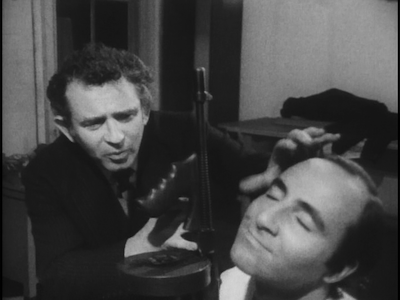
Wild 90 is essentially the three hoods sitting around a table drinking and carping at each other. Since there is no script, there is also little direction to the conversation. There's a lot of repetition, a lot of posturing, and not much of real substance. Mailer is embarrassing as the heaviest heavy, whom, in a self-aggrandizing move, he has named Prince. The auteur's "performance" consists of him mumbling, grunting, and swearing. It's mostly incomprehensible. At times, you can see Mailer using his ranting to "direct" the others, bullying them in the way he wants to go, though never ending up anyplace all that interesting. Wild 90 is a crudely made picture, shot in a small space on black-and-white film by D.A. Pennebaker (Don't Look Back [review]), who also appears on screen as one of the cops. The only sequence that comes to anything is when Beverley Bentley (a.k.a. the fourth Mrs. Mailer in real life), playing Prince's girlfriend, provides a challenge to the men's self-satisfaction. Here the nakedness of the production works, but largely because Bentley proves a commanding actress who can anchor and defy all the male egos. Naturally, it doesn't last, with Mailer ending Wild 90 by turning the spotlight back on himself to address the audience directly. I am not sure whom I am more mortified for: myself for having seen this movie, or Norman Mailer for having made it.


Tellingly, Mailer's second movie, Beyond the Law (1968; 98 mins.), ends in much the same way. Mailer looks directly into the camera, says his parting words, and freeze frames. It's a disheartening miscalculation because up until the last 20 minutes or so when he puts on his drunk act again, Beyond the Law was not about Norman Mailer. It was about people, their shared job, and the lifestyle existing around it. For the bulk of it, the director manages to restrain the love he has for hearing himself ramble and lets the movie be an independent creature.


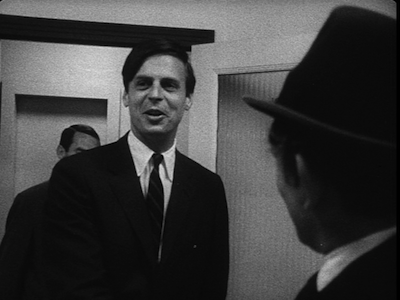
Beyond the Law has two settings: an inner-city police station and the neighboring bar where the cops go to drink. Farbar and Knox return as Rocco Gibraltar and Mickey Berk, two police officers who, at the start of the picture, end their shift by going to the pub to meet two blind dates (Mary Wilson Price and a young Marsha Mason). To impress the ladies, they start telling them about their crazy day and their bullish lieutenant, Francis Xavier Pope (Mailer). The film cuts back and forth between the bar and the station, where we watch the cops grill the day's suspects over their various crimes. Mailer and editors Jan Welt and Lana Jokel, move freely between the different Q&A sessions, blending them together, erasing any sense of linear time. The most striking scenarios involve a man who murdered his wife (Edward Bonnetti), an older gentleman arrested for soliciting (Peter Rosoff), and two hippie bikers who aren't taking any guff.


One of the bikers is played by Rip Torn (The Man Who Fell to Earth [review], The Larry Sanders Show [review]), who delivers a coarse, musky performance. Also notable is an appearance by writer George Plimpton, who is quite effective here as the Mayor. He is stopping by the precinct to question charges of unfair behavior and examine Pope's methods. The frank and unscripted manner in which the cops and the crooks interact transcends most similar genre pictures, and unlike Wild 80, actually generates a potent sense of realism. It also helps that Mailer chooses to explore material that mainstream pictures would never touch--homosexuality, sadomasochism, and pedophilia--amongst the more expected criminal behavior.


Beyond the Law's best sequence, however, occurs at the pivotal 3/4 mark, shortly after Pope gets off duty and joins the others at the bar. He is also met by his wife (Beverly Bentley again). The montage jumps between different conversations. The blind dates in the bathroom talking about the men; the men at the table talking about the ladies; and Pope getting some heavy news dropped on him. The contrast between the different points of view is remarkable, with the characters revealing themselves in the way they dish on each other. For all the self-serving fumbling in Wild 90, it didn't take Mailer long to move on from that and start figuring this cinema thing out. The result is still a bit lopsided--it's hard to understand a lot of what is being said, and the movie grinds on a little too long--but Beyond the Law fits in nicely with an emerging American cinema that would come to fruition in the next decade. (1968 was also the year of Scorsese's Who's That Knocking at My Door?, which also owes a huge debt to Cassavetes but that is ultimately more successful in realizing its aspirational cinema verité.)
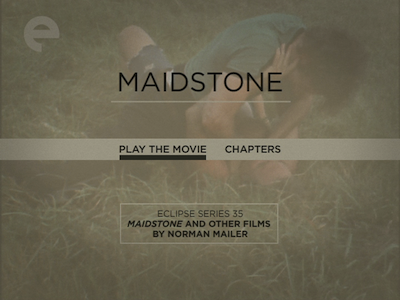

The synthesis of Mailer's art-imitates-life philosophy came with Maidstone (1970; 105 min.), an ambitious failure that attempts to create a nexus for all the chaos that marked the ragged end of 1960s America. The conflicting pursuits of personal freedoms and social responsibility come together in the figure of Norman T. Kingsley, an arthouse pornographer who has decided to run for President. This Mailer avatar has decamped to the Hamptons to make his version of a Bunuel film, a story about a whorehouse that services female clientele. While Kingsley is casting the bodies for his feature, serious minds are gathering in his home to discuss his viability as a candidate and ponder whether interests would be better served by turning the wild man into a martyr. One source of concern is Kingsley's amorphous political views; another is his entourage, a loose collection of rebels called the Cashbox, fronted by his brother Rey (Rip Torn). On hand for the weekend are also African American radicals, supervising as Kingsley has a rap session with inner-city youth. That sequence in particular harnesses the power of the unrehearsed, as the teens grill Kingsley (and really Mailer) about what he knows about being poor. He sells them a line, but openly. He admits it's a line.


The first hour or so of Maidstone is kind of great. The faux-documentary style really works, establishing a credible false reality that aids in creating an air of distrust around Kingsley. Is he a fake, or is he a real fake? He goes from group to group, claiming to be an independent entity, but yet also kind of telling them what they want to hear. The hedonistic party that is the film within the film scrapes against the serious politics.

Just past the halfway mark, Maidstone completely falls apart. Mailer attempts to harness the aforementioned chaos and control it, and it ends up beating him to a pulp. This quick-cut descent is a self-serious mess, a poor man's surrealism and smarmy psychedelia. The director can't quite wrestle his way out of it, and the lack of a clear story, the key to his improvisational experiment, bites him on the ass. Once again, he basically throws in the towel and simply removes the scrim. The morning after is an apparently real cast and crew meeting where the roles are dropped and everyone talks as themselves, dissecting how they "feel" about the five-days they've spent shooting. It's hard to say when breaking the fourth wall in this way became so ho-hum, maybe it was still invigorating in 1970; now it's a snooze at best, a cheat at worst.


Surprisingly, Maidstone gets a little of its fire back in the last 15 minutes. Despite what I just said about the cast meeting that upends the rickety narrative, I think the actual story here might be the behind-the-scenes tale: what happened beyond the range of the cameras instead of what Mailer and his crew actually captured on film. If we take this last sequence as fact, Rip Torn ambushes Mailer and they get into a very real fight, with Torn insisting he's giving Norman what he wants--a true end to Maidstone--and Norman calling the actor a traitor. Questions of the authenticity of the whole Norman Mailer construct are raised, ones that the movie leaves dangling. It's a pretty self-aware and gutsy choice for an artist who has spent so much time and effort building himself up in the way Mailer has, because Rip Torn makes the more convincing argument.


Maidstone and Other Films by Norman Mailer, the 35th entry in the Eclipse series, is a trio of films more interesting for what they represent than how they actually turned out. I give Norman Mailer credit for going at moviemaking whole hog, even if he does end up proving he should have stuck to prose. (It would be another 14 years before he was able to make another film, and by all accounts Tough Guys Don't Dance is another turkey.) His experiments at improvisation were intended to get at some unfettered truth, and at times, particularly in Beyond the Law and Maidstone, that actually happens. Unfortunately, in both cases, once Mailer has the truth in his hands, he doesn't know what to do with it. You can run with a ball as long as your lungs allow, but unless you figure out where the goal posts are, it's not really worth it. 

For a complete rundown on the special features, read the full review at DVD Talk.