Showing posts with label Leo McCarey. Show all posts

Saturday, September 18, 2021

AN AFFAIR TO REMEMBER - CRITERION CHANNEL

This review was originally written in 2011 for DVDTalk.com. 


This one is for the saps. And I say that as a card-carrying member, who types this with eyes still glassy from watching An Affair to Remember. It's a sappy movie, and it doesn't get any less sappy with age. Though, I must say, I think the older I get, the more I like it. I don't know if I am gathering a greater capacity for cheesy emotion instead of wisdom as I trundle on into the autumn of my years, but it's possible.


Immortalized as the ultimate chick flick in Nora Ephron's Sleepless in Seattle, this 1957 movie from writer/director Leo McCarey (The Awful Truth [review]) is apparently not supposed to appeal to members of my gender, but frankly, boys could learn an awful lot from Cary Grant's masculine example in this film. Grant plays Nickie Ferrante, last of the famous international playboys. When Nickie boards a transatlantic cruise to meet his fiancée (Neva Patterson) in New York, it makes the news programs around the world. Could the notorious gadabout really be settling down? Certainly his future wife's multimillion-dollar fortune is enticement even if love is not.


On the trip, Nickie meets Terry McKay (Deborah Kerr), a former nightclub singer also sailing to meet her fiancé (Richard Denning). Terry is devoted to the man who took her out of smoky bars in order to make her a proper woman, and so she easily rebuffs Nickie's charms. It's a new experience for him, and the lothario is flummoxed. The chemistry that exists between these two is one unlike anything they've felt before, and no matter how much they try to pull apart, they always end up right back together. After a sidetrip to meet Nickie's adoring grandmother (Cathleen Nesbitt) during a port stop, the two can't deny it any longer. They also can't deny that they are in a sticky situation as far as their mutual engagements, so they make a plan to take six months to disengage. Nickie, in particular, is going to break away from the old ways, take a shot at reviving his artistic aspirations and being a painter, and prove he can make his way in the world in order to be deserving of Terry's hand.


The pact the pair makes is the one Ephron famously borrowed for her Tom Hanks/Meg Ryan vehicle. In six months, at 5 p.m., if they are successful in their endeavors, Nickie and Terry will meet each other at the top of the Empire State Building and then go to be married. It takes approximately half of the movie to get to the point where the deal is struck, a seemingly lopsided structural decision, but one that is integral to making An Affair to Remember more than your typical sudsy romance.


In the first hour of the movie, Nickie and Terry really fall in love. I am not sure I fully appreciated how real their interactions on the ship come off in any of my prior viewings. McCarey doesn't go for any of the obvious tricks in bringing his lovers together, instead he exercises tremendous restraint. The whole of An Affair to Remember has an air of calm, and in that calm, McCarey is able to foment feelings of desire, longing, and eventually sadness just by letting the actors be themselves. Cary Grant and Deborah Kerr reportedly improvised a lot of their dialogue in the courtship scenes, and it shows. At times, they seem genuinely surprised at the things that come out of each other's mouth, and the natural interchange between the two makes for honest romantic yearning. You're not just going to believe they are in love with each other, but that they actually like one another, as well.


McCarey maintains this restraint through the entire picture, even when it would have been easy to go for the emotional jugular. The meeting at the Empire State Building doesn't go off as planned, for reasons I won't get into for those who may have never seen An Affair to Remember before. Suffice to say, there is plenty of pain and misunderstanding, and even though the audience is privy to more information than Nickie, there are some things that McCarey teases out slowly. The big revelation of how bad off Terry really is, in particular, could have been handled with far more fanfare. McCarey doesn't even turn up the score, letting the moment come silently, and cutting away as soon as he's sure we've figured it out. Clumsier films would have lingered, tried to tug our heartstrings with excessive force.


Instead, the director saves his biggest moments for the final scene, which itself is still played very carefully, isolated to one room, without the actors raising their voices or explaining too much. A heartfelt look will do far more than false words ever can, and the devastation on Cary Grant's face when the reality of the situation becomes clear is easily one of the actor's finest moments. It's when the tears hit my eyes, that's for sure.


So, call me a sap, I don't care. I've never been a closeted romantic, anyway. An Affair to Remember has outlasted all the scoffing it's gotten from the likes of you in the past, and it's gonna keep truckin' long after both of us have shuffled off this mortal coil. Maybe one day you'll wise up, and like Nickie Ferrante at the end of the movie, realize what a stinker you've been.


Then again, maybe not. Just because I'm a romantic doesn't mean I'm not also a realist.


Sunday, February 3, 2019

BEFORE SUNSET - #858


Confession: I didn’t see Before Sunset during its theatrical run, it was a couple of years before I finally gave in and checked it out. I had dismissed the notion of a sequel to Before Sunrise [review], being in my early 30s and still full of strange and precious ideals about story, I had rejected the idea that the magic could be recaptured or that we needed to know if Jesse and Celine ever saw each other again. It wasn’t until the graphic designer working on my graphic novel with Joëlle Jones, 12 Reasons Why I Love Her, gave me a DVD copy and insisted that I give it a try that I finally did. And was pleasantly surprised.

I mention this in part because how Jesse (still played by Ethan Hawke) answers the questions about the book he wrote fictionalizing the events of Before Sunrise sounds a lot like how I answer questions about my books. Specifically, the “did they or didn’t they” ending being a litmus test for how romantic you are. I give the same answer about the ending of 12 Reasons Why I Love Her.


Clarification: I am re-watching each movie of the Before Trilogy and writing about it afterwards. Thus, when I wrote my Before Sunrise review, I had not yet watched Before Sunset, and so when I wrote that each moment of that movie was every moment of the series, I had no idea that Jesse says the same thing, also in the scene discussing his book, in this entry. What can I say, we share a wavelength.

And the Affair to Remember [review] comparison? Fitting that the reunion of Jesse and Celine echoes the “did you or didn’t you” of the final scenes of the Leo McCarey film, though with a much lighter touch...before moving on. In Affair it was the end; in Sunset, the start.


Before Sunset is the very definition of a middle part of a trilogy. It’s a bit darker, a bit more serious. It feels incomplete, acting as the connection between the kick-off and the finale. And like most second parts, many fans are going to argue that it’s the best. For all the reasons cited.

Richard Linklater gets this. He’s not setting out to make a crowd-pleasing affirmation of Before Sunrise’s goopier potentialities. Before Sunset has a level of sincerity about what it means to be in one’s 30s that underlines how sincere its predecessor was about capturing the airiness of being in your early 20s. They’ve had a whole life to live, to fail, to lose or hang onto their romantic notions. Amusingly, Jesse is more hopeful now, and Celine (Julie Delpy) is a politically driven realist. Where their paths diverged somehow caused him to increase his belief, and for her to tamp her romance down. Then again, he is also in an unhappy marriage, so maybe by being so grounded he can appreciate feelings that are less so. I mean, there is a definite irony to her being jaded by romance, when he suffered the true disappointment; yet, her failure to carry through has arrested her emotional development. She is not sure she can ever again feel the way she did during their Viennese dalliance.
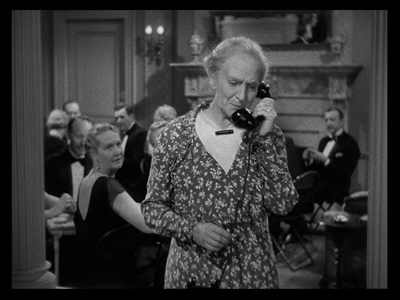
Though, even as she points out, Jesse has arrested himself. He has chosen to stay in that moment, regardless of how much his life charges on. The impetus for their reunion in Before Sunset is that he has written a novel about their one night together, and the book tour has brought him to Paris. This adds a fun metatextual layer to the movie. They are fictional characters that, at least for a brief period of the movie, are grappling with fictional versions of themselves. More importantly, though, it brings up the question of perception: his version of events vs. hers.


Or, perhaps more precisely, it questions the quality of a particular witness or narrator: how does their retelling of Before Sunrise change based on what they prefer to hide or celebrate. Of course, those alterations are based on what they feel and what they wish to suppress or keep secret--a tactic that spills over into how they represent their current life. Both begin with a desire to present their best face, forgetting that they are with the only person who is really capable of unmasking their pretenses. And they only have a couple of hours to get the job done. He has to leave for the airport at 7:30.

Fitting into the collegiate preoccupations both Jesse and Celine had in Before Sunrise, Before Sunset uses their ill-fated first reunion as a way to ponder questions of faith, the “what if” scenarios suggesting a different path for the wannabe lovers. Sure, they would have been different if they had seen it through, but not necessarily for the better. Is it possible that they needed to shed their youthful ideology in order to really be together? Would they have lasted if they had run with that first blush of emotion and not gathered the life experience that would give them the tools and tenacity to commit? Probably not. And thus, it is befitting that Before Sunset fails to end with a grand declaration, fading out instead on a quiet recommitment to love.


In terms of style and approach, not much has changed here, though it’s clear that budget and nearly a decade of work under their belts has improved all skills. The camerawork is cleaner, the look of the film more polished--but that could be an uptick in technology giving all indie filmmakers a leg up. Lee Daniel shot both movies, as he has many Linklater efforts, including Dazed and Confused [review 1, 2] and Boyhood [review], so I imagine the two had quite a rapport by this outing. Daniel also has a lot of documentary credits on his resume, which suggests certain skills he certainly could apply here.

Luckily, this progression helps rather than hurts. If the first film has the scruffiness of youth, this has the sheen of success, the characters showing off at a time when they can and when making sure everyone knows you’ve accomplished something matters. It can’t be the same every time...and as we’ll see, it won’t be.


Sunday, April 15, 2018

THE AWFUL TRUTH - #917


Given how prevalent and normalized divorces are nowadays (even moreso than when I was a wee lad), a romantic comedy that treats the act with such casual seriousness seems positively quaint. Yet, The Awful Truth is anything but. It’s funny and charming, and just as sharp now as it must have been in 1937, mostly droll in its wit but not afraid of a pratfall when necessary.

Written by Viña Delmar and directed by Leo McCarey, the team behind Make Way for Tomorrow [review], released that same year, The Awful Truth stars Cary Grant and Irene Dunne as Jerry and Lucy Warriner, a high society couple who have survived despite Jerry’s philandering. When Lucy decides to show Jerry that what’s good for the gander is good for the goose by orchestrating the perception of her own affair, the pair finally splits--only to discover they really do love one another once they see the other stepping out with someone else. First it’s Lucy getting cozy with Oklahoman millionaire Daniel (Ralph Bellamy, His Girl Friday [review]); then it’s Jerry making time with society girl Barbara (Molly Lamont). In the middle this whole time is Mr. Smith, a.k.a. Skippy, the fox terrier who is best known as Asta from the Thin Man series. A stand-in for the child they never had, Mr. Smith provides added comic relief while still keeping the lovers connected.


The structure here is rather clever, and probably owes much to the natural breaks from the stageplay by Arthur Richman. There are four essential acts: the introduction and break-up, Lucy’s time with Daniel, Jerry’s time with Barbara, and the inevitable reunion. Act Three gets the broadest comedic strokes, as Lucy pretends to be Jerry’s sister in order to insinuate herself into a gathering and meet the competition. Dunne is brilliant playing the posh socialite pretending to be a coarse showgirl pretending to be a posh socialite. That said, the funniest physical business in the entire movie is Grant and Dunne riding on the handlebars of police motorcycles. It’s silly and yet wonderfully hilarious. Delmar is equally adept at writing slapstick as she is the emotionally resonant scenes that give The Awful Truth weight; at the same time, my loudest guffaws came from the dialogue. Delmar inserts a wicked line into the script on the regular--often as an otherwise inconsequential aside, like Dan declaring man’s best friend to be his mother or Aunt Patsy (Cecil Cunningham) noting two quarrelers who race by failed to “touch second” (funny in the moment, if sterile in a review). While modern writers would likely make the Warriners overly caustic or sarcastic, Delmar strikes the right balance. Like Nick and Nora Charles, they are terribly witty, altogether glamorous, and yet ultimately relatable.


Of course, the performers have as much to do with this as anyone. Particularly given Leo McCarey’s penchant for improvisation and working without a script; without the right actors, The Awful Truth could have simply been awful. Cary Grant is at his comedic best, often hoisted on his own self-awareness, his knowledge that he’s smarter than the rest of the room never preventing him from being humiliated by his own hubris. As his foil, the great Irene Dunne is lovably assured, usually a step or two ahead of Grant’s buffoonery, but never really mean. Both manage to be endearing despite themselves, and the audience’s genuine affection for them makes it easy to root for their amorous reconciliation.


For his part, McCarey makes it look effortless. There is no punching up or punching down here, he approaches all characters equally, even if its Dan’s overbearing mother or the nigh tragic nightclub singer who doesn’t know how ridiculous her act is. (Or how ahead of its time; the same shtick worked for Marilyn in The Seven Year Itch!) There is a kind heart at work behind the camera, which is most likely what also keeps The Awful Truth from descending into bitterness and cruelty, two of the most common human fail-safes in any divorce. Again, the soft peddle of the split is endearingly old fashioned, even as the reinforcement of the marriage pact is slight earnest, playing up the romantic comedy trope of two people who everyone knows should be together even when they don’t.


Monday, October 1, 2012

SIDELINE: MORE REVIEWS FOR 9/12

My reviews of non-Criterion movies from September.


IN THEATRES...

Bachelorette, Kirsten Dunst and Isla Fisher lead a great cast into some crass territory the night before the wedding.

Compliance, dramatizing real-life events about extreme prank calls made on fast food restaurants and their employees, a film to test your ethical fortitude.

For a Good Time, Call...or as I like to call it Phone Sex and the City. I know that's not funny, but neither is the movie.

Looper, starring Joseph Gordon-Levitt as a time-bending hitman. From the director of Brick and The Brothers Bloom.

The Master, Paul Thomas Anderson's latest bid for a slot amongst the American classics of the 1970s. I'd say he got there.

Red Hook Summerthe latest Spike Lee film, takes us back to some familiar ground to tackle difficult subject matter in a fiercely compelling fashion.


ON BD/DVD...

The Babymakersperhaps the least funny comedy of the year. I like Paul Schneider and Olivia Munn, but there's no salvaging this weak script. Directed by Jay Chandrasekhar (Supertroopers).

Battle Circusa 1950s Korean War movie in which Humphrey Bogart, I kid you not, provides the template for Hawkeye Pierce.

Bored to Death: The Complete Third Season is unfortunately also the last of this literary comedy with Jason Schwartzman.

Damsels in DistressWhit Stillman's return to cinema proves he is as charming and anachronistic as ever. Plus, Greta Gerwig!

The Dark Mirrora psychological thriller from Robert Siodmak, starring Olivia De Havilland as twins, one of whom may be a murderer.

Korczak, Andrzej Wajda's devastating drama about a doctor in the Warsaw ghetto in WWII.

The Loved Ones. Inventing a new genre: torture prom. Absolute trash.

Macbeth, Orson Welles' skewed version of Shakespeare finally makes it to DVD.

Man-Trap, a post-noir love triangle gone wrong.


My Son JohnLeo McCarey's 1952 propaganda drama. "Mama, I think our boy may be a Commie."

Pursued, an excellent melding of western and romance starring an appropriately fatalistic Robert Mitchum.

The Salt of Life, another charming slice of Italian life from the director of Mid-August Lunch.

Secret Beyond the Door, in which Fritz Lang attempts to do a cover version of Hitchcock'Rebecca.

Windjammer: The Voyage of the Christian Radicha fluffy 1958 documentary noted for its use of the Cinerama widescreen format--which the Blu-Ray does an awesome job replicating.


Monday, February 28, 2011

SIDELINE: MORE REVIEWS FOR 2/11

It was a big movie month for me, despite it being pretty dead in the cineplexes. The Portland International Film Festival pretty much waylaid three weeks for me. I posted my capsule reviews I wrote for the Portland Mercury over on my main blog, and you can read all the full-length reviews I did for Criterion Cast over on my author's page there.

Thanks to both venues for hosting me!

Now, on to the regular pieces...


IN THEATRES...

* Barney's Version, an ambitious literary adaptation that can't bear the narrative weight. Fine performances by Paul Giametti, Dustin Hoffman, and Rosamund Pike at least make it watchable.

* And Everything is Going Fine, Steven Soderbergh's tribute to the late Spalding Gray. Playing the NW Film Center this weekend.

* Sanctum, boring in all three dimensions.

ON DVD/BD...

* America America, Elia Kazan's remarkable epic story of one boy trying to get from Turkey to America.

* An Affair to Remember, Deborah Kerr and Cary Grant in a romance that never loses its passion.

* Bambi: Diamond Edition, a fantastic release of one of Disney's most impressive movies, bringing this animated classic into the technology of the 21st century brilliantly.

* Burlesque, revisiting one of my favorite reviews from last year now that the movie is out on Blu-Ray and DVD.

* Futureworld, a sort of dull 1970s vision of a theme park future.


* Guest of Cindy Sherman, a documentary made by a narcissist who can't handle that his coattail ride doesn't come with its own coat. I got some particularly juicy hate mail for this review since the piece could be considered as a personal attack on the filmmaker. I stand by the assertion that if you're going to be the subject of your own movie and present yourself and your activities as some kind of plea for sympathy or even admiration, then you erase the line between art and artist. You are the art. This has been an ongoing topic of mine. I refer back to my review of Tarnation, written for this blog back in 2005. Feel free to post your thoughts on the subject below. I think it's an interesting topic worthy of discussion.

* Mesrine: Killer Instinct, the first part of last year's great French gangster epic.

* Thelma & Louise: 20th Anniversary Edition: It's still fun to hit the road with Susan Sarandon and Geena Davis. Directed by Ridley Scott.

* Unstoppable, the other Scott brother's recent film about an out of control road trip is also a pretty damn good time.

Sunday, December 19, 2010

TOKYO STORY - #217


Yasujiro Ozu's 1953 movie Tokyo Story has always been a cinematic blind spot for me, despite it having a reputation for being perhaps the quintessential film in the Japanese director's canon. I would always hear others singing its praises, including quite often being told by people how they were moved emotionally by the family tale. This led me to expect Tokyo Story to be heightened melodrama. Here are my heartstrings, Mr. Ozu, please go ahead and tug them.

I don't think this factored in my not having seen Tokyo Story in a negative way; on the contrary, the reverence with which many held this picture made me wait longer because I wanted to wait for the time to be right, to save the experience until such a time as I could really savor and appreciate it. This, as it turns out, was a smart move, though again not exactly for the obvious reasons. The surprise of Tokyo Story was that it's not the high-emotion tearjerker I suspected, but rather a melodrama of restraint. Its sadness is less the product of tragic events and more the reaction to the same. It's a movie about disappointment and loss, and the profound unhappiness of everyday life.


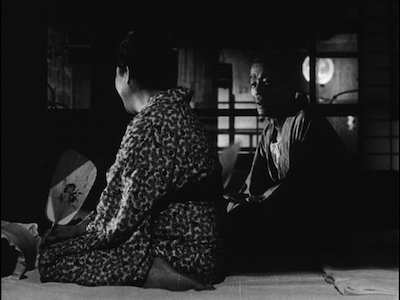
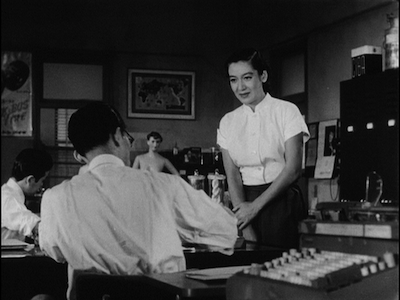
Tokyo Story is a two-part film. Part One is a ten-day trip that an elderly couple take from their home in the Onomichi prefecture to visit their grown children in Tokyo. Shukichi and Tomi, played by Chishu Ryu and Chieko Higashiyama, have had five children in total. Their youngest, Kyoko (Kyoko Kagawa), still lives with them. She is a schoolteacher. A middle child, Keizo (Shiro Osaka) lives in Osaka. The two who live in Tokyo are Shige (Haruko Sugimura), who runs a beauty parlor, and Koichi (So Yamamura), who is a doctor. Their fifth child, a son, died in the war. His widow, Noriko (Setsuko Hara), lives in Tokyo, too, and the couple will be visiting her, as well.

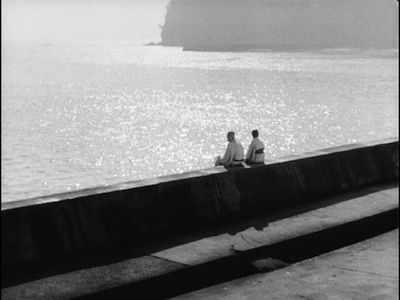
The visit in Tokyo is awkward and strained. Shige and Koichi and their families put up their parents and try to entertain them, but it is more out of a sense of duty than it is genuine pleasure for them being there. More than once they complain about their time and the money they have to spend. In the middle of the week, they send the old folks to a seaside spa under the pretext of helping them relax, but they are basically trying to get them out of their hair for a while. Only the daughter-in-law, Noriko, seems at all interested in spending any real time with Shukichi and Tomi. The generation gap is even more pronounced when it comes to Koichi's sons: the grandchildren barely even speak to their grandparents.


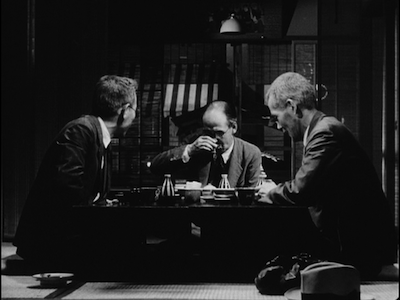
Quite subtly, Ozu and co-writer Kogo Noda are illustrating the changes in social mores and the altered expectations that have come in the post-War era. There is a divide between how the children feel toward their parents and what they think they are supposed to do. Rather than cherishing the older generation, the younger seems to find them a nuisance. Likewise, the older folks seem to be disheartened by their children measuring their success by a diminished yardstick. In one of Tokyo Story's livelier sequences, Shukichi goes out drinking with some of his old friends. They get plastered on sake and start to expose the lies their children tell them about themselves--Koichi, for instance, led his father to believe his medical practice was much bigger than it is--and the lies the fathers have told to cover their frustration. One of Shukichi's friends, a former police officer, has been telling the guys that his boy is in a management position at his firm when he is really just a mid-level assistant. These busy lives their offspring bustle about doing don't seem all that substantial.


In opposition to this, Tomi and Noriko, the mother-in-law and her widowed daughter-in-law, form a lonely bond outside the circle. While Tomi is also let down by how the trip has gone, she tends to be more forgiving, her natural instinct as the caretaker holding sway. Noriko seems poised to accept a similar role in the family, and by movie's end, she will basically maintain a middle position, forgiving both sides for their failure to see what the other is going through. In a fascinating twist, the youngest girl, Kyoko, is the most angry with her siblings' indifference. Noriko encourages her to have patience. In their parting, sobering exchange, the young girl asks, "Isn't life disappointing?" Her sister-in-law can only respond in the affirmative.


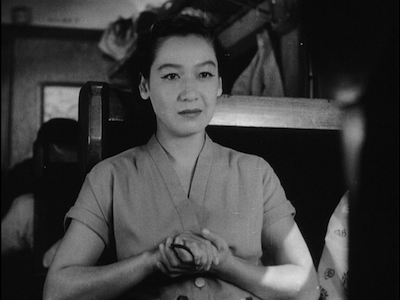
Part Two of Tokyo Story is the shorter part. It takes place back at the small town where the family hails from. Events compel the children to have to visit their parents only days after the Tokyo holiday has ended. Here the hospitality shoe would seemingly be on the other foot, though honestly this gathering doesn't go much better. Shige in particular is bossy and cold, and all three of the older children leave again as soon as they can, despite the relative importance of their sticking around. In Tokyo, they came through in the most trivial of situations, but here when it would really matter, they don't come through at all. The movie ends on dual notes of loneliness and possibility: the elderly are more isolated than ever, but Noriko is given her freedom to reengage with life rather than stay wrapped up in her grief. There is a chance that she won't, but the look on her face in the final shots of the movie, as she rides a train by herself back to Tokyo, suggests that she has changed, she has found some contentment. Is it just the good feeling of having done the right thing? Or a commitment to honor what was most recently lost?


Setsuko Hara is a familiar face from many Ozu movies. She is a charming actress, and there is something inherent in her screen presence that is likable and immediately engenders sympathy. Those final scenes in Tokyo Story--her conversations with Kyoko and Shukichi, and then her train ride--are some of her finest moments on film. She goes beyond being just syrupy sweet and reveals so much more about her character through the tone of her voice and the honest expressions on her face. Her kindness is come by bitterly; we can believe the tragedies of her own life have caused her to be this way. Instead of growing hard against it, she decides to do well unto others.

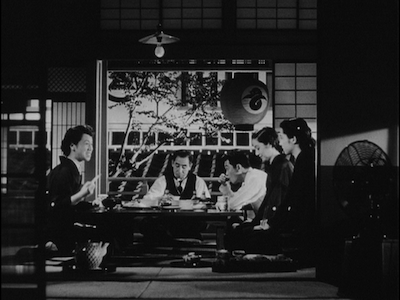
The old man Chishu Ryu is also a regular face in Ozu's filmography. He and Hara may have as much to do with the unique rhythm of the master's movies as he does. They are comfortable with the slow, quiet approach, and they make it seem natural. As with the best of Ozu, Tokyo Story is an all-too human movie. Much is made of Ozu's choice to shoot his films from ground level, with fixed and steady framing. (The camera work here is by Yuharu Atsuta, another regular of the Ozu crew.) This is generally referred to as the "tatami-mat shot." For me, this choice puts the viewer on the same level as the subjects. We are a participant in their lives, sitting with them in their homes. Ozu adds no flash to his stories, he doesn't see a need to amplify events. His movies don't necessarily work as Neorealism, there is still something very mannered and stylized about them, but there is a fundamental honesty to his scenarios that wouldn't be there if he chose to play the drama stronger.


It's said that Kogo Noda was influenced by Leo McCarey's 1937 film, Make Way For Tomorrow [review], and there are definitely similarities between the two films. Beyond the shared thematic elements of two older people who feel displaced and unwanted, Ozu and McCarey both have a similar outlook on human nature. For as soft-seeming and low-key as Tokyo Story can be, it is not without a subtext of anger and cynicism. Ozu and McCarey are both as disappointed in their characters as the characters are of each other. Their disenchantment is born of their stronger belief that humans could do better if only they'd just try. Though Tokyo Story throws most of its sentiment behind the parents, they aren't totally off the hook. Is it really okay for them to be so judgmental of their children and to not accept the lives they've made for themselves for what they are?

With this in mind, then the older couple--Tomi earlier in the movie and Shukichi at the end--encouraging Noriko to release herself from their dead son and to try to live and love again can be interpreted as redemption. It's an atonement for the mistakes they maybe made with their own children. They held their expectations too close, and they created a situation where their sons and daughter could only fail, because they could never really have their own lives. They don't want to see Noriko trapped in the same way. It's a strange irony of family--and perhaps Tokyo Story's most perceptive narrative statement--that we can so often wish and do for outsiders that which we can't afford our own flesh and blood.


Thursday, February 18, 2010

MAKE WAY FOR TOMORROW - #505


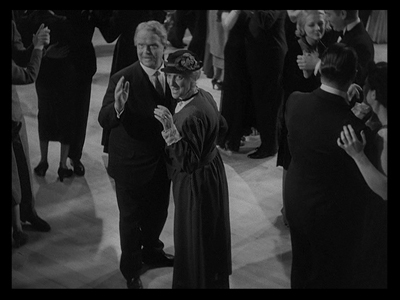
The 1937 film Make Way for Tomorrow is the story of Ma and Pa Cooper, an elderly couple who have been together for fifty years. They now find themselves as victims of their time, and Leo McCarey's sweet drama is also very much a product of that time. It reflects the economic state of the world the Coopers had aged into. Its title has an ironic double meaning: it's a hopeful looking ahead at change, but it can also be barked out like an order, telling the older people to get out of the way. Nowhere in the movie is this more sharply felt than when Ma and Pa step out on the dancefloor to waltz, only for the music to change to something faster they can't step to.

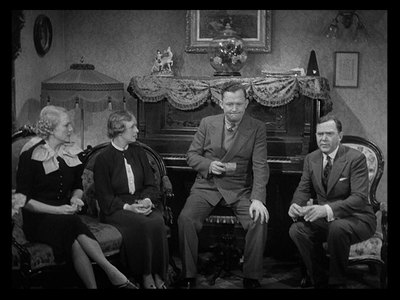
Barkley Cooper (Victor Moore) and his wife Lucy (Beulah Bondi) had five children together, and they summon the four of them that still live nearby to their childhood home to tell them that the bank is foreclosing on the house. Though they were given six months to vacate, they've waited until the last minute to tell anyone. The good son, George (Thomas Mitchell), realizes that any plans that can be made on the fly won't be ideal, they will have to split the old folks up. He will take his mother to live with his family, a three-hour drive, and his sister, the cold shrew Cora (Elisabeth Risdon), will put up their father. The plan is for the other sister, Nellie (Minna Gombell), to reunite both parents at her home in three months, something her husband (Porter Hall) quickly puts the kibosh on.


Living apart is hard on both the parents and the children. Ma is in the way in George's apartment, having to share a room with their teenaged daughter Rhoda (Barbara Read) and encroaching on how George's wife Anita (Fay Bainter) runs her household. Pa gets sick while out looking for a job, and he doesn't much like Cora's care any more than she likes giving it. Something else is going to have to be done.

Make Way for Tomorrow is a much beloved film. The DVD has testimonies from filmmakers Peter Bogdanovich and Bertrand Tavernier. Roger Ebert recently wrote about it in his Great Movies column, noting how much heart it had and how tough it was. He rightly points out that were this a movie made today, there is no way it wouldn't get stuck with a clichéd happy ending. To be honest, though, for the first 2/3 of the film, I couldn't see what all the fuss was about. I didn't dislike it, it was charming in a quaint kind of way. It moved at a slow amble, and people spoke pleasantly to one another even if the subtext was harsh. Everything about the movie was just so damned reasonable. Sure, the kids were begrudging in their charity and maybe didn't come up with the best plans for helping Ma and Pa out; at the same time, the old folks are kind of annoying.


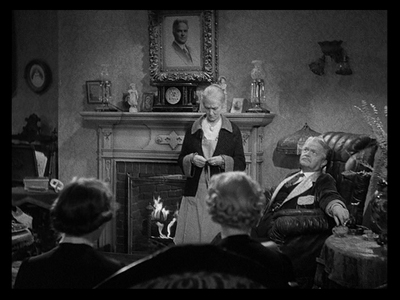
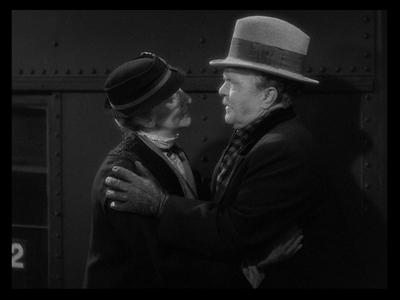
It's only in the third act that everything starts to make sense, when we see at last why everyone is so brittle. Cora decides to use her father's chest cold as an excuse to ship him off to sunnier climes. He'll stay with the absent sister out in California. Knowing she can't go with him, Ma nobly makes a plan to check into an old folk's home, but only on the condition that her husband not be told. George accepts, but he feels like a heel doing it. On the day when Pa is meant to leave, he and Cora meet in New York City for a few final hours together. They are on their own, free of their children, and they start to reminisce. Fifty years prior they had come to New York on their honeymoon. Could maybe some of the old places they visited still be there?


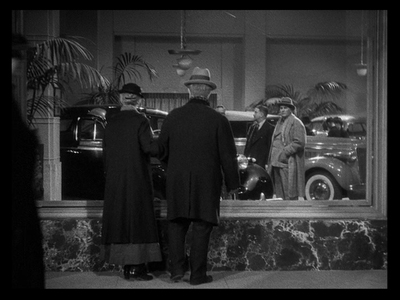
Once the Coopers are back together, Make Way for Tomorrow takes a lovely turn. The spark that has been lacking in the earlier part of the movie was intentionally left out. It's because there is no spark when Ma and Pa are apart. Together, though, oh! What charming people! They are still romantic, still impressed with what makes the other one tick, and comfortable in the way they get along together. It's not just the audience that sees how wonderful their love is, but all of New York City. An oily car salesman gives them a ride, but he has no ill will when he discovers they are broke. The old hotel they stayed at as newlyweds rolls out the red carpet when they hear that guests of such a distinguished age have returned. All the things about this wonderful pair that their offspring could not see are obvious to everyone else. You'd have to be a pretty tough customer not to have tears in your eyes when the bandleader sees that Ma and Pa are lost in his up-tempo rhythms. The part I didn't tell you up above is that he stops the faster number and goes back to a waltz to give these aged lovers more time to enjoy each other's company.


As mawkish as this all may sound, Make Way for Tomorrow stays far away from obvious melodramatic tugs or soppy sentiment. Leo McCarey, working from a screenplay by Viña Delmar (The Awful Truth), who sourced it from a novel and a play, put their faith in the material and in their audience to understand that fifty years of personal history is a long time. It would be easy to mine their story for the easy emotional peaks, but personalities are so much more interesting than plot. Of course, it helps when you have actors as insightful and empathetic as Victor Moore and Beulah Bondi. Moore had been acting in movies since 1915, and Bondi was playing a part well ahead of her years; she would act well into the 1970s, and is maybe best known as Ma Bailey in It's a Wonderful Life. Both actors pull way back for their performances here, giving themselves over to the effects of aging, moving slow, speaking softly, but never slipping into caricature. How fun it is to see Ma Cooper eventually cut loose and have a couple drinks!

Make Way for Tomorrow is a portrait of America as it was still finding its way out of the Depression. On one side, the Cooper children are doing all right and finding prosperity again, but on the other is their parents, part of an older generation that never quite found their way back to the way things were. Part of the kindness the old people find in New York is likely down to people having sympathy for them and also being impressed that they have survived this long. Leo McCarey avoids visual flash in the same way his actors avoid histrionic displays of emotion. These are dark times he is depicting, and though he isn't exactly predicting the Italian Neorealists, he does try to show the world as it was and not how Hollywood dreamed it to be. He also avoids copping out at the ending. A cheerful conclusion would have seemed hollow when there were no easy answers waiting for any moviegoers outside the theatre. It's just like how Jason Reitman left us hanging at the end of Up in the Air, one of the few movies to portray the financial hardships of contemporary times. To say it's all going to be okay would be disingenuous.


It would also probably relegate both movies to the scrap heap. Had Make Way for Tomorrow ended with money raining from the sky, I doubt we'd be talking about it today, much less watching it in a Criterion edition. Hell, this movie even makes fun of those kind of movies, the way Ma Cooper describes the predictable genre picture she saw with her granddaughter. Honesty is what resonates through the ages, what makes a story timeless and universal. I find Leo McCarey's film more hopeful because it shows us two people who can make the best of the worst times, who are resolute, and who never let go of what matters, even if they have to say goodbye to it.


As always, Criterion has put together a great package, and the best part is that Make Way for Tomorrow has multiple new illustrations by one of my favorite cartoonists, Seth. His comic book It's a Good Life, If You Don't Weaken is all about nostalgia for things lost, and recent projects like Clyde Fans and George Sprott: (1894-1975) deal with the effects of age and reconciling the life one has lived. This makes him a perfect choice to capture the charm and emotional beauty of Make Way for Tomorrow.
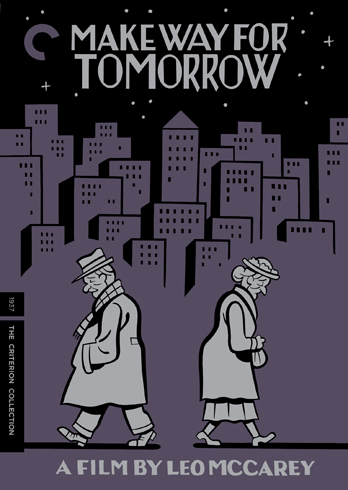
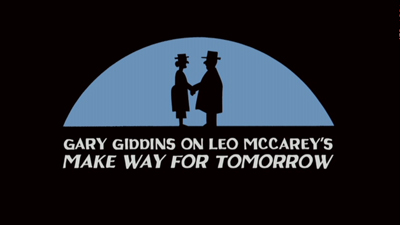




For a full rundown on the special features, read the full article at DVD Talk.