Showing posts with label david lean. Show all posts

Sunday, April 4, 2021

THE MISSION - CRITERION CHANNEL

This review was originally written for DVDTalk.com in 2010.


Roland Joffé's 1986 drama The Mission is a lush, if maybe slightly undercooked, historical epic about faith, exploitation, and redemption. It stars Jeremy Irons as Father Gabriel, a Jesuit monk who has traveled to the jungles of South America to build a church in a remote outpost. His assignment is up in the hills, above a massive waterfall that the previous missionary was dumped over. He was murdered and set adrift, lashed to a rudimentary cross, a sign of how much the Guarani tribe that lives there initially wanted to be converted to Christianity.

The Mission is set in 1750, at a time when foreign interest in this part of the world varied. In opposition to Father Gabriel's more humanitarian goals is Rodrigo Mendoza, played with a subdued fire by Robert De Niro. Mendoza is a slave trader, and it seems the only one bold enough to go that deep into the rainforest to kidnap the Guarani. After Mendoza kills his own brother (Aidan Quinn) in a dispute over a woman, the mercenary seeks his penance in Gabriel's monastic order, giving himself to God and helping to build the mission where the locals will worship.


Unfortunately, just because Mendoza has stopped rounding up the natives doesn't mean that the threat is gone. Both Spain and Portugal have interest in the slave trade and the natural resources found in this land, and they don't appreciate the missions creating productive farming communities that compete with their bottom line. The Papacy, hoping to secure the Catholic Church's position in the region while also maintaining power back home, sends a Cardinal (Ray McAnally) to sort the situation out. Though he presents himself as having an open mind and is even moved by the conversions he sees, he ultimately gives the land to Portugal and orders the various missionary outposts to shut down. The Guarani don't want to leave, and despite the threat of excommunication, the monks decide to stand their ground, as well. Only, the two men split once again. Gabriel will put his trust in his faith and stage a peaceful protest; Mendoza will pick up the arms he previously renounced and fight. Who will be more effective?

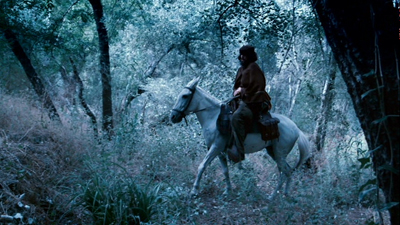
The Mission is a gorgeous movie. It was shot on location throughout South America, with actual indigenous people performing as the movie's extras. Joffé and cinematographer Chris Menges, who won an Oscar for his work, embrace the majesty of the rainforest and the mighty Paraná River. Their awe of the wild landscape is infectious, and the widescreen photography looks phenomenal in high definition. Watch it on a big TV, and you will feel as if you have taken an expedition to the Amazon. It's an immersive experience, particularly with the way Ennio Morricone's vibrant orchestration further envelopes you. This is a movie that dazzles the senses.


I didn't feel quite the same way about the characters, however. The script is by Robert Bolt, who wrote most of David Lean's more famous historical epics, and though The Mission matches those in scope and ambition, it lacks the soul of a movie like Lawrence of Arabia. I mean that in multiple ways, too. Not only did I not feel like I got to know the characters very well or understand exactly what made them tick, but I didn't feel Joffé was able to communicate the spirituality that was essentially the main motivator for everyone. In that kind of environment, and with cold-hearted capitalists serving as enemies to the pure intentioned, it should have been easy. Yet, while the villains are broadly drawn, the heroes seem like mere sketches.

The actors are not at fault for this. The two leads, in particular, inhabit their roles with convincing purpose. Jeremy Irons is soft-spoken and warm, and his expressive eyes carry many scenes, particularly as his communication with the Guarani is either silent or in the untranslated native language. The script fails Father Gabriel in the final portion of the movie, not giving enough attention to his crisis of faith, instead throwing the narrative support behind Mendoza. This rough beast represents the real arc of the movie, going from a calculating egotist to penitent and then somewhere more in the middle, when he must stand up and act with purpose. De Niro is fantastic, squashing most of the easily imitated mannerisms that he is known for, and delivering a cerebral performance. Mendoza is meditative--a thinker--and when you watch De Niro, you can see the wheels turning in his head. It may also be that I identify with his character more than I do Gabriel, who arguably shies away from his personal responsibility in the destruction of a people. Even if one accepts that he had good intentions, his presence in the jungle is as violent an invasion as the Portuguese marauders.

Which I suppose is where the real thematic resonance of The Mission lies: the rich political subtext. By being offered these two men as our identifying figures, Joffé and Bolt ask us to wrestle with our own conscience. Which would we be? The idealist who embraces nonviolent protest, or the one who acts when circumstances demand a response? It could be that neither option is ideal. The only thing that is sure is neither worked for those caught in the middle.


Friday, July 20, 2012

PYGMALION - #85


The most telling business in the 1938 film version of George Bernard Shaw’s Pygmalion comes about 2/3 of the way into the story, and it would be easy to dismiss as a throwaway comedic bit if you aren’t paying attention. Professor Henry Higgins (played by Leslie Howard, who also co-directed) is walking up his staircase, delivering what he assumes will be the last word in an argument. No sooner has he punctuated his sentence than he trips on the stairs and completely undermines the authority he has so tenuously laid out. Howard has a quick reaction before he gathers himself up and goes the rest of the way up the stairs, and in that nearly imperceptible instance, he sets the stage for the changes to come. In that moment, Henry Higgins experiences doubt in his own perfection.

It’s the cap of one of my two favorite scenes in the Leslie Howard/Anthony Asquith production of Pygmalion. Shaw’s play was based on the classic myth of the sculptor who chiseled his own perfect woman and brought her to life, and it would later be the basis of the musical My Fair Lady [review]. This brisk pre-War production is a better realization of Shaw’s original, however, sticking closer to the complex ideas. Indeed, it should, since Shaw wrote the screenplay himself. Pygmalion is a philosophical drama masquerading as a romantic comedy, and the Lerner and Loewe adaptation leans heavier on the light heart without working as hard to justify it.


For the unfamiliar, Professor Higgins is a linguist who specializes in British dialect. On a night out observing Cockney accents in the wild, he meets both one of his more revered colleagues, Colonel Pickering (Scott Sunderland), and a common flower girl named Eliza Doolittle (the splendid Wendy Hiller in her first role). Higgins makes an offhand comment about being able to tame the girl’s wild speech to such a degree that anyone would believe her a proper lady, and though he thinks nothing of it after it is said, Eliza takes it to heart. She shows up at his house the next day and asks to be given elocution lessons. Higgins and Pickering do her one better, concocting a scheme to transform the lower-class working girl completely.


What follows is a grueling course of language lessons, makeovers, and etiquette classes, culminating in a night out where Eliza charms the upper crust. The point now proved, Higgins thinks his work with the girl is complete. She is distraught at having been abandoned so completely, having harbored feelings for her stern teacher. (I am sure someone has written on the father issues at work here; Eliza’s own father is a drunken lout (Wilfrid Lawson) who “sold” his daughter to Higgins for a five-pound note.) When she leaves, after having verbally gutted Higgins thoroughly and completely, Higgins realizes he has feelings for her as well.


It’s actually that post-party sequence that ends in Higgins stumbling on the stairs. So many previously buried issues are dug up in that scene, it ends up being more memorable than even the heavier conversation in Pygmalion’s penultimate sequence, when the pair has it out for real. In this earlier argument, Shaw’s writing proves more agile. Higgins and especially Eliza say plenty of important things to each other without saying them outright, and the way they dance around touchy topics ends up revealing more about who they are than had they been more overt in their expression. Eliza very clearly sees the division between the classes and knows what is expected in less savory male/female transactions; Higgins dismisses the humanity possessed by others in deference to his own pride. Comparisons are regularly made between the Pygmalion myth and Mary Shelley’s Frankenstein, and Shaw is clearly aware of the thematic connection. He goes so far as to have Higgins refer to Eliza as a “creature” here. She is not human, she is an invention. The teaching montages are filmed at odd angles, distorted and exaggerated, partially comedic and partially macabre, looking like the heightened reality of a mad scientist’s workshop in a horror movie. Eventually, Eliza does feel marginalized, as if she is less of a person, and thus her anger stems from getting no credit for putting Higgins’ teachings into practice. He thinks the tutoring is the be-all and end-all, the student is as immaterial as the original corpse from which Igor has pilfered the body parts.


Were he not to trip on his way out, it would be impossible to see Henry Higgins as anything but a vain, self-important monster himself. In Pygmalion, hubris is undermined by comedy. This is most effectively employed in my other favorite scene. It happens much earlier in the picture, the morning after the night Eliza first comes to Higgins’ home. When he and Pickering sit down for breakfast, the professor’s maid (Jean Cadell) lectures Higgins on how to properly behave with a woman in the house. All of the faults that she highlights, including swearing, impatience, and slovenliness, are ones that Higgins has no self-awareness of, even if they are obvious to everyone around him (including the audience). It’s Higgins’ greatest fault: an oversized self-regard.

Leslie Howard is quite good as Higgins. He’s easily better than Rex Harrison, who is more known for the role due to My Fair Lady. Harrison’s portrayal was all braggadocio, with the actor seeming to approach the part from a position far above it. His ego wouldn’t let him stoop to the ugliness the role requires. Howard gets the puffery, but he also gets the pettiness. He’s particularly childish and nasty before he finally humbles himself.


That said, the true star here is Wendy Hiller. She is marvelous as Eliza Doolittle. She deals with the early comedy quite readily, including a hilarious scene when Eliza gets her first real bath, but without ever condescending to the character. In her hands, Eliza is a pure being with admirable intentions: to make herself better. Her determination gives over to efficiency, and she proves how valuable she can be when given the proper respect and the proper tasks. (One wonders how this escaped being an example seized on by Betty Friedan in The Feminine Mystique.) Her breakdown prior to her departure from Higgins’ house is heartbreaking--all the more so for the lack of histrionics. She approaches this perceived failure with the same determination she used to chase success.


This initial confrontation and the showdown that follows are both meaty and rich with ideas. The last “big” scene in Pygmalion shows the creation dismantling her creator piece by piece. Theirs is a layered argument, and one that you will likely end up conflicted about. There is no cut-and-dried meeting of the minds. Eliza asserts her independence and equality, and Higgins both accepts and applauds the same. He also maintains his own responsibility for her metamorphosis. She couldn’t have gotten there without him, and getting her there, ironically, has made him dependent on her. (A good modern analogue for this might be the dynamic between Don Draper and Peggy Olsen on Mad Men, particularly when considering the events in Season 5. Maybe, also, the film Secretary [review].) They acknowledge the common ground, they reaffirm their individual rights to traverse it, and then and only then can they come together under some semblance of love. What makes it interesting is that, in a way, they do this in order to accept more “traditional” roles of a male/female dynamic. The last line of Pygmalion is Higgins insisting that Eliza fetch his slippers, the ones that earlier she threw at his head. He doesn’t even look at her when he says it, and yet she’s happy to receive the command. It’s simultaneously conformist and iconoclastic. Rejection of a way of thinking opens the way to accepting it.

Both have grown and are happier for it, and they are now free to be who they want to be and, better yet, be that together.


Sunday, July 1, 2012

DAVID LEAN DIRECTS NOEL COWARD (Blu-Ray) - #603


One was an accomplished film editor looking to move up the cinema ladder, the other a successful playwright ready to embrace motion pictures in full. David Lean, the man who would go on to make Lawrence of Arabia and Doctor Zhivago, two of the biggest big-screen epics of all time, began his career on a relatively moderate scale by comparison, but teaming with a writer as popular as Noël Coward (A Design forLiving) was somewhat epic unto itself. The pair made four films between 1942 and 1945, showing increasing progress across the quartet and culminating in a genuine masterpiece of romantic cinema. Criterion finally collects all of these movies under one banner, David Lean Directs NoëlCoward, boasting new high-definition transfers and a healthy selection of bonus materials.

I reviewed the movies in the set separately for this blog, but you can read them compiled together, along with notes on the technical specs, over at DVD Talk.


Saturday, June 30, 2012

DAVID LEAN DIRECTS NOEL COWARD (#603): THIS HAPPY BREED (Blu-Ray) - #605


There is a breezy simplicity to the 1944 Lean/Coward collaboration This Happy Breed that almost completely obscures the ambition of the piece. Based on Coward's original play, David Lean's team--including Ronald Neame on script and camera, as per usual--remove any staginess from the production and create a seamless history of one family's ups and downs from just after the end of World War I to the sketchy days just prior to World War II.

Robert Newton and Lean regular Celia Johnson star as Frank and Ethel Gibbons. Following Frank's discharge from the service, the Gibbons family--two daughters, a son, Ethel's mother, and Frank's sister--move into a home on High Street in London. Next door is one of Frank's army buddies, Bob Mitchell (Stanley Holloway, My Fair Lady [review]), and so this new homecoming is also like a reunion. Bob has one son, Billy (In Which We Serve's John Mills [review]), who wants to be a sailor, and he will eventually fall for Queenie Gibbons (Kay Walsh). The length of their relationship is one of This Happy Breed's many subplots.


The script moves swiftly, leapfrogging over the years, showing the changing times through the news, popular entertainment, and the advancement of technology, particularly the radio. The film examines just about everything: the influence of Communism and workers strife, increasing freedom for women, crackpot spirituality, and the encroaching winds of war. Parent and child disagree and then find common ground. Hotheaded youth succumbs to everyday life. Babies are born, family members die, and through it all, Frank and Ethel persevere, growing older and more gray. This Happy Breed is punctuated with two drinking binges by Frank and Bob--one midway through the picture on the night that Queenie disappears and the other near the end, when Neville Chamberlain woos England into believing that war is being averted. The men represent a generation that has seen much trouble in their time, and who are cautious about how easy it will be to avoid such trouble again.

This Happy Breed is phenomenally compact, and yet it doesn't sacrifice depth of story or character. It would have been rather easy to rely on cliché and stereotype, and in some ways, that happens--the other daughter, Vi (Eileen Erskine), falls for a rabblerousing Bolshevik (Guy Verney) who ultimately settles into the expected role of wage earner and social conservative--but the brilliance of Noël Coward's dialogue is how he uses average conversation to reveal so much about the people engaged in the talk. These are people really saying something, not just filling the time between opening and closing credits. One of the best scenes is when Frank gives his son, Reg (John Blythe), advice on the day of his wedding. Robert Newton nails the speech, covering his nerves with a stern, fatherly tone, and Coward's writing expertly dances around sensitive issues without resorting to trite euphemism. Frank says plenty about the birds and the bees both without ever mentioning either by name.

This Happy Breed doesn't build to a big crescendo. Rather, the story evolves to a natural place, and life's changes dictate how the Gibbons family will exit their cinematic excursion. In many ways, it reminds me of William Wyler's The Best Years of Our Lives, even if it is on a completely different continent and on the opposite side of WWII. The drama is never overwrought, the sentimentality never mawkish, and the decisions never easy, holding up a compelling mirror to an audience who likely had no difficulty recognizing themselves in the faces in the glass.


Monday, June 25, 2012

DAVID LEAN DIRECTS NOEL COWARD (#603): IN WHICH WE SERVE (Blu-Ray) - #604


All you need to know about the demeanor of 1942’s In Which We Serve comes from a scene three-quarters of the way through the nearly two-hour movie. A sailor of a lesser rank receives a letter that says his superior’s wife and mother have been killed in the blitz, and he has to go and tell the other man the bad news. They speak plainly, their voices maintaining a hushed reverence. It’s the epitome of the cliché of British reserve. Forget the upper lip, everything is stiff. And if you want to know just what kind of drama this propaganda production is, the scene ends with the younger man telling the older patriarchal figure that, though that fellow’s family is dead, his own wife survived and had a baby. One generation passes away, and another carries on.

The first collaboration between David Lean and Noël Coward had one specific purpose: to celebrate the troops and prepare a nation at war to handle the hard times ahead. There will be loss and heartbreak, but there will also be much to be proud of. The British Navy? Best there is!


In Which We Serve is a somber picture. It was instigated by Coward, who not only wrote, but he co-directed with a young David Lean and also starred in the movie as Captain “D.” Lean had worked on other movies, editing notable pictures like Anthony Asquith’s Pygmalion and the Archers’ own propaganda piece The 49th Parallel [review]; however, excepting some uncredited work directing sequences of Major Barbara [review], he had never worked behind the camera. Coward brought him on to aid in helming this dream project: a tribute to the Royal Navy that would attempt to portray true naval life. In this, In Which We Serve is successful. It’s one major recommending point to this day is its incredible footage of the naval ships being built and operated. It’s celluloid as essential to the historical record as any wartime documentary.

This stuff is fascinating, as is some of the battle footage. The filmmakers don’t overdue it in the combat scenes. The visual language for overly dramatic fight sequences was perhaps not yet developed, but there is something riveting about the unadorned nature of the skirmishes here. Shot from the ship’s deck, these scenes largely feature men taking coordinates, loading guns, and firing as the German ships circle back and forth, emptying ammo clips and dropping bombs. Sure, it’s a little dry, but the whole of In Which We Serve is dry. Even when it is melodramatic, it’s as dry as Noël Coward likely preferred his martinis.

The careful measurement of In Which We Serve’s narrative is both a fault and a virtue. While it likely served to rally the British people behind their armed services without hitting any regrettable racist caricatures or resorting to jingoist language, the lack of blood and guts ultimately drags. In Which We Serve is a long movie, easily too long. The upside is that Coward has invented a fantastic structural conceit for the film.


In Which We Serve begins out on the ocean as the HMS Torrin contends with a Nazi squadron. They end up beating the German’s ace pilot, but not before he delivers a crushing blow. A handful of men make it overboard, and they cling to a life raft, watching their ship sink and reminiscing about what got them there. The main focal points are the Captain (as played by Coward), and two men in his service, one an officer and one a lower-ranked enlisted man (the ones mentioned at the outset, and played by Bernard Miles and John Mills). We see the captain’s family, complete with wife (Celia Johnson) and kids, alongside the officer’s childless but loving marriage and the younger man’s new romance. He marries just before shipping out (his wife is Kay Walsh). The back-and-forth structure, including the captain’s own underwater reverie, dreaming of his beloved in anticipation of drowning, allows us to see how the camaraderie of warriors develops and also look at the consequences back home. How the battle affected the loved ones who were left behind must have been of utmost concern to the English populace.

All of the lead actors are very good, with Mills being the most memorable as the always-genial Shorty Blake. The most striking supporting performance, though, comes from a very young Richard Attenborough, stepping on screen a few years before his creepy star turn in Brighton Rock. Here he plays a disgraced soldier getting a second chance. Attenborough makes for a very convincing onscreen drunk.

Despite neither Lean nor Coward having directed before, and forgiving the overlong running time, they show an assured hand while dealing with an extremely ambitious, complicated production. Combat footage is never easy, and I would guess particularly not on the water. In Which We Serve never looks faked or chintzy. It’s a quality war picture, and even if it is totally dated, it serves its purpose.


Sunday, June 10, 2012

DAVID LEAN DIRECTS NOEL COWARD (#603): BLITHE SPIRIT (Blu-Ray) - #606


Released the same year as Brief Encounter [review], David Lean’s adaptation of Noël Coward’s hit comedy Blithe Spirit couldn’t be further in tone from what would become the duo’s unassailable masterpiece, and yet thematically, they are actually pretty close in terms of their deeper narrative concerns. At the heart of Blithe Spirit beats questions of conjugal love, infidelity, and a cast of characters who soldier on together even when the soldiering gets rough.

Rex Harrison leads the cast of Blithe Spirit as Charles Condomine, an upper-class author content with his posh lifestyle, so much so that there is even some suggestion that his writing isn’t as good as it once was. Charles is married to Ruth (Constance Cummings), who is his second wife. She seems an able companion for him. Their senses of humor are in line with one another, and she goes along with his mad ideas. The current one is to have a medium come to their home for a séance. Madame Arcati (Margaret Rutherford, also in Asquith’s The Importance of Being Earnest) is the village joke, but she’s exactly the punchline Charles is waiting on: he is hoping to learn the art of the spiritual charlatan for the latest mystery he is penning.


Naturally, since this is a light comedy, that floating table holding the crystal ball is going to turn, and Charles is going to get what is coming to him. His first wife, the late Elvira (a saucy Kay Hammond), has been a presence in his house since her passing seven years ago, even if only as a topic of discussion between Charles and Ruth. Arcati’s shenanigans make that presence far more real: Elvira has returned as a ghost, one that only Charles can see and hear. His panic and the seemingly one-sided conversations he has with the ghost cause a rift with the understandably irritated second wife--but that’s only the beginning of Charles’ supernatural woes.

Blithe Spirit is, at a surface glance, charmingly toothless. The comedy is light and airless, playing rather innocently with the notion of a restless afterlife. In other words, it’s as far from spooky as you’re likely to get. Watching it actually reminded me of what a big fan of the Topper films I was as a child. I very much liked the idea of having spectral friends that only I could see, standing by my side, helping me out of scrapes. (Naturally, I was also on Jimmy Stewart’s team any time I watched
Harvey.) Blithe Spirit made me want to revisit Topper to see if it’s as harmless as I remember.

Because, of course, being a Noël Coward script, Blithe Spirit’s frothy appearance masks some darker, more mature undertones. There is much one can infer from the coded barbs that were the author’s trademark. (Such as, the suggestion that the previous maid got a sudden case of the marrieds because she was pregnant; it was only 1945, after all, and censorship being what it was....) Ruth’s jealousy of the unimpeachable, crystallized image of her predecessor gives way to a truer picture of Elvira when the dead woman returns and we see how she icily bullied her husband as a matter of foreplay. Presumably since they no longer have to get along by way of corporeal cohabitation, the veil between Charles’ romanticized feelings for Elvira and the side effects of her acidic promiscuity start to become more clear.


The ensemble cast is perfectly gung-ho and able-bodied. They stay committed to Blithe Spirit even when some of the slapstick gets clunky. (Lean’s direction seems to grow more wooden in direct proportion to how silly the story gets.) Rex Harrison adheres pretty closely to the Rex Harrison brand, so he is good, but offers few surprises here (none of that nastiness that makes his turn as Henry Higgins stand out amongst his filmography). Constance Cummings and Kay Hammond are both excellent as the wives: one steadfast and plucky, the other sexy and devious. Even better though, is Margaret Rutherford’s performance as the spiritualist. She is an exceptional character actress, and she creates a busy-bodied, addle-brained persona for the old woman. Rutherford’s performance is both physical and verbal, and despite the obvious craft put into it, surprisingly natural.

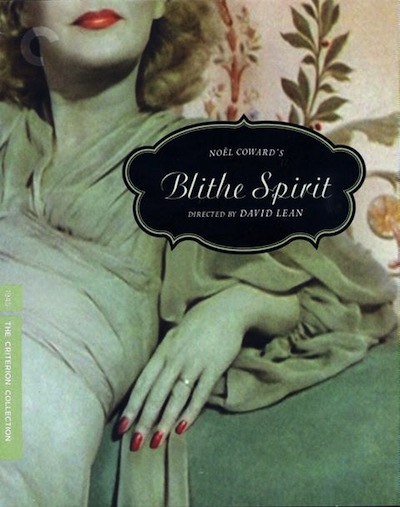
Perhaps more impressive, though, is how Lean and cinematographer Ronald Neame (who also contributed the script) handle Blithe Spirit’s special effects. There is less cinematic trickery here than there are tried-and-true stage techniques. Phosphorescent make-up and matching, flowing robes give Elvira her ghostly pallor. Only the woman’s lips have maintained a lively hue: red, passionate, alluring. Symbolically, the lady has yet to give up her last breath.

Those who have seen Blithe Spirit will know I am being coy in how I doled out that last compliment. There are some surprises to be had in the story’s later acts that, while not necessarily mind-blowing, add to the fun. The pace of the film increases as the situation becomes more desperate and Charles seeks to free himself from being haunted. The final scenes add further weight to the relationships, with us learning that Charles himself was not quite the gentleman he maybe pretended to be. Yet, there is also some validation of these relationships. Coward’s script may not necessarily seem to get behind the sanctity of marriage, but it does land firmly on the side of lifelong companionship--no matter how maddening or begrudging it might become. Some people are just meant to be stuck together.


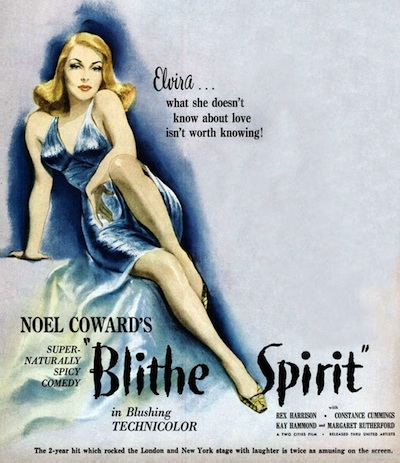
This poster makes me laugh, since it looks nothing like the movie. Compare this lovely still of Kay Hammond below to the paperback novel painting above just to see how different they are.


This disc was provided by the Criterion Collection for purposes of review.


Tuesday, February 23, 2010

GEORGE BERNARD SHAW ON FILM - ECLIPSE SERIES 20


George Bernard Shaw was one of the pre-eminent playwrights of the late 1800s and early 20th Century. He is one of those rare animals who were never bound by form, having written novels, short stories, and criticism in addition to his more famous stage productions. It is unsurprising then that his work would make an easy transition into the newer motion picture medium--and do so with Shaw's approval. The author impressively survived to see the ripe age of 94, finally passing on in 1950. He even won an Oscar in 1938 for his contribution to the adaptation of maybe his most famous play, Pygmalion.

Pygmalion was produced by Gabriel Pascal, and it was part of a fruitful collaboration between the two men. In fact, after Pygmalion, Pascal, who had begun his career making silent films in Germany, only produced Shaw adaptations, and the remainder of his film career is represented in the three films in this boxed set, George Bernard Shaw on Film - Eclipse Series 20. His devotion to Shaw was often as much of an albatross around the filmmaker's neck as it was a boon. Shaw even encouraged Pascal to expand his horizons prior to his death, but the director/producer only outlived his beloved writer by four years.

The movies in George Bernard Shaw on Film - Eclipse Series 20 span eleven years, 1942 to 1952. They consist of one wartime love story and two historical movies, one an epic and the other an allegorical comedy. They are linked only in as much as they came from the same mind. Shaw had an interest in human nature, and he was particularly fascinated by and critical of inconsistencies in behavior. From a Salvation Army mistress intent on rescuing the lost from eternal punishment to the vagaries of kings and man's limited capacity for beliefs other than his own, Shaw dissected hypocrisies with a clever wit and often withering disdain.


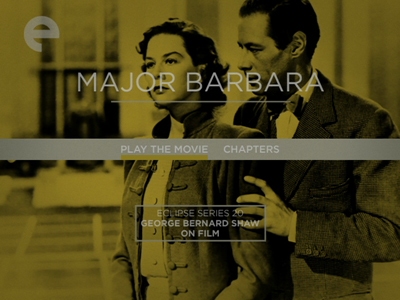
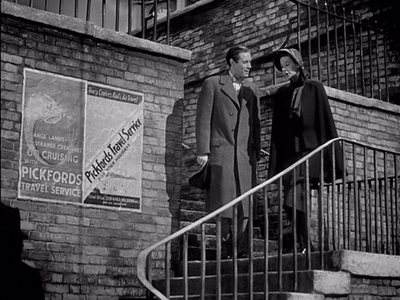
Major Barbara (121 minutes) was made in 1941. It is an updated version of Shaw's 1905 play, brought into modern times, and though the signs of WWII are everywhere--much of the sets show the damage done in the Blitz, and in fact were shot during those attacks--the actual war is mentioned little. The Major is not in the fighting forces, but a soldier in the Salvation Army. Played by the wonderful Wendy Hiller, who also starred in Pygmalion, she is a firm believer in every man's right to earn forgiveness in the eyes of God. Fearless and forthright, she has yet to meet the sinner who can stand up to her. Even the cynical scholar in Greek classics, the unfortunately named Adolphus Cusins (Rex Harrison, who starred in the Pygmalion retooling My Fair Lady years later), is willing to go along, drumming in the Army band just to be close to his new fiancée.

Barbara also has the distinction of being the eldest daughter in the Undershaft family, a well-to-do clan whose estranged father has gathered their fortunes from the spoils of conflict: he manufactures cannons. When Andrew Undershaft (Robert Morley) returns to settle some family business, he is challenged by his daughter give her religious lifestyle a serious look. He challenges her in return to consider taking over his factory. When daddy and a whiskey magnate donate heavily to the Salvation Army, bailing it out of its economic tailspin, it challenges Barbara's belief in what it takes to set right one's soul.


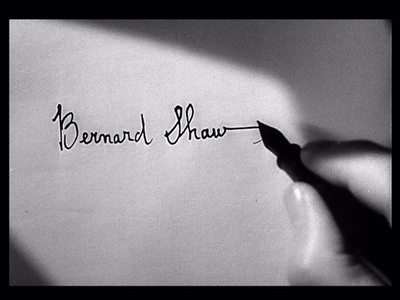
Major Barbara begins with a handwritten letter from Shaw, asking audiences to trust his vision and see his film, which was directed by Gabriel Pascal with assistance by David Lean and cinematography by Ronald Neame, as a parable. Indeed, much of what happens is abstracted from real life, and except for the juxtaposition of the war-torn backdrop, there is little here that is not purely cinematic invention. Which isn't meant to say it doesn't strike some actual emotional chords; Shaw understands this canvas better than any other, and he builds a large cast that not only includes the Undershafts, but gets into the lives of the people Barbara intends to help. She squares off with Bill Walker, a cockney bruiser played by Robert Newton, who suggests there are more practical concerns in the here and now that take precedence over the hereafter.


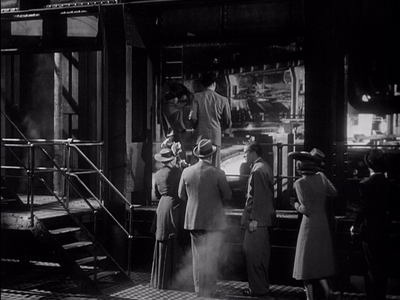
The film takes a strange turn in its third act. After Barbara rejects her rank, daddy offers her an alternative: she can believe in industry. The Undershafts and Adolphus visit his factory, and we see all the steel products the symbolically named Undershaft and Lazarus manufacture--not just the end product, but we also see footage of the mills at work. Andrew Undershaft has built a community for his workers, a kind of modern utopia where families live and toil in one big compound. It's not exactly socialism, more of a moralistic capitalism, and when Barabara sees even Bill can get on the straight and narrow once he's got something to do with his hands, she envisions a whole new avenue for rescuing men from damnation.

This ending is a bizarre mix of patriotism, capitalistic propaganda, and pro-worker jingoism that is pretty close to Bolshevism. (Adolphus is also rallying for workers rights at the start of the picture, which is its own bizarre story point.) It's hard to know how to take it, though, because there is almost an ironic falseness to it. In the last shot, you practically expect Hiller, Harrison, and Newton to wink at us. How much of this is satire? It's weird and over the top, a la Tony Richardson's The Loved One (still more than 20 years off). It left me scratching my head.


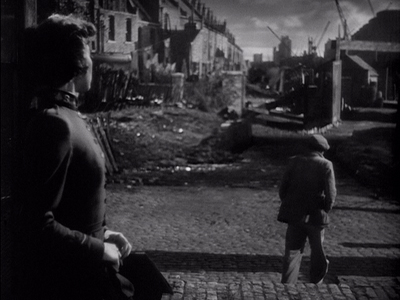
It also didn't really matter. Though most of the cast is pretty much playing stock roles, Wendy Hiller is so good as Major Barbara, the script is practically secondary. She's plucky and attractive, but she moves Barbara away from being a type and into something more authentic after her break with faith. Scenes of her alone, contemplating her heart as a bombed-out London sits in shadow behind her, make the whole movie seem rich and complex where once it came off as a mere trifle.


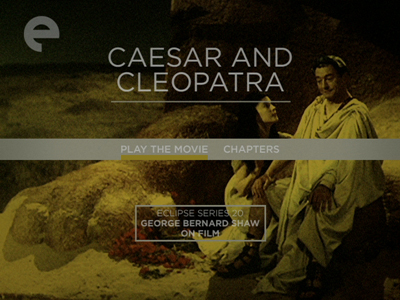
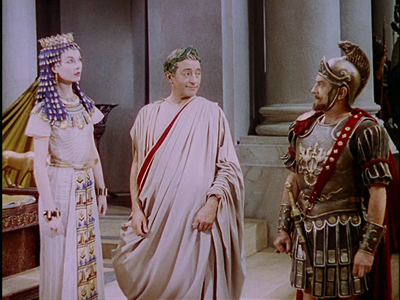
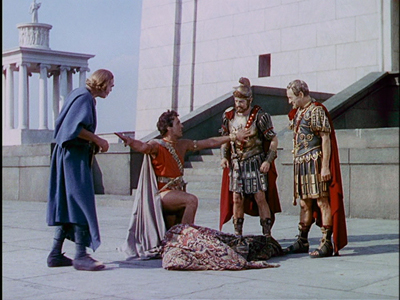
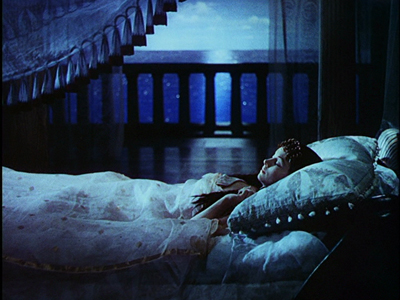
As perplexing as some of the ending of Major Barbara might be, I'd give up clarity for good not to have to sit through Caesar and Cleopatra (1945; 128 minutes) again. Once again directed by Pascal, it is based on a play written by Shaw at the turn of the century. The historical pageant is the story of how Julius Caesar (a sleepwalking Claude Rains) went to Egypt and met the precocious, overgrown adolescent Cleopatra (Vivien Leigh, on loan from David O'Selznick, as her credit tells us). The fearful Egyptians flee before the Roman might, convinced they are cannibals, and they somehow let their queen run off by herself to hide inside the Sphinx. To add insult to the improbable, Caesar meets her when she interrupts his soliloquy to the monument. He is smitten with her ditzy ranting, and takes her under his wing.


As far as epics go, Caesar and Cleopatra lacks any blood or thunder. The gears of war are clogged in red tape. Caesar roams around stating his case with a blithe vocabulary. The Egyptians say he will never rule, Cleo's tween brother is the true king; the occupying Roman army that came before Caesar says they'll keep the country they've conquered for themselves instead. Meanwhile, a Sicilian artist named Apollodorus (Stewart Granger) wanders in and out of scene, sporting a tan and bleached teeth, looking like he's misplaced his surfing movie. There's a lot of talking, but not much seems to be said. The script has traded wit for circular conversation. It's all a ghastly bore, as Caesar's British slave might say.


I can see what must have appealed about the original script. Cleopatra has an interesting arc, learning to be a political animal under Caesar's Mr. Miyagi-style tutelage. He laughs at her silly schemes, sprinkles a few homilies like fairy dust, and then walks away so she can simmer in the message. By the end of the movie, she's no longer cowering behind his skirt, but instead sending her scary witch (Flora Robson) to kill her rivals. Vivien Leigh is pretty terrible in the role, however. The writing does all the growing for her. Her performance as young Cleopatra consists of wide eyes and bubbly tones; adult Cleopatra scowls and speaks with a hiss. Pascal's production is just as false. The Technicolor spectacle never really looks convincing. Its grandeur is that of a backlot set.


Apropos of nothing, though maybe it serves as its own commentary on Caesar and Cleopatra, after I finished watching the DVD, I left the still menu sitting on the TV screen while I got my computer and prepared some food, etc. I left it up for about five minutes before I realized the pug I was babysitting was barking at it and not something outside on the street. Was it the color of yellow on the graphic, irking him like a red rag to a bull? Or was he just so sick of seeing Claude Rains and Vivien Leigh, he couldn't stand anymore? Not sure where he gets off if it's the latter, since he got to sleep through most of the movie.


There's a theory, most notably advanced by Orson Welles, that color is not the filmmaker's friend, that it exposes blemishes and distracts from the essentials. Perhaps that's part of Caesar and Cleopatra's problem, because the other Roman drama in this set, 1952's Androcles and the Lion (98 minutes), and its black-and-white rebuilding of the Coliseum works in all sorts of wonderful ways.

Gabriel Pascal takes a backseat here, still smarting from the box office failure of Caesar and Cleopatra (the seven years between productions, apparently, was not by choice). Chester Erskine (A Girl in Every Port) takes over directorial duties, adapting the Bernard Shaw play with co-writer Ken Englund. They've brought the story to life with a light comedic touch. Alan Young, who is probably most famous as the owner of the talking horse on Mr. Ed, was typecast as a lover of animals from the get-go. He plays Androcles, a big fan of furry creatures and a persecuted Christian who is the top of an alphabetical list of Jesus freaks sentenced to a date with the lions. While on the run, the gentle and bumbling tailor runs across one of those dreaded lions in the wilderness. Said king of the jungle has a thorn in his paw. Androcles removes that thorn, he and the big cat become friends, and Androcles even names him Tommy.


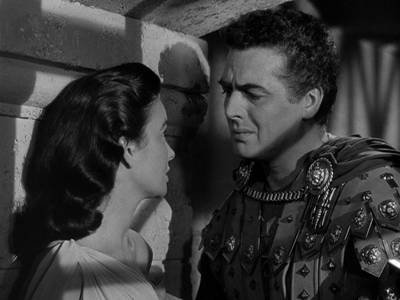
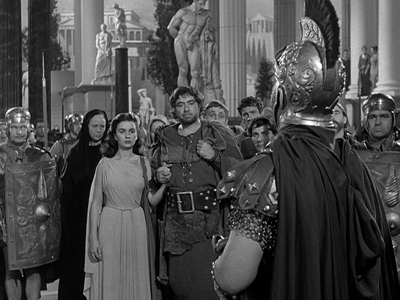
Androcles is arrested shortly thereafter, joining a band of merry Christian soldiers on a trek to Rome and the Coliseum. They travel under the guidance of a stern but thoughtful legionnaire, known only as Captain (Victor Mature). These curiously happy prisoners make him curious about what makes them so joyful, especially when one of them turns out to be a rather attractive damsel. Lavinia (Jean Simmons) is a true believer who takes no guff but is truly tender-hearted. Also amongst the group is Ferrovius, a bruiser with a crazy reputation. He apparently is quite the effective missionary, though his methods may be slightly off script. He is played by Robert Newton, who does the same Keith Moon impression here as he did in Major Barbara (though, I guess it's more likely that Moonie nicked the routine from him, given that Keith wouldn't even have picked up a pair of drumsticks yet). His testimonials are a highlight of Androcles and the Lion, and his character is far more interesting than Simmons's. She is merely a pretty face, and the romantic subplot with her and the Captain is predictable and shallow. Alan Young is the humorous glue of the piece. He orbits the other characters, adding corny asides, biding his time until the climax when he is reunited with Tommy. Their tango in the gladiatorial ring is funny in good ways and bad. The editing is really poor, making it painfully obvious that Young isn't actually with the lion most of the time, and the guy in the lion suit when the two of them quite literally dance is unintentionally hysterical.


Androcles and the Lion is kind of an odd duck. On one hand, it's pretty good secular entertainment; on the other hand, it wears its messages on its sleeve. That message is less pro-Christian than it is pro-tolerance. In fact, the heavier the Christian rhetoric, the more clumsy it seems, particularly given the anachronistic nature of much of what is said. Though Shaw's play dates back to 1912, the fable's message against persecuting people for their ideas and beliefs is one that was fairly common in 1950s pop culture. Shaw disliked hypocrites, and the verbal victories that Lavinia and Ferrovius win throughout the movie are usually in pointing out how their persecutors could just as easily have their own religion turned against them were they not in power. Androcles's love of all animals is meant to promote a respect for all living things, a respect that was often lacking in the contemporary political climate (as it often is now).

The scenes where Androcles's faith is tested on the arena dirt are actually pretty powerful, at least before the dance sequence. The movie goes on a little too long after that, everyone missing their cue to exit, but Androcles and the Lion is still an amusing distraction. I found myself laughing enough to forgive its quaint foibles, and it makes a fine companion to Major Barbara, even if we must take Caesar and Cleopatra in the middle.


For a full rundown on the special features, read the full article at DVD Talk.

Thursday, January 14, 2010

CHE - #496

"We now are in a time period where if a film doesn't receive unified acclaim, then it's viewed as damaged or a failure or something worse, and that's unfortunate. I don't feel there's a sense anymore that a movie can be polarizing and that can be a good thing. It's literally what is the number that you got on Rotten Tomatoes and if it's below a certain number, then your movie's not any good. You can imagine the number 2001 would have gotten on Rotten Tomatoes...."

- Steven Soderbergh, from the Making "Che" documentary, DVD 3


Few people have earned the level of respect I hold for Steven Soderbergh. When I first saw Che, the director had brought the roadshow version to Portland's Cinema 21, answering audience questions after a marvelous marathon showing of the movie in full. I've met plenty of people whose art inspired me over the years, and I usually have no problem keeping my cool. When I met Soderbergh, I got nervous and twitchy. My voice shook as I handed him a copy of one of my books, a small fantasy playing out in the back of my head that I would eventually get a call that he wanted to option it. One hopes that no matter how successful a person gets that they could continue to have such fantasies. Why do you think Barack Obama invites musicians he likes to the White House?

I have a feeling that Steven Soderbergh is also someone who still hangs on to his fantasies. The audacious creativity he shows from film to film leaves little doubt he dares to dream. In a way, he's a throwback to the directors who came up through the studio system in Hollywood's Golden Age, guys who never knew what their next assignment would be. Like how Robert Wise's first two movies were a historical drama and a horror movie, followed eventually by film noir, a boxing movie, comedies about oil lobbyists, war stories, corporate intrigue, and eventually some of the most popular musicals of all time. The difference is that Soderbergh has cinematic history to back him up, and he not only jumps around from subject to subject, genre to genre, but he picks and chooses what time frame he wants to emulate. Out of Sight was a 1970s crime picture, as much a character study as it was a plot-driven heist movie; The Good German emulated the 1940s in a bold and blatant manner; The Informant! laced in elements of 1960s screwball to underscore its story, especially with its Marvin Hamlisch soundtrack. Soderbergh also regularly returns to the cheap, arty indie fare he helped set the standard for with sex, lies, and videotape.


There are few filmmakers who would undertake a four-and-a-half hour, two-part biography of Che Guevara, insisting that it be filmed in Spanish to make it more authentic. Which came first? Soderbergh's mad plan or the jokes about Vincent Chase wanting to do the same thing to make Medellín on Entourage? At one point, Vinnie was even going to be replaced in the role of Pablo Escobar by Benicio Del Toro.

Che turned out better for Soderbergh than Vincent Chase's film did for him, even if it wasn't a huge box office hit. (Though, given Soderbergh's cross-platform release, making the movie available through cable on-demand services at the same time it toured theatres, it probably did better than most folks think.) It's doubtful anyone involved with Che set out to make it thinking it was going to make massive money. This is a movie like Warren Beatty's Reds, one that was made precisely because it was such an artistic gamble. It's something that both filmmakers needed to do, consequences be damned.


Beatty and Soderbergh likely looked back at the same influences when they made their films (and who knows, Soderbergh might have actually looked to Reds). Namely, I see Che as a modern political epic on par with the big movies of David Lean. In particular, Lawrence of Arabia, the story of one man, a controversial figure, who travels great lengths across harsh environments to get to his goal. Both Che and Lawrence of Arabia have two-act structures, with the break between Part I and Part II signalling significant change for the man. The difference with Soderbergh's picture is there is almost an air of "just the facts" to how Soderbergh and writers Peter Buchman and Benjamin A. van der Veen put the narrative together; there isn't the same sweep of drama that marks the Beatty and Lean.

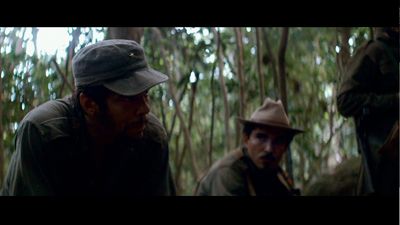
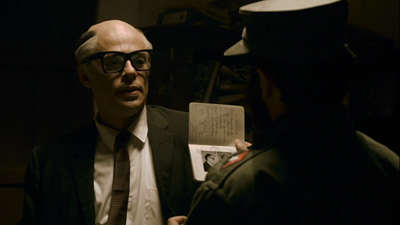
Part I of Soderbergh's film is the story of Ernesto Che Guevara's part in Fidel Castro's overthrowing of General Batista and claiming revolution in the name of the Cuban people. Benicio Del Toro starts the movie as the clean-shaven doctor joining the political cause, and he ends it as the hairy guerilla fighter immortalized on a million T-shirts and posters on college dorm walls. This portion of the movie covers three years, 1956 to the start of 1959, tracking the drive of Castro's forces from the coast of Cuba inland toward Havana. Intercut with this is black-and-white footage of Che visiting the United Nations in 1964, talking to the press, rich American intellectuals, and the whole of the UN, making a case for Cuba's independence. This is the first visual distinction Soderbergh makes in Che, contrasting the colorful and rich greens of the Cuban jungle with the newsreel-style footage in New York, which is meant to reflect how the world actually would have seen Che Guevara on his visit to the States, beamed out to them on their television screens.
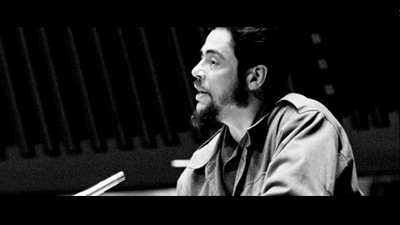


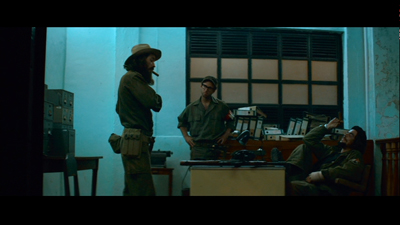
There is another major difference, though this one perhaps unintentional. The New York scenes are shot in an almost cinema-verite style, more loose and off the cuff. It's possible that Soderbergh is making a kind of cinematic pun, using the free-floating shooting techniques of the French New Wave, matching their filmic revolution to Che's political revolution. By contrast, the colorful Cuban scenes are more traditionally choreographed, with the camera often rooted in one spot. The Santa Clara sequence in particular looks and moves like an old-school battle scene, like something out of a John Sturges movie. Efficient, business-like, but still full of tension.
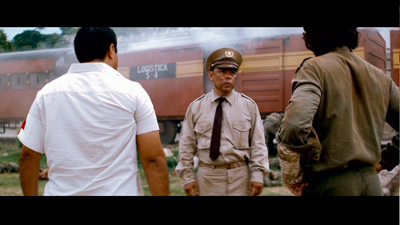


Che was the first movie to be shot entirely with the RED One Digital Cinema camera, and the device freed Soderbergh--who shoots his own films under the name Peter Andrews; also, look for him briefly as the television director when Che is getting interviewed for "Face the Nation"--to experiment and change his style and have it flow seamlessly from one look to the next. Part I of Che is shot in the very wide aspect ratio of 2.35:1, just like a big budget color movie from the 1950s or '60s, whereas Part II is a more restrained 1.78:1. This is meant to illustrate the nature of the two sides of the story. The Cuban campaign is large, full of promise, and triumphant; the Bolivian offensive is cramped, dirty, and ultimately a failure. Che spends most of the time trapped in a forest, unsure of how to get out, and so the screen boxes him in, as well. The color palette even changes. Part II is dirty, brown, and gray; it's sickly and sun-bleached.


Benicio Del Toro plays Guevara as an enigmatic, distant creature. He is kind of the quintessential Del Toro character, actually, as Del Toro's natural presence tends to put him a step or two removed from the audience. Many remember him first seeing the actor as the indecipherable Fenster in The Usual Suspects. In that role, language made him unknowable, which was also a component of how we perceived his character in his other collaboration with Soderbergh, Traffic. In that movie, he played a Mexican cop who eventually became entangled in a U.S.-based drug sting, and though his was an essential component of the movie, he was also separate. Foreign. Likewise, as Dr. Gonzo in Fear and Loathing in Las Vegas, he was practically a hallucination, a sidekick who didn't exist outside of Hunter Thompson's field of vision. It will be interesting to see how this quality comes into play in his performance as Lawrence Talbot in the upcoming The Wolfman remake.
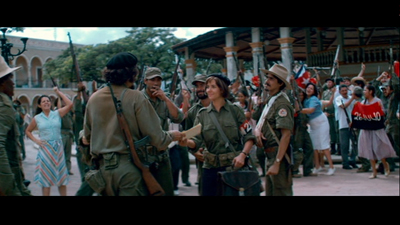


Throughout the first half, Del Toro's Che is a purposeful speaker. He is nearly humorless, completely dedicated to his mission, dogmatically so. He doesn't travel across the Cuban countryside as a warrior so much as he comes across as a missionary, a holy man ready to spread the gospel. As Soderbergh shows him, he talks his way toward Havana, be it convincing the peasants that he has come to help, motivating his troops, or negotiating with enemy officers. Some have complained about this saintly portrayal of the man, believing any film that doesn't get into the atrocities he committed toward his political enemies could never be an accurate depiction. To get into that period of Guevara's career, however, would probably require a third part to the movie, one that would sit uneasily with these two.


The way I see it, Soderbergh, Buchman, and van der Veen weren't concerned with the right or wrong of Guevara's mission. They aren't taking any sides. In fact, you could say they abstract the character to make him the mission and nothing more. Che in this movie comes to embody the revolutionary impulse, the living icon, more than just a face on a shirt. His entire life becomes about the next liberation. Part I of Che ends by flashing back to the portentous first conversation with Castro, where he agrees to join the cause if Fidel (played here by Demian Bichir) promises he can take the fight to all of Latin America once they have freed Cuba. Part II is then the portrait of a man whose single-mindedness takes him too far off the rails. He subsumes his own identity to the socialist ideal. In the opening scenes of Part II, we see Che in disguise, renouncing his Cuban citizenship (if in gesture only) and heading to Bolivia, not just unrecognizable to us, but also to himself. He is a personality in crisis.
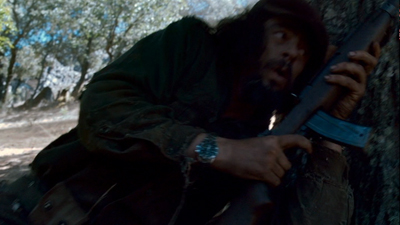


Che spends almost a year, 1966 through 1967, wandering around in the Bolivian jungle, sinking further into the morass of his own idealism. The hubris of righteous belief is taking for granted that everyone else will get on board; the Bolivians do not. The man seems to retreat into himself. He goes by a different name, never allowed to be who he really is, and his asthma all but knocks him down. The motivational speeches are almost entirely gone, there is no more of the smooth-talking rebel. Del Toro physically transforms himself, letting his hair and beard grow long, changing his posture to be more hulking. Che has been turned into a freakish outcast. By the end of the movie, his myopia has so overtaken him, we are literally looking through his eyes.
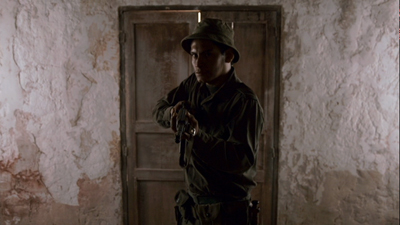


Part II is so mired in disappointment and failure, I am not sure there is any way for Soderbergh to keep it from dragging. The endless trek through the jungle starts to look the same after a while, which puts us in the shoes of the soldiers, but it may also put some people off. The Bolivian troops are a lot more anonymous than the Cuban rebels Che commanded. We don't get to know them, there aren't the distinct personality types. In Cuba, we had the teenagers who grew up in the rebel army, we had Little Cowboy and his cowboy boots, we had Che's fellow officers, who teased and joked with him, and we also had Aleida (Catalina Sandino Moreno from Maria Full of Grace), the love interest that lurked around the edges. Here, Che takes little interest in his soldiers. He's not educating them, his attitude has changed. While in Cuba he rejected a sixteen-year-old as being too young, in Bolivia he says that's an age where a man is old enough to know what he wants. This keeps the guerillas detached from the audience. Which, again, is accurate, but not as involving. Can we fault a filmmaker, though, for making us feel in a way that is appropriate to the subject?

Che ends with a brief shot of Guevara back on the boat that first carried him into Cuba, reminding us of the youthful promise he once represented, but now colored by all that has followed it. In this last shot, Del Toro somehow looks older, and he now appears pensive. It's a reminder of how far we've come, from that point until now, and the way we see Che is with a new perspective. He has become a man on a collision course with destiny, and we are left to wonder if it was all worth it. The hope of yesterday dies amidst the deluge of too many tomorrows.
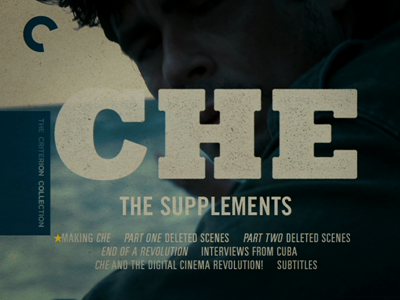


Criterion's release of Che is a three-disc set, packaged in one of their beautiful booklet-style boxes, featuring Eric Skillman's trademark photo illustrations. Each part of the movie is given its own disc, and the third disc is all supplements. The thrust of the extras is history--the history of the production and the history behind it. The film and its winding path from conception to completion is covered at length in a 50-minute making-of documentary. Those curious about how Che came about and why the production team made the choices they did will be more than satisfied by this lean, forthright peek behind the curtain. Even the criticisms the film's detractors leveled at Che are addressed. There is also a separate documentary about the use of the RED One camera that should please tech heads. Soderbergh even touches on the fact that Che the man was considered a cold personality, and addresses my query regarding the tone of the movie: he wanted Che the film to be chilly like Che the man.*

The commentary for both movies is by Jon Lee Anderson, the author whose biography Che Guevara: A Revolutionary Life was the major source material, alongside Che's diaries, for the movie. Anderson describes the intersection of fact and cinema. Soderbergh was intent on showing only events that could be backed up with historical documentation, and Anderson in turn backs the director up in his goal. There are also new interviews with other historians and people involved in the real events on DVD 3, alongside a 1967 British documentary about Bolivia's situation at the time Che's mission failed called End of a Revolution. This 26-minute program was aired on Granada's "World in Action" in England, and begins with images of Guevara's corpse. Talk about a cold opener!


There is a deleted scene from Part I where Che tells one of his men that he needs to build a hospital in a remote area. The man asks how, he doesn't have the supplies. Che, unbending tells him to figure out a way. This small scene encapsulates the figure: he saw what needed to be done and never wavered from the conviction that it could and would be done. Whatever it took, he'd figure it out. That was how he lived, and that also embodies this production. Against all odds, the people behind Che figured it out. They saw a movie to be made, and they got it done.

And for the record, Che's score on Rotten Tomatoes is currently at 62%.


* As a glimpse inside my process, I always nail down the body of my review before I watch the extras so as to formulate my own opinions free of the influence of others. So, in a case like this, if I have a question that is answered in a bonus feature, I really did ask it and try to wrestle with it myself before stumbling on the revelation. That said, Soderbergh also mentions John Sturges, and so it makes me think that Sturges came to mind for me because the director must have also mentioned that influence when I saw him speak last March.


This disc was provided by the Criterion Collection for purposes of review.