A few more Criterion DVDs are going out of print, so you should look over this list from today's announcement and seek out the ones you need before they are gone. Criterion titles regularly go up in value once out of print, and if these are indeed more titles moving to Lionsgate, then the quality of the next releases could be questionable.
I've reviewed several of the discs listed, so if you are on the fence, you can read about those again to help make up your mind:
Billy Liar
The Discreet Charm of the Bourgeoisie
The Milky Way
Touchez pas au grisbi
If you plan on buying any of the disappearing titles from Amazon, please use the search box in the sidebar to get there, or any of the links in the reviews. If you do, I get a small kickback from your purchase, store credit that could lead to me getting more discs to review.
Thanks, and happy hunting!
Friday, June 11, 2010

Wednesday, June 9, 2010
MYSTERY TRAIN - #521
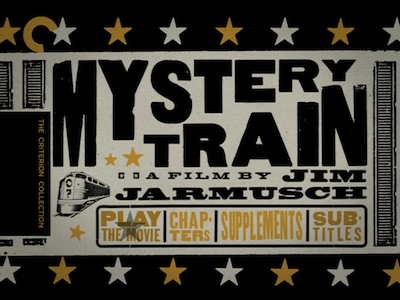
The song "Mystery Train" is only sixteen lines long, one for each car in the train being sung about. Of those sixteen lines, only half of them are unique. The remaining eight are repeats of the other eight. Its sparseness, however, is the source of its mystery. Co-written by Sam Phillips, owner of the legendary Sun Studios, and popularized by Elvis Presley [listen here], the song could easily be taken as a simplistic early-rock shuffle. Let it be, however, and it turns into something strange, sad, and haunting. Those sixteen lines only say one thing: that a train came from nowhere, picked up the singer's lover, and then left for parts unknown. Anything beyond that is up to the listener. What is this train? Where is it going? Who is inside?
Jim Jarmusch chose the song as the title for his 1989 film. Mystery Train is a love letter to Memphis, the home of Sun and Graceland, amongst other musical landmarks. It's also it's own haunting riddle--though a light-hearted one. Jarmusch's film, which he both wrote and directed, is a trilogy of distinct stories, each carrying their own passengers, but each linked like the coaches on the titular vehicle. Memphis is the destination, and a hotel at the heart of town the train's central station.
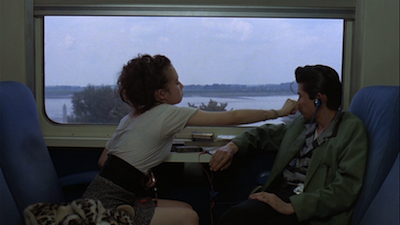
The first story in the film is "Far From Yokohama," the story of a pair of Japanese teenagers on a romantic tour of the famous spots of American rock 'n' roll. Mitzuko (Youki Kudoh) is a cute teenybopper who adores Elvis Presley, while her stone-faced boyfriend, Jun (Masatoshi Nagase), prefers Carl Perkins. He has adopted the rockabilly style, including a slick-backed pompadour and a silver Zippo that he wields like a killer with a butterfly knife. The couple are both fish out of water and wide-eyed innocents, their foreignness making them stand out while also representing the inclusiveness of the music. Jun doesn't say much, but when he does, it's important. Staring out his hotel window, he can only marvel at the excitement of being 18 and free to visit Tennessee.
Arguably, Jun and Mitzuko could also be said to merely be tourists in someone else's genuine experience--decades later, from a land somewhere distant. If Elvis and other white men stole rock 'n' roll from African Americans, then how far removed are these travellin' teens? Jun isn't the only one to dislike Elvis, who permeates just about every scene in Mystery Train. His portrait hangs over the bed in every hotel room, and the point is made that even though the hotel is in a black neighborhood and serviced by black employees, it's owned by whites. On one hand, it's cultural tourism; on the other, a great unifier.
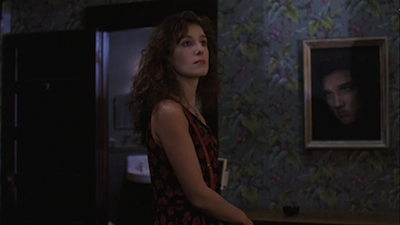
Not that Mystery Train is a political film; truly, I digress. Chapter 2, in fact, immediately gets a little more serious, but also much more silly. "A Ghost" is the tale of Luisa (Nicoletta Braschi), an Italian stuck in Memphis waiting for a connecting flight to take her husband's body back to Rome. She goes into the city to kill time, and the trusting Luisa is conned by just about everyone she sees. A magazine seller (Sy Richardson) guilts her into buying more than she needs, and a creepy bunko artist (Tom Noonan) tries to sell her a story about Elvis's ghost sending her a message. She happily goes along, but give an inch, and this guy takes a sinister mile. Luisa ends up at the same hotel as the Japanese kids, in the room next door even. Luisa also ends up sharing these digs with a motor-mouthed woman down on her luck (Elizabeth Bracco), an act of charity and happenstance. By the end of the night, Luisa witnesses the true magic of Elvis and his city, as baffling and seemingly inconsequential as that may be.
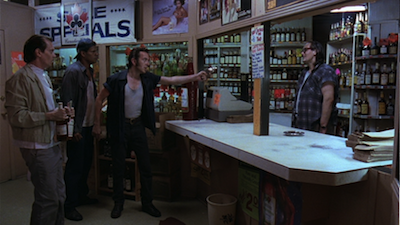
The third story, "Lost in Space," gives us three local boys--though the two white guys are transplants, one from England and the other from Jersey. On a drunken night out, the guys are turned into fumbling criminals by the rash actions of one of their crew. Johnny (played by Clash-frontman Joe Strummer) is having some problems, not the least of which is that everyone keeps calling him Elvis, much to his chagrin. (What else you going to call a white guy with a pompadour? Morrissey, maybe?) Johnny and his pal Will Robinson (Rick Aviles) just got laid off from their jobs. (Will Robinson doesn't need an annoying nickname, he has enough reasons to hate his real name. Danger! Danger!) Johnny is also the guy that the woman rooming with Luisa is running out on. Her brother is a barber named Charlie (Steve Buscemi), who is the runt of this particular litter. Drunk off his ass, Johnny shoots a liquor store clerk (Rockets Redglare) when he says something racist about Will, and the guys go on the run, though that largely means circling around town. They eventually hole up in a cursed room in the hotel. Jarmusch throws in a great gag: the Elvis painting in that room is not of the cool King of 1956, but the bloated elder monarch.
All three stories in Mystery Train intersect in small ways. The Japanese kids pass Charlie outside his barber shop, and Luisa hears them having sex through the walls. All the stories have the same late-night fulcrum: Elvis singing "Blue Moon" on the radio (Tom Waits voices the DJ). And then, of course, they end up at the same hotel, all on the same floor, and each shocked into the oncoming day by a gunshot. The night clerk at the hotel is played by the incomparable Screamin' Jay Hawkins, and I am not sure if it's the "I Put a Spell On You" singer's reputation or his bright red suit that makes him seem like the gatekeeper of the underworld. He doesn't act all that demonic here, he's actually pretty calm and even kind. He and his bellhop (Cinqué Lee, brother of Spike) act as comic relief, the mystified observers who see all these travelers coming through their town.
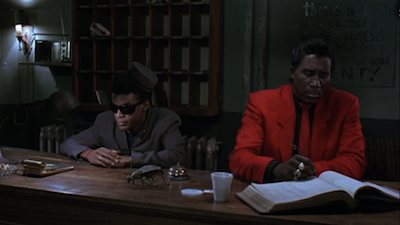
The Memphis of Jarmusch's world works as a kind of Mecca, drawing people its way, a stop on the journey looking for something else. It clearly holds its own attraction for the filmmaker. Mystery Train is as much a document of the infamous locale as it is a fictional narrative. Jarmusch and his regular cinematographer Robbie Müller lovingly capture the rundown sights, following the characters as they walk the streets, keeping the shots wide so that we can see everything they may not. Sun Studios is strangely disappointing, small and clinical looking. Other important spots are left to decay. Is that really the Stax studios all boarded up, only marked by the name spray painted on the outside?
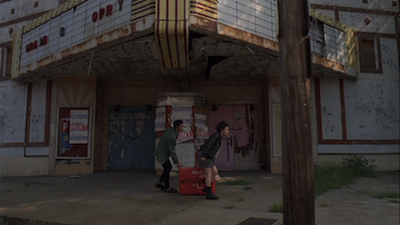
Though the city has clearly fallen on hard times--excepting, most likely, the unseen Graceland--Jarmusch and Müller find a unique beauty in it. The homes they pass have distinct shapes and colors, and the businesses have an aura of lost Americana. Perhaps this is what the travelers are searching for. Memphis is like the Purgatory between the paradise of dreams long past and the reality of the future. Rock is the flashpoint of our desires, the train is carrying away the youth and hope it represents.
In the end, like the locomotive in the song, Mystery Train the movie comes and goes, giving little explanation. Everyone but the night clerk and the bellhop move on; Screamin' Jay and his mosquito-legged chimpanzee (as he calls him) continue to be the stewards for the rest of us. Jarmusch avoids sewing it all up. The meaning is what you choose to take from it. Like the best rock songs, it seemingly a lark, something designed to move the audience, even if just temporarily; at the same time, like those tunes, it worms its way into your head, inviting further rumination and new visits. I just saw it, and I kind of want to watch it again.
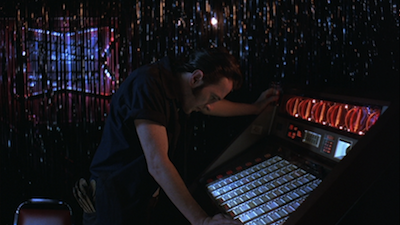
The new Criterion release of Mystery Train is a fantastic package. It's my first time seeing it (and I think completes my Jarmusch education), so I can't comment directly on how much this is an improvement over the previous DVD release, but considering how good the Criterion updates of the MGM back catalogue have been in the past (including Jarmusch's Stranger Than Paradise), I'm fairly confident that this new transfer is light years ahead of what we've seen on disc before. The colors are gorgeous, and the landscapes really come to life. I also love that Jarmusch left a hair in the bottom of the frame in one scene. It's such a natural accident, it feels oddly quaint to see something like it these days.
The history of the location and the music is further explored in a new documentary on the disc, and we also get excerpts from a Screamin' Jay Hawkins documentary. Mystery Train is the kind of film that should inspire its fans to want to know more about what it is paying tribute to. If nothing else, go get some Rufus Thomas records. (He appears on the soundtrack [listen to "Memphis Train"], and he's also the guy who asks Mitzuko for a light in the train station.) Special mention needs to be made of another excellent package design. The front cover emulates old road show posters for touring musical packages, the DVD itself is made to look like an old 45 record, and a double-page spread in the booklet shows the labels from the original 45s for songs featured in the movie. As a music geek, I couldn't be more thrilled.
This disc was provided by the Criterion Collection for purposes of review.
Sunday, June 6, 2010
BY BRAKHAGE: AN ANTHOLOGY, VOL. ONE - #184

I tried to watch By Brakhage: An Anthology, Volume One a couple of years ago, but didn't make it very far. A darkened room, a bottle of sake, and a bunch of silent, "experimental" shorts--well, it ended up being a Friday night of me sleeping in my chair.
This isn't a negative comment on the film library of Stan Brakhage, nor is it really a negative comment on me. It just is what it is. I simply had no real idea what I was signing up for. I don't know what I expected, but it was not grainy, disjointed, and let me stress silent short films. I tried to go in cold and open-minded, and it didn't work.
The video store near my house had Jim Shedden's documentary Brakhage
 , and I vowed that before I attempted An Anthology again, I'd rent that and learn a little more about the subject, give myself some kind of foundation for understanding the man and his work. It was a good choice, as Shedden gives the uninitiated the basic groundwork for understanding Brakhage without doing all of the heavy work for us. He's armed me with the basic tools to approach Brakhage while still leaving me room for personal interpretation.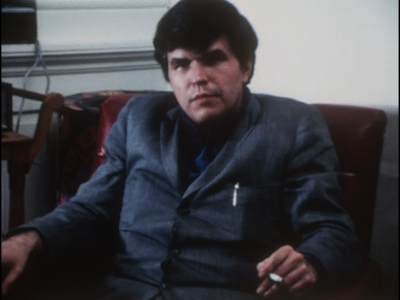
Stan Brakhage appeared on the art scene in the 1950s, at a time where traditional methods of expression were being dismantled in favor of something more personal. Perhaps it was a reaction against the conformity of the decade, perhaps it was an attempt to make a code so that the McCarthyites and other squares could not understand what was really happening. Maybe as a precursor to rock 'n' roll, the Beats and the avant-garde jazz musicians were pushing against the solid mass of post-War idealism. Into this, enter Brakhage and other new cinematic voices. Non-narrative, non-linear, their films are now called "psychodramas," and their intent was just as that sounds: a realization of the mind's abstractions, tales of the interior rather than the exterior. These were often surreal, without proper form, but one thing they were not prior to Brakhage was "first person." The filmmaker turned the camera from an outside observer looking at others to a single-person observer representing the filmmaker himself.
(Digression: I find the term "experimental" as applied to any artistic endeavor to be troublesome. As I interpret the notion of an experiment, particularly as it stems from scientific origins, is that an experiment entails putting two or more things together and seeing how they interact. The results are unpredictable, and they are what they are. There is no altering the outcome. In terms of cinema, there can be an element of randomness in what the camera captures, but the filmmaker is not beholden to the outcome. There is still choices to be made, and thus the material is manipulated. For instance, the artists chooses what to show, when to start and when to stop a shot, etc. If the final product goes beyond simply reporting the findings of the "experiment," is it still an experiment?)

There are twenty-six films on Criterion's two-disc first Anthology. The idea of reacting to each one film-by-film is daunting, to say the least. To interpret every short work here would require a particular critical rigor, especially since the films aren't really intended for traditional cinematic dissection. Stan Brakhage's shorts are meant to inspire a response that is often beyond articulation. The way he plays with light, the fleeting passing of images, is meant to leave an impression on the viewer and elicit a response that is often emotional, sometimes intellectual, but also somewhere beyond the ability of either to fully explain.
The set starts off easily enough. The first selection is 1954's "Desistfilm," the chronicle of a late-night party. It is one of the few movies in the collection to have sound, though the accompanying music is as dissonant in relation to the images as the images are in relation to one another. The camera here serves as a party guest, roaming the crowd, looking for someone to connect to but finding each of the other guests involved in their own thing. Given how inane some of the activity is, it quickly becomes obvious that this is likely staged rather than documentary. But if it weren't, which would be more self-indulgent: the action recorded or the act of recording (and exhibiting) said action?

It's a fair question, and one that certainly comes up watching the second film, 1959's "Wedlock House: An Intercourse." Brakhage records himself and his first wife, Jane, at home, moving in and out of shadow, catching small snippets of their lives together. The longer, more defined scenes involve them having sex, which is shown in graphic detail but projected in negative. Thus, the sex becomes otherworldly, almost as if we are seeing beings of living energy. (The Pander Bros. would achieve a similar effect in the 1990s with their infrared porno The Operation.) Yet, what are we to take away from Stan and Jane recording the minutia of their lives for all to see? Brakhage intended to meld life and art as one, but like reality television, is the act of living for the cameras something other than reality? (To be fair, much of these questions arose even before seeing "Wedlock House." In his Brakhage documentary, Jim Shedden shows pieces of autobio films made by Stan's friends and contemporaries that the subject wandered into, and the clips struck me as horribly self-involved. In the digital-video age especially, the act of turning a camera on oneself inspires the worst kind of narcissism. Hell, the whole internet age--the act of blogging!--has convinced us that our every brain wave is worth sharing. [For more of my thoughts on this subject, see my old piece on Jonathan Caouette's Tarnation.])
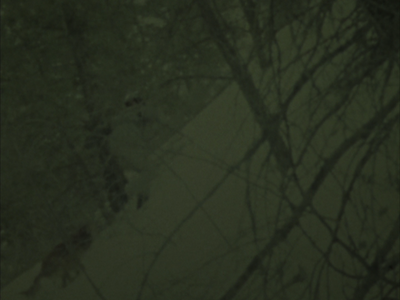
Not that Brakhage only kept the camera trained on himself and his loved ones. Though his film "Dog Star Man"* does show footage of the filmmaker and his pooch trudging through the snow in search of wood to chop, it also shows us many other things: landscapes both natural and man-made; the sun and the moon; the human body, both inside and out; water; babies; indistinct colors that shift like ink. Divided into five parts and clocking in at over an hour, "Dog Star Man" practically constitutes an epic in the Brakhage canon. Shot and edited between 1961 and 1964, the filmmaker plays with layers in this piece, overlapping his images so that two divergent tracks converge and melt together. He messes around with focus, movement, even readjusting the lens in mid-shot, stretching and distorting the captured object. His intention with all of his special effects was to replicate how we actually see things, how the eye moves as opposed to how a camera moves.
Similarly, his choice to forego audio was so that the viewer could provide his or her own soundtrack. Brakhage believed that the brain would create its own "music," as suggested by the tempo and arrangement of the imagery. If he provided music, it would create entirely different cues. Indeed, I admit to having cheated while watching "Dog Star Man". I thought Brian Eno's ultra-minimalist ambient piece Neroli
 would be quiet enough to help me stay engaged without interfering with my viewing--I have a very hard time sitting in silence--but even something as reductionist as that still created happy coincidences between sound and vision.** Then again, it's not as if we can ever watch a film in complete silence. Even turning down all my volume controls so there would be no hiss in my speakers, there was still the noise of my ceiling fan, my cat cleaning herself, and the hum of my own ears.
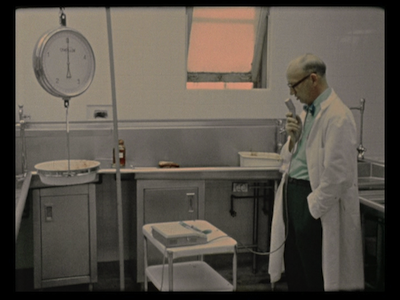
Stan's artistic intention is blatantly stated in the title of "The Act of Seeing With One's Own Eyes," the final part of Brakhage's famed Pittsburgh Trilogy. In this half-hour piece, Brakhage films in a Pennsylvania morgue, silently chronicling the bodies and autopsies. The absence of commentary does leave the viewer to only look, to absorb what is being shown, perhaps really looking at death in such gruesome and ghoulish detail for the first time in his or her life. It's strong stuff, and it closes out the first DVD in such a way that made me feel as if humanity could be and had been abstracted. This is life in all its detail. In all its absence of detail.
DVD 2 contains the bulk of the films in the anthology, and in addition to Brakhage's continued exploration of the filmed image, it also shows his shift into working without a camera at all. Brakhage's photographed shorts play out as living paintings, but in these other works, he approaches them as literal paintings. In some cases, he found ways to add paint and other substances to the movies through various means of construction; in other cases, he worked with the raw film itself, painting directly on the celluloid. "Mothlight" (1963) is one of his best known films, and it pioneered his abstract collage technique. In this case, he worked with a perforated tape to make a facsimile of film strips, and he put color and objects on them. When the resulting film prints were run through a projector, it created the illusion of movement and constructed images, including flapping insect wings. He used the same technique for his very short 1981 film "The Garden of Earthly Delights." In less than a minute and a half, Brakhage creates the sensation of being surrounded by foliage.

In 1972's "Eye Myth"--Brakhage's shortest piece, clocking at just 9 seconds--he paints around images of a man, and it alternately looks like the man is either being engulfed in the pigmentation or emerging from it. The same year, he used paint on a clear surface in front of the camera to create subtle changes over a landscape in "Wold's Shadow;" later, he'd paint on glass for other films, including 1994's "Black Ice."
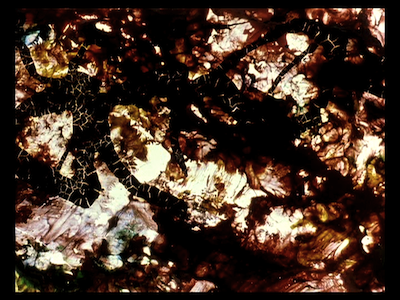
"Dante's Quartet" from 1987 shows Brakhage burying faint images under gobs of color, making his own abstract versions of Hell, Purgatory, and Heaven. For "I...Dreaming" a year later, his tools weren't so much paint, but text and music, applied with the same collage-like manner (it's one of the handful of selections with soundtracks). Text is also used in "Untitled (For Marilyn)," posing existential questions amidst a symphony of acidic blobs. Various shots of windows show them as more than gateways to seeing, but perhaps like the cliché goes, a stand-in for our eyes and thus visions of our souls; there is even a crying out to God.
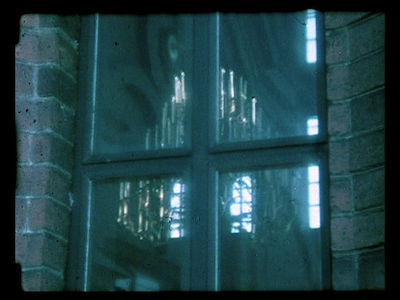
In some cases, Brakhage moved away from the concrete footage entirely, working with color to create ever evolving paintings, like the wall in a modern art museum come to life or an artist's easel engaging in a ballet. "Nightmusic" is a series of interconnected images creating one continuous effect, whereas "Rage Net" continues the experiment further through altering the strips of film before laying down the paint, creating unexpected special effects. 1991's "Delicacies of Molten Horror Synapse" uses a violent rainbow of shading to recreate the effect of television on the eye, ultimately melting away to reveal the pattern lines of a TV screen itself.
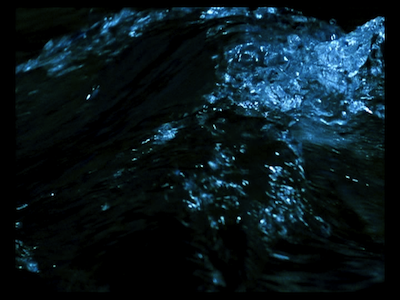
In the mid-'90s, Stan Brakhage was diagnosed with cancer of the bladder. In a case of poetic irony, one theory is that the paints and film elements he used were a cause of his illness. Unsurprisingly, his films started to examine his own mortality, and perhaps none so poignantly as one of the last films on By Brakhage: An Anthology, "Comingled Containers" (1997). The short subject is a collection of footage of water, shot in extreme close-up, sometimes so you can see the actual movement of the liquid, sometimes so that the bubbles and currents are right in the lens, appearing like glass jellyfish, storm clouds, and even in some instances like the blurry light of an x-ray. Water is the stuff of life, and like life, it can be contained yet never wholly imprisoned. Man is his body, but he is also something else. Imagination, spirit, essence--whatever you call it, it can't be held in our fragile frame.
From what I gather, this is a primary belief of Brakhage's. Much of his work is a testament to the freedom of the imagination. His lack of artistic boundaries, his expanding mode of expression, was his ultimate comment on life: what we can dream, we can see; what we can see, can be shown.
There is now also a second part to this series, and both parts are bundled together as Blu-Ray release
 . Expect a review of the second collection in the coming weeks.
* Not to be confused with Suede's seminal album Dog Man Star
 , though, given some of his other tastes, the band's lyricist Brett Anderson would most likely cite Brakhage as an influence. Anderson's reordering of the title was meant to represent the ascendency of the individual. By nature, we start out low, rise to a certain distinction, but ultimately aspire to something more brilliant.
** Though eventually Eno's music was completely out of step with the frenetic editing in the latter parts of "Dog Star Man."
Monday, May 31, 2010
SIDELINE: MORE REVIEWS FOR 5/10
The summer movie season is off to a strange and rocky start. Of the movies I've seen (some I have yet to review), the comedies are killing the action movies 2-1.
IN THEATRES...
* Iron Man 2. Robert Downey Jr. is good, but he's no Scarlett Johansson.
* MacGruber, a surprise comedy hit from the SNL-factory. Somehow the thinnest sketch of all-time has become one of the show's best movie spin-offs.
* Mother and Child, the antidote to that Babies film. Starring Annette Bening and Naomi Watts.
* Prince of Persia: The Sands of Time, a not terrible but not terribly good video game adaptation with Jake Gyllenhaal. Should have been called Abs of Time. Am I right, ladies? Can I get a wut-wut?!
* Robin Hood, the 2010 reboot of the folk hero from Ridley Scott and his glowering muse, Russell Crowe. It is to Robin Hood what "Garfield Minus Garfield" is to the Jim Davis comic strip, except "Garfield without Garfield" is actually entertaining for a couple of minutes.
* The Secret in Their Eyes, this year's Best Foreign Language Oscar winner is a twisty, involving thriller.
ON DVD...
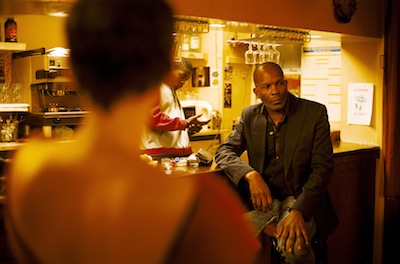
* 35 Shots of Rum, a marvelous Ozu-like drama from Claire Denis.
* The Cry of the Owl, featuring Julia Stiles in a chilled adaptation of a Patricia Highsmith novel.
* The Dukes, a genial comedy about an aging doo wop group trying to get through hard times. Part heist picture, part social commentary, it's flawed but feels good. Written, directed by, and starring character actor Robert Davi, playing alongside Chazz Palminteri.
* Five Minutes of Heaven, a revenge story that goes surprisingly intellectual on us, but not in a good way. Good performances from Liam Neeson and James Nesbitt, though.
* El Mago: Cantinflas is a legend in Mexico, but this 1949 film might make you wonder why; also, Los Tres Mosqueteros, the Cantinflas adaptation of The Three Musketeers could have been funny at about 2/3 the length.
* Mine, an alternately enraging and uplifting documentary about the plight of the pets left behind in Hurricane Katrina.
* The Sun, Russian director Alexander Sokurov's unconventional biopic of Hirohito
IN THEATRES...
* Iron Man 2. Robert Downey Jr. is good, but he's no Scarlett Johansson.
* MacGruber, a surprise comedy hit from the SNL-factory. Somehow the thinnest sketch of all-time has become one of the show's best movie spin-offs.
* Mother and Child, the antidote to that Babies film. Starring Annette Bening and Naomi Watts.
* Prince of Persia: The Sands of Time, a not terrible but not terribly good video game adaptation with Jake Gyllenhaal. Should have been called Abs of Time. Am I right, ladies? Can I get a wut-wut?!
* Robin Hood, the 2010 reboot of the folk hero from Ridley Scott and his glowering muse, Russell Crowe. It is to Robin Hood what "Garfield Minus Garfield" is to the Jim Davis comic strip, except "Garfield without Garfield" is actually entertaining for a couple of minutes.
* The Secret in Their Eyes, this year's Best Foreign Language Oscar winner is a twisty, involving thriller.
ON DVD...
* 35 Shots of Rum, a marvelous Ozu-like drama from Claire Denis.
* The Cry of the Owl, featuring Julia Stiles in a chilled adaptation of a Patricia Highsmith novel.
* The Dukes, a genial comedy about an aging doo wop group trying to get through hard times. Part heist picture, part social commentary, it's flawed but feels good. Written, directed by, and starring character actor Robert Davi, playing alongside Chazz Palminteri.
* Five Minutes of Heaven, a revenge story that goes surprisingly intellectual on us, but not in a good way. Good performances from Liam Neeson and James Nesbitt, though.
* El Mago: Cantinflas is a legend in Mexico, but this 1949 film might make you wonder why; also, Los Tres Mosqueteros, the Cantinflas adaptation of The Three Musketeers could have been funny at about 2/3 the length.
* Mine, an alternately enraging and uplifting documentary about the plight of the pets left behind in Hurricane Katrina.
* The Sun, Russian director Alexander Sokurov's unconventional biopic of Hirohito
Wednesday, May 26, 2010
OSHIMA'S OUTLAW SIXTIES - ECLIPSE SERIES 21

Continuing its tradition of focusing on specific filmmakers at distinct points in their careers, Criterion's Eclipse Series has gathered together five films by Japanese provocateur Nagisa Oshima. Made between 1965 and 1968, Oshima's Outlaw Sixties is a profile of the controversial director as he broke away from the studio system in Japan and started making complex and daring narrative/anti-narrative films that explored taboo subjects and extreme reactions to modern life under his own umbrella. "Provocateur" is not a term I use lightly in this case, Oshima was part of a rebellious zeitgeist. Referred to early on as "the Japanese Godard," his cinematic explorations were of a similar mindset to the Nouvelle Vague crowd, and his independent spirit was in line with what John Cassavetes was doing in New York. Cinema was changing worldwide, and Nagisa Oshima was one of the flashpoints.
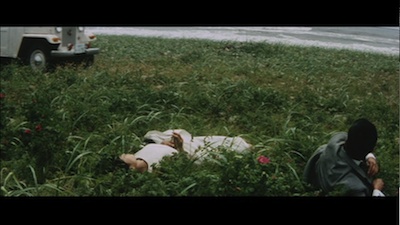
Oshima's Outlaw Sixties begins with the intriguingly titled Pleasures of the Flesh (1965; 91 minutes), the first film Oshima made via his own production company. He wrote and directed the feature, basing it off a novel by Futara Yamada. The movie contains some stylistic choices that would allow Oshima to tap into the popularity of the naughty "pink" genre (essentially, softcore shots of sex and a healthy dose of skin), but at its core, Pleasures of the Flesh is a potboiler, a strange crime film with a unique central concept. Katsuo Nakamura plays Atsushi, an obsessive man in his early 20s who has been pining after Shoko (Mariko Kaga), a young girl he once tutored. He has kept his distance from her ever since her parents persuaded him to kill a blackmailer who had molested Shoko as a child. He borrowed from the philosophy of Hitchcock and committed this crime on a train. It's good advice, and the murder was a near-perfect crime, except Atsushi was spotted by a small-time official who was about to be nabbed for embezzling public funds. He blackmails Atsushi into holding onto a third of the stolen money while he serves his full jail sentence. They have no connection, so the authorities will never know where to look for that portion of the missing cash.
At first, Atsushi dutifully does as he's told, but after Shoko marries another man and it becomes clear that he will never possess her, Atsushi decides to blow all the money. He has a year before the blackmailer will be out of prison, and if he burns through the ill-gotten gains by then, he will kill himself and avoid any further consequence.
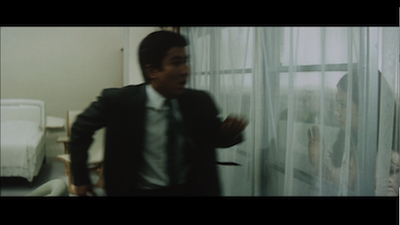
What follows is a series of paid relationships, of Atsushi hiring prostitutes and desperate women to be his live-in mistresses. Most of the women are picked for their resemblance to Shoko, who haunts his mind like a ghost. The various arrangements peter out when other circumstances get in the way. One girl is a gangster's moll, another is married and trying to earn money for her family since her husband is unemployed. The freedom this money provides, and the schism between bought love and the real love Atsushi desires, makes him cruel. He grows bored with the prizes that are easily captured.
Oshima and cinematographer Akira Takada shot Pleasures of the Flesh for widescreen, with garish, fully rendered colors and often startling, abstract compositions. Some of the storytelling is experimental, and so in terms of narrative structure, the film is a little weak. The lock-step construction of your average crime film, where events lead one to another until often the crook falls under the weight of his own guilt, is absent here, replaced by a more breathless rush from one scenario to the next. It works for the large part, though the serial relationships grow a little tiresome before the final quarter of the film finally turns into its last plot twist. Atsushi becomes entangled in ironic coincidences, bringing about punishments he planned to avoid--though not in the ways he would have expected.

Oshima shifts into black-and-white for his 1966 film, Violence at Noon (99 minutes), a choice befitting its serious tone and its themes of duality. The movie is about a love triangle between two women and one man. The man is a thug named Eisuke (Kei Sato), who is also known as the High-Noon Attacker. His nickname was earned on a crime spree. He breaks into homes at midday and rapes the housewives he finds. On the day he is reunited with Shino (Sae Kawaguchi), invading the house where she is working as a maid, he escalates and kills her employer.
Shino and Eisuke come from the same village, and at one point were part of a collective raising pigs and chickens. In with them was the woman who became his wife, the teacher Matsuko (Akiko Koyama). A flood wiped out their livestock, and desperate measures were required. Shino sold herself to a local man of means (Rokko Toura) and ultimately entered into a suicide pact with him. When her own death didn't take, Eisuke took advantage. He rescued her from oblivion, only to force himself on her--a savior who looks for payback.
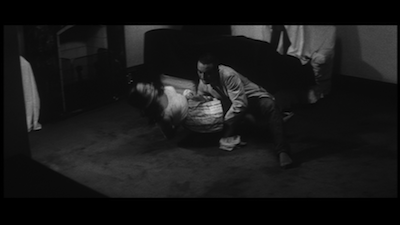
Both Shino and Matsuko are caught between their love for this horrible man and the fact that they know he is horrible. Throughout Violence at Noon, they run away from him but also run toward him. The script by Takseshi Tamura, from a story by Taijun Takeda, jumps back and forth in time to show how this killer wove a sensual web around the women. Oshima and Akira Takada use inventive camera techniques to reflect the multiple points of view and the fractured sense of self the women share. Extreme close-ups, fast zooms, whip pans, chopped-up scenes using repetition and quick cuts to turn action into collage--they all contribute to a feeling that these women are linked by a reality that has come off the sprockets. Only when they agree to their common ground do Shino and Matsuko find the courage to act. Some of the material about the two women being one, as well as the aesthetic methodology, reminded me of Ingmar Bergman's Persona
 , which was released the same year as Violence at Noon.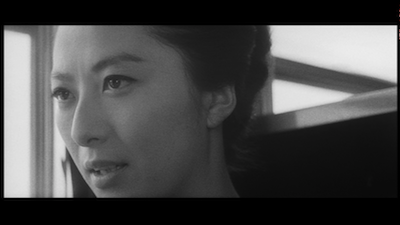

Violence at Noon can be a bit slow going at times, but its cinematic acrobatics show a more rigorous control on the story than Oshima displayed in Pleasures of the Flesh. There are none of the narrative gaps, none of the leaps that made that film stutter. The conflict between common sense and desire is already developing as a major theme in these first two films: we chase our passion even when we know it's not necessarily healthy to do so.
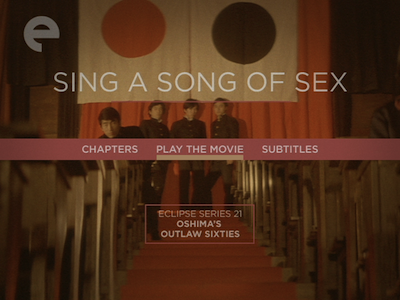
Clearly there was some cinematic back and forth going on between Japan and Europe during the 1960s. While Persona and Violence at Noon criss-crossed in their productions and likely didn't influence one another, the Godard tag that Oshima picked up earlier in his career has some real merit. The use of Shino's written letters in Violence is not dissimilar to Godard's use of title cards in his films. The French director is also known for his playful approach to audio, and I hear echoes of his technique in Oshima's soundtracks. Dropping out all sound for absolute silence, sudden bursts of incongruous music--these are JLG trademarks. The third film in Oshima's Outlaw Sixties, Sing a Song of Sex (1967; 103 minutes) begins with no sound. The camera is silently centered on a burn mark, and as the music comes in, so does the flame. (The use of audio in the opening scenes of the next film of the set, Japanese Summer, is even more dazzling.)
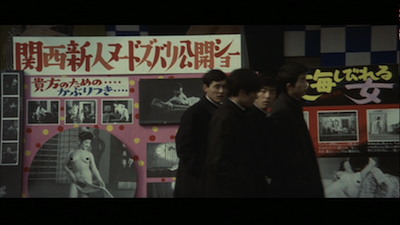
Sing a Song of Sex was a largely improvised film, and this "on the street" technique and its political posturing add more to the connection with the Nouvelle Vague. As the movie follows four restless, horny students over two days, Akira Takada's camera probes the scenes, rooting out the story. In one sequence, the camera is on a swivel, swinging back and forth between the bored and the drunk at a restaurant. In many others, it walks with its characters as they pass through the city. The use of advertising as a backdrop doesn't just evoke thoughts of Godard, but also Warhol and pop art.
In terms of story, Sing a Song of Sex is about a quartet of older students who are bored and restless as they talk about sex, go out drinking with their teacher and some of their female classmates, and deal with the intrusion of real life on their self-contained world. The movie is set during the return of a controversial nationalistic holiday, and the boys pass by protests without ever considering anything beyond their libido. Much of the film is spent searching for the elusive student #469 (Kazuko Tajima), a dreamgirl that only one of them has even seen, but for whom they all indulge a shared violent rape fantasy. Oshima is putting the political up against the personal and critiquing the disconnect of youth. His characters lack a moral center, and indeed, there is even a struggle to find the moral center of the nation. On one hand, you have the protest against the return of old-fashioned values, and on the other, you have kids looking to America, standing up against Vietnam and singing folk songs from the U.S. (Songs are seen as a method of communication that carries messages through changing history.) At the same time, Oshima brings up questions about Japan's Korean origins and the country's subsequent treatment of its neighbors.
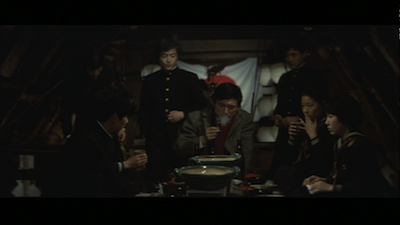
Sing a Song of Sex goes on a little too long. (I had the same problem with all the films in Eclipse Series 21, actually, including as noted above; they kept going even after my interest in the initial concepts had worn out.) The final scenes bring the boys together with three women they have objectified or victimized and they are forced to prove whether they are all talk and daydreams or if they can make their sick fantasies actually happen. The staging is abstract and pedantic, much like later Godard or the pretentious soul searching of Bernardo Bertolucci's 1968 Partner
 . The struggle for meaning is all too obvious and comes off as strained. Still, Sing a Song of Sex is fascinating up until that point. It practically twitches with agitated energy searching for an outlet; I'm just not convinced that Oshima found the right one for it.
[Side note: There is an interesting comparison to be made between Sing a Song of Sex and Toshiyaki Toyada's 2001 juvenile delinquent film Blue Spring
 and the Taiyō Matsumoto manga
 on which it is based. Perhaps another time.]
Whatever wall of reality Oshima shattered at the end of Sing a Song of Sex (I prefer to think he went past the fourth wall and straight on into the fifth or sixth), it stays shattered for his 1967 film Japanese Summer: Double Suicide (99 minutes) (a.k.a. Night of the Killer). This black-and-white parable takes place mostly underground, in a basement prison where a roving gang is locking up abductees they hope to indoctrinate into their wanton cause. Our gateway into this No Exit
 -style scenario are Nejiko (Keiko Sakurai), an 18-year-old nymphomaniac, and Otoko (Kei Sato again), an AWOL soldier with a death wish. Down in the hole with them are a weary pragmatist, a wise old man, and a crook who randomly stabs people. Also, there is a young boy (Masakazu Tamura) with a yen for killing. He doesn't care what or whom. He just wants to get his hands on a gun and start shooting.
Both the death-obsessed teen and Nejiko represent Oshima's ongoing concern with the moral bankruptcy of bored youth. The old duo "sex and death" come up time and again in Japanese Summer, though Nejiko has a hard time finding anyone who will actually sleep with her. When she finally does, it isn't satisfying and nowhere close to life affirming. When the boy makes his first kills, he also finds it underwhelming. Give the kids what they want, and they realize they don't want it anymore. Nejiko's fate is tied to Otoko's regardless, and ultimately, they will discover that sex and death are tastes that are only great when they go together.
In the bunker, the sole link to the outside world is a TV set, one that is governed over by the pragmatist, earning him the nickname Television (played by Rokko Toura). The prisoners use the TV to monitor the progress of their captors and their gang war, but also to listen to the news about an American sniper that is killing Japanese citizens for no apparent reason. Oshima makes comparisons between this man and the assassination of John F. Kennedy, as well as between the political turmoil in his version of Japan and the race riots in the U.S. His heavily coded narrative weaves in and out of these real-world analogues, and presumably, each of his characters are meant to represent some piece of society. Some of the abducted are on the side of the killer, some want him dead, and even the ones who agree with each other can't actually agree to agree.
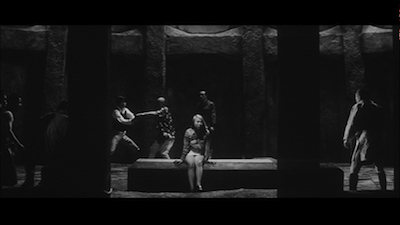
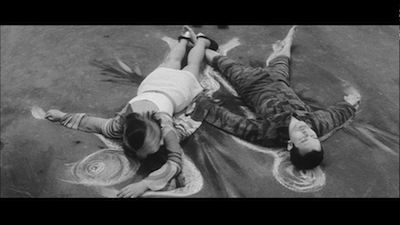
Japanese Summer: Double Suicide is obtuse by design, and Oshima provides no magic decoder ring to sort it all out. Some of his symbols are obvious (Nejiko and Otoko, for instance, are constantly framing themselves in outlines of bodies, like the chalk figures at murder scenes), and others are lost either to an historical/political context that I personally didn't understand or possibly are red herrings that only mean something to the director and his co-writers, Mamoru Sasaki and Takeshi Tamura. From the liner notes, I am led to believe that Oshima would be pleased that I was confounded by his movie; however, I am not sure how he'd feel about me being bored by it. Interestingly enough, for as abstract as the story is, the film itself is the most straightforward in terms of visual style. Japanese Summer is the first feature in the box to be shot by someone other than Akira Takada. New cinematographer Yasuhiro Yoshioka drops most of the experimentation and seems to favor more formal frame construction. The actors are usually arranged according to a very strict placement, calling to mind the look of classic paintings or still photographs.

I was disappointed to peek at the liner notes of Three Resurrected Drunkards (1968; 80 minutes) (a.k.a. Sinner in Paradise) midway through the movie and see that a Monkees comparison was already made for me, because I was totally ready to call that out. Opening with three guys walking arm and arm on a beach while a sped-up pop tune rattles along underneath, I couldn't help but think of the PreFab Five. Seeing the seemingly random comedic events that follow, the comparison stuck. Though, let's call it out: the Monkees' full-length Head
 's discombobulated narrative is practically lucid by comparison.
Three Resurrected Drunkards is like an angry art school comedy. Three new graduates--O-noppo, Chu-noppo, and Chibi, a.k.a. Big, Middle, and Tiny, a.k.a. actors Kazuhiko Kato, Osamu Kitayama, and Norihiko Hashida--go for a swim, only to have a mysterious hand come up out of the sand, take half their clothes, and replace them with other clothes and cash. Left with no choice but to put on the new outfits, O-noppo and Chibi are mistaken for two illegal Korean immigrants ("stowaways"), a soldier (Kei Sato) and his companion, who ran from South Korea rather than join U.S. troops in Vietnam. The Koreans try to kill the boys to cover their tracks, but the boys escape assassination only to be deported. They also get entangled with a Korean girl (Mako Midori) who helps them, despite having her own problems.
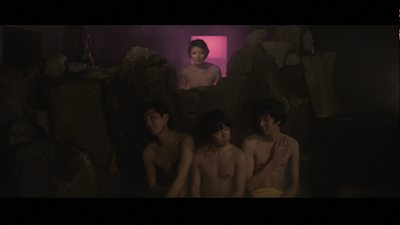
The odds are stacked against the trio, but Oshima gives them a Bunuel-esque out. Midway through the movie, Three Resurrected Drunkards resets, taking us back to the beginning. This time, though, the guys begin to alter events. Their main change: admitting they are Korean. This is a shift that was set-up by a faux-documentary digression where the actors take to the streets to interview people and challenge them as to how they define their national identity.
On paper, Three Resurrected Drunkards is a daring experiment in gonzo filmmaking; in practice, it's dated and makes for lethargic viewing. Were this really a Monkees jam, it would be a lot more manic and silly, and while that may not have been Oshima's intention, it might have been a little more palatable than the self-satisfied seriousness that is here instead. Everything seems too dialed down, including the more dramatic second half. O-noppo's crush on the girl, for instance, is too reserved, and so his anger when he sees how horrible her guardian (Fumio Watanabe) treats her doesn't have much impact. Oshima is building to a startling conclusion, one that drives home his anti-war message and boils with the anger he feels in regard to Vietnam and the historical mistreatment of Korea, but like most of the films in Oshima's Outlaw Sixties, it takes too long to get there, and the view along the way gets tiresome.

Look, I get why Nagisa Oshima is so well respected, and I also understand why the title of Oshima's Outlaw Sixties - Eclipse Series 21 is well earned. The Japanese film director was an outlaw. An independent filmmaker who broke from the studio system when it was clear he was not going to be able to make the volatile movies he wanted to make the way he wanted to make them, Oshima is a man with a mission. He is an artist with a passion for cinema, and his cinema is about the passion of individuals. Eclipse Series 21 showcases a selection of movies that are sensuous, aesthetically audacious, and for the 1960s, politically provocative. The five films in the box attack the foundations of moviemaking and dig down to its core, casting aside the rubble willy-nilly. For me, however, the more obtuse and disconnected the narratives became, the less interested I was as an audience member. This may make me an outsider, too, it's certainly not conventional critical wisdom, but I have to imagine that Oshima would respect my stance as much as I respect his. Your views on any of this, of course, will also be you own.
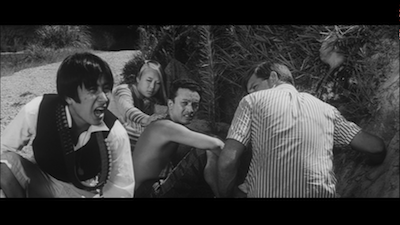
Trailers for: Sing a Song of Sex
Japanese Summer: Double Suicide
For a full rundown on the special features, read the full article at DVD Talk.
Wednesday, May 19, 2010
THE RED SHOES - #44
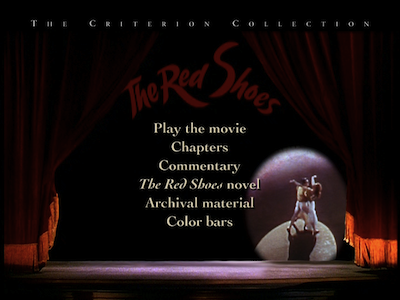
Criterion's reissue of The Red Shoes, Michael Powell and Emeric Pressburger's enchanting 1948 fairy tale, is due to be released in July. It's going to sport the newly restored print of the film that we've been hearing about for quite some time now. Spearheaded by Red Shoes-fanatic Martin Scorsese with the UCLA Film Archive, the movie was given a frame by frame scrubbing and has been one of the most hotly talked-about revivals since the new version premiered last year. A few places around the world have been lucky enough to host this spruced-up Red Shoes theatrically, and as of May 21, you can count Portland, Oregon, among them.
I wrote a bit about Cinema 21 in my review of Ran last month. The stalwart little theatre is a Portland landmark. I've been seeing movies there since I moved to town in 1994. Cinema 21 hosts first-run indies and art house, as well as being the main stop for revival pictures. It's because of Cinema 21 that I saw many a classic movie for the first time. One of the most mind-blowing experiences I had there was catching Powell and Pressburger's A Matter of Life and Death
 in the mid '90s. It was my first film from the Archers (as they are collectively known), and I was not at all prepared for the marvelous imagination this movie had to offer. At the time, it was not available on VHS and as DVD fans know, it took forever to get a digital release, so it was many years before I would ever see it again.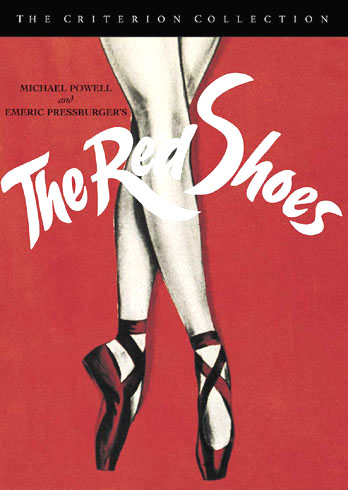
The original 1999 DVD cover.
The press screening for The Red Shoes was not my first experience with this particular film, but it might as well have been. The restored transfer is everything they claim it to be, making it seem like a whole other film. The Red Shoes looks newly minted, as if it was struck from a fresh batch of Technicolor cooked up in a lab just yesterday. The image is flawless, and the color is so vivid, it's practically a living entity. The range of pigments and the level of detail is simply astonishing. Moira Shearer's red hair looks like a swath of velvet wrapped around a tiny flame, and how did I not know before that she has freckles on her collarbone? I feel like I am finally getting to see what previously only cinematographer Jack Cardiff saw, that I have been ushered through a door into his mind's eye to bathe in everything he imagined.
For those unfamiliar, The Red Shoes is the story of an international ballet company run with an iron artistic hand by the headstrong and demanding Boris Lermontov (Anton Walbrook). On a stop in London, he meets a young dancer named Victoria Page (Shearer) whose spirit and pluck earn her a spot in his Corps. The talent seeker also hires a college-age composer named Julian Craster (Marius Goring) to be a deputy conductor after the prodigy storms into his office claiming Lermontov's latest ballet plagiarized his work. Once under Lermontov's wing, the two neophytes soon find their expression encouraged. He assigns Julian to write the score of a ballet based on Hans Christian Andersen's The Red Shoes, and Victoria will play the girl who wanted so badly to dance, she wore a pair of magic slippers that cursed her to keep dancing until she died.
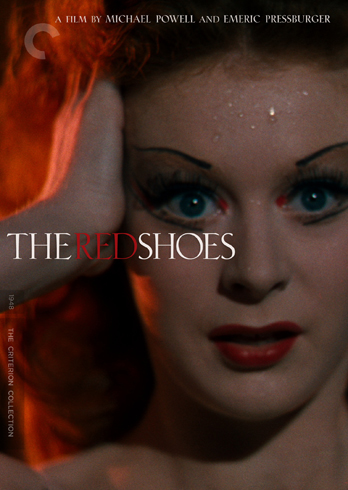
The 2010 DVD cover.
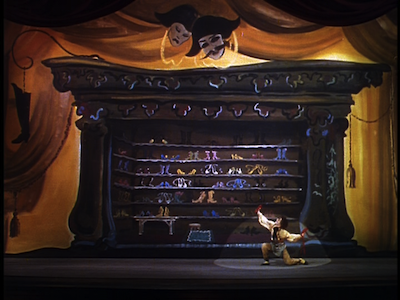
Midway through the film, the ballet is performed in full. It's the movie's most famous scene. Three years before Gene Kelly and Stanley Donen ended An American in Paris [review] with an original ballet, the Archers dropped a complete dance into the center of their backstage romance picture. It was choreographed by Robert Helpmann with music by the Royal Philharmonic, and it features world-famous dancer Leonide Massine backing up first-time movie actress Shearer, then a member of the Sadler's Wells Ballet. There were apparently 53 dancers in total, and the fifteen-minute sequence took six weeks to film. The staging wasn't a direct "shoot a live performance" set-up, the approach was more like a fantasy sequence set inside the performance. Swathed in paintings by Hein Heckroth, the production vibes toward the surreal, with special effects bringing stage conventions to life. When Julian is instructing Victoria on how to hear his music, he suggests she imagine the things that are happening in the story and make it a transformative experience. What Powell and Pressburger show us is what Victoria has imagined and by doing so they transform their film into something magical.
This ballet is no mere trifle, however. It is not a show-off exercise dropped into the center of the melodrama just for the sake of it. The story that Powell and Pressburger craft runs parallel to the themes of the dance. The push and pull between the triangle of Lermontov, Victoria, and Julian is represented in the Andersen adaptation. Lermontov is the shoemaker insisting that his ballerina perform, Julian is the lover who tries to pull her off the stage, and Victoria is the girl caught up in her dreams and desires and having no clear idea how to get out. The Red Shoes is about the passion of creation, the urges that compel artists to make art. What must one sacrifice to fulfill their dreams? Must art be all? It can be a joyful experience--the backstage material showing the collaboration and camaraderie of the company is some of the best stuff in the movie--but it can also be hard work that requires severe tunnel vision to get through.
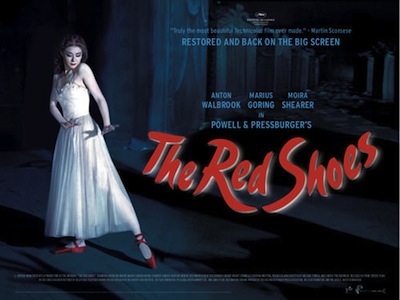
The 2010 theatrical reissue poster.
In a way, the characters all represent types, but I'd say only Marius Goring plays his as such. Julian is kind of a big baby, petulant like a schoolboy, and the actor doesn't bring much nuance to what is sort of the romantic lead. A romance develops between the music maker and his muse, and as it blossoms, it also exposes the fact that maybe Lermontov is in love with Victoria, too. It's never expressed outright, but the way Anton Walbrook looks at Moira Shearer, the way he reacts to the revelation that she has fallen in love, extends beyond a Svengali losing his puppet. As the woman torn between the two, Shearer displays both a strength of purpose but also a fragility. Her resolve to be a dancer is challenged by her feelings as a woman. The Red Shoes is one of those wonderful movies where the invention actually works: the fictional artists are creating real, believable art, and the woman whom everyone is supposed to fall in love with woos the audience to love her, as well. (In fact, check my tweet from immediately after leaving the screening.)
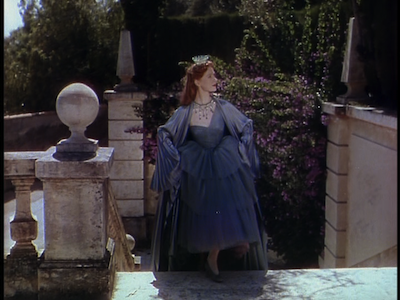
It's funny how years and multiple viewings can change one's perception, though. Boris Lermontov is generally considered the villain in the love triangle. He's the one who, in the fairy tale, would curse the girl to dance and never stop. (In the original story, they have to lop off her feet with an axe to disconnect her from the shoes; in the ballet and the movie that hosts it, Victoria's ending is still dire, though not as gory or gruesome.) Most fairy tales are fairly straightforward in their morality, and again, even here, the characters practically fall into stereotype. Or so a fairly surface reading of The Red Shoes might have you believe.
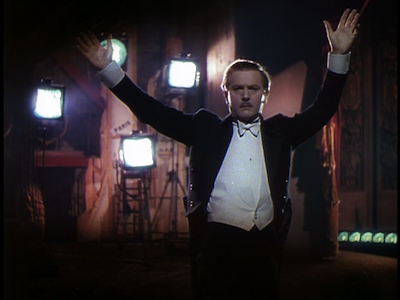
Maybe it's my more advanced age, maybe it's the fact that I've worked in a creative industry for a while now, but I found Boris Lermontov to be a far more sympathetic character than Julian Craster this time around. As things heat up within the love triangle, Boris asks Victoria if she would ever ask Julian to give up his métier, if she would ever want him to abandon music for her. When she says no, she would not, Boris then asks why she would permit Julian to ask it of her. It's a crucial question, and one that reflects badly on the young Romeo. His motivations are selfish. He wants her to be with him and no one else, to do nothing except inspire his melodies. Lermontov, sure, wants Victoria to be his and to dance at his company, but that does not require her to sacrifice who she is--nor would he ever want her to. What she means to him is entirely rooted in the talent that powers her. He knows to give up on her gifts would be to give up who she is, and then she would not be the woman he cares about.
It's wonderful to see how expertly Powell and Pressburger intertwine the drama of life with the drama of artistic expression. The Red Shoes is as inspiring as it is inspired. Cinematically, it melds so many things--fairy tales and dance and operatic melodrama--but it does so within the 1.37:1 frame. It molds these older arts into the newer one, making a movie that is as much about being a movie as it is anything else. It couldn't be done in any other form, and to now be able to see it in a way that is comparable to its debut more than 60 years ago is an astonishing treat. If you can go out and catch in the theatre now, you owe yourself to do so. You can still buy the DVD when it comes out. You're going to want to see it again anyway. And then again, and again. You're never going to want to take these red shoes off....
Part II of this review: The DVD...
Read more about Cinema 21 in this excellent article by Shawn Levy.
Please note: The screen grabs here are from the original Criterion release; see screen comparisons with the 2010 disc here.
Subscribe to:
Posts (Atom)

