Monday, February 8, 2010

PARIS, TEXAS - #501


A man walks through the desert, dressed in a pinstripe suit and a red baseball cap. He drinks his last swig of water out of a plastic jug and eyeballs the hawk that is eyeballing him. From the landscape, the endless swath of rocks that reaches back behind him and extends off into nothingness in front of him, we can tell that this is the American South. From the title of the movie, we know it's probably Texas, and even the most undereducated film fans will know that man is Harry Dean Stanton. He stands alone in a wasteland. Walking toward something, walking away from something else. Or perhaps like a shark, he is moving lest he die.
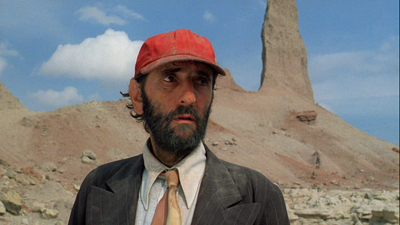


This is how Paris, Texas, the 1984 film from German director Wim Wenders and stalwart American playwright Sam Shepard, begins. It's a mysterious opening, befitting a film that is ostensibly a mystery. The central question of who this man is and why he is here is one we will be asking throughout the film's laconic 145-minute running time. Because it's Harry Dean Stanton, because it's Wenders and Shepard, we would probably wait even another two hours to get the answer if we had to. Paris, Texas is too good to look away from.

Stanton plays Travis, a man who has lost his way. He is the focal point of the mystery, but he is not its only facet. Travis has been missing for four years. From the look of his shoes, he may have been walking that whole time. He doesn't sleep, he barely eats. Right after he disappeared, his young son Hunter (Hunter Carson), then just about to turn 4, was dropped off at his uncle's house in California. Travis's brother Walt (Dean Stockwell) and his wife Anne (Aurore Clement) took him in. The boy's mother and Travis's young wife, Jane (Nastassja Kinski), eventually got in touch, but then she got out of touch again. Her only contact is depositing money in Hunter's bank account on the 5th of every month. Walt and Anne inquire after what happened, but Travis is not telling.


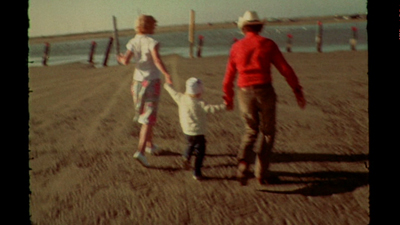
Paris, Texas is divided into two halves. The first begins with a road trip, with Walt driving out to pick up his brother in the isolated trailer park hospital where he has been taken after collapsing. They drive back to Los Angeles--Travis refuses to fly--and try to reacquaint Travis with the land of the living and with his son. The first glimpse we get of Jane is in Super 8 home movies Walt shot just before whatever went down went down, and they are so perfectly quaint and idyllic, so sharply contrasted to the vividly drawn realism of the main film, they resemble little more than fiction. That man sitting and watching himself on the screen was never really the man he is watching. That never happened.


The second half of Paris, Texas is Walt taking Hunter back to Texas to look for his mother in Houston and try to reclaim the life they saw on Super 8. It's also the life of the three people in a black-and-white photo booth strip, a memento Travis gives Hunter. He carries another photographic dream, a snapshot of a plot of land in Paris, Texas, that he has never seen but that he bought with the hope of moving his family there. He chose the spot because it's in the town where his mother and father first made love, and likely where he was conceived. The picture is just a vacant lot with a sign on it. The sign might as well say, "This is an illusion." Like father like son, Travis is chasing something false. His story about his parents is adorable and romantic at first, until later he reveals that his father's joke about meeting a woman from "Paris [pause, wait for it] Texas" was the kind of harmless lie that takes over a marriage and creates an alternate reality that the truth can never compete with.

Wim Wenders has an equally unreal love affair with America, one born out of Hollywood cinema. His affection for the wide-open spaces and dilapidated architecture of Nowhere, USA, is one that has little time for the economic desolation that has allowed these places to be rundown. He shoots his locations with a foreigner's eye, aided by his director of photography Robby Müller, a Dutch cameraman who also shot a lot Jim Jarmusch's tours through his own alternate America. Wenders and Müller work with a large frame, using the expansive terrain as a way to isolate their characters. Any man looks small standing in the center of the American frontier.

Yet, they also seem to have an idea of how unreal this dream is, and they bathe many scenes in unnatural colors. The nighttime skies are pink with pollution, and the cities are a neon green. It's a sickly palette, reflective of the inner nausea that is compelling Travis to retreat from personal contact.


Communication is often said to be the key to any relationship, and communication is all out of whack in Paris, Texas. When we first meet Travis, he refuses to talk, and the doctor who cares for him thinks he's a mute. (I am not sure if it's significant that this doctor, played by Bernhard Wicki, is a German in exile, or that Walt's wife Anne is a French immigrant--except that maybe she represents the real exotic love that is falsely evoked by the story about the brothers' parents. Amusingly, German-born Nastassja Kinski plays the love that has gotten Travis so twisted up as an authentic Texan.) It's as if Travis must learn to talk again the way he must learn to love again. Opening up is the first step to regaining his family.
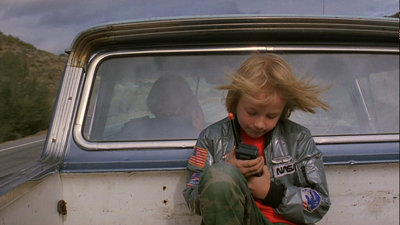


It's what Jane will eventually encourage him to do, though she won't know it's him at the time. They talk with a pane of one-way glass between them. He can see her, but she can't see him, and even then, Travis has to turn his back and talk to her. Two peas in a pod, she must do the same when she opens up. Earlier, even though Travis and his son are getting along, they default to chattering back and forth on walkie talkies, foreshadowing the emotional climax where Travis can only tell the boy how he really feels via tape recorder.

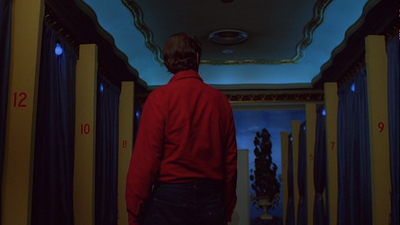
The details that went into Jane and Travis splitting are not as predictable or cut and dry as we would imagine. Both parties had a hand in things falling apart, though Travis reveals a heroic streak by taking full blame when explaining the gist of the problem to his boy. His journey has stirred up many things for himself and for the viewer. He represents grief, loneliness, and shame, but also love. Of all his sins, failing at love is the one that weighs heaviest. Loving each other should have been enough for Jane and Travis, and loving their child was the most important thing of all. Travis has been doing penance for these sins, and so has Jane. He finds her in a lurid limbo, stuck role-playing endless falsified versions of meaningful relationships. The building where she works even stands as a symbol of the believed promise of the American dream and the often sad reality of it. On one side, someone has painted a full-size mural of the Statue of Liberty; on the other, a brown-skinned woman, representing the people Manifest Destiny trampled, and also the ladies serving time inside those walls. Maybe I was too quick to judge. Maybe Wenders does see the dark underbelly of Americana after all. Sam Shepard certainly does, and Ry Cooder's bluesy score also provides Paris, Texas with some authentic roots.
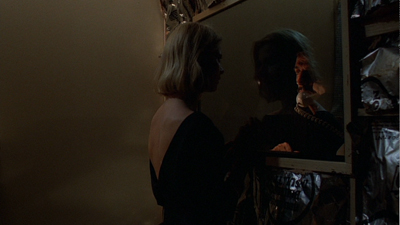
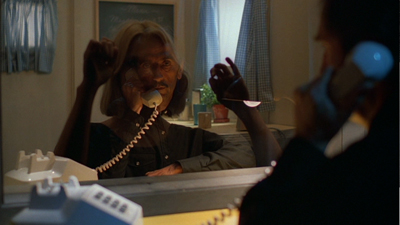


Paris, Texas ends on what many would call a sad note, but it's the kind of ending I always find hope in. Travis has made things right, he has found a way to bring mother and child back together, but even in doing so, he has accepted that he is the one thing that can't be in their lives if they are to succeed. The attraction between himself and Jane will always have that heat, they will always burn each other (sometimes literally, as it turns out), and so better for him to extricate himself. Wenders' imagery when they are finally conversing even goes so far as to show us how they tend to swallow one another whole.
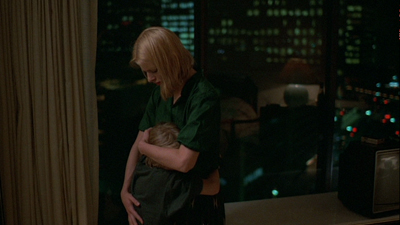


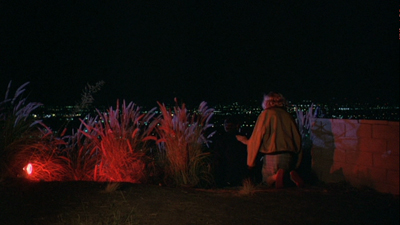
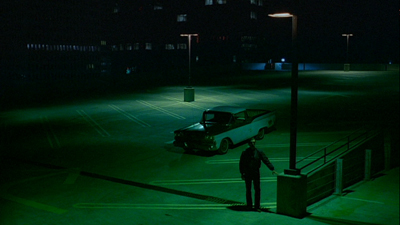
Harry Dean Stanton brings an inner nobility to the performance that allows Travis to be sympathetic even at his lowest moments. The actor has sad, soulful eyes. They express the glint of joy when Anne shows him affection or when he is bonding with Hunter, and they also show the poison of jealousy when his first reunion with Jane goes awry. Ironic, then, that his best moment comes when we can't see his face at all. The way he stands, the shape of his body, the damned aura of Harry Dean Stanton--they tell us everything. He stands in the emerald glow of an empty parking lot, watching over his son until he is sure his mother has come for him. Never mind that it would actually be impossible for him to see into Hunter's hotel window. Travis is the all-seeing father now, sacrificing himself for the good of those he cares for. It's a powerful finish, and though he may end Paris, Texas as alone as he began it, Travis has given everyone what they need to continue on, including himself. He has shed his illusions, and now he can make a new reality.


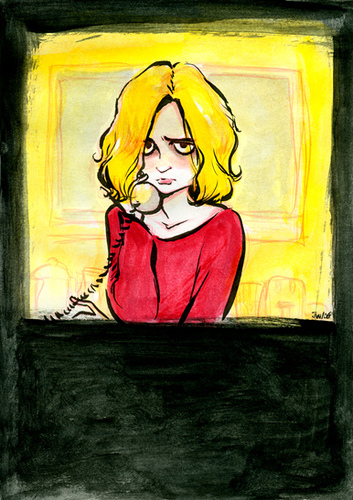
Comics artist Jen Wang once posted a piece of Paris, Texas fan art on one of her blogs. I saved it to my hard drive when she did. Like all of her stuff, it's lovely. Jen's first full-length graphic novel Koko Be Good is due this fall and guaranteed to be a must-read.


Friday, February 5, 2010

FISTS IN THE POCKET - #333


And you think your family is weird? Trust me, you've got it easy.

The family in Marco Bellocchio's perverse 1965 satire Fists in the Pocket is up there with the great oddball clans of cinema, somewhere between those magnificent Ambersons and the killing breed of Texas Chainsaw Massacre. They are emotionally twisted, physically deficient, and so caught up in each other's business, it's impossible for them to untangle themselves from one another.
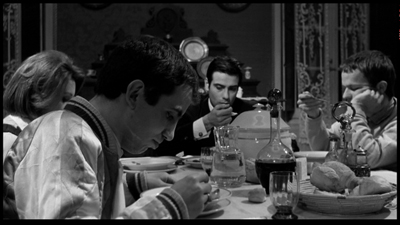
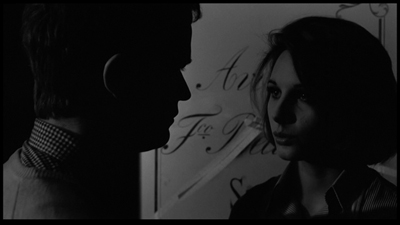

Bellochio's is a family of five--four children, and one blind mother (Liliana Gerace). Of the kids, only the eldest, Augusto (Marino Masé) has it together enough to have a job and the semblance of a normal life. He lives with the others in their out-of-the-way house on the hill, but he goes into the city to work and visit his girlfriend (Jenny MacNeil), leaving his siblings to fill their days with whatever it is they can find. The youngest is the developmentally disabled epileptic Leone (Pierluigi Troglio), who more often than not is left out of the trouble cooked up by the middle kids. Giulia (Paola Pitagora) and Alessandro (Lou Castel) share a strange bond. They are wickedly close to one another, but also constantly on each other's last nerves. Ale is the true mastermind of mischief, pushing buttons and tweaking noses at every turn, but Giulia eggs him on. There is a suggestion that there is something unnatural between them--Ale has written her a love poem that stirs up trouble at the start of the picture--but whether they've ever taken it farther, we don't know.


Giulia is capable of making her own incestuous scandals. The movie actually begins with a note she sent to Augusto's girlfriend, Lucia. Pasting it together with letters she cut out of a newspaper, she informs Lucia that she is pregnant with Augusto's child and the true love of his life. It's all lies, of course. Maybe she does have feelings for Augusto, she gives him many a long look, but the true motivation of this act is likely to sabotage his happiness and keep the family's claim on their number-one son. This is what seems to motivate all the pranks and outbursts. The circle is closed, and no one gets out. As the movie progresses, Ale even plots to keep Augusto from moving out of their family home, which is large and full of the group history. That history is represented in kitsch objects, the eccentric antiques and heirlooms and portraits gathered over the years, like a precursor to the big house in Wes Anderson's The Royal Tenenbaums. These are the sick cousins of the Tenenbaums, the ones who don't have the creative outlets their future cinematic kin find to maintain their semblance of sanity.

Alessandro actually reminds me more of Harold in Hal Ashby's Harold and Maude than he does any of Anderson's children. Like his younger brother, Ale is an epileptic, though one who is trying to keep his malady under control. In addition to his tendency for pranks, the main trait Ale shares with Harold is a morbid fascination with death. For Harold, it manifests in his staged suicides; for Ale, his gallows humor aims for a wider audience and more real results. He concocts a plan to drive himself and the others over a cliff, leaving Augusto to lead his life without being burdened by his useless relatives. When this doesn't come off--he ends up almost literally chasing a thrill instead--the plan morphs to suit the fickle boy's plans. He begins with one murder, and then moves on to two....
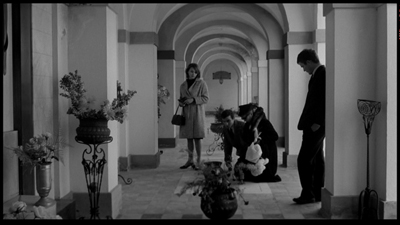
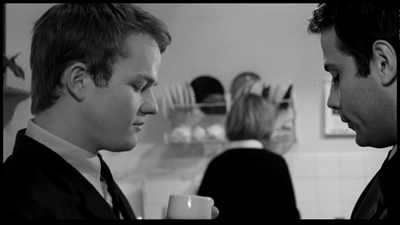
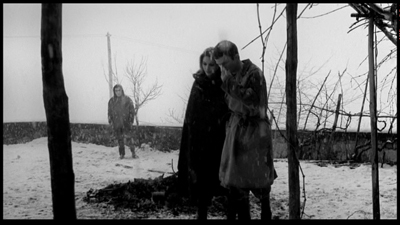
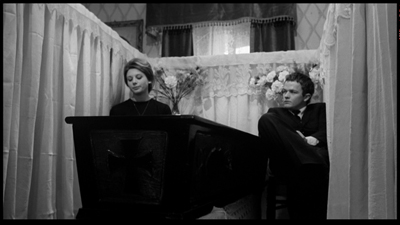
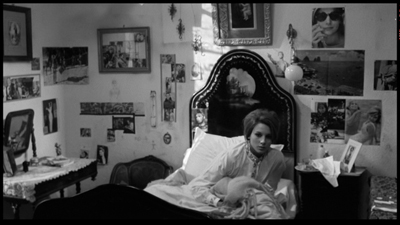
Fists in the Pocket is a bizarre film. It's Bellochio's first feature, and the writer/director revels in an anarchic storytelling style. The narrative is all over the place. Exposition is often repeated, and the script sometimes moves from one scene to another in quick jumps, skipping right over more traditional transitions. When this happens, it's almost like the crew is making it up as they go along, improvising one absurd scenario after another. Visually, the director uses composition to emphasize relationships. There are a lot of two-shots that bring characters closer, emphasizing their connections and their conspiracies. Other times, he puts objects between them, like a casket or the dinner table, to push them apart. He will also foreground those who are joined and background those who are left out, using distance just as effectively as he uses the lack thereof.


As black comedies go, I wouldn't call Fists in the Pocket laugh-out-loud funny. When I laughed, it was more out of admiration and fascination. There is a strange pathology at work in the household. The demented siblings are building their own world within it, but like ancient gods, they have grown bored of their creations. As soon as Ale has hatched one scheme, he's tired of it. His mayhem is plagued by ADD. His motivation is schizophrenic: on one hand, he decides to kill himself and the others to benefit Augusto; on the other, he does things that are meant to knock his brother down a peg. He contrives to catch Augusto cheating at cards, and he also seeks out and hires the same prostitute his brother frequents. When Augusto takes him to a nightclub for Lucia's birthday, we see Ale in the real world for the first time. He is socially awkward, unable to carry through when a pretty girl tries to dance with him.


The only girl Ale has time for is Giulia, and part of the reason his clown act keeps evolving is he's trying to keep her entertained. As an acting pair, Castel and Pitagora are perfectly in sync, working the same offbeat rhythms. The way they communicate is reminiscent of the secret language of twins. Leone tries to be part of it, but he doesn't know the code. Augusto doesn't know it either, but he has no interest in cracking it. In much the same way Cocteau and Melville critique the crumbling social mores of modern culture in Les enfants terribles by isolating their brother/sister duo from the rest of the world, so two does Bellochio draw a tight circle around Ale and Giulia. They choose who comes in and out, rejecting religion, the old and infirm, emotional nostalgia, and conventional survival. It's all empty and waiting to be exploded.


It can only end badly. The problem with this kind of nihilistic ennui is it can only go on for so long before it runs out of things to reject. Ale stumbles into a regular pitfall of the jester: he has to keep pushing for bigger reactions, and he can't see when he's gone too far. At the close of the film, he gets too cocky, thinking he can sew everyone into his web. The one thing he didn't factor on was that in creating chaos, chaos can come back on you. Giulia stops finding him funny once she's seen behind the curtain, and an accident has also left her physically incapable of indulging Ale any longer. Now she chooses to isolate him, staying in her room surrounded by images of idyllic lives they will never have, Marlon Brando and magazine advertisements, while Ale writhes around to the more extreme emotional outburst of an operatic aria. The girl leaves her brother to his own devices the way one lets a screaming baby wail and cry until he can't cry anymore. Rebellion always meets its match when it faces Indifference.


Tuesday, February 2, 2010

TITLES GOING OUT OF PRINT, ON SALE

Criterion has put up notice today that quite a large number of titles are going out of print from them, and they are pricing them to move. Get an extra $5 off at their store. Read about the whole thing here, including a full list.

Many of these films have been reviewed on the site. They are:

Alphaville
Carlos Saura’s Flamenco Trilogy (Eclipse Series 6)
Diary of a Country Priest
The Fallen Idol
Gervaise
Le jour se lève
Last Holiday
Mayerling
Pierrot le fou
The Small Back Room
Trafic
The White Sheik

Word is these titles are now part of the Studio Canal deal with Lionsgate, and given the latter studio's somewhat checkered history in terms of the technical quality of their discs, you may want to consider snatching up as much of these as you can. (Dare I buy the Pierrot le fou Blu-Ray in case I ever do get a Blu player?)

Sunday, January 31, 2010

SIDELINE: MORE REVIEWS FOR 01/10, plus CRITERION ON YOUTUBE

Criterion launched a YouTube channel this month. They are posting trailers for recent releases; watch and subscribe here.

By the way, I don't have Netflix, but they are streaming movies from the collection now, including ones I've reviewed here, such as Umberto D. Here is a list of recent additions.


IN THEATRES...

* The Book of Eli, a pleasantly surprising, entertaining action movie with Denzel Washington as the last holy warrior in a world burnt by the sun.

* Crazy Heart, with Jeff Bridges starring alongside Maggie Gyllenhaal, playing grizzled country singer Bad Blake.

* Edge of Darkness, Martin Campbell's violent revenge fantasy wastes good performances by Ray Winstone, Danny Huston, and a craggy Mel Gibson with poor pacing and a meandering plot.

* The Loss of a Teardrop Diamond, the resurrected script from Tennessee Williams raises some questions as to its completion, though Bryce Dallas Howard is mesmerizing.


ON DVD...

* Louis Armstrong: Good Evening Ev'rybody, a fantastic documentary/concert film of the performer near the end of his life.

* Attraction, Tinto Brass' 1969 exercise in psychedelic over-indulgence. Yawn.

* Big Love: The Complete Third Season, the series about plural marriage chugs along with varying results.

* The Brigitte Bardot Classic Collection, three films of varying quality starring the beautiful icon of French cinema.

* The Drummer, a solid Chinese drama from Kenneth Bi. Plus, a short Swedish animated film called Love & War.

* A Man Called Adam, the 1966 jazz movie starring Sammy Davis Jr. as a troubled trumpet player. Features performances from Louis Armstrong (him again?) and Mel Torme.

* Mighty Mouse: The New Adventures - The Complete Series, the animated cult series from the 1980s finally comes to DVD.

* The Simpsons: The Complete Twentieth Season, in which papers are filed to end this union after two decades of ups and downs.

* Weeds: Season 5, the ongoing dramedy with Mary-Louise Parker starts to regain its footing. But just barely.

* The Zombies - Odessey and Oracle (Revisited): The 40th Anniversary Concert, the surprisingly potent reunion of one of the most underrated bands of the '60s.

For those interested, Tim O'Shea of Talking with Tim ran an interview with me this month regarding film criticism and pop culture. You can read it here.

Wednesday, January 27, 2010

ROBERT ROSSELLINI'S WAR TRILOGY - #500


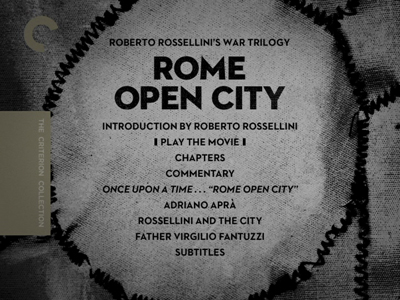
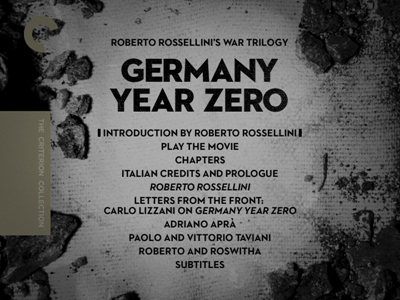
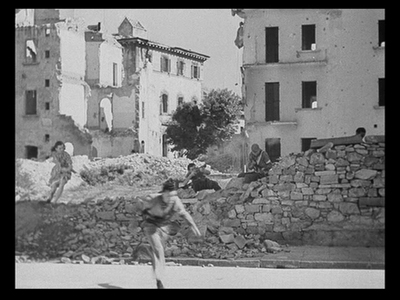
Watching the Roberto Rossellini's War Trilogy boxed set doesn't feel like you're just watching movies, but like you are watching history. The history of cinema, to be sure, but also a bonafide historical document. The films contained herein--Rome Open City, Paisan, and Germany Year Zero--were made between 1945 and 1948. They were shot on location, documenting the ravages of World War II by setting the drama in the bombed-out ruins of Italy and Germany. Working with many non-professional actors, operating on a shoestring budget and often shooting with scraps of film, this is the birth of Italian Neorealism.

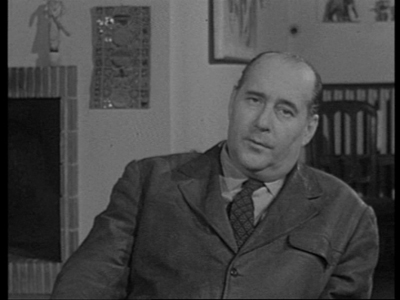
The stage is set with the 1963 introduction Rossellini filmed for French television, preparing audiences for the airing of Rome Open City. He talks about the hurdles of production and the intention of this effort. He was aiming for a sincere chronicle of what happened, to show the world what his countrymen had just experienced. It's hard not to think of the common reaction we could expect today, of audiences recoiling and shrieking, "No, it's too soon!" When did we become such ninnies, scared of the shadow of our own shared experiences? When Rossellini shot Rome Open City, the title had real significance: Rome was the only Italian city that had been liberated from Nazi occupiers. There he was, standing among the wreckage with his film camera, staring the moment right in the eye, refusing to flinch from the responsibility of telling others what happened. You can see the same thing in Iran when they protest, with citizens raising their cell phones aloft to record what is going down. Yet, in America, we get mad at journalists for telling too much and still can't figure out how to memorialize 9/11. Go figure.


Rome Open City (Roma città aperta - 1945; 103 minutes) is set in Rome during the latter days of the German occupation. There is a brief mention that U.S. forces may be on their way, but no one is sure if that is real or a myth. The story here, as written by Sergio Amidei with some assistance from Federico Fellini, is of the Italian resistance, of the regular people who did not want their country hijacked by Fascists and Nazis. They are the kindred spirits of the French Resistance, as celebrated by Jean-Pierre Melville and others, as well as the Germans who understood they were being dragged down by a madman, most recently immortalized in Bryan Singer's Valkyrie. These ramshackle citizen armies, to my mind, haven't had their stories told enough. As heroes, they are undersung. Rossellini himself would revisit the topic in his 1960 drama Escape by Night, which in a way is almost like a more Hollywood-influenced retelling of the picture that first got him noticed internationally.


In a way, the plot of Rome Open City can be boiled down to a central conflict of two men: the effete Major Bergman (Harry Feist), head of the Gestapo in Rome, and Giorigio Manfredi (Marcello Pagliero), an engineer who has become the focal point of the resistance movement. Bergman wants to get his hands on Manfredi, to torture the rebel and force him to reveal the plans and identities of his compatriots. Except to suggest this is a man-to-man fight would be to misread the situation in much the way Bergman misreads it. His enemy is not a single man, but an entire city and its populace, the people who refuse to lie down.

Aiding Manfredi in his flight is the noble priest Don Pietro (Aldo Fabrizi), the newspaper man Francesco (Francesco Grandjacquet), and Francesco's fiancé, Pina. She is played with fierce emotion by the amazing Anna Magnani, who is as much a force of nature as she is an actress. Pina is pregnant with Francesco's child, and also part of the movement, helping organize domestic revolts by gathering housewives for runs on bakeries and other businesses who they believe are hoarding or getting special treatment. The revolt is also generational. Pina's son from a former marriage, Marcello (Vito Annicchiarico), is part of a gang of boys who pull covert operations, blowing up gasoline tankers and the like, banding together on their own against the common enemy.


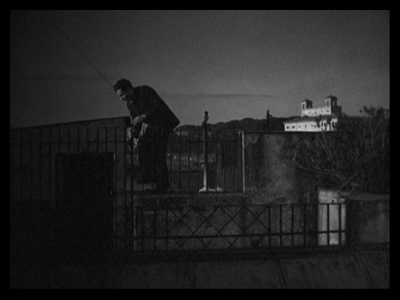
Rossellini and his writers build their movie out of all these pieces, carefully stacking them one on top of the other, but the structure never feels precarious. The narrative is told in a straightforward, linear fashion, and the unvarnished style--born of necessity, but it would come to define a movement--means they don't get in over their heads. There is little music, no overly fancy shots or stylized lighting; this is boots-on-the-ground filmmaking. There are moments of true beauty, where Rossellini and cinematographer Ubaldo Arata use the rundown environment for compositions with real depth and power, such as when the Gestapo storms Pina and Francesco's tenement and the action plays out on different floors in the building all at once. By contrast, the Gestapo's lavish headquarters are made to look unreal. These aren't invaders, they are imposters made to play dress-up. Rossellini's venom is palpable. For as deadly as he shows the Nazis to be, he also makes them comical. He laughs at them for being stupid, arrogant, and sick in the head.


Again, though, let's not make this sound overly simple. Rossellini is as unflinchingly critical of his own people where they deserve it. The rebels are ultimately brought down by Italians who don't care about anything but their own self-preservation. There are always rats, particularly when times are bad. The director also has no interest in whitewashing heroism. The good guys don't always win in the short run, even if there will be triumph in the long run. Men like Manfredi and Don Pietro show their true heroism in what they sacrifice, and though the ending of Rome Open City is grim, that gray pallor is offset by the determination in the faces of the younger generation, the ones who rebuild after the war. Defiance is more powerful than sadness.


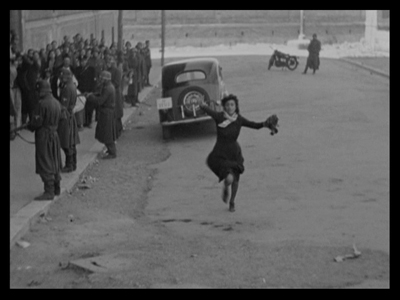
The Americans finally arrive at the start of Paisan (1946; 126 minutes), and the movie's six vignettes track them from their landing in Sicily, through Rome and Florence, and ending up in the marshes of the Po Valley in the North. Long out of circulation, this fascinating anthology film is considered to be the real treasure of this box. Written by a team of screenwriters--Sergio Amidei, Klaus Mann, Federico Fellini, Marcello Pagliero, Alfred Hayes, and Roberto Rossellini--it looks at how the American soldiers and Italian citizens interacted with each other. The individual stories show the struggles with communication, the desire to understand, and the tragedies and sacrifices that would become commonplace.

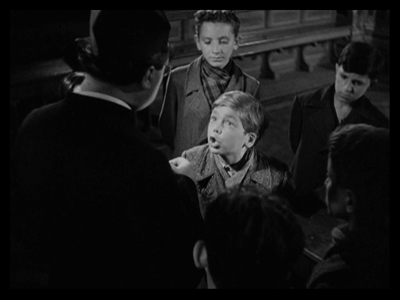
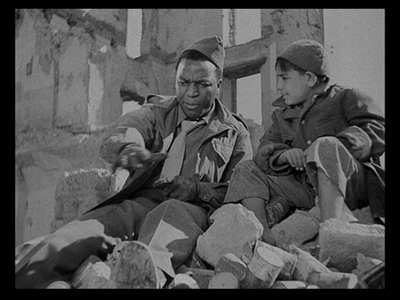
The film begins with a squad of U.S. troops landing in Sicily, hot on the heels of the Germans. They get a local girl (Carmela Sazio) to guide them around mine fields in the area, and she is left in a seaside tower with Joe from New Jersey (Robert Van Loon), an earnest soldier whose yearning to get along might get them caught. Likewise, in the second chapter, another guy named Joe (Dots M. Johnson) learns a lesson in how bad off the Italian people can be. An African American MP assigned to Naples, he gets a little drunk and is taken around the city by one of a gang of street urchins. The kid (Alfonsino Pasca) ends up stealing Joe's shoes, but anger quickly turns to compassion when he sees where the kid comes from.


Not all the Americans are compassionate, though. Another drunkard, Fred (Gar Moore), misses a chance at love with Francesca (Maria Michi again) in Rome because he has gotten too complacent in his role as a hero, whereas an American nurse (Harriet Medin) rushes into danger in Florence because she is maybe too naïve about the consequences of war. Each of these stories ends on a dramatic moment, on the lesson learned or the last twist of the narrative knife. The technique reminds me of a lot of early American TV series, ones that told different stories every week, such as Naked City or Route 66, where a complete dramatic arc had to be contained in the specified timeframe. Rossellini doesn't really attempt to sew these together. Characters don't recur from chapter to chapter, and there is no hearkening back to any one driving element. Rather, these are marks along a map, the varied experiences of the men and women struggling to get out of a nightmare.


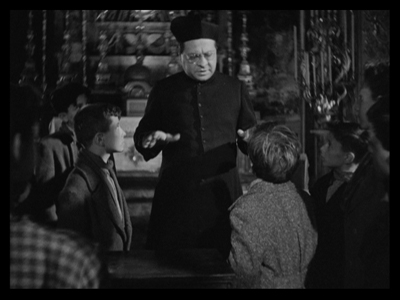
The final two chapters of Paisan are drastically different in terms of mood. The penultimate tale is set in a monastery in the Appenine Range, with real Franciscan monks portraying versions of themselves on screen, welcoming three army chaplains to stay with them. Though the setting is serene, the situation becomes uncomfortable when the monks learn that one of the Americans is a protestant and the other a Jewish rabbi, and they try to convince the catholic priest that they need to be converted. I am not sure if Rossellini intended them to come off as offensive and intolerant, that could just be my modern sensibility, since that is not the note the story ends on.

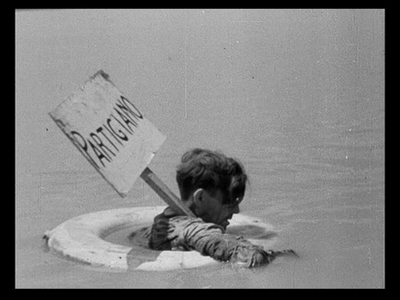
Far more grim is the final tale, with OSS agents teaming with Italian Partisans, fighting guerilla style on the river in the Po Valley. This remote outpost shows a war that is still very active and sparing few. It's a surprising finale for a film that was made after the end of the war. It strikes me as something one might expect to be made in the midst of a long conflict when there is no victory yet to celebrate. Rossellini the filmmaker, however, always wanted to show history as it was, he wasn't interested in making it seem happier or more convenient. By choosing to end Paisan on a downbeat, he also chooses to spotlight the sacrifice and pay special consideration to fighters whom the public record had not given enough attention to.


Paisan actually feels more slapped together than Rome Open City. It's not just the storytelling style, which in itself is sound, but overall, despite the grander scale of many of its locales, it comes off as the movie that maybe was made with less resources. This could be down to the places where Rossellini and cinematographer Otello Martelli took their camera. The scenes of poverty and the bustling crowds of the cities mix the filmmaker's fictional characters with real people, and once again, the director is also employing a lot of non-actors. Some of the Americans are awfully bad, even sounding like they don't really understand English that well (despite most of them being Americans). But that's part and parcel with the Neorealist style: authenticity trumps clichéd professionalism. In its way, it adds to the cumulative effect of the film. Just as there is no great narrative structure to tidy up the reality of war, there is no containing that chaos in terms of performance. This is life, flubbed speech and awkward moments included. A war may begin because of one act, and it may end with some guys signing a piece of paper somewhere, but within it, there are many trials, many failures and triumphs, and there is no meaning beyond living and dying.


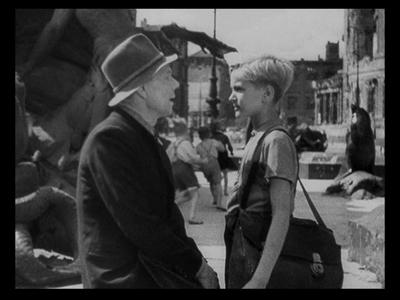
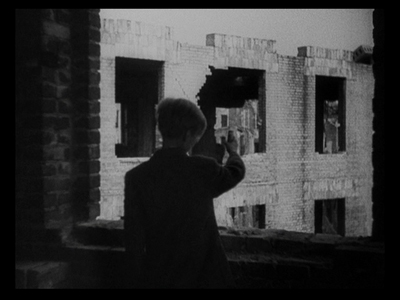
Rossellini turns his camera to the country where so much of the misery of WWII originated for Germany Year Zero (Deutschland im Jahre Null - 1948; 73 minutes). Shooting in the rubble of Berlin, he examines the aftermath of the war as it pertains to one young boy. A 12-year-old whose grammar school years were spent in the Hitler Youth, he is now having to help his family get by, and the day-to-day on the streets is teaching him harsh lessons in morality and survival. While the choice to use a child for the focal point could have been a cheap ploy in the hands of another director, an easy way to get at our emotions, Rossellini, who wrote the film with Max Colpet, handles little Edmund with precision and care, molding him into a heartbreaking example of the effects of war and the trouble facing a populace being forced to start over.


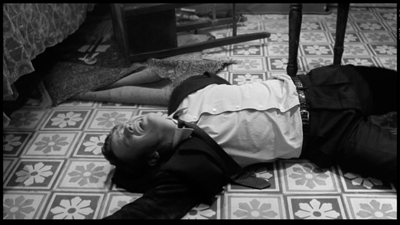
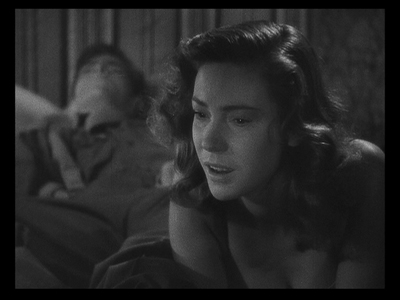
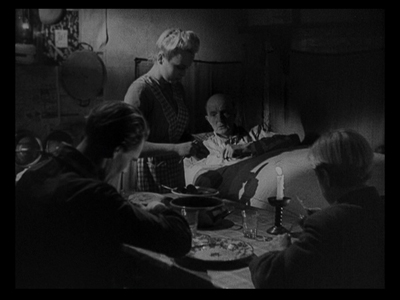
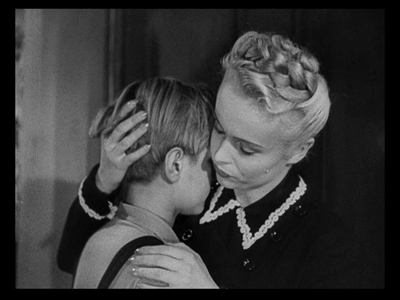
Edmund is played by child actor Edmund Meschke (as you may have noticed, it was Rossellini's practice to sometimes give characters the same name as the actors playing them). The boy is effective in the role in a way only a kid can be. Much of the part demands that he be a blank slate. Edmund has not yet established his own identity, and so he is a follower. He has traded the Hitler Youth for a gang of Dickensian thieves and con men, led by a creepy sort-of Fagin, Edmund's old teacher (Erich Gühne). Edmund's family is worried that the boy has become corrupted, but they are ineffectual to stop it. We even learn that his sickly father (Ernst Pittschau) tried to keep him out of the Hitler Youth, having lost his older son, Karl-Heinz (Franz-Martin Krüger), to the army. Karl-Heinz has returned home, but he has been hiding in the family's tiny apartment, fearing punishment if he registers as a former soldier. Both of the older men being unable or refusing to work is what shifts the burden to Edmund, and thus necessity is a large part of his corruption. The need to survive can push us to terrible things. His older sister, Eva (Ingetraud Hinze), is also skirting the line. She flirts with foreign soldiers in bars to get cigarettes she can later trade for other things, yet she refuses to trade her womanhood to get even more.


Berlin was still in a horrible state when Rossellini took his crew there. The tenements where Edmund and his neighbors live are crumbling and hollowed out. Multiple families cram into tiny apartments; in Edmund's building, likely on the only floor that is habitable. The post-war government is dictating where people live, forcing the owners of the apartment, the horrible Rademaker family (led by the slimy Hans Sangen), to take in these ne'er-do-wells despite his protests. They literally have nowhere else to go, the society is now being compelled to take care of the infirm and the immigrants they might have once cast out. In Rossellini's hands, these unstable, near empty ruins become a metaphor for Germany's moral center. The ideology that had taken them over is in tatters. In one powerful scene, when Edmund is trying to sell a vinyl record of one of Hitler's speeches to some American soldiers, the dead Führer's speech predicting victory for the homeland sounds even more delusional and sad when played over images of the destruction.


The crux of the film is Edmund being faced with another wrong choice, and when he takes it, realizing that the people who have led him there have led him astray. It's a disastrous epiphany, because the boy is left with nothing. It's Edmund's year zero, a total reset, but the true shame of it all is that he doesn't have the tools to start over and rebuild.


I don't believe that Robert Rossellini thought that there was no hope left. I think he truly believed the German and Italian people would persevere. From what we can gather from what the director said about these films, his intention with the War Trilogy was to make sure that the people remembered. Moving on from what happened was useless unless we remember what happened, and so while much of what is portrayed in Roberto Rossellini's War Trilogy is bleak, it's not unnecessarily so. Also, given the faith that Rossellini had in the power of cinematic images, he likely knew that filmgoers would walk away with the more hopeful messages tucked away in their hearts. The resistance fighters in Rome Open City, the people offering aid to one another in Paisan, even Eva hanging on to her principles when it would be so much easier to do otherwise in Germany Year Zero--these positives dominate over the negatives. Granted, we have the benefit of history to know where it will all go, but we also have the knowledge that history does repeat, having seen that governments and their people can still go in the wrong direction. Some will always refuse to learn from past mistakes, and we can only cross our fingers that there will always be more people like Roberto Rossellini and those he portrays that will do everything they can to stop the bad guys from getting away with it.


For a full rundown on the special features, read the full article at DVD Talk.

Wednesday, January 20, 2010

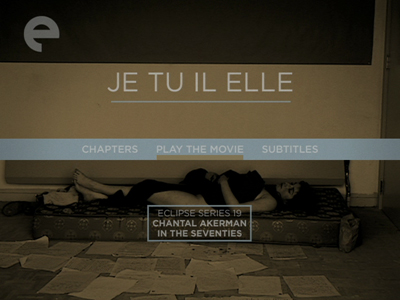
CHANTAL AKERMAN IN THE SEVENTIES - ECLIPSE SERIES 19


Before Belgian director Chantal Akerman redefined experimental feminist cinema with her scathing and insightful Jeanne Dielman, 23, quai du Commerce, 1080 Bruxelles, the young artist had to undergo a pilgrimage. It was one that required her to travel great distances both physically and artistically. It's this pilgrimage that is examined in the new Eclipse Series 19 boxed set, Chantal Akerman in the Seventies. Five movies on three discs, this collection looks at Akerman's career before and immediately after Jeanne Dielman, and taken all together, they create the image of a developing talent finding her cinematic voice.

DVD 1 of Chantal Akerman in the Seventies falls under the umbrella of "The New York Films." These are three no-budget explorations by a young woman in a strange city. Akerman left Brussels for New York in 1971. She was twenty years old, and though she had begun to make short films at home (one of which, Saute ma ville, can be seen on the Criterion edition of Jeanne Dielman), her new locale and the simultaneous feelings of acceptance and displacement that it inspired opened up a whole new world for her. The three movies represented here, released in 1972 and 1976, are collections of footage she shot around the city during her stay there. Ensconced in the underground film scene, she pushed herself to find new methods of expression.


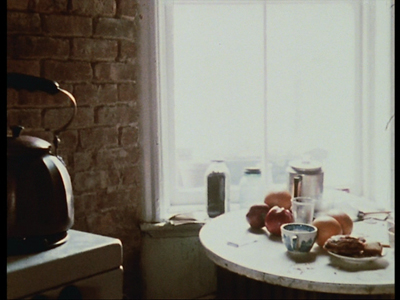
Leading the set is La chambre (1972; 11 minutes), a short formalistic exercise. Working with her long-term collaborator Babette Mangolte on camera, Akerman stars as herself, the lone figure in a small apartment. The entire film is shot from one position, the camera situated in the center of the lodging, slowly circling the room, capturing the details and the filmmaker in repose with each pass. The only thing that changes is Akerman--who is in bed, sits up, and eats an apple--but as the image goes round and round, it compels you to look, to pay attention to the details and seek out other changes, other tell-tale signs of life. The movie itself is entirely silent (as in no soundtrack, not even a trace of ambient noise), as is its follow-up, Hotel Monterey (1972; 62 minutes). The second movie is a series of images taken at the titular hotel, a rundown building in Manhattan.


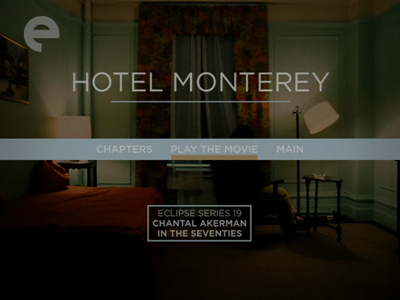
Hotel Monterey begins by spying on the lobby, looking at the people coming and going, before moving up the elevator and picking up stationary shots of quiet hallways, a few guests in their rooms, and lonely stairwells. The photography, again by Mangolte, is beautiful and painterly. (The box description compares it to Edward Hopper, and the dark color schemes definitely bring his work to mind.) It didn't really hold my interest, though. I don't have the patience for an exercise of this length. I even put music on in the background to try to keep myself from drifting. (Abel Korzeniowski's score for A Single Man.) I get what Akerman is doing, the way she is manipulating the passage of time in order to create a sense of space, eventually moving beyond the interior and out into the exterior, but Hotel Monterey lost me.


Random footage is put to better use in News From Home (1976; 86 minutes), in which Akerman juxtaposes images of New York with letters her mother wrote to her when she first left home. The director and her camerawoman, alongside additional camera operator Jim Asbell, shoot all over the city, taking in vacant lots, buildings, traffic, and subway crowds alike. We watch as life moves in front of the lens, with people often looking back at us as we stare at them, and the noise of the city quietly bleeds out of the speakers. Intermittently, Akerman shares the letters, reading her mother's passive aggressive missives with a detached tone. There is something unnerving and maddening about hearing this distant woman guilting her daughter to come home while also witnessing Akerman's great love for her new locale. The snippets of news from Belgium emphasize the distance and the longing for the familiar, evoking a sensation of being in two worlds at once.


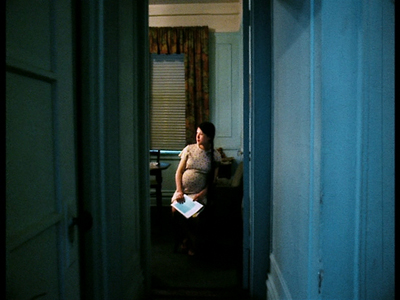
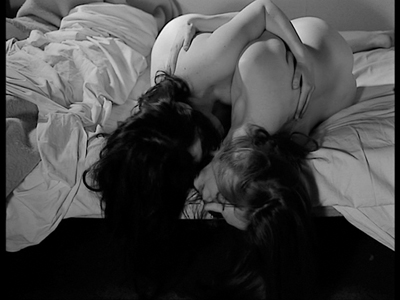
For her first full-length feature, Akerman embraces the most timid of narrative structures. Je tu il elle (Me You He She) (1975; 86 minutes) is a black-and-white portrait in three acts. Act One, a woman named Julie (played by Chantal Akerman) locks herself in an apartment, where she lazes about, eating from a paper bag full of sugar and writing and rewriting a letter to an unknown lover. Act Two sees her impulsively leave the apartment and head out on the road, where she hitches a ride with a trucker (Niels Arestrup), whom she fixates on but who only shares his abstract philosophy on love after she gives him a hand job. Act Three shows Julie arrive at the apartment of her girlfriend (Claire Wauthion). The two have a romantic dynamic that toys with need and denial: one expresses need, the other denies, then switch. This culminates in fidgety lovemaking, a kind of naked wrestling match.


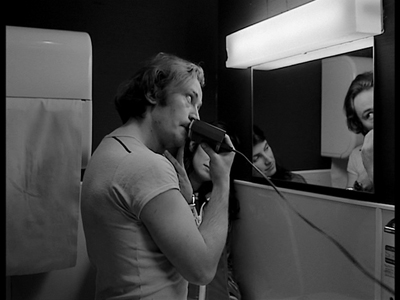
Akerman is messing around with space and time here, as she did in Hotel Monterey. The shots are long, and they compel us to linger on specific details. This is particularly pronounced in Act Two, where the focus of Benedicte Delesalle's camera is regularly off of Julie and on the trucker's face. She watches him diligently, almost obsessively, and in a scene where the driver shaves his face in a public bathroom, the way we see Julie staring at him with her gaze also reflected in the mirror suggests she is looking as intently as she expects her audience to. In Act One, the director establishes a disconnect between decision and action, effectively recreating Julie's sluggish mind by conveying her thoughts in voiceover first, then showing her acting on those thoughts a few moments after they have passed.


Essentially, the director is exploring her relationships with herself, men, and women, examining how she deals with each. At least how I interpret it, she is expressing uncertainty and frustration with her own ability to be on her own. The sugar is a childish sustenance, the inability to get the letter right suggests complications with self-expression. Men are seen as a convenient way to get along, but they are ultimately more concerned with their own needs, and the way the driver only speaks about his feelings following orgasm makes him seem like an overgrown child confessing to his latest maternal stand-in. On the other hand, Julie is predatory and forceful with her girlfriend. Is this maybe the ex that she has been writing to? Is she as incapable of tenderness as the truck driver? Like him, she only calms when the pleasure is focused exclusively on her.

Like all of Akerman's films, there is no point in Je tu il elle where the author turns around and says, "Okay, this is it and this is what it's all about." Her experiments with framing and shot-length and her unconventional story set-ups are meant to provoke, and sometimes the response is delayed--just as it was for Julie locked in that apartment. Meaning never hits you all at once, particularly in this film, where the three parts are so distinct. It's like an entrée with a trio of individual flavors, all of which stand alone, but once you've scooped them into one big bite, a new, complete flavor reveals itself.


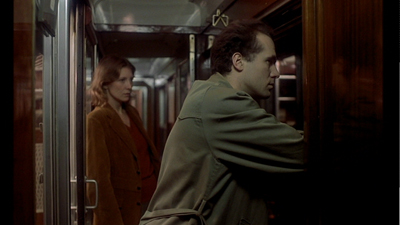
The final film in Chantal Akerman in the Seventies - Eclipse Series 19, Les rendez-vous d'Anna (1978; 126 minutes), was made after Jeanne Dielman and also after News from Home. Both of those films play their part in influencing Les rendez-vous. This semi-autobiographical film follows a successful filmmaker named Anna Silver (Aurore Clement) on a trip to Germany, where she is showing her latest film (Jeanne Dielman?). When she arrives at her hotel, a message from her mother (Lea Massari) is waiting for her. It seems Mom has been trying to get a hold of her daughter for some time, and the communication that we are privy to is very much like the real letters Akerman received from her own mother. "Where are you? What are you doing? Why don't you contact me?"

Like Je tu il elle, Les rendez-vous is structured as a series of encounters. There is the man she meets at her film premiere (Helmut Griem), a sad single father and cuckold; the older family friend (Magali Noël) she meets at a train stop on her way to Brussels; the stranger on the train (Hanns Zischler); and eventually her mother and a former lover (Jean-Pierre Cassel). Anna is another of Akerman's blank canvases, a woman we get to know by the way she reacts to these various people and how they react to her. There is an obvious parable here about how a creative person feels isolated and misunderstood. No one gets Anna as she is, they all want her to fit a role they have for her in their heads. The German one-night stand wants her to fit his romantic ideal, while the old friend speaks to her of marriage and children, encouraging her to accept the norm that is expected of all women. In all these encounters, the other characters are somehow tied into history, both international and personal. Europe, it seems, has made as many bad choices as the individuals seen here have in their love lives. Many of the characters, including Anna, have been displaced. They are looking for life somewhere other than where they are. Even her ex, Daniel, wishes he could abandon everything and disappear--and he's the go-to guy! The safe place to return to is not so safe, not so stable.


There is a formalism to the acting in Les rendez-vous d'Anna that reminds me of Robert Bresson and his theory about actors as "models." The performances are stiff and deliberate, with the actors sometimes visibly spotting their marks and going to them. They speak with little inflection, and stand up straight, positioned with intent. Akerman and cinematographer Jean Penzer frame them in static, straight-ahead shots. If it's a two-person conversation, they stand equidistant from one another, either face to face or looking off into the same direction, the camera remaining locked. For all the movement in their lives, they are stuck in the moment, only Anna keeps going.

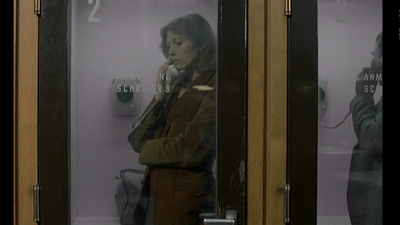
The irony for Anna is that the only person she connects to, a female fan she met in Italy, is the one person she can't grasp. While everyone else is trying to hold her, this other woman is constantly beyond her reach. She can never get this lover on the phone, and her journey back to Brussels and then Paris only puts more distance between them. Anna opens up about this to her mother as the two of them share a bed in a hotel near the train station. In a weird way, it's another one-night stand, and it's our one true glimpse at Anna's interior, a confirmation of the loneliness and grief we imagine follows her around. The fact that she asks her mother to get a hotel room rather than going back to their house indicates that Anna is only comfortable with transient things. She can't accept anything permanent, and even when she thinks she knows what she wants, she realizes she doesn't want it once it's available. Thus, she sends away the man in Germany before they have sex, or when she and the family friend, Ida, go in search of food, Anna decides she is not hungry as soon as they step through the restaurant doors.


News from Home ends with an extended shot of leaving New York City. Filmed from the back of a boat, we watch as the traveler gets farther and farther from the shore. It's one move in a journey that began prior to La chambre when Akerman left Brussels for the Big Apple. It's one that is turned to metaphor in Je tu il elle, and that is completed by the cycle of the successful filmmaker Anna passing through various stops in her life in Les rendez-vous d'Anna. The mother's letters receive their response and personal questions about art and sexuality and personal connections are at least broached, if not answered.

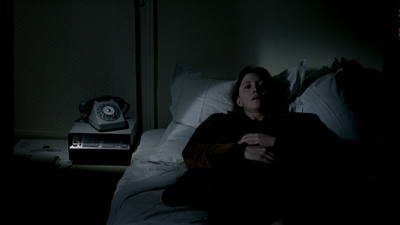
When Anna returns to her homebase of Paris, she returns to an old lover, a la Julie. There are also visual echoes of the New York films--shots of Paris passing taken through a taxi window, the empty hallway of Anna's apartment. For the first time in the movie, she reaches out to someone else, attempting to literally nurse her love back to health by taking care of a feverish Daniel. Yet, illness is its own "other state," and he rejects further advances. In the end, she is back home, alone, listening to the disembodied voices on her answering machine, the phantoms that have tried to touch her, but all said and done, she is still nowhere. "Anna, where are you?"


For a full rundown on the special features, read the full article at DVD Talk.