Still working to get my groove back, but things are getting more focused, batteries are charging. I am keeping track of every week missed, still, so hopefully there will be a flurry of activity this summer.
In the meantime, I did see a couple of movies this past month and I ended up writing about them...
IN THEATRES...
* Bernie, Richard Linklater reteams with Jack Black for a semi-successful comedic take on the true crime genre.
* The Dictator, Sacha Baron Cohen's latest is big on laughs and small on story, but if you like his stuff, the giggles win.
* Men in Black III. What does that make? At least two times too many? Josh Brolin is pretty great, though.
* Snow White and the Huntsmen. No glib line here. I actually like a review I wrote for once. I tried something different. Please read it.
"I like telling the story of life better than living it." - Spalding Gray
Spalding Gray left this Earth in January of 2004, after struggling for several years following a horrific car accident in Ireland. We see the effects of that accident at the tail end of And Everything is Going Fine, Steven Soderbergh's documentary tribute to the actor and writer. He is clearly in pain, and he no longer looks himself. It's a sad finish for a man who otherwise pulled wit and wisdom out of what he termed the great accident of life.
Gray was a struggling actor until his one-man monologues started getting notice in the 1980s. His watershed moment was Swimming to Cambodia, a stage show based on his experience filming The Killing Fields. Gray developed his own kind of theatre--just himself and a desk and a microphone, talking about his life. Several films were shot of these different monologue programs, including 1996's Gray's Anatomy, also directed by Soderbergh. It's often said that the performer's only subject was himself, but as Everything is Going Fine demonstrates, his real subject was the world and the people whose paths he crossed. He even hosted nights where he would sit on stage and interview audience members, as curious about their story as they were about his.
Soderbergh assembles And Everything is Going Fine from various taped performances and interviews, using Gray's own words to fashion a new monologue in order to come to a deeper understanding about the man and share it with a new audience. There is no linear time continuum to how Soderbergh uses the footage, he jumps from one year to the next and back again without any concern for how Gray's physical appearance or the condition of the tape might cut together. What's important in And Everything is Going Fine is the words. The splices create a narrative that takes us from Gray's early childhood and the peculiar fears and philosophies passed on to him by his mother, to how he caught the acting bug and eventually developed his art. We also hear how the restless neurotic eventually found grounding in family after the birth of the first of two sons. That son, Forrest, even contributes music to this movie about his father.
Taking a cue from his subject, Soderbergh searches out the coincidences in Gray's life, and he finds the echoes of events that haunted the great thinker as he trundled forward. An ongoing concern with his mother's madness and own suicide have unsettling reverberations when you know how Spalding Gray eventually died, as do regular references to water. In describing Ireland after the accident, he noted that he could find no bodies of water when he arrived at the Irish countryside. He oriented himself wherever he traveled by the lakes, rivers, and streams. Clearly he had to know what kind of synergy he was creating in his final act. Not that Soderbergh goes there. How could he? There was no way for the monologist to provide commentary about his own suicide.
The concept of And Everything is Going Fine is so simple, there's not much more to describe about it. The documentary is a scant 90 minutes, the average length of Gray's shows, and it manages to never appear hurried but it also never fails to be interesting. I know the impulse to reject such a thing, I passed up seeing Gray's Anatomy in its theatrical run because I didn't understand why anyone would care to see one person talk about himself for an hour and a half. Reject that impulse instead of refusing the movie. And Everything is Going Fine is wonderful viewing. There is much you will pull out of what Spalding Gray has to say, much to carry with you when the movie is over, and despite the tragedy that befell the man, he still manages to make all of us feel like it really will be fine in the end.
"One day life just wins." - James, "Blue Pastures"
If Memorial Day
is about remembrance, then one should remember clearly and accurately. Maintaining
a properly attuned record of history is the purpose of Alain Resnais’ 1955
documentary Night and Fog, a short but potent chronicle of
the Nazi concentration camps, from construction to destruction. From the very
opening, Resnais seeks to remind us that the atrocities perpetrated in WWII are
not an example of extraordinary human circumstance, but born of something more
common, more baseline, something primal within ourselves. Resnais states it
from the very start: All roads lead to human cruelty, whether intentional or
not, and we must be vigilant to make sure the worst paths are never obscured.
Night
and Fog is built around what was, at the time, contemporary footage
of the closed camps. The grass was growing over the rubble, the sun was shining
on the wreckage as if nothing had ever happened. For all intents and purposes,
the ruins could have been any working community that had been shut down--and
using archival footage and photographs, Resnais shows us that, in their way,
that’s exactly what the death camps were. The Nazis established their own
normalcy. The imprisoned had structure. There was commerce, labor, and
politics.
And there was
also brutality and humiliation. Resnais eases us into the true horror. His
narration is matter-of-fact, Hanns Eisler’s music is at times jaunty,
underscoring the dark comedy of a death mask. “We must live with this, as we do
everything else,” Night and Fog seems to say. “This is what
was, and this is what is.” Clarity is essential.
Yet, as the film
takes us deeper into the lifecycle of the concentration camp, the presentation
ever so subtly shifts. There is no denying the gruesome facts. People died.
They died horribly. The perpetrators presented an ordered front, but behind
that were the worst things you could imagine. Resnais’ point seems to be that
this is the easiest aspect to forget. As history becomes comfortable, as we get
used to the past being the past, the mind glosses over the jagged edges. Two
years prior to Night and Fog, there was Stalag
17--a good movie, but one that must have seemed unimaginable to many.
A concentration camp comedy! And one with no Jews, no ovens, no mass graves! Night
and Fog is the antidote to such flippancy.
Memorial Day can
often give over to rah-rah sloganeering--which, let’s not get it wrong, it’s
not the same thing as honoring the soldiers or paying tribute to a good fight
and hard victories. Those things should be remembered, too, but not at the
exclusion of the other side. We should consider the cost of war, the price paid
by those who participated, be they soldier or civilian. You can watch a John
Wayne movie, you can watch Saving Private Ryan, but you
should also watch Night and Fog. Its chilly denouement will
make the heroes of those other films seem all the more heroicyou’re your considering
what their sacrifice was for.
“It would be stupid for us to ruin our lives for an
ideal.”
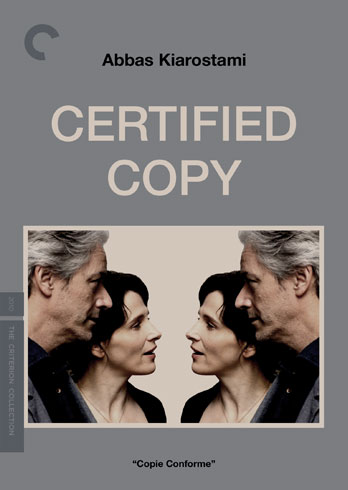
If ever a film was made for an International Film Festival,
it’s Certified Copy. A French-funded film directed by an
Iranian director, set in Italy, and featuring a script that alternates between
French, Italian, and English, it practically needs its own map.
The latest shell game from Abbas Kiarostami is, like many of
the director’s films, difficult to describe without being reductionist. In a
sense, it’s one long, roving conversation--a little like Malle’s My
Dinner with Andre [review] remade as a more grown-up version of Linklater’s
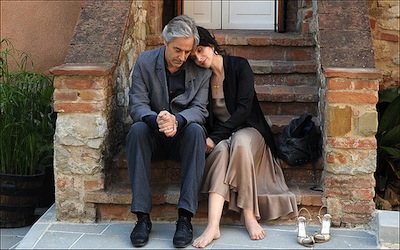
Before Sunrise. British opera singer William Shimell plays
James Miller, author of a book about the value of art reproduction as an art
unto itself. It’s called Certified Copy, and it does more
than lend its title to the film: its major themes are also the themes of
Kiarostami’s script. Is there more value in something that is genuine than
there is in something fake? Is authenticity important, or is the perception of
something’s value what really matters? James, it would seem, would say yes. But
then, he also wonders aloud whether he authentically believes in what he is
saying or he wrote a book in order to convince himself of his own ideas.
According to him, simplicity is best. Like what you like for your own sake.
French actress Juliette Binoche plays Elle, a single mother,
or so we assume, who is a fan of James’ book and also annoyed by it. She likes
what it explores, but doesn’t agree with all the conclusions. When James visits
the Tuscan town where she lives with her son, she takes the writer out for a
Sunday drive. They end up stopping in a village where couples go to get married
because it is supposed to be good luck. Even this becomes fodder for debate.
Shouldn’t they be marrying for love rather than kidding themselves that there
is some other force helping them along?
Every stop on their journey through this town adds more to
the discussion, be it a café, museum, or public square. The back and forth
becomes more heated, particularly as past connections are revealed between
them. As some might say, “shit gets real.” Except we’re never sure if it does.
When an old woman running a coffee shop mistakes James for Elle’s husband, she
doesn’t correct her, and suddenly they share this seemingly invented life.
James goes along with it, and Kiarostami quickly sows the seeds of confusion.
Just what is between these two?
Kiarostami has dealt with themes of adopted identity before,
most notably in his film Close-Up [review], a reenactment of a true
story about a man passing himself off as a famous Iranian film director and the
family that agrees to be in his “movie.” Kiarostami is a director who is
interested in the relationship between truth and fiction, of the illusion of
cinema and how the audience accepts it. His 1997 film A Taste of Cherry famously removed the veil in its final shots, showing the film
crew standing nearby. His last movie, Shirin [review], was composed
entirely of images of different women (including Juliette Binoche) watching the
same movie, the film’s narrative consisting of their reactions to the other
narrative being shown offscreen. Given that the women were looking straight
ahead, it made the audience the unseen movie. We watched them watching us.
Certified Copy also brings to mind vague echoes of Kim
Ki-Duk’s Real Fiction, though the Korean filmmaker’s
voyeuristic verité and use of doppelgangers is far more abstract and
psychologically trying.
Certified
Copy doesn’t resort to such self-reflexive tricks; instead,
Kiarostami offers multiple metaphors for his central question that keeps the
audience on its guard. There is the painting in the museum that, for two
centuries, was believed to be from Rome, but that had recently been discovered
as being a forgery from Naples. It now hangs as a multi-layered object: what it
is and what it is a copy of. But can’t it exist on its own? It’s not like the
original painting wasn’t a copy of real life. Later, James and Elle visit a
fountain with a statue that is meant to depict true love. Next to it, the
strained relationship between the flesh and blood couple seems diminished.
Which is more of an approximation?
The director playfully toys with the visuals throughout the
film. Scenes often appear on two planes, with one actor present in the frame
and another visible from outside the shot, seen as a reflection in a mirror or
glass. Kiarostami is creating copies of his own performers, calling attention
to the artifice through the construction of his image. The day out for James
and Elle is a relationship occurring at warp speed. It escalates from nervous
first impressions, through getting to know each other and straight into
commitment, and then into exasperated familiarity. Amusingly, throughout their walk,
the other couples the pair meet keep getting older and older, newlyweds to
feeble senior citizens.
Juliette Binoche is a treasure. I think she’s incapable of a
bad performance. She is the gravitational pull that dictates which way the tide
flows in Certified Copy. Hers is a fully inhabited
performance, complex in its emotional range. There are moments of tremendous
heartbreak, but she also expresses hope and joy and frustration with equal
strength. Her face is a sophisticated tool, capable of conveying any thought or
emotion. The less-experienced Shimell can’t quite keep up. There are times when
his acting appears mannered and put-on, usually when he is peering directly
into the camera. It doesn’t really hurt the film, but you can’t help but wonder
how much better Certified Copy could have been if Binoche
were sparring with a champion of equal strength.
In addition to the scenes where we see one of the actors
reflected in a random surface, we also get two scenes, one for each character, where
James and Elle regard themselves in a mirror. (Like Shirin,
what they are looking at, arguably, is us.) It’s in these moments that both
seem to be making a decision of how much they are willing to reject the
invention. If a fake life is as legitimate as a real one, then there is no
reason to go along with it. Or, depending on how you choose to see it, they are
maybe discarding the illusions and excuses that have kept them apart. The
veracity of the experience is in the purview of the individual viewer, which
could be Abbas Kiarostami’s most appropriate object lesson yet: how much you
choose to accept his fiction only reinforces Certified
Copy’s driving conceit.
* The Avengers, the film at pole position for the summer blockbuster season. Joss Whedon delivers a big budget aventure with great characters and even better action.
* The Cabin in the Woods, a fun puzzle of horror and comedy. Avoid info on this one, just go! (Whedon also writes this one.)
* Damsels in Distress, it's Whit Stillman to the rescue in the director's first movie in 14 years.
* The Deep Blue Sea, beauty and heartbreak in a new film from Terence Davies. Starring Rachel Weisz.
* The Five-Year Engagement, an uneven romantic comedy with genuine laughs and heavy sentiment. Starring Jason Segel and Emily Blunt.
ON DVD/BD...
* Roadie, Michael Cuesta's middle-aged rock 'n' roll drama has sharp writing and sharper performances.
* Something to Live For, featuring Ray Milland in an unofficial sequel to The Lost Weekend.
It's weird living in an age when someone you never met has passed away and yet you know about it faster than you might were it someone in your own family.
I first saw mention of Adam Yauch's death on Twitter this morning. That one post was then followed by four. Then countless. Like many people, I decided to head to This is My Jam and change my song to one from the Beastie Boys. Yauch was better known as MCA, one of the three masterminds behind possibly the longest-running active group in hiphop. I wanted to mark "The Sounds of Science" from Paul's Boutique because it's the one where he says, "That's right, my name's Yauch." It took me three tries to get the site to load. My queue of friends was full of Beastie songs. The outpouring of love for MCA was crashing the servers.
I always thought I'd review Criterion's Beastie Boys Video Anthology one day as a stop-gap, a quickly dashed piece about how the double-disc set was put together when I was behind the eight ball and needing a special ninja move to get out. I mean, how do you really write about a music video collection? Do you dig into the thematic narrative the way you do a regular movie? I suppose you could, but it'll probably read like a real stretch.
But now that I think about it, there is a thread that runs through the Beastie videos: it's the thread of our collective lives. Each segment represents a "where were you." At what point in your life did you first see "Fight For Your Right" or "So What'cha Want" or "Body Movin'"? Particularly in the first half of their career, when everyone watched MTV and, as one pundit whose name I've long forgotten once said, the cultural vernacular changed from, "Did you hear that new song by [Band X]?" to "Did you see that new song by [Band X]?" I remember the group returning after the post-Licensed to Ill exile and the big deal that MTV made about "Hey Ladies." It's perhaps telling of the band's influence that as much of a big deal was made last year when they debuted the long-form "Make Some Noise." I couldn't download that clip fast enough. The album that followed, Hot Sauce Committee Part Two, being pretty great was a triumph in many ways, not least of which being that, at least for the time being, Adam Yauch was beating the cancer that was destroying his body.
It's a shame that the band decided not to include their Licensed to Ill-era videos on Video Anthology. I know that the Beasties have a conflicted relationship with their debut. It's a party record, a bit of a joke, and much of the lyrical content is, if taken seriously, regrettable. At the same time, the music was revolutionary. Rick Rubin's production style, marrying samples and beats with a unique cold fusion of rock and metal, was unlike anything most of us had heard way back in 1986. It was the first rap record a lot of us ever owned, and it changed the public at large's point of view about the then relatively new art form.
Though unintentional, Licensed to Ill successfully achieved what would become Yauch and Co.'s long-term goal: it unified people. Licensed to Ill came out when I was transitioning from junior high to high school, and back then, it seemed like everyone listened to the Beastie Boys. It didn't matter what social group you belonged to, or what other music you preferred, you owned a cassette of Licensed. I remember sitting in English class and this cheerleader named Tanya was talking with the other popular girls about how Mike D was her favorite Beastie because he was the cutest, and I was able to enter the conversation to say I liked Mike D, too, because I liked his style, particularly his sunglasses. Because of the Beastie Boys, and specifically their visual image as seen in music videos, people who never talked to each other were communicating, even if only for a short time.
Paul's Boutique came out as I was getting ready to leave high school and preparing to leave home and go to college. As I mentioned, the first thing to emerge, at least in such a way to reach where I lived, was the "Hey Ladies" video. Funny to note now, but I kind of hated it when I first saw it. I wondered what had happened to the Beastie Boys. What was with all the 1970s clothes and the weird, shifting structure of the song? This wasn't what I expected from them, and though considered a masterpiece now, the album in full was not what anyone had waited three years to hear. Luckily, another kid at my school, Derek Walkington, had gotten Paul's Boutique on tape and he embraced its eclecticism and made me give it a listen. Using Licensed to Ill as a foundation, the Beasties were taking their sound and stretching it to every conceivable length. Yes, there was disco and funk, but there was also rockabilly and punk and the fragmentary experimentation of "B-Boy Bouillabaisse," the extended medley that closed the record. What initially freaked everyone out about Paul's Boutique would later be hailed as the band's willingness to explore and grow.
That attitude would pay off big time in 1992 when the Beastie Boys released Check Your Head. Though not as all over the map or even as creative as Paul's, Check Your Head drew its lines more clearly. There was the rap song, and then there was the funky instrumental, and then a punk song--it was chopped up rather than blended, and though it shouldn't have worked (and really, I'd still argue that it and Ill Communication are the least satisfying as "albums"), Check Your Head captured everything about the emerging "alternative" culture and, in many ways, pointed the way to the 21st Century, when inclusive lifestyles and a broad-based consumption of media would be the norm. Derek and I went to see the Beasties at Lollapalooza that year. We were in the orchestra pit at Irvine Meadows. Nicolas Cage and Samantha Mathis were standing behind us. I got to shake Cage's hand. And the show was awesome.
It was probably the last time I was that fully invested in the Beastie Boys, and also the only time I ever saw them live. Still, I can trace a map of my life since based on the albums that followed. Ill Communication came out the first year I lived in Portland and was working at Dark Horse Comics; Hello Nasty was released after I had left Dark Horse and was working at a record store, and it was a particular favorite of my girlfriend, who also worked there. (I should note, it's also the last period represented on Video Anthology, which was released in 2000.) To the 5 Boroughs has the distinction of being the post-9/11 album, but it also represents for me a sweet spot in my career, when I was ensconced at Oni Press and it was just me and Joe Nozemack and James Lucas Jones, our own creative trio, doing our thing. By Hot Sauce Committee Part Two, I had left Oni Press and had established myself as a freelance writer.
I realize that all of the above is, in so many ways, more about me and less about Adam Yauch, but such is how these things tend to be. MCA and I have never met, I don't know him personally, I only know how he affected my life and how, as an artist, he was always there, influencing me and inspiring me. Paul's Boutique, so weird at first, came out right when I was becoming a different person, trying new things, and breaking out of my safe teenage world. As I grew, the Beastie Boys were growing with me, and vice versa.
If anything, the legacy of Adam Yauch is one of open-mindedness and principled exploration. His career choices demonstrate that one need never be limited in what sphere they choose to operate in, and at the same time, one can be true to oneself. In word and deed, MCA showed that you could be an individual while also caring about everyone around you. Limits are only for the weak-minded. The Beastie Boys Video Anthology succinctly encapsulates the first 2/3 of the band's career, and yet puts them on the cutting edge at the same time. When it came out 12 years ago, there was nothing like it. There were so many options for how to watch the videos, and also so many options for how to listen to the songs, the DVD case actually came with a map for how to navigate between all of them. Amusingly, my favorite video is now "Hey Ladies," because its cheeky humor means it has always stayed fresh. It's kitsch without the condescension that tag normally implies. Perhaps it's also amusing that, in keeping with the Beasties ethos of standing on one's own feet, the most popular cut here, "Sabotage," is for me the least interesting. I've always found it to be a bit too one-note, a 30-second joke extended past the point of breaking. I know that's the minority opinion, but sometimes you just have to stand apart.
It should be noted before I close that Adam Yauch had become an important contributor to the world of cinema in the last several years. He often directed Beastie Boys videos and live shows (the videos embedded here are his, and chosen specifically because of that), and he was the man behind the camera on the basketball documentary Gunnin' for that #1 Spot. Yauch was also the founder of Oscilloscope Studios, one of the most influential independent film studios currently running. It has provided an outlet for filmmakers as eclectic as Lynne Ramsay, Samantha Morton, Spike Jonze and Lance Bangs, KellyReichardt, Jules Dassin, Oren Moverman, and Michel Gondry, and has introduced the world to movies like If a Tree Falls, Kisses, Monogamy, The Exploding Girl, Treeless Mountain, Scott Walker: 30 Century Man, A Film Unfinished--the list goes on. All those links are to reviews I wrote of the movies mentioned, but you can also explore this list by Movies.com of all the Oscilloscope films currently available on Netflix.
I'm embarrassed to be writing one of these posts, but I owe my regular readers an apology. I hate when bloggers go off the rails and don't meet their commitments, but here I am, three weeks behind on my reviews. A variety of the usual factors have contributed to me not getting any reviews done this month; it's all fairly predictable, I won't go into it too heavily. Needless to say, I am keeping track, and I will make up for the missed weeks as soon as I can.
The one thing I will point you to that has been a heavy-duty time suck is that I decided to serialize a novel online. It's called Bobby Pins and Mary Janes. The book is written, but I am copyediting and preparing posts for the launch on April 27. This, naturally, is time-consuming, and I am trying to set it up so I am not updating every week just in time. I have the first couple of posts ready to go already, but lead time disappears fast!
I am going to cut and paste the press release for the book below. Please consider visiting the site -- bobbypinsandmaryjanes.com -- and bookmarking it. It's a new adventure that is both exciting and terrifying, but there's no stopping it now!
Regardless, thanks for your patience. I will be back!
***
COMICS WRITER JAMIE S. RICH SELF-RELEASES FIFTH PROSE NOVEL AS AN ONLINE SERIAL
Beginning on April 27, website bobbypinsandmaryjanes.com will go live with the opening pages of Jamie S. Rich’s fourth prose novel, Bobby Pins and Mary Janes. Described as “The Devil Wears Prada for the comic book industry,” this lengthy work of literary fiction chronicles a life within the world of indie comics, complete with moody editors, sensitive cartoonists, and more than a little four-color romance. Bobby Pins and Mary Janes is a workplace drama, but also a novel of identity, exploring one character’s crises of conscience during her mid-20s. Parker Reid is a college graduate who always dreamed of literary grandeur, but she’s found herself working in a creative field she never anticipated.
“Parker’s work struggles reflect her personal struggles,” Rich explained. “She has been on her own for a couple of years, and she remains on her own. At the start of the book, she is having an affair with her employer’s top cartoonist, but by the end of it, she will have flirted with a married man, chased the safe option, and also had to contend with the unrequited love of her best friend from school. Is this the life she wants? Should she settle for a relationship the same way she settled on her job?”
The aforementioned fictional cartoonist is the creator of an original comics series called “Valerie Flames,” an ongoing series about a young girl whose adventures cross the mysteries of Nancy Drew with the escapades of Tintin. Character designs for Valerie Flames and her cohorts were drawn by Joëlle Jones, Rich’s frequent collaborator. Together they have produced the graphic novels 12 Reasons Why I Love Her and You Have Killed Me. Valerie’s adventures will be represented in the online version of the novel via sections of script. “The script interludes not only demonstrate what this invented comic book might be like,” Rich said, “but also establish a meaningful parallel with the main narrative. The technique is like Margaret Atwood’s The Blind Assassin mashed-up with Michael Chabon’s The Amazing Adventures of Kavalier and Clay.”
“The world of comic books is one I know well,” Rich commented. “I began as an editorial assistant at Dark Horse Comics when I was 21, and I spent six years as editor-in-chief at Oni Press. I’ve written my fair share of funnybooks, as well.”
Bobby Pins and Mary Janes follows on the heels of Rich’s previous prose works, including his popular first novel, Cut My Hair, and his most recent, Have You Seen the Horizon Lately? Yet, it’s his second book, The Everlasting, that the new novel has the most in common with thematically. “The Everlasting was the story of a 25-year-old boy who couldn’t make up his mind about what he wanted in a relationship. Bobby Pins and Mary Janes is like the response to that--like a retaliation record in a rap battle. It’s the flipside of the story from the girl’s point of view.”
When asked why he chose to serialize the book online, Rich’s answer was simple: “I finished writing this book a couple of years ago, but for a variety of reasons, it ended up on the back burner. In the time since, technology has changed and grown, and I wanted to take advantage of that. Plus, the serialization gives me specific goals for getting the material out there. Every Friday, another section of the novel has to arrive. When it is done, I may take it further, but for now, this is the platform.”
Each posting will be readable directly on the bobbypinsandmaryjanes.com tumblr, or downloadable as a pdf. “I want people to be able to load it into their chosen reader and take it with them.” In the run-up to the first post, Rich has been teasing visitors to the blog with images that inspired him while writing the story, including a random sketch by Joëlle Jones that became his visual marker for main character Parker Reid.
Press looking to cover Bobby Pins and Mary Janes can contact Rich at golightly[a]gmail.com. He is available for interviews and can also send the first postings for early review
Author of prose novels and comic books like Cut My Hair, It Girl & the Atomics, You Have Killed Me, and 12 Reasons Why I Love Her. Jamie's most recent novel is the serialized book Bobby Pins and Mary Janes, and his most recent graphic novels are the sci-fi romance A Boy and a Girl with Natalie Nourigat; Madame Frankenstein with Megan Levens; and the weird crime comic Archer Coe & the Thousand Natural Shocks with Dan Christensen.


 , a stage show based on his experience filming
  . Gray developed his own kind of theatre--just himself and a desk and a microphone, talking about his life. Several films were shot of these different monologue programs, including 1996's


 . British opera singer William Shimell plays
James Miller, author of a book about the value of art reproduction as an art
unto itself. It’s called Certified Copy, and it does more
than lend its title to the film: its major themes are also the themes of
Kiarostami’s script. Is there more value in something that is genuine than
there is in something fake? Is authenticity important, or is the perception of
something’s value what really matters? James, it would seem, would say yes. But
then, he also wonders aloud whether he authentically believes in what he is
saying or he wrote a book in order to convince himself of his own ideas.
According to him, simplicity is best. Like what you like for your own sake.
. British opera singer William Shimell plays
James Miller, author of a book about the value of art reproduction as an art
unto itself. It’s called Certified Copy, and it does more
than lend its title to the film: its major themes are also the themes of
Kiarostami’s script. Is there more value in something that is genuine than
there is in something fake? Is authenticity important, or is the perception of
something’s value what really matters? James, it would seem, would say yes. But
then, he also wonders aloud whether he authentically believes in what he is
saying or he wrote a book in order to convince himself of his own ideas.
According to him, simplicity is best. Like what you like for your own sake. 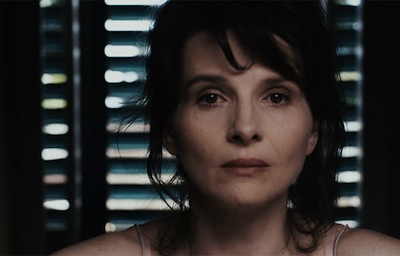

 , though the Korean filmmaker’s
voyeuristic verité and use of doppelgangers is far more abstract and
psychologically trying.
, though the Korean filmmaker’s
voyeuristic verité and use of doppelgangers is far more abstract and
psychologically trying.