Showing posts with label abbas kiarostami. Show all posts

Sunday, July 19, 2020

TASTE OF CHERRY - #45

"And when I'm lying in my bed 

I think about life and I think about death 

And neither one particularly appeals to me.”
 
     - The Smiths, “Nowhere Fast”


People don’t like to talk about suicide. They just don’t. They barely want to talk about death and the afterlife as it is; therefore, you know if you’re bringing up ending your own life, it’s going to get uncomfortable.

So Mr. Badii (Homayoun Ershadi) quickly finds in Abbas Kiarostami’s 1997 Cannes-winner Taste of Cherry. Hell, he doesn’t even want to talk about it. He doesn’t wish to share his reasons for getting out, he just needs a practical hand to double-check that he’s carried it through. And thus he drives through Tehran looking to hire someone dependable. He tries three men--a rookie soldier (someone who just does the job), a religious scholar (a man of philosophy and ethics), and a taxidermist (the preservation of the deceased)--all of them immigrants--a Kurd, an Afghani, and a Turk--presumably chosen as such to display Kiarostami’s acknowledgement of a universal experience. We are all passengers on Spaceship Earth.


Badii’s proposal is simple. He has picked out a spot and dug a hole to lie down in. As night falls, he will take all the sleeping pills he can swallow and go to sleep in the hole. At dawn, the man he hires shall go there and call his name. If he does not rouse, the fellow just needs to bury him and a good sum of money will be waiting. Seems easy enough, but the proposition causes reactions. The soldier is scared, the scholar concerned, and the older man, the taxidermist, resigned. Through their responses, Kiarostami crafts a debate around the notions of self-determination and our duty to others, both in terms of what Badii’s actions might mean to those around him and  the potential helper’s duty to stop their fellow man from inflicting harm. Ironically, Badii doesn’t recognize the most concrete example of man’s kindness when he drives his truck off the road and nearby workers rush to push him out of danger. Presumably, there could be relief should he choose. Or is his problem truly without solution, as he would suggest?


Though Taste of Cherry is a movie that thrives on conversation, it is also a film of perpetual motion. A vast majority of the picture’s running time takes place in Badii’s truck as he drives around looking for candidates and then pitches them the plan while taking them out to see where his final resting place is intended to be. This, one can assume, is Kiarostami’s metaphor for life, or at least a representation of how Badii feels about it. Life never stops, there is no rest. The closest Badii gets is a poetic scene where he sits down amongst the rubble of a quarry and watches dirt and rock be churned and ground down. Kiarostami stages the sequence as a kind of shadowplay, the dusky image of the rocks covering the shadow of the man, foreshadowing the peace waiting for him in just a few hours. I think it may be the only time we see Badii smile. In truth, he’s kind of a prick, and his secrecy makes it hard to empathize with him; it’s only in these moments, as emotion shows through, that we find an individual we can sympathize with. When roused from this reverie, Badii will not rest again until his deal is made.


Kiarostami has very much crafted a film here. Taste of Cherry is as rich in visual splendor as any other narrative film with a more complicated plot. The story here is small, but the world is expansive, as we are constantly reminded by the camera’s regular positioning outside the truck. We peer down from the mountains, from the godly perch of the audience, and see Badii driving through the hills, see the towns beyond. We aren’t just with him when we are in the truck, but we are observing him as he moves through the day. We are aware of his place in some kind of ecosystem, and privy to his impact on it. When Badii leaves a man, we do not, we get to stop and see their thoughts the moment after he exits their lives. It works just like any other movie, even if its tale is not standard Hollywood fare.

Which almost makes the coda of Taste of Cherry unnecessary. When Kiarostami exposes the crew, shows us the actors and the cameras at work, he reminds us that this is a motion picture, that no one actually lived or died. Which, we are smart people, we know this. Yet, Kiarostami wants us to stop and think about it, to question how and why we engaged. Much like in his experiment with showing reactions and not the movie being reacted to in Shirin [review], the Iranian director refuses to let the audience be passive, or to leave Badii behind when the lights go out...and come back on. 


Sticking to that theme, Criterion has included a short film called The Project that shows Kiarostami’s process, cutting together footage where he acts out scenes with his son followed by clips of him directing those same scenes with his actors. The raw material shows how passionate Kiarostami is about getting to the truth, and is reminiscent of similar films with Ingmar Bergman, particularly The Making of Fanny and Alexander [review]. It’s amazing to see how the auteur finds the spontaneity in repetition. 

A quick note regarding the new Blu-ray of Taste of Cherry: as a Criterion release with a very low spine number, Cherry was overripe for an upgrade. I’m happy to say that the new 4K restoration has done wonders for the picture quality. The image is sharp and vibrant, full of nuance and detail. Viewers in 2020 and beyond can see all the aspects of that wide world Kiarostami is looking to show.


Tuesday, May 27, 2014

LIKE SOMEONE IN LOVE - #707


A personal motto, and one I am admittedly bad at adhering to, is, “Don’t ask any questions you don’t know the answer to.” It’s a bit off the mark, just in terms of semantics, because the real meaning is, “Don’t ask a question if you know the answer is the one you don’t want.” My phrasing allows you to let yourself off the hook a little, particularly as it applies to when you’d really rather be in denial over whatever is at issue.

The old professor Takashi Watanabe (Tadashi Okuno) says something similar in Abbas Kiarostami’s latest, Like Someone in Love. His version, paraphrased, is don’t go asking questions if you suspect you’re going to be lied to. In other words, you’re probably right, so hang on to your ignorance. It’s the suspicious person’s version of, “Better to be silent and thought a fool than open your mouth and remove all doubt.” A quote that itself, in its various forms, is regularly attributed to several different people, all whom likely said a variation of the same thing.


The divide between the truth we live and the truth we present to others is very much a theme of the best of Kiarostami’s work, including movies I’ve reviewed before (Certified Copy and Close-Up). In this case, love and longing are the reasons for the dishonesty, though I think from Takashi’s point of view, it’s not so much dishonesty as an alternate translation of the truth, one befitting an individual’s personal circumstance. (He translates literature for a living.)

The story begins not with the old professor, but with Akiko (Rin Takanashi), a student in Tokyo who has a jealous boyfriend and the worst kind of job for being in a relationship with such a fellow. In short, she is a call girl, however reluctantly, and not without her fair share of shame. Watanabe is her client for the evening, though however we might judge him at the outset, it’s never clear he has any sexual designs on the girl. Upon arrival, he insists she sit down for a meal, even as she lures him into the bedroom in hopes of getting him to climb into bed and take a nap. She notices a resemblance between herself and photos of different women of different ages scattered around his apartment. A neighbor later mistakes her for his granddaughter, while also suggesting that something went wrong in Watanabe’s past to chase away the women in his life. It’s quite possible the old man is just hiring Akiko to fill a hole he’s not been able to close.


Because he certainly falls into the role of parental caretaker. The day after their would-be date, he drives the girl to her university. There he meets her fiancé, the volatile Noriaki (Ryo Kase). The boy suspects what Akiko is up to, and he vacillates between believing the evidence and expecting Akiko to deny it. It’s him that Watanabe advises against giving his lover room to be deceitful. Somewhat ironically, he’s allowing Noriaki to think he is Akiko’s grandfather at the time. It’s a convenient fiction, one that the younger man would be better off letting stand, as well. Everyone here has either invented a role for themselves or let someone else do it for them. Or they’re projecting the image they want onto someone else. Noriaki wants Akiko to be the virtuous woman he imagines, and he all but admits his intentions of marrying her are so that she can no longer be, or even pretend, otherwise.


What’s interesting about Like Someone in Love is that Kiarostami’s script is not interested in exposing the lies or revealing the secrets behind them, but rather the lengths each character will go to in order to preserve their inventions. The professor has no tearful revelations about past mistakes, nor does the student rationalize her decisions to justify how she makes money. In fact, they are the sympathetic ones here, both for their need to preserve some kind of dignity and for how they find comfort in one another. The only information required is that they somehow need what these fictions supply, needs that extend beyond the sexual and the economic.

In that vein, Noriaki is the one for whom there is little empathy. He projects his lies on others with the petulance of a child. His coping skills leave much to be desired. In light of recent events in Santa Barbara, it’s possible I am judging him a little harshly, but Kiarostami has cast him as a bit of a cliché brute. He’s a mechanic and an anti-intellectual who can’t take a woman being anything but fully focused on him. Credit to Kase for how nonchalant he manages to make some of the more chilling moments. The way he asks Akiko what book she plans to buy at the bookstore is unsettling. What should be innocuous curiosity suddenly takes on a darker subtext.


Like Someone in Love is told as a quartet of long sequences. There is Akiko getting the job and heading to Watanabe’s, her night in his apartment, the day out together where they meet Noriaki, and their rejoining one another later. Though there are brief detours in each, those are essentially the four acts of Kiarostami’s narrative. He allows each scenario to run its course, preferring natural conversations to carefully edited dialogue or snippets of interactions. A good portion of the movie is spent inside Watanabe’s car, parked outside Akiko’s school. He drops her off, he sees her argue with Noriaki, he talks to Noriaki, and then they are joined by the girl. Kiarostami doesn’t cut away upon her arrival, but instead shoots from the hood of the car, peering in through the windshield, even as the old man starts the vehicle and pulls away from the curb. We are outside and inside simultaneously.


This makes Like Someone in Love one of those movies that defies traditional narrative and instead mimics the rhythms of real life. And yet, this too is a construct, a fiction that the filmmaker establishes and then tricks us into buying into--at least in the sense that he uses the simulacrum of realism to inspire us to invest in the happenings in a completely different way. The usual story logic by which we can predict the story’s developments, the act breaks, and the film’s climax, is taken away from us. We must watch and wait. The movie even ends at a moment we would not expect. Were it to keep going, Kiarostami would have to violate his own rule about explaining things here. The next scene, were it to happen, would require resolution and denouement. Instead, the storyteller stops just before the bubble bursts, ducking out right at the moment of impact--literally so for his characters, figuratively for those of us observing.


This disc was provided by Criterion for purpose of review.

Wednesday, May 23, 2012

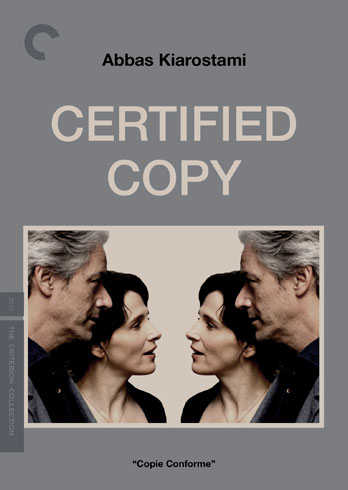
CERTIFIED COPY - #612

“It would be stupid for us to ruin our lives for an ideal.”


If ever a film was made for an International Film Festival, it’s Certified Copy. A French-funded film directed by an Iranian director, set in Italy, and featuring a script that alternates between French, Italian, and English, it practically needs its own map.

The latest shell game from Abbas Kiarostami is, like many of the director’s films, difficult to describe without being reductionist. In a sense, it’s one long, roving conversation--a little like Malle’s My Dinner with Andre [review] remade as a more grown-up version of Linklater’s Before Sunrise . British opera singer William Shimell plays James Miller, author of a book about the value of art reproduction as an art unto itself. It’s called Certified Copy, and it does more than lend its title to the film: its major themes are also the themes of Kiarostami’s script. Is there more value in something that is genuine than there is in something fake? Is authenticity important, or is the perception of something’s value what really matters? James, it would seem, would say yes. But then, he also wonders aloud whether he authentically believes in what he is saying or he wrote a book in order to convince himself of his own ideas. According to him, simplicity is best. Like what you like for your own sake.
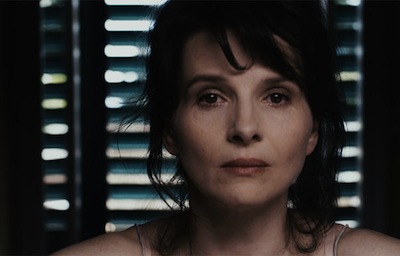


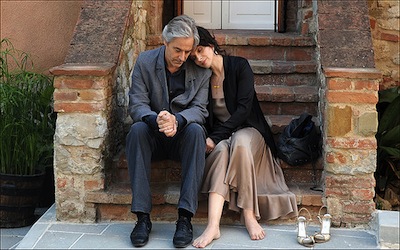
French actress Juliette Binoche plays Elle, a single mother, or so we assume, who is a fan of James’ book and also annoyed by it. She likes what it explores, but doesn’t agree with all the conclusions. When James visits the Tuscan town where she lives with her son, she takes the writer out for a Sunday drive. They end up stopping in a village where couples go to get married because it is supposed to be good luck. Even this becomes fodder for debate. Shouldn’t they be marrying for love rather than kidding themselves that there is some other force helping them along?

Every stop on their journey through this town adds more to the discussion, be it a café, museum, or public square. The back and forth becomes more heated, particularly as past connections are revealed between them. As some might say, “shit gets real.” Except we’re never sure if it does. When an old woman running a coffee shop mistakes James for Elle’s husband, she doesn’t correct her, and suddenly they share this seemingly invented life. James goes along with it, and Kiarostami quickly sows the seeds of confusion. Just what is between these two?


Kiarostami has dealt with themes of adopted identity before, most notably in his film Close-Up [review], a reenactment of a true story about a man passing himself off as a famous Iranian film director and the family that agrees to be in his “movie.” Kiarostami is a director who is interested in the relationship between truth and fiction, of the illusion of cinema and how the audience accepts it. His 1997 film A Taste of Cherry famously removed the veil in its final shots, showing the film crew standing nearby. His last movie, Shirin [review], was composed entirely of images of different women (including Juliette Binoche) watching the same movie, the film’s narrative consisting of their reactions to the other narrative being shown offscreen. Given that the women were looking straight ahead, it made the audience the unseen movie. We watched them watching us. Certified Copy also brings to mind vague echoes of Kim Ki-Duk’s Real Fiction, though the Korean filmmaker’s voyeuristic verité and use of doppelgangers is far more abstract and psychologically trying.

Certified Copy doesn’t resort to such self-reflexive tricks; instead, Kiarostami offers multiple metaphors for his central question that keeps the audience on its guard. There is the painting in the museum that, for two centuries, was believed to be from Rome, but that had recently been discovered as being a forgery from Naples. It now hangs as a multi-layered object: what it is and what it is a copy of. But can’t it exist on its own? It’s not like the original painting wasn’t a copy of real life. Later, James and Elle visit a fountain with a statue that is meant to depict true love. Next to it, the strained relationship between the flesh and blood couple seems diminished. Which is more of an approximation?


The director playfully toys with the visuals throughout the film. Scenes often appear on two planes, with one actor present in the frame and another visible from outside the shot, seen as a reflection in a mirror or glass. Kiarostami is creating copies of his own performers, calling attention to the artifice through the construction of his image. The day out for James and Elle is a relationship occurring at warp speed. It escalates from nervous first impressions, through getting to know each other and straight into commitment, and then into exasperated familiarity. Amusingly, throughout their walk, the other couples the pair meet keep getting older and older, newlyweds to feeble senior citizens. 

Juliette Binoche is a treasure. I think she’s incapable of a bad performance. She is the gravitational pull that dictates which way the tide flows in Certified Copy. Hers is a fully inhabited performance, complex in its emotional range. There are moments of tremendous heartbreak, but she also expresses hope and joy and frustration with equal strength. Her face is a sophisticated tool, capable of conveying any thought or emotion. The less-experienced Shimell can’t quite keep up. There are times when his acting appears mannered and put-on, usually when he is peering directly into the camera. It doesn’t really hurt the film, but you can’t help but wonder how much better Certified Copy could have been if Binoche were sparring with a champion of equal strength.

In addition to the scenes where we see one of the actors reflected in a random surface, we also get two scenes, one for each character, where James and Elle regard themselves in a mirror. (Like Shirin, what they are looking at, arguably, is us.) It’s in these moments that both seem to be making a decision of how much they are willing to reject the invention. If a fake life is as legitimate as a real one, then there is no reason to go along with it. Or, depending on how you choose to see it, they are maybe discarding the illusions and excuses that have kept them apart. The veracity of the experience is in the purview of the individual viewer, which could be Abbas Kiarostami’s most appropriate object lesson yet: how much you choose to accept his fiction only reinforces Certified Copy’s driving conceit.


Wednesday, March 16, 2011

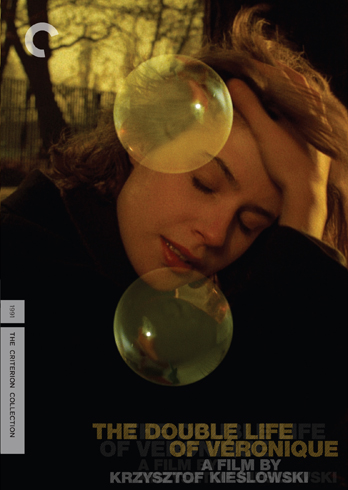
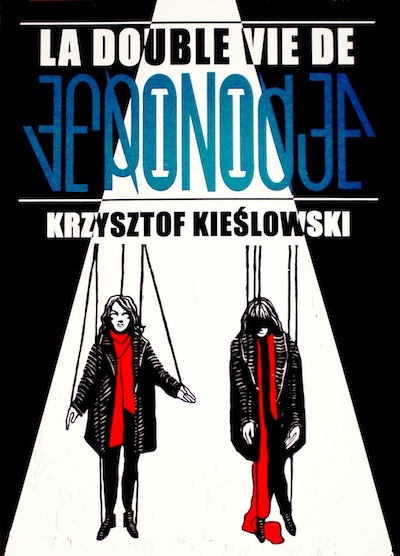
BLU REDO: THE DOUBLE LIFE OF VERONIQUE - #530


For this viewing of The Double Life of Véronique I did something I generally don't do: I read my old review. It's been over four years since the DVD of The Double Life of Véronique was first released, and so that long since I last saw it. I was curious what the me of 2006 had to say about the picture. Was I insightful? Was I way off base? Would how I thought then be a way of thinking I'd even recognize now?

These questions of intellectual identity aren't just the curiosity of a writer who sees how he writes about cinema as an ongoing process, but they are also thematically in tandem with the philosophical and metaphysical questions Krzysztof Kieślowski poses in his 1991 masterpiece. Is it possible that we are more than one person? Forget the idea of a physical double for a second. Maybe the way our thought processes evolve creates separate, parallel versions of ourselves. When we change our minds, some version of who we are splinters off and becomes its own entity.

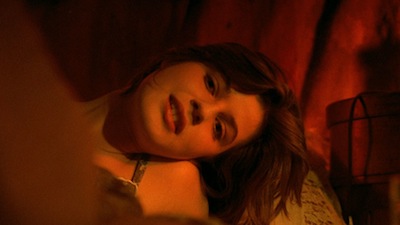
There is certainly that kind of magical thinking within Kieślowski's screenplay. One could interpret a variety of different reasons for why there is a Polish Weronika and a French Véronique (both played with a fragile intensity by Irène Jacob). Both versions wake up startled from dreams at different times, so maybe one is dreaming the other. Both fixate on an image of one version of themselves during sex, possibly creating a dissociative fantasy. Maybe they are a manifestation of the puppeteer (Philippe Volter) and the fictions he creates. His seduction of Véronique follows the outline of one of his books, and he does create two marionettes in the women's image. Or maybe the external force is the filmmaker, as it is his fiction after all, and there is no more explanation needed here than there is for the sudden change of actresses in Luis Buñuel's That Obscure Object of Desire. It is what it is, the question answers itself. For some reason, I was also reminded of Abbas Kiarostami's Certified Copy [review], particularly in the way Alexandre, the puppeteer, chased Véronique through the street; maybe we could interpret, as one could with Kiarostami's couple, that the game they are playing stops being play and becomes real.


Because up until that point, Alexandre is playing a game with Véronique. He remodels courtship as a kind of scavenger hunt, but one where the disparate pieces of the puzzle are sent to her instead of Véronique having to seek them. It's a love letter delivered as code, and like the riddle of the Sphinx, if you crack it, something remarkable awaits. When she surrenders, all kinds of things begin to happen. Exactly what...ah, well, that's still part of the mystery.

It's amazing how much one can forget about a movie in the years between viewings, and it's also amazing how much more you can notice once you have a basic idea of what you are in for. On one hand, there was so much in The Double Life of Véronique that felt new to me, I almost questioned whether I had seen it at all. Specific scenes and turns of the plot had been lost to my fading brain power. For instance, had I ever seen the Polish woman who had come to Paris, who spies Véronique and recognizes Weronika in her, thus connecting the doppelgangers? I'm not sure.

At the same time, it's interesting to note how much takes on deeper significance precisely because of what you do remember. It's like watching a murder mystery when you know who the killer is. All of that person's actions take on added meaning. Right from the start of The Double Life of Véronique, I was acutely aware of different visual cues, of small gestures or indicators, and of the surreal aura Kieślowski cloaks everything in. The storytelling here is almost episodic, even disjointed, yet one must assume everything is placed where it is for a specific purpose. For instance, the statue of a communist leader that Weronika sees being hauled away at the start of the movie could have a variety of meanings. On one hand, there is the political interpretation. In the early 1990s, European communism was failing. Symbolically, the man immortalized in stone is now the one being tied down and hauled off. He is taken away, and in his place is freedom.


Yet, if we know that later there will also be life in miniature, that the puppets will also be carved imitators of life that require their own string, then the statue is foreshadowing. Going from one to the other is going from large to small, from a universal symbol to an individual one. Our heroine complains of a feeling of not being alone in the world, and that feeling could just as easy be her connection to her fellow man. None of us are alone, we're all in this together.

It's an unknowable feeling, immutable. Like the light that lingers in Véronique's apartment even though the reflective surface is withdrawn, or the reoccurring chord that binds the women together though its origins are unknown. Or maybe it's not so unknowable, maybe it's simple. Like the removal of the dictator gives the Polish people freedom, so too does Weronika's fate make way for Véronique's blossoming. Alexandre's puppet show portrays a ballerina who breaks her leg, and yet despite the crippling injury, she wants to keep dancing. Her will is so strong, she transforms into a butterfly and flies away. Weronika is the ballerina, and Véronique the colorful insect who takes flight.


Before I wrap up, special mention should be made of the fact that this viewing was also my first time watching The Double Life of Véronique on Blu-Ray. Kieślowski's movie looks astounding in high-definition. The Double Life of Véronique is a film that is intricately designed, with specially tuned color palettes and a meticulous attention to every corner of the image frame. The light in this new digital version is warm and full of undulations, and the tiniest detail is given equal due. Take a look at the scene where Irène Jacob is bouncing the rubber ball and she dislodges dust from the ceiling. Minute particles rain down on her, and on Blu-Ray, each one is its own individual sparkle, a glittery cloud of fairy dust.

In terms of supplements, the new edition is an exact copy of the DVD release. The only thing that has changed is the packaging...which kind of sucks by comparison. I can appreciate the compact nature of the small Blu-Ray case, but I prefer the handsome box and book version, which was more like its own art object, a physical treasure chest to unfold, than it was merely functional. For that alone, I'll likely be hanging on to both versions of The Double Life of Véronique even though I'm only likely to actually watch the Blu.


This cool poster by artist Joanna Lisowiec is something I stumbled across doing a search for, well, Double Life of Veronique posters. She made it for a contest. I hope it wins!

This disc was provided by the Criterion Collection for purposes of review.

Thursday, September 30, 2010

SIDELINE: MORE REVIEWS FOR 9/10

One piece of business: I broke my own philosophy and joined a club that would have me as a member...

Online Film Critics Society: Jamie S. Rich: "MEDIA AFFILIATION DVD Talk Criterion Confessions Confessions of a Pop Fan LOCATION Portland, OR ABOUT JAMIE Jamie S. Rich is a novelist ..."

So, yay that!

Now, on to the reviews:

IN THEATRES...


* Henri-Georges Clouzot's Inferno, the amazing tale of a film director and the movie that burned away. For two nights only at the NW Film Center!

* Howl, the story of the Allen Ginsberg poem, with James Franco as Ginsberg. Plus, cartoons.

* I'm Still Here, Joaquin Phoenix takes one to the face.

* Lebanon, a tense Israeli war movie that takes place entirely inside a tank. Trust me, you want to catch this one. It's riveting.

* Let Me In, an exercise in redundancy. I'm debating between "No thanks, I'd rather stay outside," and "Fine, but once you're in, stay in!"

* Machete, Robert Rodriguez's new movie is probably exactly what you think it is.

* The Social Network--Sorkin? Fincher? Me and this movie are totally friends.

* The Town, Ben Affleck has made the best Michael Mann movie this century. (Bring it, nerds!) Check out my friend Plastorm's review, too.

* Wall Street: Money Never Sleeps, though not as incisive as the original, it's pretty good...until Oliver Stone loses his erection. He needs movie viagra.

* A Woman, a Gun and a Noodle Shop, Zhang Yimou's flaccid remake of Blood Simple. And by "flaccid," I mean "limp." Like a noodle. Haw! Get it?

ON DVD/BD...

* Ajami, called the Israeli Pulp Fiction by some, its narrative acrobatics left me a little cold.

* Bored to Death: The Complete First Season, Jason Schwartzman is great in the Jonathan Ames-created TV show. Modern literary rom com mashed-up with the private detective genre.

* The Exploding Girl, a quiet peek into the life of one girl. Starring Zoe Kazan in a career-making performance.


* The Law, this late '50s genre-buster from Jules Dassin is wicked fun. Gina Lollobrigida can pull a knife on me any time.

* Leonard Cohen - Bird On a Wire, the "lost" chronicle of the bard's 1972 concert tour has been found, and it's essential viewing.

* None but the Lonely Heart, an edgy Cary Grant performance makes this Clifford Odets production.

* One Flew Over the Cuckoo's Nest - Collector's Edition, a very cool new packaging of an exceptional movie.

* The Secret in Their Eyes, the literary thriller took this year's Foreign Language Oscar for Argentina, and it's still good on DVD.

* Secretary, a sweet romance in weird kid's clothing. Maggie Gyllenhaal and James Spader are amazing, but this Blu-Ray reissue could have been better.

* Shirin, a fascinating experiment from Iranian director Abbas Kiarostami turns the moviegoing experience around on the audience.

* Soundtrack for a Revolution, a good but unfocused documentary about the music of the Civil Rights movement, with contemporary artists doing new versions of the old songs.

Wednesday, June 16, 2010

CLOSE-UP - #519

"You see, this is my life! It always will be! Nothing else! Just us, the cameras, and those wonderful people out there in the dark!...All right, Mr. DeMille, I'm ready for my close-up."


At the end of Sunset Boulevard, faded movie star Norma Desmond is lured from her house to answer for her crimes by a staged press conference and the promise of a movie that's never going to happen. Forty years after Billy Wilder made his classic tale of a Hollywood delusion, Iranian director Abbas Kiarostami has flipped the idea on its head. What if the movie is still fake, but the crime is real? What if instead of a movie actress trying to get back in front of the camera, it's a regular joe trying to get behind it?

Close-Up is the story of Hossein Sabzian, a print maker who convinces a middle-class family in Tehran that he is filmmaker Mohsen Makhmalbaf. Makhmalbaf is a renowned Iranian director, at the time best known for his 1987 film The Cyclist. The fact that the identity Sabzian adopts is that of an actual person is one of the many layers that Kiarostami, who also wrote and edited Close-Up, overlaps to obscure the separations between fiction and documentary. Hossein Sabzian is even the actor's real name, and when we finally do see the real Makhmalbaf, they really do look alike. Which probably helped when he actually did pretend to be him once upon a time. Because, oh yeah, this is based on true events.
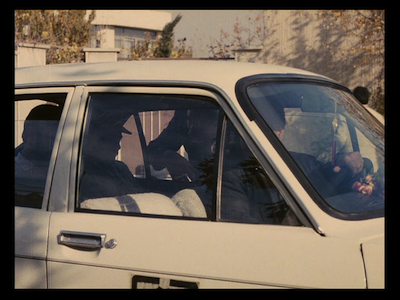
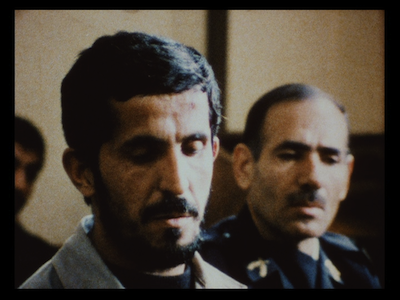
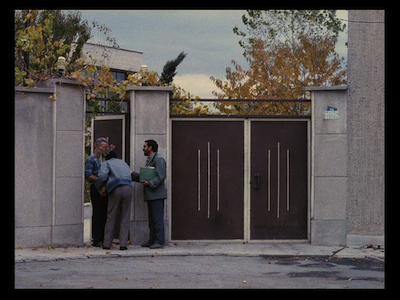
The film opens up on a bumbling sting operation, where a reporter (Hassan Farazmand, also playing himself, as everyone in the film does) leads two police officers into the Ahankhah home to nab the alleged con man. This kick-off introduces Close-Up as a narrative construct, albeit a Neorealistic one. From a writing point-of-view, it starts with a bang, as it does drop us right down into the action--though not a typical crime movie bang. It's more of a criminal whimper, with Sabzian being carted off in a taxi cab by the arresting officers while Farazmand runs around looking for someone who can loan him a tape recorder so he can record the forthcoming interrogation. Woodward and Bernstein this guy ain't.

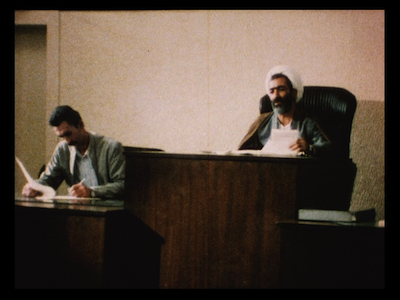
Only in the second sequence does Kiarostami introduce the notion of Close-Up as faux documentary/docudrama. Having read Farazmand's magazine article about the story, Abbas Kiarostami himself shows up at the police station to try to gain access to the faker. He wants to film Sabzian's trial, and Close-Up follows the steps he takes to get permission, first talking to the meek criminal and then seeking permission from the presiding judge. Kiarostami also interviews the family members who fell victim to Sabzian's scheme, whatever that may have been. That's something they hope to figure out at trial.


Once the court proceedings get underway, Close-Up jumps back and forth between the "reality" of the courtroom and fictional staging's of Sabzian's interactions with the Ahankhahs. As far as criminal undertakings go, Sabzian's master plan seems rather undercooked. He meets the matriarch of the family, Mahrokh, on a bus and casually tells her he is Makhmalbaf. After that, he starts spending time with the family, and the worst thing he does is borrow a small amount of money off the youngest son, Mehrdad. It takes less than week for this tangled web to unravel.

I hesitate to call the more traditional dramatic scenes "re-enactments," because essentially the entire film is a re-enactment. Sabzian did pretend to be a famous director, and the Ahankhahs were the intended victims, such as they were. Close-Up is not quite real, not quite fake--almost literally surreal in how it stands apart. It's like a distant cousin to Spike Jonze and Charlie Kaufman's Adaptation in that you really don't want to know what is truth and what is invention, what is technique and theory and what simply is.
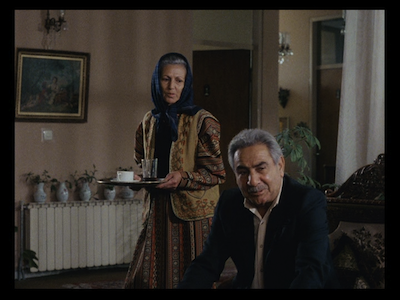
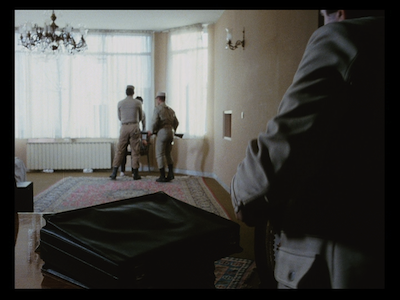
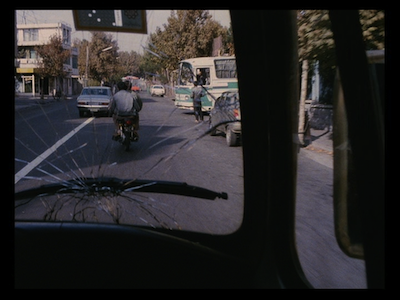
Abbas Kiarostami details this story in the most unspectacular of fashions, letting most of the juicier bits be told through Sabzian's testimony rather than staging the scenes as drama--quite possibly because these are the parts of the situation that are most up to interpretation. Who are we to believe? Sabzian's stated motivation is simple enough: he liked the attention and he liked the control that being a director allowed him, even on a small scale. He would have gone ahead with trying to make a movie if the fraud went on too long, and the reason he decided to be Mohsen Makhmalbaf is that he identified with the man's films. The Cyclist, in particular, depicted real problems he could identity with, it was like watching a movie of his own life. Ironically, he is now in one. (And judging by the extras, the real-life Hossein Sabzian was getting exactly what he wanted by being in Close-Up, as well; this is definitely art imitating life and not the other way around.)


As far as the probing eye of the camera, Kiarostami's is non-judgmental. If anything, he wants us to feel sorry for Sabzian. The man is devoid of his own personality, and his life is so full of hardship, he must resort to losing himself in fantasy. Very subtly, the filmmaker also lays down questions about exploitation. Sure, Hossein Sabzian was exploiting the Ahankhah family, but they were eager to be exploited. They were eager to star in his movie, even to give up their house for him. Mehrdad loans the trickster the money not out of kindness but in order to prove he's a good guy ready to do what it takes to please a big-shot movie director. It wouldn't be heard to remake Close-Up today. The fame-seeking that Kiarostami is depicting has only gotten worse. Haven't there been reality shows about wannabe filmmakers, and aren't all reality contestants would-be actors?


The good thing about Close-Up is that, in its refusal to create an obvious separation between what "really happened" and what has been "dramatized," the film goes deeper than any reality show ever would. The big picture here is less about fame and desire, or even about the illusory art of cinema; Close-Up is far more human than that. It's a movie about true remorse and forgiveness--not redemption, that is something else. The charity given to Sabzian at the end of the movie requires real empathy and honest emotion, and it hits the viewer as hard as it hits the "character."


At one point in Close-Up, when Hossein Sabzian is explaining what kind of films speak to him, he turns to Abbas Kiarostami, who is part of the courtroom interrogation, and acknowledges how he felt a personal connection to Kiarostami's debut feature, The Traveler. The inclusion of this 1974 film on DVD 1 of the Criterion edition of Close-Up makes this a double A-side disc, a dual film release, and one that sheds some light on the kind of Iranian cinema that Sabzian identifies with. (Shame we couldn't get Makhmalbaf's The Cyclist, as well. I'm so greedy!)

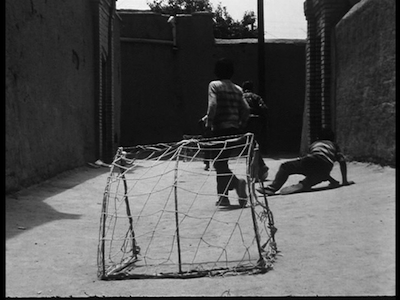
The Traveler is the story of a young boy named Qassem, played by an Iranian Jean-Pierre Léaud by the name of Hassan Darabi. Qassem is obsessed with soccer, so much so that he forsakes all else and even cheats the local news seller just to buy a new soccer magazine. He's got a bad reputation at school because his mind is always on the game, and his mother is fed up with him. When his favorite team is playing in Tehran, Qassem hatches a scheme to raise money to go see them. He cons school kids by pretending to take their picture with a stolen camera, and when that isn't enough, he sells his neighborhood team's goalie nets and ball. His journey to the city ends up being an eye-opener, a glimpse of disappointment, struggle, and isolation.


Even in this early film we can already see Kiarostami's thematic concerns developing. The boy who dreams of soccer is not all that far away from Hossein Sabzian and his moviemaking fantasies. In fact, that's what Sabzian sees as having in common with the kid in the movie: this desire for something more than what they have and whatever it is that compels them to do anything it takes to achieve it. Qassem's grift with the camera is even suggestive of Sabzian's cinematic misdirection.

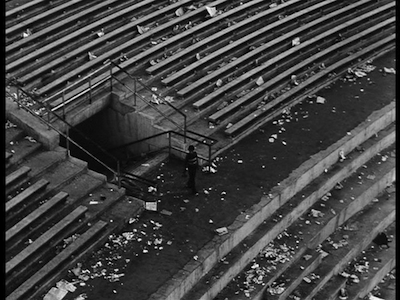
The Traveler was shot in black-and-white and on location, and it has the same Neorealist aesthetic as Close-Up. Though the film is lacking in extraneous fat, that doesn't mean Kiarostami shies away from the quiet moments. He juxtaposes Qassem's anxious waiting in his bedroom with the more calm, eager waiting during the bus ride. He also takes the boy from small-town life where the locals trust his family name to the big city where no one knows or cares who he is. In the end, The Traveler is more cynical than Close-Up, Kiarostami has softened over the years. The lonely figure of the boy in an empty stadium has a long way to go after all if he is to become the weeping man finding peace in the arms of his fellows.


For a full rundown on the special features, read the full review at DVDTalk.