Showing posts with label costa-gavras. Show all posts

Sunday, March 19, 2017

CANOA: A SHAMEFUL MEMORY - #862


Released in 1976, Canoa: A Shameful Memory is considered a milestone of Mexican cinema, influencing future filmmakers (Guillermo del Toro and Alfonso Cuarón both appear in supplements on this new release) and setting a standard for the local industry to follow. Felipe Casals’ innovative, probing docudrama is equal parts Costa-Gavras and Francesco Rosi. It's dramatic and real and maybe a little long in the tooth, but fascinating all the same. Also, relevant to our times--and like most older films that maintain their bite, I might add, sadly so.

Based on a real-life incident from the mid-1960s, Canoa is essentially a story of small-town hysteria and political bullying. Taking place in the rural village that gives the film its name, Canoa centers around one night, including the preamble and the aftermath, when a terrible crime occurs. The catalyst is the arrival of a handful of university workers visiting the region to hike in its hills. They get off the bus at the start a torrential rainstorm, the severity of which prevents them from traveling further before sunrise. Word of the strangers spreads quickly, especially when they are refused shelter by the town sheriff and the local priest (Enrique Lucero)--a miniature dictator who has been squeezing the town dry for years. His anti-communist rhetoric, combined with his acute paranoia, misleads his congregation into believing the group are activist students who have come to undermine the Catholic church. As tails of their intentions become exaggerated, a mob forms and does what a mob does, ending in several murders.


Casals crafts Canoa: A Shameful Memory like a faux documentary, complete with an off-screen narrator and an on-screen witness (Salvador Sánchez). The latter is the most compelling part of the film. A worker from Canoa, the witness gives us the inside dope on town politics, speaking directly to the camera, as much a tour guide as an interview subject. His self-aware, glib cynicism colors the whole of the picture. He speaks with both the benefit of hindsight and distance. Granted, no one asks where he was on the night in question, and we aren’t entirely sure of where he fits in all of this. Not that it matters. He is the outside observer, disgusted yet not surprised. Even in the film's denouement, he already sees the powers that be turning tragedy into opportunity.


This witness basically sets the tone for Canoa. The movie is both real and unreal, an accurate depiction of events and yet a fictional re-creation of the same. We have access to closed-room machinations with the priest and his flunkies, a narrative conceit unavailable in a true documentary, not to mention an artful POV shot that reminds us that the minister is the shadowy villain behind the whole thing, the noirish lighting shaking off the cinematic grit that otherwise marks the picture. When it comes down to it, most of Canoa’s visuals conform more to the standards of fictional drama than any verité aesthetics. We also see Cazals push the limits of his budget in some of the performances, particularly the university workers, whose expositional scenes in the city are amateurish and contrived. Canoa’s fundamental cinematic constraints are showing.

The one exception is the violence that comes in the final act, when the mob comes for the unsuspecting visitors, breaking down the door of the meager shelter they found. Here Casals pulls no punches, embracing the terrible events in all their lifelike horror. The attack is vicious and bloody, and the brutality of it is appropriately unsettling. By the time the townspeople come for the outsiders, the truth of their visit is no longer important. In fact, to their minds, the boys’ explanation for coming this way is exactly something lying communists would say to save their skins. The violence is drawn-out and cruel, and Canoa doesn't shy away from some of the harsher details. As shown here, the hive mind succumbs to its most primitive impulses, trading its humanity for self-preservation.


But is it self-preservation? Is it even self-serving? They think so, but if we reconsider the info we got at the start of Canoa, these farmers make no real money, and what little they have is siphoned off by the clergy and funneled to its political cronies, sometimes as a trade-off for delivering such basic conveniences as electricity and telephones, other times for delivering nothing at all, the price of an empty promise. That the priest distracts from this thievery by inspiring a fear of the "other" should be all too familiar. Ignore my hand in your pocket, because that other guy is going to steal what I want before I do. And then pay me to "protect" you. Or show me how strong you are by protecting yourselves, you freeloaders!

So, despite showing its age in filmmaking, Canoa: A Shameful Memory remains as potent as ever. Swap its decades-old setting for a current one, wherever xenophobia and oppressive rhetoric holds sway, and you’ll find a cautionary tale for our era. One would have hoped that in these "enlightened" times we would be better, that Canoa would be considered fantasy rather than realism, and that such prejudices would have been rooted out--if not in the 1960s then at the end of the Cold War--but if the first few months of 2017 have shown us anything, we haven't really evolved much at all, and we’re getting busy creating a few new shameful memories of our own.


This disc proved by the Criterion Collection for purposes of review.


Saturday, October 24, 2009

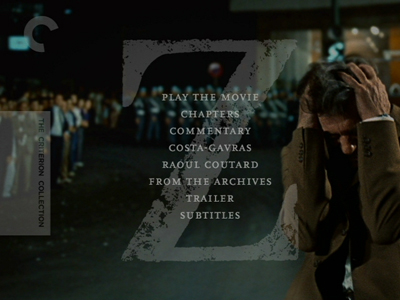
Z - #491


In the 1990s, when the original Rodney King trial went the wrong way despite what to most people was pretty compelling evidence, arguments were made about what we think we see versus what we actually saw. A video of a man being beaten, we were told, was not clear-cut. You see that club there? It's not actually connecting. And it's only one vantage point. You weren't there. How could you know?

Last year, there was a Hollywood movie actually called Vantage Point where the investigating feds piece together a political assassination using all the different cameras in the crowd. I never saw the movie (just like most people), but it wasn't hard to guess that the plot hinged on the idea that even with so much photographic evidence, with surveillance everywhere, the truth is still a puzzle put together from many points of view. It's the Rashomon conundrum of the digital age. The more people who see a thing, the more angles we can look at it from, the more differing interpretations can garble the message.


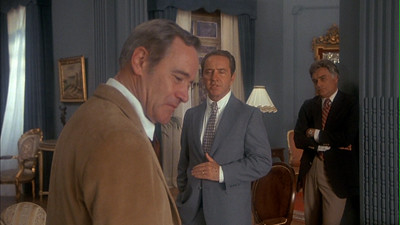
While that's not really the point of Costa-Gavras' 1969 political thriller Z, I was struck by how ahead of the curve he was in predicting how placing cameras in different places could show us the same event in different ways. Z is shot a lot like a documentary, an investigative procedural that has aesthetics in common with the Nouvelle Vague and the films of Francesco Rosi, and would in turn inspire Alan J. Pakula, David Fincher, and Steven Soderbergh. Z could almost be seen as a stylistic fulcrum on which the two sides of that equation balance, the link between Salvatore Giuliano and All the President's Men, The Battle of Algiers and Zodiac.

Written by Costa-Gavras alongside Jorge Semprun and based on a book by Vassilis Vassilikos, Z is a loose retelling of the real-life killing of leftist Greek politician Gregoris Lambrakis. In the movie, Yves Montand plays a charismatic Socialist activist who preaches pacifism and equality. Known only as "the deputy"--though Z starts with a statement that all resemblance to actual persons or events is far from coincidental, names are obscured and often forgone completely--the film opens on a day when he is to deliver an address to a large gathering of sympathetic followers. Police pressure has caused the Party's venue to disappear, however, and amidst the scramble to find another locale, the deputy's team also hears about a possible threat on their man's life. The deputy insists the event will go on as planned, staged on the same night as the Russian Bolshoi is performing in town. Their demonstration will provide a counterpoint to the bourgeois ostentation.
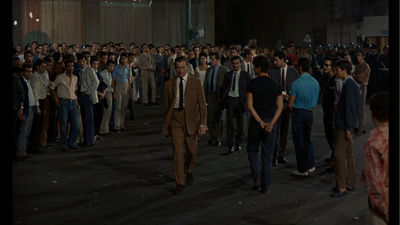
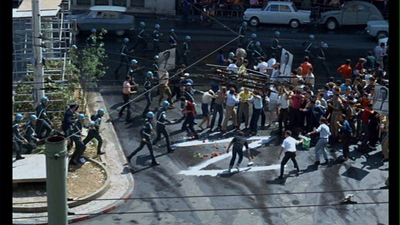
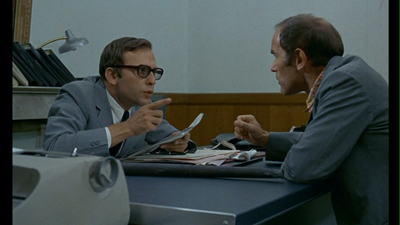
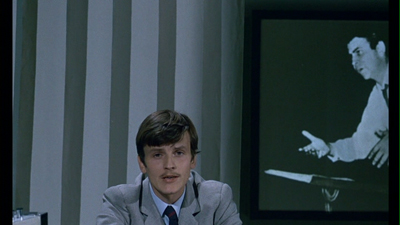
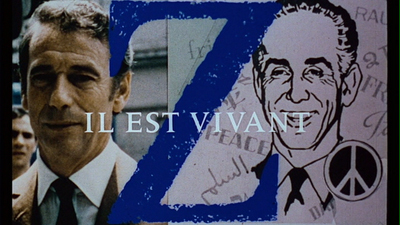
The rally is far from peaceful. As the police stand by and watch, there are multiple skirmishes and attacks, the last of which leaves the deputy bleeding in the road. The culprits, Vago and Yago (Marcel Bozzufi and Renato Salvatori), are arrested and their story about being harmless drunk drivers perpetrating an unfortunate hit-and-run is accepted as fact whereas any counter theories are dismissed as Commie propaganda. Only after the deputy dies does an autopsy reveal that his skull fracture is more consistent with a clubbing than with an auto collision. A diligent prosecutor (Jean-Louis Trintignant) and a gutsy reporter (Jacques Perrin) start digging further, and pretty quickly, more inconsistencies in the story begin to show. Connections between Vago and Yago and a right-wing religious group further reveals connections between that group and the chief of police (Pierre Dux) and his right-hand thug (Julien Guiomar). Further attacks on witnesses only fuel the prosecution, as does government opposition.

Costa-Gavras takes us through the investigation step by step. He lines up each piece in their natural order, only taking minor detours into extraneous character stuff (Vago's sexual predilections; the deputy's heartbroken wife, played with stalwart grace by Irene Papas, and even glimpses of their marital strife). Working with renowned cinematographer Raoul Coutard, who shot the bulk of Godard's 1960s films (and who also shows up on the other side of the camera as a British surgeon), he shoots most of the action as if it were a documentary. Coutard's camera is rarely nailed down, but often moving with the flow of activity, acting more as a cold witness than an active part of the story. The fact that we can be everywhere at once creates a kind of hyper-naturalism. Z looks real, but it's not bound by time or space. Flashbacks are common, quick glimpses of memory, and even moments of minor comedy.


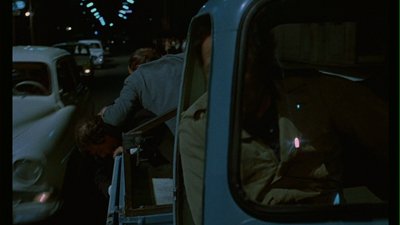
When the deputy is struck down, we see it clearly. The truck drives by, Vago leans out and hits the man, and the crowd parts to let them leave. Or is that what happened at all? I don't think that Costa-Gavras means us to really doubt what we saw the first time, but as we see the event as it is described by others, we see how the story of the drunk driving could appear plausible from their field of vision. It also keeps us on our toes, we're never quite sure of who knows what. Even one of the deputy's own people isn't positive the man got clubbed, and when he tells the story, we don't see the fatal blow. We do see the cruel hysteria of the crowd, snippets of the onlookers and enemies circling the victim playing backwards and forwards like we're flipping through snapshots. Costa-Gavras also drops out most of the audio, leaving only the elements the witness relates. It's cinema as point of view, as unreliable and incomplete as that can be. Watching Z, you can start to understand how one can argue about the veracity of a length of videotape.


As Z moves forward, it builds up a head of steam, and the investigation gathers its own momentum. Though the prosecutor doesn't make any grand speeches, he emerges as a heroic figure, committed to fairness and the truth. He is as distrusting of any one side as he is another. Trintignant plays him without any affectation. He's as straight a straight shooter as you're likely to get. On the other hand, there is nothing selfless about the reporter's pursuit of the story, the way he always secretly takes photos even when instructed not to and is aware of the monetary value of the information he's gathering. Perrin is loose limbed and energetic, jumping around and sometimes quite literally chasing the story. These guys are like the European version of Redford and Hoffman.


Interestingly enough, despite the successful exposure of the conspiracy, Z does not end on a hopeful note. Costa-Gavras gives the film a coda where things get worse instead of better. A news broadcast by Perrin informs us of the fate many of the players suffered, and a voiceover and text scroll details a government crackdown that follows, shifting Z out of amped-up Neorealism and into Orwellian sci-fi. It's a far more cynical way to close the movie than, say, Nixon being taken down (to continue the All the President's Men comparison). In this, too, Costa-Gavras is ahead of the game. In the decades that followed Nixon's souring of the American political system, we've often seen those members of his party who succeeded him use unsavory methods to take back the respect Tricky Dick lost them. It's much easier than earning it, and much more effective in demoralizing the public so they won't question the government's methods again. The ending of Z isn't science fiction at all; it's clairvoyant.


For a full rundown on the special features, read the full article at DVD Talk.


Costa-Gavras


Monday, October 20, 2008

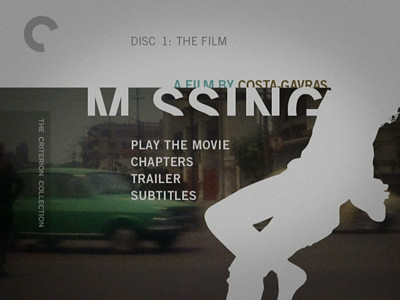
MISSING - #449


The early 1980s was a weird time in my movie-going education. My family did not go to movies for most of my early childhood, a religious embargo I managed to break in 1979 when a seven-year-old me whined his way into getting to see The Black Stallion. I remember vividly how my mother glared at me while my father called around to get what I assume now were show times, but she said to me in that vicious mother's voice we've all likely heard, "You see what your father is going through trying to get you tickets? I hope you're happy."
As a matter of fact, Mom, I was.


Anyway, once this barrier had been shattered, all bets were off, and we went to the movies pretty much every week. My father was a master theatre hopper, and so an outing to the movies usually involved seeing two or three movies in a day, sometimes all of us going to completely different films. I chronicled some of this in my review of Hopscotch, one of those movies we saw that I probably shouldn't have seen at my age. It makes for a strange variety of nostalgia, these formative years where I could see Kurt Russell in both a revival run of The Computer Wore Tennis Shoes and in the first-run of Silkwood and not really understand why he was so different in one than he was in the other. I could have asked my Dad, but he'd have likely lied to me. Like when I saw Mike Farrell in a TV movie without his moustache and then also saw him on "M*A*S*H" in the same week. I asked how it was possible for him to have his hairy lip back in time for the show, completely oblivious to the fact that the two programs weren't made within hours of their airing, and my father told me that they kept the hair in a baggie and they glued it back onto his face when he returned to playing Capt. B.J. Hunnicut.

Anyway..., of movies that I saw but maybe shouldn't have, I think they could be classified in three categories. First were the movies like Silkwood that I liked but probably didn't really understand why. Second were the movies that I knew were terrible and even kind of offensive, such as De Palma's Scarface or Verhoeven's Flesh and Blood. The third category was neither a like or dislike category, but reserved for movies that were so beyond my realm of comprehension, I didn't know what to think of them. These movies now hold the most fascination for me, because they have stayed lodged in my memory as these mysterious objects that hold some significance but whose true quality I will likely be discovering for the first time. Whereas Silkwood is still solid and Scarface is still execrable, the movies in this third area could be anything.


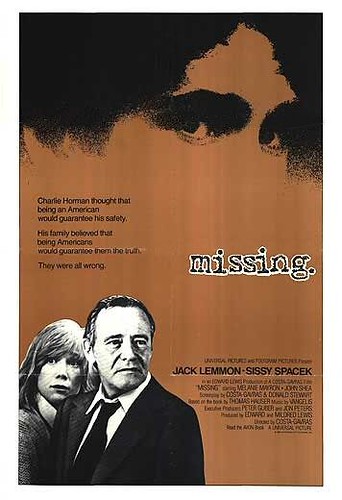
One of these third beasts was Costa-Gavras's 1982 political drama Missing. I was ten when it was released, not yet ready to absorb the entirety of what this extremely complex docudrama had to say. I've always remembered seeing it, though, and I even remember being bored while we were watching it, maybe even walking out or going to sleep. Yet, just remembering that must hold some significance. This thing I could not understand had obviously left an impression. Why else would I, twenty-six years later, still remember the grainy black-and-white newspaper reproductions of the movie poster from when we were going through the listings to see what was playing? How else do you explain that I had three images from the movie lodged in my brain? Jack Lemmon holding Sissy Spacek close, helicopters, and John Shea posing for a photo by the beach--all three of these would come to mind any time the subject of Missing would come up.


I admit to feeling a little electrical charge when I first saw the announcement that Criterion was releasing Missing. After all this time, I would sit down with this highly lauded film and relive the experience that had so baffled me as a ten-year-old boy. It's impossible to explain why I had waited all this time to see it again. Things just have a habit of staying out in front of you, y'know?

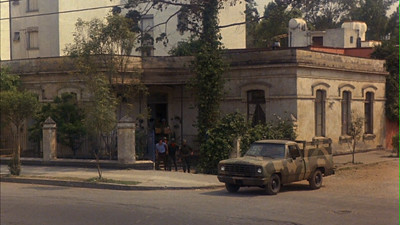
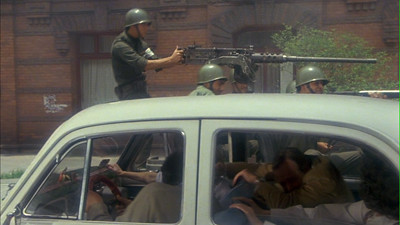
I'm pleased to say up front that my mind was effectively blown. Missing is a phenomenal motion picture, on par with iconic intelligent thrillers from the 1970s like All the President's Men, movies by Lumet, Pollack, and Pakula, that showed real people striving to find answers and to accomplish something. Based on the real-life story of an American writer who disappeared during a Chilean coup in 1973, when Augusto Pinochet began his blood-soaked regime, Costa-Gavras examines the story of the search for Charles Horman (Shea) using an earthy, human approach that moves us through the hunt step by step, following his wife Beth (Spacek) and his father Ed (Lemmon). Through a series of ambiguous flashbacks, each possibly altered by the memory of the teller, they begin to get to the bottom of the mystery and learn more than they bargained for as it becomes increasingly obvious that the U.S. military had some kind of hand in destabilizing the region. (One memorable reenactment changes and morphs as conflicting witnesses argue over trucks and soldiers, displaying the tenuous relationship of truth and perception quite effectively.)


Good journalistic storytellers know that there is an inherent drama in real life that is just as reliant on coincidence and narrative convention as anything invented from whole cloth. The screenplay for Missing was written by Costa-Gavras, Donald Stewart, and John Nichols, working from a book by Thomas Hauser, and the writers smartly see that the drive of their two very different characters makes the personal journey they undertake in searching for Charles just as fascinating as the investigation itself.

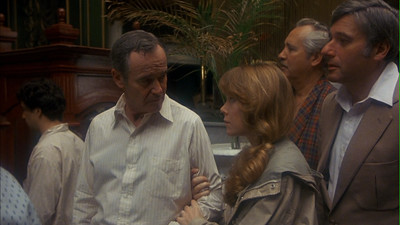
Charlie and Beth were young idealists living in Chile for no other reason than they enjoyed the way of life down there. Though left-leaning in their politics, neither were political activists. Charlie only really became caught up in what was happening in Chile because he happened to be there, either the right place at the right time or the wrong place at the wrong time, depending. As soon as Ed Horman arrives in Chile a couple of weeks after Charlie has disappeared, it's obvious that father and son couldn't be more different, even without them ever having a scene together. Ed is a devout Christian Scientist who believes in God and country and doesn't understand why his son would live in South America, living as if he were poor and not continuing on the life path his family always thought he was meant to follow. Ed doesn't believe Beth's theories about Charlie's abduction, he's more inclined to trust his government and even accepts the explanation that maybe this is a stunt Charlie is trying to pull in order to embarrass the U.S.


As a Christian Scientist, however, Ed has one core belief that eventually puts him and Beth on the same page. When he is asked to explain the fundamentals of his religion, Ed boils it down to having faith in the truth. The common goal of both father and wife is to find out what happened to their son and husband, and the further they go into the investigation, the more their beliefs merge.


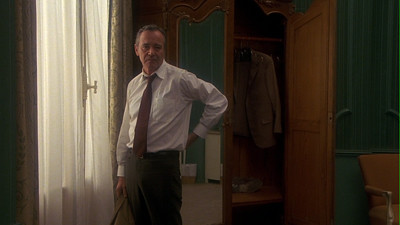
From an acting point of view, Lemmon has the meatier role. His character is the one who is going to change the most, who is going to have the foundations of his beliefs rocked. It's probably no coincidence that he confirms his change immediately following an earthquake, the shaking hotel reminding him enough of his own mortality and dislodging his stubborness to such a degree that he feels he has to apologize to Beth. It's not a showy transformation, though, it's one that happens little by little. Lemmon already had a natural hunch at this time, but as Ed grows increasingly defeatist, it becomes more pronounced. The actor mainly plays him as soft-spoken when dealing with authority, but more tenacious when talking to Beth. It's the tenacity of a father, however, and when he realizes that his attentions are misplaced, we see the mannerisms reverse. Ed becomes a verbal attack dog when stonewalled by the U.S. embassy in Santiago.

Ed's transformation is not just in how he views the world, though. There is a far more subtle shift in the writing. He also changes as a father. Just as he is at first angry with Beth, he is also angry with his son, not understanding how his little boy became a man so far from the family's way of things. In trying to figure out what happened to Charlie, Ed starts to see how his parenting has really influenced his child. More than once someone points out a gesture that the two share, or how they each behaved in a similar situation, and each time it closes the gap. The father discovers that the fruit stayed much closer to the tree than he had ever thought, and the same tenacity for the truth that has brought Ed searching for his lost child is also why the powers that be wanted the child lost in the first place.


Missing proved to be a real political hot potato at the time of its release. Though the film gets no closer to the answers than Ed and Beth did in 1973, it does lay out a complex map of events that don't seem so far fetched now that we know more about the Pinochet government and the U.S. connections to the same. I don't think it would be a stretch at all to draw analogies between what Nixon and his people may have done down in Chile back then and what the current administration has also pursued in its involvement in regime change in the Middle East. More importantly, though, I think Missing rather sharply defends a particular strain of patriotism that current political rhetoric would have us believe is somehow un-American. From where I sit, both Charles and Ed Horman are the best kinds of patriots, the ones who love their country enough to call it out on its shame not to detract from but in order to defend it principles. When Ed tells the people who have filibustered him that he is going to take every action to make sure the word gets out about what they have done, one of the U.S. consuls says to him, "Well, I guess that's your privilege." In response, the movie version of Ed memorably declares, "No, that's my right! I just thank God we live in a country where we can still put people like you in jail." Inherent in that statement is the core belief that United States, regardless of the wrong turns it may take, is a nation that is always better than the bad decisions of the most misguided or selfish of its people.

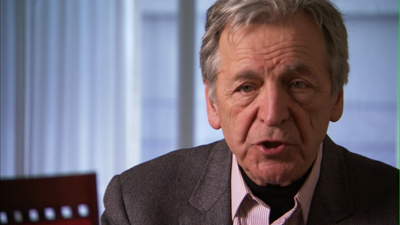
Of course, sitting in a theatre at age ten, I wondered more about when Missing would be over than I pondered what Costa-Gavras was telling me. (The director has himself said that Missing stands as a testimonial of the power of free speech in America, and is also swayed by the individual's personal beliefs or investment in seeing justice done.) Even so, whether or not I was conscious of it, I think the message still got through, at least enough to leave me with the impression that eventually revisiting the movie would be important. That's the true power of a piece like this, and the true validation of Ed Horman's faith: the truth will always get through, regardless of how many shadowy hands try to hold it back, as long as the rest of us demand it be told.


Costa-Gavras