Monday, April 16, 2012

SIDELINE: ONE WRITER, MISSING IN ACTION

I'm embarrassed to be writing one of these posts, but I owe my regular readers an apology. I hate when bloggers go off the rails and don't meet their commitments, but here I am, three weeks behind on my reviews. A variety of the usual factors have contributed to me not getting any reviews done this month; it's all fairly predictable, I won't go into it too heavily. Needless to say, I am keeping track, and I will make up for the missed weeks as soon as I can.

The one thing I will point you to that has been a heavy-duty time suck is that I decided to serialize a novel online. It's called Bobby Pins and Mary Janes. The book is written, but I am copyediting and preparing posts for the launch on April 27. This, naturally, is time-consuming, and I am trying to set it up so I am not updating every week just in time. I have the first couple of posts ready to go already, but lead time disappears fast!

I am going to cut and paste the press release for the book below. Please consider visiting the site -- bobbypinsandmaryjanes.com -- and bookmarking it. It's a new adventure that is both exciting and terrifying, but there's no stopping it now!

Regardless, thanks for your patience. I will be back!

***

COMICS WRITER JAMIE S. RICH SELF-RELEASES FIFTH PROSE NOVEL AS AN ONLINE SERIAL

Beginning on April 27, website bobbypinsandmaryjanes.com will go live with the opening pages of Jamie S. Rich’s fourth prose novel, Bobby Pins and Mary Janes. Described as “The Devil Wears Prada for the comic book industry,” this lengthy work of literary fiction chronicles a life within the world of indie comics, complete with moody editors, sensitive cartoonists, and more than a little four-color romance.

Bobby Pins and Mary Janes is a workplace drama, but also a novel of identity, exploring one character’s crises of conscience during her mid-20s. Parker Reid is a college graduate who always dreamed of literary grandeur, but she’s found herself working in a creative field she never anticipated. 

“Parker’s work struggles reflect her personal struggles,” Rich explained. “She has been on her own for a couple of years, and she remains on her own. At the start of the book, she is having an affair with her employer’s top cartoonist, but by the end of it, she will have flirted with a married man, chased the safe option, and also had to contend with the unrequited love of her best friend from school. Is this the life she wants? Should she settle for a relationship the same way she settled on her job?”

The aforementioned fictional cartoonist is the creator of an original comics series called “Valerie Flames,” an ongoing series about a young girl whose adventures cross the mysteries of Nancy Drew with the escapades of Tintin. Character designs for Valerie Flames and her cohorts were drawn by Joëlle Jones, Rich’s frequent collaborator. Together they have produced the graphic novels 12 Reasons Why I Love Her and You Have Killed Me. Valerie’s adventures will be represented in the online version of the novel via sections of script. “The script interludes not only demonstrate what this invented comic book might be like,” Rich said, “but also establish a meaningful parallel with the main narrative. The technique is like Margaret Atwood’s The Blind Assassin mashed-up with Michael Chabon’s The Amazing Adventures of Kavalier and Clay.” 

“The world of comic books is one I know well,” Rich commented. “I began as an editorial assistant at Dark Horse Comics when I was 21, and I spent six years as editor-in-chief at Oni Press. I’ve written my fair share of funnybooks, as well.”

Bobby Pins and Mary Janes follows on the heels of Rich’s previous prose works, including his popular first novel, Cut My Hair, and his most recent, Have You Seen the Horizon Lately? Yet, it’s his second book, The Everlasting, that the new novel has the most in common with thematically. “The Everlasting was the story of a 25-year-old boy who couldn’t make up his mind about what he wanted in a relationship. Bobby Pins and Mary Janes is like the response to that--like a retaliation record in a rap battle. It’s the flipside of the story from the girl’s point of view.”

When asked why he chose to serialize the book online, Rich’s answer was simple: “I finished writing this book a couple of years ago, but for a variety of reasons, it ended up on the back burner. In the time since, technology has changed and grown, and I wanted to take advantage of that. Plus, the serialization gives me specific goals for getting the material out there. Every Friday, another section of the novel has to arrive. When it is done, I may take it further, but for now, this is the platform.” 

Each posting will be readable directly on the bobbypinsandmaryjanes.com tumblr, or downloadable as a pdf. “I want people to be able to load it into their chosen reader and take it with them.” In the run-up to the first post, Rich has been teasing visitors to the blog with images that inspired him while writing the story, including a random sketch by Joëlle Jones that became his visual marker for main character Parker Reid.

Press looking to cover Bobby Pins and Mary Janes can contact Rich at golightly[a]gmail.com. He is available for interviews and can also send the first postings for early review

Saturday, March 31, 2012

SIDELINE: MORE REVIEWS FOR 3/12

A round-up of the non-Criterion movies I saw in March, 2012.


The Hunger Games art by Ross Campbell


IN THEATRES...

* The Conquest, a biopic of French President Nicolas Sarkozy. The satirized starts to become the seducer...

* Friend with Kids, a truly adult "no strings attached" comedy with an exceptional cast.

* The Hunger Games, odds are I sorta kind love this movie. A smart adaptation of the books makes for one pleasing blockbuster.

* Jeff, Who Lives at Home, a preciously magical comedy. Or magically precious. I can't remember which. Either way, it's very good.

* John Carter, a mixed bag of sci-fi action and deathly dull exposition.


ON DVD/BD...

* Conversation Piece, the elegant penultimate film from Luchino Visconti.

* The Double Hour, this recent Italian thriller is a must-see. The debut of director Giuseppe Capotondi, and starring Filippo Timi

* Downton Abbey: Season 2, or Gosford Park Goes to War.

* Everyday Sunshine: The Story of Fishbone, an in-depth documentary on the seminal Los Angeles rock band

* Looney Tunes Super Stars: Pepé le Pew, I should have reviewed this as if it were a tragedy, not a comedy.

* Public Image Limited - Live at Rockpalast 1983, a classic live concert from Lydon & Co.

* The Sitter, the latest in the decline of David Gordon Green. A tepid comedy starring Jonah Hill.

* This is Not a Movie: Three Edward Furlongs, one bad script. 

* Tyrannosaur, a brutal social drama about the cycle of violence from British actor Paddy Considine

* La Visita (The Vistor), a bittersweet 1960s romantic comedy starring 8 1/2's Sandra Milo


Wednesday, March 28, 2012

READER MEET AUTHOR: EMERALD CITY COMIC CON

Hey, everyone.

I am packing to head up to Seattle for this year's Emerald City Comic Con. Joëlle Jones and I have a table at the show, #H-11.

We will be selling books, and Joëlle has her vintage ad prints. She will also be doing black-and-white sketches.

I'll also have promo cards for my new project launching at the end of April. I am already teasing about it on the site dedicated to the material. Bookmark it!

To whet your appetite, check out this awesome Contempt-era Brigitte Bardot she did as a commission recently.


Note that we'll also be part of the evening programming on Friday night.

The Not So Late Late Show with Oni PressRoom: 2ABTime: 7:00 - 8:00Join Oni Press’ marketing guru Cory Casoni for an exciting new adventure in comicon programming: a live comic book talk show! It’s just like the gabfests you see on TV, but with people talking about nerdy stuff you actually love! Cory’s guests at this inaugural event include Scott Pilgrim creator Bryan Lee O’Malley and the creative team behind Tiny Kitten Teeth, Becky and Frank. Featuring fake baking with House of Night artist Joëlle Jones, special musical guest Delta!Bravo, and a whole lot of comedy... some of it intentional.

I look forward to meeting some of you.

And when I get back, I'll be writing about that new David Lean/Noel Coward set...


Sunday, March 25, 2012

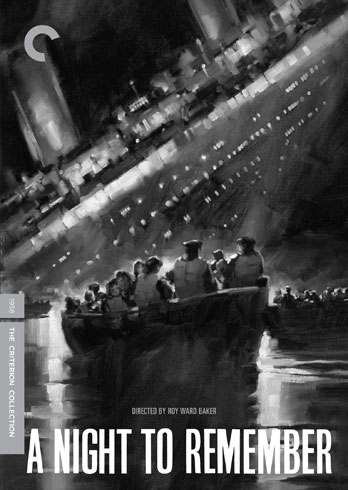
A NIGHT TO REMEMBER (Blu-Ray) - #7


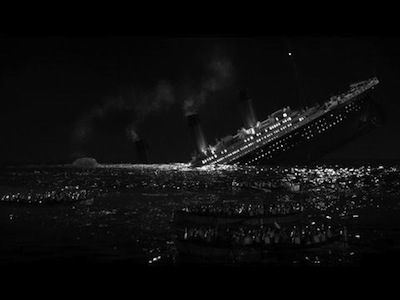
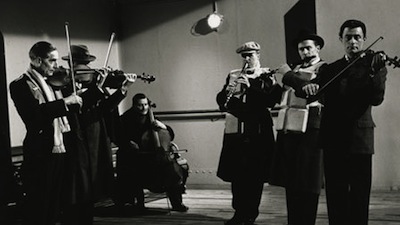
There is much about the catastrophic sinking of the Titanic in 1912 that has entered into common knowledge. The Unsinkable Molly Brown, "women and children first," the band playing even as water spilled over the decks, the ship's designer and captain both maintaining their posts until the end--these are all things most people can recall about the historic event when prompted. Yet, they are just markers in a larger story, details that are required for any retelling, but merely the starting point, not the finishing touches.

Walter Lord's book A Night to Remember was the first definitive retelling of the tragedy. The author sought out Titanic survivors and interviewed them about what they saw. The 1958 film adaptation was a personal project for producer William MacQuitty. Even half a century later, many still considered it to be "too soon." On one of the supplements on the Criterion Blu-Ray, MacQuitty notes that shipping companies refused the use of their ocean liners for shooting because no one wanted their boat associated with the worst maritime disaster of the 20th Century. Undaunted, MacQuitty soldiered on.
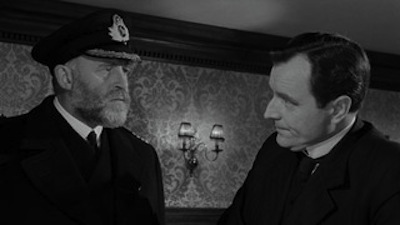

The eventual film version of A Night to Remember was a landmark of British cinema. The sober account of the ill-fated maiden voyage of the Titanic was eventually adapted by Eric Ambler and directed by Roy Ward Baker, whose other notable credit (at least for me) is the chilly Marilyn Monroe thriller Don't Bother to Knock. In that earlier motion picture, Baker works with claustrophobic spaces, confining his drama to the interiors of hotel rooms, to mimic a feeling of being trapped in one's own head. A Night to Remember has a similar trapped sensation, but the scope is massive. The passengers of the Titanic aren't just trapped on the doomed vessel, but the entire vast ocean.
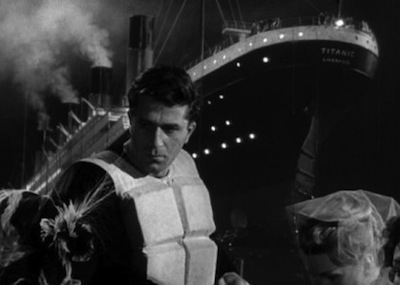
A Night to Remember is more docudrama than melodrama. The structural outline is simple: passengers gathering for launch, the early part of the voyage, and then the sinking. The latter element takes up most of the film, and to be honest, it isn't until the crisis is underway that A Night to Remember starts to warm up. The script moves between the classes, noting the difference in comforts and how this will eventually come into play when it's time to abandon ship. The fancy upstairs reserved for the wealthy upper classes, the less ostentatious second class, and, of course, steerage, with is full of poor immigrants in search of a better life rather than sailing for pleasure. We are also privy to the completely separate world of the ship's crew, of the people whose duty it is to keep the Titanic in operation. Even here, though, we can see similar divisions. There are officers and there are enlisted men, technical operators and grunts, and also servants. It is a society within a society. Indeed, early in A Night to Remember, someone likens the ship to a floating city; aptly, the boat operates as such.


Not that these lines are drawn sharply. The elegance of Baker's movie is that, except for a few instances, it eschews heavy dramatization in favor of letting the details of the situation speak for themselves. There is plenty going on in the story that provides a natural tension, such as the unceasing efforts of the communication officer to raise help, the filmmakers don't need to manufacture any added suspense. We know that more than half of the people on board the Titanic died, but A Night to Remember's anxiety is in wondering who will survive and how. The horror of the real events need not be overstated--the off-screen screams of unseen passengers cause genuine shivers--we know the outcome and have our own fears about being in a similar situation already in place. Just seeing all that water pouring into the cabins is enough to put me on edge.

The tone of the picture is very British, adhering to the "stiff upper lip" cliché. One should not mistake this for a lack of emotion or even coldness, however; on the contrary, Baker finds proper heartbreak within the reserved behavior. The scenes with the young family, when the father gathers up his wife and three children and takes them to the lifeboats, careful not to tip his hand as to the full breadth of the emergency or the likelihood of his being able to follow, are probably the most moving in the whole story. She knows the truth, even if he won't speak it. Likewise, the movie is not without humor. The baker getting drunk in his room provides consistent laughter without being crass. It alleviates the heaviness just enough so that we aren't weighed down.


It's not that I have a problem with taking the story the other way. On the contrary. I am actually on record as liking the James Cameron Titanic, which certainly goes for a far more histrionic level of Hollywood dramatics. I think it's good that we have both pictures. One balances out the other. One aspect Cameron's approach might have over Baker's is that, in Titanic, we do get to know and care about the characters more; in A Night to Remember, the focus figures get such a short time in the spotlight, it takes most of the effort we can give just to keep them straight. The one thing they both have in common, however, is that they are crowning technical achievements. Both Cameron and Baker were concerned with details, and A Night to Remember's special effects are astonishing for any era, not just 1958. Even with the heightened clarity of high definition, very few cracks show. MacQuitty's team has succeeded in creating a seamless illusion, jumping between models, sets, a real ship, and in the launch scenes, archival footage of the actual Titanic. There's never a clear demarcation between any of the elements. A Night to Remember is all of one piece, and thus is wholly convincing.

A Night to Remember was one of Criterion's earliest DVD releases, and though it's only been a little over a decade since that first edition, technology has moved light years since. The restored digital transfer and uncompressed soundtrack created for the Blu-Ray serve to further prove just how fantastic this new technology is for older films. The black-and-white photography looks flawless, and despite only being a mono audio track, the soundscape has a lot of depth. Criterion has further rounded out the package with video features focusing on the survivors of the Titanic, as well as a BBC documentary examining the science behind icebergs and another looking at the making of A Night to Remember, with extensive interviews with MacQuitty and author Walter Lord. (The latter feature, as well as the history-focused audio commentary, were also on the 1998 DVD.) It's an impressive presentation, and I am glad to have been able to experience the film again in this way. I'll confess, I wasn't that taken with A Night to Remember when I watched it previously, and so am pleased to have been so moved by it this second time around.


This disc was provided by the Criterion Collection for purposes of review.


Tuesday, March 20, 2012

NIKKATSU NOIR: A COLT IS MY PASSPORT - ECLIPSE SERIES 17


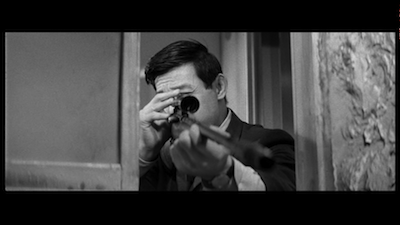
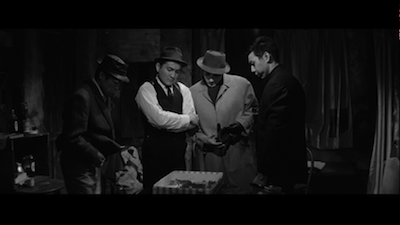
The final film in the Nikkatsu Noir boxed set is easily the best. Takashi Nomura's 1967 fugitive picture A Colt is My Passport stars Joe Shishido as a hitman on the lam. Paid off by one crime boss to kill another crime boss, his plans to scarper out of the country with his partner, Shun (Jerry Fujio), are scuttled by the dead man's loyal gunmen showing up at the airport to block their way. One ingenious getaway later, and the two guys are hiding out by the wharfs, missing one departing ship after another, their freedom receding over the horizon.


A Colt is My Passport is at once both methodical and maniacal. In executing the hit, Shishido's Kamimura is precise and cold. Yet, the bold nature of the killing is anything but. Told he has to produce a confirmed kill before he gets the rest of his money, he chooses to shoot the mark when he's right next to the man that's paying him. While shuttling back and forth between hotel and harbor, Kamimura never panics, he is always calm. At the same time, the final shoot out is about as gutsy as it gets. Kamimura photographs the sequence on a wide-open lot, with no visible landmarks or buildings. Kamimura says it's a landfill, but it could just as easily be the plains of an American desert. The harmonica and brass-laden score by Harumi Ibe self-consciously borrows from Ennio Morricone's spaghetti western compositions. It's so we make no mistake: Joe Shishido is cast from the same cynical, upstanding mold as Clint Eastwood's nameless loner.


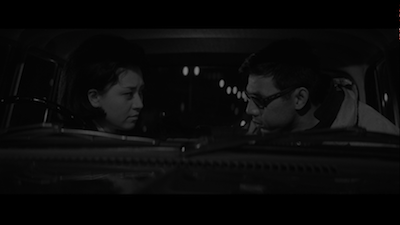
On the other hand, Kamimura also has plenty in common with American noir protagonists. Unlike Eastwood's Man with No Name, Kamimura has a partner. In this, he is much like a Bogart private eye, and just like Bogie went to bat for his cohort in The Maltese Falcon [review], so does most of Kamimura's motivation on the backend of A Colt is My Passport come from a code of ethics that demands he stand up for his brother. There is an underplayed--so, of course, possibly unintentional--homoeroticism to their bond. Chitose Kobayashi, who plays Mina, the ostensible love interest, at one point comments that she wishes she could have the same friendship with a man as they have with each other. She even lies to try to get Kamimura away from Shun, the ultimate no-no. (I mean, come on, has Mina never even seen The Maltese Falcon?) Mina's tragedy is that men regularly fail her. They are more concerned with their games, whether it's the posturing hood (Hideaki Esumi) who killed her previous lover or this new leading man with his over-pronounced sense of duty. Mina is trapped in a heartbreaking pattern, both literally and metaphorically. We are told that she has tried to escape this life many times, only to chicken out at the very last. Kamimura's gift to her, even if he won't go with her, is to make sure she leaves once and for all.


Director Nomura and his cinematographer Shigeyoshi Mine (Tokyo Drifter [review]) experiment with extremes in A Colt is My Passport. Like Leone, they like to move in close on their anti-hero's eyes. They also like to show technical details: the mechanics of putting together a gun or other weapons, or the tricks the guys pull to get out of a jam. Mine's clear photography takes great advantage of the seaside locations. The vast openness of the sea is ironically contrasted against the cramped motel rooms that the killers hide out in. Freedom is right there, they can see it all around, they just can't get to it. In the landfill, Kamimura can run all he wants, as far as he can in any direction, and he'll still get nowhere. When Shun is beat up, he has his face pressed against a round window, a cruel reminder of the portholes on the ships that keep leaving without him.


There's no fuss to A Colt is My Passport. A problem arises, Shishido handles it, he picks up the pieces and wipes off the fingerprints, and he takes his next step. There is no room for error, anger, or romance, even if all three present themselves. There is only getting the job done. In that, Takashi Nomura is fantastically successful, creating one of the best Japanese crime pictures of the 1960s. 


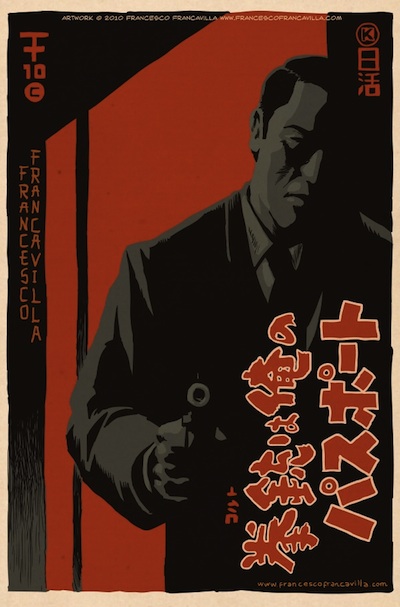
BONUS: Check out this cool tribute to A Colt is My Passport drawn by Francesco Francavilla. Check out Francesco's website for tons of movie, comics, and pulp-related art.


Sunday, March 18, 2012

NIKKATSU NOIR: CRUEL GUN STORY - ECLIPSE SERIES 17


"It's a fine line between a stray dog and a lone wolf."


Cruel Gun Story is a weird, bald-faced title, one that gives central position to the weapon and may lead us to assume that the fate of the characters involved will be directly tied to a particular firearm, something like Kurosawa's Stray Dog or Robert Altman's short-lived 1980s television show Gun. In truth, it must be something in the translation, or maybe a case of a title testing well and being applied haphazardly to a script, because the only gun to get any singular attention here is the one bought by Joe Shishido. It's an automatic rifle that was taken off an American G.I. and it comes with a warning: if you aim it, be prepared to kill; one pull of the trigger, and the target will have seven holes in his chest. Many men fall by ending up on the wrong side of its muzzle.

Cruel Gun Story was made in 1964 by director Takumi Furukawa (Season of the Sun), and it borrows its premise from Stanley Kubrick's hard-bitten noir The Killing. Four guys working for the mob are set up to rob an armored car carrying loot from a racetrack. The heist will be led by Togawa (Shishido), a convict fresh out of prison. He was serving a bid for crippling a careless truck driver who had run over his sister Rie (Chieko Matsubara, Tokyo Drifter [review]). Togawa wants to go straight, but the big score promised by this job could mean an operation to save Rie's legs. Though the doctors tell him it's futile, Togawa is a man who goes against destiny.


Joining him for the robbery is his old ally Shirai (Yuji Odaka), whom Togawa trusts implicitly, and two hoods forced on them by their backers. One is a punchy ex-boxer (Shobun Inoue), the other a junkie gambler (Saburo Hiromatsu, Take Aim at the Police Van [review]). The job is simplicity itself: divert the truck from its routine, and the guards will make a stupid mistake. It's Criss Cross married to The Italian Job: use a roadblock to send the vehicle down the wrong path, load it into a bigger truck, and take it away.


Of course, nothing ever goes as planned, and not only do the guys get the truck, but they end up kidnapping the two guards. They also are on their way to a several double-crosses, both within their ranks and beyond them. The crooked lawyer who hired them and the mob boss who put him up to it never intended to split the money with Togawa's gang, and the lawyer even has some ideas about setting up his own organization. The body count is going to get fairly high--there are two massive shootouts before Cruel Gun Story is through--and naturally there is an ironic twist of fate just waiting to happen.


The action in Cruel Gun Story is exciting, and the narrative keeps cracking at a quick pace, preventing the film from ever settling too long. There are a few logic problems in the story--when Togawa is about to get the shaft, it never makes sense that he's willing to go to a hotel for the night and leave the others back at the hideout with the loot--and though it's neat to see the heist planning in the ideal form (how Togawa imagines it will go), the actual theft doesn't divert enough from the fantasy to really justify that early run-through. Those nitpicks aside, Furukawa has put together a stylish, tough-minded crime movie with a subtle layer of social commentary. All of the crooks have some kind of difficulty, either personal or socio-economic, compelling them to take this drastic action, and the implication is that post-War Japan doesn't offer them an alternative to solve their problems. It's telling that all of their hiding places are buildings that have been ruined by occupying American soldiers, and the one guy who has been making a clean living, Togawa's friend Takizawa (Tamio Kawachi, Black Sun [review]), does so by running a jazz bar catering to black American soldiers. Even the greater cosmic forces have a Western face. Rie is in a Christian hospital, and in one of Cruel Gun Story's most potent scenes, Togawa rejects God for being callous and unforgiving.


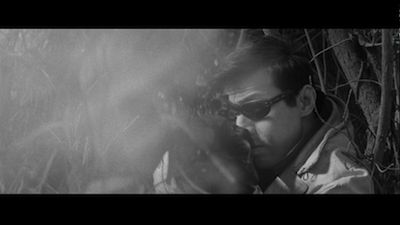
These are desperate times, and as the saying goes, desperate measures are called for. Shishido is perfecting the tough-guy swagger that he is best known for (he rarely takes off those sunglasses), but he also plays Togawa as conflicted and vulnerable. He doesn't want to pull this robbery. His instincts tell him it's the wrong thing to be doing and he's doing it with the wrong people; yet, he blames himself for Rie losing her legs because he sent her out to the store the night she was struck down. In a sense, she's like the maguffin of his particular story, though the reward is emotional rather than monetary. It makes Togawa's choice to go after the boss' own flesh and blood, the thing he cares about the most,  all the more chilling. He knows exactly what kind of damage that will do.


Cruel Gun Story isn't without its levity, either. It's hilarious how much these guys beat up on each other as a standard course of business. There was actually supposed to be a fifth robber (Hiroshi Kondo), but after Togawa and Shirai pretend to be rival gang members and beat the crap out of him, he folds. They also rumble with the boxer and pull a drive-by on the gambler, all to test their mettle. And any time someone talks back to Togawa, he pastes them hard on the mouth. All the guys bounce back, though, even if the furniture does not.

The final act of Cruel Gun Story shows Togawa trying to salvage things and get back at the men who betrayed him. It's violent and smart and not without its bittersweet ironies. The final shot definitely owes a tip of the cap to the ending of The Killing, but not before one last dirty twist on the part of the filmmakers, giving Togawa one further disappointment to chew on. The last act of violence perpetrated in the movie is done because someone mistakes him for being their mutual enemy, suggesting that in a world that's gone this wrong, the ultimate cruelty is for a man to become everything he hates.


Sunday, March 11, 2012

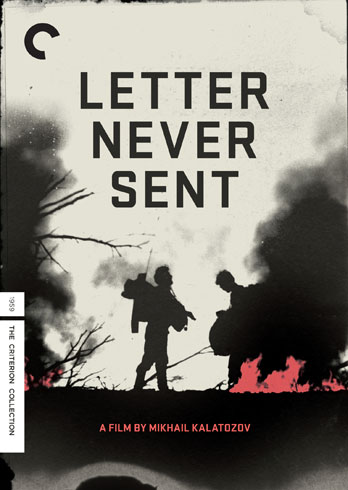
LETTER NEVER SENT (Blu-Ray - #601)


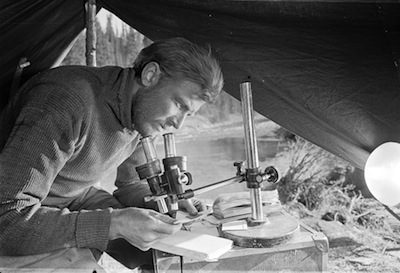
An expedition of four enters the Siberian wilderness. Scientific tests of the soil in the area have shown a possibility for diamond deposits. The group consists of three geologists and their guide, all veterans of similar hunts, though yet to experience success. The mission to find the diamonds could bring them great glory; if they are successful, the treasure will fund new Soviet endeavors. If they fail, it's uncertain if they will get another chance or if new explorers will be sent in their stead.

This is the premise for Letter Never Sent, Russian filmmaker Mikhail Kalatozov's 1959 backwoods drama. It's a man vs. nature tale worthy of Werner Herzog, one with hubris, misplaced ambition, and even a touch of romance. Letter Never Sent is both human and elemental.

Sabinin (Innokenti Smoktunovsky) leads the search party. He is a level-headed man, and his ongoing missive to his wife (Galina Kozhakina) gives the film its title. He began the letter on the plane, but instead of sending it back with the flight crew, he hangs onto it, turning it into a record of their endeavors. The pair of geologists on his team is in a relationship. Andrei (Vasili Livanov) is smart and affectionate, and he and Tanya (Tatyana Samoilova, also in Kalatozov's The Cranes are Flying [review]) share a common pursuit. The guide for the trip, Sergei (Yevgeny Urbansky), also has feelings for Tanya. He is physical and earthy. He is not necessarily Andrei's better, but he is the man's opposite. One is analytical, the other instinctual.


This set-up creates a strong dynamic. All the players have their function, and they serve them. Tanya is aware of Sergei's intentions, as is Sabinin, who acts as a calming influence. Whether Andrei has any clue is up to interpretation. He and Sergei have an altercation that ends ambiguously. It may be telling, however, that Tanya discovers the evidence they have been seeking after dismissing Sergei, and its Andrei that she first celebrates with. Yet, each man has a redemptive moment on the horizon, a chance to take action and make a sacrifice.

It's after Tanya's finding that the real movie begins, and Letter Never Sent turns into a story of survival rather than one of discovery. The morning after she digs up the diamond, the team awakens to a forest ablaze. It's as if Mother Earth is rising up to stop them. She can't simply let these men tear into her soil and take her prize. The hunting party must grab what they can and make a run for safety. Before they find it, they will contend with not just fire, but rain and snow, as well. The terrain is unforgiving, and the weather unrelenting.


Letter Never Sent is a wondrous thing to witness unfold. Mikhail Kalatozov, who is perhaps best known for his innovative travelogue I Am Cuba [review], has a remarkable sense of framing and a masterful photographic eye. He and his regular cinematographer Sergei Urusevsky possess an uncanny grasp of black-and-white dynamics. The nature photography in Letter Never Sent is beautiful, with the camera acting as a vibrant observer. Kalatozov moves with and around the actors, dodging tree branches, going underneath and above the performers, and often acting in concert with them. Though a cold observer, the camera additionally serves as a unifying tool, connecting what the geologists are doing with the environment they are doing it in. In the early scenes, Kalatozov employs montage to show their tireless hunt while laying flickering flames over the top of their activities. As it is occurring, it appears the fire is meant to symbolize the passion with which they undertake their duties; as we get deeper in, these conflagrations are revealed to have been foreshadowing.

Kalatozov's direction manages to be both poetic and realistic, striking an intentional balance between artistic expression and the truth of his scenario, the virtuosity of the invented visuals and the actual beauty of the Siberian forests. This illustrates the disparity between man's dreams of glory and the harsh reality of the natural world. The obvious flourishes of Letter Never Sent's first act disappear once the fire comes for real. From there, the only fantasies Kalatozov indulges are Sabinin's delusions. He converses with his wife, and he sees the industry he believes their findings will make possible. Yet, neither is really happening.

Which isn't to say that all the beauty vanishes once the trees start to burn. Nature has the same capacity to nourish as it does to destroy. The cleansing rain creates salvation, and Kalatozov and Urusevsky capture the relief in a way that resembles religious ecstasy. Tanya leans against a tree and lets the water pour over her, and her expression is serene and joyous. The irony, of course, is that the same rain will turn to ice and become their next deadly obstacle. Time and space become immaterial, with seasons seemingly passing overnight and civilization appearing no nearer. Letter Never Sent is a test of wills: do these explorers have what it takes to get home? Can Sabinin deliver his message, or is failure and hopelessness all that really waits for those who dare challenge that which is bigger than all of us?


For a complete rundown on the special features, read the full review at DVD Talk.

Please Note: The images used here are from promotional materials, not from the Blu-Ray.