Monday, December 24, 2007

RAYMOND BERNARD - ECLIPSE SERIES 4


Raymond Bernard is a director who had seemingly fallen through the cracks of cinema history. A prolific lensman in the 1920s and '30s (and up to the late '50s), his is not a name I've heard bandied about before this double-dose collection. For the fourth volume in their Eclipse Series, the people at the Criterion Collection have expanded their scope from presenting sets of lesser known segments of a director's filmography in order to present a lesser known director.

The son of playwright Tristan Bernard, Raymond began his career as an actor before moving into the director's chair, cutting his teeth on silent cinema and working on early historical epics that would pave the way for the two grandiose films presented here. Both films show a technical sophistication on par with anything coming out of Hollywood at the time, and there is a certain poetry to his use of montage and metaphorical imagery that is both dreamlike and realistic at the same time.


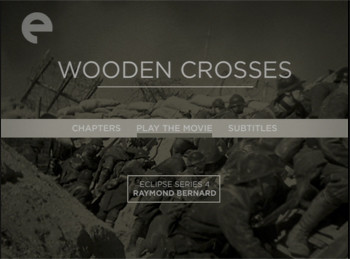
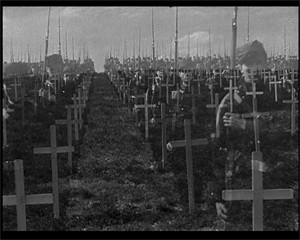
Bernard's two major sound films were made for Pathé-Natan Studios in the early 1930s as part of a bid to compete with American cinema. Wooden Crosses (Les croix de bois) (113 minutes) was a major effort for 1932. Adapted from the popular WWI novel by Roland Dorgelès, the lyrical examination of the harsh trenches of battle in both mediums can be compared most obviously to the similar novel and subsequent film adaptations of All Quiet on the Western Front. Opening with shots of row upon row of grave markers, each expanse of crosses fading into the next as the camera zooms tighter and tighter, finally landing on a single memorial, Wooden Crosses is one of the most tender and tough antiwar films to come out of the era.

The film forgoes conventional plot in that there is no great goal or fantastic mission for its regiment of soldiers to complete. That's part of the point, to show the drudgery of everyday life in the army. For most of the men, their tour of duty was only noble for them being there, not for what it accomplished. Our main character is a rookie, Gilbert Demachy (Pierre Blanchard), who waited to enter the fray until he completed law school. A bit of a dandy when he arrives--he uses a perfume soaked handkerchief to block out the stench of his comrades--he will become hardened by the things he sees.

Gilbert is no more important than any other soldier, though, something Bernard will emphasize repeatedly. The first dead body we see belongs to the man who takes our rookie out on his first patrol, and Bernard lingers on his corpse, face down in the dirt, limbs bent unnaturally. He chronicles how the changing light effects the look of the body, its shadow expanding like a stain. It lingers for us the way it lingers for Gilbert back at the camp. Later, at the location of Wooden Crosses' final battle, a wounded soldier is stranded offscreen, dying in No Man's Land. He repeatedly begs for his brothers not to forget him, reminding them that "I have a mother." Essentially, it's Bernard reminding us all not to forget the boys doing the fighting, to remember they all have mothers. It's a message many could do well to heed in 2007.

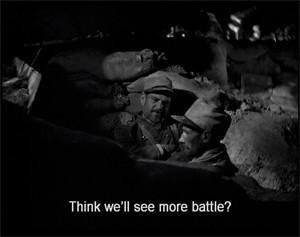
From a moviemaking standpoint, the battles in Wooden Crosses are staged at a staggering scale. It's hard not to be impressed by Bernard's ability to capture the sheer terror and chaos of the attacks. He stays down in the trenches, giving us a more humanist picture of war by staying at ground level with the men. The push here is to always to identify with the guy holding the rifle, the one putting it on the line. As the war continues to go on and the soldiers grow tired of their extended duty, issues of class come up again and again. Disgruntled men despise the captains who can hang back while they run to certain doom. There are also the people back home who carry on with their lives, only seen in brief flashes of memory from individual men. In one important death scene, a dream of the soldier's lover dancing turns into a cascade of coins that then morph into funeral wreaths. Is that what they are all fighting for? Ironically, one of the worst battles in the movie ends with the men being pushed into a cemetery, where a well-placed bomb could bury them all alive. No need for ceremony, no need for markers. This is the reality of death.

(Trivia buffs will note that theatrical theorist Antonin Artaud appears as a soldier in Wooden Crosses.)


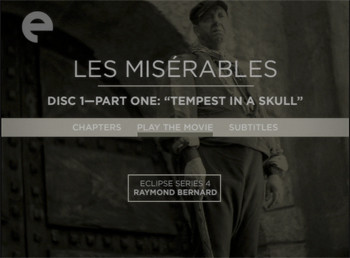
Bernard perfected his earthy lyricism in his next feature, his mammoth adaptation of Victor Hugo's Les Misérables. Released in 1934, a year ahead of the Fredric March/Charles Laughton Hollywood version, Bernard's film is four hours and twenty-one minutes long, and it's broken down into three interconnecting shorter films: "Tempest in a Skull," "The Thénardiers," and "Liberty, Sweet Liberty." By doing this, the writer/director was able to cram in as much of the original Hugo story as possible.

The plot of Les Misérables is, of course, ingrained in our culture at this point. Jean Valjean (Harry Baur) was sent to prison for stealing a loaf of bread. Released nineteen years later, he finds the world turns a hard shoulder to a man of his status. An act of kindness sets him on the straight and narrow, however, and over the next several decades, he adopts multiple identities to stay out of prison and live a decent, philanthropic life. The first film, "Tempest," charts his first tastes of freedom and the life he builds as a mayor of an out-of-the-way town. There he befriends Fantine (Florelle) and gets involved in a moral quandary that could force him to choose between rescuing her child (Gaby Triquet) from evil foster parents or keep a man who looks a lot like him (Baur played this character, too) from being imprisoned for crimes Jean Valjean committed.

Part 2, "The Thénardiers," picks up when Jean is on the lam. He rescues the girl and sets up a new life with her. Only, when Cosette (now Josselyne Gaël) grows older, she falls for Marius (Jean Servais), a young bourgeois revolutionary. Also, a second run-in with Cosette's old foster parents exposes Jean Valjean yet again.

Finally, part 3 is concerned mainly with the 1832 revolt that Marius is a part of, as Jean tries to keep the boy alive and rescue Cosette's happiness. Also, Inspector Javert (Charles Vanel), the police officer who has long dogged Jean's trail, is finally catching up with his quarry.

The main thing that makes Raymond Bernard's Les Misérables special has to be Harry Baur. A big bear of a man, he is a threatening physical presence on screen. Particularly as the newly freed Jean Valjean, he appears to be dangerous and menacing. Over the course of the movie, and the two identities he will adopt, he gets quieter, gentler, more contemplative. All the key story turns hang on how Jean will choose to handle a moral dilemma, and Baur does more than debate his options vocally through isolated soliloquies, but the arguments also manifest physically, in his body language and on his face. It's a remarkable performance, and all the more for the completely separate character Baur plays, the somewhat unbalanced Champmathieu. The characters in the movie may mistake him for Jean Valjean, but Baur makes him so different, the audience never would.

Outside of the performance he gets from Baur, Bernard also shows an increased visual flair. At the start of part 2, when young Cosette runs through a dark forest at night, Bernard gives the woods an eerie anthropomorphic quality that precedes Disney's similar scene in Snow White by three years. The very next scene, however, is spirited and fun, as we move to a lively street fair. In all of these things, Bernard is fusing epic grandeur with a dynamic realism, often juxtaposing the harsh actuality with a melodramatic trope, such as when the convict caravan passes at the end of part 2, underscored by a swelling orchestra. The tidal wave of bodies and debris that comprises the uprising in "Liberty, Sweet Liberty" also rivals any of the battle scenes in Wooden Crosses.

Amazingly, Les Misérables never got a full North American release prior to this DVD, letting lesser movie versions carry the load that Raymond Bernard and his hulking Jean Valjean carried so much better. When we consider the past masters, surely there is a place for Raymond Bernard, a literate filmmaker with an eye for movement and visual metaphor. The Raymond Bernard - Eclipse Series 4 boxed set seems like a step in the right direction, putting the director's artistic zenith in the hands of a new audience. Now that I'm educated, I'd consider myself a fan.


Originally written July 16, 2007. For technical specs and special features, read the full article at DVD Talk.

Sunday, December 23, 2007

BLAST FROM MY OWN PAST: VIDEODROME - #248

From the now-defunct "Can You Picture That?" column, September 21, 2004. It should be noted that I gave Cronenberg's recent picture, Eastern Promises high marks. Just for curiosity's sake.


I've never been much of a David Cronenberg fan. I've enjoyed his stuff on the periphery, with late '80s efforts like The Fly and Naked Lunch standing out as favorites amongst the bunch. For me, his fascination with breaking down the body and seeing how far he could go into abstract gore didn't resonate, and I often felt his visual fetishes overtook the storytelling. There was always something very cerebral about his work, but it tended to get lost in the blood and puke. The brain's products were less important than its tissue being exposed in a very literal sense.

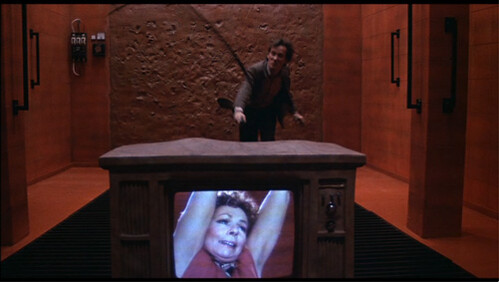
Videodrome was a film of his I had never seen. Made in 1983, I had the impression that it, along with other earlier efforts like Scanners, were farther to the splatter end of things than was to my taste. When the Criterion Collection announced they were doing a two-disc set, it didn't inspire much of a reaction out of me; however, as I read about the movie as the release drew closer, I was intrigued. From the basic synopsis--James Woods plays a man running a small cable station turns to softcore porn and violence to compete, and eventually stumbles upon what is possibly a snuff version of reality TV--Videodrome sounded eerily prophetic. Was Cronenberg two decades ahead of the Fear Factor curve?

Upon viewing the film, I would have to say that yes, he was. Incredibly so.

Videodrome looks to be the flashpoint where modern horror truly began. With its use of stylized video images, it points the way to the media obsessions the genre would adopt in the new century. The poison video tape in The Ring, the bizarre mania of the zombies in 28 Days Later, the disjointed time and shifting visual approach of Ju-On: The Grudge (the Japanese in particular seem to really relish in Cronenberg's legacy)--the seeds for all these things were first planted in Videodrome.

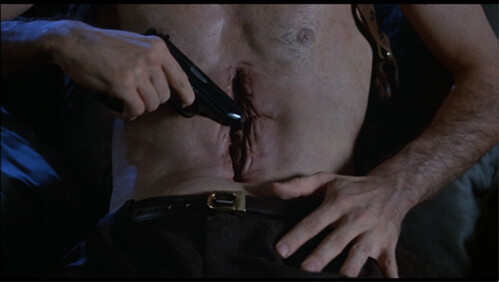
Unfortunately, I'm not that impressed with the movie itself. Videodrome has its moments, but its ideas exceed its execution. The narrative feels disjointed, particularly at its climax, and Cronenberg tries to cheat his way out of explaining things by piling on the gore. We'll be so ooged out by the big vagina that has opened up in James Woods' stomach, we won't necessarily notice that the story doesn't always make sense or that the psychology is a little obvious.

Which can often work. Horror movie is about inspiring reactions, after all, and in its day, Videodrome may have scared the beejezus out of people. From watching the second disc's making-of documentary, Rick Baker's effects for the movie were certainly innovative for their day. Twenty-one years later, though, they no longer have the ability to maintain their sense of realism. Woods' malformations ooze and spit in ways that call too much attention to themselves, as, once again, the more ickiness Baker dumps out, the less obvious the fakeness is--the same trick Cronenberg uses. The neatest effect, the melding of man and TV fares better. I was able to ignore the fact that it was obviously a big balloon just because it was so damn cool.

Criterion has put together an amazing package, to my mind far exceeding what Videodrome deserves. The discs contain two commentaries, a recent short film by Cronenberg, various documentaries, collections of photos, and a vintage discussion on horror between John Landis, John Carpenter, and Cronenberg shot while Videodrome was in production. I can't imagine why anyone would want the unedited films that comprise the fictional Videodrome TV show, though. I would think you'd have to have a rather grisly brain malfunction to want to sit through their extended torture scenes.

The neatest feature, though, may be the package itself. It's designed to look like an old VHS tape--the Videodrome tape--including a paper slip cover and a spine made-up to resemble a handwritten label. It's a perfect melding of design and theme, keeping in the spirit of the film. There is also a 40-page booklet of photos, credits, and extensive essays.

I am sure fans of this sort of thing will appreciate it more than I, and Criterion once again sets the standard for how a movie should be treated (great sound, great picture, great extras), but in the end, for this viewer, Videodrome doesn't live up to its reputation.


Wednesday, December 19, 2007

TWO-LANE BLACKTOP - #414


B-movies and genre pictures are quite often more than they seem. Sure, most of them are exactly what they seem, and I've seen plenty that others have claimed have carried some heavy message only to discover that someone misread nonsense for wisdom. When it's working, though, when the cast and crew understand what kind of Trojan Horse they're loading into the projector, it can be truly magical.

Monte Hellman's 1971 road race movie Two-Lane Blacktop, just released on a double-disc DVD by the Criterion Collection, can be watched as a film about a trio of guys with no roots looking for kicks on the open highway, and on that alone, it's an enjoyable flick. That's the beauty of the stealth genre picture, it has very real pleasures right on the surface. It's up to the individual to find any more in it, and in the case of Two-Lane Blacktop, whatever it is you find is also up to interpretation.

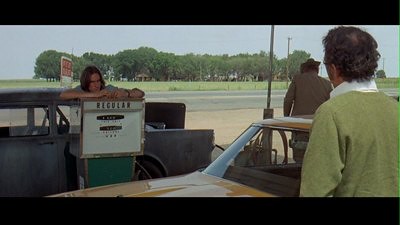
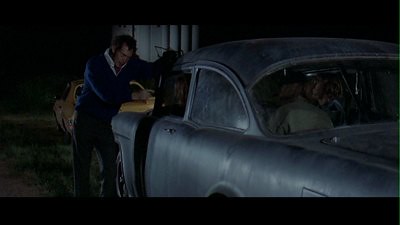
Hellman and screenwriter Rudy Wurlitzer (Walker) take a Spartan approach to their cast list. The characters have identifiers in place of names. Folk singer James Taylor is "The Driver," while Dennis Wilson, drummer for the Beach Boys and one-time misguided associate of Charles Manson, is "The Mechanic." They roam the country in a tricked-out 1955 Chevy, drag racing for money and thrills. They say very little, and when they do speak, it's usually about the car and the road. On their way through the Southwest, they keep getting buzzed by a 1970 Pontiac GTO (the cars get credits, too). It's driven by Peckinpah-mainstay Warren Oates, named only for the car himself. "GTO" is the opposite of the Chevy duo. He likes to chat up a storm, bending the ears of the hitchhikers he regularly picks up off the side of the road. What he says isn't always the God's honest truth, and his stories will change from one airing to the next. To hear him tell it, it's the Chevy that keeps landing on his tail, not the other way around.

Eventually, these two cars end up on a race to Washington D.C. The loser surrenders his pink slip and the car it represents. Along the way, they change positions in the race about as often as they pass the only other passenger, a nameless "Girl" (Laurie Bird), between their vehicles. Their attention seems to rarely be on the contest, anyway. The Chevy can't resist shorter races (sometimes compelled by financial concerns), whereas GTO's ever-changing ride-alongs trace a nature trail along America's weird underbelly.


Which, arguably, is what Two-Lane Blacktop is really about: the state of the American frontier. With Manifest Destiny all played out, modern day cowboys no longer have any territory left to explore. Instead, they shoot back and forth across the map looking for something to do. No roots, no responsibilities, just keep moving. The Chevy duo has only their thrills to look forward to. The very fact that they have nothing else--no family, no past, at least as far as we know--is probably what put them on the road. GTO, as unreliable a narrator as he is, makes several mentions of a past he is trying to escape. Was he really a TV producer that lost his mind and burned rubber in search of a way to make an outlaw automobile film on his own? If so, one suspects he is a stand-in for Monte Hellman, standing out in the wilderness along Route 66 making a subversive movie about a paved-over pioneer trail.

You can actually see the feeling of wild abandon. Though the film is full of many wonderful compositions, the camera regularly breaks free to shoot what it wants to shoot, either enjoying the unpredictability of a large crowd (was that extra in the Texas Panhandle scene supposed to clip Laurie Bird when she goes running like that?) or in capturing information in untraditional ways, like ambling away from a café table to look out the window at incoming characters, defying convention in such a way to show us what we need to see without having to cut. He also sets up deep frames, taking in the full horizon, and with some semblance of life going on in every corner of it.

At another juncture, however, GTO tells a traveling Texan (Bill Keller) that he used to be a test pilot that flew jets, and he switched to cars because he needed something to ground him. He also tells the Girl that he needs to find the end of the road before he jumps right off it and goes into orbit; contrary to that, the Chevy duo see no end to the highway. The only real threat is the loss or destruction of their vehicle, something they get close to as an unexpected result of their race with GTO. Out of cash, they have to put their tools up as their stake in a wager, and for the first time, the Mechanic and the Driver get testy with one another. The tools keep the engine running, and without them, the machine could fail.

It’s just one of many flip-flops Hellman and Wurlitzer pull in Two-Lane Blacktop. A lot is backwards on their racetrack. It must be significant, for instance, that the old man drives the newer car, trying to make a claim to being part of the present and not a relic of the past. The two younger men, however, drive an older car, placing themselves within a tradition that was over before they even knew what it was. If you consider it that way, it almost seems inevitable that these entities would eventually collide, coming together only to repel one another, two magnetic forces that both attract and repulse.

Where they end up is entirely up to you. They both stick to their original routes, but what they find there is the personal riddle that each viewer brings to the picture. Like the mysterious ending of Easy Rider, this movie's closest cousin, there is no denouement that puts Two-Lane Blacktop into perspective. Unlike Easy Rider, there is no heavy-handed, self-conscious symbolism to sort through, either. The way I see it, the racers continue on, stuck in gear, happy in being doomed to participate in the eternal struggle. Your mileage may vary, though, and that could be Monte Hellman's ultimate statement about the freedom we all seek. Like the open highway, this movie and what it means to you--and life itself--is only limited by the amount of fuel you're willing to expend getting there.


For technical specs and special features, read the full article at DVD Talk.

Tuesday, December 18, 2007

THE TWO OF US - #388


It doesn't matter how many movies you see, some will still surprise you.

It's not always easy to do in our current climate of over-saturation and hype. Afraid of what might happen if ticket buyers didn't know exactly what they were in for before entering a cineplex, movie studios tell us everything they can about their product, sucking the spontaneity right out of it. That's why once I know I am planning on seeing something, I try to shut everything out. Better yet, if a movie slides across my desk that I'm not familiar with, I don't read up on it. I won't even flip it around and read the summary on the back. Let every frame of it be brand new!

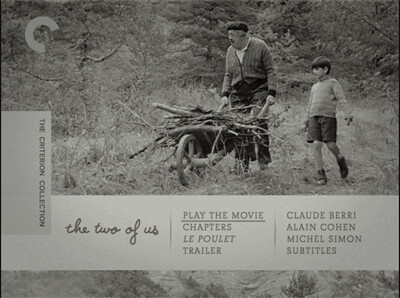
So it goes that I received The Two of Us - Criterion Collection, the new DVD release of Claude Berri's 1967 French film. The original title is Le Vieil homme et l'enfant, more accurately translated as "The Old Man and the Boy." You look at the cover photo, and that title would appear to be pretty accurate. It looks to be a movie about the relationship between a kindly old man and a young kid. And that is what it is, but it's also so much more.

The Two of Us is set in occupied France. As the film opens, an introductory title and voiceover narration set the stage by telling us that the story is one of "poetic nostalgia," based on the real experiences of the main character, the director's stand-in. Claude (Alain Cohen) wants to be a normal nine year old. He's aware of the Second World War, but he'd rather block it out, because it gets in the way of being a kid. Easier said than done, as his family is Jewish, and Claude's refusal to keep his head down and quietly go about his business is a constant risk to their lives, forcing them to move over and over to avoid being exposed to the Germans.

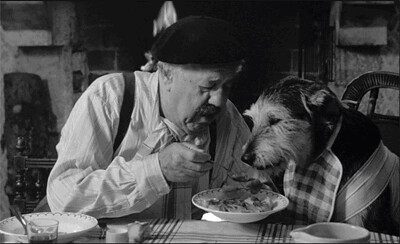
Fed up with Claude's antics, his folks arrange through a friend to have him sent to the countryside, away from suspicious eyes, where he will live with the friend's parents. Claude will have to pretend to be Catholic, however, as the old man he will soon call Grandpa is a raging anti-Semite. Pepe is played by Michel Simon, the wonderful French actor who starred in Jean Renoir's Boudu Saved From Drowning, and he was 72 by the time The Two of Us was made. In his old age, his round face and droopy features made him look like a hound dog. When Berri actually introduces us to Pepe, it's a two-shot of the man and his dog sitting at the dinner table, eating together. The dog wears a bib and Pepe feeds him with a spoon. The old man could almost be feeding his own image in a mirror.


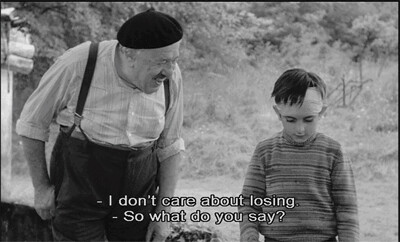
Claude Berri would go on to create the two-part epic Jean de Florette/Manon of the Spring, as well as many other grandly executed films, but this early effort is simplicity itself. The director stays true to the film's frontispiece, maintaining the eyes of a child while telling the story. This means that Pepe is neither vilified nor taught a great lesson, because that is not what happened in real life. It's not that the young Claude is unaware that his new Grandpa is a bit touched in the head, he just chooses to ignore it. As Pepe peddles his ridiculous stereotypes, it's hard to tell at first if Claude is actually buying into the rhetoric or not, but once we realize that the boy is taunting his elder, goading him into spouting off with his silliness and even poking holes in his logic, it all becomes deeply humorous. We are seeing the two extremes, the old ways and the new, misguided experience vs. innocence and wonder. Senior citizens can be just as childish as schoolboys can be wise, and here they meet somewhere in the middle.

It's a rather ingenious thing that Berri has done here. The Two of Us is not only a testament to man's capacity to actually get along, but it also neutralizes the hate by exposing the inherent silliness that forms its foundation. I wouldn't call Pepe harmless, but like so many racists, his notions about other people are so exaggerated, they are cartoonish. Berri need not humiliate him or make him look foolish, he does it all by himself. What else can you make of a strident vegetarian that won't eat animals because it makes him a "cannibal" but can rant just as vehemently about the influence of the Freemasons in the French government? When the Liberation comes, Pepe can see the times changing, and he realizes that it's all passed him by. He's out of step.

So, too, will Claude be leaving him. Pepe's sadness over the direction of the political winds is just as much a sadness about the ending of this friendship. When you set aside the film's subversive technique, The Two of Us is about the loving friendship Claude and Pepe forge. When it comes down to it, that might be the most subversive element of all, that we don't finish the movie thinking about Pepe's hate, we instead think about the love between him and his young pal. The experiences they share, such as Claude's first crush and how Pepe comforts the tearful child when his heart is broken, are stronger. The old man's prejudice has been shrunken down to the comical image of him chasing Claude with a knife between his teeth, pretending to be a Bolshevik who eats children. Seeing such things, racism doesn't seem so unconquerable after all.


Originally written June 12, 2007. For technical specs and special features, read the full article at DVD Talk.

Monday, December 17, 2007

THE THREEPENNY OPERA - #405


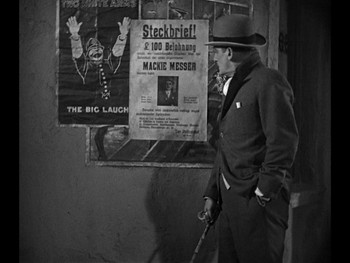
When The Threepenny Opera premiered on the German stage in the 1920s, it wowed the Weimar Republic and changed the face of theatre forever. The brainchild of perpetual underdog Bertold Brecht and the intellectually effete Kurt Weill, it was a free-floating, living theatre experience, updating John Gay's Beggar's Opera with modern cabaret, jazz, and a bit of early Marxist scandal. Its pulpy foundation is actually kind of like a connector between the pre-20th century tales of ribaldry and the emerging gangster movie genre. The play's main character, Mack the Knife, is the prowling outlaw, the deadly killer in a flashy suit that we can't help but be drawn to in spite of ourselves.

Despite being a huge hit in Germany, it took several years for The Threepenny Opera to make the transition from stage to screen. In 1931, pioneering German director George W. Pabst finally tackled the material, taking down Brecht in the process, creating a somewhat morphed version of the original production while making a classic of the early sound period in the process.

One of the main things Pabst did in his adaptation was to tighten up the actual story, dropping about half of Weill's songs and giving The Threepenny Opera a more standard movie narrative. Mackie Messer (Rudolf Forster) is a pimp, a thief, and a murderer who runs the show amongst the shadowy figures of Bohemian London. He's the kind of colorful, charismatic outlaw that they sing songs about, and in this case, the famous standard "Mack the Knife," performed by Ernst Busch, a street singer who regularly interjects himself into the movie, acting as a scruffy Greek chorus and even addressing the audience directly. Mack has rejected the whore who loves him, Jenny (played by Lotte Lenya, Weill's wife and the originator of the role) and is seducing Polly Peachum (Carola Neher), the daughter of Jonathan Peachum (Fritz Rasp). Peachum is the "King of the Beggars," an enterprising crook who has organized the London panhandlers. For a fee, he will issue a beggar's license and give you the tools you need to extract the most sympathy from the bourgeoisie. As he says, the moneyed class has no problem creating misery, they just can't stand to look at it and will pay for the privilege not to.

When Mack and Polly marry, it causes an underworld standoff. Peachum doesn't want to lose his daughter to this shark, and so he leans on police chief Tiger Brown (Reinhold Schunzel), an old war buddy of Mackie's, to throw the noose around his pal's neck. If not, the beggars will march through the London streets and disrupt the coronation of the new Queen. If Brown can't keep the peace during this important occasion, his career is sunk.


While Pabst works with a cinematic language, the film version of The Threepenny Opera maintains a certain theatrical feeling. The elaborate sets seem to occupy the middle ground between the neorealist look of Marcel Carne's as-of-yet unmade Port of Shadows and the more obviously constructed set designs of the live stage. The buildings and the streets are wonderfully detailed, but the sky is usually just out of sight. When it comes into view during the more romantic moments, such as Mackie and Polly serenading one another on the deck of a ship, it has a gorgeous perfection, looking both three-dimensional and painted on. So, too, does the action seem to bounce back and forth between a prowling realism and a more stylized mode of expression. Shots of authentic looking beggars give way to moments of vaudevillian comedy and, of course, eruptions of song. Keeping with the cabaret style, the performers aren't so much singing their thoughts or driving the narrative, but instead are stopping cold to either perform as part of that narrative or wryly comment on it.

As far as the acting, I was most impressed by Forster. He chooses to play Mack as unflappable, slightly above it all, and always chill. Fleeing from the police is obviously a necessary action, but he's not going to be reduced to panicked running. Rather, he strolls easily from his fevered pursuers. He could get away or he could not, it doesn't seem to matter to him much either way. Intentionally or no, this seems to fit Brecht's more cynical message, that regardless of social strata, most people are just out for themselves. If Mack is best buds with the chief constable, than who is really mining the store? It makes all the sense in the world that Polly, once she takes over her husband's operations, would choose to buy a bank instead of continuing to rob them. It's what every gangster wants nowadays, to go legit. As Enron and other white-collar rip-offs have taught us in recent years, there's more money to be had on the supposed right side of the law anyway.

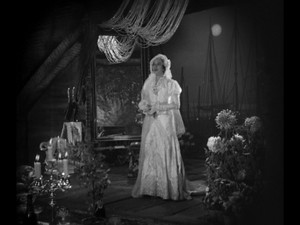
Pabst's strangeness in tone and the satirical, cynical eye are the most potent elements of The Threepenny Opera, and despite this otherworldly air, the director doesn't forget to remind us that the social ills Brecht describes are very real. When the beggars stand before the Queen and her parade, Pabst frames them as a sea of weathered faces, the lines of labor and despair appearing as unmistakably deep, etched into black-and-white celluloid. That the Queen only has a bouquet of fresh flowers to hide her face is a powerful metaphor. If you're going to bury your shame in something, it might as well be beautiful and deliciously scented.

It's those same elements that also keep this older film, restored last year in celebration of its 75th anniversary, from being too rickety. Sure, The Threepenny Opera lacks the sophisticated pacing and slick packaging that was to come, just like any other relic of early cinema, but the unrepeatable combination of talent is worth more than any polish.


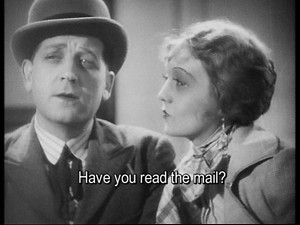
The lead feature on the second disc is the French version of The Threepenny Opera that Pabst shot simultaneously with the more revered German version, using the same sets, just swapping the German actors for French ones. It's easy to see why the German is more well known, as the French is more stiff and lacking in the graceful storytelling of its sibling, even when things are done exactly the same. The actors feel more like stock performers from central casting, and Mackie in particular is weak-chinned by comparison. It's an okay film, but Pabst was definitely more comfortable in his own language. Likewise, this French version is not as lovingly restored. The picture is shaky, and the framing often seems a bit too tight, cutting off the tops of actors' heads. The subtitles are also burned into the image.


Mackie et Polly en Francais


Originally written September 18, 2007. For technical specs and more special features, read the full article at DVD Talk.

Friday, December 14, 2007

BLAST FROM MY OWN PAST: ONIBABA - #226

From the now defunct "Can You Picture That?" column, April 20, 2004. It's not one of my best, but since it was originally part of a three-movie review, this piece is mercifully short.


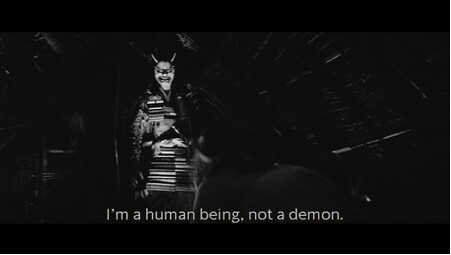
The title Onibaba translates as “Demon Woman,” and the 1964 Japanese sexual parable dressed in the tropes of horror films is dark and gruesome, an unflinching look at the extremes people will go to in order to survive. Set in a swamp during a particularly violent period of Japanese history, two women--a girl (Jitsuko Yoshimura) and her mother-in-law (Nobuko Otowa)--are forced to go it alone, killing wayward samurai and tossing their bodies in a deep hole in order to pawn their armor. When a neighbor man, Hachi (Kei Sato), returns from the war and reports that their son/husband was killed trying to escape from battle, the delicate balance of their lives is upset completely. The women’s sole bond has been waiting for the man to return--and now they have nothing.

Knowing she can’t survive alone, the older woman attempts to instill a righteous fear in the girl, using stories of a Buddhist hell to scare her into stopping her midnight dalliances with Hachi. When her measures get more drastic, the players in this twisted scenario end up getting a quick lesson in instant karma.

This gorgeously shot black-and-white film seems impossibly daring for its time. This trio of lost souls lives a primal life, full of blood and sex, and director Kaneto Shindo doesn’t sugarcoat their actions at all. The new transfer triumphantly delivers the deepest black shadows, every eerie nuance of moonlight; additionally, every bloodcurdling scream and sensual squeal comes through in detailed surround sound. Onibaba features a fantastic score by Hikaru Hayashi, sparse at times and rhythmically exciting at others. The producers of the DVD made sure every drumbeat would rattle the viewer’s ribcage.


Extras include a new interview with Shindo, as well as notes and on-set footage from the production. Onibaba was an independent effort, bucking the Japanese studio system. The features give us a glimpse into the difficult communal project. Shooting on a real swamp, the team found themselves at odds with nature, racing against a changing season to complete their film. It makes the quality of their effort all the more impressive knowing the pains it took to bring Onibaba to life.

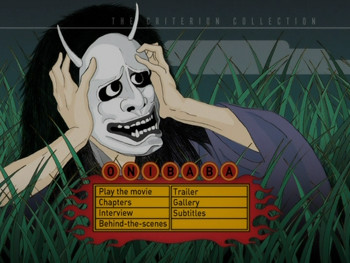
The only complaint I’d have is with the art direction. The cover art and limited, flash-style animation of the menus are the first from the Criterion Collection that I have genuinely disliked. It looks to me more like a rough for the final product, not the final product itself.

Thursday, December 13, 2007

LATE OZU - ECLIPSE SERIES 3


Yasujiro Ozu is one of the old masters of Japanese cinema. He began making films in 1927, during the silent era, and carried on doing so until 1962. As with any artist, he survived the undulating tide of fashion, falling out of critical favor when a new wave of Japanese directors decided to change the scene. On paper, that itself is almost like a plot out of one of Ozu's own films, which often dealt with the schism between the young and the old, youth's boastful self-possession clashing with knowledge and experience. Time would eventually bear Ozu out, and his oeuvre is now acknowledged for its breadth and consistency.

Naturally, with a filmmaker who has made as many motion pictures as Ozu has, sprucing all of them up for the DVD age would take a Herculean effort. The Criterion Collection established their Eclipse Series offshoot to handle just such a problem, creating lower-priced, no-frills boxed sets to handle pieces of a director's filmography that might otherwise languish on a shelf for years while studios worked their way through the more in-demand touchstones of an auteur's work. The Eclipse sets have so far been arranged by two thematic approaches: a particular type of film from a director's catalogue (such as the non-fiction selections in Series 2, The Documentaries of Louis Malle) or a specific timeframe in the director's career (five of the first films Ingmar Bergman made were bundled as Series 1, Early Bergman). Series 3 falls in the latter category. Late Ozu brings together five movies from the last seven years of Ozu's career. Made between 1956 and 1961, the only films not represented from this period are either already available through Criterion (Good Morning, Floating Weeds) or still awaiting a DVD release (his last movie, An Autumn Afternoon).

Unlike the Early Bergman box, where the set showed a style in development, Late Ozu showcases a journeyman whose themes and style have been carved out and are at the point where they are just being polished. Ozu's reputation was earned on dramas that dealt with issues of ordinary people, usually focusing on some element of family. Though his stories were generally sentimental, he kept them from being maudlin or mawkish through sweetness and humor. The director was also a master of unhurried pacing. He employed long, steady shots to let the emotion of a scene have time to take root, and he never rushed a moment. He understood that inaction was sometimes the best action. An appropriately placed pregnant pause could do more damage than a punch in the nose. Similarly, just by choosing the proper season for a particular story section to take place in, Ozu could create a setting more evocative than any done with computers and digital painting. The outer weather and climate equaled interior mood.

All of these hallmarks of the Ozu style remain intact in Late Ozu, but even within such a well-defined technique, he still had room to roam and explore. He may have been an old dog by 1956, but he wasn't out of tricks.
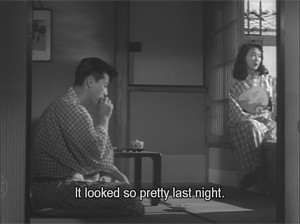


* Early Spring (Soshun) (black-and-white; 145 minutes - 1956): For the subject of Early Spring, Ozu chose the young commuters who traveled into Tokyo every day on crowded trains to work in drab, stifling offices doing uninteresting jobs. Most of the men are young enough to have served in WWII, but not so old that they can't make a transition into something else. It seems to me the title likely is meant to invoke a time where the onset of change is still early, but also, ironically, a time when things get planted and their course of growth is set.

Ozu chooses to start the film in a rather interesting way. He trains his camera on the human stew, going from house to house as workers wake up and head for work. He stirs the pot so that all the various members of the large cast drift by before his main characters rise to the surface. The focal point of Early Spring is Shoji (Ryo Ikebe), a veteran in his early thirties who has become a white-shirted salaryman. The various philosophical anxieties of modern life are coming to a head for poor Shoji. One of his best friends is sick and possibly dying, and his reunions with his old army unit just remind him of past glories. His marriage to Masako (Chikage Awashima) has grown stale, and as we learn more about them, we also learn that there is a deeper, more profound rift between them, an estrangement built on loss. Shoji wants to go out drinking and playing mahjong in the evenings, and on nature hikes with his coworkers on the weekend; Masako wants to stay home. Thus, he gets involved with a colleague nicknamed Goldfish (Keiko Kishi), a needy woman who is a bit of an office joke. As the gossip about the new couple begins to grow, so too does the chasm between husband and wife.

Early Spring was Ozu's forty-sixth film in twenty-eight years, and it followed on the heels of his most lasting success, Tokyo Story. All of the familiar themes of community and family are still there, especially as Shoji's friends gather for a love intervention and Masako's provide her with a place to retreat to as her husband's indiscretions come to light. Yet, the normally good-natured director can't provide any clear advice for his hero. Shoji's elders offer no hope. Their own dimming lives only speak to the diminishing returns of Shoji's career, and they would all rather see him jump the course, even if they don't always say it outright. Shoji's crisis is over which of all of these elements he chooses.

There are no histrionics on display in the interpersonal dramas. Most things are discussed quietly, often sitting down. Only Goldfish gets any real outburst, which is probably her due since her passionate love affair with Shoji is just as restrained as their do-nothing jobs. Some of Shoji's soldier buddies imbibe in spirits, but it only proves to make them talkative and pathetic. The most anyone can muster is an ironic singalong of "Auld Lang Syne." Even so, the sadness builds to a bittersweet conclusion that signals hope, but that almost feels like doom in disguise.
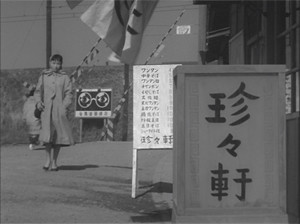


* Tokyo Twilight (Tokyo boshoku) (black-and-white; 141 min. - 1957): Similar themes of parents being unable to steer their wayward children in the proper direction give shape to Tokyo Twilight. It's a sign of the shifting times that Ozu, who usually ended up siding with the elder faction in the generational divide, made this duo of movies where the older folks no longer had any wisdom to impart that would set youth on the straight and narrow. The sins of the past were being visited on the present.

Plot-wise, Tokyo Twilight is a bit like an East of Eden for girls. Shukichi Sugiyama (Chishu Ryu) had to raise his two daughters, Takako (Setsuko Hara) and Akiko (Ineko Arima), on his own after their mother ran off with another man. Now that the girls are grown, they have fallen on hard times by chasing the wrong guys--sometimes by their father's urging, no less. Takako's husband, who was approved by Sugiyama over a better choice, is a derelict writer (Kinzo Shin) who isn't prepared to support his family, and so his wife has moved back in with her father, bringing her own daughter with her. Akiko is mixed up with a childish playboy (Masami Taura) who has been dodging her even though she is desperately trying to find him in order to tell him some important news. One of the places she keeps looking is a mahjong parlor, which just so happens to be run by a woman who knows a lot about Akiko's family. Her sudden appearance is the final catalyst this precarious situation needs for it all to come crashing down.

There is a startlingly dark gravity to Tokyo Twilight that one wouldn't normally expect from an Ozu film. He tackles quite a few heavy subjects here, and Tokyo Twilight is actually quite progressive in its honest portrayal of society's normally unspoken secrets. There is a literal crossing of the tracks in the movie when Akiko goes from her safe Tokyo home to a less savory district where her boyfriend likes to gamble. Guarding this entryway, which we are told is actually nicknamed Devil's Crossing, is a billboard with a pair of glasses, presumably warning her to watch out for the ways of sin. It reminds me of Fitzgerald's similar billboard for Dr. T.J. Eckleburg in The Great Gatsby, and these painted-on spectacles do about as much good in both masterpieces. As in Early Spring, Ozu may give us a last shot that suggests hope, but there is also a permanent slouch to old man Sugiyama's shoulders that speak of a despair that can never be fully tamped down.
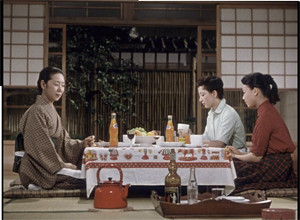


* Equinox Flower (Higanbana) (color; 118 min. - 1958): Father and daughter relations are also the central conflict of Ozu's Equinox Flower, made a year after Tokyo Twilight. In this, his first color film, the director would give himself over once and for all to changing times. Equinox Flower stars Shin Saburi as Hirayama, a graying father of two who is full of conflict. Feeling that his own marriage was lacking because it had been arranged for him, he supports the new generation's desire to change tradition and choose their spouses out of love. That is, he supports these ideas as they apply to other people's daughters, not his own. Though his oldest child, Setsuko (Ineko Arima), has picked a man for herself, Hirayama stands against her, insisting that she does not know if her fiancé is truly a good man.

Yet, he contradicts his own harsh position when it comes to advising other young women. When an old school buddy (Chishu Ryu again) comes to him for help, Hirayama builds a bridge between the man and his estranged daughter, who now works as a cocktail hostess and lives out of wedlock with her musician boyfriend. Likewise, when Yukiko (Fujiko Yamamoto), the daughter of a family friend, ponders how she can escape the bad matches her mother keeps trying to make for her, Hirayama instructs her to follow her own heart. He never sees the division in his thinking, not even when it's pointed out to him. Part of his problem is that he's not ready to see his daughter leave the nest, but it's also that change is hard, and for as much as he wants to be progressive, he's not ready to give up control to the generation on its way up. At regular class reunions, he and the other old patriarchs that he went to school with all express bafflement at the way social standards have shifted. Through the gentle urging of his wife (Kinuyo Tanaka), as well as the example of the other girls he's been asked to counsel, Hirayama will eventually have to learn to cope.

Ozu takes it easy on his protagonist. Though the character's hypocrisy is plainly evident, Ozu isn't one to make him look foolish; rather, he shows Hirayama as an essentially good man, so much so that other fathers turn to him for advice. The director never puts too fine a point on it, but it's a contradiction as old as time: we can always see our own inherent flaws in others even as we are blind to them in ourselves. Ozu uses the frame of the camera lens to cradle his old man into a new way of thinking. There are no sweeping movements, no complicated compositions, but simple, straight-on shots. He doesn't jar or jostle, but eases the story along, refraining from having anyone even raise his or her voices. Rather, Ozu lets the women massage Hirayama's opinions in the right direction, their quiet rebellion being more powerful than any blunt force--or for that matter, overly dramatic film technique--could ever hope to be.

Ozu also uses a soft touch with color for his first time out, not overdoing it with an explosion of brightness but instead only using more vibrant hues when it fits the story. As visual metaphors, things like hot-colored clothes and bright orange soda bottles stand out as symbols of the younger generation, while Hirayama and his chums wear their drab suits. Even their hair is losing its luster, the black pigment disappearing, giving way to gray and eventually white. It's an impressively aggressive adaptation on the part of the director, taking advantage of his new tools in his trademark style of intelligent restraint.
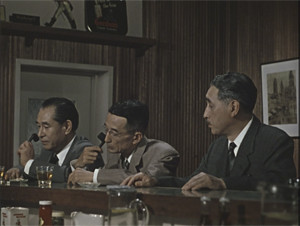


* Late Autumn (Akibiyori) (color; 129 min. - 1960): By contrast, Late Autumn has a richer, less conspicuous color scheme, but it is also more rigidly formal. A reinterpretation of the 1949 Ozu film Late Spring, this story of three men searching for husbands for their late colleague's daughter and widow is composed entirely of straight-ahead set-ups, using the square 1.33:1 aspect ratio like a picture frame, locking the drama down inside. In conversations, Ozu mechanically cuts back and forth from one speaker to the other, calling attention to his style by his willful lack of it.

The effect of this choice is a nod to tradition. Not only is Ozu reliving a former success, but he also seems to be reclaiming the most obvious signatures of his technique. Yet, this choice also skews ironic. The director is having a bit of fun with his male leads, an out-of-date trio who think they know how the world works but are really bumbling through it (they are played by Ryuji Kita, Nobuo Nakamura, and a returning Shin Saburi). Their matchmaking skills leave something to be desired, particularly as two of them have a crush on the mother (Setsuko Hara) and are really only reaching out in order to indulge their egos. Though Late Autumn is primarily the mellowest of melodramas, Ozu sneaks in some good chuckles here and there, usually at the expense of these three aging lotharios. The movie particularly comes to life when the guys are taken to task by a young friend of the girl they are supposed to be helping. Yuriko, played by the adorable Mariko Okada, not only sets these dummies straight, but she gets them to pay for a night of sake and sushi, too. Note how Ozu lets Okada engage with the camera more than anyone else in the film. She alone is the spirit of youth. Yuriko is the most animated character in the movie, sticking her tongue out, spinning to look over her shoulder as she walks away, and speaking her mind freely. It's a crush-worthy performance.

The true heart of Late Autumn, however, is the mother/daughter relationship. Ayako (Yoko Tsukasa) is avoiding marriage because she doesn't want to leave her mother alone. Likewise, the elder woman, Akiko, is willing to sacrifice her own desires in order to see her daughter achieve happiness. There are shades of O. Henry in how neither knows the lengths the other is willing to go to on her behalf. Their devotion lends a wholesomeness to the movie that Ozu makes work without becoming encumbered by sentimentality the way less sincere directors would. It's why, despite its creeping pace, Late Autumn maintains a warmth that is pleasing up to the very end.
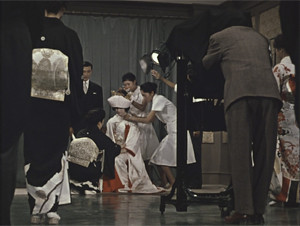


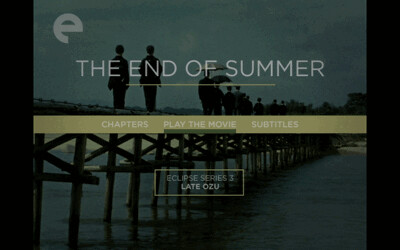
* The End of Summer (Kohayagawake no aki) (color; 103 min. - 1961): Both Setsuko Hara and Yoko Tsukasa return in The End of Summer, this time playing sisters instead of mother and daughter, but still portraying women in search of husbands. Hara's Akiko is even a widow, while Tsukasa's Noriko is torn between the man her family has found for her and the man she met at her office job. The office set looks very similar to the one Ayako worked at in Late Autumn, and these shared studios and cast members provide a continuity to all of these Ozu movies, as if they were part of an ongoing serial rather than separate entities. These female characters could be the same in both movies, just as the wedding ceremony at the end of Late Autumn could be the same as the one at the beginning of Equinox Flower. As a crash course in the director, Late Ozu speaks loudly to the consistency of his work.

Of all the movies in the box, The End of Summer is the most adept at capturing both the laughter and the tears of family life. The Kohayagawa family runs an ailing sake brewery. They struggle along on their own while larger companies swallow up others of their kind. The head of the family, Manbei (Ganjiro Nakamura), has reached the stage of life where he returns to childish things, sneaking out of the house to see his mistress and gleefully lying to cover his tracks. Though he causes his family no end of frustration, he will end up being the example by which his daughters learn to pursue their own happiness rather than doing what is expected of them. Even as the men of the family feel crushed by the demands of the business, Akiko and Noriko find freedom in jettisoning from their daughterly duties. The pair practically operates as a separate pocket, anyway, stealing away to discuss their romantic desires in secret rather than talking openly with their siblings.

The End of Summer was Ozu's second-to-last film, and it's a fitting lid to put on the Late Ozu - Eclipse Series boxed set. While the title here obviously refers to the twilight years of Manbei, it's also the signal for his daughters to finally make a decision about their lives. Traditionally, when summer ends, work and school reconvenes. So, too, must life go on.


With Late Ozu, Criterion's boutique Eclipse Series continues its winning streak. Picking five thematically linked movies from the last years of Yasujiro Ozu's career, they have created a primer of the great Japanese director's work. These dramas about the bonds of family and the struggle between the generations as traditions pass away and social expectations change are all captivating, thoughtful creations. In a parallel line to the narrative themes, we see a change in style and skill as the veteran filmmaker also transitions from black-and-white to color. While some my gripe at the unadorned presentations, Late Ozu fulfills the Eclipse manifesto of creating a mini retrospective of films that might otherwise languish in the vaults waiting for a bigger release.

Originally written June 12, 2007. For technical specs and special features, read the full article at DVD Talk.