Showing posts with label brecht. Show all posts

Sunday, February 23, 2020

LE GAI SAVOIR - CRITERION CHANNEL

This review originally written for DVDTalk.com in 2008, and it sometimes refers to features on the DVD release.


In the late '60s, Jean Luc-Godard was at his most politically strident. Discontent with representational cinema, he was moving away from his pop-culture retreads into something more confrontational and less reliant on narrative. From his feature film Weekend [review] to his short segments in anthology films like Far From Vietnam [review] and Love and Anger, and even in his Rolling Stones documentary, Sympathy for the Devil (a.k.a. One Plus One), with its perplexingly didactic skits, he was breaking down the notion of cinema frame by frame. By 1969, he was ready to issue a new manifesto, and he did so in the film Le Gai Savoir.

Explaining Le Gai Savoir is a daunting task, almost as daunting as watching it. With the 16th-century philosopher Jean-Jacques Rousseau credited as co-writer, Godard had come a long way from Bogart-obsessed gangsters. Though his movies always toyed with sound and image, and he laced even the most familiar genre subjects with political undertones, don't expect the same kind of experience here. Le Gai Savoir is practically his line in the sand, setting the stage for his collaborations with Jean-Pierre Gorin and even his more recent films, including 2004's Notre musique [review]


Forget plot summary. The closest we have to a plot here is that two activists, the student-representative Emile Rousseau and the voice of the working class Patricia Lumumba--who also go by their real names, Jean-Pierre Leaud and Juliet Berto, in the movie, and who both were in Godard's La Chinoise [review] and Weekend--are meeting in a Beckett-esque void to discuss a maelstrom of ideas including the current world climate, the purpose of cinema, and even personal philosophies. Their dialectic is illustrated by a collage of words and images, including news photographs, cartoons, advertising, and propaganda posters, an ever-flowing montage bringing to life Godard's theories about the marriage of image and sound.

That's as near as I can confidently get to the main goal of Le Gai Savoir: finding where image and sound intersect and asking how that informs how we know what we think we know. For Godard, it is a central question that pertains to what we, as people, do in order to advance this world. We can't, for instance, engage with corrupt leaders or change the way the system is run if we don't understand how they use these things to transmit their agenda. How else can we break the inundation of false information and bend it toward the truth?

Eventually, the argument even turns back on itself and Godard is forced to question the role cinema plays in this dialogue. This is where the manifesto element of the movie comes into play, the director issuing a demand to the world directors, from Italy to Cuba, to create material that challenges and provokes. Always one to wear his influences on his sleeve, Godard throws the names of Bertold Brecht and Antonin Artaud in with Mao, Guevara, and Castro. Certainly the long, loud electronic pulses that periodically blared from my speakers fly the flag of Artaud's theatre of pain. Godard himself speaks as a professorial narrator, instructing his actors through the robotic voice box that he used in other films like Alphaville [review] and Oh, Woe Is Me! [review]. He also cuts up documentary audio of real speeches and protests to show us how information can be manipulated. The auteur even self-effacingly accepts that compromise can touch his own work, fabricating censorship with missing audio and excised scenes that never really existed.


Le Gai Savoir challenges its viewer to stay alert. I can't say I digested the entire thing, as it moves with a furious pace, in some instances the rapidly changing images and the words both written and spoken acting more as a subconscious provocation than easily grasped nuggets of wisdom. I would guess this is part of Godard's intent, to shock us from what is comfortable, to force us to engage with what is happening on the screen. I am not sure I enjoyed it so much as I appreciated it, and I know many people will find it to be pretentious drivel. Still, I'm fascinated by it, and though I don't particularly want to sit down and watch Le Gai Savoir again right now, I do want to revisit it eventually and try to chip away at its dense layers.

Unfortunately, I don't believe Koch Lorber, who are releasing Le Gai Savoir on DVD in Region 1, has done its U.S. audience any favors toward making it easier for us to consume the movie. Le Gai Savoir has the original French soundtrack with removable English subtitles, and though the audio is consistently translated, the words that appear on the screen are not.* Almost every still image Godard chooses to show in his long montages either come with words already built-in or he has written his message on top of the picture. The DVD producers have only translated the phrases that appear when they conveniently fall between spoken lines--and even then, not necessarily. The title Le Gai Savoir appears on the screen multiple times, and I don't recall it being translated even once. The phrase "The Joy of Learning" has some bearing on the meaning of the movie, and it should be drummed into our brains. Plus, given that one of the movie's slogans is that spoken language is our enemy, it seems counterintuitive to give it heavier weight than the other uses of language in the picture.

Not that I could likely have kept up with all of that additional stimuli, but that's not really the point, is it? A layer cake without a layer is less of a cake, and by Godard's way of thinking, our comfort with the way things have been is what allows us to end up with where things currently are. With the crises of Vietnam and the clashes of communism and capitalism that so occupied many intellectuals in the 1960s, Godard was trying to make something immediate that spoke of the dangers of complacency and the need for revolutionary fervor. You almost need a scorecard to keep up with the political players he references (and, hey, that would have made a nice DVD extra), but he never expected to solve the problems, just incite his viewers to want to know more.


* Given that this technique was also applied to many of Godard's more recent efforts, like Film Socialisme [review] and The Image Book, I now would believe it to be intentional on the part of the director. 

LA CHINOISE - CRITERION CHANNEL

"We need to confront vague ideas with clear images." - slogan painted on the wall in La Chinoise

"In any case, you need sincerity and violence." - Guillaume (Jean-Pierre Leaud)


1967's Jean-Luc Godard feature La Chinoise (The Chinese) makes no bones about the director's emulation of agitprop pioneer Bertold Brecht. Not only does one of the main revolutionaries, Guillaume (Jean-Pierre Leaud, The 400 Blows [review]), espouse the benefits of the playwright's political theatre as handily as he praises Chairman Mao, but in one scene, standing before a blackboard filled with names of philosophers, politicians, and other figures of the world stage, Guillaume erases them all except Brecht. La Chinoise is Godard moving agitprop from the stage to the cinema.

The film takes place over one summer, filming five students in their apartment as they use their vacations to form a radical Communist cell devoted to the teachings of Chinese dictator Mao Tse-Tung and his little red book. At the head of this group is drama geek Guillaume and his philosophy-major girlfriend Veronique (Anne Wiazemsky, star of Bresson's Au hasard Balthazar [review] and Godard's one-time wife). They are of the no-compromise, no-retreat variety of activists, while their cohort Henri (Michel Semeniako) is more willing to accept the contradictions of political revolution. This eventually gets him dispelled from the group, though ironically, amongst all the talk of change and fomenting an uprising, Henri is the only one who we know has left the apartment and joined in any action. He first appears onscreen having been beaten and bloodied by Communists loyal to Russia. Of the many ideas tossed around here, one is that Kruschev has done little to maintain a socialist ideal, and that European Communism is pretty much endorsed by Imperialist America, who is more than willing to do business with Soviet countries when it suits them. The true threat of Asian Communism, as it were, is their lack of interest in playing in the capitalist reindeer games of the U.S. Though there is much to disagree with in La Chinoise, there is also much that intrigues and provokes.


For the most part, La Chinoise is a series of interviews, speeches, and debates amongst the cell, who stay in their apartment and endlessly pour over Mao's book, rows of which line every shelf in the place. Cut into the discourse are Godard's trademark title cards and propaganda-like still images, sometimes working in concert with what is being said, sometimes in juxtaposition to it. Some images are even integrated into the scenery, such as when Veronique shares her revolutionary ideas while sitting beneath a collage of pin-up girl drawings. In addition to the polemics about current political events, Godard uses La Chinoise as another treatise on the purpose of cinema, even breaking down the fourth wall, appearing himself as (presumably) an off-screen interviewer and panning around to show cinematographer Raoul Coutard manning the camera. Hell, he even manages to namedrop Nicholas Ray yet again. Has anyone done a count for how many Godard movies make mention of Johnny Guitar? And it still isn't on DVD?! [Except it is.]

Though the movie isn't exactly subtle with its politics, it is somewhat difficult to dissect what Godard may be personally endorsing from what he is throwing under the bus in his savage portrayal of the students. While I think the director would love to be able to wholeheartedly embrace a youth movement that supported real social change, he clearly is disenchanted with the all-talk and no-action navel gazing that such activists can engage in. Henri may begin as the character we dislike, particularly when it's revealed that he endorses his girlfriend (Juliet Bento, Weekend [review]) engaging in prostitution to pay the cell's bills as a living example of the disparity between working-class reality and socialist ideal, but by the end, Henri's revealed as the only one with a clear head when he refuses to engage in terrorism. Guillaume also may be slightly redeemed in sticking with his theatrical plan, but there is some suggestion that he may only be in it for the girls. (He eventually splits with Veronique to hook up with Bento's more impressionable character.) Really, there is more sincerity than there is violence here, and for some, probably more vagueness than clarity, too.


The most pungent critique is saved for Veronique, the one most fervently advocating acts of terrorism. On a chance encounter with one of her former teachers, the dissident Francis Jeanson playing himself, she tells him of her violent intentions, and he quickly sees how misguided she is. He damns her with one persistent question: once you have carried out your plan, what next? Veronique obviously has no idea how to fill the hole she wishes to create, and right there is seemingly Godard's major issue with bourgeois politics: they have no game plan for how to sustain the change they advocate. Thus, they spend more time talking about change than enacting it, and when they do jump into the fray, as Veronique eventually does, they screw it up. Which is fine for them, because they can walk away, return to school for the new semester, completely unaffected. Therefore, it's almost better to be the fifth member of the cell, the almost psychotic Kirilov (Lex De Brujin), who kills himself rather than do nothing--or, as it were, finally have to do something, and maybe something that will mean nothing.

As far as Godard's political cinema is concerned, La Chinoise is not necessarily the director's best. It's not nearly as incendiary as Weekend or as successful on its own terms as Tout va bien. Even so, he does effectively encapsulate what is often wrong with liberal political movements and their ability to harness youthful enthusiasm without knowing how to apply it, and the director both appreciates the young activists of 1967 even as he exposes their flaws. (Bertolucci has a similar take on the '60s student movement in his film The Dreamers, and even hangs a La Chinoise poster on their bedroom wall.) It's easy to have radical ideas when you, yourself, aren't under any real threat. The middle class can speak for the working class without threatening their own bottom line. In Godard's mind, this is where all Communism has gone wrong, as eventually there will be new leaders to replace the deposed ones.


Of course, charges of ineffectual intellectualism could easily be turned back at Jean-Luc. He is completely aware that one could accuse him of sitting in a vaunted position and making movies rather than joining on-the-ground protests, hence his built-in defenses for cinema. If Nicholas Ray's B-movies could be as effective as a Brecht's overtly political plays as tools for social change, then why not also more enlightened cinema like La Chinoise? When Guillaume starts his theatre, he does take it to the streets, after all, knocking on doors and sharing his ideas and seeing the social reality that surrounds him as he does. Arguably, rock 'n' roll was the more active art of the 1960s, something Godard even saw, hence his coupling with the Rolling Stones a year later.

When it comes down to it, it's not a dispute easily settled, and with Godard's open-ended cinema--Susan Sontag argued that he wasn't making individual movies, but one long, ongoing dialogue--the debate continues. Ironic, in its way, sitting in a room, watching the movie, and then typing about it on a laptop before sending said ideas out into the ether all on their own. Such an endeavor could make me just as deluded as the kids in La Chinoise. And yet, here you are reading it, and the idea passes on. So, maybe Godard's method does work, after all?


This review originally written for DVDTalk.com in 2008.


Wednesday, May 16, 2018

MANDERLAY - FILMSTRUCK

This review was originally written for DVDTalk.com in 2006.


In 2003, Danish filmmaker Lars von Trier began a daring film trilogy exploring the political mythology of the United States of America. A work of Brechtian agitprop, Dogville was an exciting parable that illuminated and baffled in equal measures. Many were angered that a European director who impishly admitted to having never visited American shores would make such a hypercritical film about the country; others found the harsh honesty refreshing. Last year, von Trier released part two, Manderlay, and while its meaning might be a little more clear, it's likely destined to be just as hotly debated.

Bryce Dallas Howard (The Lady in the Water) plays Grace, the reluctant daughter of a ruthless gangster. In Dogville, the role was filled by Nicole Kidman, who had to bow out of Manderlay due to a schedule conflict. As much as I love Nicole Kidman, the change ends up being a lucky turn for von Trier. Howard brings a different kind of physical power to the character, one that is well suited to Grace's current state of mind. In Dogville, Grace humbly submitted herself to the cruelty of her fellow man in an attempt to atone for her father's sins. Kidman gave her a quiet air of shame that made it believable for Grace to continue trusting the citizens of Dogville even after they turned against her and exploited her time and again. Howard picks up Grace after the good people of small-town Dogville, a sort of Depression-era Anytown U.S.A., have broken her. She is now more action oriented, ready to do good rather than just be good, and she's no longer afraid of harsh tactics. At the same time, Howard gives Grace an added naïveté. Her guilt has taken a more liberal bend, and the trust that remains is now given to the downtrodden.


The change in lead actresses adds to the formalist experiment of the trilogy. Like its predecessor, Manderlay has a style of transparency. Rather than build fancy sets to portray the southern plantation of the story, von Trier has shot his film on an open soundstage. Lines on the floor mark where walls are, and only the most essential of props are given to the actors. Doors and running water are all pantomimed. It creates an air of unreality that reminds the audience that Manderlay is allegory, while also stripping away all distraction. Instead of focusing on the beauty of the art direction, as one might if Grace were talking to the plantation's workers in front of a glorious mansion, the audience has no choice but to focus entirely on what is being said. Adding to the sense of parable is John Hurt's wry narrative. Speaking in a slightly sinister voice, he delivers ironic jabs when von Trier needs to put a finer point on the events of the narrative.

And the narrative is one of considerable power. Grace and her father (now played by Willem Dafoe instead of James Caan) are traveling across the map (literally) in search of a town suitable for reestablishing their criminal enterprise. At one stop in Alabama, a woman runs out of a rich estate to ask for help. A man inside, Timothy (Isaach De Bankolé, Miami Vice), is about to be whipped under the false accusation that he stole a bottle of wine. When Grace and daddy's hoodlums intercede, she discovers that Manderlay is a remote plantation that has never heard of the Emancipation Proclamation. When Grace confronts Manderlay's matriarch, Mam (the legendary Lauren Bacall, who played a different character in Dogville), the old woman is overcome with the shock of it. On her deathbed, she begs Grace to burn a book hidden in the room, and Grace refuses, choosing instead to let Mam's shame outlive her.


It is with this sort of bleeding-heart hubris that Grace plows forward, freeing the slaves of Manderlay. With the help of the house servant, Wilhelm (Danny Glover), and keeping a few of her gun-toting crew on hand for good measure (including Udo Kier and Jeremy Davies, both also from Dogville, though only Kier was in the same role), Grace establishes a new community on the plantation. Before he leaves, her father warns her that freedom is not so easy to come by, that oppression always finds its way back, but Grace doesn't heed his warning.

Point of fact, Grace ignores a lot of warnings over the course of Manderlay. If she believed everyone would live up to their word in Dogville, now she seems to think by refusing to listen to anyone, she can make her own word come alive. For instance, the book Mam is so desperate to see destroyed contains all the laws with which she governed Manderlay and ranks each slave on a number system meant to mark them by their various personalities. Just as Grace is cautioned that it will, this book brings about many troubles, including some of the surprising shocks of the film's climax.


von Trier is fearless in Manderlay. He's not willing to make an easy or safe film about the politics of race. Rather, he's made something that is dirty and complicated that doesn't shy away from historical stereotypes, duck uncomfortable language, or create any angelic figures to stand apart from the rest and lead everyone down the right path. While he has given Manderlay an American context, his real stock-in-trade in this trilogy is human nature. His morality plays are set in small towns, and thus they represent life in microcosm. The new community on the plantation is not idyllic, but instead is subject to individual error, selfishness, and the problems that any group of people might encounter when thrust into a way of life they are not used to. A lot of the choices they have to make may seem wrong, including ones that allowed for their pre-Civil War state of being to be preserved, but what von Trier is posing is that what seems so obviously correct from the outside is not always so easy on the inside. His willingness to be messy is a welcome relief after Hollywood's self-satisfied back-patting at this year's Oscars--an event that itself answers why it took a European director to make something like Manderlay. Unlike Crash, there are no magic twists of fate to pull people out their own myopic worldview, and not everyone is really noble-hearted deep down. Manderlay doesn't make us feel good about ourselves and fool us into thinking we're more progressive than we really are, and Grace's liberal guilt in action skewers such self-importance quite savagely. Hurt's voiceover jabs turn into a straight punch in the gut when he delivers his final thought, followed by the same kind of photo montage that ended Dogville, once more cut to David Bowie's "Young Americans."

At the close of Manderlay, Grace is lost in the wilderness. She is horrified by what she has witnessed, though it remains to be seen if she has yet realized her own complicity in it all. (The former slaves surely have, given the position they have attempted to put her in.) Given the marked turn the climax of Dogville drove Grace to, we can bet that she won't be the same person when Washington* comes out next year as she was when Manderlay's credits rolled. Lars von Trier is 2/3 of his way to a masterpiece, though, so I for one can't wait to see where his misguided heroine ends up.


* It should be noted that the third film never got made, and doesn't seem likely to happen anytime soon.

Sunday, March 25, 2018

BAAL - #914


Made for German television in 1970, Volker Schlöndorff’s adaptation of Bertolt Brecht’s Baal transports the 1918 play to (then) modern day, providing filmmaking wunderkind Rainer Werner Fassbinder with an impressive showcase for his acting skills, but ultimately failing in making the work feel vital to the times. In fact, Brecht’s widow was so unhappy with it, the family estate placed a ban on the release that was not lifted until four decades later.

Baal is the story of a larger-than-life personality--a bisexual, alcoholic poet--equal parts Byron, Kerouac, and Bukowski. Fassbinder plays the bard with a full-force gusto. Baal is besotted with drink and with his own self-worth, resorting to reciting his rhymes rather than engage with others, preferring squalor to success and society. Indeed, the film’s second scene--each individual sequences is announced by numbered title cards, lending a kind of nouvelle vague tenor to the whole montage--is probably its most interesting. Decked out in a suit and tie, Baal is being hosted by a rich benefactor willing to publish his poems. Surrounded by upper crust intellectuals, Baal tweaks their noses rather than get along. He drinks too much, stuffs his face, insults them, and openly hits on the rich man’s wife (Miriam Spoerri). It’s a bit like watching the charity banquet scene in Ruben Östlund’s The Square--an animal has been let loose in the soiree. Baal’s response to their objections? You shouldn’t have invited me in if you didn’t expect me to be myself.


Which pretty much sums up how Baal conducts himself throughout the story. Anyone who enters into his orbit should expect to be brought down by his gravitational pull. At first, this is compelling in the way that the behavior of scoundrels can often be; across subsequent scenes, Baal publicly humiliates the rich man’s wife, steals the girlfriend of a loyal friend, deflowers her, and then shames her into suicide. The dude is bad news. But as Baal progresses, and we watch the main character wander from bottle to bottle, shivving anyone who stands in between, he starts to be less interesting. To Fassbinder’s credit, he never hits a false note, and the hatred he engenders in the viewer is real, but he and Schlöndorff fail to give us any nuance to the character. His philosophy never shines nor sticks. Brecht appears to provide moments where we might get glimpses of an actual soul beneath the rough exterior, but the filmmakers don’t seize on them.


That said, Baal arrives with a surprising punk rock aesthetic that has less in common with either the French New Wave and Easy Rider Hollywood than it does with the anarchic back-half of the 1970s. From the opening scenes, when a leather-jacketed Baal strolls to the beat of a song celebrating his godlike status, there is a feeling that something gutsy is occurring. Cinematographer Dietrich Lohmann, who would work with Fassbinder on many of his own films like Love is Colder Than Death, has a gritty spontaneity to his shooting. His camera never feels locked down, and so Baal comes over as improvisational as the life of its subject. That keeps the movie interesting even when the screenplay lacks heft.

Side note, but when Baal and his cohort Ekart (Sigi Graue, The Merchant of Four Seasons) hit the road in the German backwoods, was anyone else reminded of David Gordon Green’s Prince Avalanche? Knowing Green’s tastes, it would not surprise me if Baal was somehow an influence.


This disc provided by the Criterion Collection for purposes of review.


Wednesday, March 27, 2013

M - #30


I don't know if Fritz Lang's M would be considered the first police "procedural" in cinema, but the 1931 motion picture is certainly very close to it. Having seen the film multiple times now--and this go-around actually seeing it in a theater for the first time, as I caught a screening of the new 2K digital restoration put together by the Munich Film Archive--M is one I've gotten to know fairly well but that still manages to surprise me each and every time I see it. Since first discovering M as a teenager, I usually focused on the almost surreal, Brechtian depiction of Germany's criminal underworld, culminating in the trial sequence where the crooks judge the murderer. Seeing it this time, I was struck by how methodical Lang and his wife and screenwriter, Thea von Harbou, are in arranging the different elements of the story, following the case step by step toward its conclusion.

M opens on a city in distress. Someone is kidnapping and killing children. The situation has already passed into popular culture, as evinced by the little girls singing jump rope songs about the murderer. He is a bogeyman, one notch to the right of an urban legend. This specter of death is also, at that moment, on the prowl. Peter Lorre stars as the disturbed killer, Han Beckert, delivering a performance that is chillingly calculated. Beckert is an icy personality with a chameleon's talent for fitting in. He is kind and warm to the little girls whom he bribes with candy and balloons, cocky when writing letters to newspapers about his actions, but cowardly when consequence comes knocking.


Early portions of the film follow the police as they chase down leads looking for the killer. We glimpse into private meetings, back room preparations, and the investigative labs, with Lang showing us how the detectives, experts, and technicians process the evidence and build the case. When the clues yield few results, the cops hit the streets and start putting the boot into the criminal class. The homicide bureau is led by Lang-regular Otto Wernicke, who plays the recurring character Inspector Lohmann, a fearsome and corpulent scourge of shady practices and their practitioners. Lohmann's raids on speakeasies and other criminal hangouts begins to put a damper on the various illegal businesses, so the top crooks put their heads together and vow to capture the child killer themselves. The various criminal divisions are con men, pickpockets, and burglars, with the top of the food chain being a dangerous individual referred to only as "Safecracker." Actor Fritz Odemar strikes an imposing figure. He is easily the most stylish of the bad guys, swaggering in his leather trench, bowler, and cane.


The crooks employ the Beggars Union as their street team. The theory is that panhandlers regularly go unnoticed. The case is cracked when a blind balloon salesman (Georg John) hears Beckert whistling Edvard Grieg's "In the Halls of the Mountain King" and recalls hearing a customer whistle the same melody on the day the last little girl was killed. The beggars spring into action, marking Beckert with a chalk "M" on his coat and following him street to street before cornering him after hours in an office building. The jig is up!


Lang spends sufficient time with each aspect of the story, letting every character have his or her due, fully developing cop and criminal alike as their investigations run parallel to one another. What is perhaps most revolutionary and daring for the era, however, is how much screen time the director gives to the killer. While we are spared seeing any of the bloody details of Beckert's deeds, we are privy to his behavior after he satiates his bloodlust and how the compulsion next takes over him. Lorre is well known for his buggy eyes and reptilian voice. He is chubbier here than he would be for his more famous Hollywood roles in films like The Man Who Knew Too Much [review] and The Maltese Falcon [review], but he is already cultivating that sweaty, ghoulish manner that would see him play villains for most of his career. Hans Beckert is perhaps one of his most varied roles, as it features him jumping through many moods. At times, he is pitiful and almost sympathetic; at others, sinister. A scene of Beckert making faces at himself in a mirror is darkly comic and yet also unsettling. Lorre looks like he is legitimately losing his mind.


Fritz Lang's approach to the storytelling in M is perhaps best exemplified in how the criminals work through the office building, searching it floor by floor, room by room, until they find their man. (One sees a direct line from here to Rififi [review] and Le cercle rouge [review], in the nearly dialogue-free heist with robbers drilling through the ceiling, among other things.) This is how Lang and von Harbou also develop the script, considering every possible scenario, looking at the community impact the string of disappearances would have, how the fear and paranoia would turn neighbor against neighbor. As a director, Lang controls every aspect of his scenes and how he delivers the information to his audience. For instance, one of the major elements that the restoration efforts of the last decade have set out to correct are all the changes made to the soundtrack without Lang's blessing. He chose to show many sequences without any audio at all, using silence to build anxiety and anticipation. When police raids descend on the streets, there is no dialogue, no ambient noise. It's dead quiet as swarms of men arrive in automobiles and begin corralling suspects. When the sound does return, the initial jolt is shocking.


The Munich Film Archive print of M represents the film in its most complete form, quite possibly the edit that Lang originally intended. Though the running time is not much longer than the version Criterion released in 2004, it is substantially different in that the newly discovered nitrate has allowed the restoration team to fix jittery cuts and drop-outs and maintain a more consistent picture throughout. The film looks wonderful projected digitally. Lang's use of high and low angles, and his sense of how to frame an image, particularly his extreme close-ups, works even better when seen at a theatrical size. There are many engagements set up around the country, including the weeklong run at Portland's Cinema 21 that begins this Friday, March 29. Check the Kino site to see if M is coming to your area. It's well worth whatever effort it takes to see this in the cinema. M is an unforgettable film, melding a social consciousness with expert storytelling, balancing the macabre with realism for a queasy balance between the things that scare us and our desire to watch them come to life.


Tuesday, November 2, 2010

SIDELINE: MORE REVIEWS FOR 10/10

Below are other movies I reviewed over the last month.

But first, some belated Hausu-themed artwork by Nicolas Hitori De, featuring characters from our comic book Spell Checkers. I figured you all might get a kick out of it.



IN THEATRES...

* The Girl Who Kicked the Hornet's Nest, the Swedish crime trilogy yawns and stretches to completion.

* Hereafter, Clint Eastwood's meditation on the afterlife fails on nearly every level. A serious contender for worst movie of the year--or at least the most boring.

* Never Let Me Go, an undercooked contender. I was really underwhelmed by this. Needed more of the story explained and more character material.

ON DVD/BD...

* Agora, a thought-provoking historical epic about the Christian takeover of Alexandria in 4 AD. Starring Rachel Weisz.

* Eccentricitie's of a Blonde-Haired Girl, Manoel de Oliveira's not-so-eccentric literary adaptation.

* The Grapes of Wrath, John Ford's astonishing adaptation of John Steinbeck, with Henry Fonda in the lead. Repackaged, not reissued.

* I Am Love, melodrama as a sumptuous feast. Starring Tilda Swinton.

* Kisses, an excellent Irish drama about two kids on the run from the abusive lives. A fairy tale, both light and dark.

* The Pacific, the television miniseries about the campaign against Japan in WWII. The follow-up to Band of Brothers.

* Richard III, Ian McKellan's inspired take on the Shakespeare classic, reset in fascist pre-War Britain.

* Samurai Vendetta, a tepid swordplay story that is strangely light on the revenge.

* Theater of War, an uneven documentary about the 2006 staging of Bertolt Brecht's Mother Courage starring Meryl Streep. It's best when it's just about Brecht himself.

* William Shakespeare's Romeo + Juliet, Baz Luhrmann's innovative modern adaptation of the classic doomed romance.

Monday, December 17, 2007

THE THREEPENNY OPERA - #405


When The Threepenny Opera premiered on the German stage in the 1920s, it wowed the Weimar Republic and changed the face of theatre forever. The brainchild of perpetual underdog Bertold Brecht and the intellectually effete Kurt Weill, it was a free-floating, living theatre experience, updating John Gay's Beggar's Opera with modern cabaret, jazz, and a bit of early Marxist scandal. Its pulpy foundation is actually kind of like a connector between the pre-20th century tales of ribaldry and the emerging gangster movie genre. The play's main character, Mack the Knife, is the prowling outlaw, the deadly killer in a flashy suit that we can't help but be drawn to in spite of ourselves.

Despite being a huge hit in Germany, it took several years for The Threepenny Opera to make the transition from stage to screen. In 1931, pioneering German director George W. Pabst finally tackled the material, taking down Brecht in the process, creating a somewhat morphed version of the original production while making a classic of the early sound period in the process.

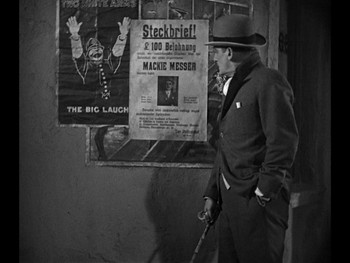
One of the main things Pabst did in his adaptation was to tighten up the actual story, dropping about half of Weill's songs and giving The Threepenny Opera a more standard movie narrative. Mackie Messer (Rudolf Forster) is a pimp, a thief, and a murderer who runs the show amongst the shadowy figures of Bohemian London. He's the kind of colorful, charismatic outlaw that they sing songs about, and in this case, the famous standard "Mack the Knife," performed by Ernst Busch, a street singer who regularly interjects himself into the movie, acting as a scruffy Greek chorus and even addressing the audience directly. Mack has rejected the whore who loves him, Jenny (played by Lotte Lenya, Weill's wife and the originator of the role) and is seducing Polly Peachum (Carola Neher), the daughter of Jonathan Peachum (Fritz Rasp). Peachum is the "King of the Beggars," an enterprising crook who has organized the London panhandlers. For a fee, he will issue a beggar's license and give you the tools you need to extract the most sympathy from the bourgeoisie. As he says, the moneyed class has no problem creating misery, they just can't stand to look at it and will pay for the privilege not to.

When Mack and Polly marry, it causes an underworld standoff. Peachum doesn't want to lose his daughter to this shark, and so he leans on police chief Tiger Brown (Reinhold Schunzel), an old war buddy of Mackie's, to throw the noose around his pal's neck. If not, the beggars will march through the London streets and disrupt the coronation of the new Queen. If Brown can't keep the peace during this important occasion, his career is sunk.


While Pabst works with a cinematic language, the film version of The Threepenny Opera maintains a certain theatrical feeling. The elaborate sets seem to occupy the middle ground between the neorealist look of Marcel Carne's as-of-yet unmade Port of Shadows and the more obviously constructed set designs of the live stage. The buildings and the streets are wonderfully detailed, but the sky is usually just out of sight. When it comes into view during the more romantic moments, such as Mackie and Polly serenading one another on the deck of a ship, it has a gorgeous perfection, looking both three-dimensional and painted on. So, too, does the action seem to bounce back and forth between a prowling realism and a more stylized mode of expression. Shots of authentic looking beggars give way to moments of vaudevillian comedy and, of course, eruptions of song. Keeping with the cabaret style, the performers aren't so much singing their thoughts or driving the narrative, but instead are stopping cold to either perform as part of that narrative or wryly comment on it.

As far as the acting, I was most impressed by Forster. He chooses to play Mack as unflappable, slightly above it all, and always chill. Fleeing from the police is obviously a necessary action, but he's not going to be reduced to panicked running. Rather, he strolls easily from his fevered pursuers. He could get away or he could not, it doesn't seem to matter to him much either way. Intentionally or no, this seems to fit Brecht's more cynical message, that regardless of social strata, most people are just out for themselves. If Mack is best buds with the chief constable, than who is really mining the store? It makes all the sense in the world that Polly, once she takes over her husband's operations, would choose to buy a bank instead of continuing to rob them. It's what every gangster wants nowadays, to go legit. As Enron and other white-collar rip-offs have taught us in recent years, there's more money to be had on the supposed right side of the law anyway.

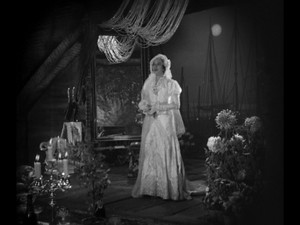
Pabst's strangeness in tone and the satirical, cynical eye are the most potent elements of The Threepenny Opera, and despite this otherworldly air, the director doesn't forget to remind us that the social ills Brecht describes are very real. When the beggars stand before the Queen and her parade, Pabst frames them as a sea of weathered faces, the lines of labor and despair appearing as unmistakably deep, etched into black-and-white celluloid. That the Queen only has a bouquet of fresh flowers to hide her face is a powerful metaphor. If you're going to bury your shame in something, it might as well be beautiful and deliciously scented.

It's those same elements that also keep this older film, restored last year in celebration of its 75th anniversary, from being too rickety. Sure, The Threepenny Opera lacks the sophisticated pacing and slick packaging that was to come, just like any other relic of early cinema, but the unrepeatable combination of talent is worth more than any polish.


The lead feature on the second disc is the French version of The Threepenny Opera that Pabst shot simultaneously with the more revered German version, using the same sets, just swapping the German actors for French ones. It's easy to see why the German is more well known, as the French is more stiff and lacking in the graceful storytelling of its sibling, even when things are done exactly the same. The actors feel more like stock performers from central casting, and Mackie in particular is weak-chinned by comparison. It's an okay film, but Pabst was definitely more comfortable in his own language. Likewise, this French version is not as lovingly restored. The picture is shaky, and the framing often seems a bit too tight, cutting off the tops of actors' heads. The subtitles are also burned into the image.


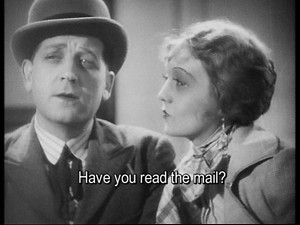
Mackie et Polly en Francais


Originally written September 18, 2007. For technical specs and more special features, read the full article at DVD Talk.