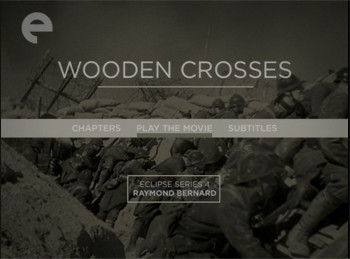
Raymond Bernard is a director who had seemingly fallen through the cracks of cinema history. A prolific lensman in the 1920s and '30s (and up to the late '50s), his is not a name I've heard bandied about before this double-dose collection. For
the fourth volume in their Eclipse Series, the people at the Criterion Collection have expanded their scope from presenting sets of lesser known segments of a director's filmography in order to present a lesser known director.
The son of playwright Tristan Bernard, Raymond began his career as an actor before moving into the director's chair, cutting his teeth on silent cinema and working on early historical epics that would pave the way for the two grandiose films presented here. Both films show a technical sophistication on par with anything coming out of Hollywood at the time, and there is a certain poetry to his use of montage and metaphorical imagery that is both dreamlike and realistic at the same time.
Bernard's two major sound films were made for Pathé-Natan Studios in the early 1930s as part of a bid to compete with American cinema.
Wooden Crosses (
Les croix de bois) (113 minutes) was a major effort for 1932. Adapted from the popular WWI novel by Roland Dorgelès, the lyrical examination of the harsh trenches of battle in both mediums can be compared most obviously to the similar novel and subsequent film adaptations of
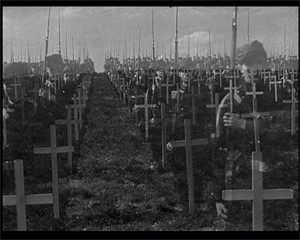
All Quiet on the Western Front. Opening with shots of row upon row of grave markers, each expanse of crosses fading into the next as the camera zooms tighter and tighter, finally landing on a single memorial,
Wooden Crosses is one of the most tender and tough antiwar films to come out of the era.
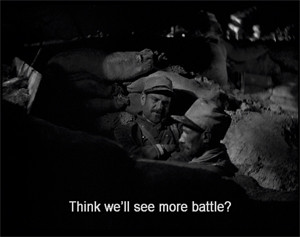
The film forgoes conventional plot in that there is no great goal or fantastic mission for its regiment of soldiers to complete. That's part of the point, to show the drudgery of everyday life in the army. For most of the men, their tour of duty was only noble for them being there, not for what it accomplished. Our main character is a rookie, Gilbert Demachy (Pierre Blanchard), who waited to enter the fray until he completed law school. A bit of a dandy when he arrives--he uses a perfume soaked handkerchief to block out the stench of his comrades--he will become hardened by the things he sees.
Gilbert is no more important than any other soldier, though, something Bernard will emphasize repeatedly. The first dead body we see belongs to the man who takes our rookie out on his first patrol, and Bernard lingers on his corpse, face down in the dirt, limbs bent unnaturally. He chronicles how the changing light effects the look of the body, its shadow expanding like a stain. It lingers for us the way it lingers for Gilbert back at the camp. Later, at the location of
Wooden Crosses' final battle, a wounded soldier is stranded offscreen, dying in No Man's Land. He repeatedly begs for his brothers not to forget him, reminding them that "I have a mother." Essentially, it's Bernard reminding us all not to forget the boys doing the fighting, to remember they all have mothers. It's a message many could do well to heed in 2007.
From a moviemaking standpoint, the battles in
Wooden Crosses are staged at a staggering scale. It's hard not to be impressed by Bernard's ability to capture the sheer terror and chaos of the attacks. He stays down in the trenches, giving us a more humanist picture of war by staying at ground level with the men. The push here is to always to identify with the guy holding the rifle, the one putting it on the line. As the war continues to go on and the soldiers grow tired of their extended duty, issues of class come up again and again. Disgruntled men despise the captains who can hang back while they run to certain doom. There are also the people back home who carry on with their lives, only seen in brief flashes of memory from individual men. In one important death scene, a dream of the soldier's lover dancing turns into a cascade of coins that then morph into funeral wreaths. Is that what they are all fighting for? Ironically, one of the worst battles in the movie ends with the men being pushed into a cemetery, where a well-placed bomb could bury them all alive. No need for ceremony, no need for markers. This is the reality of death.
(Trivia buffs will note that theatrical theorist Antonin Artaud appears as a soldier in
Wooden Crosses.)


Bernard perfected his earthy lyricism in his next feature, his mammoth adaptation of Victor Hugo's
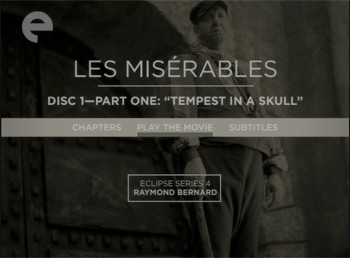
Les Misérables. Released in 1934, a year ahead of the Fredric March/Charles Laughton Hollywood version, Bernard's film is four hours and twenty-one minutes long, and it's broken down into three interconnecting shorter films: "Tempest in a Skull," "The Thénardiers," and "Liberty, Sweet Liberty." By doing this, the writer/director was able to cram in as much of the original Hugo story as possible.
The plot of
Les Misérables is, of course, ingrained in our culture at this point. Jean Valjean (Harry Baur) was sent to prison for stealing a loaf of bread. Released nineteen years later, he finds the world turns a hard shoulder to a man of his status. An act of kindness sets him on the straight and narrow, however, and over the next several decades, he adopts multiple identities to stay out of prison and live a decent, philanthropic life. The first film, "Tempest," charts his first tastes of freedom and the life he builds as a mayor of an out-of-the-way town. There he befriends Fantine (Florelle) and gets involved in a moral quandary that could force him to choose between rescuing her child (Gaby Triquet) from evil foster parents or keep a man who looks a lot like him (Baur played this character, too) from being imprisoned for crimes Jean Valjean committed.
Part 2, "The Thénardiers," picks up when Jean is on the lam. He rescues the girl and sets up a new life with her. Only, when Cosette (now Josselyne Gaël) grows older, she falls for Marius (Jean Servais), a young bourgeois revolutionary. Also, a second run-in with Cosette's old foster parents exposes Jean Valjean yet again.
Finally, part 3 is concerned mainly with the 1832 revolt that Marius is a part of, as Jean tries to keep the boy alive and rescue Cosette's happiness. Also, Inspector Javert (Charles Vanel), the police officer who has long dogged Jean's trail, is finally catching up with his quarry.
The main thing that makes Raymond Bernard's
Les Misérables special has to be Harry Baur. A big bear of a man, he is a threatening physical presence on screen. Particularly as the newly freed Jean Valjean, he appears to be dangerous and menacing. Over the course of the movie, and the two identities he will adopt, he gets quieter, gentler, more contemplative. All the key story turns hang on how Jean will choose to handle a moral dilemma, and Baur does more than debate his options vocally through isolated soliloquies, but the arguments also manifest physically, in his body language and on his face. It's a remarkable performance, and all the more for the completely separate character Baur plays, the somewhat unbalanced Champmathieu. The characters in the movie may mistake him for Jean Valjean, but Baur makes him so different, the audience never would.
Outside of the performance he gets from Baur, Bernard also shows an increased visual flair. At the start of part 2, when young Cosette runs through a dark forest at night, Bernard gives the woods an eerie anthropomorphic quality that precedes Disney's similar scene in
Snow White
by three years. The very next scene, however, is spirited and fun, as we move to a lively street fair. In all of these things, Bernard is fusing epic grandeur with a dynamic realism, often juxtaposing the harsh actuality with a melodramatic trope, such as when the convict caravan passes at the end of part 2, underscored by a swelling orchestra. The tidal wave of bodies and debris that comprises the uprising in "Liberty, Sweet Liberty" also rivals any of the battle scenes in
Wooden Crosses.
Amazingly,
Les Misérables never got a full North American release prior to this DVD, letting lesser movie versions carry the load that Raymond Bernard and his hulking Jean Valjean carried so much better. When we consider the past masters, surely there is a place for Raymond Bernard, a literate filmmaker with an eye for movement and visual metaphor. The
Raymond Bernard - Eclipse Series 4 boxed set seems like a step in the right direction, putting the director's artistic zenith in the hands of a new audience. Now that I'm educated, I'd consider myself a fan.
Originally written July 16, 2007. For technical specs and special features, read the full article at DVD Talk.