Showing posts with label spike jonze. Show all posts

Wednesday, July 13, 2016

THE PLAYER - #812


My thing about movies that are about movies is that the good ones make me want to watch other movies. If I watch The Bad and the Beautiful, for instance, I’m going to want to chase it with Cat People. Who didn’t watch the opening of The Player back when it was released in 1992 and not immediately go view--or even re-view--Touch ofEvil? Or how about pairing it up with Bicycle Thieves [review]? Better yet, another movie about movies, based on a book about movies, Elia Kazan’s vastly underrated adaptation of F. Scott Fitzgerald’s The Last Tycoon. Monroe Stahr, the movie mogul in The Last Tycoon, was modeled after Irving Thalberg, whom surely director Robert Altman and writer Michael Tolkin had in mind when they created Griffin Mill, their motion picture wunderkind, as played by Tim Robbins.

And it’s not just that The Player is about movies, it’s utterly in love with them. You get that right from the virtuoso opening shot, which runs without cutting for 8 1/2 minutes (certainly no coincidence), referencing not just Touch of Evil, but The Sheltering Sky and Rope and a couple of other films that pulled off similar feats (this was pre-Tarantino, mind you). There are easter eggs throughout this thing, and not just the cameos by then au currant celebs, but jokes and winks and the careful placement of other films and filmmakers to cue the audience to what is coming next. Be it Griffin walking under a movie marquee as the lights go out on The Bicycle Thief to signal his own oncoming moral dilemma, or the fake-out of Lyle Lovett walking by a Hitchcock photo as an indicator of suspense and a deep visual pun about “the wrong man.” The murder victim declares, “See you in the next reel, pal,” ironic last words befitting the noir plot Griffin Mill will find himself in, as predicted by the posters in his office.


If you’re a cinephile, you’re going to eat this stuff up.

If you’re not, if you’re just a casual movie fan, then no worries, you’re going to dig The Player, too. It’s more than a collection of in jokes and elbowing Hollywood in the ribs. Altman and Tolkin bring an honest-to-goodness murder plot along with all the references. The Player is a movie that aims to be as good as all the other movies it emulates.

In terms of story, it’s simple. Griffin Mill is a hotshot Hollywood producer who appears to be going cold. In the midst of his concerns that his boss is bringing in his replacement (Peter Gallagher), he’s also getting harassing post cards from an anonymous writer that he never called back. When the threats turn scary, Griffin tries to figure out who it is, settling on one writer in particular, David Kahane (played by a young, nearly unrecognizable Vincent D’Onofrio). Griffin tracks Kahane to a revival screening of the Neorealist classic The Bicycle Thief (or Bicycle Thieves) and tries to reason with him. Only, Kahane isn’t the guy--even if he hates Griffin all the same. Accusations cause tempers to flare and a scuffle ensues, leading to the writer ending up dead and Griffin trying to make it look like a robbery.


And he’s successful for the most part. The only problem is, someone saw the two of them together, and the cops (Whoopi Goldberg and Lyle Lovett) think it’s suspicious that the movie exec was somehow randomly the last person to see a no-name scribe alive. This line of thinking is only heightened when Griffin starts dating the deceased’s girlfriend (Greta Scacchi). In any conventional script, Griffin would certainly look guilty.

Which, of course, we know he is, but that’s immaterial. The question that lingers, what will he do to get out of it? That’s what any good suspense movie is about. Plus, we know that the real stalker is still out there, and he could strike at any minute. Somehow these things have to converge, right? That’s what the rules of screenwriting have taught us. Not to mention that the fake moviemakers in the movie we are watching keep harping on the need for a happy ending. Griffin Mill has to find his way out of it, or The Player will fail.


That might actually be The Player’s most ingenious bit, how Tolkin builds in all this conventional wisdom about what makes a successful movie--twists, turns, sex, surprising rescues, happy endings--and then delivers on each. It’s the artiest of blockbusters, The Player is. Like if the Kaufman Brothers in Adaptation cracked the code and managed to sincerely make it work. (Which, let’s be honest, it works in Adaptation; as soon as Donald takes over, the film becomes a crowdpleaser.)

Tim Robbins brings an interesting energy to his performance. He is both slimy and trustworthy, at times believably dim and yet otherwise extremely cagey. It’s excellent casting, how we feel about Griffin is probably how a lot of people feel about Robbins, who himself can be seen as a little pretentious and also a bit of a windbag due to his openness about his politics. Yet, he also always seems like a decent guy, he’d probably be pretty nice in person. We like him, but we want to hate him, too.

Fans of Hollywood lore will see other nods to history in The Player, perhaps most deftly in Fred Ward’s fixer character, which resembles MGM’s Eddie Mannix, immortalized in both the films Hollywoodland and more recently Hail, Caesar! There is also some amusing commentary about television actors wanting to be in movies, which seems only ironic and outdated given how so much and so many have shifted from the big screen to cable television for better opportunities in recent years. Tim Robbins himself was last seen on HBO in a bad Dr. Strangelove rip-off.


Television may be the current perceived assassin of big studio pictures, but moviemakers have had many threats before this one--including TV, which was originally supposed to be the death knell of the moviegoing experience back in the 1950s. Most would say the changing of the guard in the 1960s was the true end of Golden Age Hollywood--which is largely what Altman is paying tribute to here. His movie studio resembles the classic system as much as it does the bloated 1980s version he’s critiquing. The Player actually came at a time when independent films were having their heyday, and the Sundance crowd was moving in. I guess these things are cyclical. If the auteurs of the 1960s and 1970s gave birth to the blockbuster, then the indie scene of the 1990s gave us the mega blockbuster. Would there even be a Griffin Mill now, or would he just be a collection of stockholders?

I guess it doesn’t really matter. All we can say for sure is that he’d still be getting away with it. Now more than ever.


Tim Robbins, Sydney Pollack, and Robert Altman on set.


Saturday, February 6, 2016

JELLYFISH EYES - #787


For decades now, going back to at least the 1980s when I was a kid, Japanese popular culture has steadily gained influence around the world. Anime, manga, and video games have become predominant art forms, with an aesthetic that eventually could be seen in American comics, cartoons, and movies. Perhaps the only modern movement to have more of a foothold is hip-hop--which itself has never been afraid to borrow from across the Pacific. Take a look, for example, at Pharrell Williams’ video for the song “It Girl.” Set to an anime backdrop featuring cute cartoon girls and colorful settings, the clip was produced by renowned artist Takashi Murakami, whose “superflat” fine arts brand has always borrowed from all of the above to create energetic pop art that has permanently altered the visual landscape.

Given the buoyant nature of Murakami’s creations and its source material, it’s only natural that he’d experiment in different media. So it was that he moved into feature-length motion pictures in 2013, directing Jellyfish Eyes, a sci-fi children’s adventure designed as a perfect vehicle for the artist’s visionary imaginings.


Jellyfish Eyes is a bit like a live-action Pokemon. It tells the story of Masashi (Takuto Sueoka), who after losing his father in a tragic accident, moves to a new town with his widowed mother. The night before his first day at school, the nervous boy stumbles upon an odd looking mini-monster whom he calls Jellyfish Boy. Like Elliot luring E.T. into his home with Reese’s Pieces, Jellyfish is enamored of Masashi’s chee-kama, a snack stick made from cheese and fish. Though surprised at first by the rubbery pink-and-white goblin, Masashi discovers his new pal is playful and fun, and so he adopts him as a pet, carrying him everywhere in his backpack. Even to school.


It’s in class that the boy discovers that all the kids in his new home have a creature like Jellyfish Boy. They also have small iPhone-like devices they can use to control them, and they have secret tournaments where their avatars fight. Unlike Masashi, they did not find their creatures by accident, but they were given to them by the mysterious scientific cabal running a nearby lab. Masashi’s uncle Naoto (Takumi Saito) works there. It’s through him that we discover that Jellyfish Boy is an escapee from the program that created the creatures, which are code-named F.R.I.E.N.D.s, a rather unruly acronym that stands for “life-Form Resonance Inner Energy Negagive emotion and Disaster prevention.”


That’s right, disaster prevention. Through means that aren’t entirely clear, the children and their F.R.I.E.N.D.s can stave off or harness other-dimensional bad energy. Energy that four black-cloaked rogue scientists in Naoto’s company want to take advantage of. It’s because of them that Jellyfish Boy has escaped. And it’s going to be up to Masashi and his little buddy to stop an even bigger monster from taking the town.

Jellyfish Eyes mashes together a variety of influences, including Godzilla [review] and countless anime series about young boys being pushed into a noble destiny by virtue of their command of something special (think, for instance, the teenage pilots operating giant mecha in Neon Genesis Evangelion). Girls get their due here, too, as Masashi’s first ally is Saki (Himeka Asami), who has the largest F.R.I.E.N.D., a hairy combo of Sweetums from TheMuppets and Spike Jonze’s take on the Wild Things. Murakami does fall a bit on familiar tropes, as the girl is of course the voice of reason among the bloodthirsty boys, but then, Jellyfish Eyes is lathered in genre trappings. The cloaked masterminds look like wizards out of a horror movie, while Naoto is caught in a cautionary sci-fi tale. In a clever twist, he ends up having to fight a F.R.I.E.N.D. that is an exact replica of himself. It all comes down to Jellyfish and Masashi, however. Like Pikachu before him, Jellyfish turns out to be as important and powerful as he his cute and diminutive. And Masashi will have to give up everything in order to save the world.


It’s all rather fun, but not entirely unique. The arc is familiar, and Murakami’s screenwriters don’t add anything to the genre. It’s really only Murakami’s colorful designs, and the exquisite digital animation that brings them to life, that distinguishes Jellyfish Eyes from any number of similar features. (Stephen Chow’s terrible CJ7 comes to mind [review]). Each F.R.I.E.N.D. is different, there are no two alike, and they are distinctively Murakami. Jellyfish Boy flies using the pink artichoke leaves on his head; he coos like a kitten when happy, snorts like a bull when triumphant. The action in the fight sequences is fast and energetic, and viewed in high-def, one can really appreciate the craft with which Murakami’s team brings it all together.

That said, Jellyfish Eyes still is little more than a trifle. The same movie made with a less revered practitioner at the helm wouldn’t have likely been imported around the world, much less added to the Criterion Collection. It doesn’t have that certain something special, it just is what it is.


Which I suppose is enough, especially when Murakami ultimately delivers his message of peace and understanding. The children eventually learn to respect nature, not to use living things as violent toys for their amusement, and to get along with one another rather than compete. (In one tremendous set-up near the climax, one schoolboy leads his entire class in a coordinated attack, sending their swarm of F.R.I.E.N.D.s  up against the big bad.) And like the aforementioned Godzilla, Jellyfish Eyes cautions against using science irresponsibly.

In all that, it may have more resonance with younger audiences; as an older fellow, it failed to charm me into that childlike state the way a more equipped filmmaker like, say, Hayao Miyazaki can. Jellyfish Eyes is basically a well-presented diversion--particularly in this package. The transfer is top-notch, and the sound design takes full advantage of the multiple speakers. Special effects fiends will also enjoy the pair of documentaries looking at the making of the movie and its invented stars.


This disc was provided by the Criterion Collection for purposes of review.

Sunday, January 17, 2016

BEING JOHN MALKOVICH - #611


When watching Anomalisa a few weeks back, I was reminded that when it comes to Charlie Kaufman, you kind of have to go all in or not at all, there is no meeting him halfway. This is particularly true since he started directing his own scripts, removing any outside editorial eye. Anomalisa and his previous feature, the astonishing, maddening Synecdoche, New York [review], allowed all of his thematic obsessions to come full-bore in such a way that, as Marc Maron would phrase it in his recent podcast interview with Kaufman, the audience would have to reckon with them. At times, it’s hard to tell if Kaufman is entirely in control or he’s just on a determined quest to get as much out as he can at any one time.

And yet, backing up and watching his first produced script, Being John Malkovich, helmed by Spike Jonze back in 1999, we see that Kaufman has changed hardly at all in the last 17 years. He’s very much the driving force here, the virtuoso guitarist who defined a band’s sound, and it’s his collaborators--Jonze and Michel Gondry--who had to redefine themselves upon his leaving.


Even if you haven’t seen Being John Malkovich in a while, you’ll still probably make the connection between the odd puppets used in Anomalisa’s stop-motion animation and the marionettes used by John Cusack’s character, Craig, in Malkovich. For Craig, the puppets are a means to express his inner anguish, as witnessed by the modern dance routine he puts his doppelganger through in the opening sequence. Likewise, anguish is the order of the day in Anomalisa. As so many reviews have suggested, it is the most human film you are likely to see right now, and there isn’t an actual human in sight. Nor do Kaufman and his co-director, Duke Johnson, attempt to make their creations appear real. The seams around their parts still show, we are aware that there is a hand guiding them. Kaufman as puppeteer.


The puppets from Being John Malkovich.


The puppets from Anomalisa.

Which creates an image within an image. Kaufman as the man holding the strings above Cusack holding the strings of the Craig puppet. What Anomalisa shows and what Craig attempts to create is a world diminished, and that diminished world within a world. It’s not just the puppet stage held within the movie screen, but also the floor 7 1/2, the floor between the other floors, where Craig goes to work, where every person who stands has to stoop. (And, it is likewise explained by a movie within a movie.) Yet this is also the visual metaphor of Synecdoche, NY, the endless iterations, the idea within the idea. You build a movie set that mimics the outside world and inside that set is another set that replicates the first and so on--with the fictional director (Philip Seymour Hoffman) standing in for the real director, orchestrating his own large scale shadow dance.

Thought of this way, the portal into John Malkovich’s head in Being John Malkovich is a similar construct. As the audience, we project things upon an actor like Malkovich--in the movie, the jewel thief role he never played--and so why not take that a step further and go inside his head and become him. The puppetmaster is absorbed by his puppet. Malkovich does a much better job of imitating Cusack imitating him than either Travolta or Cage switching in Face/Off despite being about as believable a scenario. The device also allows Kaufman to say something about our own self-absorption. When Malkovich is in Malkovich, then everyone is Malkovich. We project on him, but he projects himself right back. Or, consider it the other way: when Craig gets a chance to fulfill his wish of being in someone else’s skin, he just reverts to being who he is. He doesn’t masquerade as John Malkovich the actor, he reinvents John Malkovich as a puppeteer.


As with any Kaufman movie, there is a lot to unpack in Being John Malkovich. There is a surfeit of ideas, both progressive and transgressive. For instance, there is the notion that perception itself is a kind of malady, such as the way Mary Kay Place’s Floris dismisses her own hearing problem as everyone else having a speech impediment. (Compare David Thewlis’ Michael Stone in Anomalisa and the Fregoli Delusion, by which he hears and sees all other people as exactly the same.) Or the complicated identity issues of Cameron Diaz’s Lotte mixed with Craig’s troubling reaction to the same. Diaz has never had another role quite like this one, doing more here than burying her usual cuteness under a rat’s nest wig, but somehow tangling her own natural charisma in Lotte’s insecurity so that we can see there is more to the girl than meets the eye. For his part, Cusack has never been so unlikable. His casting subverts audience expectation, he’s usually the guy we root for, yet Kaufman and Jonze spend the length of Being John Malkovich turning us against him. Could the pair of them have cursed Cusack, or did they see the writing on the wall, that his manchild persona was reaching its expiration date. Cusack would make High Fidelity and Serendipity right after Being John Malkovich, and in both, he would play a romantic who would have to come to grips with his youthful ideals in some fashion. These are also arguably his last two truly good movies, and the last of his quality performances. This growing up thing did him no favors.


Is it telling, too, that I seem to have lost any interest in trying to dissect or summarize any of the plot here? Being John Malkovich is structurally unconventional, freely changing directions when necessary as its bizarre machinations reveal themselves. Most descriptions would probably focus on the “weird,” but Being John Malkovich is never weird for its own sake. Rather, Kaufman is really playing it for laughs. This is an absurdist comedy. The exaggeration of the situations exposes the normalcy of the characters. These are all people with small dreams and conventional desires. In some way, everyone wants control, but yet, they also all want love, even if their core problem is they don’t know how love works or how to give it. Deep down, past all the layers, the different players just want to be who they are. Even Malkovich, who gets one of the film’s truly heartbreaking moments, the brief instance between expelling Craig from his mind and the next group coming in, where he realizes he has gotten himself back. His pleads to maintain his own persona, of course, go unanswered. “Is Malkovich Malkovich?


The view of humanity we get in Being John Malkovich isn’t very positive. Everyone here is operating only for himself or herself. It is a movie, after all, where Charlie Sheen serves as a kind of moral compass, and only a chimpanzee has empathy. The brief shift of POV to go inside the chimp’s memory and see through his eyes when he was taken into captivity as he attempts to tell Lotte that he understands the abuse Craig is heaping on her is disturbingly effective. He not only empathizes, but he somehow forgives that Lotte keeps him caged in a similar manner. One might argue that Kaufman’s own empathy has increased over the years, that he exorcised something through Philip Seymour Hoffman’s dictatorial director in Synecdoche, and that by erasing the presence of the puppetmaster as a literal being on screen in Anomalisa, he allows his characters to make their own mistakes and somehow loves them more for doing so. (Though, that weird Japanese sex toy, a puppet of another kind...but then, a toy Michael Stone doesn’t really understand how to operate.) He leaves Michael to his own fate, to live out his own existence, rather than concoct the elaborate EC Comics horror curse that befalls Craig at the end of Being John Malkovich. But then, the cynic in me might say that’s the worst curse of all: leaving us alone to be ourselves.


Monday, February 17, 2014

THE FANTASTIC MR. FOX - #700


I'm just going to come out and say it: I loved Fantastic Mr. Fox.

Wes Anderson's stop-motion animated adaptation of the Roald Dahl children's book captivated me from start to finish. It's a charming blend of old-school kids movies, literature, and the sort of meticulous, virtuoso filmmaking that Anderson fans clamor for. Make no mistake, the writer/director's move from live-action adult parables to cartoons has not dulled his aesthetic. This looks and feels just like a Wes Anderson film, from the way the shots are framed and how the characters behave, to the carefully chosen soundtrack and the obsessive attention to detail. It's even a story about fathers and sons, how one fox's midlife crisis causes strife for his wife and child, the familiar emotional terrain of almost all of Anderson's personal epics.


Mr. Fox is voiced by George Clooney, and he is the kind of blindly optimistic, cocksure rapscallion this particular leading man has always done well. The film opens as a young Mr. Fox and his wife, Felicity (Meryl Streep), find themselves in a rather sticky situation outside a chicken coop. Mr. Fox is a chicken thief by profession, but when he's told that his wife is expecting, he's also informed that he's expected to settle down. Fast forward several years and Fox, now a newspaper columnist, realizes that he is only six months younger than the age of his father when the old man died. Not content to leave a minor mark when he passes on, he buys his family a home on top of a hill looking down on the area's three most successful farms, owned by the three meanest famers. His secret plan: one last heist, robbing the full trio.

Yes, I realize that a mid-life crisis is a weird central conflict for what is ostensibly a family movie. Then again, many a classic children's tale is about very adult concerns, they are only dressed up in youthful clothes. The best kiddie fare is multi-leveled, inventive, and intelligent, three descriptives I would apply to Fantastic Mr. Fox. Wes Anderson and his co-writer, Noah Baumbach (The Squid and the Whale), manage to create a way for their younger viewers to engage with the material without talking down to them. A very important side story involves the Fox offspring, Ash (Jason Schwartzman), competing with his talented cousin, Kristofferson (Eric Anderson, who created all the artwork for his brother's other films). The prize is Mr. Fox's favor. Ash is a "special" kid who likes superheroes and wants to be a rascal like his dad. If only it came as natural for him as it does to Kristofferson...


Fantastic Mr. Fox moves at a leisurely pace, regularly stopping to enjoy the world that Anderson has borrowed from Dahl and explore its details. Explanations of the animal children's favorite game, "whack bat," and schematics of the local geography enhance the narrative rather than slowing it down, recalling similar moves that Wes Anderson has made in movies like The Royal Tenenbaums [review] and The Life Aquatic with Steve Zissou. [review] These elements hearken back to one of the themes of the director's earlier pictures, the lesson that the patriarch of each film tries to impart to his children: enjoy the specifics before you lose them. We often forget that children's entertainment is as obsessed with mortality as any high-brow literature or cinema. You're never too young to gather those rosebuds.

Which is not to imply that Fantastic Mr. Fox is heavy. It's anything but. This film is a fun romp through the animal kingdom. Eventually, the three farmers--voiced by Michael Gambon, Robin Hurlstone, and Hugo Guinness--have had enough of Mr. Fox's thieving and decide to do something about it. Their hunt for the creature goes overboard, driving all the animals underground, where they reconvene and rise up . The ensuing battle gives Mr. Fox a chance to redeem himself in the eyes of the others and Ash the opportunity to prove his worth to his father (and himself) and reconcile with his cousin. Along the way, there are musical interludes, references to other movies (Willem Dafoe voices a rat straight out of West Side Story), and many big laughs.


It's interesting that two of our most unique modern filmmakers--first Spike Jonze with Where the Wild Things Are [review] and now Wes Anderson with Fantastic Mr. Fox--have chosen to withdraw from adult features and focus on adaptations of all-ages material for their latest efforts. Both have yielded amazing motion pictures with emotional resonance, and each with remarkably similar messages despite having different timbres. Just as Litte Max had to indulge in some wild rumpusing to understand himself in Jonze's film, so too does Mr. Fox encourage the other animals to be who they are, to let themselves go wild when the time calls for it. It's good to be responsible, but not at the sacrifice of one's sense of self. Bill Murray can provide the voice of a badger and they can put that badger in a three-piece suit, but underneath, he's still a mean ol' badger and even deeper down, still Bill Murray.


Another thing that Jonze and Anderson have in common is the creation of a visually stimulating universe using mostly traditional methods. For his Wild Things, Jonze insisted on putting actors in giant Muppet suits rather than creating them using CGI, and the result was that they had a real presence on screen with the boy hero. Anderson doesn't have any "real" elements in his animated movie, but his use of stop-motion techniques that have been made all but obsolete by computers lends Fantastic Mr. Fox a nostalgic quaintness that you're never going to find in the Shrek movies. This looks like weird shorts I used to see on PBS when I was a kid, and though some of the production team has groused about Anderson's demands for real hair and the use of other difficult materials, his stubbornness pays off. The animation looks remarkable on the screen, and I quite regularly forgot that I was watching a cartoon. Though there is nothing extra in the credits, I urge folks to sit through them and see how many people it took to make Fantastic Mr. Fox. This type of thing really does take a village.


Beyond the animators, part of the success of the film's believability is also owed to a smart cohesion between animated object and actor. Anderson achieves Pixar-level casting, having his animators borrow mannerisms from Clooney and Schwartzman and the rest in such a way that the performance becomes so believable, you stop hearing the famous voices and instead hear real characters talking. It's easy to line up a superstar cast, it's much harder to get the right people for the job. These creatures have personality and panache, and even the smallest part is thoughtfully considered.

I am sure that there will be much debate about Fantastic Mr. Fox. I am sure some badger-types will insist that the vision of Roald Dahl is sacrosanct, and others will question the occasional adult touches; others will grouse that Anderson is too precious for his own good, the way they so regularly do. Let them cuss and shout those complaints loudly; I will cuss louder. Bottom line is that Fantastic Mr. Fox is a youthful, joyful effort from a filmmaker who has spent his career chasing his childhood visions. I'm happy to say that with this feature, Wes Anderson has finally caught up with them.


This review was originally written for the theatrical release of the film; images are taken from the 2009 DVD edition.

Monday, September 27, 2010

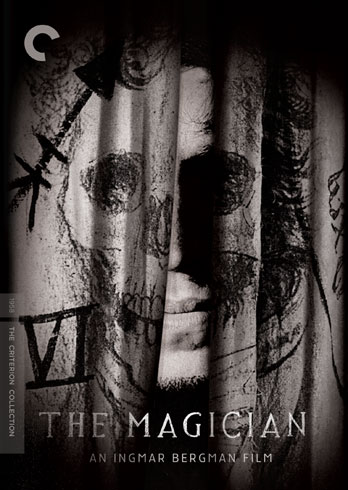
THE MAGICIAN (Blu-Ray) - #537

"Pretense, false promises, double bottoms."


Ingmar Bergman's 1958 supernatural caper The Magician is one of those movies where nothing is as it seems, everything has two explanations, and the very notion of the "knowable" is called into question. Its knotted narrative is full of tricks and surprises, some obvious and others not so much, and by the end, Bergman has pulled off his own cinematic magic trick, leaving the audience wondering just which of his flickering illusions to believe.

The Magician opens in a Swedish forest somewhere near the tail end of the industrial age. We move in on a traveling sideshow led by one Dr. Vogler (Max von Sydow). Amongst his group are the master of ceremonies Tubal (Ake Fridell), Vogler's grandmother (Naima Wifstrand), the androgynous Mr. Aman (Ingrid Thulin), and the carriage driver, Simson (Lars Ekborg). We are given multiple explanations as to what this band of performers does. They regularly insist on their own lack of veracity--they do tricks for show, nothing more. They sell noxious potions that are really interchangeable and have no actual effect. Or do they? Granny is a witch, so maybe she does know some magic spells. Dr. Vogler is also said to be a master hypnotist who heals people with magnets. Tall, dark, and bearded, Vogler is an imposing figure; he is also mute.

In the woods, the troupe finds an ailing actor (Bengt Ekerot). They take him in their carriage, and he dies before the group reaches civilization. They take the body to the police, but find they are in trouble for other infractions. Their various reputations precede them. The performers are hauled before a tribunal of three: a smug police chief named Starbeck (Tovio Pawlo), a local scientist called Dr. Vergerus (Gunnar Björnstrand), and Consul Egerman (Erland Josephson), a town dignitary. They demand Vogler and his people account for themselves, and even push for a demonstration of the Doc's powers. It turns out that Vergerus and Egerman have a bet going. Vergerus believes that all this world has to offer is what science can verify, whereas Egerman insists there are unquantifiable forces always at work.

Most of The Magician takes place over the tense night in custody at Egerman's home. The various members of Vogler's crew interact with Egerman's staff, seducing them and demonstrating their special talents. There is a subtle comment on class here: the more common folk believe in religion and magic, the more affluent and educated do not. Yet, as Bergman holds back the curtain and shows us things that defy rational explanation, who are we to side with? The dead actor wanders the house as a ghost, interacting with Granny and Vogler. A thunder storm brings strange portents. Passions are stirred. Mrs. Egerman (Gertrud Fridh) is drawn to Vogler. She claims to want the psychic to explain the recent death of her daughter, but her heaving bosom suggests she desires more. Likewise, Vergerus makes no bones about his interest in Aman, though Aman proves more loyal than he expected--all the more frustrating, as what Vergerus perceives as Vogler's charlatanism represents everything the scientist hates.

Bergman is blessed with a powerhouse cast for The Magician. von Sydow, Thulin, Josephson, and many of the others are all recurring members of his reparatory, as is Bibi Andersson, who plays Sara, a servant girl who takes a love potion with Simson. As the night wears on and all the players become entangled, it's hard not to think of Bergman's comedy Smiles of a Summer Night; The Magician is like the brooding companion piece, Frowns on an Autumn Evening. With dawn approaching, more layers are folded back, more masks dropped. Everyone has hidden agendas, everyone has secrets. Vogler acts as a funhouse mirror for all of them: they see in him what they want to see.

This all leads to a command performance for the tribunal, their servants, and their wives. Vogler and his people turn the tables, and rather than expose themselves, they expose things about their accusers. One man who is part of Egerman's guard is so undone, he even resorts to violence. There is something about Vogler's chosen practice that makes the common men angry. His dark arts are an affront to what they believe, a challenge to their morals and their mortality. In the bonus features, critic Peter Cowie suggests this was Bergman's metaphor for the director's contentious relationship with a moviegoing audience hostile to the complicated metaphysics that are a hallmark of his work.

Regardless, the magician's actions put into motion the final act of the film, where the thinking man, Dr. Vergerus, must confront Vogler's illusions directly. It's hard to say much more without giving it away. My instinct to contextualize the story by the genre it most reminds me of would even reveal too much. Suffice to say, the final act of The Magician has some bold story moves, as well as some of Bergman's most audacious surreal imagery. He and cameraman Gunnar Fischer and production designer P.A. Lundgren could have taken what they started here and made one hell of a carnival haunted house, let me tell you.

There is a lot to digest in The Magician. All the characters are dealt with before the finale, all the subplots wrapped up, and together they create a dramatic tapestry that is fun to pick apart and analyze. Emphasis on fun. Bergman's movie is one of his more self-conscious entertainments. It's spooky and challenging, and Bergman uses all the mechanics of a good fireside ghost story. If Cowie is right about the director responding to his harshest critics, then it makes the strange Hollywood-like ending that caps the picture make more sense. It's similar to the swindle of Spike Jonze and Charlie Kaufman's Adaptation, like Ingmar is saying, "You can have the cheap entertainment you so desire, I can fit my cinema of ideas into that, no problem." Yet, the ultimate sleight of hand is The Magician isn't really that thing audiences think they want, yet it sneaks in anyhow, and quality wins out after all.
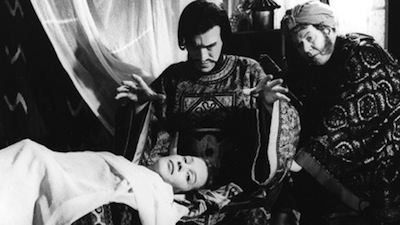


The 1080p, full frame image on The Magician - Criterion Collection is gobsmacking in its clarity. The black-and-white photography looks gorgeous on this disc. There isn't a scratch on the film, and the values between light and dark are wonderful. Every little detail comes through absolutely. Though made in 1958, The Magician looks brand new.

The uncompressed mono audio track is also exceptionally clear. There is no hiss or any off sounds. There is even some subtlety, despite only being a single channel. Take note, for instance, of a scene between Vogler and his wife where a bell peals in the distance. For a second, I didn't even realize it was in the movie, I thought it was somewhere outside my house.


For a full rundown on the special features, read the full review at DVDTalk.

Wednesday, June 16, 2010

CLOSE-UP - #519

"You see, this is my life! It always will be! Nothing else! Just us, the cameras, and those wonderful people out there in the dark!...All right, Mr. DeMille, I'm ready for my close-up."


At the end of Sunset Boulevard, faded movie star Norma Desmond is lured from her house to answer for her crimes by a staged press conference and the promise of a movie that's never going to happen. Forty years after Billy Wilder made his classic tale of a Hollywood delusion, Iranian director Abbas Kiarostami has flipped the idea on its head. What if the movie is still fake, but the crime is real? What if instead of a movie actress trying to get back in front of the camera, it's a regular joe trying to get behind it?

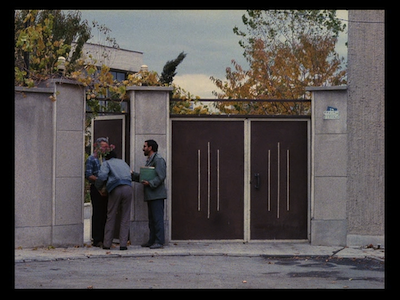
Close-Up is the story of Hossein Sabzian, a print maker who convinces a middle-class family in Tehran that he is filmmaker Mohsen Makhmalbaf. Makhmalbaf is a renowned Iranian director, at the time best known for his 1987 film The Cyclist. The fact that the identity Sabzian adopts is that of an actual person is one of the many layers that Kiarostami, who also wrote and edited Close-Up, overlaps to obscure the separations between fiction and documentary. Hossein Sabzian is even the actor's real name, and when we finally do see the real Makhmalbaf, they really do look alike. Which probably helped when he actually did pretend to be him once upon a time. Because, oh yeah, this is based on true events.
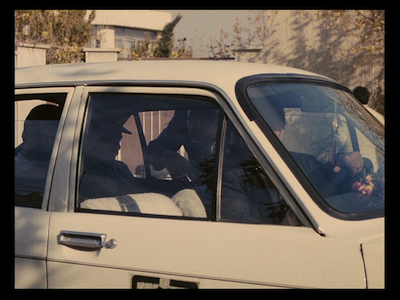
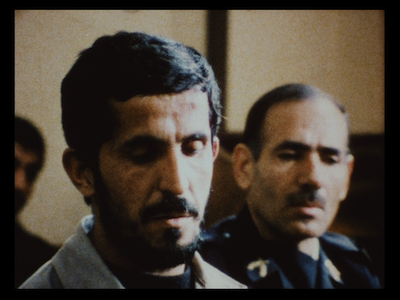
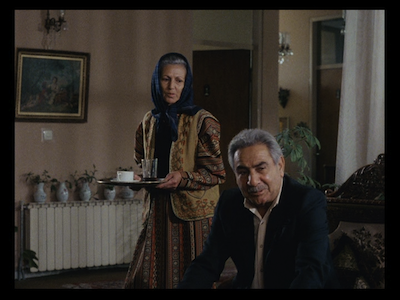
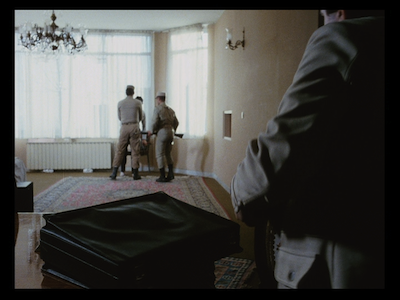
The film opens up on a bumbling sting operation, where a reporter (Hassan Farazmand, also playing himself, as everyone in the film does) leads two police officers into the Ahankhah home to nab the alleged con man. This kick-off introduces Close-Up as a narrative construct, albeit a Neorealistic one. From a writing point-of-view, it starts with a bang, as it does drop us right down into the action--though not a typical crime movie bang. It's more of a criminal whimper, with Sabzian being carted off in a taxi cab by the arresting officers while Farazmand runs around looking for someone who can loan him a tape recorder so he can record the forthcoming interrogation. Woodward and Bernstein this guy ain't.

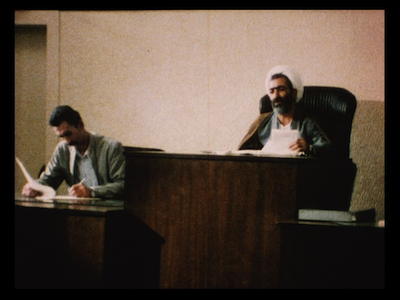
Only in the second sequence does Kiarostami introduce the notion of Close-Up as faux documentary/docudrama. Having read Farazmand's magazine article about the story, Abbas Kiarostami himself shows up at the police station to try to gain access to the faker. He wants to film Sabzian's trial, and Close-Up follows the steps he takes to get permission, first talking to the meek criminal and then seeking permission from the presiding judge. Kiarostami also interviews the family members who fell victim to Sabzian's scheme, whatever that may have been. That's something they hope to figure out at trial.


Once the court proceedings get underway, Close-Up jumps back and forth between the "reality" of the courtroom and fictional staging's of Sabzian's interactions with the Ahankhahs. As far as criminal undertakings go, Sabzian's master plan seems rather undercooked. He meets the matriarch of the family, Mahrokh, on a bus and casually tells her he is Makhmalbaf. After that, he starts spending time with the family, and the worst thing he does is borrow a small amount of money off the youngest son, Mehrdad. It takes less than week for this tangled web to unravel.

I hesitate to call the more traditional dramatic scenes "re-enactments," because essentially the entire film is a re-enactment. Sabzian did pretend to be a famous director, and the Ahankhahs were the intended victims, such as they were. Close-Up is not quite real, not quite fake--almost literally surreal in how it stands apart. It's like a distant cousin to Spike Jonze and Charlie Kaufman's Adaptation in that you really don't want to know what is truth and what is invention, what is technique and theory and what simply is.


Abbas Kiarostami details this story in the most unspectacular of fashions, letting most of the juicier bits be told through Sabzian's testimony rather than staging the scenes as drama--quite possibly because these are the parts of the situation that are most up to interpretation. Who are we to believe? Sabzian's stated motivation is simple enough: he liked the attention and he liked the control that being a director allowed him, even on a small scale. He would have gone ahead with trying to make a movie if the fraud went on too long, and the reason he decided to be Mohsen Makhmalbaf is that he identified with the man's films. The Cyclist, in particular, depicted real problems he could identity with, it was like watching a movie of his own life. Ironically, he is now in one. (And judging by the extras, the real-life Hossein Sabzian was getting exactly what he wanted by being in Close-Up, as well; this is definitely art imitating life and not the other way around.)


As far as the probing eye of the camera, Kiarostami's is non-judgmental. If anything, he wants us to feel sorry for Sabzian. The man is devoid of his own personality, and his life is so full of hardship, he must resort to losing himself in fantasy. Very subtly, the filmmaker also lays down questions about exploitation. Sure, Hossein Sabzian was exploiting the Ahankhah family, but they were eager to be exploited. They were eager to star in his movie, even to give up their house for him. Mehrdad loans the trickster the money not out of kindness but in order to prove he's a good guy ready to do what it takes to please a big-shot movie director. It wouldn't be heard to remake Close-Up today. The fame-seeking that Kiarostami is depicting has only gotten worse. Haven't there been reality shows about wannabe filmmakers, and aren't all reality contestants would-be actors?


The good thing about Close-Up is that, in its refusal to create an obvious separation between what "really happened" and what has been "dramatized," the film goes deeper than any reality show ever would. The big picture here is less about fame and desire, or even about the illusory art of cinema; Close-Up is far more human than that. It's a movie about true remorse and forgiveness--not redemption, that is something else. The charity given to Sabzian at the end of the movie requires real empathy and honest emotion, and it hits the viewer as hard as it hits the "character."


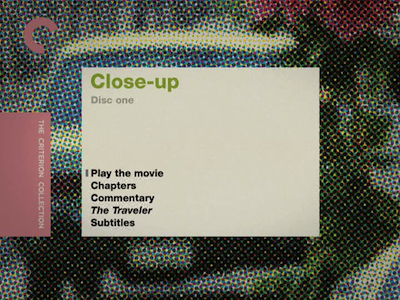
At one point in Close-Up, when Hossein Sabzian is explaining what kind of films speak to him, he turns to Abbas Kiarostami, who is part of the courtroom interrogation, and acknowledges how he felt a personal connection to Kiarostami's debut feature, The Traveler. The inclusion of this 1974 film on DVD 1 of the Criterion edition of Close-Up makes this a double A-side disc, a dual film release, and one that sheds some light on the kind of Iranian cinema that Sabzian identifies with. (Shame we couldn't get Makhmalbaf's The Cyclist, as well. I'm so greedy!)

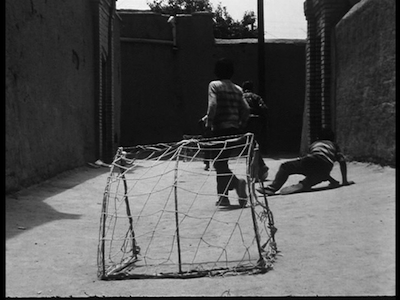
The Traveler is the story of a young boy named Qassem, played by an Iranian Jean-Pierre Léaud by the name of Hassan Darabi. Qassem is obsessed with soccer, so much so that he forsakes all else and even cheats the local news seller just to buy a new soccer magazine. He's got a bad reputation at school because his mind is always on the game, and his mother is fed up with him. When his favorite team is playing in Tehran, Qassem hatches a scheme to raise money to go see them. He cons school kids by pretending to take their picture with a stolen camera, and when that isn't enough, he sells his neighborhood team's goalie nets and ball. His journey to the city ends up being an eye-opener, a glimpse of disappointment, struggle, and isolation.


Even in this early film we can already see Kiarostami's thematic concerns developing. The boy who dreams of soccer is not all that far away from Hossein Sabzian and his moviemaking fantasies. In fact, that's what Sabzian sees as having in common with the kid in the movie: this desire for something more than what they have and whatever it is that compels them to do anything it takes to achieve it. Qassem's grift with the camera is even suggestive of Sabzian's cinematic misdirection.

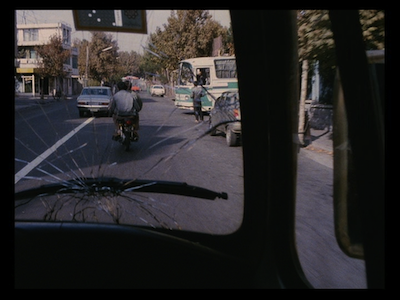
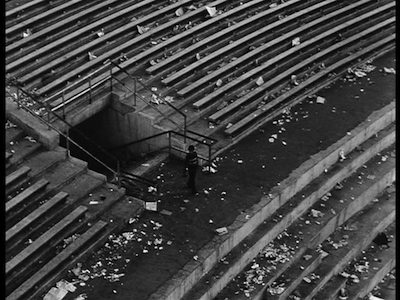
The Traveler was shot in black-and-white and on location, and it has the same Neorealist aesthetic as Close-Up. Though the film is lacking in extraneous fat, that doesn't mean Kiarostami shies away from the quiet moments. He juxtaposes Qassem's anxious waiting in his bedroom with the more calm, eager waiting during the bus ride. He also takes the boy from small-town life where the locals trust his family name to the big city where no one knows or cares who he is. In the end, The Traveler is more cynical than Close-Up, Kiarostami has softened over the years. The lonely figure of the boy in an empty stadium has a long way to go after all if he is to become the weeping man finding peace in the arms of his fellows.


For a full rundown on the special features, read the full review at DVDTalk.

Sunday, February 28, 2010

SIDELINE: MORE REVIEWS FOR 02/10, plus CRITERION ON HULU

After launching their YouTube channel last month, Criterion has now also started a Hulu channel, beginning with the first six Zatoichi movies. Details here.

Also, I reviewed a bunch of films over the last couple of weeks that I saw as part of the Portland International Film Festival, including such anticipated releases as A Prophet, Fish Tank, and Police, Adjective, and the new work of Ken Loach, Marco Bellocchio, and Bong Joon-ho. You can see all my pieces at my other blog, here.


IN THEATRES...

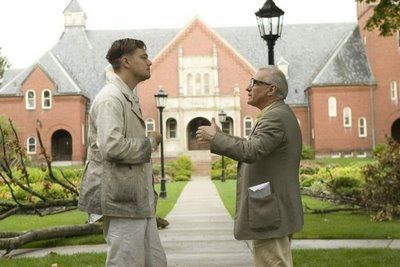
* Shutter Island, Martin Scorsese's pulpy Dennis Lehane adaptation. Over-the-top B-movie excitement, sure to inspire debate.

* The Wolfman, needs to disappear gently into that dark night. What a tragic bore!

* The White Ribbon, Michael Haneke's Oscar-nominated black-and-white period piece. The most affecting morality play ever, or the most affected bunch of twaddle? Can't decide

ON DVD...

* Buena Vista Social Club, a by-numbers reissue of the Wim Wenders musical doc, part of Lionsgate's Music Makers series.

* Eleven Minutes, a documentary about the (annoying) first winner of Project Runway.

* Orson Welles in King Lear, a somewhat stiff 1950s television broadcast.


* Rod Serling - Studio One Dramas, two live teleplays from the master writer.

* Sarah Silverman Progam: Season Two, Part 2, a hilarious collection of episodes skewering the sitcom format in Silverman's inimitable way.

* Split Second, a B-movie that drops a nuclear bomb on the crime genre. Directed by Dick Powell, who was Philip Marlowe once upon a time.

* Tell Them Anything You Want: A Portrait of Maurice Sendak, Spike Jonze and Lance Bangs give us a wonderful documentary about the Wild Things author.

* Wild Oranges, a lusty King Vidor silent picture.