Friday, November 20, 2009

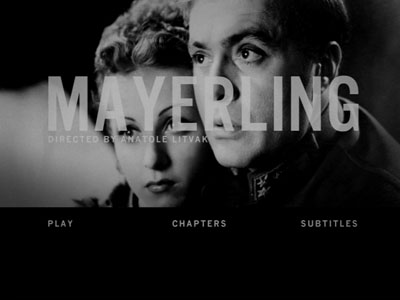
MAYERLING - ESSENTIAL ART HOUSE


Well, I guess it just goes to show, you're never as smart as you think. Here's what I knew about Mayerling: that it showed up regularly on lists of Audrey Hepburn movies as a 1957 television production the actress starred in opposite her then husband, Mel Ferrer. I had always hoped this show would one day surface, being pretty much the only significant television appearance Hepburn made in the first half of her career. I didn't know anything about the story, much less that it was based on a true event and that there were a bunch of other film versions of the tale. All were based on what is known as the "The Mayerling Incident," an 1889 scandal involving the murder-suicide of Crown Prince Rudolf of Austria and his lover, Baroness Maria Vetsera. Live and learn.

Anatole Litvak directed that Hepburn performance, twenty years after he helmed the story for the first time in this French production, realeased here as part of Criterion's Essential Art House line and which also happens to be the first dramatization of the affair. Made in 1936, Mayerling stars Charles Boyer as Rudolf and Danielle Darrieux as Maria. The two would also reunite later as the stars of Max Ophuls' The Earrings of Madame de..., a far more successful coupling as far as I'm concerned. There is nothing wrong with Litvak's Mayerling, per se, it's just that this arch costume drama is the product of a different time. A somewhat dispassionate, reserved time.
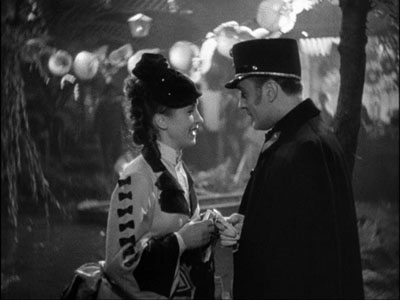


The story follows the outline of many a tragedy. The young Archduke Rudolf first goes astray by entertaining rogue political ideas. He is friends with Szeps (Rene Bergeron), a rabble-rousing newspaper editor known to be part of anti-monarchy protests. Rudolf is quickly put into line and pushed into an arranged, loveless marriage. The years pass, and Rudolf lets most of them go by drinking and partying with his buddies and loose-moraled gypsies. The party boy image is a front, however, and Rudolf yearns for an anonymous life and true love. He finds both when he runs into Maria Vetsera, who at first doesn't realize who this handsome soldier is. When they find each other again, they begin a secret affair, one that eventually becomes public. When the pope turns down Rudolf's request for a marriage annulment so he can be with Maria, the prince reaches the end of the line. Told by his father (Jean Dax), to get rid of Maria, Rudolf resorts to drastic measures. They go on an overnight trip to Mayerling, never to return.

The screenplay for Mayerling was adapted by Joseph Kessel (the novel Belle de jour) and Irma Von Cube (Johnny Belinda) from a novel by Claude Anet. The spicy historical details, and I am sure more than a few embellishments are all there, though I imagine the 1930s production code kept the filmmakers from going too far with what really went on. References to whores and lewd carryings on make it slightly more risqué than had it been a Hollywood production, but the folks in California also knew clever ways of getting more scandalous points across without saying everything outright. There are moments when I thought maybe I was supposed to infer more than what was being shown--like, were Rudolf and Szeps gay lovers, in addition to political radicals?--but also thought that could have been my modern eye spying things that weren't really there.


Litvak stages Mayerling as a grand spectacle, including nights out at the ballet and fancy-dress balls. The evening at the theatre, when Rudolf and Maria see each other for the first time after their chance meeting, is put together wonderfully. Litvak moves up and down and in and out of the various boxes, using a modified upstairs-downstairs technique to indicate the levels of the class structure in the royal court. His camera flies on the wings of gossip, mostly lead by the Archduke's cousin, and the whispered plans for future rendezvous provides Mayerling with its only real heat. Except for their final outing together--and we know how that one ends--most of the lovers' meetings look to be ridiculously chaste. Though, one has to wonder why army officers weren't more careful back in the day when they took their mistresses out for drinks. Rudolf getting caught out by his men, as well as Maria's brother, is remarkably similar to Lord Nelson being discovered boozing with Lady Hamilton in Alexander Korda's That Hamilton Woman.

Though we are apparently to believe that Maria Vetsera is a ripe seventeen, Danielle Darrieux and, indeed, the whole movie comes off as much older than that. Mayerling is really too mature. It needs a touch of Romeo & Juliet adolescent angst to give this star-crossed love affair a little more oomph. Even Rudolf's quickly jettisoned political rebellion could have been cranked higher. For a guy doing his best to piss off his father, he cordially stays out of the old man's face. There is little to signal that these two are passionate or dramatic enough to want to take their own lives. It's a development that comes out of nowhere, and seeing Boyer's shaky determination in the final scenes made me wonder where this kind of emotion had been in the preceding 90 minutes. Even the atmosphere out at Mayerling is different--more desolate and remote, with the lovers playing hide and seek on a late foggy night.
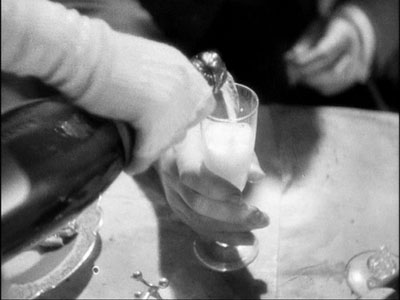
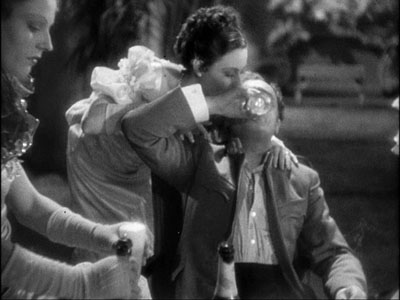


Anatole Litvak would eventually leave France and enjoy a fairly successful career in Hollywood, including directing the jazz film Blues in the Night, the desperate noir The Long Night, and another historical drama, Anastasia with Ingrid Bergman. Mayerling definitely shows a style in development. He understands that a costume piece like Mayerling has alternating demands, with wide shots needing to be employed to show the big set pieces and extreme close-ups necessary for the extreme emotions. He also finds ways to get his camera moving, regularly starting tight on a specific thing and moving back to reveal the whole scene. There is a particularly memorable use of this technique in the middle of the movie, when Rudolf has been drowning his sorrows during Maria's absence. We have heard that the Prince has been out carousing, and Litvak takes us into the decadence by starting on a champagne bottle and then zooming out as it's poured, showing the drunk royal in his cups amongst his courtesans. So, despite some slowness in the overall narrative, it's clear that this filmmaker is just starting to get warmed up.
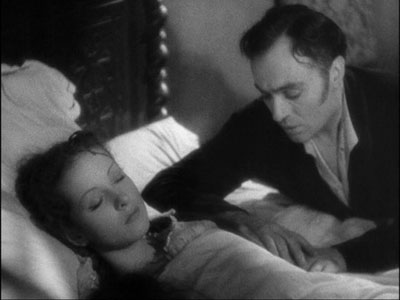


This does make me wonder, though, is there a more definitive version of Mayerling out there? There are multiple films of the story, including one with Omar Sharif and Catherine Deneuve, and even interpretations off the screen--a ballet, a German opera, a Japanese musical, and a manga, of all thngs. What say you readers? What do you recommend?

By the way, in researching this article, I discovered that a 9-minute clip of the Audrey Hepburn/Mel Ferrer production is now online and that we may actually see this surface in the future. Info here, and the clip itself:


Thursday, November 12, 2009

GOMORRAH - #493


When I first saw Gomorrah earlier this year, I was at a loss for how to easily describe it to people. It's a complicated work, packing into 2 hours and 17 minutes enough story to cover an entire season of a quality cable television program. In the end, I turned to one such program for my analogy. You know the Hamsterdam storyline in the third season of The Wire, when Major Bunny sets up a miniature city inside an abandoned Baltimore tenement where the gangs are allowed to run free, slinging dope and selling sex unencumbered? Gomorrah is like that, but with barely any cops at all. Hamsterdam abandoned.


Directed by Matteo Garrone and adapted by a squadron of screenwriters (six in total) from the journalism of Roberto Saviano (also one of those six), Gomorrah is a hyperrealistic portrait of Italy's Scampia slum and other areas near the Bay of Naples. The title is both a play on the Biblical city of sin as well as the crime family that rules the area, the Camorra. The mega complex at the center of the film is a mini society that is fueled by narcotics and locked in an endless cycle of crime and poverty. So complete is this little city, there is even a faction called the "secessionists," a motivated group of gangstas who have decided they don't want to take crap from the Camorra anymore. The projects are locked in their own civil war.


Gomorrah is a multilayered film, moving up and down the criminal lines to look at the different levels of the mafia organization. Garrone presents five separate stories, all running parallel, all sending whatever money being earned in the same direction, but never crossing over. This starts young, with a rookie being indoctrinated into the club, and runs all the way up the flagpole to a veteran swindler who is now working the business end of things. Franco (Toni Servillo, also seen this year in the aesthetically similar political film Il Divo) is running a waste management scheme, though unlike the waste management in The Sopranos, it's a real operation, not a front. He offers to unload any garbage, no matter how toxic, for half the price of his legitimate competitors, finding remote locations where he can hide the stuff away. He even pays farmers who are in debt to let him further sully their land. Franco is a go-getter, and he never uses a gun, he is capitalism personified. His social justification: screw the other guy if it means helping your own. Or, more importantly, yourself.


On the other side of things is Toto (Salvatore Abruzzese), a kid from the slum who goes from delivering groceries to muling drugs in one easy move. The chilling thing here is not that Toto chooses to be a part of the warring gangs, but how easily he does it. There doesn't seem to be much thought to it, it's just the next logical step at his age. His trial by fire is standing still wearing a bulletproof vest and letting one of the enforcers shoot him in the chest. Toto could conceivably survive to one day be like Franco, though he is more likely to be one of the anonymous dealers that run the day-to-day and who either get arrested or shot. In such a case, the Family takes care of the family of their fallen comrade, and actually Toto is best reflected in Don Ciro (Gianfelice Imparato), the delivery man who brings the salaries to those left behind. Dressed in a beige windbreaker, dutifully following his list, Don Ciro is a big nothing in the grand scheme of things, and he knows it. He is a small speck within the larger construct, and as it all continues to engulf him, he's losing his nerve.


See how complicated this all is? And that's still only three of the five stories. All aspects of life are represented in Gomorrah, the garbage people pump into themselves and the garbage they pump out--literally and metaphorically. Whole industries thrive within Naples, including underground garment manufacturing. Designers come in with a clothing line, and different sweat shops bid on how quickly and cheaply they can make a large order. Top of the line in terms of production is Pasquale (Salvatore Cantalupo), a tailor who knows how to get results. His boss is a bit of a shyster, however, and never comes through on promised bonuses and overtime pay. When a Chinese rival approaches Pasquale to come give his workers a tutorial in how to produce quality on the cheap, Pasquale takes him up on it. It's not the best choice. This is akin to a criminal double-cross and not without its consequences.


The final story is the most memorable and perhaps the most important. Wreaking havoc throughout Naples are two teenage boys, Sweet Pea (Ciro Petrone) and Marco (Marco Macor), two self-styled Scarfaces who fancy themselves big-shot Mafioso. They steal drugs and guns and thumb their noses at the local crime bosses. They are media culture come to dangerous life, hip-hop wannabes with more bravado than sense. Yet, they are also complex characters, their seeming lack of motivation beyond their own pleasure actually being a smokescreen that masks their frustration at not being able to uncover their own hidden depths. When not in action, they are restless and lost, always looking for something to occupy their feral minds. Sweet Pea in particular seems out of step with himself, shy with women and quick to panic when the violence turns against him. In a scene after their first on-screen drug heist, he dances to music on the jukebox, making come-hither advances on Marco, suggesting a homoerotic tension underlying their relationship. The sequence actually reminded me of Wong Kar-Wai, with the music, the Hawaiian shirts, and the inability to communicate passion.


Garrone apparently borrows Gomorrah's aesthetic from Saviano's book, which blended reporting with fictional technique to make something that was more evocative of the reality by bending the facts to fit the writing style. Garrone's regular director of photography, Marco Onorato, shot Gomorrah like a documentary, and the editing by Marco Spolenti favors long cuts, letting the camera move in and around the action rather than jumping between the actors with more traditional coverage. There is no effort made to gloss this story up with fancy gunplay or clever "street poetry" dialogue. Sometimes having the characters say nothing is more effective, and when they do talk, it's often clumsy, repetitive, and reflective of their station. Though literary themes are built, including plenty of dualities and an image near the end that shows human bodies being treated very much like Franco's barrels of toxic waste, there is no attempt made to sew these things up, no great "ah-ha!" moments. In fact, the only time the film attempts to moralize is the only time it falters. Franco is given a chance to defend himself when his protégé walks out on him, and his "the world needs men like me" speech is surprisingly on the nose for a script that otherwise avoids being so obvious.


Nearly 1,200 words in, and I still find myself circling what really makes Gomorrah tick. This is the kind of movie you just have to climb in and roll with it. I admit, it's actually easier to comprehend, and thus more rewarding, on a second viewing, because there are so many characters and different elements to keep track of, the first time through, I was just getting acclimated. There were whole segments I forgot about from one watching to another, it was practically a new movie for me anyway.


Special kudos go to Neil Kellerhouse for his exceptional and evocative package design for this release. The images he chooses--and partially creates--reflect the depth of the story in both terms of narrative complexity and literal spatial connections. The cover of the interior booklet shows an aerial shot of Don Ciro walking amongst the bodies of the slain, looking past walls and ceilings and creating an illusion of higher and lower, as if he is separated from them even though he is right there in middle.

More striking is the cover of the actual box. The other Ciro, the young thug, is shown in his bathing suit and tennis shoes, brandishing a pistol, and walking over the city like a malevolent god. In thumbnail form, the way I kept seeing it online, it just looks like a still from when he and Marco are having target practice at the river. It's only when you really look at it and see it at regular size that the full picture becomes clear.


The whole DVD experience for Gomorrah is enhanced to peel back the various layers and show the schematic of the narrative. A second disc is devoted to the behind-the-scenes on the movie, including new interviews with Matteo Garrone and Roberto Saviano, as well as an hour-long look at the making of the film and the five stories that form its whole. Given the way the movie already blends fact and fiction and blurs the lines between, it's all the more fascinating to obliterate the illusion altogether. Moviemaking is its own bizarre version of reality, a kind of separate fiction where real life is surreal anyway, so in a case like Gomorrah peeking behind the curtain locks everything together like fingers on two corresponding hands.


This disc was provided by the Criterion Collection for purposes of review. It will be in stores on November 24.

Friday, November 6, 2009

THE HIT - #469


At the end of last night's episode of The Office, Michael Scott (as played by Steve Carrell) says that, in a moment of what was admittedly mild violence, he saw his life pass before his eyes. In the end, he had four kids, a hover car, and a hover house. I guess that's one benefit of being an "optimist savant" (I doubt that's a term, but there it is): what everyone else sees as a finale, you see as a beginning. The rest of us see into the past, your imminent death is not an imminent death, but a window to the future.

I didn't think about that at all while I was watching Stephen Frears' 1984 crime picture The Hit. I rolled from my Thursday night sitcoms into this British pulp without considering if there was a thread between them, because why would I? It was only when I was pondering whether there was some other way to open this review than with a cold summary that it came back to me. If Michael Scott were to be kidnapped by a pair of criminal assassins and taken on a drive out of Scranton to New York to have his brains blown out in front of David Wallace, it would likely never occur to him that he was really going to die. He would smile and chat and roll along in oblivious contentment. His is the certainty of survival.


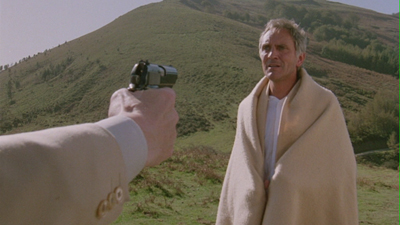
It's quite the opposite for Willie Parker, the aging gangster played by Terence Stamp in The Hit. He knows exactly what is waiting for him: the certainty of death.

The Hit opens in the mid 1970s. Willie has turned state's evidence, selling out his partners in a couple of bank heists in trade for immunity. As he exits the courtroom, the men he doomed serenade him with "We'll Meet Again," the old standard made famous by Vera Lynn during WWII. It's a sentimental tune turned to threat.


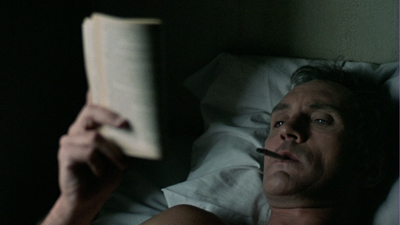
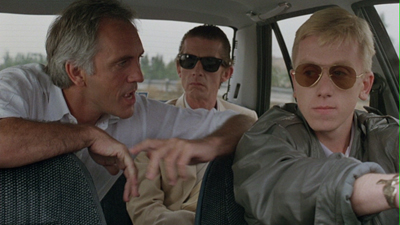
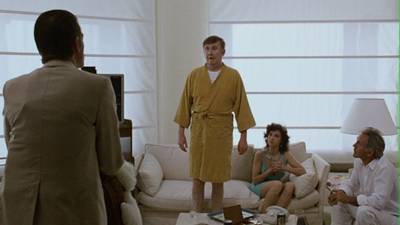
Flash forward ten years and Willie is holed up in Spain, living a life of quiet contemplation, alone with his books, bicycling the countryside. The jig is up for Willie, however, and that day, a group of young thugs are waiting for him. They put a sack over his head, throw him into a car, and deliver him to a pair of killers who have come looking for him. One is an experienced triggerman named Braddock (John Hurt), the other a twitchy kid by the name of Myron (Tim Roth), a bleach-blonde punk on his first job. Braddock and Myron are to drive Willie up to Paris, where he can answer to the recently released crime boss he put in jail. Then he will be shot.

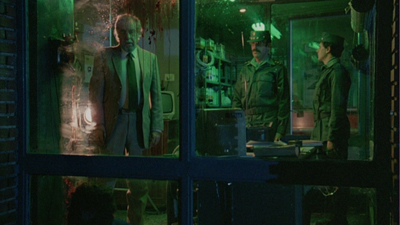
It was meant to be an easy grab-and-go, but the kids who nabbed Willie killed the cop who was guarding him on their way out and so now the heat is on. The police are on their trail pretty quickly, though always a few steps behind. The posse is lead by an officer played by the great Fernando Rey, whose presence is always felt despite the fact he only has a couple of lines to speak at the very end of the movie. That's star power right there, commanding the screen without saying a word.


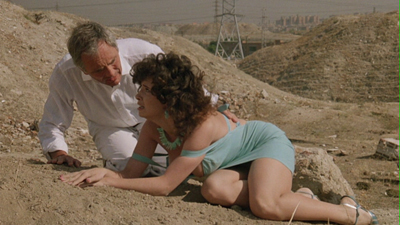
The road trip is one of constant screw-ups. A detour to get a new car off a local hood gains the group a fourth passenger, a Spanish prostitute named Maggie (Laura del Sol). The same stop also adds another body to the pile-up, Maggie's British boyfriend, another ex-patriot crook (Bill Hunter). Each pit stop only serves to blow their cover more, the cool criminals slowly unthawing and unraveling. Myron suspects this is all Willie's doing, that the Zen master with the white hair and white clothes has a plan to get under their skin and unnerve them, and judging by the evidence, he may be right.

Willie's monastic lifestyle seems to have served him well. When we first see Willie in court, he doesn't appear to be very smart. He's slow on the uptake, and it turns out he was merely the driver for the robberies. It's a low-level position in the criminal scheme of things, but symbolically, Willie does fulfill a role as a delivery agent, shuttling the others to their fate. By the time his own fate catches up with him, he is older, wiser, better spoken, and seeming free of any cares. He lightly accepts his kidnapping, cleverly manipulating Myron for information and needling both men in stressful situations to fray their nerves and give them cause to doubt the other. He's got them both made out pretty good, and he particularly sees Myron as a weak link. This is Tim Roth's big-screen debut, and he's already a feral little weasel, particularly as displayed in an impromptu fight Myron engages in at a roadside bar. He doesn't know when to shut up or settle down.


Braddock is the opposite. He is cool and measured, and John Hurt is as cold as Roth is hot. This puts Willie in the middle as someone who is neither one nor the other. His refusal to show concern, to scream or fight or even try to escape, undermines the confidence of both men. He knows he's going to die, what does he have to be so happy about?

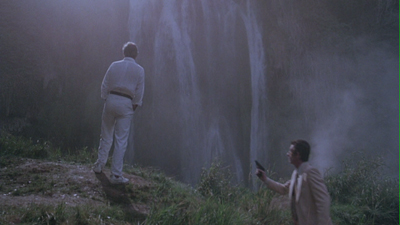
Well, everything really. Willie has accepted that all life is transient, that death is a move from one state to the next, and as he tells Myron, what happens on one side is pretty much the same as what happens on the other. If John Lennon, one of his personal heroes, could face the Grim Reaper, so can a nobody like him. Today, tomorrow, what's the difference? There is an almost religious serenity to how he carries himself. He looks like he is dressed to go down to the water and be baptized, a costume that I can only assume is intentional, particularly since on what could be his last evening on Earth, rather than run for it when he gets the chance, Willie instead stands by a waterfall and lets the mist cleanse him.


In the midst of this, the girl is the wild card. If being robbers is a game that boys play because they decided to never grow up, then the women are on the other side of the board where the game gets real. Unlike Willie, Maggie wants to survive, and indeed, has been making moves to ensure her survival since before these guys crossed her path. Laura del Sol is smart and feisty in the role, constantly looking for an angle out. Hers is the part of the watcher, the one who must always be looking and then react.


Stephen Frears had an extensive television career before transitioning into features with The Hit. I am sure the no-fluff approach displayed here is attributable to that background. When you're used to constrained resources, you learn to make anything count, and there is certainly nothing wasted here. The look of the film (it was shot by Mike Molloy) is cold and bare, with the action mostly taking place either in the car or in big, open spaces. The script by Peter Prince (Waterland) is extremely economical. There is nothing said in this film that doesn't advance the narrative. No stray outbursts from Myron, no extraneous speeches from Willie. Like I noted, we don't even get any instructions from the head of the police, they maintain a silent pursuit. Confidence affords an artist the luxury of never having to explain himself.


Like any road movie, The Hit isn't really about where these people are going, but how they get there. Or more accurately, how they arrive. Prince and Frears save a few surprises for the finale. When faced with the inevitable conclusion, each person reveals his or her true nature, and ultimately, the movie says something about what it means to live tough. (Spoiler: the toughest of all is the one without the penis.) Who is posturing, who has the courage of their convictions, will any of them see their future staring back at them from the barrel of a gun--these are things you have to watch the movie to find out.


Saturday, October 31, 2009

SIDELINE: MORE REVIEWS FOR 10/09

IN THEATRES...


* Amelia, Mira Nair's biopic of Amelia Earhart is an emotionless snoozer. Starring Hilary Swank.

* Antichrist, the new Lars von Trier philosophical shocker is one of the most unsettling movies I have ever seen. Not for the faint of heart or the quick to judge.

* Astro Boy, a cool looking movie that is stuck somewhere between the quality of the original material and a misguided desire to satisfy the kiddie market.

* Coco Before Chanel, starring Audrey Tautou as the fashion designer in her formative years.

* A Serious Man, the new Coen Bros. mind blower. I know everyone has seen the trailer, but I am including it above just because it's one of the best ever. And best of all? It tells you NOTHING!

* No Impact Man, a documentary about Colin Beavan and his family, who tried an experiment of living off only sustainable resources for a full year.

* Where the Wild Things Are will make you believe in the impossible in every way.

ON DVD...

* Actors & Sin, a slick entertainment-themed double-bill from Ben Hecht.

* British Cinema: Renown Pictures Crime & Noir (Blackout, Bond of Fear, Home To Danger, Meet Mr. Callaghan, No Trace, Recoil), collecting six films from the 1950s, none of them very good.

* Luis Bunuel's Death in the Garden, a 1950s potboiler from the surrealist director's Mexican period.

* Diary for My Children (Napio gyermekeimnek), a 1984 film from Hungarian writer/director Márta Mészáros is a personal portrait that is maybe too personal to effectively communicate its tale.

* Il Divo, a flashy Italian biopic of politician Giulio Andreotti.

* Fados, Carlos Saura's performance documentary on a particular style of songcraft from Portugal. Lots of songs, very little information.

* Lightning Strikes Twice, King Vidor's mild melodrama about women who fall for the wrong men.

* Management, in which Steve Zahn stalks Jennifer Aniston and they call it a "romantic comedy." Both terms are almost entirely wrong, though there are glimmers of quality.

* My Fair Lady, the Audrey Hepburn musical is reissued and downgraded. Keep your old DVDs, they are better.

* Whatever Works, the Woody Allen/Larry David movie comes to DVD, and I revisit my old review from its theatrical run.

Thursday, October 29, 2009

WINGS OF DESIRE - #490

"There is no greater story than ours, that of man and woman. It will be a story of giants...invisible...transferable. A story of new ancestors."


I still remember seeing Wings of Desire the first time. I had heard about it from watching Siskel & Ebert, and knew vaguely that it was the same filmmaker who was responsible for Until the End of the World, which I had not seen either, but I obsessively listened to the soundtrack, which I had purchased for the new Depeche Mode track. Just as that CD had introduced me to a bunch of bands I didn't really know, expanding my musical horizons (Elvis Costello covering the Kinks was like a double-shot of "What's this good stuff?"), Wings of Desire would be important to my understanding of experimental narratives and cinema as art. If nothing else, it made foreign films that didn't have samurais in them a little less scary.

I only begin this way--the first two paragraphs in a movie review shouldn't really lead with a first-person pronoun--because I think Wings of Desire is a "Where were you when?" film. Where were you when you first saw it? Who showed it to you? Who were you? Up until a couple of days ago I had forgotten, for instance, that I had given the previous DVD edition to one of my best movie pals several years ago. He had never seen it before that. Wings of Desire is just that kind of film. Once you've seen it, you don't keep it to yourself. (And you certainly stop anyone you can from seeing the remake. Friends don't let friends watch City of Angels.)


Released in 1987, Wings of Desire is the brainchild of German writer/director Wim Wenders. The filmmaker was at the zenith of his creative powers in this period, with Wings being in the middle of his three best fictional films, sandwiched between Paris, Texas and the aforementioned Until the End of the World. (Seriously, when the hell are we going to get a DVD of that?!) That's some esteemed company, but even amidst those films, Wings of Desire is still the best, the uppermost tip of Wenders' artistic spear.

That's because Wings of Desire is the film that could not be made by anyone else, that could not be made at any other time. This was two years prior to the fall of the Berlin Wall, and I think that fact alone would have changed the tenor of Wenders' masterpiece. Though there is very little mention of the political situation in Berlin at the time, the separation that city felt was very much a part of the subtext. Wings of Desire is about a world divided, about the line between the spiritual and the physical, the fanciful and the practical. Between the poetry of words and thought and the true poetry of life.


Bruno Ganz stars as Damiel, one of an army of angels assigned to Berlin. In this reality, angels act not as guardians, but as witnesses. They wander through our lives, silent and invisible, observing our activities and eavesdropping on our thoughts. They might follow one person in specific, or they might roam through a crowd, sampling a little something from each. There are wonderful scenes on a plane or in the public library where the sound mixers scroll through the gathered people, moving from one inner monologue to another the way we flip through channels with our TV remote. In the library, there are almost as many angels as there are mortals, all looking for something interesting to commit to memory or maybe scribble down in one of their little notebooks.

Damiel shares just such discoveries with his best friend Cassiel (Otto Sander). After centuries of observing the human race, they are still capable of being charmed by our irrational behavior. Just reporting that he saw a woman close her umbrella and allow herself to be drenched in a downpour brings a smile to Damiel's face. What unpredictable creatures! What must they feel? How do things taste? What's it like to really hold something in your hand? The angels can take objects from us, but they are merely copies and not tangible. It's not the same.


Call it divine existentialism. Our earthly version of that philosophy ponders what it must be like to transcend the physical and join the divine; for an angel, the crisis of identity involves shedding your wings and eternity and becoming flesh. Damiel has grown tired of watching, he wants to start doing things. The final catalyst for "taking the plunge," the human idiom for what is essentially a fall from grace, is a beautiful trapeze artist, Marion (Solveig Dommartin), that the angel has become smitten with. She is his human analogue, soaring above the ground as she does, even wearing a pair of feathery wings. Marion dreams of flying, Damiel dreams of walking--opposites, prepare to attract!

The transformation from heavenly to earthly creature thankfully comes in the final third of the film. Had it come sooner, it would have made for a much cheaper experience. There is nothing wrong with the end of the film, it's actually quite perfect, and Bruno Ganz is at his most compelling as the excited new human rushing through Berlin, seeking every sensation, tasting his first cup of coffee and learning to whistle. His childlike exuberance is infectious. The romantic meeting is also splendid, with Wenders and co-writer Peter Handke avoiding the triteness of love story coincidences by properly joining the fates of Damiel and Marion early on. Though angels can't directly influence a human, they can make their presence felt, and Damiel's constant hanging around lends Marion peace while assuring that he will be familiar to her when they meet face to face. (At a Nick Cave concert no less. Some vintage footage here!)


The romance is sort of the cherry on top, and the rest of the movie is the true sundae. It's the build-up, the gathering together and the exploration of this world. Wenders takes us on a tour through the city, showing us people from all walks of life. Under his gaze, living is a lyrical happening. One of Cassiel's favorite people, an old poet named Homer (Curt Bois, who had acted in his first movie eighty years before Wings), asks why no epic ballads have ever been written in tribute to peace the way they have been about war. This would seem to be a personal challenge that Wenders has made to himself and buried within the movie proper. What Cassiel and Damiel observe is like a visual song celebrating an everyday peace. It's not all happy--there is suicide, bills to pay, drug addiction--but there is a nobility to forging ahead, to making your own personal story even if no author is ever going to write it down. It's easy for the angels, they pass through everything unharmed; humans have the ability to touch and be touched in turn. Divinity has its purpose, but as Peter Falk, playing himself as a former angel, informs Damiel, there is nothing to compare to the sensations of the finite.


Wim Wenders and Peter Falk


Falk's role also connects the film to history. He's come to Berlin to make a movie about a private detective in WWII, and extras stand around on the set wearing Nazi uniforms and clothes marked with the Star of David. The past is alive and well within the city, and old newsreel footage is cut into Wings of Desire, seen from car windows, the ghost of memory. It's another division between realms, one of many in the movie. Wim Wenders and cinematographer Henri Alekan (Topkapi), along with assistant director Claire Denis, create a vivid visual division between the heavenly and the earthly. The angels and what they see are shot in crisp, cool black-and-white (restored here to a more silvery hue rather than the gold of previous DVDs) while the mortal experience is shown to us in full color, rich in tone and often garish. Humanity experiences the full spectrum, whereas the angels' vision is limited. For all of their peeping in on our brains, the angels are confined. They can't do anything else. This is the core of existentialism: choice is what makes us free. Our imperfections define us. The brightest light burns half as long.


For all these happenings, Wings of Desire actually ends on a downbeat. Though Damiel has found love and joy with Marion, Cassiel is now alone in the heavenly realm, watching his friend's new life without anyone to talk about it with. His divine plight is one of loneliness, but as the final words of Homer and the "to be continued" card that precedes the credits tell us, this is only the beginning of the story. Like an acorn falling from a tree, Damiel is only the first. The sequel, Faraway, So Close!, was several years off, and I don't recall it having the same impact. Maybe it was best to leave well enough alone. Somehow the suggestion that maybe Cassiel will follow Damiel's example is more effective than him actually doing so. It's probably because it allows us all to be Cassiel, looking to a more hopeful future all our own. The follow-up story itself ends up being too specific, and thus not satisfying.

I don't recall movies from the same period being nearly as hopeful as Wings of Desire. Not without resorting to treacle. Wim Wenders manages to avoid the schmaltz. Wings of Desire is the work of an artist who can see a better world on the horizon and is using his art to reach out for it, to pull it closer. His message remains in the abstract, but it's no less effective for not being spelled out. That angelic power of observance, the god's eye view afforded by the camera, equalizes all life in our vision, let's us find ourselves within it, and forever changes how we see things in the process. Or at least that's how it was for me. How about you?


For a full rundown on the special features, read the full article at DVD Talk.


Saturday, October 24, 2009

Z - #491


In the 1990s, when the original Rodney King trial went the wrong way despite what to most people was pretty compelling evidence, arguments were made about what we think we see versus what we actually saw. A video of a man being beaten, we were told, was not clear-cut. You see that club there? It's not actually connecting. And it's only one vantage point. You weren't there. How could you know?

Last year, there was a Hollywood movie actually called Vantage Point where the investigating feds piece together a political assassination using all the different cameras in the crowd. I never saw the movie (just like most people), but it wasn't hard to guess that the plot hinged on the idea that even with so much photographic evidence, with surveillance everywhere, the truth is still a puzzle put together from many points of view. It's the Rashomon conundrum of the digital age. The more people who see a thing, the more angles we can look at it from, the more differing interpretations can garble the message.
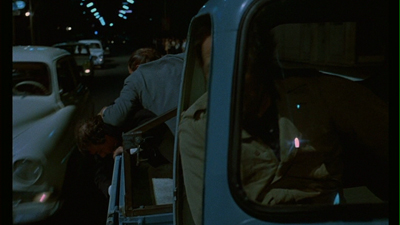


While that's not really the point of Costa-Gavras' 1969 political thriller Z, I was struck by how ahead of the curve he was in predicting how placing cameras in different places could show us the same event in different ways. Z is shot a lot like a documentary, an investigative procedural that has aesthetics in common with the Nouvelle Vague and the films of Francesco Rosi, and would in turn inspire Alan J. Pakula, David Fincher, and Steven Soderbergh. Z could almost be seen as a stylistic fulcrum on which the two sides of that equation balance, the link between Salvatore Giuliano and All the President's Men, The Battle of Algiers and Zodiac.

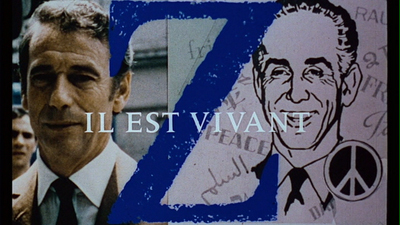
Written by Costa-Gavras alongside Jorge Semprun and based on a book by Vassilis Vassilikos, Z is a loose retelling of the real-life killing of leftist Greek politician Gregoris Lambrakis. In the movie, Yves Montand plays a charismatic Socialist activist who preaches pacifism and equality. Known only as "the deputy"--though Z starts with a statement that all resemblance to actual persons or events is far from coincidental, names are obscured and often forgone completely--the film opens on a day when he is to deliver an address to a large gathering of sympathetic followers. Police pressure has caused the Party's venue to disappear, however, and amidst the scramble to find another locale, the deputy's team also hears about a possible threat on their man's life. The deputy insists the event will go on as planned, staged on the same night as the Russian Bolshoi is performing in town. Their demonstration will provide a counterpoint to the bourgeois ostentation.
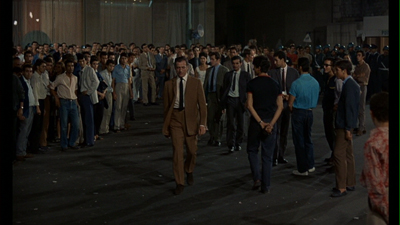
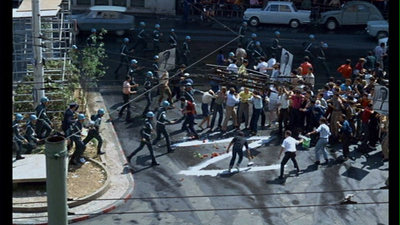
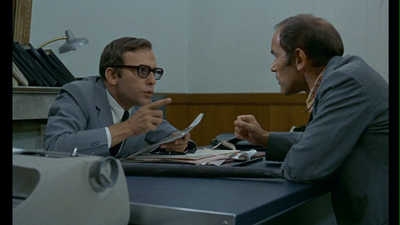
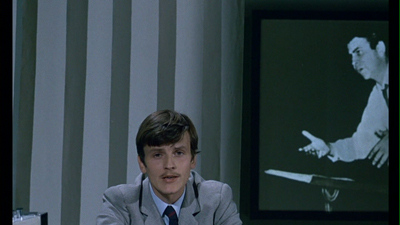
The rally is far from peaceful. As the police stand by and watch, there are multiple skirmishes and attacks, the last of which leaves the deputy bleeding in the road. The culprits, Vago and Yago (Marcel Bozzufi and Renato Salvatori), are arrested and their story about being harmless drunk drivers perpetrating an unfortunate hit-and-run is accepted as fact whereas any counter theories are dismissed as Commie propaganda. Only after the deputy dies does an autopsy reveal that his skull fracture is more consistent with a clubbing than with an auto collision. A diligent prosecutor (Jean-Louis Trintignant) and a gutsy reporter (Jacques Perrin) start digging further, and pretty quickly, more inconsistencies in the story begin to show. Connections between Vago and Yago and a right-wing religious group further reveals connections between that group and the chief of police (Pierre Dux) and his right-hand thug (Julien Guiomar). Further attacks on witnesses only fuel the prosecution, as does government opposition.

Costa-Gavras takes us through the investigation step by step. He lines up each piece in their natural order, only taking minor detours into extraneous character stuff (Vago's sexual predilections; the deputy's heartbroken wife, played with stalwart grace by Irene Papas, and even glimpses of their marital strife). Working with renowned cinematographer Raoul Coutard, who shot the bulk of Godard's 1960s films (and who also shows up on the other side of the camera as a British surgeon), he shoots most of the action as if it were a documentary. Coutard's camera is rarely nailed down, but often moving with the flow of activity, acting more as a cold witness than an active part of the story. The fact that we can be everywhere at once creates a kind of hyper-naturalism. Z looks real, but it's not bound by time or space. Flashbacks are common, quick glimpses of memory, and even moments of minor comedy.


When the deputy is struck down, we see it clearly. The truck drives by, Vago leans out and hits the man, and the crowd parts to let them leave. Or is that what happened at all? I don't think that Costa-Gavras means us to really doubt what we saw the first time, but as we see the event as it is described by others, we see how the story of the drunk driving could appear plausible from their field of vision. It also keeps us on our toes, we're never quite sure of who knows what. Even one of the deputy's own people isn't positive the man got clubbed, and when he tells the story, we don't see the fatal blow. We do see the cruel hysteria of the crowd, snippets of the onlookers and enemies circling the victim playing backwards and forwards like we're flipping through snapshots. Costa-Gavras also drops out most of the audio, leaving only the elements the witness relates. It's cinema as point of view, as unreliable and incomplete as that can be. Watching Z, you can start to understand how one can argue about the veracity of a length of videotape.


As Z moves forward, it builds up a head of steam, and the investigation gathers its own momentum. Though the prosecutor doesn't make any grand speeches, he emerges as a heroic figure, committed to fairness and the truth. He is as distrusting of any one side as he is another. Trintignant plays him without any affectation. He's as straight a straight shooter as you're likely to get. On the other hand, there is nothing selfless about the reporter's pursuit of the story, the way he always secretly takes photos even when instructed not to and is aware of the monetary value of the information he's gathering. Perrin is loose limbed and energetic, jumping around and sometimes quite literally chasing the story. These guys are like the European version of Redford and Hoffman.


Interestingly enough, despite the successful exposure of the conspiracy, Z does not end on a hopeful note. Costa-Gavras gives the film a coda where things get worse instead of better. A news broadcast by Perrin informs us of the fate many of the players suffered, and a voiceover and text scroll details a government crackdown that follows, shifting Z out of amped-up Neorealism and into Orwellian sci-fi. It's a far more cynical way to close the movie than, say, Nixon being taken down (to continue the All the President's Men comparison). In this, too, Costa-Gavras is ahead of the game. In the decades that followed Nixon's souring of the American political system, we've often seen those members of his party who succeeded him use unsavory methods to take back the respect Tricky Dick lost them. It's much easier than earning it, and much more effective in demoralizing the public so they won't question the government's methods again. The ending of Z isn't science fiction at all; it's clairvoyant.


For a full rundown on the special features, read the full article at DVD Talk.


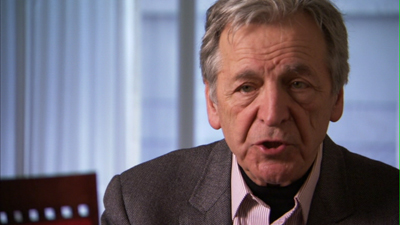
Costa-Gavras