Showing posts with label stephen frears. Show all posts

Saturday, January 6, 2018

MY BEAUTIFUL LAUNDRETTE - #767


I pulled My Beautiful Laundrette off the shelf for two reasons. One, it’s directed by Stephen Frears, and it would make a nice companion to my reposting of my review of his 2009 effort Chéri. Second, I saw Paul Thomas Anderson’s Phantom Thread last week, and Daniel Day-Lewis’ intense performance was so quietly astonishing, it made me want to look back and see what he was like as a younger man. This is my first time viewing the 1985 film, despite being aware of its reputation and also having been a fan of other work by both the director and his performer.

It was a misguided adventure.

Honestly, I’m not sure why My Beautiful Laundrette was so critically lauded back in the day. My guess is the progressive subject matter being unlike anything else in the cinema at the time, and also because even in this small indie, Daniel Day-Lewis still stands out.

But I’m ahead of myself...


My Beautiful Laundrette is a British drama set in a poor London neighborhood where a family of Pakistani immigrants have set up several small businesses. One of the younger family members, Omar (Gordon Warnecke), is trying to get out of the house so he can escape a father (Roshan Seth, Gandhi) paralyzed by grief. To do this, he enlists the help of an uncle (Saeed Jaffrey, Hullabaloo Over Georgie and Bonnie’s Pictures) who is willing to give him a job. After Omar proves his worth, the uncle gives him a rundown laundry to run.

Being back in the ’hood, Omar runs into Johnny (Day-Lewis), a friend from high school who now runs with a tough crowd. Omar enlists Johnny to help him out, hatching a plan to skim drugs from Omar’s gangster uncle (Derrick Branche) and use the profits to fix up the laundromat. In the midst of these shenanigans, Omar and Johnny also give oxygen to a long smoldering physical romance between them--a relationship Johnny has to hide from his thuggish friends and Omar has to conceal from his family, who want to arrange a union with a nice girl.


There is interesting stuff here, but screenwriter Hanif Kureishi (Buddha of Suburbia) mostly dances around it. Part of the narrative is that both boys are in denial about certain things, and so it takes a while to learn that they stopped hanging out in their younger days because Johnny became a skinhead--a great character detail--but rather than that revelation leading to an outpouring of emotion or delving into what that meant then and what it means now, why the boy changed, it’s mostly glossed over. Likewise, the full implications of their relationship is never really explored, Kureishi and Frears resorting to the old cliché of an interruption of violence bringing the two together.

Perhaps more disconcerting than the thin writing, however, is Frears trying to disguise amateurish filmmaking and adolescent impulses as quirky style. From the broad character comedy to the cartoonish music and sound effects, the filmmaker tries to imbue My Beautiful Laundrette with an off-center sensibility, but it never quite works. Stage this same story as a grimy kitchen sink drama, shot on the same locations with the same shoestring budget, and you may have a rather challenging story of sexuality and race. Instead, My Beautiful Laundrette is a goofy culture clash send-up without much genuine wit.


This isn’t helped by the mostly inexperiencde cast. They are all game, but few have the actual chops. Seth and Jaffrey are both confident older performers, but they appear to be in different movies--one is working for Merchant Ivory, the other auditioning for a sitcom. And then there’s Daniel Day-Lewis. His unwavering commitment to character, not to mention his shock of bleach-blonde hair, causes him to stand out in every scene. He’s on a whole other plane than his castmates. It’s as if he is the one adult at a children’s birthday party, and he’s too busy thinking about death to clown around with the kiddies.

Again, I assume My Beautiful Laundrette felt bold and fresh when it was released, a sideways critique of Thatcher’s England that was frank about immigrant issues and homosexuality, but the intervening decades have not been kind. What was once sincere now seems naïve, and what had been deep insight just appears shallow.


Friday, January 5, 2018

CHERI - CRITERION CHANNEL

This review was originally written for DVDTalk.com in 2009. 


Chéri opens with a jocular recounting of the history of courtesans, using a slick presentation to detail some of the more famous kept women of history complete with vintage photographs and Toulouse Lautrec artwork. It's a fun sequence, lively and full of cheeky humor. Director Stephen Frears supplies his own voiceover, and he sets the stage for the last lady of the evening on the list, Lea de Lonval, as played by Michelle Pfeiifer. It's an entertaining beginning, and it announces a movie that I would really like to see; unfortunately, the movie it announces is not the one that follows.

The basic story of Chéri is that Lea is a high-priced prostitute who is getting on in years, and having just lost her latest long-term client, is finding her prospects have changed. Having earned many a big ticket over the course of her career and, as we learn, invested wisely, she is nowhere near destitute, but the game is changing. Rather than going out and finding a new sugar daddy, she adopts 19-year-old Chéri (Rupert Friend, The Young Victoria [review]), the son of Madame Peloux (Kathy Bates, Titanic [review]), another old whore. Already bored of debauchery, and bereft of an inner life to the point of being soulless, Chéri slips easily into the role of a boy toy kept by a beautiful older lover who takes care of his every need.


Jump ahead six years, however, and Momma Peloux has decided that she wants the one thing Lea can't give her: grandchildren. She has arranged Chéri's marriage to another of their colleagues' daughters (Felicity Jones, Like Crazy [review]; Rogue One: A Star Wars Story). Understanding that this is the way the cookie crumbles, Lea accepts her bitter fate with a stoic resolution, but in private, her heart is breaking. While Chéri and his bride are honeymooning in Italy, she disappears to a private resort to chase muscle-bound youngsters. It's quite possible that her move is intentional, that she knows by taking the treat away from her young pup, he will go looking for it, but if such is her motivation, it's never spoken. Were Lea's plans and schemes made more obvious, or if we even knew more about her anxieties, Chéri would be a much more interesting film; instead, the tug of war with Lea and Chéri's heartstrings ends up just being surface and predictable.


The lack of clear plotting is surprising, given that Chéri reteams writer Christopher Hampton with director Stephen Frears. The pair covered similar romantic ground a couple decades ago with the delicious and wicked Dangerous Liasons. The secret motivation of lovers should be their stock in trade. Likewise, one might expect something sensuous and sexy from them, particularly when adapting a writer like Colette, an author known for the steam heating the spaces between the lines in her stories. For all the swallowed tears and ailing hearts in Chéri, the movie is cold and dispassionate, and for all the talk of sexual affairs, there's not much lovemaking on the screen.

I was actually surprised to see that Chéri was not based on one, but two novels by Colette, because there didn't seem to be all that much story there. I asked a friend who I know has a fairly substantial knowledge of the author, and she said that the books weren't really plot oriented, that mood and internal conflict is more important than story points. This makes it all the more shocking, then, that Hampton and Frears were so reluctant to delve deeper into what was going on under the surface, to get at the heavy feelings behind the steely expressions. Michelle Pfeiffer would surely have been capable of handling more nuanced material. You can see her trying to add to her scenes, to communicate what the dialogue does not through her face and her startling blue eyes. It's a performance absent of vanity, with the actress unleashing outbursts of emotion that are almost embarrassing in how clumsily true they are.


By the time of the big emotional climax of Chéri, I should have been all fired up, but I was just sleepy. For such a short film, it started to feel like it was going on forever, and for as long as it felt, it's all the more annoying that Chéri turns out to be a film that's hardly about anything at all. Is it just that they were scared to sell us all of the fire and passion of a May/December romance? If so, that's just ironic and sad. Squandered potential, really. Like the returning voiceover informs us at the end, the biggest tragedy of Lea and Chéri is that had circumstances been different, they could have had so much more. So, too, could this film.


Sunday, March 31, 2013

THE GAME (Blu-Ray) - #627


"Does this thing end?"

Michael Douglas, playing investment banker Nicholas Van Orton, asks the question midway through a rigorous test to determine whether he is suitable to participate in the elaborate scenario that is the singular plot point of David Fincher's 1997 movie The Game. It's a question he will ask again as the film wears on, one of many echoes and repeats that occur throughout the motion picture.

More important than the question, however, is what is going on and how he asks it. Van Orton has been watching a series of filmed images with subliminal messages buried in them, a horrifying montage certainly meant to recall a similar B-roll shown to young Alex in Kubrick's A Clockwork Orange*. Fed up with the grotesquerie, the man stands and turns into the blinding light, bathed in the flickering images as they emanate from the projector, staring deep into the lens. It's as if he is asking the movie itself when it will stop.


Or letting it absorb him. Because, for whatever else it is, The Game is a tribute to the art of cinema. It is a romp through motion picture technique, bringing the visceral experience that movies attempt to re-create to its protagonist, establishing its own meta reality, a wheel within a reel. Nicholas Van Orton will soon find himself in his own version of North by Northwest, part of an unstoppable action scenario, though this time by way of the convoluted grifts in con men movies. The staging of each incident would be impossible in real life. Or so we tell ourselves. Isn't the biggest con of a movie like The Grifters or The Sting or The Brothers Bloom [review] that we end up accepting that these schemes work? It's the promise of all good movies: for the two hours we sit in the dark, we are made to believe.

Nicholas Van Orton is kind of your typical protagonist for this kind of story, the imaginary rich man bored with his routine and too disconnected to know it. Divorced, isolated, all work and no play. His brother Conrad (Sean Penn) is his predictable opposite, a "free spirit" whose life choices have had other consequences (drugs, legal trouble, etc.). It's Conrad who buys Nicholas a session with Consumer Recreational Services. This clandestine business, conducted behind smoked glass, provides specialized experiences for each of its clients. What Nicholas will soon be in for is an elaborate set-up, a running adrenaline-junkie dramatization of a wronged man scenario. Nicholas is barely in the game before he loses track of what is real and what isn't. Is he really playing a part in an out-sized fiction, or is he being scammed? Hospitals, cops, attack dogs, guns, car crashes, private eyes, pretty girls, keys with no locks, a mausoleum in Mexico--all of these puzzle pieces could either add up to the greatest thing that's ever happened to Nicholas, or it could just be a backdoor to ruining his reputation and siphoning off his money.


The excess on display is its own gag. At one point, Nicholas loses a shoe and comments, "There goes $1,000." When the waitress, Christine (Deborah Kara Unger), clarifies that his footwear costs a cool grand, he quips, "That one did." The economic divide between them--and really between Nicholas and everyone else--is one Fincher never lets us forget. His lifestyle is ridiculous, as is his endless pursuit of more. This is the underlying critique of The Game, and it won't be the last time Fincher puts the boot into greedy corporate stooges. (See also: the character assassination of Mark Zuckerberg in The Social Network [review]; the villainous bankers in The Girl with the Dragon Tattoo.) This skewering seems even more prescient now, or at least no less relevant, given the current ongoing, worldwide economic crises. Nicholas Van Orton is reckless with how he spends his money and lacks empathy when his actions cost others. The fact that the film's criticism of his behavior doesn't maintain its sharpness is perhaps why many find The Game unsatisfying. Nothing bad actually happens to Van Orton, and his sins are washed away right alongside his daddy issues in the movie's finale.

The thing is, the moneyman's existential story arc is secondary to the plot. Van Orton learning to live in the moment and to be more self-sufficient (I'm surprised we don't actually get to see him change a tire by the time credits role) is merely the excuse that allows Fincher and screenwriters John Brancato and Michael Ferris to do all the other stuff.** It's like one of the characters explains, "Discovering the object of the game is the object of the game." Any greater meaning is unnecessary. The whole idea here is to keep us guessing, keep us watching, and keep us asking what happens next.


Which is what makes The Game such a rollicking success. For as obvious as Fincher's technique can often be--and pause during literally any point in The Game and you can't help but admire how beautifully Harris Savides (Somewhere [review]; Margot at the Wedding [review]) shoots this thing--the magic trick here is the sleight of hand by which the expert filmmaking disappears. The music, the editing, the excellent performances from the movie's cast--all of these things blur together and fade into the background. Fincher doesn't give you time to ponder how it's all fitting together, you're too busy trying to keep up. He is the cinematic con man, and we are his marks, and the only way the ruse will work is if we don't ever question its veracity.

Thus, it doesn't really matter if, in a way, there is no "there" there. The Game has shallow characters and a hollow center, but the pleasure that comes from watching the wheels spin round and round means that none of that matters. Hell, even the end, with a promise of canoodling at the airport, offers romance without any of the weighty details. Fincher could have just as easily cut to Deborah Kara Unger and Michael Douglas rolling into an upper berth as their train passed through a tunnel. The Game is, indeed, that obvious--and also that entertaining.


* The piano trills throughout the movie, provided by composer Howard Shore, kept making me think of another Kubrick film about deception, Eyes Wide Shut. Any actual reference point to that movie would be impossible, however, since it was still two years away when The Game was released.

** There apparently were many other writers who doctored the script, which isn't surprising. Brancato and Ferris, as a team, are responsible for quite a few stinkers, including De Palma's Femme Fatale, The Net, and Catwoman. These writers could use a helping hand or two.


Friday, November 6, 2009

THE HIT - #469


At the end of last night's episode of The Office, Michael Scott (as played by Steve Carrell) says that, in a moment of what was admittedly mild violence, he saw his life pass before his eyes. In the end, he had four kids, a hover car, and a hover house. I guess that's one benefit of being an "optimist savant" (I doubt that's a term, but there it is): what everyone else sees as a finale, you see as a beginning. The rest of us see into the past, your imminent death is not an imminent death, but a window to the future.

I didn't think about that at all while I was watching Stephen Frears' 1984 crime picture The Hit. I rolled from my Thursday night sitcoms into this British pulp without considering if there was a thread between them, because why would I? It was only when I was pondering whether there was some other way to open this review than with a cold summary that it came back to me. If Michael Scott were to be kidnapped by a pair of criminal assassins and taken on a drive out of Scranton to New York to have his brains blown out in front of David Wallace, it would likely never occur to him that he was really going to die. He would smile and chat and roll along in oblivious contentment. His is the certainty of survival.


It's quite the opposite for Willie Parker, the aging gangster played by Terence Stamp in The Hit. He knows exactly what is waiting for him: the certainty of death.

The Hit opens in the mid 1970s. Willie has turned state's evidence, selling out his partners in a couple of bank heists in trade for immunity. As he exits the courtroom, the men he doomed serenade him with "We'll Meet Again," the old standard made famous by Vera Lynn during WWII. It's a sentimental tune turned to threat.


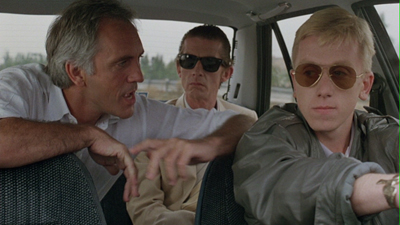
Flash forward ten years and Willie is holed up in Spain, living a life of quiet contemplation, alone with his books, bicycling the countryside. The jig is up for Willie, however, and that day, a group of young thugs are waiting for him. They put a sack over his head, throw him into a car, and deliver him to a pair of killers who have come looking for him. One is an experienced triggerman named Braddock (John Hurt), the other a twitchy kid by the name of Myron (Tim Roth), a bleach-blonde punk on his first job. Braddock and Myron are to drive Willie up to Paris, where he can answer to the recently released crime boss he put in jail. Then he will be shot.

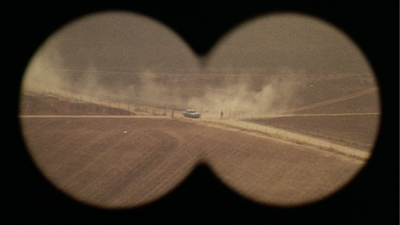
It was meant to be an easy grab-and-go, but the kids who nabbed Willie killed the cop who was guarding him on their way out and so now the heat is on. The police are on their trail pretty quickly, though always a few steps behind. The posse is lead by an officer played by the great Fernando Rey, whose presence is always felt despite the fact he only has a couple of lines to speak at the very end of the movie. That's star power right there, commanding the screen without saying a word.


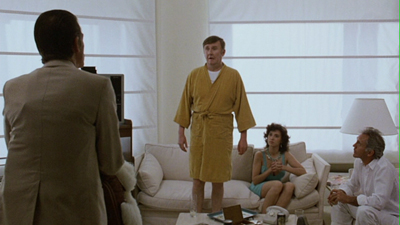
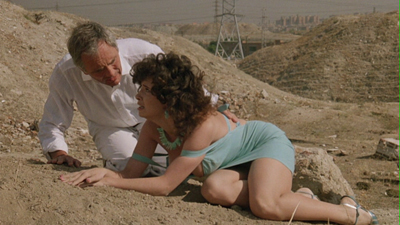
The road trip is one of constant screw-ups. A detour to get a new car off a local hood gains the group a fourth passenger, a Spanish prostitute named Maggie (Laura del Sol). The same stop also adds another body to the pile-up, Maggie's British boyfriend, another ex-patriot crook (Bill Hunter). Each pit stop only serves to blow their cover more, the cool criminals slowly unthawing and unraveling. Myron suspects this is all Willie's doing, that the Zen master with the white hair and white clothes has a plan to get under their skin and unnerve them, and judging by the evidence, he may be right.

Willie's monastic lifestyle seems to have served him well. When we first see Willie in court, he doesn't appear to be very smart. He's slow on the uptake, and it turns out he was merely the driver for the robberies. It's a low-level position in the criminal scheme of things, but symbolically, Willie does fulfill a role as a delivery agent, shuttling the others to their fate. By the time his own fate catches up with him, he is older, wiser, better spoken, and seeming free of any cares. He lightly accepts his kidnapping, cleverly manipulating Myron for information and needling both men in stressful situations to fray their nerves and give them cause to doubt the other. He's got them both made out pretty good, and he particularly sees Myron as a weak link. This is Tim Roth's big-screen debut, and he's already a feral little weasel, particularly as displayed in an impromptu fight Myron engages in at a roadside bar. He doesn't know when to shut up or settle down.


Braddock is the opposite. He is cool and measured, and John Hurt is as cold as Roth is hot. This puts Willie in the middle as someone who is neither one nor the other. His refusal to show concern, to scream or fight or even try to escape, undermines the confidence of both men. He knows he's going to die, what does he have to be so happy about?

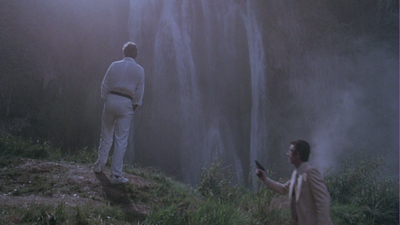
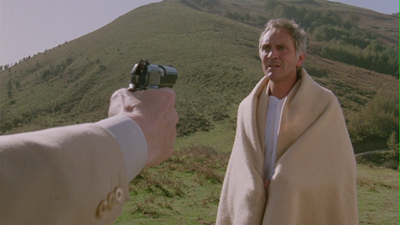
Well, everything really. Willie has accepted that all life is transient, that death is a move from one state to the next, and as he tells Myron, what happens on one side is pretty much the same as what happens on the other. If John Lennon, one of his personal heroes, could face the Grim Reaper, so can a nobody like him. Today, tomorrow, what's the difference? There is an almost religious serenity to how he carries himself. He looks like he is dressed to go down to the water and be baptized, a costume that I can only assume is intentional, particularly since on what could be his last evening on Earth, rather than run for it when he gets the chance, Willie instead stands by a waterfall and lets the mist cleanse him.


In the midst of this, the girl is the wild card. If being robbers is a game that boys play because they decided to never grow up, then the women are on the other side of the board where the game gets real. Unlike Willie, Maggie wants to survive, and indeed, has been making moves to ensure her survival since before these guys crossed her path. Laura del Sol is smart and feisty in the role, constantly looking for an angle out. Hers is the part of the watcher, the one who must always be looking and then react.


Stephen Frears had an extensive television career before transitioning into features with The Hit. I am sure the no-fluff approach displayed here is attributable to that background. When you're used to constrained resources, you learn to make anything count, and there is certainly nothing wasted here. The look of the film (it was shot by Mike Molloy) is cold and bare, with the action mostly taking place either in the car or in big, open spaces. The script by Peter Prince (Waterland) is extremely economical. There is nothing said in this film that doesn't advance the narrative. No stray outbursts from Myron, no extraneous speeches from Willie. Like I noted, we don't even get any instructions from the head of the police, they maintain a silent pursuit. Confidence affords an artist the luxury of never having to explain himself.


Like any road movie, The Hit isn't really about where these people are going, but how they get there. Or more accurately, how they arrive. Prince and Frears save a few surprises for the finale. When faced with the inevitable conclusion, each person reveals his or her true nature, and ultimately, the movie says something about what it means to live tough. (Spoiler: the toughest of all is the one without the penis.) Who is posturing, who has the courage of their convictions, will any of them see their future staring back at them from the barrel of a gun--these are things you have to watch the movie to find out.