Sunday, November 30, 2008

SIDELINE: MORE REVIEWS FOR 11/08

In addition to those reviews, here are some other movies I was able to scare up reviews for in the past month:

IN THEATRES...

* Synecdoche, New York, the directorial debut of Charlie Kaufman. The writer of Adaptation achieves his goals, but that doesn't mean the movie is necessarily good.

ON DVD...

* Looney Tunes: Golden Collection, Vol. 6, an amazing new set of some of the greatest cartoons of all time. Includes a war-themed disc and a disc of one-offs and special creations.

* Love Songs, an annoying "21st-Century Umbrellas of Cherbourg." Barf!

* Paris, Je T'aime, a re-release of the two-disc version of one of my favorite movies of recent memory.

* Popeye the Sailor: 1941-1943, vol. 3, the third set in the Popeye series takes us into the war years and a shift in production companies.

* Roberto Rossellini 2-Disc Collection (Director's Series), a double dose of the Neorealist from the filmmaker's 1950s oeuvre.

* Roman Holiday - The Centennial Collection and Sabrina - The Centennial Collection, Audrey Hepburn's first two films get a major DVD upgrade.

Monday, November 24, 2008

TRAFIC - #439


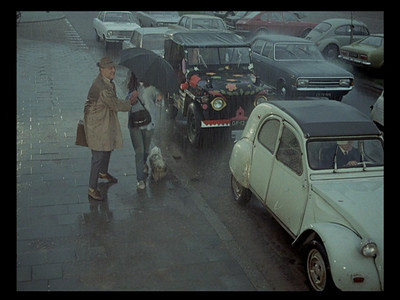
Throughout Jacques Tati's 1971 comedy Trafic, we get multiple updates regarding a rocket ship to the moon. It begins with the lift-off, when Tati's Monsieur Hulot and his driver are stopped at a mechanic's looking for help, and ends with the astronauts walking on the surface of the moon while they are at yet another mechanic further down the line. In that scene, the wrench-man Tony (Tony Knepper) and the truck driver Marcel (Marcel Franval) re-enact the spacewalk by moving in exaggerated slow motion around the auto shop. Hulot, frustrated by the slow progress that this goofing represents, gets angry, the final punctuation of an understated visual gag that connects many of the episodes in the film. Seeing the rocket blasting off as Hulot's land-based journey comes to a halt, Tati is casually playing with the cliché, "We can send a man to the moon, but we can't...[fill in the blank]."

In the case of Trafic, the blank would be "but we can't drive from Paris to Amsterdam." For this later Hulot feature, Tati has put his raincoat-wearing, pipe-smoking comic figure into a situation full of delicious irony: the seemingly impossible trek to an auto show in Amsterdam so that Hulot, now a car designer, and his company, Altra, can show off their latest vehicle. You'd think that one thing that folks in the business of building transportation devices could accomplish would be transporting their new model to where it needs to go. Ah, but no such luck! Engine trouble and blown tires, traffic jams, law enforcement, and multi-car pile-ups all await them, and not once does Hulot, Marcel, or the hyperactive press agent Maria (Maria Kimberly) ever consider that if the truck can't go the distance, they could just pull the car out of the back and drive it.


Jacques Tati has always been fascinated by the confluence of human ingenuity and modern living. Noting that machines rely on humans to keep them running as much as humans need their machines, he sees that both are dependent on and subject to human foibles. In Mon Oncle (1958), the writer/director/star sent Hulot to a fully automated house where he was delighted and confounded in equal measure by the endless array of modern conveniences, whereas in the monumental Playtime, (1967), he showed us how an entire city could work together as one amazing symphony. For Trafic, he reconstructs the ballet of highway travel.

Tati's films are mostly free of dialogue, with the focus instead being on the movements and the sounds of industrial life. The squeak of a windshield wiper can say as much as a verbal joke, and in a Tati film, he may even wring more laughs out of a situation by cutting through the need for vocabulary and getting right to the funny. In fact, there is a gag about windshield wipers in Trafic, coming near the end of the picture when the skies open up on one final congested road. Tati moves in to see a pair of women talking in their car, the back-and-forth of the wipers matching their wild gesticulations and the sound of rubber on glass standing in for whatever inane chatter they are engaged in. It's a perfect Tati moment, humans and machines working in concert. It's representative of his overall approach. Throughout the film, the director gives equal time to the technology and to the people who use it. He is just as likely to linger on an interesting face as he is a finely crafted piece of metal. One always needs the other to make Trafic work.


The windshield wiper incident isn't the only time the two things crossover, either. Earlier in the movie, gawking men on the street are seemingly admiring Maria's roadster, its structure and its accessories, only for us to realize that they are talking about the hot rod's hot driver when another attractive woman has crossed her path. In this case, Tati breaks form a little, creating a gag that uses technical jargon to show us how we are becoming one with our toys: men talk about women the same way they talk about cars. Within that gag is an added gag, a visual countermeasure that works in tandem with the leering fellows. We see in detail how Maria uses her car as a kind of fashion accessory, a mobile closet, stashing her clothes in various compartments, including her hat in the wheel well with the spare tire.

There are other wonderful moments of choreography in Trafic. Sometimes it works for the characters, such as the synchronized motorcycle cops who pull Hulot and Marcel over, and sometimes it all goes south, like when the distracted traffic conductor accidentally instructs all four directions to go at once, causing a hilarious pile-up worthy of an episode of "CHiPs." The sight gags in that sequence alone make the movie worth it, including a very pointed joke about a priest servicing his VW Bug as if it were an altar to be prayed at. Our cars have even become our religion!
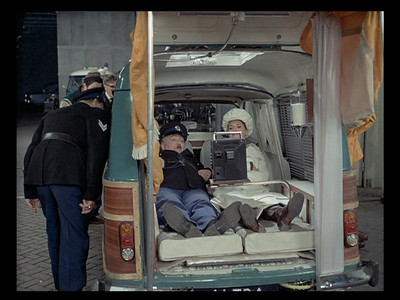


The true marvel of construction, though, is the car Hulot is looking to premiere at the auto show. Stopped by customs crossing the border from Belgium to Holland, the guys are forced to display their wares to the curious customs officials. As it turns out, the automobile Hulot has concocted is a camping vehicle, full of all the conveniences campers may need, from a pullout tent in the back to a front grill that converts to a barbeque grill. There are even blow-up mattresses in the bed of the car (oh, these puns!), an electric shaver in the horn, and a shower. It's like the house from Mon Oncle squished and mounted on four wheels. It also explains the fake forest Hulot's advance team constructs at the car show, complete with a big log that the single car that made it to Amsterdam drove in on its roof. It's another visual joke from Tati, this recreation of nature in the most unreal of places being a sign of our age. (Anyone doubting the size and spectacle of the auto show should revisit Louis Malle's auto industry documentary Humain, Trop Humain, which features footage of a similar convention; Tati did not need to exaggerate for comedy. Hell, the title could even be applied to Tati's oeuvre in the same ironic way Malle uses it. "Human, all too human.")

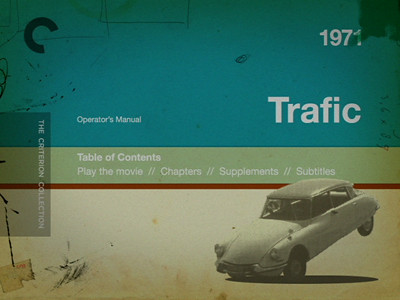
Fittingly, Trafic ends up not in this fake environment, but in a real lakeside hideaway. The last mechanic, Tony, is off the main road and by the water, and his refusal to work in the dead of night serves as Tati's admonition to all of us. Settle down, enjoy yourself, admire nature, because whatever you are rushing to will be there later. You may miss the big event, but so what? People will still buy your widgets, and at least you enjoyed yourself in the process. Thus, the meticulously constructed film (man, even the poster was a masterpiece of design! [see below]), ends on the simplest of notes: two people walking in the rain, leaving the vehicles they arrived in far behind.


Tuesday, November 18, 2008

THE SPY WHO CAME IN FROM THE COLD - #452


The thing that differentiates a great espionage picture from a bad or even merely good one is the same thing that drives the genre's detractors mad: the degree to which it leaves the viewer in the dark. When watching a spy movie, one should often be scratching one's head, sometimes even while exiting the movie theatre and the movie is over. Criss-crossing lies, duplicitous relationships, and a sense of futility are the spymaster's stock and trade. The Coen Bros. recently made great comedy hay out of the ridiculous obfuscation of these kinds of stories in their film Burn After Reading, keeping their hapless C.I.A. agents guessing as much as the audience--though in that case, the audience knew what the government didn't, that it all looked meaningless because it really was.

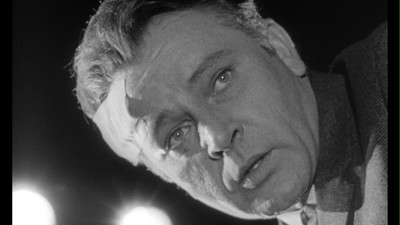
In the 1965 adaptation of the John le Carré novel The Spy Who Came in from the Cold, everything hinges on a similar question: does it mean anything at all to be out there fighting the Cold War, or do the wheels just continually grind on? Meaning vs. meaninglessness is of the utmost importance. The lead cloak-and-dagger man of the film, British covert agent Alec Leamas (Richard Burton), is regularly asked to state his beliefs. He says he has none, be it in God or Karl Marx or Santa Claus, and the answer is always met with skepticism. One of his enemies, the Communist agent Fiedler (Jules and Jim's Oskar Werner), even goes so far as to ask how a man can sleep at night without some kind of philosophy to keep him warm.


Alec is a veteran of the Cold War, having been the long-term head of British operations in East Berlin. He's seen it all, the trading of human lives and the dogmatic adherence to rules that forbids lending a helping hand to a defector running across Checkpoint Charlie until he's already reached the safety point. It leads to a man's death and gets Alec pulled back to England. He thinks he's going to be fired, but his boss (Cyril Cusack) has a much more ironic assignment for him. He will pretend to retire instead of taking a desk job, letting his disgruntlement be known, and then pose as a defector himself. Once he has crossed to the other side, he will confess to evidence that the Brits had planted long before, implicating the #1 commie, a former Nazi named Mundt (Peter Van Eyck), as a traitor and giving Fiedler reason to make a move against him.


That is about as clear about the plot as I want to be without giving too much away. That's even more than I knew going in, and the air of confusion and mystery is created rather quickly once Alec begins his undercover work. For the beginning of it, I wasn't quite sure if he had accepted the assignment or not, and until he meets one of le Carré's most popular characters, George Smiley (this time played by Rupert Davies), his true motivations for his prior actions are left unexplained.

As are his true emotions. It's in that meeting with Smiley and their boss, the aptly named Control, that we get the sense that the young radical Alec met at the library he has been working at has actually made an impression on the heavy-drinking spy. The girl, Nan (Claire Bloom), is an idealist who thinks communism can bring peace, and her earnest commitment is laughable to an old cynic like Alec. Even so, the girl is kind to him, and when it looks like the operation to smear Mundt is going to get dangerous and pull him out of England, Alec does his best to protect her. Of course, this will also be his biggest mistake: for a man who sees no meaning in anything else, the fact that Nan now means something to him won't fail to go unnoticed.


The world of The Spy Who Came in from the Cold is a harsh one full of moral tundras that make the distinction between right and wrong seem childish. Even the phrase, which refers to an agent like Alec being brought back to regular life after field service, evokes a landscape that is dangerously chilly. (So much so that the characters in the film are always bundled up, no matter what country they are in.) If there is ever a case to be made for why some movies work best in black-and-white, it's a film like this, where the basic tonal values of the photography can drive home the extreme gulf between the warring points of view, not just in the use of whites and blacks but in all the grays that lay in the middle. Director Martin Ritt (Hud) and cinematographer Oswald Morris (Kubrick's Lolita) avoid the more stylized film noir aesthetic and its angular, perfectly placed shadows, instead choosing to go for a stark look borrowed from the Kitchen Sink school. The anger and the bile of working class British men is there in Alec, too. Richard Burton plays him as if he is always on the edge of an explosion, and when the flare-up does come, it's like a verbal pummeling, particularly in his climactic speech to Nan where he lays out all of the sordid details of his occupation, exposing the falsity of Control's earlier speech about what separates a noble society like England from their foes.
The true message that Alec must accept, though, is the one he delivers to Nan earlier. After discovering her anti-nuke, power-to-the-people leanings, Alec tells her an espionage parable, based on events he witnessed, where two grey trucks converged on a highway, crushing a family station wagon that was driving down the middle of the road between them. He didn't see the crash himself, he had moved on, never looking back. Though he thinks that the point of the story is that the mighty, interchangeable forces of world government always trample the innocent underfoot as they rush for power, the true message is the one that everyone else is trying to teach him: you can't stay in the middle, one must choose a side. It doesn't have to be either of the grey behemoths or even either side of the Wall they have built to separate their ideologies, it can be taking a stand against both of them in defense of the station wagon. You just have to stand for something. If you don't, you will find yourself caught in the no man's land, confused as to why the men on both sides of the divide have their guns trained on you.


For a full rundown on the special features, read the full article at DVD Talk.

Friday, November 14, 2008

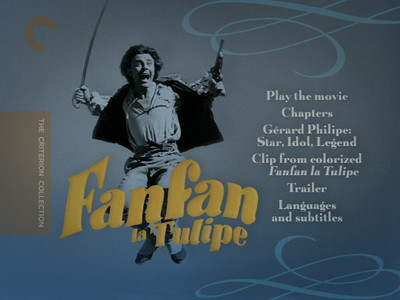
FANFAN LA TULIPE - #451


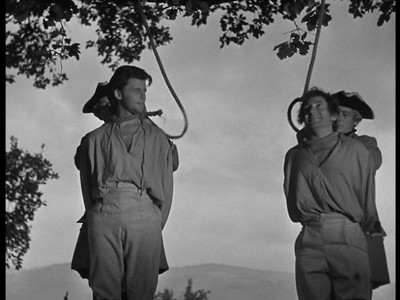
Fanfan la Tulipe is a ridiculously entertaining adventure film, nothing more, nothing less. The 1952 French swashbuckler is classic moviemaking at its most fun, a lightweight actioner with a wink in its eye and a sparkle in its smile.

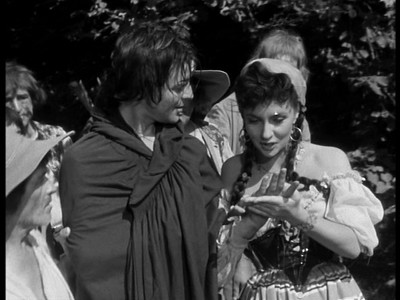
Matinee idol Gerard Philipe is the title character, a rapscallion who joins the army of Louis XV (Marcel Herrand) in order to escape a shotgun wedding with a provincial lass. He signs up believing it will lead to his marrying the King's daughter, Henriette (Sylvie Pelayo), a false prophecy delivered by the daughter of the captain of the guard, a luscious lass who pretends to be a gypsy. This gal, Adeline (Gina Lollobrigida), has wooed many a man into believing many a lie all in the service of lining daddy's regiment. Of course, she has met her match in a rogue like Fanfan, and even after he is told she duped him, he continues to believe that a royal wedding is in his future.


As fate would have it, this far-fetched notion may not fetch as far as originally thought. On his way to basic training, the caravan of La Franchise (Nerio Bernardi), Adeline's pa, happens to be riding parallel with the carriage of Princess Henriette and the Marquise de Pompadour (Genevieve Page) when it is attacked by highwaymen. Though the other soldiers would rather hide and let the bandits pass, Fanfan rushes to the rescue, sword in hand. He successfully routes the attackers, and the Marquise presents him with a bejeweled tulip, hence his nickname. Having now glimpsed his romantic quarry, Fanfan will stop at nothing to scale the castle walls and glimpse her again, getting himself and his pals into trouble and inadvertently winning the affection of Adeline, who then manages to capture the hearts of Fanfan and King Louis alike. And why not? She's Gina Lollobrigida, for goodness sake, and while women as beautiful as her have started many a war, she may be the first to have ended one. In his fight for her hand, Fanfan manages to bring the Seven Years' War to a close. All in a days work!

If my writing skills are worth a damn and that description was fun for you to read, then you will certainly enjoy Fanfan la Tulipe. I enjoyed writing the above, and I definitely enjoyed watching the flick. Directed by Christian-Jaque, this comic action picture is about as unpretentious a pleasure as you are likely to find. It's not overly elaborate, nor does it intellectualize, but it's not stupid either. In fact, there are some quite clever touches, including a narrative voiceover that casts a wry eye backwards over history, and a reverse masking audio effect that renders the English soldiers' dialogue as incomprehensible to our ears as it would have been to their French enemies. It sounds like a one of the adults from the Peanuts animated cartoons wandered into a Twin Peaks dream sequence.


Gerard Philipe is an irresistible cinema star. He may not be as acrobatic as Douglas Fairbanks, but he's at least as much of a rake as Errol Flynn. His boyish good looks and optimistic charm makes him a joy to watch, and his continual and often unexplained outsmarting of his enemies is almost as funny as the many times he cockily blunders into his own defeat. Philipe has a natural agility that makes the swordplay appear easy. One can't help but root for him to get the girl and save the day.

Fanfan la Tulipe is bawdy, exiting, romantic, and a tad bit silly. In other words, totally delightful.


For a full rundown on the special features, read the full article at DVD Talk.

Wednesday, November 12, 2008

THE DISCREET CHARM OF THE BOURGEOISIE - #102


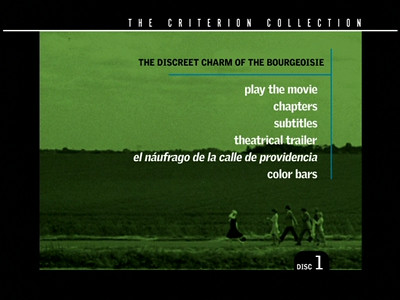
At several intervals in Luis Bunuel's biting satire, The Discreet Charm of the Bourgeoisie (1972), the director impishly cuts away from the main story to show us his six characters walking down a desolate road in the middle of an open plain. They are fully dressed, the men in suits and the women in dresses, and slightly hurried without looking too concerned. We never see where it is they are going. Is this a kind of purgatory they have found themselves in, or is it merely a symbol of the futility of their petty lives? Or could it be that these things are one in the same?

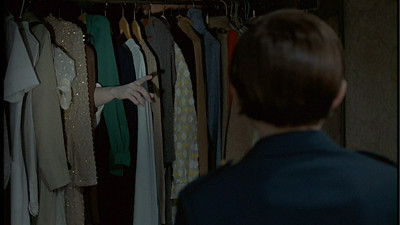
The Discreet Charm of the Bourgeoisie is an episodic savaging of the well-to-do French middle-class. An old surrealist, Bunuel builds a puzzle box of a movie, full of stories within stories, dreams within dreams. At several points, we cut to one of his dyspeptic gentlemen waking from sleep, horrified by what he--and by extension, we--just saw. Amusingly, the dreams often go several scenes back, including another guy waking up in bed, so that the second dreamer was actually imagining the first dreamer and his disturbing vision. Not unlike watching a film where the characters might suddenly become aware they are being watched. Or if the viewer could turn around and discover that he or she is being filmed.


The vignettes all revolve around meals that six friends try to partake of together. Luncheons and dinners are how these people congregate, the way they gather to share their banal views on politics and the world around them. They are demanding of the service class and blind to their problems. On their first outing, where the would-be diners are required to a go to a restaurant due to a mix-up with dates, they discover that the owner of the inn has died and is in the next room waiting to be taken to the funeral parlor. The employees he left behind plan to go on with their duty and still serve customers, but the friends all leave rather than have their meal. Not because they feel bad, but because they find it inconvenient. They can't even see the necessity of work, that these others must carry on in order to survive.

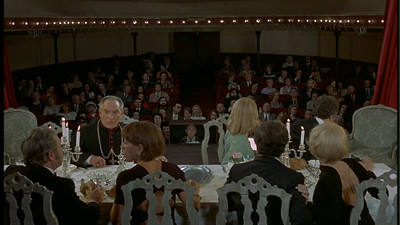
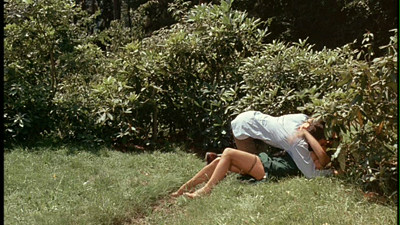
All of the meals this group tries to sit down to are interrupted in similar ways, and in each, something is revealed about the humanity the bourgeois are so desperate to bury beneath their tailored manners and carefully chosen banter. One lunch is postponed due to the host and hostess, Alice and Henri Senechal (Stephane Audran and Jean-Pierre Cassel), having sex outside in the bushes rather than be heard doing it in the house. Not that it wouldn't be easier to control their urges, but suppressing them would be admitting they have them. One dream of a failed dinner party sees the group on stage, mocked by an audience, Henri unable to remember his lines. In a dream immediately after, Rafael (Fernando Rey), the South American ambassador of the fictional country Miranda, shoots the host, an army colonel (Claude Pieplu), for insulting his country; again, not because it's untrue, but because you don't say such things out loud. This is the same group, after all, where the men smuggle cocaine into the country but will sit around sipping martinis and denouncing drug addicts as disgusting.


Bunuel clearly finds the social mechanisms of the bourgeoisie to be hilarious, and the discreet charm he is looking for encompasses the hypocrisies and the foibles that they try to pretend don't exist. Greed, hunger, lust, these are all things they assume of the common man, but never of themselves. The director's scenarios are like little pranks he plays on his subjects, provoking them to react. At the same time, the laughter has a morbid timbre. A metaphysical dread hangs over the movie. Again, I think of purgatory, that Bunuel has trapped these dead souls in his film until they can figure out for themselves how empty their lives are. The specter of death hangs all around them. In the dinner party play, they are prompted to invite a ghost to sit with them. One solider whom they meet twice tells them stories about his dead mother, one allegedly a memory where she instructs him to kill his father, another a dream where the ghouls he meets seem to intimate that he is as dead as they are. “You smell like earth,” he says to one, only to earn the reply, “So do you.”


In the end, the fate that Bunuel's dinner party suffers is that of their own making. Each interruption carries with it the fear of punishment, that sins will be exposed. It's ironic, then, that when the punishment does come, there are no charges leveled against them, and of course they admit to nothing. Yet, when Rafael destroys his own escape by exposing himself in order to get another bite of lamb, the implication is obvious: they do it to themselves. Of course, it also makes sense that we are now in Rafael's dream, and upon waking, having learned nothing, he runs to the fridge to devour some leftovers like a wild dog tearing into roadkill.


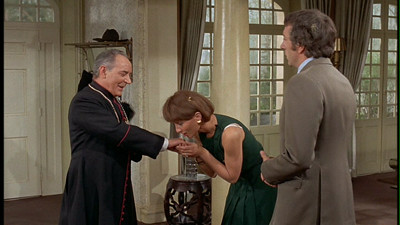
Since this is Bunuel, religion does not escape being parodied. The character of Monsignor Dufour (Julien Bertheau) is actually the most interesting of the lot, having the most complete story arc of any of them. He comes to the Senechal house on the day when the couple is rutting in their garden with the same sort of impulse control that got Adam and Eve expelled from Eden. With the others already having fled, fearing a police raid, and the maid (Milena Vukotic) at a loss to explain where her employers have gone to, the Monsignor takes it upon himself to fulfill the purpose of his visit. He has heard that the Senechals have fired their gardener, and he would like to take over the position. He goes down to the gardener's hut and gets dressed in the uniform, relishing in the straw hat and the tools of the trade the way an s&m dabbler might fetishize leather boots and whips.

When the Monsignor at last meets Alice and Henri, he is dressed as a gardener. They rebuke him, not believing he is a priest. When he returns wearing the uniform of his office, they suddenly kowtow to him, everyone involved completely missing the analogy to a Christly parable about how the those who lack spirit will not recognize God when He is standing in front of them.

Of course, the Senechals aren't the only ones to blame, the Monsignor is also guilty of kowtowing to these wealthy and vapid people while also being smug and patronizing to the poor who truly seek guidance, like the maid who honestly believes or the doubting peasant woman (Muni) who comes to retrieve him to perform last rites on a dying man (Georges Douking). He listens to them, but then dismisses them with empty platitudes. He doesn't even connect the dots when he is told the ailing man is a gardener who recently lost his job. This is the very gardener the Monsignor has replaced! A deeper connection is revealed, however, when it is discovered that this is also the man who had killed the priest's parents when he was just a boy. It's like a scenario out of a sweaty potboiler. No wonder the Monsignor is obsessed with gardening, he has been walking in the shoes of the killer who orphaned him!

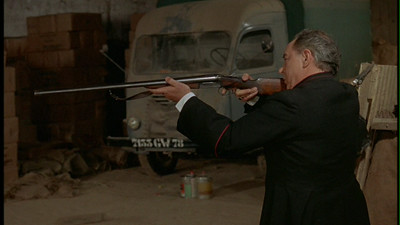
When the dying man asks for forgiveness, the Monsignor goes through the motions and gives him absolution. He then picks up a shotgun and murders the murderer. Just as it is in everything else, the clergy also say one thing and do another.


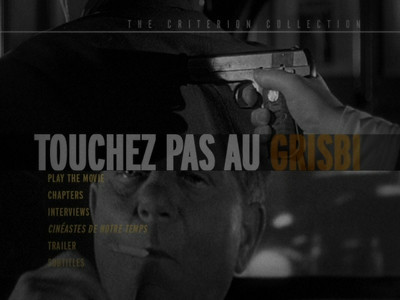
TOUCHEZ PAS AU GRISBI - #271


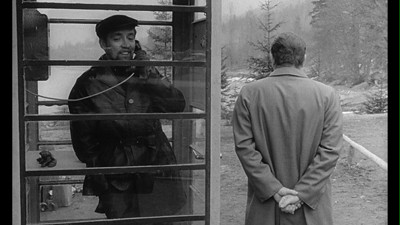
In Touchez pas au grisbi (1954), Jean Gabin's Max the Mentor precedes Jean Servais' Tony le Stephanois from Rififi by only a year, but in a way, the two are as far apart as they could get. Then again, there is a lot about them that is the same, as they are both aging gangsters who are seeing that their time in the crime game is growing short. You could almost turn these two films into companion pieces, a single epic about two friends on opposite sides of the tracks. Call it something like Rich Crook, Poor Crook.

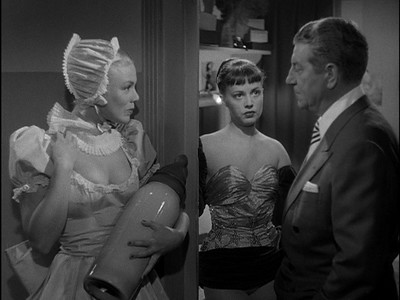
Whereas Rififi is set in rundown streets and hollowed-out buildings, Jacques Becker's Touchez pas au grisbi (translation: "Hands off the loot!") shows us the ritzy Parisian nightclubs where men of means pursue their more lurid hobbies. Whereas le Stephanois has had a less than successful career that has included jail time, Max has managed to stay on top for the duration. His nickname denotes the level of respect that others have for him: he's seen it all and knows how it's done. He spends his nights enjoying himself, indulging in the ladies and what have you; yet, he also manages to stay disciplined. He eats properly, stays clean, maintains a personal order.


Perhaps sensing something is in the wind, Max decides it's time to move on. He has made a big score in gold with his longtime partner Riton (Rene Dary), and once he unloads it, he can go off the job. For a guy who values being in control, things are starting to slip away that will make this complicated. Riton has a new girl (a young Jeanne Moreau) and information from his loose lips passes to hers, and then on to Angelo (Lino Ventura), the drug dealer angling for the top spot. Max even tries to offer up his own protégé, Marco (Michel Jourdan), to plug the hole he will leave, but it's no good. Riton gets kidnapped, and now Max's last big score will have a totally different payoff.

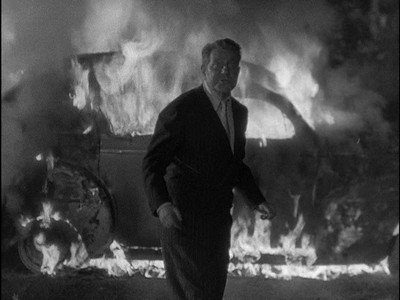
In contrast to the control Max is losing over his own life, Jacques Becker exerts it in spades over his film. Touchez pas au grisbi is masterfully constructed, moving at a confident pace and building in tension and suspense as Max's predicament worsens. It would be easy to just pile the conflicts on the beleaguered hood, but Becker is exacting in his plotting, twisting the plot only when it makes sense, not just for the sake of having more kinks in the narrative. The finale of the picture is haunting and desolate, involving a burning car far off the beaten path, a flaming symbol of the tragic end that could await all of these players if they don't maintain the core values of loyalty and commitment to purpose that Max has always placed his trust in and that have carried him through this far.


As a personal aside, the scenes with the car in Touchez pas au grisbi bring to mind something that happened to me when I was younger. It was in my college years, during a period where I regularly drove back and forth from Los Angeles to where I lived in the high desert because there was nothing to do in our town. One night, on the opposite side of the freeway, I saw a car stopped in the middle of the road, its headlights on, and a man on his hands and knees in front of it, facing the vehicle. No one else saw it. I was driving, and my passengers insisted I was crazy. But I know I did, I know it was there.

I guess it's neither here nor there, and it seems like something out of a modern rural crime picture than Jacques Becker, but Grisbi makes me think of it all the same.

This was prepared as part of my review of the boxed set 10 Years of Rialto Pictures for DVDTalk.com.


Tuesday, November 11, 2008

BAND OF OUTSIDERS - #174

"From difficult child
To spectral hand
To Claude Brasseur
Blah blah blah
"

-- Morrissey, "At Last I am Born"


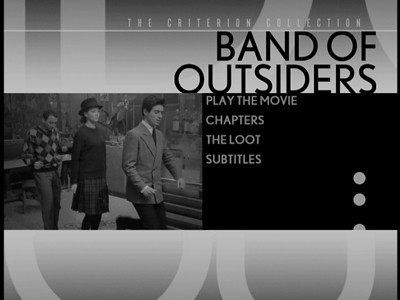
Jean-Luc Godard's Band of Outsiders (Band a part) has been gaining in reputation over the years as one of his most playful self-reflexive genre benders, a riff on a Fritz Lang film noir that manages to confine the director's impulses in its old Hollywood structure and also give him as much freedom to goof around as he was ever likely to find. Even more so than his musical comedy A Woman is a Woman, this meta heist picture brims with the joyous belief that anything is possible. As long as there is film in the camera to capture it, nothing is too silly. Perhaps it was the fact that a Technicolor musical was already expected to be fun that makes A Woman is a Woman slightly less so than Band of Outsiders, as if fun is its own restriction whereas the daring of the unexpected is far more liberating.
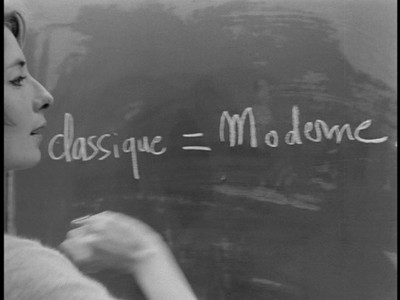


As with most of Godard's genre deconstructions, Band of Outsiders has a plot of sorts. Two thugs--the physical Arthur (Claude Brasseur) and the more sensitive Franz (Sami Frey)--vie for the affection of Odile (Anna Karina), both because she is cute as can be and because her miserly uncle keeps a fortune hidden in his big house on the outskirts of town. Odile is cold yet interested, not necessarily committal but not entirely aloof. As with anything, the guy who pushes the issue has the most success, and so Arthur has the edge on Franz. One can bully in romance just as one can be a bully in anything else. It's also Arthur who pushes hardest for the crime, and Odile and Franz must just go along, even as it is clear that they are heading for disaster.

Like any heist film, more time is spent on the planning than the robbery itself. In the case of Band of Outsiders, though, the gang doesn't sit and pour over plans as much as they sit and pour over each other. The preamble to the act involves a lot of sitting around and waiting, of biding their time as if they are at a job and waiting for the boss to leave for the day. Here is where Godard gets most of his kicks. It's in these moments of boredom where inspiration can blossom. Thus, we get the trio dancing "the Madison" in a cafe, framed like a pause in the film, a momentary aside (and later to inspire Quentin Tarantino, whose production company's name is a play on the movie's French title). We also get the famous scene where they see how fast they can race from one end of the Louvre to another.


In the end, the outcome Godard provides for his characters is like an affirmation of their choices. Franz and Odile are more adaptable, subject to change, more in tune with the demands of the heart, whereas Arthur must plow forward like a bull intent on the single target, even as it becomes more evident that doom lurks in the background. Though Arthur's fate is just as much a staple of gangster movies as Odile and Franz's fate, it is also the more real, fulfilling its own promise. As for the others, Godard tells us they will have a happy ending that is generally only found at the end of a Hollywood production, and they will have an ever after seen in a sequel that there was likely never any serious intention to make. It's as if riding off into the sunset is more final than the alternative, or perhaps just unreachable. Only in Hollywood, not anywhere else, and not amongst the self-invented wannabes of a B-movie love story from France.


This was prepared as part of my review of the boxed set 10 Years of Rialto Pictures for DVDTalk.com.