Showing posts with label jeanne moreau. Show all posts

Saturday, November 24, 2018

ELEVATOR TO THE GALLOWS - #335


There is something dazzling about how softly Louis Malle weaves together all the narratives in his 1957 debut, Elevator to the Gallows. What is seemingly random happenstance, a sorry turn of fate, eventually swirls its way back around to be important, to affect change and create an unavoidable outcome. Elevator to the Gallows is perfect French noir, taking the bleak criminal narratives of American film noir, injecting a touch of politics, and amping the existential irony to degrees that would impress even Sartre. Every well-motivated action will bring about bad results, every attempt to escape just tightens the noose.


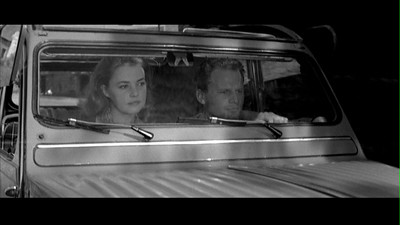
The plot is supposed to be simple: army veteran Julien Tavernier (Maurice Ronet, The Fire Within [review]) is going to kill his boss (Jean Wall), a war profiteer, and make it look like suicide so he can run away with the man’s wife, Florence (Jeanne Moreau, The Lovers [review]). The plan is to do the deed in the boss’ office on Saturday, leaving him to be found when the workweek resumes. After a distraction causes Julien to miss a crucial detail, however, he has to head back to the scene of the crime--where he promptly becomes locked in the elevator when security shuts down the building for the weekend.

With Julien trapped, things begin to unravel. Feeling jilted when he misses their rendezvous, Florence wanders the street looking for him--even after she spots his car leaving town, the young girl from the flower shop (Yori Bertin) riding in the passenger seat. What she doesn’t see, though, is that Julien is not the driver. Rather, it’s the girl’s delinquent boyfriend (Georges Poujouly, Forbidden Games) taking the convertible for a joy ride. And from here we have as series of misadventures and misunderstandings, the night intensifying, becoming more desperate, the narratives growing simultaneously more disparate and more tangled.


Elevator to the Gallows works as a taut crime thriller, but it’s also a story of romantic longing. While on the elevator, Julien worries less about being caught and more about leaving Florence waiting. He tries everything he can to escape, Ronet turning in a quiet, determined performance, showing the soldier thinking through every potential angle. Malle works the tension of the moment via the claustrophobia, putting the camera in tight so as to almost insert the viewer into the scenario. I can’t imagine myself being even close to as resourceful as Julien were I in the same situation. There is also one moment of genuine peril that gets the heart racing in a movie that otherwise takes its time.


It’s really Jeanne Moreau who carries the film, however. A seemingly simple role, the part of Florence mostly involves walking the streets, peering in doorways, and conveying a sense of deep longing. Even without her voiceover to give us further insight into her feelings, Moreau’s performance is so compelling, her sadness so electric, one can’t take one’s eyes off her. Indeed, as she passes pedestrians, they all stare, proving how magnetic Jeanne Moreau truly is. It’s not the camera they peer into or that draws their attention, it’s her. And her true strength is how expertly she blocks them all out. Watch her in the one shot where she crosses the street, never looking at the cars, but yet passing perfectly through traffic. How did they choreograph that? It looks more dangerous than Julien’s elevator shaft stunt!


There is a contrast to be seen here between the two sets of lovers, between the dedicated and deeply felt adults, willing to take any chance to be together, to the more impulsive and superficial bond between Louis and the flower girl. The troubles that befall Julien and Florence are unforeseen consequences of considered decisions; the trouble Louis causes is a product of adolescent chaos, and Véronique’s solutions just the same. In most other stories, the inevitability of tragedy would be reserved for the younger star-crossed lovers. How much more tragic, then, that we never actually see Julien and Florence together, and almost never see Louis and Véronique apart? In noir, there is no young and old; all of us must receive our due comeuppance.


Malle’s approach is a mixture of New Wave realism and Dassin-esque artistry. The grainy exteriors mask the artifice of the plotting, while the naturalistic performances invigorate the carefully constructed story machinations. Moving through all of it is Miles Davis’ famous score, lending a bit of Americana to the very French proceedings, while also emphasizing Elevator to the Gallows’ aimless melancholy. The music seems particularly on point when it shares the screen with Moreau, as if she were the muse teasing every note from Davis’ trumpet.

Beyond the story, Elevator to the Gallows is the meeting of these three singular talents, a chemical formula that would have been impossible to predict, much less replicate. It couldn’t have worked if any of the participants had been swapped out, and yet it’s also so organically magical, it doesn’t feel like it could have been planned. It’s the perfect collision of performance, of visual and audio, resulting in a film that transcends its own genre trappings to be something entirely unforeseen.


Wednesday, November 12, 2008

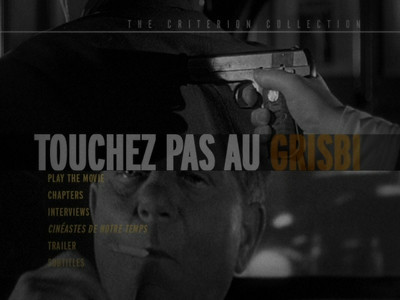
TOUCHEZ PAS AU GRISBI - #271


In Touchez pas au grisbi (1954), Jean Gabin's Max the Mentor precedes Jean Servais' Tony le Stephanois from Rififi by only a year, but in a way, the two are as far apart as they could get. Then again, there is a lot about them that is the same, as they are both aging gangsters who are seeing that their time in the crime game is growing short. You could almost turn these two films into companion pieces, a single epic about two friends on opposite sides of the tracks. Call it something like Rich Crook, Poor Crook.

Whereas Rififi is set in rundown streets and hollowed-out buildings, Jacques Becker's Touchez pas au grisbi (translation: "Hands off the loot!") shows us the ritzy Parisian nightclubs where men of means pursue their more lurid hobbies. Whereas le Stephanois has had a less than successful career that has included jail time, Max has managed to stay on top for the duration. His nickname denotes the level of respect that others have for him: he's seen it all and knows how it's done. He spends his nights enjoying himself, indulging in the ladies and what have you; yet, he also manages to stay disciplined. He eats properly, stays clean, maintains a personal order.


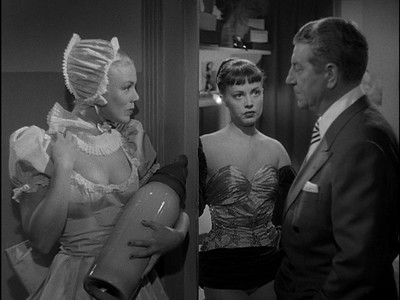
Perhaps sensing something is in the wind, Max decides it's time to move on. He has made a big score in gold with his longtime partner Riton (Rene Dary), and once he unloads it, he can go off the job. For a guy who values being in control, things are starting to slip away that will make this complicated. Riton has a new girl (a young Jeanne Moreau) and information from his loose lips passes to hers, and then on to Angelo (Lino Ventura), the drug dealer angling for the top spot. Max even tries to offer up his own protégé, Marco (Michel Jourdan), to plug the hole he will leave, but it's no good. Riton gets kidnapped, and now Max's last big score will have a totally different payoff.

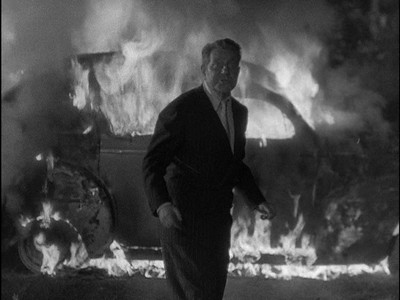
In contrast to the control Max is losing over his own life, Jacques Becker exerts it in spades over his film. Touchez pas au grisbi is masterfully constructed, moving at a confident pace and building in tension and suspense as Max's predicament worsens. It would be easy to just pile the conflicts on the beleaguered hood, but Becker is exacting in his plotting, twisting the plot only when it makes sense, not just for the sake of having more kinks in the narrative. The finale of the picture is haunting and desolate, involving a burning car far off the beaten path, a flaming symbol of the tragic end that could await all of these players if they don't maintain the core values of loyalty and commitment to purpose that Max has always placed his trust in and that have carried him through this far.


As a personal aside, the scenes with the car in Touchez pas au grisbi bring to mind something that happened to me when I was younger. It was in my college years, during a period where I regularly drove back and forth from Los Angeles to where I lived in the high desert because there was nothing to do in our town. One night, on the opposite side of the freeway, I saw a car stopped in the middle of the road, its headlights on, and a man on his hands and knees in front of it, facing the vehicle. No one else saw it. I was driving, and my passengers insisted I was crazy. But I know I did, I know it was there.

I guess it's neither here nor there, and it seems like something out of a modern rural crime picture than Jacques Becker, but Grisbi makes me think of it all the same.

This was prepared as part of my review of the boxed set 10 Years of Rialto Pictures for DVDTalk.com.


Monday, May 12, 2008

THE FIRE WITHIN - #430

"Life flows too slowly in me. Tomorrow I kill myself."


The Fire Within, Louis Malle's 1963 mediation on the Pierre Drieu La Rochelle novel Le feu follet, is surely a polarizing piece of cinema. The above line, spoken by Maurice Ronet in the role of Alain Leroy, recovering alcoholic and depressed lout, isn't a metaphorical come-on. He really means it, and The Fire Within is 108 minutes of watching Alain prepare for his suicide.

Suicide is still one of those subjects that authors and filmmakers tend to be shy about. More often than not, when the topic is examined, it's either from the point of view of someone avoiding it or more likely about the fall-out the suicide leaves behind and the effect the death has on his or her loved ones. It's always been odd to me that there aren't more fictional endeavors that seek to understand the point of view of the suicide himself (I hesitate to call anyone a suicide "victim;" you certainly couldn't do so for Alain in this movie). In a day and age when a serial killer can be the protagonist of a TV show, a person taking his own life is still taboo, still not talked about. Some fear that maybe such a film will romanticize the idea and make the choice seem attractive; others may just fear to entertain the possibility because they fear what they will see at that edge of life, or they are so set in their ways about it being wrong or cowardly or what have you, they don't even bother to look at the grayer nuances of the morality.

Again, any of those fears could just as easily be applied to a sociopathic killer. You might make murder look cool, you might have to accept your own violent fantasies, and Jesus, yes, murder is wrong!

Louis Malle disproves all of those concerns in The Fire Within, and he does so by not addressing them at all. There is nothing romantic about Alain Leroy's final days, and whether Malle answers any questions about himself within the narrative is an item he keeps to himself (though, we do know that he lived a happy and productive life long after completing the movie, dying from lymphoma in 1995 at the age of 63; so, clearly making this picture didn't push him over the edge). Questions of right and wrong don't even come into play. Alain has made his decision, and the camera merely follows him on his way.

"The thing is, I can't reach out with my hands. I can't touch things. And when I do touch things, I feel nothing."


When we meet Alain, he is on his first outing following four months of intensive detox at a clinic in Versailles. Alain, as we will learn, was once the life of the party, a pretty boy who has destroyed his looks and his nerves through an excess of alcohol. The ladies loved him, and as we'll see over the course of the movie, often more out of a desire to take care of the lost little boy than anything sexual. As it is, Alain is currently on a date of sorts with Lydia (Lena Skerla), a woman who is not his wife. Alain left his wife, Dorothy, back in New York, where apparently his demons got the better of him. Dorothy has ended all contact with her husband, and despite whatever horrible things Alain did to cause this, Lydia still encourages him to run away with her. Alain has other plans.

Malle smartly keeps Alain's past sketchy. If Dorothy can't forgive him, we might not be able to either if we knew what he had done to earn her disdain. We only learn more about Alain's past as he encounters people who were a part of it. Some are oblivious to the changes in him, only remembering what a wild man he once was; others cautiously believe that he will return to his former self; while still more pity a man who is a mere shell of his youthful Bacchanalian image. Alain falls mostly in the latter category. He holds no pride in his past, seeing it as a string of failed connections. He has no one, and that makes him no one. (As Morrissey would say, "I enter nothing, and nothing enters me.") He wanders through Paris, seeking to make peace with his friends on the eve of his final deed, like a hero in an F. Scott Fitzgerald story. Charlie Wales in "Babylon Revisted," visits his old friends because he wants to prove he has changed; unlike Charlie, Alain has accepted that he has not. Maybe he has found some clarity, but once the cloud of booze has been lifted, there is not much remaining that's worth liking.
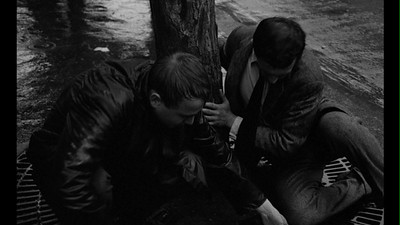


A perpetual gray hangs over The Fire Within, like Alain is stuck at the moment when the sun has just begun to set. The only atmospheric changes to come are rain and the skies growing even darker. For a lot of the picture, particularly when outside or in the larger apartment of Alain's friends the Lavauds (Jacques Sereys and Alexandra Stewart), Malle and cinematographer Ghislain Cloquet keep a respectable distance, shooting Alain with a preservative pallor. He walks through Paris like it's a museum, pausing next to statues, visiting his old haunts like exhibits of a distant artistic period. Here is the bar where I had my morning pick-me-ups, and over here the apartment where my former drinking buddy has settled into a life of family and letters. On the other side, you will find my friends the radical political activists, still pursuing the lost cause the way my poet pals still pursue medicated oblivion.

In some fashion or other, Alain tells all of these people that he is going to kill himself, something we know those contemplating suicide will do. For the most part, they choose to ignore it, thinking their friend is being dramatic and will snap out of it. Only Jeanne (Jeanne Moreau), who lives amongst the decadent poets, seems to take it at face value, accepting her own helplessness with regret when she lets Alain get away. These reactions serve to establish that otherness that Alain talks about. Conversation proves his separateness from other people, the camera shows he is one step removed from his surroundings. Even his confining room in the clinic appears larger than him, the clutter of his life arranged in an attempt to mimic the clutter of the outside world, but serving more like a mausoleum. Or, again, like a museum--a place where the defunct is entombed for posterity. The photos of Lydia and Dorothy, a brunette and a blonde, the attainable and the irretrievable, that Alain keeps on his mirror are no substitute for the real thing.

The Fire Within is a sad movie, but it's also engrossing in a way that is almost counterintuitive. I found myself worrying more that Alain might fall off the wagon and take a drink than I was if he would carry through with the suicide. In fact, if I'm being honest, what worried me about that was that if he got too drunk, he might not carry it through. If Alain were to go on a bender, he could get stuck in the same cycle and never get out. I suppose I could have been wishing for a parable out of the Albert Camus school of thought, using the writer's concept of the plight of 20th-century man, which has so fascinated me and been a part of my own work, the idea that by accepting the need to kill oneself, a metaphysical death occurs that makes the physical one redundant. Yet, again, there is not a lot of philosophy here. Alain discusses a variety of ideas about the forward momentum of existence with his buddy Dubourg (Bernard Noel), the armchair Egyptologist, but Alain has already reached that Camus state. The larger questions no longer concern him.

"I leave you with an indelible stain."
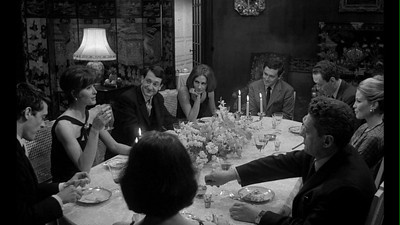


It would be silly to think, though, that Malle is able to avoid all moral questions in regard to Alain's decision simply by not bringing them up. Every viewer enters into The Fire Within with his or her own set of morality, and while ideally any story can take us out of our own safe world and teach us a little something about what others experience, in the end we still can only measure what goes on in that story against what we already know or believe. In my case, for instance, I found myself differing from Alain when Malle reveals what words his subject intends to leave behind. Alain only composes his note on the day he is to commit the act (July 23, the date written across his mirror), after indulging in a morning comprised of the purely mundane. He packs up his things, finishes the book he has been reading, and takes down his photographs.

In this tidying up of his own mess, Alain brings to mind the character of Robert Frobisher in David Mitchell's Cloud Atlas. Frobisher chooses suicide for very different reasons than Alain, but in a way, some of his methods are the same. He even goes so far as to wrap a towel around his head to try to keep from making too much of a mess for the poor hotel maid to have to clean up. Alain, too, wants to exit in an orderly fashion, but I can't agree with the ulterior motive that surfaces late in the game to contradict the previously stated intention.

The suicide note is telling. Whereas Frobisher wants his death to reverberate as little as possible across the lives of others, Alain reveals that his decision isn't just about personal release, but a final act of revenge. He wants to get back at Dorothy, and in a grander way, all of womankind, which he has seen as abandoning him. His death would be the "indelible stain," and though he would be finished with the pain, Dorothy will have to live with the lingering after-effects. Was I blind to this meanness in his previous poetic musings, or is this the first time that he has truly been honest? That is the final question I was left asking myself as The Fire Within concluded, drifting off quietly with no announcement, a black screen, not even a "Fin" title card. In a weird way, the final frozen image of Alain echoes the last shot of Antoine Doinel in Truffaut's The 400 Blows. On one hand, it says everything we expect it to say, and on the other, it hints at deeper ambiguity. Is it hopeful? Will they get everything they wanted? Or have the trials only just begun?
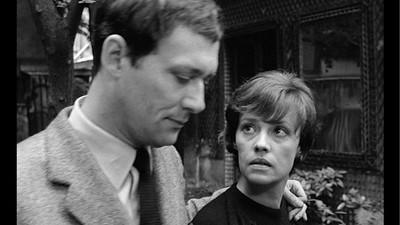


Having had the time to think about it, I realize that it's this last turn that makes The Fire Within truly special. It's one thing to track Alain's decline, to let the pieces fall where they may and simply present us with a glimpse at a rarely examined state of being--that would have been something unique and glorious on its own--but it's a whole other to stop us in our tracks and ask us if we really have it all figured out, if what we have seen is limited to what appears on the surface of it.

It's a daring move. It takes The Fire Within from a portrait that seemingly avoids editorializing to one that reveals that everything has an editorial slant. If we got back to the reasons filmmakers and writers might be scared to tackle the suicide question, it could be that they don't want to risk getting caught in the quagmire of something that can only bring more questions that have no answers. At least not ones that can be found without going over to the other side--and once we do, we can never come back to share, we only become another query.


BLOG BUSINESS: I apologize to my readers for not updating last week. I would like to pretend it was on purpose in order to keep that cute picture of Jeanne Moreau riding high on top of the blog, but that just isn't true. Various comic book events over the last three weeks meant a lot of increased activity and almost all of my reviewing ground to a halt. I will be attempting to post at least two more reviews here in the next two weeks in order to catch up.

Thursday, May 1, 2008

THE LOVERS - #429


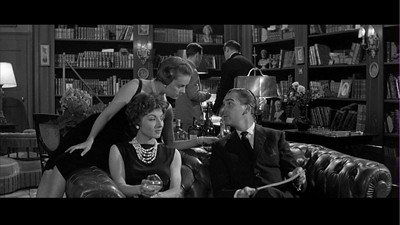
Louis Malle's 1958 film The Lovers (Les amants) is an erudite reimagining of a traditional bodice ripper. Jeanne Moreau, who had made her name with the young director in Elevator to the Gallows, plays Jeanne Tournier, a bourgeois housewife stuck in a passionless marriage with a rich newspaper editor, Henri (Alain Cuny). Seeking refuge from this dismal union, she regularly travels from their country home to Paris under the cover of visiting her best friend Maggy (Judith Magre), but really to hook up with her lover. Raoul (Jose Luis de Villalonga, the Brazilian moneyman in Breakfast at Tiffany's) is a dashing Spanish polo player, and Jeanne sees him as a rugged and sophisticated man's man, the alternative to her button-down, business-minded husband.

Jeanne's disaffection not only shows on screen, but also surfaces in a third person narration that Malle cunningly chooses Moreau to read. It has a disassociative effect, that the woman is both in the moment and out of it, commenting on her own existence as a pitying other. Perhaps sensing his wife's ennui, as well as maybe picking up signals regarding her true relationship to Raoul, Henri starts insisting that Jeanne spend more time at home. He even cancels his own plans so that he can spend the weekend with his wife, asking her to invite Maggy and Raoul to their home rather than allowing her to spend the time away. She still insists on an overnight trip to Paris, ostensibly to lay the groundwork for this impossible situation, but also presumably as one last hurrah in case it all falls apart.

It's hard to tell what Henri really knows. Once everyone is at the Tournier home, it's fairly obvious to the outside viewer that Jeanne is incapable of hiding her unease of having her lover and her husband in the same place. Henri seems to see it, but he doesn't show it. He pours on the charm, but his motives are unclear. As it turns out, he's watching the wrong man, anyway. Neither he nor Raoul suspects that Bernard (Jean-Marc Bory), the learned drifter that has escorted their woman home, is going to be the downfall of them both. He's a man who, though born into their level of the social hierarchy, has dropped out in favor of what he sees as a more liberated existence, and he has a contempt for the way all of them conduct themselves.


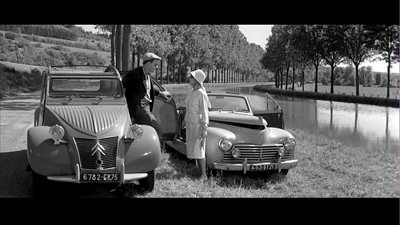
Malle appears to take great delight in playing with the conventions of seedy romantic tales, turning rather conventional situations into visual and literary metaphors. When Bernard first meets Jeanne, she is literally stranded, her car having broken down on the side of the road, next to a river, equidistant between her lover in Paris and her husband at home in Dijon. He rescues her first from that predicament, and then from her stalled sex life. While Raoul and Henri represent society and industry, Bernard is nature and instinct. His ruggedness makes Raoul's safely structured athletic career seem ridiculously wimpy. Jeanne and her people have tried to sequester themselves from the natural world, seeing it as a quaint thing to visit but otherwise as an impediment to their consumption of fashion, gossip, and the other accoutrements of a material life. Bernard's appearance is like an infestation. At dinner, a bat flies in through the window; later, a fly buzzes around Jeanne's head, irritating her, yet pushing her outside, where she meets Bernard for their first, albeit unplanned, rendezvous.

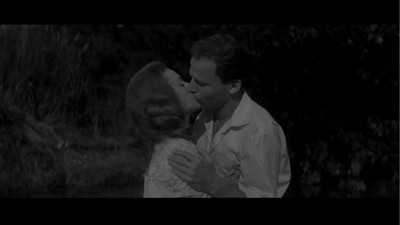
The night forest is photographed in chilly grays, lit to appear almost otherworldly, Jeanne standing out from the background in stark relief thanks to her angelic white nightgown. Bernard is not content to make Henri a mere cuckold, but he mocks the husband, as well. Before he even meets the man, he characterizes him as a bear, but not a force of savagery, one who is more domesticated, like a circus performer. Leading Jeanne through the woods, he happens upon a fish trap that Henri has set in the river, and Bernard sets all his capture free. He then takes Jeanne onto a small boat on the selfsame river--likely also the one she was stranded by only that afternoon--and the two new lovers float adrift on its waves, surrendering to the natural flow. Though earlier in the film Maggy thinks she can see a change in her friend thanks to her love of Raoul, Bernard awakens something more primal in her. When they return to the house, the dogs stir, barking at the newly sensual beasts that approach.

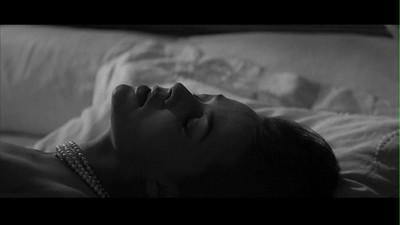
1950s audiences must have been as scandalized as the dogs when they saw the scenes that followed. Bernard ravages Jeanne in her bedroom. She wears nothing but a pearl necklace (yes, I know!), and Malle shows her writhing in ecstasy after Bernard has disappeared off the bottom of the screen. Yet, here amidst the breathless, orgasmic exclamations, Malle is already starting to turn our preconception of romance stories on its ear. Though our inclination is to root for Jeanne's liberation, it's difficult not to question her moral choices. On the way to her bed, the two adulterers pass through her daughter's bedroom, and Jeanne checks on the girl, the tuck-in serving as a good-bye of sorts to her old life. My eyebrow certainly rose when Bernard almost immediately turns the girl's existence into a part of his seduction, declaring that he not only loves Jeanne, but her daughter, as well. Men truly will say anything to get a woman into bed!


That crass come-on resonates well into the next scene, particularly when Jeanne makes silly declarations about the eternal value of their very young love. While we know her quality of life has not been ideal, Malle has had his topsy-turvy way with our perceptions from the moment the drama settled at the Dijon estate. Raoul reveals himself to be a bit of a bore, and Henri is uncharacteristically doting, and though Jeanne and the audience both suspect that it's fueled by his own suspicions, it causes us to doubt if he is as bad as we thought. Then again, maybe it's not uncharacteristic, since a concerned maid has told us that the father spoils his child, so maybe Malle has made us too trusting in Jeanne's interpretation of things. The writer/director has already fooled us in this way once, making us think that Henri was also engaging in infidelity before revealing that his mistress is his work, exactly as he said it was.

Certainly we are ill prepared for Jeanne, a wife and a mother, to abandon it all to run off with this wanderer whom she has just met. Even his decision to carry her away is somewhat ironic, given that when they first met, he refused to hurry her home, claiming he never resorted to speeding in his car because he didn't believe in going too fast. Their flight is meant to be romantic, but something isn’t right. Bernard insists she bring no possessions, and though it's meant as a gesture to their new life where they need only each other, given his previous political statements, it comes off more possessive of him. If she has nothing but him, she can rely only on him. Plus, he is making her come to him on his terms, sacrificing all for his sake.

Post-coital guilt rises with the sun. Even as they flee the estate, the bliss of their night of passion starts to go sour. Mirrors reflect their guilt back at them by showing them their own haggard appearances--he is unshaven, her sleepless night has created bags under her eyes that her lack of make-up leaves uncovered. She can barely stand to be looked at. Bernard says that he wishes it could always be night, and almost immediately after, a rooster crows three times. It's a Biblical number, making me think of Peter denying Christ three times before the cock crowed. It's just the quantities here have been swapped.

The final images of the lovers together, along with the last telling lines of narration, are also reminiscent of Mike Nichols' The Graduate. Though all the words spoken and everything we know tell us this must be a happy occasion, love conquers all, the expressions on the faces of the pair doing the loving suggests something else entirely. Real life waits over the horizon. The idyll only existed in darkness.

The Lovers is one of those movies I have been anxiously awaiting on DVD. I first saw it at a retrospective of Louis Malle films a couple of years ago. It was actually the only installment of the series I attended, and more for Jeanne Moreau than Malle. I can't recall whether I had seen this movie before or after I saw Moreau in Tony Richardson's similar 1966 film Mademoiselle, but they still exist as linked for me. Whereas Richardson's story of a repressed schoolteacher teems with sweat, musk, and the earthiness of dew and soil, Malle's picture is perfumed and well bathed. Mademoiselle posits that society's repressive morality has real consequences, and the pent-up sexual energy is released with the forcefulness of natural disasters, but Malle seems to suggest that the problems here are not so much with society as with the individuals. Jeanne is certainly not repressed, as her affair with Raoul is never presented as non-sexual. The problem lies more in the fact that she has created her own illusion about her fancy life, and she fails to see that by accepting Bernard's Kerouac-esque presentation, she is really trading one illusion for another. Both relationships are jails, just with different jailers.

Which isn't mean to suggest that the sexiness of The Lovers is somehow false, because nothing could be further from the truth. It's a story tantalizingly told, panting with the salaciousness of Hollywood "women's pictures" by the likes of John M. Stahl or the female-centric noirs of Otto Preminger. It's just that for as sexy as the movie is, Louis Malle is aware of the consequences of surrendering too much to raw emotion and never stopping to ask yourself what will be waiting behind the lust when it eventually clears.


The box boasts that this is the original, uncensored version of the film. I don't know exactly what was censored before, though it was most assuredly in the orgasmic love scene, which includes a very brief glimpse of female nudity. The film infamously was embroiled in an obscenity case in the U.S. when it was shown in Ohio, so I am sure it was trimmed for subsequent theatrical showings to avoid any further litigation, despite the original ruling against the film being overturned by the Supreme Court. In fact, it was The Lovers that apparently inspired the still-in-use loose definition of obscenity: "I know it when I see it."


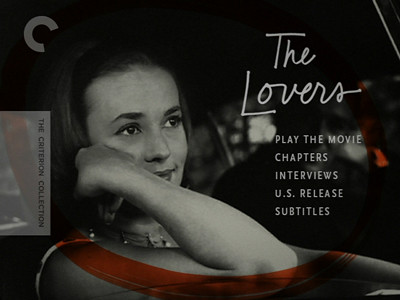
The Lovers - Criterion Collection is packaged in a clear plastic case with printing on all sides of the cover. I like that the same image that appears on the disc itself also appears underneath, though the circular red swirl that goes around Jeanne Moreau on the surface of the DVD has a nice vertigo effect, evoking the spiral of passion her character will find herself in. The accompanying 14-page booklet has cast, crew, and chapter listings, along with photographs and a critical history of The Lovers by film professor Ginette Vincendeau.


For technical specs and special features, read the full article at DVD Talk.


This DVD set will be released on May 13, 2008.