Showing posts with label jane campion. Show all posts

Thursday, January 20, 2022

BRIGHT STAR - CRITERION CHANNEL

 This review was originally written for DVDTalk.com in 2009.
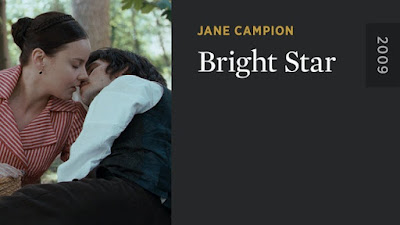


As a moody, death-obsessed writer whose genius has yet to be recognized, Jane Campion's portrayal of poet John Keats in her new film Bright Star hit a little too close to home. Depressed, misunderstood, doomed romance--hey, John, I can identify. Just tell me how I can be lucky enough to get tuberculosis, and I'll follow you all the way down. Damn my parents and their stupid vaccinations!*


Bright Star isn't an all-encompassing biopic of the Romantic poet, but rather, it follows Keats over a couple of specific years, beginning in 1818 when the young writer met the love of his life and the tragic turn that soon followed. Keats is played by Ben Whishaw, who portrayed the antagonistic, on-trial version of Bob Dylan in Todd Haynes' I'm Not There (he was the one in black-and-white who wasn't Cate Blanchett) [review]. He's getting pretty good at this broody poet thing. Alternately cocky, self-loathing, and frightfully charismatic, he makes Keats a dark and dreamy apparition. Thus, it's no wonder that the pretty young seamstress, Fanny Brawne (Abbie Cornish, Elizabeth: The Golden Years [review]), is attracted to him, despite having no understanding of poetry and thinking that wit and smooth moves on the dancefloor are the two best traits in a man. Opposites do attract, though, and both the poet and the girl have an intensity to their personalities that somehow makes them a perfect match.


Not that everyone would agree. Socially, John Keats is a pauper. His books don't sell, and he has no viable prospects, so as a candidate for marriage, he doesn't lead the pack. He's also friends with another poet, Charles Armitage Brown (Paul Schneider, All the Real Girls and TV's Parks and Recreation), a crank who is protective of Keats' talent and also distrustful of women, especially girls he sees as flirty and frivolous. Fanny fits this category as far as he is concerned, and the two spare no opportunity to express their disdain for one another. Ironically, Charles is probably more along the lines of what Fanny expects of a male suitor, even if his humor is much darker and pointed than she would like. Paul Schneider, whose previously been best known for his David Gordon Green collaborations, gives the best performance of his career as the sardonic poet. I've never seen him so comfortable in his own skin and so at ease with his lines. His previous performances often relied on a quirky naturalism that is all but gone here, replaced by a more forceful presence. Some of the film's strongest scenes come as Brown is revealed to lack the moral purity that was so valued by the Romantics. He is not John Keats, and he knows it, and he can live with it as long as no one else points it out.
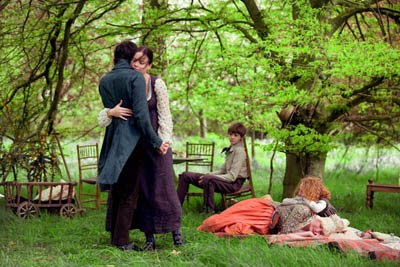


Campion, who also wrote the screenplay for Bright Star, establishes a fascinating social order in the movie. No one here is entirely well off, and though they are members of polite society, there is some funds-stretching going on. One trick is apparently moving house a lot, following the changing seasons in search of cheaper lodgings. This puts the Brawne family--Fanny's widowed mother and her two siblings--in the other half of the house where Charles Brown is renting and where he lets Keats stay for free. Being in such close proximity, the romance between the poet and his new muse, which previously has consisted largely of poetry lessons, misunderstandings, and a gentle touching of hands, can take full bloom. Soon it's kissing in the forest and touching the wall that separates their beds night after night, feeling the heat of love pass between. Fanny becomes entirely wrapped up in Keats, which can feel just as bad as it may feel good since he is prone to mood swings. If he writes a line about butterflies in a love letter, Fanny catches every butterfly she can and creates an oasis for them in her bedroom; when he selfishly ignores her, she demonstrates her ineptness at suicide. Abbie Cornish is very good as Fanny. The actress understands the melodrama of adolescent angst, and she manages to make it real without overdoing it. Her most enthralling moments, however, are when she lets herself be an empty vessel silently letting Keats fill her up.


There's something refreshing about seeing a romantic relationship on film that doesn't involve sex. It's not that Campion isn't comfortable with it--she did direct In the Cut, after all--it's that she is aware here, as she was in The Piano [review], that the greatest passion often lies somewhere beyond physical expression. Though there is no crossing over to the other side the way the characters did in The Piano, Bright Star is more intensely realized for it. Why not a love affair that involves reciting poetry and quickly stolen glances? Brown encourages Keats to bed the girl and get it over with, hoping it will cure his friend of his crush, but Keats won't even consider it. Perhaps he sees the consequences Brown fails to consider when he knocks up the maid, but I doubt it's anything as crass as all that. Poetically, to take their relationship further would spoil it. Campion sees Keats' life as one of extremes: the butterflies and the punctured veins, dazzling beauty and dark lows. She and cinematographer Greig Fraser capture both sides beautifully. They infuse the warm summer with color and light, and yet they shoot the snow of the chilled winters with as much clarity, letting each flake stand out under a dark sky. At the same time, there is a softness to everything, as if a very thin veil of muslin had been placed over the camera lens. This faint yet ever-present whiff of grey reminds us that there is a sadness that can't be escaped in this story. Bright Star is young love on a deadline.


John Keats' death at 25 is well known. He contracted tuberculosis, which also took his brother from him not long after he and Fanny Brawne had met. Keats foreshadows this regularly by talking about his own death even when he is healthy, something Campion never portrays as ironic or dramatic, but something Keats firmly believed. Any biopic that ends in such a way is always faced with the challenge of overcoming the audience's knowledge of the inevitable, and the fact that Bright Star doesn't worry about getting around that is both one of its greatest strengths but also its only weakness. The movie does drag a little at the tail end when the closeness of death is more obvious. Perhaps had Campion not let Whishaw be so earnest in his doom and gloom we might not feel it as heavily--which could have been a bad choice all on its own. As it stands, it's a small point, and the benefits of that choice far outweigh any of the failings.
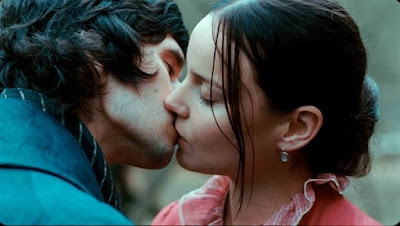


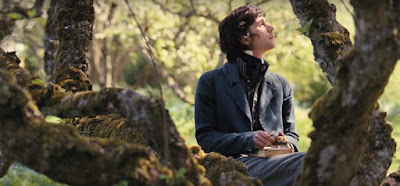
When it comes down to it, Bright Star works because it inspires the viewer to take part in the tenderness and the sorrow. In explaining poetry to Fanny, John Keats likens the act of reading to jumping in a lake. You don't dive into the water just to do so, to go under and then get out; you jump in to experience the water, to be in it. So, too, must one linger on a poem, spending time within it, experiencing its language and images and not just reading it line by line. The same could be said of a biopic, that a good one lets you walk a mile or two in its subjects cinematic shoes. Jane Campion achieves just that with Bright Star, making us part of Fanny and John's world for two hours. To watch it is not to stand at a distance, but to step right into the middle of it and feel it all.


* 2022 Update: Jokes! I am totally pro-vaccines.

Wednesday, January 22, 2020

THE PIANO - CRITERION CHANNEL

This review originally written for DVDTalk.com in 2012.


The Piano begins like no other film. A tentative voice begins speaking, setting the scene and establishing the unique narrative point of view by introducing itself as the interior expression of the movie's main character, a woman who has not spoken aloud since she was six years old. It's not as she has ever been heard by others, but how she hears herself. Ada has recently been sold into an arranged marriage, and she and her young daughter are being sent far away to New Zealand to live with the new husband. Whatever suffering our heroine must endure, she can face it as long as she can bring her piano, which for her provides a precious means of expression. Though she knows sign language, her separateness has allowed her to ascertain that most people don't use their words for anything of significance. Music need not justify itself, it only need flow from the instrument.

Released in 1993, Jane Campion's romantic story of perseverance and self-actualization was rightfully greeted as cause for celebration. Critics and audiences both embraced The Piano, and it was a mainstay at all the year-end award shows. Holly Hunter won a Best Actress Oscar as the star of the film, playing silent Ada with incredible insight and physical acuity; her young co-star, an 11-year-old Anna Paquin (later on True Blood and recently in Scorsese's The Irishman), also took home a Supporting Actress statue. The pair were perfectly believable as mother and daughter, just one of the many carefully arranged elements that lent Campion's film an emotional honesty that has not dimmed in the decades since.


When Ada and little Flora end up at their remote destination, their new lives look bleak. Alisdair Stewart (Sam Neill, Jurassic Park) is a nervous, socially awkward man who is more at ease bargaining for land than he is at exchanging pleasantries with his new wife. To be fair, Ada is not exactly as she was described to him, nor does she make things easy for the inexperienced groom. Her piano is a particularly burdensome piece of luggage, and it has to be left on the beach. Alisdair has not brought enough Maori workmen to carry it back up the mountain.

Eventually, Ada turns to a neighbor to help her with her predicament. George Baines (Harvey Keitel, Thelma and Louise [review]) is friendly with the locals and served as translator and guide on Ada's journey to her new residence. George apparently left a wife in England, but whatever drove him halfway around the world is not revealed. He has taken to his adopted home to such a degree, he has even tattooed his face in the Maori style. He buys the piano from Alisdair under the guise of wanting to learn to play music, but in reality, he wants to use it to bargain with Ada. If she will engage in increasingly intimate acts with him, he will return the musical instrument to her.


Though begun as a simple supply-and-demand transaction, the relationship between Ada and George grows increasingly complex. The Piano is a literary romance filled with potent symbols and expressive metaphors. Of all the players in this love triangle, Ada is the one who communicates most directly, and her methods draw George out of his shell while further alienating Alisdair. In turn, George's care inspires new feelings of trust in Ada, as well as bringing other sensations to her life. The basic plot of the film is a series of seductions, some selfish and some transcendent. George reveals hidden kindnesses, Alisdair unveils unforeseen cruelties, and all are watched by the eyes of a child, who serves as both provocateur and conscience. For Ada, she is the angel on her mother's shoulder insisting she make the moral choice, only then to flit off to her stepfather and whisper devilish gossip in his ears.

Anna Paquin delivers an unpretentious, unmannered performance as the little girl. Campion (whose other credits include Sweetie [review] and Bright Star [review]) has clearly connected with the young performer's sense of play, getting her to engage wholly with the space. She never appears as anything less than totally immersed in the scene, and her naturalism challenges the adults to match her instinctual gifts and also gives them the sense of "other" that they can play off. Flora doesn't understand everything that is going on with the grown-ups, and it lends even more intensity to their deception. As George, Harvey Keitel is both primitive and surprisingly modern, displaying a sensitivity that Ada can't help but respond to. For his part, Sam Neill appears as a man haunted by his desires. His wife's touch, reaching so close to forbidden areas, sets him atremble; yet, she refuses to let him touch her in return. Ada commands both of them, but Holly Hunter is careful not to let the character's stubbornness be so pronounced that we lose sight of her vulnerability. This is a woman whose life has been overtaken by something she can never put a name to, and so she can never be completely in control.


The Piano was shot on location in New Zealand, and cinematographer Stuart Dryburgh (The Painted Veil [review], Taymor's The Tempest [review]) makes great use of the open, natural landscape to be found there. Shots of the seaside are breathtaking, with Ada and Flora placed between the mountainous terrain and the vast ocean, emphasizing their isolation from their former lives. This also means that "civilization" as they've defined it is a distant thing. They are now surrounded by untamed jungle, creating an environment where they are sufficiently hidden away to indulge in passions they'd not be allowed back home. (For her part, Flora becomes a bit of a wild child, left to her own devices, which ironically also forces her to be more of a grown-up.)

Of course, no review of The Piano would be complete without also making mention of Michael Nyman's score. His music is beautiful without being intrusive, his incidental compositions taking a backseat to Ada's emotional sessions at the keyboard. When she starts playing, the music pours out of her. As another character describes it, it's like when a mood takes you and refuses to let you go. It's another of Campion's perfectly considered metaphors. Only Ada allows herself to feel this way, the others find her music strange--though ultimately, it does soothe the savage beast. The piano's central position in Ada's life is both a great asset for her and a curse, and it's one she will have to contend with before she can ever truly live.


Friday, February 3, 2012

SIDELINE: MORE REVIEWS FOR 1/12

A round-up of the non-Criterion movies I saw in January, 2012.


IN THEATRES...

Chroniclea "found footage" superhero movie that could have just as easily stayed lost.

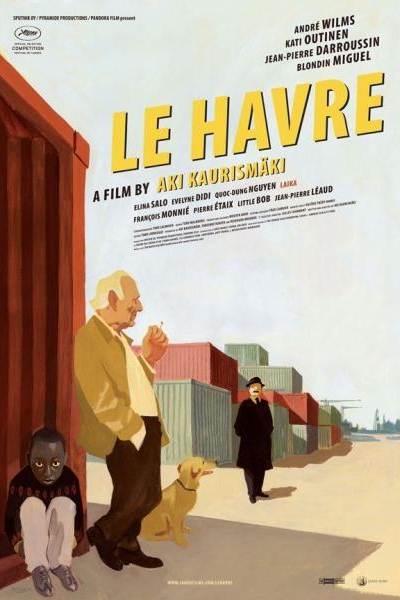
Le HavreAki Kauirsmäki's newest has a familiar quirkiness, and not necessarily in a nourishing way. 

The Man Nobody Knew: In Search of my Father, CIA Spymaster William Colby, a documentary as unwieldy as its title. Colby remains as much a mystery in the end as he was at the start.

A SeparationAsghar Farhadi's remarkable Iranian family drama.

The Woman in BlackDaniel Radcliffe's turn as the victim of an old-fashioned ghost story in this Hammer horror production.


ON DVD/BD...


A Beautiful Life, Andrew Lau's melodramatic romance picture starring Shu Qi as a woman learning to love.

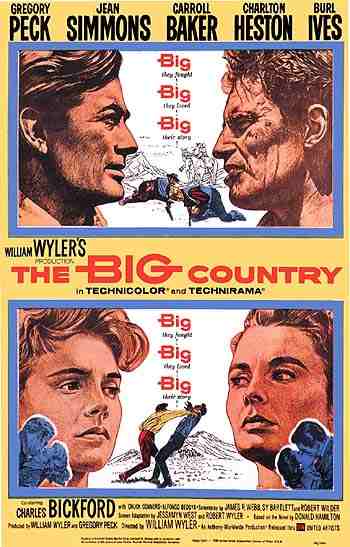
The Big Country, a uniquely masculine western with Gregory Peck and Charlton Heston.

Boardwalk Empire: The Complete First Seasonan awesome Blu-Ray packaging of the Scorsese-helmed Prohibition-based television show.

The English Patienta sweeping epic spanning two timelines, though the one with Juliette Binoche is better than the more famous romantic storyline.

Film SocialismeGodard's most recent intellectual puzzler.

Love Story: If love is never having to say you're sorry, but I hated this movie, doesn't someone still owe me an apology?

Outrage: Way of the YakuzaTakeshi Kitano enacting a bloody chess game with all the boredom of real chess.

The PianoJane Campion's literary romance, starring Holly Hunter, Harvey Keitel, and a young Anna Paquin. (Get prepared to feel a little creepy, True Blood fans!)


Thursday, October 1, 2009

SIDELINE: MORE REVIEWS FOR 09/09

IN THEATRES...

* 9, the new animated film from Shane Acker turned out to be one of the most disappointing movies this year. Pretty, but pretty vacant.

* The Baader Meinhof Complex, an involving docudrama about the 1970s campagins of the European terrorist organization, what Luke Haines called a "Hate Socialist Collective."

* Big Fan, the Patton Oswalt-starring drama is a good portrait of one man's chosen isolation and obsession, though it may be getting oversold in the hype.

* Bright Star, Jane Campion's portrait of the romance between John Keats (Ben Whishaw) and Fanny Brawne (Abbie Cornish).

* Capitalism: A Love Story, an important message from Michael Moore. Keep an open mind, you don't have to be his fan to listen to the message.

* Extract, Mike Judge's new comedy. Some big laughs, but ultimately too uneven.

* The Informant!, my favorite movie of recent memory and one of the best of the year. Steven Soderbergh delivers another winner in this offbeat comedy starring Matt Damon.

"


* Lorna's Silence, a suspenseful drama from the Dardenne Brothers.

* Whip It, Drew Barrymore's directorial debut is an endearing turn on the sports flick starring Ellen Page.

* Whiteout, the Greg Rucka and Steve Lieber comic book comes to the big screen. As an original editor on the comics, what did I think...?

* World's Greatest Dad, an unfunny black comedy from director Bobcat Goldthwait and Robin Williams. I am surprised by the reviews of this, as I am apparently the only one who found it execrable. I didn't laugh at all, and seeing Robin Williams' penis...well, that speaks for itself.

* Zombieland is funny and gross. A great time at the movies. Woody Harrelson, FTZ.


ON DVD...

* The Girlfriend Experience, Steven Soderbergh scores another big win in this experimental picture with Sasha Grey.

* Important Things with Demetri Martin: Season One, a pretty good attempt at a thinking man's sketch comedy show.

* Mad Monster Party: Special Edition, a new reissue of the Rankin-Bass horror send-up, one of my favorite movies from my childhood.

* Observe and Report, Jody Hill's divisive dark comedy. It made me laugh.

* Treeless Mountain, the second feature from director So Yong Kim. This quiet tale of two young sisters and their private world is wonderfully observed and poignant.

Tuesday, November 6, 2007

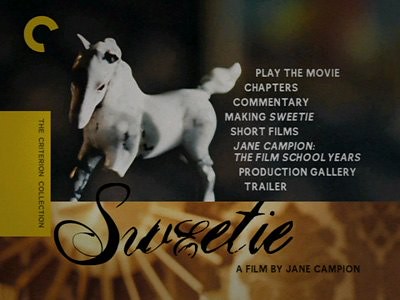
SWEETIE - #356


Movies like Sweetie remind me of why I live alone. And in a different state than the rest of my family.

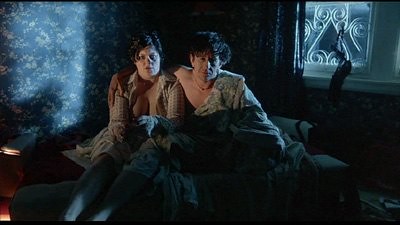
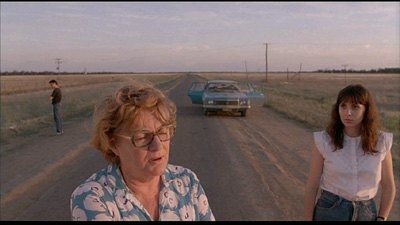
Jane Campion's 1989 debut is a self-consciously quirky movie about extreme family dysfunctions. Kay (Karen Colston) is a sourpuss who believes in fate more than she does engaging in actual social interactions. An outcast at her workplace, she sets her sights on a coworker's fiancé, Louis (Tom Lycos), after he personifies a fortune teller's prophecy about the love of Kay's life. Louis accepts Kay's advances, and thirteen months later (lots of superstitious imagery here), they are still together--though with problems. Louis plants a sapling in honor of their love, and Kay tears it out of the ground in the middle of the night, afraid it will die and turn into a bad omen. Self-fulfilling prophecy, as it turns out. This is also when Kay starts sleeping in a different bed.

The couple try a few things to try to get their equilibrium back, and it's when they return from one such excursion that they discover Kay's sister, Sweetie (Geneviève Lemon), has broken into their house and moved herself in. Sweetie is apparently a little mentally unbalanced and has possibly gone off her meds. Sweetie instantly takes over the place, destroying Kay's room with her boyfriend Bob (Michael Lake), who she says is a producer who is helping her with her music career, but he appears to be the only person on the planet more fried than her. Kay's childhood frustrations come rushing back, particularly when Louis chastises her for being so hard on her sister. It seems that Kay is the only person in the world that can see how obnoxious Sweetie is.

Well, Kay and the person viewing the movie. I suppose it's a testament to Lemon's performance how much I wanted to reach through the screen and throttle her. Sweetie barrels her way through everything, refusing to listen to anyone, and when she doesn't get her way, she throws a childish tantrum. The main reason why she has gotten away with such behavior for so long is that her father (Jon Darling) indulged her every whim and filled her head with delusions of her own talent. Oddly enough, the high-maintenance Sweetie requires has become the bonding force in the family. When she's around, the others can ignore their own problems. Suddenly the relationship woes between Louis and Kay take a backseat; however, back home, now that Sweetie is gone, the girls' mother (Dorothy Barry) has left their father to try to gather her head. This sends daddy over to Kay's place, where he camps out and continues to let Sweetie get away with murder. Campion gives us some hints to darker overtones in the father/daughter relationship, but only hints. Given Sweetie's dominance, it's most likely less about the father being perverted than it is about Sweetie controlling the situation even further.


Eventually, Kay, Louis, and the old man go in search of his wife, leaving Sweetie behind. The reconciliation is one of the few calm spots in the film, the family finally able to catch its breath. Only, they are all going to have an enraged Sweetie to deal with when they get home, as well as the interpersonal problems they have been avoiding.

Sweetie was a critical success when it first came out, but like a lot of early '90s indie movies, it hasn't aged as well as it could have. Campion is not yet the self-assured director that would make The Piano only a couple of years later. She pushes the odd factor a little hard in Sweetie, composing her frames at askew (though intriguing and often lovely) angles and layering on choral world beat, doo-wop music that seems too grandiose for the small story being told. Every character is so strange, it starts to feel forced, and though Lemon really gives the performance her all, it's kind of hard to swallow that so many people would turn a blind eye to Sweetie's petulance.

It's the more relaxed moments--the mini vacation away from Sweetie, the denouement, etc.--that work the best in the picture. While they exist to balance out the more outrageous struggle with Sweetie's personality, the values are too starkly contrasted. By the time the respite comes, it's just as much for the audience's benefit as it is for the other characters. I found that instead of wanting to get back into the story and see how the family would finally deal with their wild child, I really would have rather they stayed out in the middle of nowhere and give us all a break.

Still, there is power in Campion's finale, and her film isn't without purpose. As I noted, the camerawork is often quite special. Director of photography Sally Bongers fetishizes everyday objects with a true photographer's eye. It's just that from a writing standpoint, Sweetie could have maybe benefited from the deft hand of a more experienced filmmaker.


Originally written October 27, 2006. For technical specs and special features, read the full article at DVD Talk.