Showing posts with label ichikawa. Show all posts

Monday, February 19, 2018

AN ACTOR'S REVENGE - #912


An Actor’s Revenge opens and closes in a theater, bookending its vengeance tale with performance and placing the audience in a comfortable place that reminds us that this is entertainment and thus meant to be enjoyed a certain way. What lies in between fits the bill perfectly: a bonkers drama with ludicrous twists and audacious visuals. It is artifice at its purest, yet drama at its most sincere.

Writer/director Kon Ichikawa (The Makioka Sisters [review], Fires on the Plain [review]) has set his 1963 film, based on a novel by Otokichi Mikami, in the 1830s, at a time when life in Japan was difficult. The common people lived under the shogunate, and the economy was bad. Rice shortages caused unrest, becoming grist for the mill here as one component of the manipulative scheme put forth by Yuki (Kazua Hasegawa, Gate of Hell), a popular kabuki actor considered by many to be the finest female lead in all of Japan. Yes, this was a time when women’s parts were played by men, and not only does Yuki play a woman on stage, but for all intents and purposes, he remains androgynous in real life--dresses, make-up, speaking at a higher pitch. As with Satyajit Ray’s The Hero [review], the actor has an image to uphold.


At the start of the film, Yuki’s troupe is beginning a guest run in Edo. While on stage, the actor sees several familiar faces in the crowd, ones that chill him to the core. Watching from expensive box seats are men who drove Yuki’s parents to suicide. As we learn through Yuki’s internal monologue--expressed while still performing, the show must ever go on--he has been waiting his whole life for the chance to take his revenge on them. And so Yuki puts into motion an elaborate plot to drive the three merchants to madness and ultimately death, using the lead man’s daughter, Namiji (Ayako Wakao, Street of Shame [review]), as the entry point into their lives and homes. Namiji is smitten with Yuki, and Namiji is a woman of great influence, so all doors open.


The intrigue along this track develops over private conversations, with Yuki meeting with his three targets in their individual residences, working his way into their personal business, while also developing a genuine connection with Namiji. Meanwhile, outside, a collection of local thieves not only competes for fame in their province, but they also continuously cross paths with Yuki. They are both comic relief and a plot complication. The lady thief Ohatsu (Fujiko Yamamoto) falls for Yuki after he physically stops her from robbing Namiji. Another, Yamitaro, keeps watch from afar, enjoying how Yuki’s life is its own performance, how everything he does has a specific choreography. Hasegawa plays Yamitaro as well as Yuki, a dual role you may not notice on first viewing. That’s how good the actor is. It’s not just make-up and costume, but he creates distinct personas for each. Given that this was his 300th film, he certainly had plenty of time to hone his craft.


It’s the juxtaposition of these two characters where the artifice and the reality truly come together in An Actor’s Revenge. Ichikawa is interested not just in the parts people play in their actual lives, but in how they present themselves to others--and likewise how he can present these things to the film-going audience. An Actor’s Revenge relies heavily on style and staging. Nighttime scenes are set against solid black, with no discernible backgrounds. When Namiji loses her way, she is found on a similarly empty plain, shrouded in fog. Yuki’s plot against his enemies is essentially a stage play helmed in a natural theater. You almost suspect that when Ichikawa returns everyone to the actual stage in the end, he’s going to reveal we never left, and the film actors will return to take a bow.

At the same time, Ichikawa’s approach is deadly serious. There is no irony, no winking at the audience. If art is a reflection of real life, then it must be approached with the same vigor. Our entertainment has consequences. It has lessons to teach. It’s the oldest storytelling trick in the book: lull the consumer into a certain happy state, only for the weight of what we are seeing to land heavily upon us. There is a price for revenge, and one not always paid by the person with the vendetta.


This disc provided by the Criterion Collection for purposes of review.

Sunday, September 30, 2012

KENJI MIZOGUCHI'S FALLEN WOMEN: WOMEN OF THE NIGHT - ECLIPSE SERIES 13


Okay, so maybe Kenji Mizoguchi's 1948 drama Women of the Night wasn't the best choice for a Saturday evening's entertainment. Particularly since I hadn't even started drinking. Correcting that now.

The third film in the Eclipse set Kenji Mizoguchi's Fallen Women has some years distance from the previous entry in the box, 1936's Sisters of the Gion. Damn, a whole war actually happened during the time from one production to the next, so it's fairly understandable that Women of the Night would be so tragic and bleak. The director kept making movies in that time, including his masterwork The 47 Ronin, but Women of the Night is his first significant return to the theme explored in this collection.


World War II informs everything about the drama of Women of the Night, which was based on a contemporary novel about life in Japan at the time. Though, unlike the post-War films of Seijun Suzuki, Mizoguchi never addresses the problem of occupying U.S. troops, the effects of the combat are both felt and seen in the rubble and poverty that pushes his characters to the brink. Fusako (Kinuyo Tanaka) is struggling to get by and hoping her husband will return from Korea. She lives with her mother-in-law and tries to care for her sick child. The only man we see in this early portion is her alcoholic brother-in-law, who did return from service and does not like what he did or the outcome. His little sister Kumiko (Tomie Tsunoda) lost her husband to the fighting, as did many other women her age.

Fusako has been selling clothes to make ends meet, and though the red light district is just around the corner, refuses to degrade herself. She suffers the one-two punch of finding out her husband is dead and finally losing her son to illness, but she maintains her dignity and even manages to secure a job with her husband's former boss. In fact, things are looking up when she is reunited with her own younger sister, Natsuko (Sanae Takasugi), who she thought lost. Natsuko has returned from Korea a widow, and she bears her own scars from the fighting. Currently, she works as a hostess in a dance club.


The good times don't last. Natsuko and Fusako both strike up an affair with Fusako's boss, and when the older sister finds out, she leaves home and becomes a prostitute with the intent of punishing all men by spreading sin and disease. She believes that the men of Japan are seeking to destroy her and all women like her, so why not pre-emptively take advantage of their base desires? Her point of view is a little hard to argue with. The boss man turns out to be less than a stand-up guy, and when Kumiko tries to leave home to make her way in the world, she is taken advantage of by young male pretending to want to help. The naïve girl is deceived, raped, and pushed into prostitution herself.


Apparently Kenji Mizoguchi had been inspired by the movies that began coming out of Italy after WWII, and there is a definite influence of the Neorealist movement in evidence in Women of the Night. The choice between honest work and dishonest gain is not that far off from De Sica's father/son drama Bicycle Thieves [review], and much like similar ruins set the scene for Rossellini's Germany Year Zero [review], Japan's war-ravaged landscape provides a perfect backdrop for Mizoguchi's cautionary tale. Civilization has been ruined, and with it, any balance of right and wrong. The ladies in the movie will suffer all manner of humiliation and loss. Gone is any whiff of the hypocritical judgment of the common populace that made the struggles of the characters in Osaka Elegy and Sisters of the Gion [review] so difficult to traverse; replacing it is a moral obligation to set things right, one that few engage with, and those who do seem inconsequential in the face of so much decay.


Mizoguchi's cast is excellent. They play their characters with nuance and, even in the worst cases, empathy. They appear to be more than simple "types," regardless of how insignificant their function in the narrative. Of particular note is the obvious divide between the sisters. Fusako is more compassionate at the start of the film, making her rejection of her previous life all the more drastic. Kinuyo Tanaka, whom Mizoguchi would use again in both Ugetsu and Sansho the Bailiff, could have easily resorted to a cartoonish transformation. There are plenty of examples of how she might have made Fusako less sympathetic; most of the other prostitutes look like the prototype for bad girls in 1950s juvenile delinquent exploitation pictures. Instead, Tanaka relies on weariness and disappointment more than bravado. She plays Fusako as a woman who has given up, and her whole demeanor changes as a result--she goes from humbly slumping in deference to her social betters to defiantly displaying who she is.

Sanae Takasugi is equally as good when it comes to establishing the subtle distinctions between Fusako and Natsuko. Despite the hardships she has already endured, Natsuko has not given in to despair; rather, she has gotten crafty and she masks her troubles with an erudite manner. She is a woman that is used to being taken care of and having things paid for. Takasugi (who later worked with both Ozu and Ichikawa) plays her as borderline haughty. She carries herself differently than the actress playing her sister. Again, you can make out their approach to life just in how they present themselves, and by the end of the film, their stance has pretty much swapped. For all her good posture, however, things don't go much better for Natsuko. There are no good choices left for these ladies.


Women of the Night is an unrelenting tragedy. The downward spiral of its main characters is both dizzying and deep. Unfortunately, I think Mizoguchi tips the balance too far. In its final 20 minutes or so, Women of the Night becomes comically overwrought. Everything goes wrong, and instead of just letting the bad stuff happen, Mizoguchi and his longtime collaborator, screenwriter Yoshikata Yoda, inflate the aforementioned moralizing, however flailing it might be, and resort to cornball histrionics. Fusako and Kumiko are reunited in a bombed-out Christian church, complete with stained-glass windows depicting the Virgin Mary and the Baby Jesus. A brawl breaks out amidst the rubble, as prostitutes who are angry that Fusako would try to rescue herself and her friend from this way of life descend on them in a frenzy of violence. It might have actually worked had Mizoguchi just let them take their beatings. Instead, Fusako's protests move her attackers to tears, and the film ends with labored wailing and cries to the heavens. It's a bit much. The director seems to have lost his restraint in direct proportion to his main characters' loss of dignity.

Goddammit, pour me another drink.


Thursday, June 9, 2011

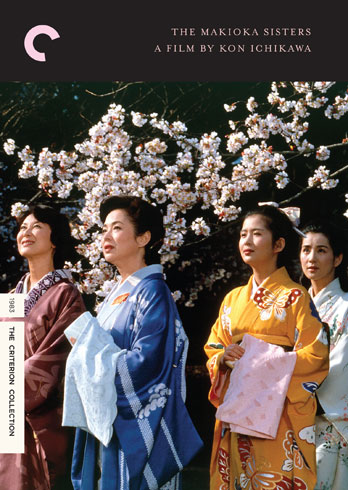
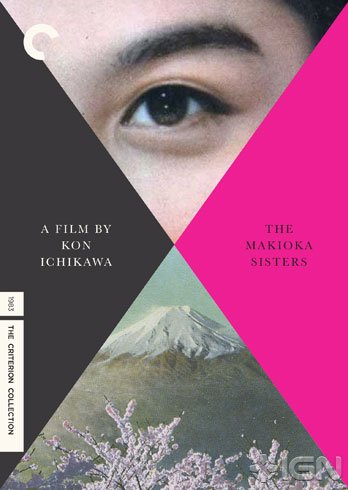
THE MAKIOKA SISTERS (Blu-Ray) - #567

"Seasons change...but nothing really changes after all."


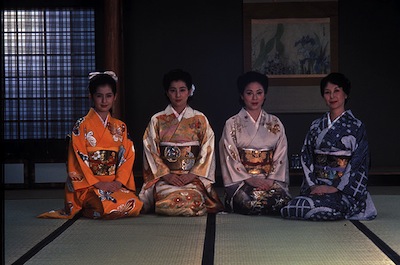
Kon Ichikawa's 1983 drama The Makioka Sisters is the very epitome of understated grace. This story of four sisters in the years prior to World War II underscores its inherent melodrama with a soft-spoken calm that is mesmerizing in its own unassuming way.

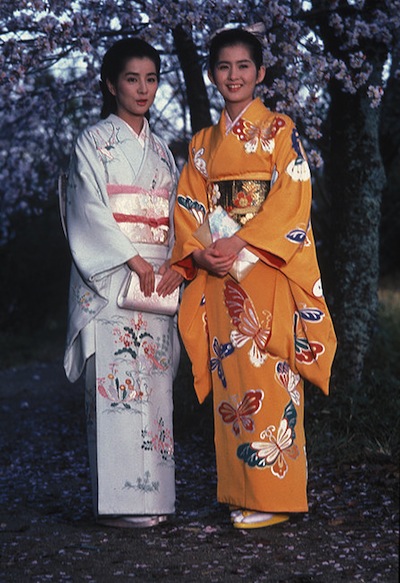
The movie starts in 1938. The four Makioka siblings have lost both of their parents. The two eldest girls, Tsuruko (Keiko Kishi) and Sachiko (Yoshiko Sakuma), are both married, while their younger sisters, Yukiko (Sayuri Yoshinaga) and Taeko (Yuko Kotegawa), are not. Yukiko is regularly meeting suitors, but if she's not rejecting them for her own reasons, Tsuruko is ending the engagements because she thinks the potential husbands are beneath her family's standing. What their standing is exactly is up to some debate. The family kimono business was in debt when their father died, and Tsuruko's husband Tatsuo (Juzo Itami) had to sell it off. The girls should not have the same pride of money they once had, since they don't have the same amount of money. Yukiko and Taeko, who is 24 at this time, have a dowry in trust, but they actually have to find husbands to get the cash.

There is a natural divide between the sisters, one that is indicated by age. The older women have a more natural bond, while the younger women seem to be closer. Yukiko and Taeko moved out of their eldest sister's house five years prior after a scandal involving Taeko running off to elope with a jeweler's no-good son. She has since carried on a clandestine romance with him, though her affections are straying. It is likely a generational indication that the youngest girl is also becoming the most self-sufficient. Taeko is a budding artist with a growing business making high-end dolls.


Much of the conflict between the sisters comes with keeping up appearances. On one extreme, Tsuruko carries on as if she is still the daughter of a wealthy artisan. On another, Sachiko turns a blind eye to her husband, Teinosuke (Koji Ishizaka), having an inappropriate infatuation with Yukiko. Meanwhile, Taeko secretly smokes and keeps a studio away from home where her boyfriends come to meet her.

Kon Ichikawa co-wrote The Makioka Sisters with Shinya Hidaka, and the script is adapted from a popular novel by Junichiro Tanizaki. The film has the austerity of an Ozu movie, but the familial relationships are also pure golden-age Hollywood. The Makioka Sisters could have been a pretty good melodramatic feature for the likes of Bette Davis or a Joseph Mankewicz vehicle, something along the line of A Letter to Three Wives, or even a Douglas Sirk production. Under Ichikawa's guiding hand, it's a much more restrained affair. While keeping up those appearances, very little is said that is meant. The sisters dance around the issues, and they employ dramatics when necessary. Tsuruko, for instance, breaks down in front of her husband to get her way; when she tries similar exaggerations with Sachiko at the start of The Makioka Sisters, the other girl sees right through them. The movie is rarely as warm as the few times the older siblings laugh together.


For as small as the action can be, Ichikawa builds a large canvas for his production. The sets are huge, and the interiors go way back in the frame, giving the viewer a real sense of how high on the hog the Makioka girls have been living. Ichikawa and his cameraman Kiyoshi Hasegawa often shoot from a middle distance, fixed in position, observing from the edge of the room. They let the lives play themselves out, they don't push the material forward. Within that, the filmmakers also take their time observing the surrounding details--the trees, wall decorations, kimono fabric. They remember to stop and smell the cherry blossoms, as it were, to mark the beauty of life that exists all around its subjects.

The ensemble cast in The Makioka Sisters is remarkable. Not only are they believable as siblings, but their carefully measured performances do render the various emotional shades of the story with considerable--and considered--technique. So much of what is required of them is meant to stay under the surface, so at least half of each performance is silent glances and telling gestures. Each actress does well establishing her personality within the unit. No one really shines over the others, though we remember them for all the right reasons. Sayuri Yoshinaga's sweetness inspires us to recall Yukiko fondly, while Yoshiko Sakuma's warmth makes us feel sorry for Sachiko, to realize how difficult her position in the family often is. I suppose if I had to pick, Yuko Kotegawa's portrayal of Taeko is the most memorable, only because she harnesses the girl's inner struggle and somehow makes her dreams of a romantic life come true.


Then again, her character also gets the most modern arc--which is fitting, as she is the most modern sister. Lots of heavy plot twists go down in the final hour of The Makioka Sisters. Each of the women is faced with various choices, and though they approach them with the same heavy resignation as they would have in the first hour, the potential consequences only gain weight as the story progresses. While in some ways, this emotional restraint maybe makes The Makioka Sisters seem a little slow at first, you will likely be simultaneously impressed by how quickly the time passes and how much you find yourself invested in the Makiokas' travails. The movie's ending is bittersweet, though I find myself flipping back and forth whether it's worst for those who were pushed forward reluctantly or those who were ready to leave the past behind for a brave new world. That's the sting of nostalgia: it validates and invalidates personal growth in equal measure.


Criterion's superlative 1.85:1 transfer for The Makioka Sisters shows an incredible level of detail. The image goes deep, with lots of visible specific background and foreground information. You'll notice so much even in just the opening scene: the rain falling outside, glimpsed through a doorway in the back wall behind the actors; the texture and material of their kimonos; the beautiful lines of flower petals and the glistening rain drops that hang off of them. Colors are rich and nuanced, and the resolution is very good with a nice level of grain. In a later scene, the green neon of a bar light is both sickly and alluring, summing up the alcoholic experience in one neon brushstroke. The Makioka Sisters is a gorgeous movie, rendered to its maximum prettiness on this Blu-Ray.

For a complete rundown on the special features, read the full review at DVDTalk.

Sunday, September 13, 2009

THE HUMAN CONDITION - #480


As a fan of early-20th Century American literature, I always noticed that the one group of writers that could inspire real envy in all of the famous Americans was the Russians. Tolstoy and Dostoevsky and the like are regularly mentioned by Hemingway and Fitzgerald and their crew as the authors they most looked to in terms of what they wished they could do, the level of craft they aspired to achieve. For a long time, I didn't understand why, because like many young readers, I was a little frightened by the prospect of reading these legendarily long tomes. Charles Dickens wrote books that fat, and I didn't much care for him, so what chance did these Ruskies have?

Then a couple of years ago I finally read Tolstoy's Anna Karenina, and that changed everything. While I can't claim to have gobbled up a ton more since then, the densely plotted yet deftly told Anna Karenina made me realize what inspired the men who inspired me. The writing is detailed yet lyrical, the story complicated but has enough soap opera to keep it from being boring, and the characters are so richly drawn, you feel like you get to know each and every one, no matter how insignificant. Having experienced Tolstoy, it helped me understand what Steinbeck and Fitzgerald were trying to do when they wrote the mammoth East of Eden and Tender is the Night (respectively), both books I read (and in the case of Fitzgerald, reread) in my post-Anna K. world.

Funny that I should be scared of a big novel, though, as I've never been scared of big cinema. Granted, watching a movie takes place in a set amount of time, and at my reading speed, I've had books drag on for upwards of a year for me. Still, I've spent weekends devouring the whole Godfather set or a complete season of The Wire, an entire evening in an uncomfortable theatre watching The Best of Youth, so why not some time flipping through the pages of War and Peace? When it comes down to it, such substantial artistic experiences are rare. How often do we really get to see or read a truly brilliant work of such incredible density? Berlin Alexanderplatz looked like an insurmountable expedition when I cracked open the box, but I had watched all fifteen hours within two or three days and never checked the clock out of boredom. Shouldn't, then, Proust be on my nightstand?
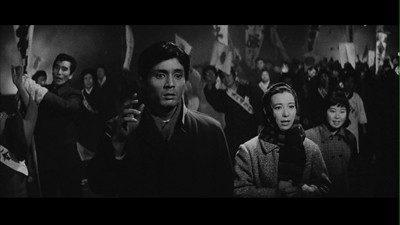


Masaki Kobayashi's nine-and-a-half-hour film The Human Condition was released as three parts over three years, spanning 1959 to 1961. On this new Criterion edition of the landmark film, the three-part structure is preserved over three discs, and it includes the original intermission breaks in each part. So, really, The Human Condition is like a six-chapter novel, the equivalent of six ninety-minute television episodes. Not so daunting when you think about it that way, is it? Not that you'll likely stop at any particular break. Just like reading a good book, I watched The Human Condition into the wee hours, dropping out and going to bed when I just couldn't keep my eyes open anymore, then picking it up where I left off the next day.

Now, even if watching The Human Condition isn't a daunting task, reviewing it is (I know, and get on with it already, right?). To adequately cover the full girth of this particular piece of cinema would practically require a book unto itself. The reason a movie like Kobayashi's is so engrossing is that, like a Russian novel, it is full of recurring themes, side characters with their own lives, and a story that maneuvers through territory as wide as any map--and likely territory that was also covered in the Gomikawa Junpei novel upon which The Human Condition was based. When it comes to a movie of such magnitude, whatever you write in a space like this, it's like using measuring spoons full of water to show someone what the ocean is like. I need flowcharts and character graphs just to keep it all straight!

But here, I'll try...
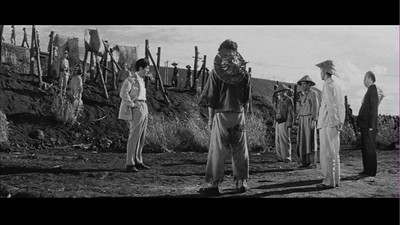


The Human Condition opens in Manchuria in 1943. Japan is in the middle of World War II and using their occupation of China and the country's natural resources as fuel for the war effort. Kaji, played by Tatsuya Nakadai, is twenty-eight years old and full of ideas. He believes that improving working conditions for the common man will improve production output, and even thinks the Chinese forced into labor are entitled to be treated as human beings. Not surprisingly, some consider Kaji to be a radical. His theories sound vaguely Communist.

Like any young man, Kaji is also interested in romance, and he has been dating Michiko (Michiyo Aratama), who works in the same compound with him. She is ready to get married, he is not, as he fears that any day he could be drafted into the Japanese army. A reprieve comes, however, when he is assigned a position at a remote mine where Kaji can employ some of his crazy notions in the aid of extracting precious metals from the Earth. This important work will buy him an exemption from military service. Eager to do some good, Kaji marries Michiko and the two move to the desolate mining town. There, he befriends the tough but fair foreman Okishima (So Yamamura), but quickly makes enemies of the other bosses, who thrive on bribes and sadistic motivational techniques.
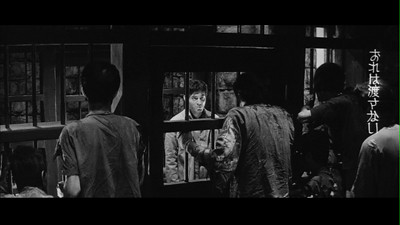


Kaji eventually succeeds, but not without much effort and little praise. Things get more difficult when the army drops off 600 Chinese prisoners and puts Kaji in charge of them. When his enemies help several prisoners escape in order to line their own pockets, Kaji not only loses the trust of the POWs but also runs afoul of a macho military police officer, Sergeant Watai (Toru Abe), who ceases to be amused by Kaji's tactics. Convinced that Kaji has been turning a blind eye to the escapes, particularly once it's revealed that a Chinese boy (Akira Ishihama) that Kaji has taken under his wing has been part of the plot, Watai puts the screws to our hero. Having already been forced to compromise his ideals to the detriment of his self-esteem and his marriage, and often at the cost of lives, Kaji decides to take a stand. His reward? Conscription into the army.
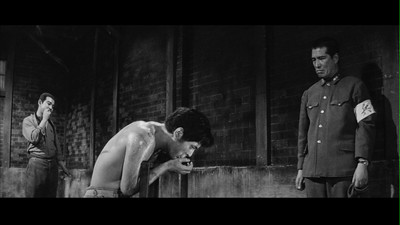


End of Part I, often subtitled No Greater Love; part II is Road To Eternity, and it opens with Kaji on the tail end of his basic training. He and one other solider, the disagreeable Shinjo (Kei Sato), are both outcasts due to their perceived Communist-sympathies, but Kaji in particular has distinguished himself as a sharpshooter. He has also tried to be an ally to the nerdy, pathetic Obara (Kunie Tanaka), who clearly was not cut out for military life. (His kowtowing and almost pathological sycophancy reminded me a little of the similarly pathetic but altogether more unctuous Arthur Storch character in Jack Garfein's The Strange One, released a couple of years earlier but likely just proving there is one in every pack.) The fact that Obara can't be helped is just another lesson about the harshness of reality versus the purity of ideals that Kaji is going to have to learn. While at the start of Part I he is really a student who has not yet been pushed out into the world, by the time he gets to the army, he has experienced injustice in practice, not just in theory. The army will make a man out of him yet. Whether it's the man they want or not will remain to be seen.

There is a crucial moment in Part I where Kaji makes a connection with one of the leaders in the Chinese prison camp, an older man named Wang Heng Li (Seiji Miyaguchi). Wang has been the man whom Kaji has been most eager to have trust him, and even tries to blame Wang's distrust on why some things are going wrong in the camp. It's Wang that expresses that there is more to trust than asking for it, and more to being brave than being stubborn. He cites the fact that they are standing face to face, though staring across barbed wire, and connecting, bridging a divide between their people. It's the men you meet in life whom you find this common connection with that will define the social contract and make the way for real change, be it collective or personal. This encounter will end up being the most important for Kaji in terms of how he deals with the various types he meets from here on out. Which of them will provide the same connection?
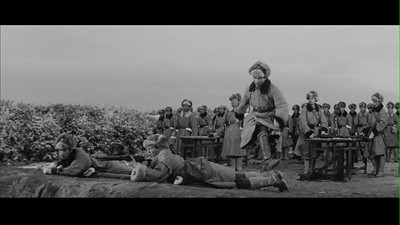


It's also an important instruction from Masaki Kobayashi and co-writer Zenzo Matsuyama on how we should perceive what is going on in this movie. Regardless of the vastness of the landscape, it boils down to the people, the ones who connect with each other, and the ones who connect with us as the audience. This is a technique not dissimilar to David Lean's. The British director used large backdrops and epic stories to create portraits of individuals, showing their courage and their fumbles in the face of situations that were larger than they were. For as awesome as the images we see are, for as breathtaking or soul crushing the locales, it all comes back to the man in the center of the frame.

And make no mistake, in terms of visual power, The Human Condition is awesome. Kobayashi and director of photography Yoshio Miyajima shot their film in black-and-white at a wide 2.35:1 aspect ratio. Within each frame, we see how barren the mine is and also how cramped the army camp; the unending battlefield versus the stifling forest they escape into (Part III). A figure placed within these vistas can appear lonely and overpowered, or if close enough in the foreground, powerful, eclipsing the world behind him. The size also makes close-ups all the more intimate, such as the scenes between Michiko and Kaji when she comes to visit him at his training base and they share a night in the storage shed. The image panel is all about them, all about their love, be it the tight shots of Kaji hugging her naked torso or when they lie down together. Conversely, when their marriage is strained, moving between them and their separate bed mats within this stretched visual space implies a canyon of loneliness and alienation between them.
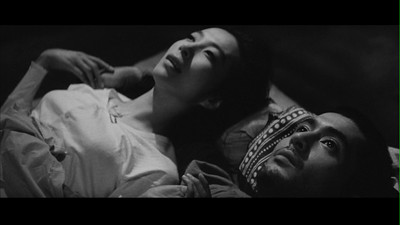


Ironically, though the love of Michiko and Kaji is such an important aspect of his strength in the first arc of the movie--she is both a source of power and temptation--the separation of the pair is integral to Kaji's growth in the second. Her visit to the camp is a farewell of sorts. It's tender, and it's sad; Michiyo Aratama is heartbreaking in how she reacts to her husband clinging to her. After she is gone, though, a sour turn for Obara forces Kaji to stand up for something in the army barracks the way he failed to do back at the mining camp. When he slapped the boy Chen on the urging of a superior, he ignored his better instincts for how workers should be treated, and when his inability to push Obara over the hump leads to hazing and dark consequences, Kaji ends up advocating they enforce the army's judicial code. Again, it's ironic in that he ends up maintaining his own moral strength by embracing the army's stringent guidelines and achieves his own purity by insisting on them being followed exactly. It's a similar stance to the one he took at the mining camp, but this time he manages to make it work without letting authority lord it over him.

The isolation from his wife further allows Kaji to create a tighter sense of community in his new surroundings. When asked to train new recruits, he once again insists on reform, and he creates a solid unit by taking a more humanist approach to basic training. Earn their respect and loyalty with kindness, rather than brutality. Unfortunately, when battle does come to Manchuria, it comes too early, and the men aren't ready in terms of skill, but they do share the bond Kaji hoped for. The fighting turns out to bigger than they are, however. Combat is portrayed as pointless and demeaning, Kaji's unit hiding from the enemy like a giant game of whack-a-mole. One man is assigned to each foxhole, so though the experience is a commonly shared one, they are also isolated. The fewer there are to stand together, the more self-preservation becomes important, and Part II ends with Kaji abandoning what is left, running alone into a darkened wasteland, both in terms of its physical, bombed out appearance and the black clouds hanging in the air, and in the metaphorical sense. Our idealist is rushing headlong into an existential abyss.
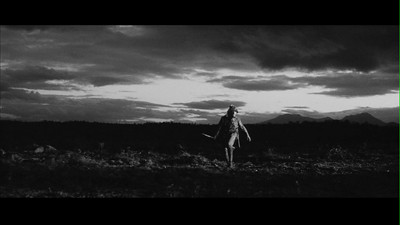


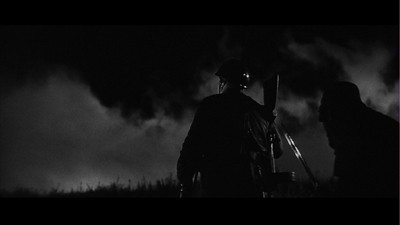
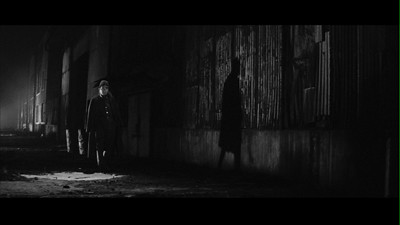
The battlefield sequences are shot with a startling realism, including impressive explosions and large stagings of battle. The enemy is faceless and distant, but there is a starkness to the detail that rivals Kubrick's Paths of Glory or Spielberg's Saving Private Ryan. The size makes it alienating and impersonal. All the more interesting, then, that Kobayashi opens part III of the movie, A Solider's Prayer, with a scene that brings the fighting right to Kaji: a hand-to-hand skirmish with a Soviet soldier. What we see of this, some of it as memories (memory plays a big part in this last third, Kaji's shame shown in freeze frame), is more surreal, the warriors framed in tight shots, a brightly lit night sky full of dark smoke behind them. Kaji is now a man taking charge of his own destiny, and that includes killing. A later one-on-one confrontation with Kaji's ideological rival (Nobuo Kaneko) in a labor camp pushes the expressiveness further, with Kobayashi and Miyajima lighting the beating like a scene out of a film noir. Likewise, eroticism is shot like these individual battles, with the camera moving in so tight, the images of these couplings are practically seen as abstracts.


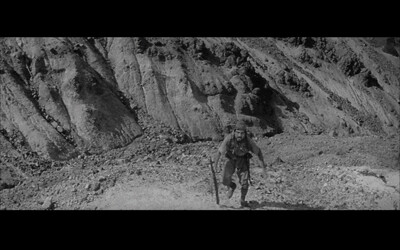
This fifth chapter is concerned with Kaji's long trek home. Reminiscent of Kon Ichikawa's Fires on the Plain, it first shows his hike across an empty wilderness, but soon he is consumed by the jungle that stands between death and freedom. Once inside, he no longer knows where safety lies. At the same time, he is denying the rule of the army, taking charge over a Corporal even though he is only a Private First Class, and eventually establishing his own mini-community. He and the few soldiers he is left with pick up a small group of peasants that they will try to shepherd to secure ground. Most of them won't make it out alive, but they still test Kaji's faith and his leadership, the beliefs by which he defines himself. He is becoming decisive, acting on what he knows to be right without hesitation or compromise. It's Kaji's way, like it or lump it.

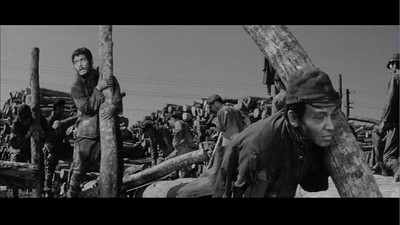
In these final chapters, Kaji becomes a sort of Japanese Ulysses on his own Odyssey, his one goal being to get back home to his wife. Along the way, he encounters many perilous temptations, including several women who look to his strength and dedication with desire, but who fall under his single-mindedness much the way his wife had before them. He runs across leaders who refuse to deviate from their outmoded missions, make-shift refugee camps, and other soldiers who have lost their way, and who either seek the kind of leadership Kaji offers or the lawless alternative. In all things, Kaji emphasizes choice. Like I said, it's his way once you've come on board, but at each crossroads, any man in his company is allowed to decide which fork to take. Eventually, however, he ends up a POW forced into labor by the Russians, a predicament that baffles him. In his mind, it goes against the Communist ideal he would have expected from the Soviets, and it also takes him full circle: he is now subject to the very work conditions he once tried to stop. There is a great sequence where he confronts the Russian leaders with what he has learned and what he sees as being wrong with their behavior, but his impassioned speech is merely splatter against the language barrier. Oh, futility!


Tatsuya Nakadai is still a working actor to this day, and he has appeared in a number of great films, including starring in Kurosawa's High and Low, Ran, and Kagemusha. He even worked with Kobayashi again in Samurai Rebellion, Kwaidan, and Harakiri. The acting range he displays in The Human Condition is nothing short of extraordinary. Though we only glimpse his character over a handful of years (and, indeed, Nakadai played him for almost as long as the time that passed in the script), we see Kaji go through a full arc. Call it a practical education if you will, growing from an idealistic youth with more stubbornness than technique to an experienced soldier that can enact a philosophy in actual situations and all the way to rock bottom. Just like Ulysses, the final leg of Kaji's journey is spent in the trappings of a beggar, though unlike the hero of myth, Kaji undergoes this development for real.
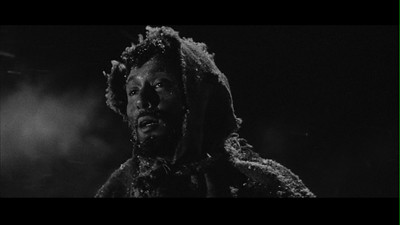


The ending of The Human Condition is bleak. Kaji spends the final scenes on the frozen Manchurian countryside, a tragic turn given that this is where he has run to in order to escape Siberian imprisonment. The world we see through the camera eye is now bleached out, flattened, a blank slate that cannot sustain life. If we continue to consider The Human Condition with an existential mindset, this is a perfect metaphor for the plight of modern man. Sticking to one's ideals, as Kaji does up unto the very end, is a noble pursuit, but one met with more punishment than reward in a world that demands conformity override individual concern. (Indeed, Kaji's problems with the Red Army's approach to socialism is that it swallows men whole in order to just make them part of the same old injustice.) Kaji has gone as far as he can go, and that is a place where he is completely alone, in a landscape that is literally cracking under his feet. Yet, he stumbles onward, his last thoughts being of his wife, the beacon he has followed, the lighthouse of his principles. In one light, this is tragedy, a man who can't be broken but who breaks all the same--that is the human condition, our moral code still depends on our physical body--but in another light, it's a triumph of the same. One can go on but need not give in.

The last shot pulls away from the figure at rest, leaving it rather than zooming in to join it. The reversal takes us from the personal, back to the widescreen picture, back into the world, carrying the image of the man in the snow with us.

The Human Condition has been out of print for many years, and there aren't kudos big enough for Criterion having brought it back to audiences in such spectacular fashion. I've been kicking myself for nearly a decade now for not buying the original three-disc release after spotting it used shortly after getting my first DVD player. In all that time, I hoped Criterion would put out a set and I could finally correct my mistake. To see Kobayashi's masterpiece at last and in such fine packaging--a beautiful looking multi-covered book, a fourth disc full of extras, a remarkably clean transfer--it's been well worth the wait. The Human Condition is an enriching, incomparable cinematic experience.


Sunday, January 27, 2008

FIRES ON THE PLAIN - #378


"War is hell" isn't really a novel message anymore, and it hasn't been for some time. Even so, most works of art, even ones with this message, don't really go as far as they could to illustrate how hellish the situation can be. It's hard not to make a hero of your main character, to steer past the things that make service in wartime a noble pursuit; there's something unavoidably worthy of respect that the soldiers know it's hell they face and still they face it anyway. So, when a movie comes along that shows us to what extent conflict can ravage the human soul, it still shocks us, still unnerves its audience. No one emerges as a hero from Kon Ichikawa's 1959 motion picture Fires on the Plain (a.k.a. Nobi), no one even tries to fight the good fight. It's a dour and grisly portrait of how battle can change the landscape of a particular patch of land until you will believe it is hell on earth and reminds us of how far we may be asking men to go when we ask them to stand up and fight.

Eiji Funakoshi plays Tamura, a hapless private in the Japanese army who is stationed in the Philippines during World War II. As the film opens, Tamura is being berated by his staff sergeant, who is sending him back to the field hospital a third time to be treated for his tuberculosis. If he can't work, he's useless on the front, and if the hospital rejects him yet again, Tamura is instructed to throw himself on his own grenade. He takes the long trek back to the medical station, and of course, they refuse him once more. The doctor tells him if he can walk, he doesn't belong there among the real wounded.

At this point, Tamura becomes an outcast, joining a group of other soldiers who have also been stuck in this sort of limbo, unfit to serve but not committed enough to die. He's not a part of the army his uniform represents, he's not sick enough to be taken care of, and he's not even in his own country. The world beyond him is a terrifying unknown element. All he can see on the horizon are plumes of smoke. Everyone thinks they most be some kind of signal, they just don't know of what.

When the enemy attacks and destroys the hospital, Tamura is once again scattered to the wind. He knows he should use that grenade, he knows that there is only danger out there, but he begins to wander. His journey leads him from one atrocity to another, a trail of corpses and the desperate living in search of their way out. Word has come down that the Japanese forces are gathering in one spot and then they will be shipped out, so everyone wants to get there. Tamura will kill, and he'll see killing; he'll forage for food, and he'll see foraging and even theft; he'll witness people giving in and giving up, and he'll witness the price that might be paid when his fellow troopers completely let go. Tamura will even let go himself, first of the trappings of a soldier and then eventually his own humanity. Trapped out in the wilderness with two of the other hospital refugees, Tamura will find himself in a sort of Treasure of the Sierra Madre situation, only the treasure isn't gold, it's survival. Just how will Tamura find his way back to being a person again? The answer may reside in that tower of smoke that has suddenly returned, but once again, if it's a signal, it's all going to be a matter of how it's read.


Kon Ichikawa isn't afraid to celebrate the power of the human spirit. Anyone who has seen his vision of the lone African runner in his documentary Tokyo Olympiad knows the director believes that one man can overcome impossible odds. This makes it all the more impressive that he had previously gone to the totally opposite to show the depths of individual degradation. Tamura doesn't engage nearly as much as he watches, but like Jerzy Kosinski's young protagonist in his novel The Painted Bird, there is only so long any one person can let the horrors of war rage around him until he succumbs to them. Also as in Kosinski, the world surrounding the focal character is so transformed by the destruction, it loses all earthly familiarity. Hell may just be a metaphor here, but when Tamura looks back over the river bed that was supposed to be the border of his freedom and sees the corpses that piled up while he escaped, it's as close to seeing Hell on the physical plane as you're likely to get.

Though Fires on the Plain is bleak, it's not unrelenting. There is some laughter in the face of destruction. In one scene, a soldier finds a nice pair of boots abandoned in the mud. He trades them for his own shoes, which are starting to become worn down. The next soldier then trades this newly discarded pair for his own, and so on, each pair of shoes getting worse and worse until the last pair has no soles on them at all. Just as most people do when faced with grisly circumstances, Ichikawa indulges in a little gallows humor to keep his audience's spirit up long enough to get to the final destination. So, don't worry, though Fires on the Plain will weigh heavy on you, it won't crush you. Like Tamura, you may end up punch drunk (he gets more comical the farther he goes over the edge), but you'll still be standing.

Ichikawa and his wife and frequent collaborator, screenwriter Natto Wada, working from a novel by Shohei Ooka, weren't trying to create a movie that represented the experience of every soldier or say all men who served in the Philippines engaged in the poor behavior represented on the screen. When you sit back and look at it, there is no propaganda here at all. No one espouses a message. Quick scenes with the American soldiers don't vilify them. Ichikawa isn't teaching us, rather he's using Fires on the Plain to show us how far things could go were circumstances to pile up as they do and trusting the meaning to be obvious. Thus, Tamura is meant to serve as a reminder, or maybe more accurately, a warning. Tamura stands in stark relief against the regular cinematic soldier who is far more ready to pick up his rifle and rush across the trenches to save the day. Fires on the Plain is the other side of that story, showing the men who might be on the receiving end of the movie hero's bullets. It's a harrowing wake-up call. War may always be hell, but it's not often that we experience it burning this coldly.


Originally written March 13, 2007. For technical specs and special features, read the full article at DVD Talk.