Monday, April 12, 2010

THE FUGITIVE KIND - #515

"This is a snakeskin jacket! And for me it's a symbol of my individuality and my belief in personal freedom." - Sailor (Nicolas Cage) in David Lynch's Wild at Heart

"That's where I come from, it's not where I'm going." - Valentine (Marlon Brando) in The Fugitive Kind
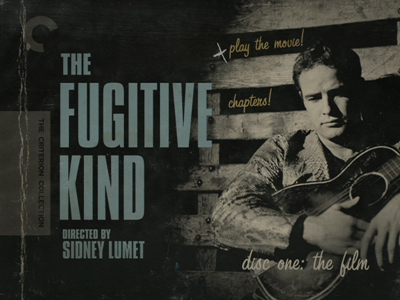


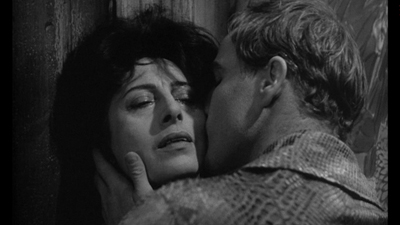
I know that New York isn't really earthquake country, but has anyone checked the records for 1959? Because surely the ground did shake when Anna Magnani and Marlon Brando met each other on the set for The Fugitive Kind. Such colossal screen talent in one place, the soil must have shuddered. That the two apparently did not get along did not matter. Such are the laws of the jungle. As performers, these two were primal.

The Fugitive Kind was directed by Sidney Lumet, most recently seen on modern movie screens helming the fantastic Before the Devil Knows You're Dead. It was adapted by Tennessee Williams and Meade Roberts from Williams's play Orpheus Descending. It reunited the playwright and Marlon Brando, who had changed acting forever as Stanley Kowalski in Williams's A Streetcar Named Desire, first igniting the boards in the original stage version, then recapturing the flame in Elia Kazan's movie version.
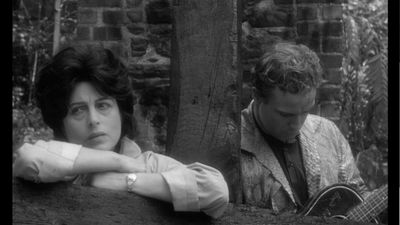


This time around, Brando plays Valentine Xavier, also known as "Snakeskin," named so for his snakeskin jacket. Val is a performer in love with his guitar, which he carries everywhere yet really only plays once (accompanied by an unconvincing overdub [video]). When we meet Val, he's standing before a New Orleans court, having caused a ruckus at an illicit party the night before. His guitar is in hock, he was hired to go to the party for his other talents. Snakeskin is a stud. He oozes sexuality. Just about everything out of his mouth sounds like a come-on.

Val is just about to turn 30, and he's sick of the festive lifestyle, so he retrieves his guitar and gets out of the Big Easy. He drives until his car won't drive anymore, settling into a small town. The sheriff's wife (Maureen Stapleton) takes pity on him--a bad habit of hers, by the looks of it. The night Val arrives, Sheriff Talbot (R.G. Armstrong) and his boys are hunting down an escapee that muscled passed Mrs. Talbot when she took his dinner to the jail cell. They catch him, but this time they give him a pine box instead of a metal one with bars. Still, Val wants to turn over a new leaf, and Mrs. Talbot believes him.
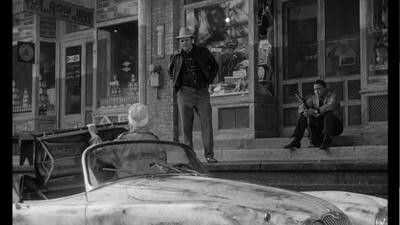


The next day, Mrs. Talbot takes Val to the local all-purpose store. The owner of the store, Jabe Torrance (Victor Jory), has been in the hospital and is coming home that afternoon. Since Jabe is still bedridden, his wife, Lady Torrance (Magnani), is going to need some help keeping things running, as her time will be divided between caregiving and clerking. Val's job interview is delayed by the arrival of the town wild girl, Carol (Joanne Woodward), who remembers Snakeskin from a New Year's shindig in New Orleans (indeed, he wears her cousin's watch, stolen during their last encounter). She takes him out for a drunken night in highway roadhouses, but it only reminds Val that he's done with that kind of foolishness. He returns to the store and engages in a late-night mental joust with Lady. There is something between them, something neither wants to name, and Lady gives him the job as long as he agrees to pretend that something isn't there.
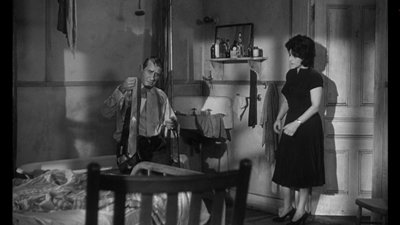


The mythological Orpheus was a master of the lyre and a singer of songs. The most well-known story about him, and the one that Williams was referencing in Orpheus Descending, involves the musician heading down into the underworld to rescue his wife, Eurydice, from the grips of Hades. His songs move the heart of the oppressor and earn the woman a second chance at life. Except on the way out, Orpheus hesitates. Despite being told to get out of the underworld and not turn around until he is through to the surface, Orpheus looks back at his wife when only part of the way to freedom, and her soul is damned for eternity.

Williams and Lumet transplant this old story to the American south. Val leaves a life of abandon for the more constricted, isolated small town where the locals either dole out punishment (the men are bullies, the women judgmental gossips) or are damned (characters regularly refer to this place as being a prison). Carol, for instance, is punished for her transgressions. The alcoholic party girl is also a political provocateur, challenging the racial divides prevalent at the time, and beat down for it. Woodward plays Carol as unhinged, but in much the same way a caged animal loses its sense of perspective. She can't beat the zookeepers, so she can only bang on the cage.
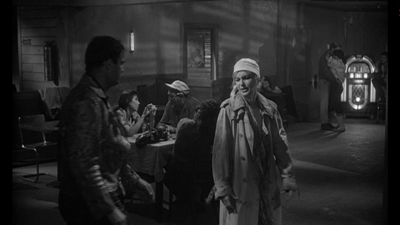


Race is a big issue in The Fugitive Kind, and so is sex. Both transgressions are met with small-minded justice. Lady dared to love once. As a youth, she had an affair with Carol's older brother (John Baragrey), but the price for it is that now she is in a loveless marriage with a sour man. She is trapped in a place that is too small for her, and one that has already brought her much damnation. We don't know how this Italian family got there, but her father once ran a little wine bar on the outskirts of the 'burg, only to have it burned down--and he with it--because he sold some liquor to black customers. It was the same summer that Lady's romance ended, and she's carried the hate from it ever since.
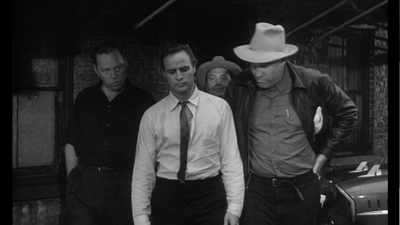


Val has a philosophy about the world, that there are only two types of people, the ones that are bought and sold, and the ones doing the buying and selling. Everything has a price, including human flesh. (Indeed, the implication of his story at the start of the movie is that he was prostituting himself.) There is also a third type, but it's so rare as too hardly count. It's this group that Carol dubs "the fugitive kind." These are the folks that choose to get out of the cycle. Val likens them to birds with no legs, ones who can never land and must always stay high in the sky, above the predatory hawks that would knock them down. They "sleep on the wind" and only touch the ground when they die. Val is this type, Carol is this type, shouldn't Lady also be? She definitely has plenty to run away from, and she certainly doesn't fit in where she's at.
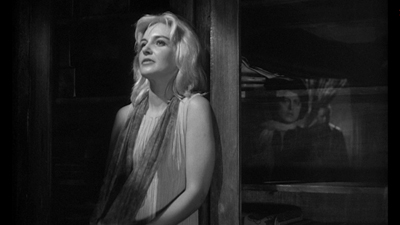


As his name suggests, Valentine Xavier is no ordinary man. He is a strange creature with odd habits, described as being a "peculiar talker." Names in The Fugitive Kind obviously mean something. "Lady" is the lady of the story, the damsel in distress, and a "Valentine" is a trinket, an object of contrived emotion that uses love as barter for sex. Lumet points out in the extras that this particular pheromone factory's full name is a play on "Saint Valentine the Savior." Every woman who comes into contact with this Valentine wants him in some way, even if it's just to mother him like Mrs. Talbot. They are drawn to him like moths to flame. (Val describes himself thus: "My temperature's always a couple of degrees above normal, the same as a dog.") Likewise, Val knows what these women feel. His presence inspires them to confess what is inside of them. In a very tender scene, he talks to Mrs. Talbot about her painting. A far too kind a soul to be married to the mean-hearted Sherriff, Mrs. Talbot has taken up art to express herself. She can't explain it, it's precisely because she doesn't have the words that she has turned to the canvas, and Val's claims to understand soothe her. The kindness that passes between them is quiet, and it's just as powerful as any of the more assertive emotions that flare up elsewhere. Maureen Stapleton's performance is heartbreaking.
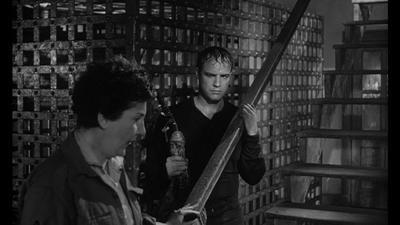


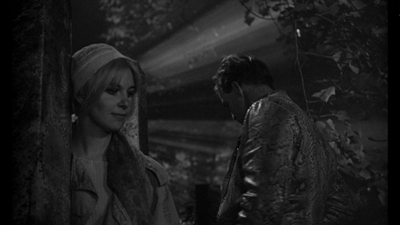
If Val is a figure of myth, then the world he lives in must also be mythic. Sidney Lumet and director of photography Boris Kaufman, along with art director Richard Sylbert, create an isolated environment, one that is moody and at times overwrought. The graveyard that Carol takes Val to is like an oasis in the dark, and the bright lights that filter through the foliage around it make it look like a portal into another world. In contrast, the dusty town is like some kind of pit, a hole in the earth. The interior sets are either bare (the roadhouse, the bedrooms) or overly packed (the jail, the Torrance store). In one sense, we see the poverty and the isolation; in another, we see how small everything is. These people are stuck together, they can't help but be on top of one another. If it's not Hell, it's at least Purgatory, a stop along the way (Orpheus is descending, after all, he's not there yet). Jape Torrance sweats his life away up in his room, the presiding death dealer, and the store beneath him has an understated surreal quality, like Dante rejigged for commerce. In opposite corners, still mannequins stand like guards, watching what goes on.


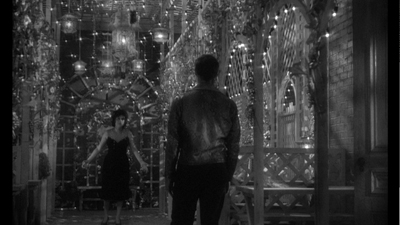
When Lady takes Val out to the ruins of her father's wine garden, we see that it was once a colorful escape from the dreariness of the village. Lady is hoping to recreate that place of peace and celebration, she is building her own little nightclub on the side of the store. She calls it the Confectionary, and when it's put together, decorated with tinsel and hanging lights and flowers, it looks like a wedding chapel. Like the graveyard, it's a romantic gateway to somewhere else. It's a symbol of love and happiness, and a big f.u. to the hardened hearts of the men around her. She knows that amongst the townsfolk are the racist "vigilantes" who killed her father. In truth, her exile is self-imposed, she is waiting to find the truth and punish the murderers.


These various elements give The Fugitive Kind a palpable tension. The heat between Val and Lady is met in intensity by the doom hanging in the air. If they finally come together, it will surely be the end of them both. Yet, like the classic myth, there is an inevitability to their coupling. This is there fate. Everything Val does only seduces Lady more, feeding her loneliness and need. This makes Val a fugitive from his own nature. He wants desperately to get away from her, to not ensnare her with his charms or be ensnared by her desire, but he can't. He tries, he's on his way, but she draws him in. He turns around before he's gotten out of the underworld. Love forces the bird to land.

As noted at the outset, the pairing of Magnani and Brando is pretty significant. Anna Magnani is a forceful screen presence, and her powerful performances in films directed by the likes of Rossellini, Renoir, and Passolini are unforgettable. Her acting is fired by an inner force, something that can't be entirely articulated, it's just when you see her, she seems so real that you want to know what more there is. It's impossible to take your eyes off of her. It's a quality that Brando also possesses, yet his method makes him seem mercurial and unknowable, whereas Magnani is solid. When they come together, it's like ocean waves beating against a concrete shore. They are their characters: he can't be grasped, she can't be moved.
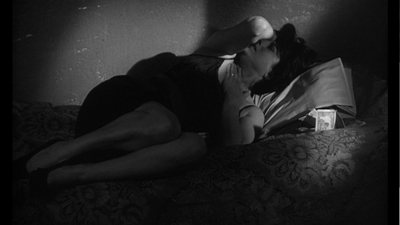


Though Brando reportedly found Magnani unattractive, there is still a sexual spark between them. Perhaps he knew what he was doing, he was turning himself into something she could not have to draw her out. Apparently his mush-mouthed delivery made it hard for the Italian-born actress to pick up her cues. She had learned her lines phonetically, though you would never know it. With these two actors, expression transcends language. Ironically, it's just this kind of actor that can wrestle with Williams's often overwritten poetry and make it sound believable. Brando in particular sucks the pretention right out of it by making the lines sound so off the cuff.

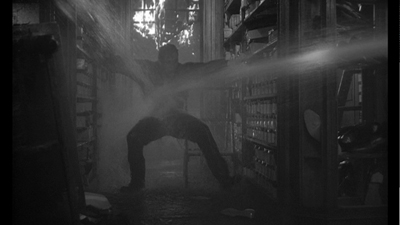
The constant references to heat are apt. This is Hell, and the fires will burn as they will. The Fugitive Kind builds to an incendiary climax, one befitting the story's classic origins. It's also one that befits the tumultuous politics of the times. Small-minded morality and the brutality that comes with it was on its way out, and though they may have seemed crazy, it's the ones who saw the sea change coming that also kept moving forward. Not sure if that's by choice, Williams seems to say they are unmoored. If it's a sea change, they are stuck beating against the tide. The Fugitive Kind seems more cynical about social progress than hopeful. In the final scenes, it's suggested that there is no changing who people are. The skin we wear, the very nature of our beings, cannot be shed, only transmuted. The sellers and the sold may be condemned to stagnation, but those who would be free are condemned to forever be separate, to always wander, and never be blessed with the growth their stubbornness may inspire.


The Fugitive Kind is a two-disc set, and the second disc is all supplements, including a discussion with Lumet about his roots in television and his previous adaptations of Tennessee Williams.

Fans of live TV of the 1950s will be pleased to find the hour-long Kraft Television Theatre production, Three Plays by Tennessee Williams, collecting "Moony's Kid Never Cries" (starring Ben Gazzara and Lee Grant), "The Last of My Solid Gold Watches" (starring Thomas Chalmers), and "This Property is Condemned" (starring Zina Bethune and Martin Huston). These three plays show three different ages, three stages of life: childhood/pre-adolescence in "Property," early adult life in "Moony's," and old age in "Gold Watches." In each stage, there is a sense of disillusion and disappointment, the characters have all seen that the promise of whatever life has preceded them was false, and the tomorrow they hoped for is not waiting for them. In some cases, it's their own future that is faltering, and in the case of Chalmers in "Gold Watches," it's that the whole world is changing and going in such a way that not only has he become obsolete, but all that he thought he accomplished no longer matters. The theme in Williams is always of a dream deferred. Even in The Fugitive Kind, Snakeskin has realized that the high life is not so high, and Lady has discovered love is a hard, bitter thing. These one-acts move quickly, and the acting is exceptional. Sidney Lumet was a facile director, agile in the live arena, and this production sizzles.


For a full rundown on the special features, read the full article at DVD Talk.

Saturday, April 10, 2010

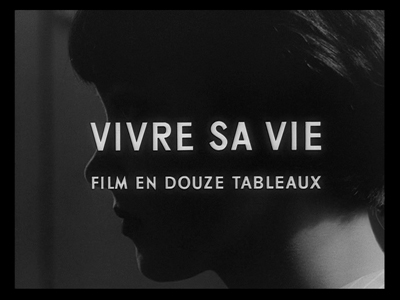
VIVRE SA VIE - #512

An impressionistic review written in homage to the inspirational spirit of the source material. A criticism in six tableaus.


1. THE CHURCH OF CINEMA - ANNA KARINA MARTYRED

It's not that Jean-Luc Godard wants to remind us that we are watching a movie because he wants us to differentiate motion pictures from real life, it's that he wants to confuse the two. In his worldview, the two should be one.

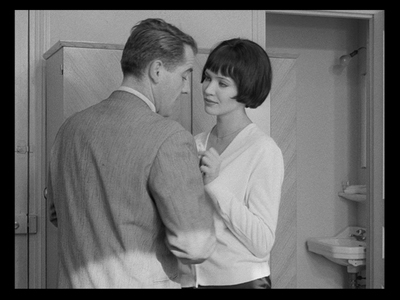
And so his 1962 film, Vivre sa vie (My Life To Live) begins by seemingly falling apart. Only a couple of lines in and Nana, our savior, played with a convincing naturalistic ease by Anna Karina, seemingly flubs a line, repeats it, tries it a number of different ways. No, Godard has not included a blooper to throw us off, but rather, he has inserted a reality of cinema into the reality of his cinema. Nana is an actress, she is practicing a line. It's one of life's bloopers.


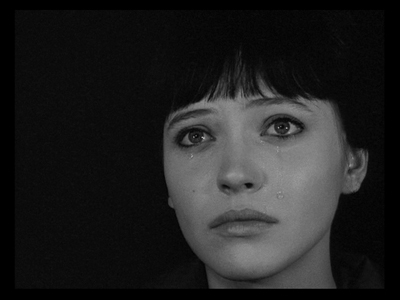
Nana's life takes two important turns in the movie, both precipitated by cinema. One happens early on when she goes to the movies to see Carl Th. Dreyer's The Passion of Joan of Arc, the 1928 silent film starring Falconetti, an icon of early French cinema. During the sequence, as Nana watches a scene from the movie with tears in her eyes, "Falconetti" is the only word uttered. There is no other sound, and her name is spoken reverentially, whispered by...who? Later in the movie, Nana will talk about her desire to live in silence, and the true value of words will be debated. Shortly after, she will be in a silent film herself. Literally. Though this time accompanied by music.


The second invocation of actual cinema comes after, when Nana and her pimp, Raoul (Saddy Rebbot), are supposed to go on a date to the movies and do not. Raoul is discussing business. Directly relating to that first movie, it's right after seeing Joan of Arc that Nana decides to become a prostitute to pay the bills, her dreams of being a film star failing; in the case of missing this later trip to the pictures, she meets the "young man" (Peter Kassowitz) as a result of the detour, and he arguably becomes the one person to have affection for her after her life dovetails. It's certainly when it becomes clear that at least Raoul doesn't care about her. He's the only man in the room who does not dote on Nana.

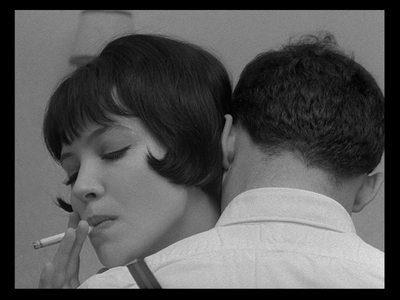
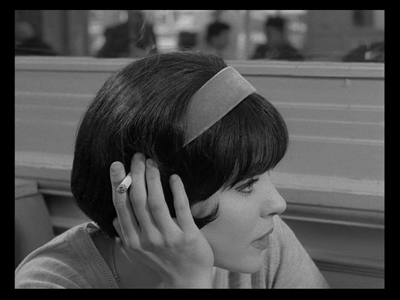
Raoul is merely a pawn, though, this is about Nana. It's by no coincidence that Anna Karina's character shares a name with the heroine of an Emile Zola novel and, perhaps more importantly, a silent film adaptation directed by Jean Renoir in 1926. The previous Nana was an actress who became a kept woman, and who then destroyed herself and the man who kept her. She is part of a sprawling fictional history invented by Zola, just as Godard's Nana is part of his own history and also the history of cinema. This is why her story is told as a series of religious tableaus, the 12 Stations of the Passion of Anna Karina. Vivre sa Vie begins with multiple angles of Karina's face shown under the opening credits. We view her in the same abstracted light as Dreyer showed us Falconetti. She is to be revered, admired, worshipped. And she will die for our entertainment.


2. IN HIS OWN WORDS

The summary Jean-Luc Godard wrote for the original release of the movie, reprinted in the Criterion booklet:

"A film on prostitution about a pretty Paris shopgirl who sells her body but keeps her soul while going through a series of adventures that allow her to experience all possible deep human emotions, and that were filmed by Jean-Luc Godard and portrayed by Anna Karina. Vivre sa vie."

Note the expanded credit the filmmaker gives himself: "Thought out, written, shot, edited, in sum, directed by Jean-Luc Godard."


3. KIDS WITH GUNS

The men in Vivre sa vie don't hang around, that's true. Even the ones Nana has a relationship with, including her ex Paul (Andre Labarthe), with whom Nana has a child, don't last. This is by Nana's choice more than theirs, however. She discards the date who bought her the ticket to see Joan of Arc, trading him for a skeevy photographer. He prefigures the pimp, Raoul, in that he has his own designs on what he will acquire from Nana--the photos he wants don't really seem to be for her, and we never even see them--and then he goes. Godard is drawing a direct parallel between a film actress and a prostitute, both give up something of themselves for the pleasure of others. He is fascinated by the connection moreso than he intends to make it a negative. The guilt is on us.


The very mythology of movies seems to be unfairly balanced. Why do boys get to be the gangsters and the girls unwitting pawns in their childish games? Godard himself famously boiled cinema down to girls and guns, and time and again he shows his overgrown adolescent heroes engaging in gunplay (see also: Breathless, Band of Outsiders, Pierrot le fou). In this mythology, girls are interchangeable, either the femme fatale or the kindly caregiver/romantic. Is it then a surprise that, by being neither, Nana will ultimately be punished? As someone who swaps men around, the ultimate disempowerment will come when Raoul swaps her--though, since he trades her for cash, arguably it's what he's been doing all along. To further push the idea of entertainment as a similar illicit transaction, consider how easily we now acquire, consume, and discard our films. I've owned Vivre sa vie on VHS and one DVD prior to this. How different, how transient, will the interaction with Nana be when she's available for download on demand?


4. ART AND BEAUTY ARE LIFE - THE SACRIFICE

There is, of course, the question of the male gaze in cinema. Raoul Coutard's camera is as in love with Nana as we are. The way he lingers on her face, often posing her against a white background (again: see Dreyer and Falconetti; also, compare the black of the theatre's darkness while Nana watches the film), it's as lurid as it is worshipful. Is it then a coincidence that the pimp and the cinematographer share a name? One can't deny that Godard is aware of the abstraction art makes of its female subjects. When Nana's admirer finally speaks, he reads from Poe's "The Oval Portrait," the story of a painter who becomes so obsessed with the portrait of his beloved that he is creating, it eclipses the obsession with the woman who originally inspired this passionate impulse. To the point that he doesn't realize that while bringing her to life on his canvas, she has died.

This reading is sandwiched within the two silent film sequences with the boy, and Godard makes the connection clear. The declaration that the woman is dead is a reminder of the last words we see on the screen in the clip from Dreyer. Joan of Arc is asked "And your deliverer?" to which she replies "La mort." Death.


Anyone who has seen enough Godard movies should instantly recognize his gravelly voice dubbed over the young man's. It's the director who is reciting Poe, not the actor. This directly inserts the artist in his art, confirming his awareness of his inherent role in the breakdown of his character and also dismissing another division between life and art. His opinion of himself and of men in general does not seem very high at this point: even those who might profess to love Nana use her to satisfy an aesthetic need. The boy is in love with being the one looking at her. Since Godard and Karina were married at this time, what is he doing by making her the fetish objects of his films?


There are several moments when the gaze is turned back on us in Vivre sa vie, but one is the most striking. In the café just before Nana meets Raoul, Anna Karina looks directly into the camera, and her eyes seem to be asking us, "Can you believe this? Is this enough?" Godard has tricked us, though, and he flips it again. Nana is actually looking at a young couple seated across from her. They appear to be in love, but they also look like they are in distress; it's ambiguous. Then Raoul's cohort plays an overly sentimental pop song on the jukebox. It's a song called "Ma môme" by Jean Ferrat. "My Kid." It's a mawkish ballad about the love for a child framed in romantic language.


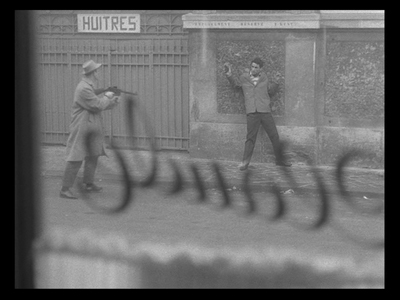
Godard seems to be undercutting Nana's dreams here. She is giving up romantic love, giving up her role as a mother, giving up her dreams to be an actress, and choosing to be something else. Just before she does so, her friend Yvette (G. Schlumberger), another single mother who has turned to prostitution, reveals that the husband/father that abandoned her was last seen as an actor in an American movie. A man gets his dream, the woman is left holding the bag. Just after all this, there is a gunfight in the streets, so violent the very sound of the machine gun fire shakes the screen. Warning, Nana: Danger Ahead.


5. THE UNWITTING PHILOSOPHY

Make no mistake, Nana does make her choice, good or bad. This is at the root of how Godard can maintain that she has kept her soul. The other woman, Yvette, is willing to blame outside circumstances for her current occupation; Nana very clearly is not. She says straight out that she does what she does by her own power and it is thus her responsibility. It's the core of existential thought: you decide how you go on in this life, and when you do, live with it. "Escape is a pipe dream," Nana tells Yvette. "It just is."

"It just is." It's very simple, but if we are to see Nana/Anna Karina as a religious martyr, we need to understand that she represents determinism. "It just is." It's like DeNiro in The Deer Hunter: "This is this. This ain't something else. This is this. From now on, you're on your own."


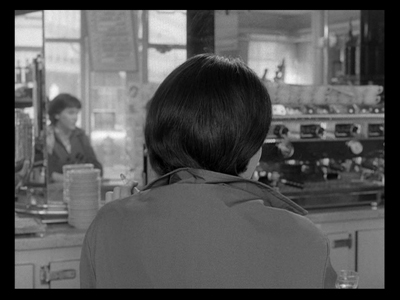
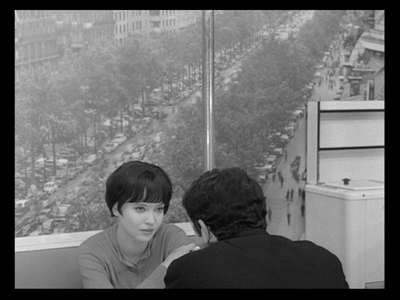
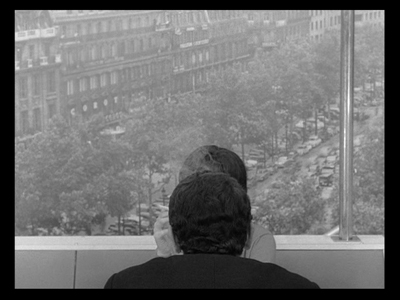
Being on one's own is important to Nana. Let's think about how Godard frames the conversations she has with the men she is attached to. In the start, when she is with Paul, we never see their faces. Godard and Coutard shoot the pair from behind, and we see only a glimmer of Nana in the mirror on the other side of the bar. The camera moves back and forth between them, not dominated by either. In the next sitdown, when Nana meets the photographer, she asserts a little more control, and though the camera is once again behind them, the actors are turned to give us a side view.

Next, there are two conversations with Raoul. The first is in the café when he is playing Nana for a fool. Wanting to know if she is "a lady or a tramp," he decides to insult her. If she gets mad, she's a tramp; if she laughs it off, she's a lady. (Yeah, that's one sick mode of thinking.) He is seducing her (indeed, the whole scene, with the unknown couple and the Ferrat song, is a seduction), and he stays mostly out of frame, he let's her be the focus. When they meet again, with Nana sitting in front of a large photograph of Paris, as if she were somehow representing (encompassing?) the whole city, Raoul sits across from her, so that his back is to us and we can see her face. The camera still moves back and forth, though, but somehow it captures less and less of Nana. As Raoul takes her over, she is almost totally obscured from our view.


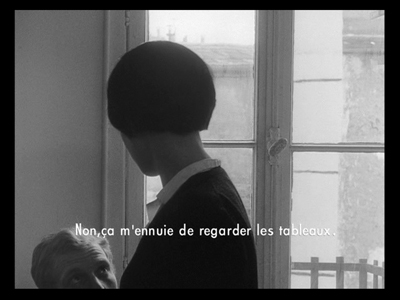
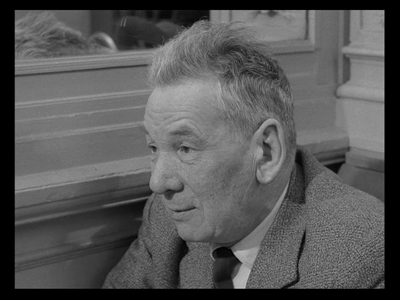
Unsurprisingly, Nana also becomes obscured from herself. At one point in the movie, she says, "I...is someone else." It's almost a non sequitur, a bit of a Freudian slip, but it's a true philosophical expression, and one that we can't help but recall in Vivre sa vie's most memorable scene. In the penultimate tableau, Nana meets an old man in a café. After inquiring about what he is reading, Nana joins him at his table and they have a discussion about the meaning of discourse and one's ability to express oneself. The man is played by the real-life French philosopher Brice Parain, and in this scene, he extends the theory that our ability to express ourselves is directly related to our ability to know ourselves. Language is only as faulty as our ability to think, since thought is inseparable from our vocabulary.


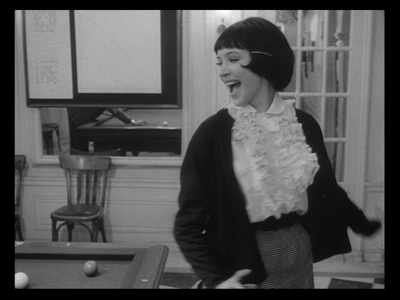
The conversation between Nana and Parain is the only time in the movie that someone takes Nana seriously as a person. The old man doesn't want to sleep with her, take photos of her, or earn money off her. He doesn't expect her to find the records he's after like the customers in the record store where she worked, nor does he pity her the way that the police officer who interrogated her pitied Nana. He simply wants to talk to her and share ideas, and in the process, Nana reveals herself as a deep thinker. She is a bright individual not just in the mental sense, but in her whole aura. Talking to Parain, she positively glows, as if she is coming alive. The only other time we have seen her this active is when she is rebelling against Raoul in the pool hall, when she meets the young man and dances around the room to a song of her choosing [video]. Of course, the irony is that this could be seen as what Raoul will punish her for. His given reason is that she refused a customer, but the subtext is that she dared think for herself.

Parain's validation actually gives Nana permission to think for herself, but also permission to make mistakes. He says that we must "pass through error to arrive at truth." More simply, we have to mess up in order to learn how to be better. As a deterministic force, Nana must remember that it's okay to acknowledge a misstep and correct it. She even seems to be trying to do so by accepting the affection of the young man and deciding to leave Raoul's "employ." This, however, is when the movie shifts into silent movie mode. She is now Falconetti, now Joan of Arc, and her crazy ideas of self-actualization threaten the male establishment.


6. FIN

In terms of style and form, Vivre se vie is one of the more exciting and lively Godard films from the 1960s, even as it is also one of the most melancholy. This is a sad movie, one that even questions the very possibility of happiness. It may be less playful than some of Godard's other films from the period, but he trades that for a tighter control. Vivre se vie strikes me as the film where the director was most in command of the production, where he knew each move and calculated how that move would affect the overall whole.

This seems necessary on his part if we are to accept Nana as a metaphor for cinema, and that the start and end of this movie is to be the star and end of a singular life. Indeed, the very last shot seems to show us the camera itself dying, as if wounded by the gunshots that just rang out. In the last seconds, the camera drops its gaze, as if it were gasping its last breath, before smashing to black and the last title card: FIN. It has a devastating effect, but one that is also exhilarating, akin to religious ecstasy. Martyrdom crystallizes the cause, makes way for reinvigoration and rebirth.

Nana gave herself for the sins of cinema, and Anna Karina and even Jean-Luc Godard have subsumed themselves to the force of the narrative on her behalf.


If there was ever a disc in your collection you needed to replace for a newer version, it's the 1999 Fox Lorber version of My Life to Live for the Criterion Vivre sa vie. Just popping the old disc on and scanning through it, I saw so much dirt and so many scratches, I almost thought I should check my cable connections to make sure there wasn't something wrong. Not that I needed to cast a glance backwards to see how marvelous the full screen transfer (1.33:1 aspect ratio) on the Criterion disc is. The beautifully rendered black-and-white image is so crisp, so clear, and so full of nuance and depth, I am not sure that people seeing Vivre sa vie at its premiere in 1962 saw it looking this good.

Also look at how the Criterion "picture boxing" allows for more image area than the straight full-screen transfer.


Fox Lorber


Criterion


For a full rundown on the special features, read the full article at DVD Talk.

Godard's 1962 trailer for Vivre sa vie.


Thursday, April 8, 2010

RAN - #316


Stillness and silence.

These are the things that we first experience at the start of Ran, and they could be said to define the movie. The very first shot of the film shows a hunting party on horseback, and for the first few seconds, no one moves, there is barely a sound. Until one of the figures finally shifts just after the director’s credit, it almost looks like a still photograph or a painting.


Akira Kurosawa’s 1985 masterpiece is a loose retelling of Shakespeare’s King Lear. Transplanted to 16th-century Japan, it is the story of aging feudal lord Hidetora Ichimonji (Tatsuya Nakadai). Realizing that his powers are flagging, Hidetora decides to put his oldest son, Taro (Akira Terao), in charge of his land. When his youngest, Saburo (Daisuke Ryu), raises concerns about this decision, his father banishes him from the kingdom. Sensing that the boy was right and appreciating his forthrightness, one of the Ichimonjis’s neighbors, Lord Fujimaki (Hitoshi Ueki), invites him to come live at his castle and marry his daughter. Exit Saburo, stage left.

Saburo’s fears quickly turn to reality once he is gone. Taro’s wife, Lady Kaede (Mieko Harada), has a deep resentment of her father in law. He destroyed her family and took their land, and so this Japanese Lady Macbeth encourages her husband to curb his father’s remaining status. Deeply offended, Hidetora takes his retinue and goes, seeking shelter with his middle child, Jiro (Jinpachi Nezu). Jiro has other ideas, however; he’d rather be in charge and so he also embarrasses his dad, suggesting the old man should live far more humbly than he is accustomed to. Enraged, Hidetora leaves again, heading to Saburo’s abandoned castle. The exiled son’s army has already left it, heading toward Fujimaki’s province to rejoin their commander.


Ran is a colorful spectacle. It’s an historical drama that may take its story cues from Shakespeare but its quiet nature is more reminiscent of traditional Japanese theatre. Kurosawa and his trio of photographers (Takao Saito, Masaharu Ueda, and Asakazu Nakai) frame the proceedings ceremonially, viewing the political debates and wicked scheming from a respectable middle distance. The acts of men are small and contained, whereas the world and nature itself is larger than they are. He shows the hunters on a hillside that takes up 80% of the screen, leaving them to share the remaining 20% with the sky. When Hidetora and his fool (Peter) are at their lowest, we see them lying against opposite walls in a chasm, photographed from above to show how far they have fallen. The final shot of the film is of a man standing on a rock wall built out of a hillside, the camera leaping farther and farther away from him until he is indistinguishable from any other object on the hill. For all their bluster and their perceived indignities, these humble players are but tiny specks in a universe that would rather flick them away than indulge their cries of pain.


Themes of sin and redemption begin to emerge when Hidetora goes to visit Jiro. The wife of the second son is Sué (Yoshiko Miyazaki), and she is another spoil of Hidetora’s many wars. In opposition to Kaede, Sué is kind and sweet, a practicing Buddhist, and she inspires guilt in a surprisingly compassionate Hidetora. Having his sons treat him so poorly is forcing the old man to look at how he conducted his life. If they have grown up to be so disrespectful, clearly his choices were not as sound as he once thought. Fittingly, then, when Hidetora and the fool end up hiding out in the ruins of Sué’s childhood home, the Lord calls it the final circle of Hell.


Hidetora is experiencing a Hell on Earth all around him, and it’s a product of his own misdeeds and of his madness. Signs of senility are shown to us shortly after the hunt that starts Ran. Though the movie’s title card is preceded by a sharp and ruthless Hidetora taking down a wild beast with his bow and arrow, his meeting with his sons and his political rivals immediately after shows a different kind of ruler. His mind wanders, and he falls asleep while they are talking. This is why he cannot recognize that Saburo or his aide Tango (Masayuki Yui) are really on his side. Saburo is the only child who cares about his father, masterfully illustrated by his chopping down leafy branches and making a shade for the sleeping man so he won’t get sick in the sun.


Yet, when Hidetora awakes, he doesn’t notice the kind gesture. Instead, he comes bursting through the partition they have set up out in the grassy fields, unsure of where he is, and frightened. This foreshadows the full-blown mental break he will suffer later in the picture, shortly after his square-off with Jiro.

The siege of Castle Three is the most memorable of the many visually astonishing sequences in Ran. Not long after Hidetora has set up camp and gone to rest at the uppermost tower in Saburo’s palace, both Taro and Jiro attack. Outmanned and outgunned, Hidetora’s meager forces fall under the full armies brought to battle by his sons. It’s also where Jiro makes his move, and brother betrays brother. It’s significant that this is the only sequence in the movie where the silence is completely broken and music is used in full. There were hints of an orchestral score in the opening credits and in transition scenes prior, but the rest of the scenes are shown without any musical accompaniment. When the soldiers storm the palace gates, Toru Takemitsu’s score takes over completely. The bloody battle plays out like a silent movie. We don’t hear the cries of the many dead, we only hear the mournful music. The orchestra is stopped by a gunshot, one single explosion giving away to a cacophony of murder. The title Ran can be translated to mean either “chaos” or “revolt”--both of which are at work here.
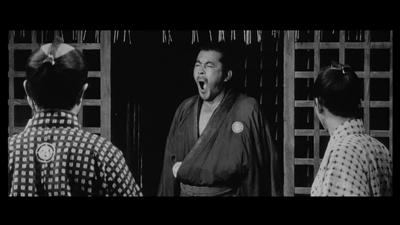


The fool warns his master that Hell is all around, and this metaphor detonates during this battle scene. The grotesque images of death and anguish, the fire-engine red of the blood staining the black soil of Saburo’s land, makes the interior of the castle look like a dumping ground for tortured souls. Hidetora is high above it, but he is not immune to it, and when Hell blossoms, so too does his madness come into full. Kurosawa has loaded up on the symbolism here. Hidetora must descend down into the carnage, leaving his armor behind to burn as the castle falls. When he emerges from the dark smoke, he looks like the undead. His skin is pale, but his wrinkles and the circles under his eyes are dark. The armies part to let him pass. No one wants to mess with a restless zombie.

There is no underestimating actor Tatsuya Nakadai’s importance to the success of Ran, or as part of Kurosawa’s 1980s renaissance, which began with Kagemusha, starring Nakadai as a king and a pauper. He is a long way from his 1960s roles for Kurosawa, playing Toshiro Mifune’s nemesis in Yojimbo and Sanuro. Though only just past 50 at the time of shooting Ran, Nakadai doesn’t appear to be putting on an act by playing the older Lord Hidetora. His make-up gets exaggerated midway through the movie as the man goes looney tunes, but in the early scenes, the actor’s face accepts the more realistic aging process quite naturally. This is made all the more convincing by his manner. His gait and his bearing is one that speaks of experience. His posture is strong and commanding, and as Hidetora loses his grip, Nakadai lets his carriage deteriorate, practically folding in on himself. The intensified aging make-up is meant to enforce the notion that Hidetora is the walking dead. He is literally decaying his way into the grave. When his robe blows open, we see his spindly, skeletal legs. He is becoming a bag of crazy bones.


As in Lear, the very weather is attuned to the ruler’s madness. Clouds roll in, wind and rain lash at the people and the ground below, and for the rest of the movie, even when the rains have subsided, Kurosawa employs some remarkably realistic lighting effects where the exterior dims and brightens and then dims again, replicating the clouds passing by the sun and obscuring its light. As another auditory cue, Kurosawa also uses the sound of cicadas to create a buzz around Hidetora, as if their clicks and clacks are the noise in his head.

If we consider what I wrote above about nature overpowering mankind, however, then we also must view this “madness storm” in a different way. It’s not that Hidetora is in tune with the weather, it’s that he’s out of tune with the natural world, with what is proper. After he disappears from Castle Three, Hidetora is out in a field trying to gather wild flowers. While this is kind of a traditional signifier of a madman in literature--often they wear flowers in their hair--it can also be seen as Hidetora directly trying to reconnect. It also recalls the last kindness he has seen, Saburo building him the leafy shelter. The fool distorts that kindness by building his Lord a new helmet out of weeds and reeds, practically putting the flowers in his hair for him. The withering old man wearing the jester’s cap is a sad, far cry from the armor that was turned to ash by his boys.


It’s interesting to consider that during all of this, the fool, whose name is actually Kyoami, is wearing clothes outfitted with a dragonfly pattern. Dragonflies can be seen as symbolizing multiple things. Ironically, in Japanese art, they were often meant to show positive change and joy, the absolute opposite of what is going on in Ran. Equally ironic in the case of poor Hidetora, for older people, dragonflies are supposed to signify mental clarity. These insects tend to be associated with transformation, not dissimilar to butterflies. In some representations, they are said to inhabit two worlds, because they begin their life in water and then take flight. If the fool and his master are stuck in a Hell on Earth, this would make some sense. Likewise, the fool’s function is to operate as both a faithful servant and as someone who mocks whom he serves, and he is both himself and another character. In an enlightening real-life parallel, the actor who plays the fool goes by Peter because as a young man his tight outfits and style of dancing in nightclubs earned him the nickname “Peter Pan.” The boy who wouldn’t grow up is forced to be damn serious by the end of Ran.


Another major theme of the movie is how truth has been subverted by lies. The fool notes that the whole world has gone topsy-turvy. Saburo and Tango are exiled for speaking their minds, while Jiro and Taro use deceit to bring reward. Jiro is also sunk by the lies of Kaede, who is easily the most deceitful and evil character in Ran. She continually calls for the death of Sué, who is her moral opposite, and when Jiro’s right-hand man, Ogura (Norio Matsui), tries to stop her, he risks the same fate as Tango. This would be something he would have brought on himself, however, as the true mastermind behind Jiro betraying his elder brother and the one who fired the assassin’s bullet. When truth is punished, it makes room for the lies, and there is little a man can do to correct his blunder. As Ogura discovers, there are too many people willing to exploit the hole you’ve opened in the defenses. Let one falsehood in, and a battalion of them come flooding through. His only choice is a very Japanese one: step up and take your death honorably.


Hidetora is also incapable of righting the wrongs he has done. Even returning to the scene of his greatest crime, tearing down Sué’s home, brings him little succor. Ran in this way is a very cynical movie. Saburo may maintain his core values and continue to do the right thing, but he must pay the ultimate price. That is the nature of a tragedy: all the players, good or bad, must be taken off the field before the game can be reset. A famous quote from the film comes in response to Hidetora crying out that he is lost. The fool tells him, “That is the human condition.” We could conjecture then, that the last man standing, the blind man (Takeshi Nomura), is the stand-in for all of us. He’s the one who becomes so small as to be indistinct, trapped on a precipice with no idea how to get off.

We are left with another frozen shot. Stillness. And silence returns in that moment when the screen blinks black.


On a personal side note, Ran is the first Akira Kurosawa film I ever saw. I caught it on PBS, my guess is around 1986 or so. It was a part of an education I was giving myself in film. I had basic cable in my room, and so had access to TNT and AMC back when they showed classic films. But it was PBS that introduced me to Japanese movies, including more Kurosawa to follow and Kenji Mizoguchi’s Ugetsu. Ran is now the second of Kurosawa’s films I have seen on a big screen, and this review was written after viewing a new print at Portland’s legendary Cinema 21. It looked and sounded amazing, and if you’re in the area, Ran is booked at the theatre starting on April 9.


The Criterion of Ran is, alas, out of print, replaced by a not-so-hot Lionsgate/Studio Canal Blu-Ray. Buy this version if you can get your hands on it.

Sunday, April 4, 2010

SANJURO - #53


I'm continuing a runthrough of Kurosawa films this week. Following on the heels of my review of Yojimbo, I'm going to cover its follow-up, Sanjuro. On Thursday, expect a new review of Ran [here it is], which is currently playing around the country in revival theatres. It's coming to Portland's Cinema 21 on Friday, April 9.

Sanjuro was made a year after Yojimbo, and like that film, features Toshiro Mifune as a samurai drifter who can't manage to stay away from people who need his help. In this movie, his alias is that of "30-year-old camellias," trading the berry bush for a flower-bearing tree; yet, he's still almost 40.


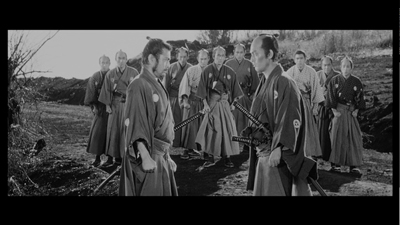
You can immediately detect a new confidence in this sequel. Mifune's entrance is the kind of cocky appearance that most action stars dream of, but that in the wrong actor's hands, can come off as more smug than genuine. Sanjuro opens with a group of nine young samurai discussing how they will deal with a corruption scandal in their town. Once they've laid out the facts, effectively getting the viewer up to speed, they hear someone stirring in the dark room behind them. Sanjuro has been taking a nap, and he overheard everything. He steps out of the shadows, yawning and scratching himself, and informs these misguided nine that they have it all wrong.

The group is lead by Iori Izaka (Yuzo Kayama), and he believes that his uncle, Chamberlain Mutsuta (Yunosuke Ito), is robbing the citizens. The guys have it backwards, though, and the man they reported their suspicions to, Superintendent Kikui (Masao Shimizu), is the real culprit. They misinterpreted Mutsuta's warnings, that even though he is the one who is not attractive and Kikui is handsome, the worst people tend to hide in plain sight. Misjudging based on looks will only get you in trouble--such as assuming the ragged ronin you've just met is not worth the metal in the blade he carries. That appearances are deceiving will be a running theme throughout Sanjuro, as most of the action hinges on trickery. Likewise, there is a lesson to be had from doubting the simplicity of the obvious: eventually, Sanjuro and his nine will set up camp right next door to his enemy.


The cowboy tropes of Yojimbo are gone, and so are the wide open spaces. Sanjuro takes place in a more confined environment. Though Sanjuro can save the nine's necks from a raid by Kikui's men, led by the skilled killer Hanbei Muroto (Tatsuya Nakadai, once again taking the role as Sanjuro's main rival), he's too late to stop Kikui from kidnapping Mutsuta and framing him for his own crimes. They set up shop in a home right next to the property of Kikui's main lieutenant, Kurofuji (Takashi Shimura). Again, this is a lesson where someone should have trusted the obvious; Sanjuro picks this spot since he knows the bad guys will never look right under their noses. Who would be crazy enough to move in next door?


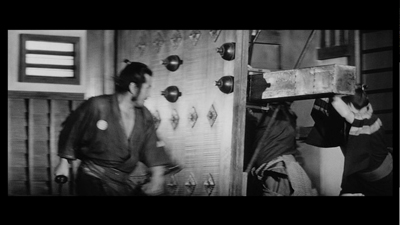
Most of the first hour of the film is spent trying to figure out where Mutsuta is. Sanjuro tries various schemes to get Kikui to tip his hand, including accepting an offer from Muroto to work for him. That particular plot ends badly, though not for the audience, since it inspires a spectacular sequence where Sanjuro takes out an entire room of men (even if we are chastised for enjoying it). Each new maneuver is eventually screwed up by the nine samurai Sanjuro has adopted. They refuse to listen to him, only realizing after it has all gone wrong that he was actually right. It's a recurring gag that keeps being funny, even as the consequences get more drastic. There is even a surprising use of anachronistic music to underscore a scene where the young men get excited and want to celebrate their perceived victory.


Sanjuro is less serious in tone overall than Yojimbo (even if it's final message is stronger). I realize that may seem odd, since it's not like Yojimbo plays like a lost Bergman film, but the first film has a feeling of doom hanging over it. The town that Sanjuro is saving is already destroyed, and from what we can see, hardly anybody lives there anymore. While men do die in Sanjuro, because the scheming is amongst the upper classes and not down with the peasants, there isn't as much urgency. The attitude of Mutsuta's wife (Takako Irie) sums up my feeling on this. While we are supposed to find her refusal to tolerate Sanjuro killing her captors or to get dirty climbing over a wall to escape as comical, there is also a sort of Marie Antoinette "Let them eat cake" vibe underlying everything she does. These are just the games she knows boys to play, and must they get so serious about it?


Sanjuro's reaction to her protests are indicative of a shift in his character. Though the other samurai find him crass and disrespectful, he actually shows real respect for the older woman and listens when she insists he tone down his plans. This includes sending a torrent of flowers downstream as a signal to attack rather than setting Kurofuji's house ablaze. It's not just her, though, Sanjuro himself is more reluctant to kill. The brigands who were running wild in Yojimbo were bad characters who lived by the sword, whereas the men under Muroto appear to just be hired hands. When they offer no threat, Sanjuro doesn't see much point in killing them. He even gets angry at the nine for forcing his hand.


This is an older, wiser Sanjuro, or it might just be that the story has now shifted its interest. Perhaps it's the naïveté of the nine samurai that makes obvious what a more experienced life does to a man. Mutsuta's wife describes Sanjuro as a living sword, but one who has leapt out of its sheath. It's the superior sword that keeps its sharp edge covered, who finds another way. In the last scene of the film, this homily not only comes back, but Sanjuro reveals that he agrees with it. He has left the village now that the work is done, having traded in the kimono of the resistance for the rags he wore at the outset. The newly rescued Mitsuta understands, Sanjuro is not a man who knows how to be contained, and so he must wander. Like the cliché about sharks: keep moving or die. You may encounter death on the road, but that is the risk. The ronin's last act is to teach his pupils a final lesson and show them how horrific killing really can be. It's the most gory display in either film--the dead man has a fountain of blood issue forth from his chest--but it's actually not over the top. Anything less would be selling Sanjuro's sacrifice short. This is the horror he has endured for the good of these undeserving others. For a light-hearted film, it's a rather dark way to close this chapter, and such is the power of Mifune, he looks like he is carrying the weight of death as he walks off into the horizon.


Toshiro Mifune played this character two more times in the early 1970s, though not in films directed by Akira Kurosawa. These future sequels included an encounter with another famous samurai, Zatoichi the blind swordsman. It speaks to the enduring appeal of the character that he would still be popular eight years later, though I think what people were really responding to was seeing Toshiro Mifune pick up a sword again. He could have been playing any character, much the same way that the public always likes Clint Eastwood to put on a cowboy hat. Doesn't matter if it's the Man with No Name or the Yojimbo, we just want to see these icons do what they do so well.


See Sanjuro's trailer.

Thursday, April 1, 2010

SIDELINE: MORE REVIEWS FOR 3/10

Welcome to April...


IN THEATRES...

* Alice in Wonderland, Tim Burton's ego-driven "reimagining" of a classic that didn't need his help.

* The Art of the Steal, a documentary about Philadelphia's appropriation of the legendary Barnes Foundation and its art collection.

* Chloe, a Skinimax flick wearing the lingerie of high art. I wasn't fooled. Which is amazing, because I'm easily distracted by boobs.

* Clash of the Titans. Yes, yes, I know you want big monsters fighting, but do you also want to be bored by those same monsters and totally unimpressed by the digital effects and 3D? Then by all means, let the gods punish you.

* The Ghost Writer. What's all the fuss about the new Roman Polanski? What's the hubbub, bub?

* Greenberg, an emotional suckerpunch of a movie from Noah Baumbach, who pulls an amazing performance out of Ben Stiller. I love this movie so much, and it only gets better the longer it sits in my brain.

* Green Zone, the new one from the Bourne guys goes heavy on the action and the politics.

* Hot Tub Time Machine - Not a comedy, but a Republican fantasy about going back in time to the Reagan era and then returning to the modern world to discover your actions in the past caused the victory of Capitalism. Also, lots of boobs. More failure for boobs this week. The world has gone crazy!!!

* The Most Dangerous Man in America: Daniel Ellsberg & the Pentagon Papers, a compelling documentary about the man who tried--and kind of succeeded--to stop the Vietnam War.

ON DVD...

* 44 Inch Chest, a talky British gangster drama that loses its way, squandering an amazing cast that features Ray Winstone, Tom Wilkinson, John Hurt, and the might Ian McShane.

* The Beaches of Agnes, the enchanting self-portrait by the first lady of the New Wave, Agnes Varda.

* The Brothers Warner, a mild profile of the guys who started the famous studio that bears their name.

* Ciao, an indie film searching for love in the midst of loss. Flawed, but shows great potential.

* An Education, one of my favorites of 2009 is now on DVD. A wonderful character study that brings early 1960s London to life.

* Fantastic Mr. Fox, the irresistible stop-motion animated movie from Wes Anderson. Well, you could resist it, but why would you hate yourself that much?

* Gigante, an oddball subversion of the romance genre from Uruguay. Also coupled with the even better Danish short Dennis.

* Gogol Bordello Non-Stop, a documentary about the gypsy punks.

* More Than This: The Story of Roxy Music, not the most comprehensive Roxy documentary, to be sure, but I liked it.

* Paris, in which Cédric Klapisch bites off more than he can chew trying to portray a whole city. A fine performance by Juliette Binoche makes it watchable, though.

* Young Sherlock Holmes, repacking an old childhood favorite. I find the movie holds up.