Showing posts with label pasolini. Show all posts

Monday, February 17, 2020

TEOREMA - #1013

Teorema. Theorem. “A general proposition not self-evident but proved by a chain of reasoning; a truth established by means of accepted truths.”


Pier Paolo Pasolini’s 1968 film Teorema presents a fictionalized social experiment, playfully rooted in a false reality, starting off with what seems to be documentary footage, presenting the thesis that the bourgeoisie can be pushed towards change, but they will never really go all the way.

The Italian auteur’s set- up has a Bunuel quality to it. Essentially, Pasolini takes a standard upper-class family and drops a grenade into the middle of their existence. Terence Stamp plays an unnamed houseguest who arrives without explanation, and immediately seduces all members of the household--father, mother, daughter, son, and even the maid. In many cases, his mere presence is enough, a blank canvas for each person to project their desires upon, from the sex-starved mother to the (supposedly) misunderstood father, whose perceived sorrow alienates him. In some cases, one family member sees what is going on with another, but that doesn’t stop anyone from giving themselves to the young Brit.


Things get even more interesting, however, when the stranger leaves, and suddenly these people are once again faced with the void, only this time far more aware of what it means to have found something to fill it. And so each goes chasing the experience. The maid (Laura Betti, La dolce vita [review]) removes herself from the mansion and pursues an ascetic life, seeking absolution. The mother (Silvana Mangano, Conversation Piece [review]) drives through the city looking for a stand-in for the lover who abandoned her. The son (André José Cruz Soublette, The Specialists) seeks to revive the missing man through art.


In each case, the resolution is up to interpretation, the success subjective, but if we consider these outcomes through the lens of Pasolini’s initial statements, then we can start to question whether his theorem holds water. For instance, the maid rejects all exploitation, but the matriarch seeks it out. The daughter (Anne Wiazemsky, Au hasard du Balthazar [review]) shuts down all expression, while her brother hunts a pure vehicle for emotion.


All eyes are on the father, however. Paolo (Massimo Girotti, Last Tango in Paris [review]), as it turns out, is the bourgeois factor owner referenced at Teorema’s beginning, the progressive boss who turned his business over to his employees. But is this the full expression of his change? Paolo’s discussions with the stranger seemed to suggest that he needed someone else to understand him, or to be more simplistic, to see him. Thus, with the visitor gone, the older man strips himself bare in ways both literal and metaphorical, all to draw others closer to him.


But are any of these people doing the “right” thing? And what are we really saying when we suggest the moneyed class never can? Pasolini offers no ground rules, and arguably, all of his characters consistently act in their own interest. There is nothing selfless or noble about their dalliances, nor in their chasing after the phantoms the encounters conjured. The stranger isn’t looking for any desired effects, he is just identifying their individual levers and pulling them. If even that. He is merely there, and the family takes from him what they want.

Terence Stamp is an interesting choice for this. The star of Far From the Madding Crowd [review], The Limey, and The Hit [review] is known for him slow burn, his quiet smolder. Here he says little. His grandest gesture is to return a glance. The audience is left to project as much onto him as the Italian family. His appearance is Pasolini’s provocation of his viewer, and his removal our challenge to find meaning.


It’s all very intriguing, and surprisingly light on pretention. It features the agitprop of Godard and the surrealism of Marco Ferreri but without the former’s stridency and the latter’s excess. It’s Pasolini at his most artful, relying on subtle stratagems rather than the direct confrontation that colored some of his more infamous work. The result is a theorem that is partially proven but ultimately unsolved; yet, Teorema invites further study and likely welcomes different conclusions each time.


This disc provided by the Criterion Collection for purposes of review.

Sunday, October 30, 2016

THE EXECUTIONER - #840


Consider it a black comedy “meet cute.” José Luis (Nino Manfredi, I Knew Her Well [review]) is an undertaker charged with transporting the bodies of men killed on death row to the funeral home. After the aged executioner Amedeo (José Isbert) leaves his tools in José Luis’ truck, the undertaker has to chase the old man to his apartment to return them. There, he meets Amedeo’s daughter Carmen (Emma Penella, E amor brujo [review]). The two share an attraction, and bond over their similar predicaments. No one wants to date her because she’s the executioner’s daughter, and women are turned off by him because he’s an undertaker. Love doesn’t exactly blossom, but still, there’s something.


The Executioner is a 1963 feature from Spanish director Luis García Berlanga. Reminiscent of Italian films of the period--and, indeed, featuring a nod to Michelangelo Antonioni, alongside Ingmar Bergman, as if Berlanga wanted to state his influences outright (though I’m thinking more Pietro Germi)--The Executioner is one-part comedy of errors, one part family drama, and then something wholly unique unto itself. Though at first turned off by the little man who would become his father-in-law, José eventually falls completely under Amedeo’s sway. Even the marriage between José and Carmen seems orchestrated by the talkative death merchant. It’s less like they fall in love, and more like they want to make sure not to disappoint Amedeo--or at the very least get him out of their hair.


Our trio is a band of outsiders in Spanish society. No one looks upon Amedeo’s profession fondly. It’s not that there is a political debate anywhere in The Executioner, it’s more that people treat Amedeo as a bad omen. His hands have caused much death, and thus it follows him around. In terms of a family business, José could do worse than to have his father-in-law at one end of the supply chain, but as he’ll soon find out, there’s a lot more bureaucracy to be reckoned with than lives to be taken. When Amedeo’s impending retirement threatens to keep the new family out of a swank two-bedroom apartment, Amedeo pushes José into becoming his successor. The final third of the film is all about José’s reluctant acceptance of the job and his fear that he will actually have to perform his duties. How long can he skate by on pardons and happenstance before he has to kill a man for real?

Much of the humor here is situational, with José serving as the classic straight man pushed into situations far beyond his capacity to handle. What’s interesting about Berlanga’s pairing, however, is how neither José nor Amedeo are played to the extreme. They are both almost straight men. Manfredi never succumbs to hysterics, and though Isbert can be annoying, he doesn’t push it to comic excess. This is not, say, a Bill Murray-style pest whose persistence is both frustrating and charming. The stooped Amedeo is just undeniable. Not exactly bullish, maybe more like a billy goat. He won’t be dissuaded.


This makes for more quiet chuckles than huge guffaws, but that’s okay. The Executioner has a pleasant pace and finds its humor in how deeply the screws get turned on José’s life. Berlanga has a keen eye for character moments--the book signing where the other famous directors are namedropped or the scene where the prison warden casually counsels a panicked José have a sharp satirical age--that cause you to root for each character to turn against their own self-interests. It’s weird, because in a way, that ends up being a kind of support. Call it tough love. Or tough laughter. You’ve got to like a movie with a dark enough sense of humor to have a title song called “The Executioner Twist.” Its use serves as a good indicator of how far apart our core cast is from everyone else--something we also see via the stray details of more normal, frivolous lives going on in the background. The two things come together at the end with the well-dressed young people dancing on a sailboat as they head out to sea, and José Luis departs in the other direction, off to settle into the life that he is now unable to extricate himself from.


The Executioner was shot by Tonino Delli Colli, who also worked with Raffaello Matarazzo, Pier Paolo Pasolini, and later LouisMalle. His black-and-white work for Berlanga is clean and expressive, observant in a Neorealist fashion, but also appropriately tuned in to the humor. For instance, staging the scene where José and his fellow undertaker pick up their paychecks while wearing tri-corner hats and 18th-century uniforms from inside the accountant’s booth allows for a more visual gag. Both of them peeking through the tiny windows trying to charm the paymaster to hand over their checks makes them look simultaneously like strange intruders and also relics mounted on a wall. The costumes inspire further humor in the next scene when a nervous José tries to calm a fight out of fear one of the squabblers will get killed--and he’ll have to execute his killer.

Which he’ll eventually become comfortable with doing. All of Berlanga’s characters in The Executioner serve their roles, be it to society or to family, and the greater message here is to suggest we can’t help but be who we are, even when others might not be so keen on it. In the end, José and Carmen and Amedeo and the new baby make a solid unit that supports one another and gets by as best they can. It’s just that sometimes José needs a little more coaxing to get with the program.


This disc was provided by the Criterion Collection for purposes of review.

Sunday, November 18, 2012

PIER PAOLO PASOLINI'S TRILOGY OF LIFE (Blu-Ray) - #631


Pier Paolo Pasolini was a notorious author and activist before he became a filmmaker. As a self-described homosexual Marxist Catholic, his viewpoint was, to say the least, unique and his chosen means of expression often abrasive. He began his cinema career as a screenwriter and became a protégé of Fellini--though the two had a falling out when Pasolini struck out on his own to make his 1961 debut, Accatone, the story of a pimp in the Italian slums.

After a decade of increasingly pessimistic movies, Pasolini decided to adopt a new outlook on life. Turning to classic literature, he chose to helm a Trilogy of Life: three films adapting famous books that themselves were a collection of short stories and fables. Working with material by Boccaccio, Chaucer, and tales from One Thousand and One Arabian Nights, jumping from Italy to England and then to the Middle East, the filmmaker embraced the ribald and the sensual, turning these well-known parables into a celebration of mankind's pleasures, devotions, and freedoms. Politics and religion were mocked--sometimes lovingly, other times sharply--with Pasolini ultimately letting the human condition--and the human comedy--dictate a narrative free of all expected restrictions (and predictably censored for the same).

It's a surprisingly good fit for the director, even if his newfound blithe spirit was not to last. Shortly after completing the Trilogy of Life, Pasolini rejected the work, claiming that he had succumbed to a particularly thin, knee-jerk liberalism. His next, and sadly last, film turned out to be his most misanthropic and controversial yet. Salo, or 120 Days of Sodom is still one of the more discussed and disturbing pieces of cinema [you can read my review here], both reviled and revered in counterbalancing measures. It's kind of bizarre to consider how Pasolini jumped one to the other. If you saw Salo separately from The Trilogy of Life and had no idea who had made either, I doubt you'd guess it was the same man.


I keep a copy of Boccaccio's The Decameron next to my bed, where I can occasionally grab it and read one of the stories. (Also, to let the ladies know I am edumacated and/or a would-be pretentious intellectual.) The 14th-century tome is credited with having originated the art form of the novella (which is not just a short novel, but that's a discussion for another time). It's basically a collection of short stories, 100 in all, told by ten travelers to pass the time. They are alternately funny, philosophical, dirty, and magical. Despite the book's considerable age, it doesn't read like an antiquated relic. It's lively and bawdy and quite entertaining.

For his 1971 adaptation of the book, Pasolini quite understandably whittles the text down from 100 to about a dozen entries or so (including at least one that is told, rather than performed). His version of The Decameron (111 minutes) also jettisons the framing sequence, instead letting the stories flow naturally one into the other. A few characters connect from one to the next, sometimes stumbling into the neighboring scenario just to kickstart the next tale and send the narrative on its way. For the first half of the film, there is a recurring character of a con man and a thief (played by Pasolini regular Franco Citti; he's in all the films in this set and also in Mamma Roma); for the second half, there is a painter who is struggling to complete a fresco in a church. He is played by the director himself, and so no surprise that the painter's vision gives The Decameron its most fantastical images, including a living painting re-creating classic religious iconography. He also gets to utter the movie's last line, "Why complete a work when it's so beautiful just to dream it."


Pasolini's focus tends to be on stories with either a sexual or religious base, often both, as well as tales that are generally derailed by one person's greed or folly. While much of what we see borders on the blasphemous--a convent full of nuns taking advantage of a man they believe to be mentally deficient; the robbing of a Bishop's grave, etc.--Pasolini is only tweaking the nose of the church playfully. He is creating a connection between earthly and heavenly pleasures, suggesting that each exists in concert with the other. Hence, the penultimate story of the man who literally screws himself to death. He returns from the afterlife to reveal that sex is considered to be a virtue, not a sin, and his punishment will be for other wicked deeds. Granted, he is in Hell, so we don't really know how God and his minions feel about the matter, but the message here is, hey, regardless of the outcome, its worth it.


Pasolini's depiction of medieval living is neither romanticized nor prettied up. The buildings and clothes are shabby, the people are dirty. There are so many rotting teeth in The Decameron, my own mouth started to hurt after a while. Director of photography Tonino Delli Colli, who also collaborated with Raffaello Matarazzo and Louis Malle, shoots without much added light, preferring the natural look of sunlight and shadows--however musty some of those shadows might be. Likewise, Pasolini doesn't push his rather large cast--which is made up in large part of non-actors, in the Italian Neorealist tradition--toward big acting. He plays the comedy for what it is, but mostly let's the rest of the behavior just be. It makes for a surprisingly lithe anthology picture, one that sets the tone for its sibling films.


The set-up for 1972's The Canterbury Tales (111 mins.) more closely mirrors the frame of the Geoffrey Chaucer book: travelers on the road to Canterbury in medieval England agree to swap stories to pass the time--though who is telling the tale and where is never really addressed again. Instead, the thread that runs through the movie is that of Chaucer himself, another winking role for Pasolini, sitting at his desk and writing his book. He says little, instead mostly just looking up from his work to smile at a clever punchline or two.

Pasolini has chosen eight stories from the original text, once again favoring ribald anecdotes and morality plays that involve human greed and betrayal. The sections range from the humorous (a wife and her lover trick her husband into locking himself away while they make love, only for her previous lover to show up looking for action) to the more dire and serious (Franco Citti plays the devil come to Earth to observe human misery; three young boys plot against each other after finding treasure). Some of the sequences lack the punch or the narrative flow that made The Decameron more riveting. Laura Betti (1900 [review]) plays the Wife of Bath in a short vignette that comes to very little, and outside of some familiar settings, not much leads the viewer from one story to the next.


Still, The Canterbury Tales has two superior segments that alternately surprise, delight, and in the case of the second one, horrify. First is Ninetto Davoli, who played a swindled bumpkin in The Decameron, returning here as a shiftless teenager making merry and causing trouble in both work and play. The scenario is Pasolini's tribute to silent cinema, with Davoli doing an imitation of Chaplin's Tramp. The slapstick is funny and the homage loving, with the modern director juxtaposing the "innocence" of the early motion pictures with Chaucer's not-so-innocent characters. (Another Chaplin connection: the revered auteur's daughter Josephine plays the lovely girl May in the opening story.)

The second sequence is essentially the film's big finish. It features a materialistic clergyman being visited by a youthful angel who spirits him away to Hell to take a glimpse at what happens when men of God betray their vows. Pasolini builds a large outdoor set on an English wasteland, with naked demons painted head to toe in garish colors and grotesque scenes of torture and punishment. It's at once both disturbing and hilarious. The director's rudimentary special effects, depicting giant Satanic buttocks releasing wicked priests back into the sulfurous landscape, succeed on sheer audacity. It's hard to laugh when you feel so queasy!


As with The Decameron, perhaps the best element to recommend The Canterbury Tales is the art direction. Pasolini's unique take on ancient living, embracing all the stink and filth, is so vivid, he successfully erases all trace of modernity and creates an alternate world that is believable and intriguing. Even if the movie doesn't gel in terms of narrative, it still looks remarkable. It also seems had Pasolini chosen a better way to end the film, he might have turned what is a very good effort into something great. Sure, the trip to Hell is remarkable, but The Canterbury Tales lacks any final message. There is no summation a la the painted fresco, nor do we get something akin to the libertine's moral that we are privileged to receive at the end of The Decameron (or even the closed circle of The Arabian Nights). Instead, The Canterbury Tales just stops. Ironic for a film about a journey that it kind of doesn't end up anywhere.


Pasolini all but abandons the collected story structuring for 1974's The Arabian Nights (130 mins.), even going so far as to drop the frame from the original source material. Likewise, he steps comfortably away from any overriding religion, instead embracing a more freeform narrative line where man determines his own fate, with only happenstance and our own foolishness to get in the way.

If there is any throughline in The Arabian Nights, it's the clever slave Zumurrud (Ines Pellegrini), who arranges for her own sale to the handsome young Nuredin (Franco Meril). When her "master" refuses to heed her advice, she is kidnapped and they are separated. Thanks to her wiliness, Zumurrud escapes again, and her flight from capture eventually lands her in a city in search of a king. Mistaking her for a man, and following an ancient tradition, the ruling powers put her on the throne. Meanwhile, a properly shamed Nuredin goes searching for his lost inamorata.


As in The Decameron, one aspect of the script tumbles into the next, with Zumurrud's enemies criss-crossing over plot lines and also getting their comeuppance. Pasolini shot the exteriors of the film in the Middle East, with the interior sex scenes taking place on an Italian soundstage--meaning he also foregoes local actors when away from Italy, presumably because actors willing to get nude for his camera would have been harder to find in Muslim countries (as they apparently were not in England; you ever wanted to see Doctor Who's Tom Baker getting' busy? Me neither!). Even so, The Arabian Nights appears even less like studio-based constructions than the preceding films. The legitimate sights serve the production well.

Midway through the picture, when Nuredin has been taken in by a trio of horny sisters who read to him from, one presumes, One Thousand and One Nights, Pasolini diverges from the path and dives down a rabbit hole into more stories. Ninetto Davoli returns as Aziz, who has lost all he has known in the world, including his love and manhood. He is found in the desert by Taj (Francesco Paolo Governale), and the wandering Prince listens as Aziz relates the circumstances by which he came to be so dejected. This leads to Taj forming a new plan to pursue love on his own, and as he puts his scheme into motion, he gathers the histories of those he recruits in aiding him. These stories end up being the most outrightly mystical of any of the tales in all three movies in the Trilogy of Life, suggesting the happy outcome that is soon to come is more fated than the participants realize.


Unfettered as it is from Catholic judgment and any governing morality, The Arabian Nights is the only film where indulgence in our most natural impulses is not punished. Sexuality morphs freely, basically creating an idealized world where all could act as they pleased, the only price that had to be paid was involvement. Aziz has bad things happen because he doesn't govern his own fate, and Nuredin loses Zumurrud when he does not heed her advice. Yet, those who embrace life are rewarded. Even Nuredin eventually. Perhaps this is what soured Pasolini so, he knew his vividly realized fantasy was not to be. There are couple of key scenes of brutal violence in The Arabian Nights, at least one of which (a castration) is shocking enough to be in Salo. One could argue that maybe Pasolini's disillusionment was quite possibly born from the fact that even in an invented world where everyone was free to frolic and love as they saw fit, such attacks were necessary, because otherwise we might take our free will for granted.


The Canterbury Tales also has an English dub that was overseen by Pasolini. Though I generally shy away from dubs, this one makes sense, as the film was shot in England and features plenty of British actors. The Cockney accents fit the material. Additionally, though they don't play within the movie, there is a supplement with the English inserts Pasolini created for the written elements, like letters and Chaucer's book, seen in the film.

Each disc has its own handful of extras, with the lead bonus on The Decameron, Patrick Rumple's 25-minute visual essay "On The Decameron" being essential viewing early on. I kind of wish that I had watched it before watching the movie, because it both lays the groundwork for how Pasolini built his career up to the point of taking on Trilogy of Life, but also gives some insight into how The Decameron is structured and points out Pasolini's influences from the world of cinema and painting, including the material he borrowed from Giotto, the painter whose work becomes the tableau vivant in the last portion of the film.

This vivacious detour by Pier Paolo Pasolini makes for an interesting, albeit tragically brief, third act in an accomplished film career. Trilogy of Life is an anthology of anthologies, three movies based on famous collections of stories from classic literature: Boccaccio's The Decameron, Chaucer's The Canterbury Tales, and the more mystical The Arabian Nights. Over the three films, Pasolini dissects human desire and our capacity for error, examining sin, indulgence, and punishment, building toward a morality where all would be free to love as they choose. The tales collected are funny, sensual, and sometimes poignant, all composed stylishly. Sure, the message doesn't always gel, and some sequences are clunky, but overall, Trilogy of Life is exactly the enjoyable life-affirming experience Pasolini set out for it to be, regardless of his own eventual disappointment in its thematic qualities.


For a complete rundown on the special features, read the full review at DVD Talk. Images here were taken from promotional materials and were not taken from the Blu-Ray under review.


Tuesday, October 18, 2011

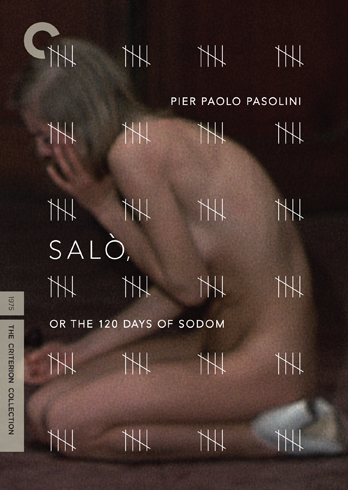
SALO, OR THE 120 DAYS OF SODOM (Blu-Ray) - #17

"All's good if it's excessive."


Once upon a time, Criterion spine #17 was the rarest of the collection*. The early release of Pier Paolo Pasolini's 1976 shocker Salò, or the 120 Days of Sodom was the one of the first discs to go out of print for the label, disappearing not long after it had first been issued. Copies of the release sold for several hundred dollars on eBay, and fans created online guides to steer potential buyers through the murky waters of knock-offs and bootlegs.

When I was working on building a complete Criterion library some ten years ago, Salò was always the one that eluded me. Both the cost-prohibitive mark-up and the movie's scandalous reputation made me gun shy. Eventually, I bought a dubious Chinese facsimile so I could actually watch the thing. My hope was, if Salò was as off-putting as everyone said, viewing it would convince me that it was not something I needed to drop major coin on.

The theory panned out. One time through with Salò was enough for me. It was not a movie I ever felt the need to see again. I finally bought the legitimate reissue a couple of years ago, but I never even opened it. It was gathering dust on my shelf, still wrapped in plastic, when the Blu-Ray came through. I guess enough time had passed. I was finally going to watch Salò a second time after all...
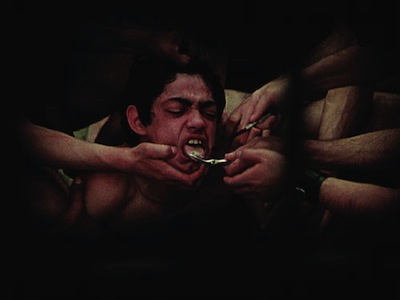


Pasolini's film in is an infamous slab of transgressive art. Inspired by the work of the Marquis de Sade, the controversial Italian director leveled his aim on his country's ruling class. Though set during the years during World War II when Italy was occupied and the Fascist government colluded with the Nazis, Salò takes place away from the combat, isolated to a sprawling, secluded villa owned by a shadowy collective of privileged dignitaries. These men have formed a secret pact, marrying each other's daughters as an old-school symbol of joint power. The four of them are intense libertines, and they have kidnapped nine teenage boys and nine teenage girls, all virgins, and taken them to this hidden house to engage in their every depraved fantasy. With them are adolescent thugs who act as their enforcers and aging prostitutes who stimulate the conversation by sharing the greatest hits of their illustrious careers satisfying the kinky fetishes of other powerful men. The men listen to these stories of indulgence and then indulge themselves with their captives.

Salò is essentially an escalating chain of humiliation and degradation. As the days wear on, the humiliations inflicted on the kidnapped adolescents gets worse and worse. Religion is banished, as is any display of emotion. If any of the prisoners break these rules, their names go into a little black book. When the excursion is over, the list of wrongdoers will receive a special punishment. Indeed, that perversion of justice is the climax of Salò, an orgy of torture, rape, and death. It's a bizarre concept to wrap your head around. These children have been violated, forced to eat human feces, and beaten, and yet in this upside-down mini society, they are the sinners. You'd think there was no penalty left, yet for Pasolini, no matter how cruel a human can be, there is always someone more cruel, always a deeper level of selfishness and evil that man can sink to.
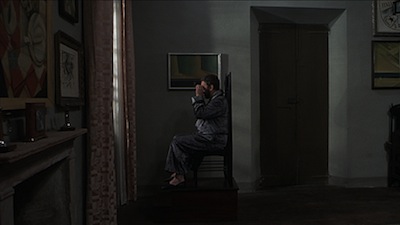


It can be hard to judge button-pushing art, especially once some time has passed. What was shocking and meaningful in 1976 may not have the same impact or relevance in 2011. Salò, or the 120 Days of Sodom still has the power to disgust. I retched more than once while watching it and frequently squinted or covered my eyes to obscure some of the more terrible depictions. So, I guess that is a win against the belief that we, as a filmgoing public, have been desensitized over the years by increased sex and violence in entertainment. Salò still has the power to make me sick.

On the other hand, it no longer has the power to shock. Maybe it's hard to compete in an age where we have something like The Human Centipede, the goal post has definitely been moved when it comes to deranged concepts. Or maybe it's that Pasolini's technique is so transparent, it's hard to take his film entirely seriously. Yes, much of what he shows on screen is gross, but some of it is also outright ridiculous. A man in leather panties and dog collar talking about how much he likes anuses and being urinated on may be a very real fetish, but the use of such images in Salò seems more like juvenile rabble-rousing than it does a mature exploration of challenging world views.

Which isn't to say that Salò, or the 120 Days of Sodom is without subtext. For as much as Pasolini is getting his jollies by creating this tableau of human indignity, he also is trying to make a point about the corrupt nature of governance and the true motivations behind fascism. Any will to power, his script suggests, is essentially selfish, no matter how much the would-be leaders crow about the greater good. In amongst the sex talk here, the abusers espouse theories about politics and human nature that seemingly explain and justify their actions. Pasolini undercuts their self-belief by demonstrating that these are just excuses they make in order to satisfy their own base urges. Unsurprisingly, the more harsh things get, survival tactics get more desperate. Prisoners turn on each other. Mankind is its own worst enemy.

Which is where I would guess Pasolini is really coming from. His contempt for the Fascists is equal to his contempt for the common man. Salò, or the 120 Days of Sodom is the product of a severe misanthrope, one whom I suspect wants to get back at a populace that has misunderstood and persecuted him. He is serving us the cinematic meal he thinks we deserve in a way that is almost ironic: he decries cruelty and humiliation by beating up his audience using all the tactics his villains use. You will know what he means because he will make you experience it.

It's not a particularly complex response to a complicated world. Were Pasolini's filmmaking skills not so refined, I'm not sure we'd still be watching and debating Salò, or the 120 Days of Sodom all these years later. It's a well-made movie even if I don't think it's a very good one. I know it has its defenders, and to be honest, I take no issue with that, just as I think Pasolini wouldn't take issue with my negative analysis. Salò is meant to be visceral, and so any visceral reaction on the part of the viewership means success. For my money, though, a better film would have moved me in a more profound manner. It would have still caused me to look away, but it would also inspire me to think about why I had done so. The deepest question I took away from Salò, or the 120 Days of Sodom had nothing to do with narrative or thematic meaning; rather, I just kept wondering how you cast a movie like this. How do you go about finding actors who will read the script and say, "Oh, you want me to strip down to nothing, pretend to get sodomized, and sit in a barrel of excrement? Sounds like the role of a lifetime!"
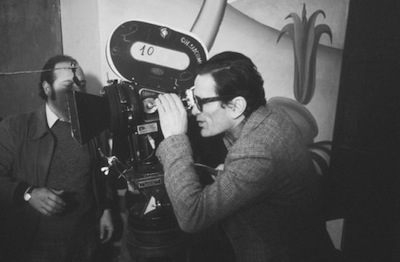


Criterion has put the two-disc Salò, or the 120 Days of Sodom package onto one Blu-Ray, packaged in a handsome cardboard box with a thick 80-page book featuring credits, chapter listings, photos, and a collection of seven different essays about the movie from filmmakers and critics. It seems to me that it's essential for a film of this nature to acknowledge the debate and give space to a variety of voices to discuss it, so I'm pleased that Criterion has done so both in this written format and on the disc itself. The essays in the booklet actually connect well to the 23-minute Fade to Black featurette that talks to Bernardo Bertolucci, Catherine Breillat, and others about their reaction to the film.

Pasolini himself gets his say in the 33-minute "Salò: Yesterday and Today documentary, which actually did serve to make me appreciate his vision more. He had clear intentions for what he wanted to do, even if some of those intentions are lost in the translation between artist and audience. We also get a look at the actual production in the 40-minute The End of "Salò," which gathers participants and crew members to discuss the working process and also the aftermath, including Pasolini's murder prior to the movie getting released. Amongst those interviewed are set designer Dante Ferreti, who also returns for a separate 12-minute interview. Also interviewed alone is film scholar and director Jean-Pierre Gorin (28 minutes), an aficionado of Pasolini and an appreciative viewer of Salò.

For a complete rundown on the special features, read the full review at DVD Talk.

* In terms of actual number of copies on the market, the very first pressing of The Seven Samurai may total less than Salò, or the 120 Days of Sodom, but given that the only change was the removal of a tiny restoration demonstration, I always considered the pursuit of that particular collectible to be the province of the overly fanatical.