Teorema. Theorem. “A general proposition not self-evident but proved by a chain of reasoning; a truth established by means of accepted truths.”
Pier Paolo Pasolini’s 1968 film Teorema presents a fictionalized social experiment, playfully rooted in a false reality, starting off with what seems to be documentary footage, presenting the thesis that the bourgeoisie can be pushed towards change, but they will never really go all the way.
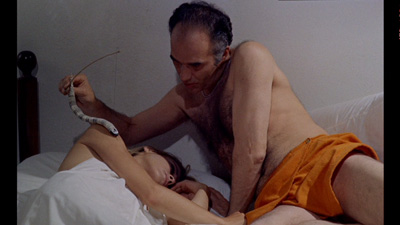
The Italian auteur’s set- up has a Bunuel quality to it. Essentially, Pasolini takes a standard upper-class family and drops a grenade into the middle of their existence. Terence Stamp plays an unnamed houseguest who arrives without explanation, and immediately seduces all members of the household--father, mother, daughter, son, and even the maid. In many cases, his mere presence is enough, a blank canvas for each person to project their desires upon, from the sex-starved mother to the (supposedly) misunderstood father, whose perceived sorrow alienates him. In some cases, one family member sees what is going on with another, but that doesn’t stop anyone from giving themselves to the young Brit.
Things get even more interesting, however, when the stranger leaves, and suddenly these people are once again faced with the void, only this time far more aware of what it means to have found something to fill it. And so each goes chasing the experience. The maid (Laura Betti, La dolce vita [review]) removes herself from the mansion and pursues an ascetic life, seeking absolution. The mother (Silvana Mangano, Conversation Piece [review]) drives through the city looking for a stand-in for the lover who abandoned her. The son (André José Cruz Soublette, The Specialists) seeks to revive the missing man through art.
In each case, the resolution is up to interpretation, the success subjective, but if we consider these outcomes through the lens of Pasolini’s initial statements, then we can start to question whether his theorem holds water. For instance, the maid rejects all exploitation, but the matriarch seeks it out. The daughter (Anne Wiazemsky, Au hasard du Balthazar [review]) shuts down all expression, while her brother hunts a pure vehicle for emotion.
All eyes are on the father, however. Paolo (Massimo Girotti, Last Tango in Paris [review]), as it turns out, is the bourgeois factor owner referenced at Teorema’s beginning, the progressive boss who turned his business over to his employees. But is this the full expression of his change? Paolo’s discussions with the stranger seemed to suggest that he needed someone else to understand him, or to be more simplistic, to see him. Thus, with the visitor gone, the older man strips himself bare in ways both literal and metaphorical, all to draw others closer to him.
But are any of these people doing the “right” thing? And what are we really saying when we suggest the moneyed class never can? Pasolini offers no ground rules, and arguably, all of his characters consistently act in their own interest. There is nothing selfless or noble about their dalliances, nor in their chasing after the phantoms the encounters conjured. The stranger isn’t looking for any desired effects, he is just identifying their individual levers and pulling them. If even that. He is merely there, and the family takes from him what they want.
Terence Stamp is an interesting choice for this. The star of Far From the Madding Crowd [review], The Limey, and The Hit [review] is known for him slow burn, his quiet smolder. Here he says little. His grandest gesture is to return a glance. The audience is left to project as much onto him as the Italian family. His appearance is Pasolini’s provocation of his viewer, and his removal our challenge to find meaning.
It’s all very intriguing, and surprisingly light on pretention. It features the agitprop of Godard and the surrealism of Marco Ferreri but without the former’s stridency and the latter’s excess. It’s Pasolini at his most artful, relying on subtle stratagems rather than the direct confrontation that colored some of his more infamous work. The result is a theorem that is partially proven but ultimately unsolved; yet, Teorema invites further study and likely welcomes different conclusions each time.
Showing posts with label marco ferreri. Show all posts
Monday, February 17, 2020
Thursday, March 11, 2010
DILLINGER IS DEAD - #506

Dammit, you got me again, Marco Ferreri! Advantage to you. While our contentious relationship isn't exactly on par with the feud between Armond White and Noah Baumbach--for one thing, even if you were alive, you'd likely have no idea who I am--this cinematic ping pong game has got to stop. The first serve I took from you was your vaunted masterwork La Grande Bouffe, and to say I was underwhelmed would be to put it mildly. Your second volley was your follow-up, 1974's absurd take on U.S. history, Don't Touch the White Woman. That film irritated the living crap out of me, and in my review, I promised to stay out of your way if you stayed out of mine.
Well, you had to go and get yourself a Criterion release, didn't you? Hit me where I live, whydoncha? So here we go, third pitch and third strike*: Dillinger is Dead, your 1969 oddball nugget about one man's restless, insomniac night roaming around his own mind. Despite my misgivings, I was willing to give you a fair try. And I did. Only it's another swing and a miss.
Thankfully, unlike the other films, this one neither irked nor angered me. On the contrary, Dillinger is Dead has left me so nonplussed, I really don't know what to say about it. I have no reaction beyond a shrug. Not exactly a stellar recommendation or a fiery condemnation, I know. In fact, I think we'd both feel more comfortable if I hated it even worse than White Woman. My review might as well be written on a wet paper bag.

Let me try to explain this movie for the folks in the cheap seats. Esteemed 1960s screen actor Michel Piccoli plays Glauco, a man who makes a living designing gas masks. Not necessarily an ignoble profession: if the modern world is going to poison the air you breathe, Glauco is going to protect you from that poison. Though, when it comes down to it, he's really designing the devices so that his side of whatever war may be around the bend can survive gassing the other side.

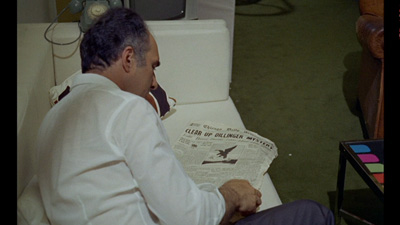
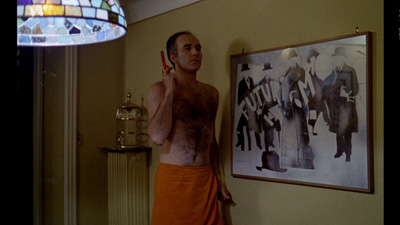
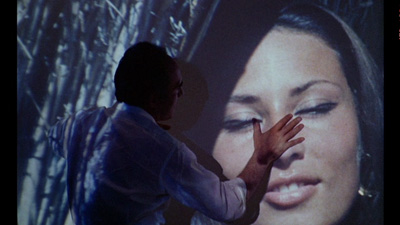
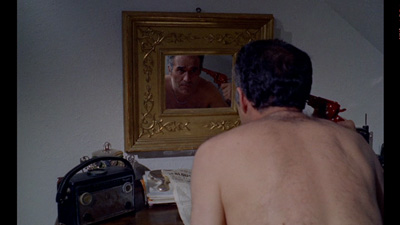
After a brief introduction at the gas mask factory, Glauco returns home. There, he visits with his druggy wife (Anita Pallenberg, sexy paramour of Rolling Stones-guitarist Keith Richards), rejects the dinner left out for him, and makes himself something else instead. (In foreshadowing to La Grande Bouffe, Piccoli stares at pictures of meat in a cookbook the way other men stare at pornography.) In the midst of cooking, the maid Sabina (Annie Girardot) comes home. Glauco also goes looking for some spices, and in the closet, he finds a mysterious bundle. It's a pistol wrapped inside a newspaper with a headline announcing the death of legendary gangster John Dillinger. Glauco dismantles the gun, reassembles it, and paints it red with white polka dots. He also has his dinner and watches some home movies, sometimes molesting the screen, sometimes reenacting what he is seeing.

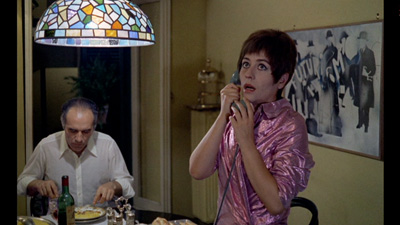
In the midst of this, Glauco also spies on the maid, and then tries to have sex with her after he fails to wake his wife up to do it. As the man of the house, Glauco is a predatory but ultimately impotent lion. He stalks around, but he gets little attention and little respect. Maybe that's his lot in life. He doesn't kill, he just enables other men's success on the battlefield. Sabina uses the telephone to talk to her secret lover, and Glauco's wife uses her own modern toxins to dismiss him.

This is all told in exacting detail, step by step, with many of the tasks shot in real time and without interruption. The action is accompanied by a steady stream of contemporary songs broadcasting over Glauco's radio, many of them lyrically apropos to what is happening. As the film rounds its final corner, there is even one shocking act that so surprised me, I jumped in my chair. Without giving too much away, let's just say that gun in the first act definitely paid off in the last one.
To what end, though, I really don't know. The events of Dillinger is Dead are seemingly random, accurately portraying an aimless night, but maybe they are not. Maybe there is some complex code here that I am meant to put together were I so inspired. I would make a go at it if I were being graded, but I'm not, you are, Maestro Ferreri, and you've done nothing to compel me to want to understand Dillinger is Dead more. The way I see it, it's your job to make me want to know what it all means, not mine to find a reason for your film existing. That's the pact you make with the audience: we're willing to do the work, you just have to make it worth our while.

What's odd is, I didn't hate Dillinger is Dead. I wasn't bored by it, nor did I find it tedious. The set designs, with the cool '60s furniture and the vivid colors, were easy on the eyes. Similarly, Piccoli is an actor worth watching. He is extremely confident in front of the camera and comfortable in his skin. His every move is natural, he's not shackled by actorly gestures. There is talent here, it's just not sufficiently focused in such a way as to make me care.
The back cover of the DVD calls Dillinger is Dead "a surreal political missive about social malaise," a description that brings to mind Luis Bunuel's The Discreet Charm of the Bourgeoisie. That is a film I very much enjoy, probably because Bunuel's pranksterism and point of view give the viewer something to hang their hat on. In his essay in the Criterion booklet, critic Michael Joshua Rowin suggests that Ferreri had no such interest in giving his audience the same courtesy. He labels Dillinger is Dead as intentionally irrational, designed to duck away from any one interpretation and leave itself open to varying opinions and arguments. In one of the interviews with Ferreri reprinted in the same booklet (okay, I guess I did at least do some of my homework), the director states that "ambiguity" is Dillinger is Dead's reason for being.
So, I guess mission accomplished, then?

* I'm not good at athletics. Let the mixed sports metaphors abound!
The film's trailer.
For a full rundown on the special features, read the full article at DVD Talk.
Subscribe to:
Posts (Atom)