Showing posts with label carol reed. Show all posts

Monday, July 1, 2013

SIDELINE: MORE REVIEWS FOR 6/13

While I was neglecting this site, I was still watching a lot of movies. Here's proof.

Oh, and I was also redesigning my other site! Have a look. See what I'm working on. Buy some signed books. confessions123.com


IN THEATRES...

Before Midnight, the latest in the ongoing relationship series is its deepest and most emotionally fraught, and quite easily the best. Once again starring Ethan Hawke and Julie Delpy, directed by Richard Linklater.

 * The Bling Ring, the latest from Sofia Coppola, telling a tale of disaffected Bonnies and their tagalong Clyde.

Byzantium, Neil Jordan's all-too-serious return to the vampire genre.

Dirty Wars, a documentary about the covert strikes happening outside the approved combat zones in the War on Teror.

Man of Steel, is neither worth loving or hating. It's boring and fun and long and loud and dazzling and doltish all at the same time.  

Monsters University, a Pixar prequel that's funny, if not as fresh as the original.

Much Ado About Nothing, Joss Whedon's backyard retelling of the Bard.

Some Girl(s), starring Adam Brody as a writer lacking in self-awareness taking a tour of his old flames. From a script by Neil LaBute.


My Oregonian columns...

* June 14: French animation gets arty in The Painting;  Disney's Pete's Dragon flies back to the big screen; and a life re-examined in Long Distance Revolutionary: A Journey with Mumia Abu-Jamal.

* June 21: Another visit with Andre Gregory in Before and After Dinner, the nuclear power doc Pandora's Promise, and a sleazy Italian slasher flick from 1973, Torso.

* June 28: the dark Australian comedy 100 Bloody AcresDoin' it in the Park's wild history of NYC pick-up basketball; and a revival of the classic Grant/Hepburn crime/romance hybrid Charade.


ON BD/DVD....

Broadway Musicals: A Jewish Legacy, documenting the history of the great Jewish songwriters of the American stage.

First Family, a tepid 1980 White House satire from writer/director Buck Henry and star Bob Newhart that lacks any political bite.

Free Radicals: A History of Experimental Film, a worthy introduction to the more abstract side of cinema.

The Great Gatsby: Midnight in Manhattan, a short BBC documentary about F. Scott Fitzgerald and his best-known novel. Bonus: a 1975 teleplay with David Hemmings as the author.

Happy People: A Year in the Taiga, Werner Herzog's refashioning of a longer documentary looking at the life of fur trappers in Siberia.

The Key, a dark wartime drama from Carol Reed. With William Holden and Sophia Loren.

A Night to Remember, a screwball mystery with Loretta Young, released in 1942.

Second-Hand Hearts, a romantic flop that kicked off the '80s for Hal Ashby. 

Whoopee! A good-time musical with Eddie Cantor. Two-strip Technicolar from 1930!


Friday, September 10, 2010

NIGHT TRAIN TO MUNICH - #523


Rex Harrison is a glorious bastard. In Carol Reed's 1940 war movie Night Train to Munich, the all-too-British actor dons a Nazi uniform and waltzes through enemy lines with nothing but a false letter of introduction and an uncommon sense of bravado. Lucky for him, unlike Michael Fassbender in Quentin Tarantino's Inglourious Basterds [review], he doesn't have to worry about getting the German accent right. Everyone here speaks the Queen's English regardless of national origin.

Which was kind of confusing at the outset, I must admit. Though the heroine of our tale, Anna Bomasch (Margaret Lockwood), and her father (James Harcourt) are first seen in Prague, I didn't get right away that they were Czech. And you really can't fault the Nazi officer later in the picture who doesn't realize that Charters and Caldicott (Basil Radford and Naunton Wayne) are proper British gentleman. Everyone in Carol Reed's version of Europe is!
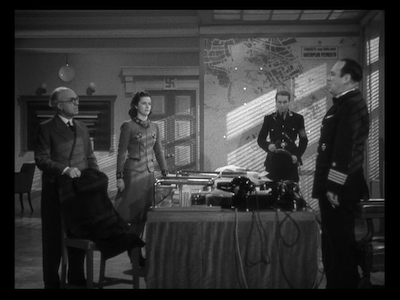


Night Train to Munich is a quaint propaganda thriller made while England's involvement in the war was still fresh. Writers Sidney Gilliat and Frank Launder, working from a story by Gordon Wellesley, set their script a year prior to the production, on the eve of France and the UK getting into the combat. It portrays an England that was ready for anything, their eye firmly and suspiciously trained on their aggressive neighbors to the west. The intention of the film was similar to that of Powell & Pressburger's The 49th Parallel [review]: to bolster and inspire through popular entertainment. Hollywood made similar movies throughout the war, though with a far toothier American demeanor--most of our heroes followed an arc that took them from cynical loner to righteous patriot in 90 minutes. The British film industry, on the other hand, gave us upright citizens more than eager to engage in what was right. As a result, a lot of their wartime films, including Night Train to Munich, are far more obvious in their mission.


Though, to be fair, Night Train manages to scrounge some pretty good nail-biting scenarios out of all these good intentions. The personnel involved knew their way around a suspense picture. Gilliat and Launder previously wrote another mystery set on a train, Hitchcock's early masterpiece The Lady Vanishes [review], a film that also starred Lockwood and introduced us to the droll supporting players Charters and Caldicott, the sort of fellows who apparently only vacation in trouble spots. (Tip to time travelers: if they are ever on your train, get off!) And, of course, Night Train's director Carol Reed would famously master the post-War thriller with films like The Third Man [review] and the less-known but equally intense Odd Man Out (a movie in dire need of a Criterion edition). Thus, despite depicting a version of WWII that is far less grotesque than what we know it to be (the concentration camp Lockwood is sent to looks like a vacation resort compared to the real thing), Night Train to Munich is still a successful espionage adventure, full of romance, thrills, and more than its fair share of snappy dialogue.
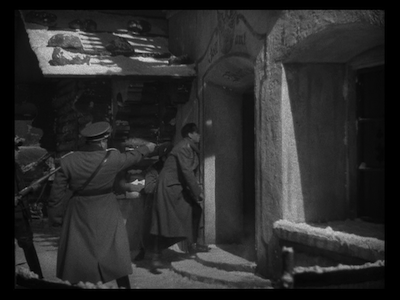


Dr. Axel Bomasch is a Czech scientist developing a particularly strong new alloy that will be perfect for armored vehicles. When the war comes to Prague, he and his associates high tail it for England. The only hitch is that his daughter, Anna, is arrested at their house just as she is heading for the getaway plane. She is sent to a prison camp, where she meets the stalwart schoolteacher Karl Marsen (Paul Henreid, later to play the freedom fighter Victor Laszlo in Casablanca). Spotting one of his former students amongst the guards, Karl manages to plot their escape, and they make it across the sea to England. Once they are on shore, Anna is contacted through shadowy back channels to let her know where her old man is. He's been working for the British and is hiding out by the seaside under the care of secret agent Gus Bennett (Rex Harrison). Anna finds Gus obnoxious, particularly compared to the suave and selfless Karl. Can you guess which one gets the girl?


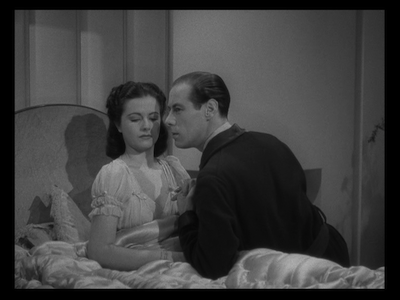
I like that the love triangle in Night Train to Munich continues even after Karl is revealed to be a Ratzi. I like even more how it's done. How very British that so much of it is unspoken, and Karl's feelings in particular are never expressed. He is made a cuckold before he ever gets the chance to make a move, the fate of a man who chose his job over the girl. When he nabs the Bomasches and takes them back to the Reich, Gus switches places with him by going undercover as a Nazi officer who claims to have sway over Anna because they once had an affair. When he is given permission to spend the night romancing her in her (scandal!) hotel room, Karl is positively seething with unspoken anger. Not only is this cocky rival coming in and doing a job he can't (convincing the girl to convince her father to give up his secrets), but now there is a love affair, too? Little does he know that it's a pretend one, but then, Rex Harrison is such a wily cassanova, that's actually how he works his mojo. If you make the lady pretend you're irresistible often enough, she'll realize you really are!


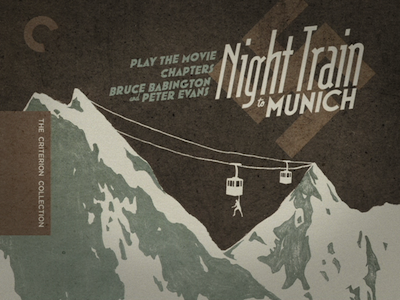
Once these wheels are in motion, the group eventually ends up on the titular train, and that's where they also run into the comedy duo of Charters and Caldicott, followed by the eventual chase through Munich, including the scenes on the sky trams depicted on the cover of the DVD (the awesome artwork smartly modeled after old travel posters). The shootout in the mountains is a marvelous action sequence, and Reed and cameramen Otto Kanturek do a tremendous job of re-creating the majesty of the Swiss Alps via models and matte paintings (also note the cool model work when Anna and Karl escape the concentration camp). By this point, Night Train to Munich has transcended its propaganda origins and turned into a cracking movie.

If I have one complaint about Night Train, it's probably that Margaret Lockwood is an undervalued member of the team. Both Harrison and Henreid are so good in their roles and have such meaty material to wrestle with, it sometimes feels like the girl they are fighting over is lost in the process. Gus does try to make Anna an active part of the scheme, but the writers don't go far enough with it. Margaret Lockwood is charming and very pretty and so more than capable, and Anna has a plenty of motivation for being a killer lady spy, but the boys in charge are far too willing to let their fellows take control. Particularly once Radford and Wayne join the escape party, their banter practically shoves any conversation between Anna and Gus off the screen.


Still, that's a minor problem in what is otherwise some damn fine light entertainment. Thought not as deep as Reed's later movies--even if we do get a few scenes where his use of shadows suggest the noir to come--it's actually a lot more fun. His light touch with the action and the humor more than makes up for any heavy hand in the underlying message, and all told, Night Train to Munich makes for an enjoyable return trip to the matinees of yesterday.


Friday, November 16, 2007

THE THIRD MAN - #64

"It's not that I enjoy puddling in the mess, but if there's a mess, I feel that it's our duty to look at it." - Graham Greene, writer of The Third Man


There's a wonderful symmetry to Carol Reed and Graham Greene's classic of British noir, The Third Man. In something akin to the interplay of light and shadow that so epitomizes the movie's visual style, there is also an interplay of various elements in the story itself. Perception and reality, reputation and action, and the solid, old fashioned morality of good and bad. Survivors in this story stand in the gray, neither too enveloped by shadow or too exposed by the light. Forcing the world to conform to an either/or scenario will only be your downfall.

The Third Man is the story of Holly Martins (Joseph Cotten), a pulp novelist who has traveled to post-War Vienna on the request of his school chum, Harry Lime (Orson Welles). Believing he is coming to the bombed-out city to help with a medical charity, Holly is surprised to discover that Harry has died in what the police are calling an accident. Other versions of the story suggest it's murder. The loud and brash American wants Calloway (Trevor Howard), the more reserved British officer who had been investigating Harry, to look into the incident, but in Austria--a territory now divided by several different nations and thus criss-crossed by various standards of laws and lawlessness--such deaths will all come out in the wash. According to his police file, Harry Lime wasn't a very nice dude, and the city's populace is better off without him. Holly refuses to accept that Harry isn't the stand-up guy he always knew--even though even he admits that Harry was always running some kind of racket--and starts poking his nose where it doesn't belong. He's consistently warned away, but his cowboy naivete shoves him hopelessly forward. It's Graham Greene's self-reflexive critique--the writer is going to have to learn the difference between the easy morals of the printed page vs. the complications of the real world.

The title refers to a mysterious figure who was there at Harry's death but whom no one will officially identify. Holly believes the key to finding the truth is uncovering the identity of the third man. In another nice piece of symmetry, Holly picks up a female sidekick along the way. Anna (Alida Valli) is a Czech actress who was Harry's lover, and she's the only person besides Holly who will ever swear to Harry doing a bit of good. Together, they will have their belief in the man they knew tested, and Holly will also become smitten with her. Does he really love her, though, or is it a kind of playground payback for another indiscretion years prior? (Anna even calls him Harry a couple of times.) Or, once again, must it really be one or the other? All we really know is that only Anna's cat is truly loyal to the missing figure. He doesn't trust Holly, but he still has a thing for Harry.

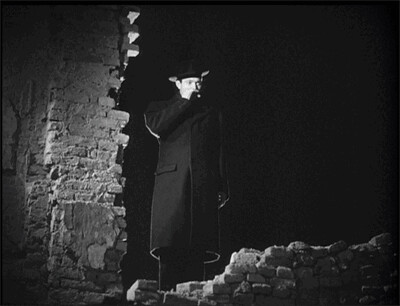
The Third Man has earned a reputation based on three major components. First, the dark visual style. Reed plays up the noirish paranoia by taking full advantage of shadows, showing men in silhouette or their figures cast across a stone wall. The climactic chase through the Austrian sewers is dizzying and exciting, taking us down into the metaphorical underground of men's souls via the foreboding tunnels pumping their real world waste. The second component is the zither music, and the famous Harry Lime theme that would become an international hit.

The third, not coincidentally, is Harry Lime himself. As played by Orson Welles, he is an attractive scoundrel. When he shrugs and asks his pal what the big deal is, it's hard not to chime in, "Yeah, Holly, what's the big deal?" His entrance in the movie is often cited as one of the most famous in cinema. Where first there was darkness, then there is light, and with it, Welles' impeccable naughty-boy smirk. The amazing thing is that Welles is barely in the movie, only a couple of scenes. Oftentimes, when a movie is about how everyone is obsessed with one particular person, that person isn't interesting enough to make us understand why anyone is getting so bent out of shape. In this case, we see exactly why Harry Lime is the eye of this particular storm.

The director Reed and the writer Greene would collaborate together several times, but The Third Man is definitely their best effort. Perhaps it's telling that this is the one story they developed exclusively for the screen. It's a virtuoso thriller, full of twists, turns, and red herrings galore. Black humor that's really funny, slithering menace that really feels threatening, and a grisly denouement that ranks amongst noir's most cynical finales. If you've ever been concerned before, or even let down, by a film not living up to its reputation, The Third Man should cause no such concerns. This is the real deal, one that others will always be measured against.

The Third Man is an absolute must.


Originally written May 22, 2007. For technical specs and special features, read the full article at DVD Talk.

Thursday, November 15, 2007

THE FALLEN IDOL - #357


Director Carol Reed and author Graham Greene had several successful collaborations together, including the original work The Third Man and the much later adaptation of Greene's novel Our Man in Havana. Their 1948 film The Fallen Idol is maybe more unique among them for the way it eschews the regular conventions of a crime film and imagines what it would be like to view misdeeds from much smaller eyes.

Actually, to reduce The Fallen Idol to being a movie that is exclusively from a child's point of view would be to do it a disservice. Yes, its particular charm is that its plot ebbs and flows on the whims and dubious interpretive skills of an elementary school boy. Simultaneously, however, Reed and Greene also unlock the door to the rarefied world of a foreign embassy, an existence within regular society and standing apart from it. It's a world where anything can happen because it is beyond the gaze of normal citizens, and the true trouble comes from when a reality where anything is possible butts heads with a child's imagination, another pocket universe where anything can be perceived as possible.

First-time child actor Bobby Henrey plays Phillipe, the son of a foreign ambassador to England. Phillipe's father doesn't take an active role in his care, and his mother has lived away from them for some time. This leaves the fathering to Baines (Ralph Richardson, Richard III), the kindly butler who lives at the embassy. His treatment of the lad couldn't be more opposite from the boy's relationship with Mrs. Baines (Sonia Dresdel), who attempts to run the house with an iron fist. On the weekend over which Fallen Idol takes place, the ambassador is heading home to meet his wife and ferry her over to England. It's an attempt to restore familial order that is coming a little too late.

After Phillipe has a row with Mrs. Baines, he is confined to his room. Only, when he sees Mr. Baines leave for an afternoon walk, the boy sneaks out and follows him. He finds the father figure in a tea shop whispering with a younger woman. Julie (Michèle Morgan, Passage to Marseille) isn't Baines' niece, as he tells Phillipe she is, but of course, they are having an affair. Phillipe has seen it all, but he doesn't understand what it is that he's seen. Ironically, the bigger problem is going to come when he doesn't see something but thinks he knows what happened.

Once Baines has asked the child to be a part of his secret, it creates yet another world for Phillipe to navigate. When Phillipe inadvertently tells Mrs. Baines about her husband's rendezvous, she too asks the boy to keep quiet. If he were an adult and this kind of deception was just another part of his everyday life, then Phillipe might find it easier to juggle, but with so many secrets to keep straight, he no longer has a clear picture of where he's standing.


Things seem to be taking a turn for the better when Mrs. Baines goes away for the weekend. Julie comes over for dinner with the men, and they play a game of hide and seek afterwards. The huge house, which already stands alone as a transplanted chunk of foreign soil, becomes their private domain. The secret Baines has led Phillipe into becomes the trio's whole reality. It creates a sense of safety for the child. He is once more in a place that is comfortable.

Except Mrs. Baines has tricked them. She didn't go away at all. She comes crashing into their idyllic existence, and her invasion sends things spiraling out of control. A legitimate accident causes her to fall to her death, but since Phillipe didn't see the action, only the aftermath, he is convinced that murder has taken place. This not only sends him running out into the real world, careening through beautifully lit cobblestone alleyways, but her death acts as an invitation for the real world to muscle its way into what has previously been a private domain. As Baines attempts to cover the elements that will make him look guilty, Phillipe is thrust in over his head. Thinking he is helping, he tries to lead the police away from his friend, but he only pushes them towards Baines. As the butler tries to explain himself, he must also unravel the fictions he has told the boy in an attempt to amuse him. Phillipe sees his hero disintegrate before his eyes. He no longer knows what to believe.

Reed and Greene have put their young protagonist in a situation that is going to test the limits of his innocence. Early in the film, Baines says that a lie isn't so much of a lie if it's intended to be kind. This kind of moral degree is beyond the scope of a child, and Phillipe is out of his depth. Reed teases an excellent performance out of his young charge. The actor's natural precociousness comes to good use when it's time for Phillipe to drive the police batty with his ever-changing story. Up until that point, Henrey is constantly chattering and bobbing around the set. The audience is nearly exasperated with him, as well, so it's easy to believe that the stalwart detectives have lost their patience.

Thematically and stylistically, The Fallen Idol has much in common with Hitchcock's Shadow of a Doubt. In both movies, a young person loses faith in the adult they previously admired because of certain indiscretions they think they've discovered. Reed is being trickier, however, in that he has already informed his audience that Baines is innocent. The tension comes from our fear that it won't matter, that his concerns of how the truth might incriminate him will become the noose around his neck. Ralph Richardson is amazing. As Baines' life sinks deeper and deeper into the morass, his face falls, his body slumps, and his voice loses volume. It's hard not to feel for the old guy. Nothing seems to be going his way.
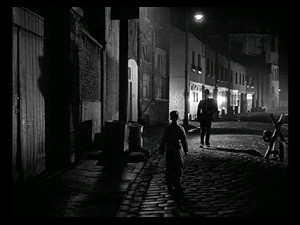
The Fallen Idol maintains its grip on our nerves right up until the very last shot, where Reed lets both us and his young star off the hook. The finale is one big sigh of relief, a reassurance that the hard lessons Phillipe has learned can be set aside at least for a little while. Maybe he'll eventually understand why Baines did what he did, maybe he won't, but we at least know that life will go on. That's the best thing about a suspense film, the release of the tension, a payoff for the nail biting we have gone through. It's to Carol Reed and Graham Greene's credit that they didn't just go for the shocks, but sculpted characters that feel and breathe and learn, as well. We could get an ulcer from our fear that they might be too badly damaged, but our reward is the hope that the barriers that have segregated them are now gone, leaving them to carry on stronger than before.


Originally written November 2, 2006. For technical specs and special features, read the full article at DVD Talk.