Tuesday, February 28, 2012

ANATOMY OF A MURDER (Blu-Ray) - #600


The next time you hear someone grousing about how movies are only supposed to be 90 minutes long and anything over two hours is an affront to their patience, hand them a copy of Otto Preminger's Anatomy of a Murder. After they have sat through the entire 161 minutes, if they start arguing about where the movie allegedly goes long or give a hint that they were ever bored, even for a second, stop talking to them immediately. Leave the room (or kick them out if it's your house), delete their number from your phone, and cut them out of your life immediately. Life's too short for you to need someone like that in your life.

The term "perfect film" shouldn't be bandied around lightly. It's a distinction that should be reserved for a movie like Anatomy of a Murder. The 1959 production is a lot of things: it's a legal drama, a social parable, and a relationship picture. It has humor, menace, and even grisly crimes. It touches on deeper issues of friendship, the bonds between man and wife, and the difficult ethical quandaries that go hand in hand with a complex system of justice. Sure, there are no real fistfights on screen, but we sure hear the details of a lot of off-screen action. About all Anatomy of a Murder really lacks is romance.
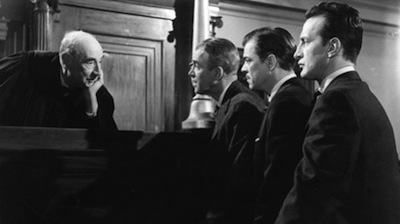


Anatomy of a Murder was written by Wendell Mayes (The Stalking Moon [review]) from a novel by Robert Traver. Traver was the pen name of Judge John D. Voelker, who had served as a defense attorney in Michigan in the early 1950s and was counsel on the original murder case that this story was based on. In the movie, the lawyer is called Paul Biegler, and he is played by James Stewart. Paul is a confirmed bachelor and a small-town counselor with passions for jazz music and fishing. In fact, he was out on a lake with rod and reel when Army Lieutenant Frederick Manion (Ben Gazzara, The Strange One [review]) walked into a bar and shot the owner six times. Manion did it because he believed the bartender had raped his wife, Laura (Lee Remick, A Face in the Crowd). He believed it was what any decent man would do. It appears to be an open and shut case; Biegler takes it anyway.

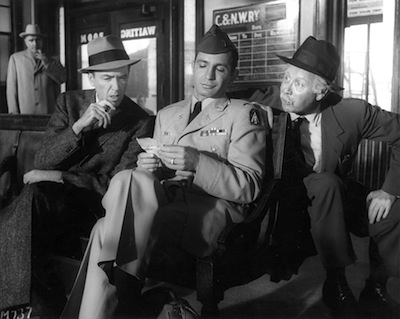
Most of Anatomy of a Murder is given over to the trial, including the investigation on Biegler's part that not only leads up to the start of the proceedings, but is also woven into them. Helping Paul out is his secretary Maida (Eve Arden, Grease) and his best friend Parnell (Arthur O'Connell, Cimarron [review]), an attorney who has stopped practicing as a result of a drinking problem. Brought in to shut down Biegler's defense and aid the local prosecutor is Claude Dancer (George C. Scott, Patton), a state's attorney from the city. These guys make a classic genre duo: rural vs. urban, substance vs. flash. Jimmy Stewart even has a line about being a "simple country lawyer." The two of them go toe to toe in the courtroom, poking holes in the other's version of events. Neither Manion nor his wife are exactly reliable witnesses. He's a hothead and she's a flirt.
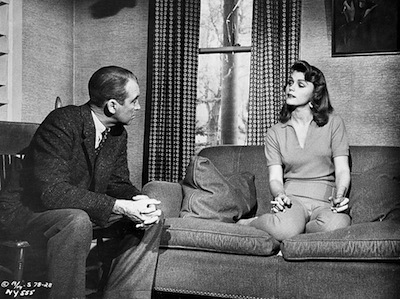


Upon release, Anatomy of a Murder caused a scandal for its frank use of words like "sperm" and "panties." Those words have since lost their ability to shock, but the details that come out about the actual attack have not softened over time. Nor has our outrage over how Laura is treated by authorities in order to minimize what was done to her. On the contrary, these days, we are probably more sensitive to it. What makes Anatomy of a Murder amazing, however, is that even as we react to Laura's horrific story, we can't help but wonder if we really believe her. As in any true crime tale, every participant has many reasons to lie. We never really entertain Manion's defense of temporary insanity, and yet, we also somehow collude in this bending of the truth. Our weighing of the case is often not based on whether any of the actions were right or wrong, just which guy was more rotten--the murderer or the one he killed.

To be honest, Ben Gazzara is lucky to have Jimmy Stewart on his side. The former is oily and cocky, whereas the latter, of course, has a certain homespun, trustworthy charm. Both actors always appear to be thinking, but where Gazzara is understandably inscrutable and shifty, Stewart's motivations always seem clear. He is a man solving a puzzle, consistently trying to work out the next move. It's because we like him so much that we root for the case to go his way--which may have been Preminger's point in casting him, to challenge our sense of justice by drawing on our prior allegiance to a movie star and perhaps expose our own prejudices in the process.


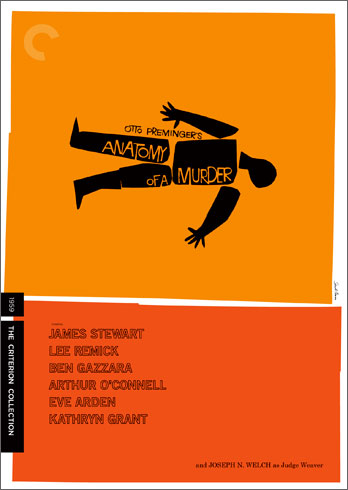
Anatomy of a Murder is packed with talent from top to bottom, from the famous credits sequence by Saul Bass and all the way through with every note of Duke Ellington's snazzy score. Preminger's narrative is smart and insightful, and his mis-en-scene is light on its feet. He uses the real environments to capture an accurate image of the average American town, including both the sense of true community and also those who are marginalized from the "mainstream." Paul Biegler serves as a sort of cultural nexus for the time. As Laura Manion puts it, he's a funny kind of lawyer. He employs old-fashioned common sense in how he approaches a trial, and yet he smokes small cigars and plays piano in juke joints. He is progressive about race and sex, and yet a guy of staunch moral fiber. You have a sense that he'd likely get on just fine in the decade that was just to come. He might even grab a drink with Atticus Finch and trade some war stores.

So, too, does Anatomy of a Murder sit in this sweet spot between the old and the new. Its matter-of-fact writing was progressive and daring, and yet this is pure entertainment in the tradition of Hollywood's Golden Age. It's intelligent and strident in purpose, but Anatomy of a Murder never forgets that its primary duty is to hold the audience's interest. It's easy to watch, even if it doesn't go easy on the viewer and resort to simple representations of difficult issues. Every scene advances the narrative, and every shot is constructed to impart the essential information with clarity and style. There is not a hair out of place, and at the same time, not a moment that doesn't feel spontaneous. No matter how many times I see it, it always feels fresh and new, like it's my very first time, and when the credits roll, it's tempting to just skip back to 1 and start the whole thing again.


For a complete rundown on the special features, read the full review at DVD Talk.

Please Note: The images used here are from promotional materials, not from the Blu-Ray.

Wednesday, February 15, 2012

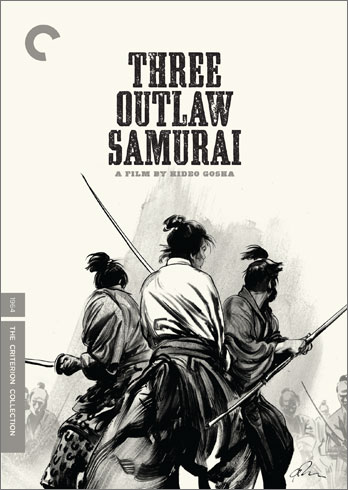
THREE OUTLAW SAMURAI (Blu-Ray) - #596


Hideo Gosha's Three Outlaw Samurai could easily be dismissed as a simple exercise in genre, but to do so would be to fail to see just how potent well-executed genre material can be. Released in 1964, it has as much in common with the work of Sergio Leone as it does with Akira Kurosawa. Though, given that the trio here predates Leone's The Good, the Bad and the Ugly by a couple of years, one could go a bit nutty trying to figure out who influenced whom.

Tetsuro Tamba (Kwaidan, Blackmail Is My Life) stars as Sakon Shiba, a wandering swordsman who ends up in a situation he didn't plan on. He finds a fancy hairpin in the grass, which leads him to enter a nearby shack. There he finds three peasants holding a young girl (Miyuki Kuwano) hostage. She is the daughter of the local magistrate, and they have kidnapped her to try to bargain for better living conditions. Shiba is amused by the idea. He is pretty sure the peasants are in for a terrible wake-up call. He cynically settles in to observe the fun.
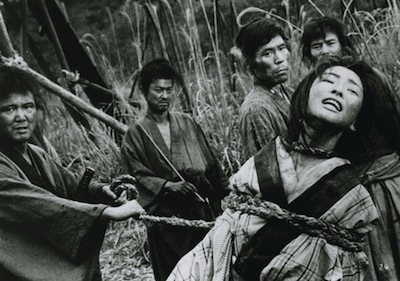


Only, when the man comes for his daughter, Shiba's sense of fair play kicks in, and he stands up for the locals. With this first rescue attempt having failed, and with the magistrate's boss due to arrive in town in a matter of days, the situation is about to turn humiliating for the official. He puts a local samurai, Kikyo (Mikijiro Hira, Sword of the Beast), in charge of the operation, a job that the laconic warrior takes halfheartedly. He is only in the man's employ to take advantage of his wealth, and what happens to anyone else doesn't matter much. He gathers a handful of ronin from the jail to take out to the shack and kill Shiba. Among them is a vagabond samurai named Sakura (Isamu Nagato). Like Shiba, he starts off amused by all the goings on; it's only when he hears the true story that he switches sides and joins the cause of the lower classes. His only sticking point is he accidentally killed one of the farmers who was trying to sneak the men food. Out of guilt, he starts looking after the dead man's wife (Toshie Kimura), and they end up falling in love.

What is supposed to be a simple rescue mission grows increasingly complicated as Three Outlaw Samurai progresses. Shiba makes a deal with the magistrate to save the kidnappers' lives, but when the scoundrel reneges, the crusade is renewed. Shiba is definitely meant to be the traditional, stand-up swordsman. His punishment at the hands of the bad guy, and his subsequent recuperation, has particular echoes of how Clint Eastwood's Man with No Name would be beaten within an inch of his life, only to hole up in a cave and let his body heal. If this were a Kurosawa movie, Shiba would be played by Toshiro Mifune. He's the crafty schemer who can't let a bad deed go unpunished. Tamba lacks Mifune's charisma, but then, most actors do. Even so, he's a solid hero, speaking with authority and more than able to hold his own in combat.


Actually, Sakura could have been a Mifune role, as well. He is a more mannered version of Mifune's character in Seven Samurai [review]--gruff, hairy, physical. Nagato brings levity to the part, and he is most impressive when faced with tough choices. On the flipside, Hira's portrayal of Kiko vacillates between villainy and nobility. He is eventually compelled to join the others in their efforts, though reluctantly so. All the characters in Three Outlaw Samurai are faced with a decision: go with the flow regardless of who is hurt, or draw a line in the sand and protect those who need it. For Shiba, Sakura, and Kikyo, choosing to go against the powers that be makes them outlaws, but it also makes them heroes.

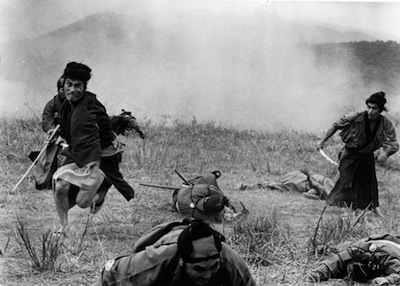
Three Outlaw Samurai was Hideo Gosha's first directorial feature, and the beginning of a long career. He co-wrote the script with two other writers, including Eizaburo Shiba, who he would work with again on Sword of the Beast. The film was shot by Tadashi Sakai, who would only end up behind the camera for three more movies, two of which were directed by Gosha. Despite this crew being fairly unseasoned, Three Outlaw Samurai is an accomplished effort. The sword battles have the right balance of clear choreography and chaos, and Gosha juggles the narrative's many elements without losing focus. The ending is particularly satisfying for its cynical take on human nature, but it also features technical flourishes that add a surprising kick to the finish. In particular, when Shiba loses his cool and goes hunting for the magistrate, Gosha, Sakai, and editor Kazuo Ota get him there quickly by employing quick cuts and zooms. It's shown from his point of view, and the pacing matches his angry stride.


The last scene of Three Outlaw Samurai is a perfect closing of the chapter. Gosha loops the story back to the beginning, with Shiba surrendering to the agent of chance that started this detour. Had he wanted, Gosha could have easily spun what happened next into a series of films. It's the samurai equivalent of the cowboys wandering off into the sunset. You just know that whatever town they find down the road, there's also going to be trouble there, and if they don't do something about it, no one else will.


This disc was provided by the Criterion Collection for purposes of review.

Sunday, February 12, 2012

TINY FURNITURE - #597


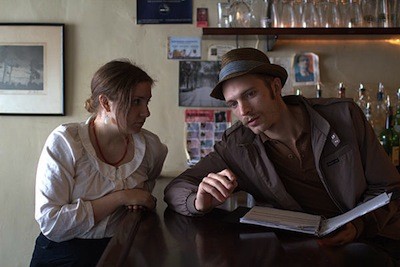
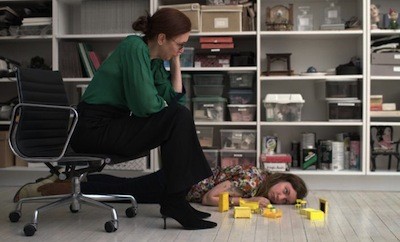
Aura just graduated from college, getting a film degree and a YouTube video of herself frolicking in a bikini in the school fountain to go with it. Her name is ironic, because though it conjures hippy-dippy images of love and happiness, Aura is more like a plague of whining. The movie Tiny Furniture is the story of what she does immediately after school. The grad returns to her home in Tribeca to sponge off her artist mother, squabble with her little sister, reconnect with old friends, and chase after the wrong men. She also gets a job, but the subject of her future is something she's actively avoiding. I don't think she ever says she doesn't know what she wants to do, it's more that she doesn't want to think about it. 

Engaging with the disengaged can be tough sometimes. So it is with Tiny Furniture. There is clearly ambition on display here: not for nothing, Lena Dunham has it together enough to assemble a whole movie. This is Dunham's first feature, and she wrote, directed, and starred in the thing, shooting it on a miniscule budget in her mother's real apartment, and roping her real-life mother and sister--Laurie Simmons and Grace Dunham--into putting up with her on the screen. One can't presume to say that this movie is autobiographical, but it is a little surprising that, given the opportunity to dream up an imaginary life for herself, Lena Dunham went for such an uninteresting one.

The story of Tiny Furniture basically covers two weeks of Aura in freefall. Just prior to leaving school, her boyfriend of two years dumped Aura to go find himself. It's a split that is given little credit, though it's thematically significant. In fact, if you consider the men that Aura gloms on to once she is back in New York, it becomes clear that this is a woman currently letting others define the world around her. The vain and selfish Jed (Alex Karpovsky) is pursuing television deals for his own YouTube vids, though from what we see he's not nearly as funny as he thinks he is, while the emotionally manipulative hipster Keith (David Call) is a sous chef in the restaurant where Aura briefly works. Aura is attracted to Keith because he has something he cares about: food. Or so she says. By all evidence--and the film proves our first impressions right--Keith just cares about pills and sex. And tentacle porn. Seriously, ladies, if a guy tells you he's into tentacle porn, it shouldn't be considered a mark in the plus column.


Two of the best scenes in Tiny Furniture actually come as a result of these sorta hook-ups. Midway through the movie, Dunham gives herself actual conversations with both men, where the poses fall away and people actually talk to one another rather than work their way around the mealy-mouthed punchlines that otherwise serve as humor. In terms of comedy, there isn't much that made me chuckle here. The script is like a Noah Baumbach rough draft, the outline of jokes the writer might make before he does the soul searching to give his quips meaning. The only real laughs come from Aura's best friend Charlotte (Jemima Kirke), a spoiled rich girl who has transformed her malaise into withering scorn that somehow becomes more comical by being delivered in a fake British accent. The rest of the laughter comes from the horror of how sad this all really is--and not in a good "laughing with you" satirical way, either. By the time we get to a terrible and awkward sex scene that serves as the film's climax (pun not intended by me, but possibly intended by the filmmaker), it would seem that the nausea and disgust is intentional. The boredom, however...?

In terms of filmmaking, Dunham and cinematographer Jody Lee Lipes don't do a bad job. Though Tiny Furniture is light on planned aesthetics, there are occasional inspired set-ups. The pair make good use of the large apartment Aura's family lives in, shooting through doorways and using walls as natural dividers. In one shot, Aura is laying on the couch while her overachieving sister, who towers over her in accomplishment and stature, is only visible as a pair of legs on a treadmill. It makes for a good contrast. The rest of the film is mostly static, though it thankfully avoids the shaky-cam we have come to expect from most mumblecore features--"mumblecore" being the almost-genre Tiny Furniture most closely resembles. The performances here fit that movement, with all the actors under-acting in an attempt to appear "real." It doesn't work for Dunham or her cast. This feels like a production that never got out of rehearsals.

Tiny Furniture does end on a positive note. The last scene, following the bad sex, features the first real communication of the film. Aura and her mother stop bickering and actually talk, and connections are made between the generations that suggest that Aura's predicament is not only normal, but that things will get better. The insight is maybe too little, too late, but it gives me hope that maybe Lena Dunham could eventually figure this whole cinema thing out, too.


Because for as much as I didn't enjoy Tiny Furniture, there is small part of me that doesn't want to outright hate it. I know plenty of others haven't, the film came to me with some high recommendations--a SXSW win, raves from Salon, the Village Voice, and Roger Ebert--so it's possible it's just not for me. It's fine for characters to be aimless, annoying, or even unlikable, as long as there is something compelling about them that makes you want to keep watching what they do. Such is not the case here. If I am being honest, were I to end up at a party with all of the characters from Tiny Furniture, I wouldn't stick around, not even to just stand in the corner drinking free booze and talking smack about them. Which is also exactly how I feel writing this review. Can't my words be better spent elsewhere? Let these folks do their thing, far be it from me to break up the shindig. I'll just clear off and go do mine.


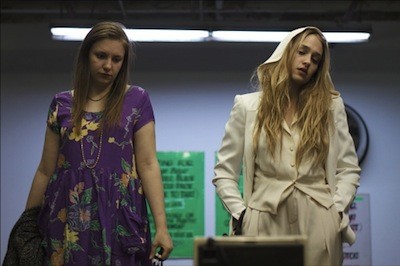
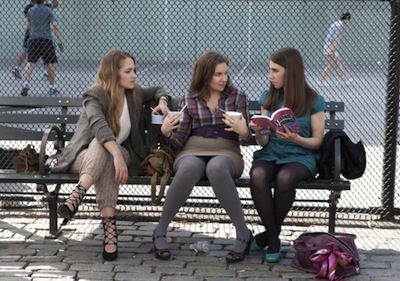
POSTSCRIPT: This review was originally written when Tiny Furniture was released theatrically, so there has been some time to see if the auteur would deliver on the more promising aspects of her creative endeavor. Dunham's new project is helming a sort-of sitcom for HBO. Girls is produced by Judd Apatow and is set to debut this year. I've seen the pilot, and though having a strong producer has helped in terms of tightening the material structurally, I am afraid in terms of the things that concern Dunham and how she presents herself, what we've seen is what we're going to get. Girls is more of the same and, unless there is significant development in the episodes that follow, it's likely only going convince detractors that we were altogether too kind to give credit where we perceived it to be due.

POSTSCRIPT 2: Now that the whole season has run its course, I have done a complete 180 on Girls. Please read this update.


Still from Girls


Sunday, February 5, 2012

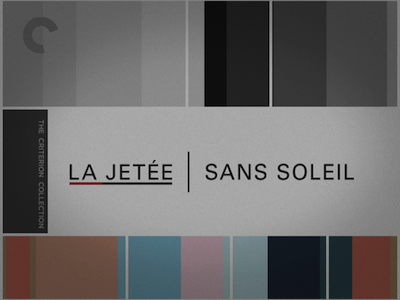
LA JETEE/SANS SOLEIL (Blu-Ray) - #387


Chris Marker is, undisputedly, a unique and gifted filmmaker. His point of view is unlike any of his contemporaries, and over the years, he has continued to work at his own pace and pursuing his own interests. I am sure there was a time when he could have chucked it all and pursued some big deals, but at this juncture, he has so far resisted. Marker is still alive, and the 90-year-old artist is still working, his last published credit being the updated version of his CD-ROM Immemory in 2008.

La Jetée, Marker's most famous film, like so much art, was conceived under seemingly unsurpassable restrictions. Marker could not afford a movie camera, so he made do with the materials available to him. La Jetée is a short film put together with still photographs and audio narration recorded by the writer/director on a tape recorder. The fact that the 27-minute visual narrative that emerged is so complex and daring is something akin to a miracle.


The story of La Jetée begins with an unforgettable incident in one boy's life. He witnessed a man die at the airport when just a child, and he was never able to shake the image from his mind. As an adult, he survived World War III only to end up the guinea pig in a time-travel experiment. The man (Davos Hanich) is an ideal candidate because his fixation on that one moment gives him a focal point for his journey. During his first forays into the past, he finds a woman (Hélène Chatelain) who was also at the airport during the death scene, and they develop a relationship. It's only when the man goes forward into the future that he realizes his captors have different ideas for how they plan to use him and the technology he is helping develop.

Plot-spotters might recognize this tale as the inspiration for Terry Gilliam's 12 Monkeys. As much as I like that later film, there is something more elegant about La Jetée. It is far simpler and yet far more emotional. The scenes of the man and the woman enjoying their dates are understated and direct, reminiscent of Luchino Visconti's Le notti bianche. Marker avoids the usual goopy sentimentality of love stories by allowing for the romance to be an unexpressed tension interpreted by the audience. What exactly is the man doing in pursuit of this love he can never have? What does it mean for his greater mission?
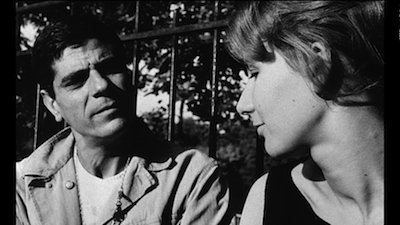


Despite the lack of movement or dialogue, La Jetée is never stagnant. It is like a living comic book. The images of Paris post-devastation are awe-inspiring, and the art direction for all the future scenes makes use of cramped framing to work around the limited budget. Yet, it never feels as if Marker is cheating. The ingeniousness of the solution is that the future is a time of burial; the open skies of the past are just that, a thing of the past. All of our tomorrows are distant and shrinking as mankind destroys itself.

The movie has a variety of interpretations. It ruminates on war, madness, and mortality. Which facet you choose is important will dictate how you relate to it. You may choose to explore all at once, even. It's all there.


Marker released Sans Soleil twenty years after La Jetée, following a period of primarily focusing on politically motivated filmmaking. Thematically, Sans Soleil is similar to La Jetée in that it deals with memory, time, and the consequence of history. Its title, which translates as Sunless, refers to an interlude in the film when, after looking at some footage of Iceland, Marker imagines a science-fiction movie he might one day make. It is one where a distant traveler will come to Earth and be surprised by the inconceivable injustice that exists within an otherwise blessed society. The director immediately dismisses the movie as one he will never get off the ground, but it's a tangent worth exploring nonetheless.

I say that the director dismisses the idea of Sunless, but in reality, the narration in the film is amorphous. It folds letters from world traveler Sandor Krasna into Marker's visual collage. The narration is actually read by women--Alexandra Stewart in English, Florence Daly in French--effectively abstracting the point of view, which is then further obscured by the fact that Krasna is really Marker himself, hiding behind the guise of a fictitious cameraman. It's a playful conceit for a film that embraces the elasticity of experience. Sans Soleil isn't about any one thing. It is a global journey where the route is dictated by human caprice and random encounters.


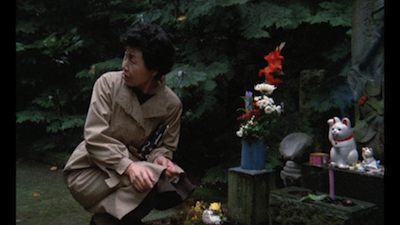
Most of what we see takes place in Japan. While shooting AK, his portrait of Akira Kurosawa, Marker filmed street scenes and spiritual rituals and grappled with the incongruities of Japanese culture. In many ways, the old traditions still exist, but in many other aspects of life, new ideas, invigorated by advertising and technology, are taking shape. For Marker, most activities reveal a search for a sense of self, of trying to find a place of belonging in the grander scheme of things. What he sees in Tokyo brings to mind the revolution in the West African nation of Bissau, as well as the memory games of Alfred Hitchcock's Vertigo [review]. He visits both through archival footage, but he also travels to San Francisco to tour the real locations from Hitchcock's mind-bending thriller. There are also the aforementioned detours to Iceland and brief stops in France.


The sum of all these parts is one that can be a little elusive in calculation. Sans Soleil is a bit like one of those see-sawing paperweights that pushes brightly colored water back and forth inside its plastic casing, creating the illusion of a rolling tide. Marker purposely wants to the movie to slip through the viewer's grasp, to force us to adapt to the changes. His movie is about how experience can't really be recorded, halted, or held. Life is ever changing, and that is why our search for self never truly ends. At the same time, memory can be abstracted and preserved and reevaluated. Marker illustrates this by showing documentary footage run through an electronic synthesizer. People are turned into blobs and shapes, yet their meaning isn't removed. They are no longer solid objects, but they still exist.

The end product here is more essay than documentary, a collection of impressions rather than an overly sculpted narrative. Marker rarely imposes meaning on his footage, instead choosing to juxtapose words and images in a way that draws the watcher into the cinematic flow. He does this with an impressively light touch. Despite the seriousness of much of the topics explored, Sans Soleil remains entertaining throughout, creating a sense of mystery that leaves us wondering where it will all go next.


For a complete rundown on the special features, read the full review at DVD Talk.

Please Note: The screengrabs used here are from the standard-definition DVD released in 2007, not from the Blu-Ray.

Friday, February 3, 2012

SIDELINE: MORE REVIEWS FOR 1/12

A round-up of the non-Criterion movies I saw in January, 2012.


IN THEATRES...

Chroniclea "found footage" superhero movie that could have just as easily stayed lost.

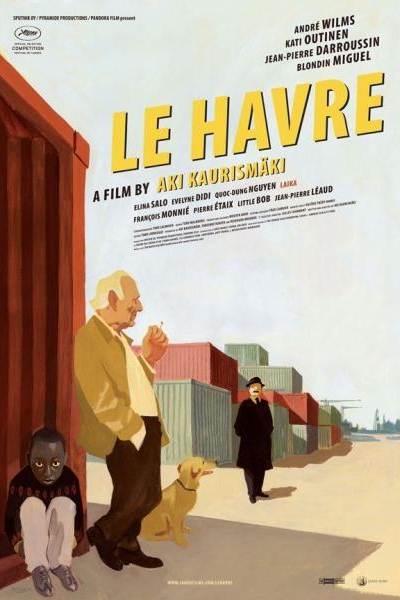
Le HavreAki Kauirsmäki's newest has a familiar quirkiness, and not necessarily in a nourishing way. 

The Man Nobody Knew: In Search of my Father, CIA Spymaster William Colby, a documentary as unwieldy as its title. Colby remains as much a mystery in the end as he was at the start.

A SeparationAsghar Farhadi's remarkable Iranian family drama.

The Woman in BlackDaniel Radcliffe's turn as the victim of an old-fashioned ghost story in this Hammer horror production.


ON DVD/BD...


A Beautiful Life, Andrew Lau's melodramatic romance picture starring Shu Qi as a woman learning to love.

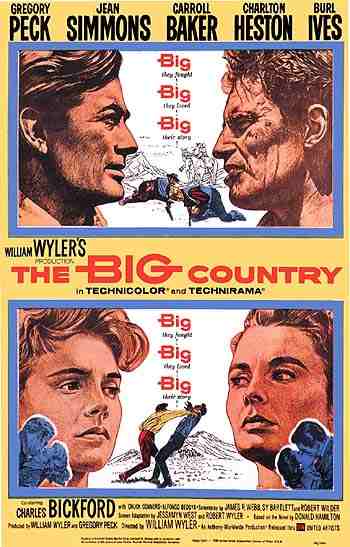
The Big Country, a uniquely masculine western with Gregory Peck and Charlton Heston.

Boardwalk Empire: The Complete First Seasonan awesome Blu-Ray packaging of the Scorsese-helmed Prohibition-based television show.

The English Patienta sweeping epic spanning two timelines, though the one with Juliette Binoche is better than the more famous romantic storyline.

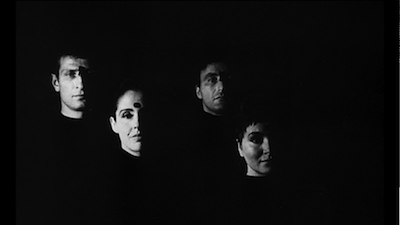
Film SocialismeGodard's most recent intellectual puzzler.

Love Story: If love is never having to say you're sorry, but I hated this movie, doesn't someone still owe me an apology?

Outrage: Way of the YakuzaTakeshi Kitano enacting a bloody chess game with all the boredom of real chess.

The PianoJane Campion's literary romance, starring Holly Hunter, Harvey Keitel, and a young Anna Paquin. (Get prepared to feel a little creepy, True Blood fans!)


Sunday, January 29, 2012

VIRIDIANA - #332


A month spent with some of Luis Buñuel's 1960s output ends with one of his most revered, the controversial 1961 drama Viridiana. Then again, "drama" doesn't exactly feel like the right word. How does one classify this picture? It's got drama, but it also has satire; it has social commentary, but is also a moral parable. It has small touches of Buñuel's usual surreal pranksterism, but yet is also restrained. The director is in complete control of his material, and he doesn't let his gadfly impulses get the better of him.

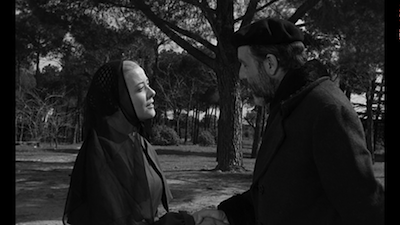
The marvelous Silvia Pinal stars as the title character. Viridiana is a young woman who has just finished her schooling at the convent. Before she takes her vows as a nun, however, her mother superior insists she go visit her ailing uncle, Don Jaime (Fernando Rey). He paid for her education, but Viridiana doesn't know him. She goes to his home reluctantly.


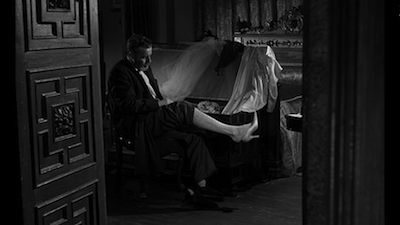
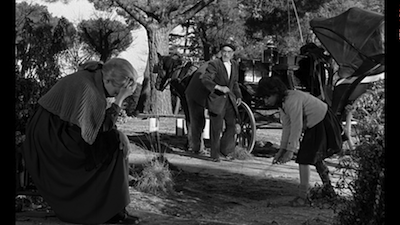
Don Jaime lives alone with his maid Ramona (Margarita Lozano), her daughter Rita (Teresita Rabal), and two handymen. He is a widower whose only child is a son born out of wedlock whom he hasn't seen in years. Viridiana does not approve of his lifestyle or his choices, but she is forgiving. Her time under his roof is pleasant, and he even indulges her idiosyncrasies. One night Don Jaime witnesses his niece sleepwalking. In this nocturnal trance, she burns her knitting yarn and pours ashes on his bed--a symbol, we are told, of both penitence and death. Don Jaime could use the former, and he is prepared for the latter. His easy acceptance of this odd behavior is partially relief. Had Viridiana been awake, she'd have seen him cross-dressing, trying on his dead wife's shoes and girdle.


He is also thankful for the brief glimpse of Viridiana's virginal thighs. Being asleep, she wasn't aware enough to cover what was exposed. The beautiful blonde attracts plenty of attention from men. As much as the religious woman desires to blot out sin, there is a reactive impulse from the sinner to want to ruin purity. Don Jaime actually has been scheming the whole time to make Viridiana stay and marry him, replacing her aunt, whom she resembles. As much as this is a perfectly lurid melodramatic detail, it's also a carefully chosen symbol. Buñuel is warping the idea of a nun being married to her savior. There is an understated allegorical element to Viridiana where Don Jaime is God, though in this scenario, the Supreme Being is disillusioned with his creation. The noble ideals that inspired his earliest efforts have been replaced by an understandable disappointment in life, and the son he sent out into the world has done his own thing rather than continue the mission*. Rey captures this weariness and Jaime's internal conflict perfectly. His whole being appears to sag as he discusses his disillusionment. He's also equally adept at showing how he, too, is subject to base human impulses. Viridiana's romantic allegiance, might restore some of the goodness to Jaime's life, and her sexual surrender** will give him more immediate personal satisfaction.


Viridiana is caught in a hypocrisy that Buñuel quite rightly sees as systemic of organized religion. Despite a fundamental desire to do what is right, Viridiana often only does so after a guilt trip compels her to. When she attempts to take care of herself, other forces demand that she bury her own desires and give in to theirs. When she rejects Don Jaime, he resorts to drastic measures to trap her in his home.

The writing here, by Buñuel and Julio Alejandro, is sharp. It is never overbearing or obvious. The director is actively thumbing his nose at Catholicism--and Viridiana was banned by the Vatican as a result--but he's not resorting to easy polemics or, heaven forbid, preachiness. He lets the events suggest meaning; action speaks for itself. He also doesn't limit his contempt to just the church. As Don Jaime has likely figured out--and here, we can assume, so has the auteur--humanity is its own worst enemy. Religion has not just been born out of superstition and fear, but also out of a real-world need to impose some kind of moral order on the greater citizenry. Sin is real, even if God is not, and left to our own devices, we will succumb to every selfish impulse and bad behavior available.


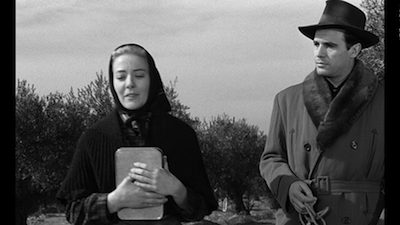
This becomes the focus of the second half of Viridiana. Traumatized by all that has happened at her uncle's home, the girl decides not to take her vows. Instead, she will stay at Jaime's house and care for the local poor. She invites the street beggars back to his place and gives them room and board, only asking for piousness and a little work in return. At the same time, the lost son, Don Jorge (Francisco Rabal), comes to take over his father's land. Don Jorge represents the modern world that Viridiana has so far avoided. He is a man of industry and doesn't like seeing his father's land going to waste. He listens to rock music and is in a relationship with a woman (Victoria Zinny) who is not his wife. He is kind to dogs, but not very compassionate toward man. And like every other male, he is attracted to Viridiana.


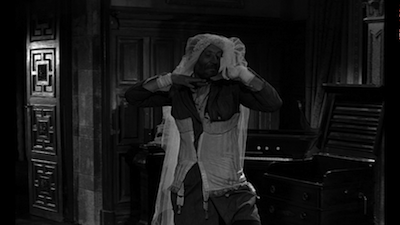
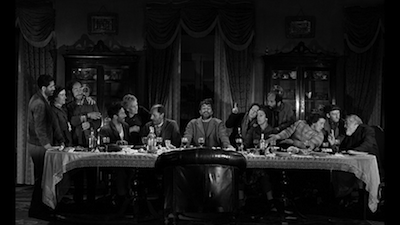
Funnily enough, for all the anti-religious readings of Viridiana, one could actually apply the opposite to the film's final act. Don Jorge's influence appears positive when you see how he transforms his father's estate, but his personal behavior often hurts people. He disregards the needs of others for his own, a trait that would be easy to blame on his money and his class position, except the disenfranchised lower classes he so disdains are no better. Despite Viridiana's kindness, the men and women she has taken under her care reward her by throwing it back in her face. The first time she leaves the farm, they break into the house and throw themselves a party. As noted in my review of The Exterminating Angel, Buñuel regularly uses dinner table scenes for both comedy and critique. The blind beggars and social misfits are a grotesque parody of how they envision the upper classes behaving. They are sloppy, over indulgent, and downright hedonistic. A leper dresses in the wedding dress of Don Jaime's widow, providing a distorted mirror image of the old patriarch's own cross-dressing. The same sickly beggar has also slaughtered a white dove, a traditional symbol of religious piety. (This is contrasted with the black bull that little Rita sees earlier in the movie, suggesting the devil is coming for them.) The feast ends with the rabble rousers posing as the diners in Leonardo da Vinci's The Last Supper. If these are Jesus' most precious disciples, are they really worth saving? (Though, credit where its due, the punchline of the joke from the woman whose "camera" will take this picture is hilarious.)


Buñuel amps up the melodrama for the scenes that follow, and the effect is disturbing. I am sure he was aware that by allowing Jorge to play the hero, he is giving the audience what they suspect they want. Indeed, even casting the square-jawed actor validates a kind of Hollywood image of a leading man. Francisco Rabal talks like Charlton Heston, and he smolders like Rock Hudson. Yet, are any of us really prepared for the true side effects? For someone to be a hero, another person has to be a victim. If we don't feel queasy seeing innocence spoiled, if we get a charge out of Jorge's coming to the rescue--as pathetic as those efforts kind of end up being--then there is something wrong with us. If we also lusted after Viridiana, if we yearned to see more of Silvia Pinal's flesh exposed, then we are no better than any of the drooling predators on the screen.

The final shot of the film is one of capitulation and defeat. There is no coming back from this trauma, no restoring old-fashioned values. The holy trinity has been replaced by a completely different sort of threesome, and this one has about as much chance of filling the existential void as its predecessor.


* Though the son here could also easily ask, "Father, why hast thou forksaken me?" 

** I suppose one could make a case for Don Jaime's initial lie about having deflowered Viridiana being an attempted distortion of Mary's virginal impregnation, but I am not quite sure how to pull it together. An intriguing parallel, nonetheless. 


BONUS BUNUEL: My reviews of discs from the director not featured in the Criterion collection:

* Susana (1951)

* Death in the Garden (1956)


Sunday, January 22, 2012

BELLE DE JOUR (Blu-Ray) - #593


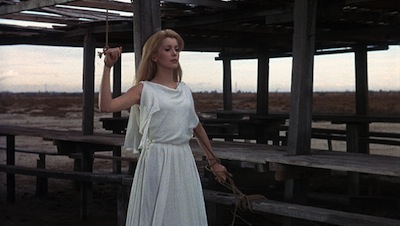
Luis Buñuel's 1967 adaptation of the Joseph Kessel novel Belle de Jour may be tame by today's standards in terms of what we actually see on screen, but the icy tale of sexual peccadilloes and alternative pleasures still has a psychological resonance, bolstered by the director's casual acceptance of fantasy as a means for expression. It's one of Buñuel's best films, as well as one of the most ideal roles for its beautiful lead actress, Catherine Deneuve. The star of Repulsion [review] and The Umbrellas of Cherbourg (and of more recent films like Apres Lui [review]) has often been criticized for her chilly demeanor, but a smart director like Buñuel can take what others see as faults and turn it into a performer's greatest strength.
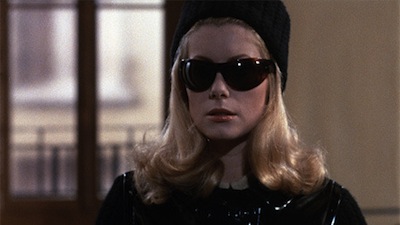
Deneuve stars in the film as Séverine, a 23-year-old newlywed who, despite having been married to the handsome doctor Pierre (Jean Sorel) for a year, has not yet consummated her marriage. The couple sleeps in separate beds, like the marrieds of a 1950s sitcom, and Pierre's attempts to cross the transom between are met with dismissal. You'd think the dirty dreams Séverine is having would otherwise stimulate her underwhelming libido, but as we see, these fantasies all involve some kind of degradation or violence. One such dream is Belle de Jour's opening scene, and in it, an angry Pierre has Séverine whipped by coachmen before handing her over to one of them to do what he will. Even if Pierre knew about his wife's hidden desires, it's hard to imagine he could do anything about them, he's too upstanding a citizen. Then again, if he knew that all of her fantasies somehow referenced cats, he could maybe buy a few kitties for the apartment. You know, meet his wife halfway.


Unsurprisingly, it's a man whom Séverine despises that changes her erotic life. Husson (Michel Piccoli, Dillinger is Dead [review]) is dating Séverine's girlfriend (Macha Méril, Une femme Mariée [review]). He's a brash character, and he even puts the moves on Séverine. When another woman in their social circle is rumored to be working in a brothel, Husson tells Séverine where his favorite house of ill repute is located. Intrigued, Séverine goes there and signs up for work. She is nicknamed "Belle de Jour" because she has to leave by 5 in the afternoon so her husband doesn't realize something is up.

What follows is Séverine's measured acceptance of her new lifestyle. She resists her first client, but he wants her to assume control, and that's not her thing. Her actual first customer (and by some implication, her first sexual partner) is a Japanese man with some kind of bizarre device that buzzes like a bee. It's hidden in an ornate box, and for all the things that censorship standards wouldn't let us see in Belle de Jour, Buñuel scores by playing on our imagination. I am sure everyone watching has some ideas about what the man has brought with him--though, the other prostitute's refusal to go with him might erase any innocuous interpretations. Whatever it is, it liberates Séverine, and she soon accepts her new job in full, going so far as to fall for one of her regular customers, a young criminal with a golden grill. Marcel (Pierre Clémenti, The Leopard) is just the kind of uncaring bastard Séverine has been seeking. It's only natural, then, that when he starts to care--albeit in his own way--the whole arrangement starts to unspool, and Séverine's life unspools with it.


With Belle de Jour, Luis Buñuel has given us a glimpse into a seedy world, but by virtue of how he shows it to us, it doesn't seem seedy at all. Rather, once Séverine is inside, the landscape changes and this secret society becomes normal. Within the walls of the brothel, her passions are just as accepted as any other. It's only when the internal business goes outside, or someone from the outside comes crashing in--such as when Séverine's alter ego is discovered by Husson, who is played to sleazeball perfection by Piccoli, even down to the man's bruised ego--that any question of the morality of Séverine's sexual adventure is ever raised. The threat of exposure could undermine everything. (Though, it may be worth noting that the one perversion dismissed is anything having to do with underage girls; Buñuel rightly gauges his audience's comfort zone. Also, this lends weight to the brief flashbacks to his heroine's own childhood, when she was abused herself.)

Belle de Jour is less about sex, anyway, and more about the notion of double lives and the difficulties that come with not being able to express who we are. Deneuve is quite affecting as Séverine, a woman trapped by her own fear and the social mores that give them foundation. She is bottled up, and it shows in her demeanor, how she stands, where she casts her eyes. As the movie progresses, and particularly after her time with Marcel, the actress shows Séverine warming up, becoming happy, and becoming surer of herself. This makes it all the more sad and, honestly, scary when it threatens to all come crashing down.

And at the same time, strangely reassuring when, in the end, she gets exactly what she wants, even if not in any way she could have predicted. She has a life of servitude with a man who knows exactly who she is, and she is now free to roam the landscapes of her erotic fantasy world without ever leaving the comfort of her marriage home.


Criterion's 1080p Blu-Ray transfer is encoded with MPEG-4 AVC and presented at a 1.67:1 widescreen aspect ratio. The quality of the transfer is quite lovely, with a fine level of detail and well-rendered colors. Luis Buñuel and director of photography Sacha Vierny have created an aristocratic look for Belle de Jour, with softly rendered backgrounds and a color scheme that resembles old paintings. This comes across nicely on the new high definition upgrade, particularly with the soft grain that permeates the whole presentation. You will still notice minor print damage remaining, some slight scratches on the image at times, but these are rare occurrences and the image quality far surpasses previous North American DVD releases.

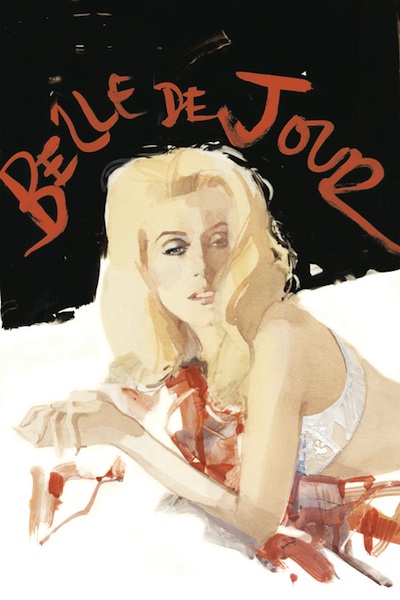
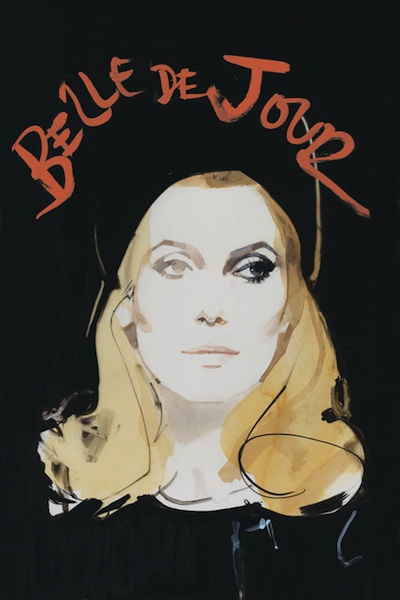
Once again, Criterion has enlisted artist David Downton to provide covers for one of their releases (he has previously contributed to their Max Ophuls library [reviews]), and the results are stunning. He has done new artwork for the front cover and the cover of the interior booklet.


More on Catherine Deneuve.

For a complete rundown on the special features, read the full review at DVD Talk.

Please Note: The images used here are promotional stills not taken directly from the Blu-Ray.