Wednesday, July 22, 2009

EQUINOX - #338


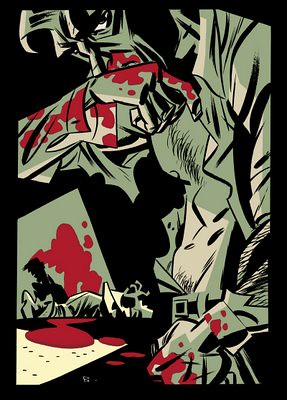
I'm off to Comic Con International in San Diego, CA, where Joëlle Jones and I will be hanging out at the Oni Press booth to celebrate the debut of our new comic book, a little crime novel called You Have Killed Me. Two years in the making, an indie effort from our two pairs of hands, and I couldn't be more proud. (See more here and here.)

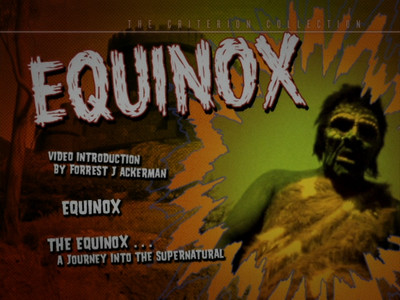
In honor of that, I thought I'd review another indie effort, though this one in a different field and a different genre. The low-budget, self-made Equinox is perhaps another of those cult classics with a back story that is more interesting than the film itself. (But then, if you stop and think about the term, we usually associate the term "cult" with blind believers that have been duped, don't we?) In this case, Equinox, or as the original version was called The Equinox…A Journey Into the Supernatural, is a late '60s monster movie put together by a group of guys who loved monster movies. The effort was spearheaded by Dennis Muren, who would later go on to work on Star Wars and change the way special effects were done at Industrial Light and Magic. This 1967 picture, written and codirected by Mark McGee, was more in line with old school effects as pioneered by Ray Harryhausen, far from the more refined tricks Muren would later develop. So, a heaping amount of the love for Equinox comes from the fact that the monster effects were done in stop-motion using clay figurines designed by Muren and largely animated by David Allen. And indeed, these make for the best parts of the movie, my favorite effect being the tentacled monster that destroys the house of Dr. Waterman (Fritz Leiber). Colorful and malleable, it's exciting in its almost innocent primitivism. The very fakeness of it suggests a world beyond our imagination.


Though, truth be told, the animation is where most of the imagination went. The Equinox borrows heavily from monster flicks of drive-ins past, but most obviously from Jacques Tourneur's Curse of the Demon. (Good choice. Tourneur's film noir past also influenced me when writing You Have Killed Me, and eagle-eyed readers will note he gets a shout-out in the book.) The main version here, its title truncated to Equinox and released theatrically in 1970, actually beefs up the story some (if you can believe it), with producer Jack H. Harris (The Blob) hiring director Jack Woods (writer of Son of the Blob) to shoot a new version with the same actors and working around Duren's stop-motion sequences.

The Equinox story focuses on four college kids who go into the woods for a picnic and to meet Dr. Waterman, the professor of David Fielding (Edward Connell a.k.a. Skip Shimer), ostensibly the hero of this piece. They arrive to find Waterman's house destroyed, a strange cop named Asmodeus (Woods doubling as an actor), and an old man hiding in a cave (Louis Clayton). The old man gives them a demonic tome that is then stolen by Waterman, and all kinds of weird monsters start showing up--a kind of half lizard/half ape, a flying devil, a green Neanderthal. Orchestrated by Asmodeus (like his name wasn't a tip-off!), the gang manage to hold off this hellish army with crucifixes, rocks, and sticks for a while, but soon their numbers start dwindling. David escapes, but only just--and he takes a terrible death curse with him.

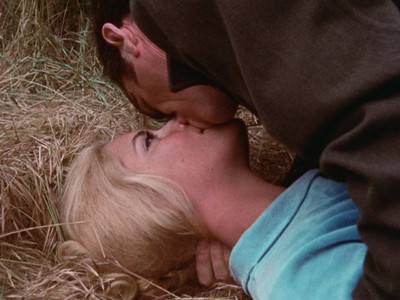


Equinox isn't very scary, nor is it even all that exciting. The closest we get to a real fright are the close-ups of Asmodeus attempting some malformed version of a French kiss when he tries to force himself on David's date for the day, the hot blonde Susan (Barbara Hewitt). Woods, being either an egomaniac or a genius, seemed to know this shot was gold, because he keeps going back to it, the horrifying memory of her near defilement haunting Susan. Given the breakneck pace of the movie (it's practically in real time), no other romantic subplot develops, so don't expect exploitative sexiness either. The closest we get is Dave pulling a crucifix out the front of Susan's pants. I guess she doesn't have any pockets…so to speak.


From a script standpoint, you pretty much get what you might expect from an amateur movie with a bunch of kids running around in the forest talking about a milquetoast devil and screaming. If that's your idea of fun, then you will probably dig Equinox. Its backyard vibe has a certain infectious charm. There are no hidden layers to it, however, no deep message, nothing to offset the fact that it's not too frightening or, really, very good at all. I mean, when your best actor is Frank Bonner, he who would be Herb Tarlek of WKRP, I guess you take what you can get.

Still, even more than 40 years later, it's plain to see Duren's skill at stop motion, and his enthusiasm lights up the screen whenever the effects shots take over. His creatures, especially the big simian known as Taurus, have cool designs, and the ambition of putting these clay creations in with real humans is pretty impressive. The lack of sophistication just reminds you that some guy made this, he carved it and made it move with his own two hands, and he did it back when hardly anyone else could. Equinox survives by and large because of that, because it's a quality you just can't get in the digital age. Even when people go old school, it's a gimmick, a conceit, no matter how genuine; it can never be the same kind of genuine.
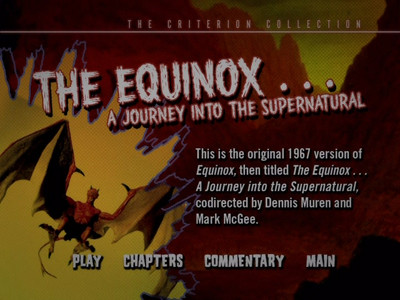


Included here, and serving as an even bigger testimony to Duren and McGee's DIY ethos, is the original The Equinox…A Journey Into the Supernatural. Shot on a cheap camera and with a skeleton crew, the difference between the productions is immediately obvious. The 16 mm Bolex camera they used only allowed for 30 second shots, and so there is a faster pace to it, even as the amateur acting slows the movie down. (It's interesting how much younger the cast looks despite not that much time really having passed). In a way, it adds to the verite feeling of the production (the disc's liner notes make a point out of quoting New Wave directors in relation to their praise of amateurs). There is a natural, unmannered look to the cinematography that I think actually helps the action scenes to be a little scarier. The short shots don't allow for any lingering. Likewise, despite the more labored set-up--the explanation that gets Susan along on the trip is totally unnecessary--we get our first glimpse of the Lovecraftian monster destroying Waterman's house before we even reach the 20-minute mark.

Aw, who am I kidding. The Equinox…A Journey Into the Supernatural is pretty much unwatchable. Every time a conversation comes along, the movie stops dead. Without the Asmodeus character, there is also a lot less drive to the plot, less of a presence of an immediate threat; the expedition into the woods is more meandering, more random. Despite his own hammy performance, at least Jack Woods also had a better sense of how to work with his actors. If you're watching this DVD for the effects, you might as well stick to Woods' redo, as the picture is better preserved and the image more clear.


I realize that in these kind of situations, it can be rather dreary to have an old fart like me hanging about complaining about the quality of the production. Kind of like were someone to unearth new high school-era skiffle recordings of the Beatles and I spent more time complaining about the audio quality and their inability to play rather than fully appreciating that I am listening to/looking at where so many things started. The spirit of how Equinox came together is probably best exemplified by the eight-minute short included on disc 2 here, Zorgon: The H-Bomb Beast from Hell. A lot of the same folks who worked on the main feature reteamed in 1972 for this goofy little movie, covering a lot of the same territory, proving that monster movies are in their blood--and apparently that they'd been watching a lot of Scooby-Doo. The closing shots of all the folks who took part, standing together and mugging for the camera, shows off the kind of heart that goes into these sorts of things.


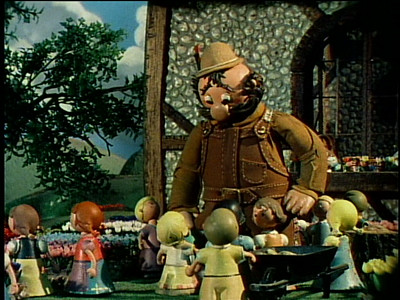
Also buried on disc 2 is the real surprise of this set: The Magic Treasure, a 20-minute solo film by effects animator David Allen. This claymation short is a lovingly realized fairy tale about a giant, an evil magician, and a much coveted treasure chest that is said to hold the secret of humanity's true specialness. Allen has created an entire storybook world, and though the message is simple, it still has meaning. This is a child's fable, after all, without the pretensions of adulthood, without the need for long explanations that go on for pages.

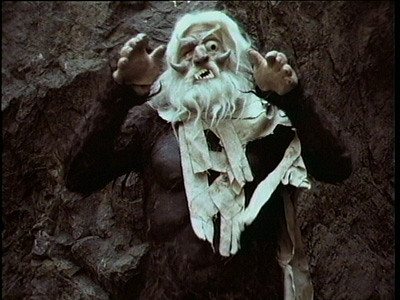
The Magic Treasure is interesting in comparison to Equinox, as both involve secrets that can change man's life and the giants who protect them. It's just a topsy-turvy version, where here the secret is positive and the giant is good. The scenes where the giant confronts the evil magician who steals the box--a kind of Asmodeus, if you will, and just in like the bigger movie, his actions suggest that man brings ill upon himself when he only desires selfish gain--are not dissimilar to some of the scenes we've seen in Equinox. Compare the still below to the one above where Skip Shimer is being chased by the shade.


Saturday, July 18, 2009

SIDELINE: AN INTERVIEW WITH YOURS TRULY


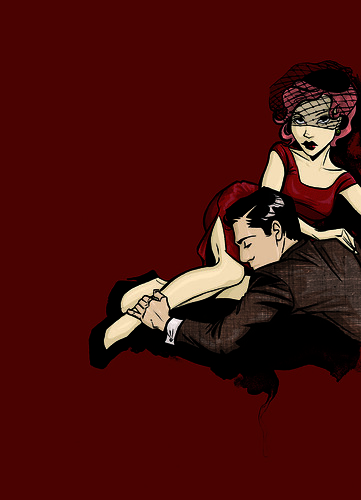
Mark Coale, proprietor of Odessa Steps Magazine has posted an older interview he did with me over on his Earth Three blog. The occasion is this week's release of my new comic book with Joëlle Jones, the hardboiled noir-homage You Have Killed Me, as well as San Diego Comic Con International, which Joëlle and I will be attending. You can see our signing schedule here. The above In the Mood for Love inspired drawing was done for Mark's publication, and the line art is being used as a con-exclusive bookplate, as well.

You can read the piece in its entirety on Mark's blog. He and I share a magnificent Criterion obsession, and he asks me a few question about that, as well.

Q: As of this writing [Summer 2008], what's the best Criterion you've watched lately?

A: I had a weekend where I watched Yukio Mishima's Patriotism and then Mishima, Paul Schrader's biopic of the Japanese author, back to back. In terms of packaging and content, both were excellent, and though I'd had some limited contact with Mishima in years past, these films made me realize I probably should delve deeper into his library. As a person and as a writer, he had a lot of similar concerns to what shows up in my work, including a romantic yearning to stand against the tide and to, essentially, stand for something rather than caving in to modernity. He was also preoccupied with suicide, as are many of my characters. If you watch Patriotism, which he wrote, directed, and starred in, and you see him playing a Japanese solider disemboweling himself, it's quite powerful, particularly when you chase it with the Schrader picture and all the extras that come with it and hear about how he ended his own life the same way. It's easy to see why his widow demanded the movie be buried while she was alive. The scene in Patriotism where he slices his belly open is gruesome, and not just by 1960s standards, but any standards.

Q: Here's the obligatory Desert Island question. What five Criterions would you take with you? Feel free to cheat and name box sets as one entry.

A: In the Mood For Love, dir. Wong Kar-Wai
The Cranes are Flying, dir. Mikhail Kalatozov
Days of Heaven, dir. Terrence Malick
Contempt, dir. Jean-Luc Godard
Sullivan's Travels, dir. Preston Sturges

The first three are pretty rock solid. Godard would also always take
the fourth slot, though there are a couple of others I might debate
over. I'd also be able to change the last slot a million times before
walking out the door, but I figure I needed a comedy in there.


I can't believe I've only reviewed one of those five. I'll have to do something about that!

Read a large preview of You Have Killed Me.

Friday, July 17, 2009

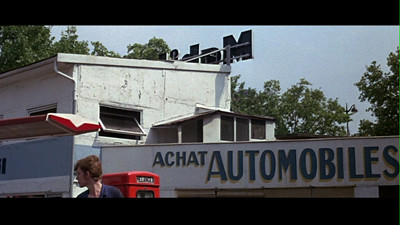
2 OR 3 THINGS I KNOW ABOUT HER - #482

"Language is the house man lives in."


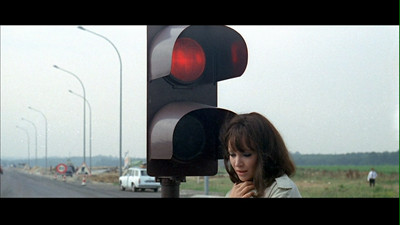
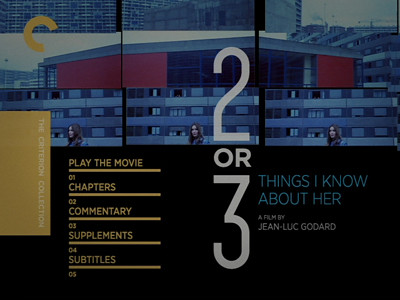
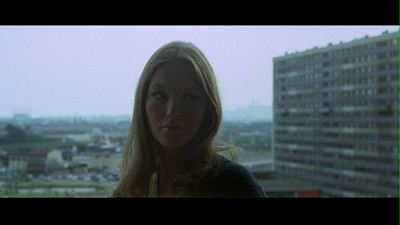
This is the second time I've seen Jean-Luc Godard's 1967 film 2 or 3 Things I Know About Her, and I still am not entirely sure what to do with it. It's a complicated movie, obtusely structured, full of ideas and jarring storytelling conceits, but also aesthetically pleasing, glowing with bright colors and full of beautiful girls. At the end of the film Godard shot alongside this one, the (by comparison) more conventional Made in U.S.A., he made a declaration with a double meaning, "Left, Year Zero." Being as Anna Karina and Philippe Labro were discussing politics, it leads one to believe that it's a call to the radical thinkers to get back to basics, but since they are also in a car, it's a direction, turn left to get back to square one.

That declaration is also tied to the belief that language is dead, we need to redefine how we classify and communicate. These were ideas that were very much on Godard's mind as he headed for the death of cinema that was his kiss-off to the 1960s, Weekend. He was looking for a way to put cinema back at its reset point, to understand further how language transcends image, how both can push ideas across. In 2 or 3 Things, comic strips are mentioned as a prime example of the disparity between what is written and what is seen, between explanation and perception, form and function.


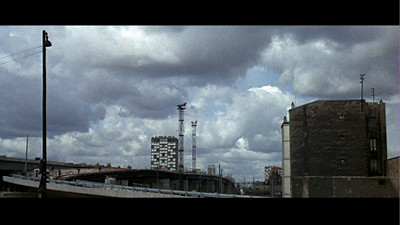
Though this twitchy film rarely sits still for long, we could break it down to two narrative lines. In one, Godard shows us construction and the changing Parisian landscape, as he speaks to us in hushed voiceover about progress, capitalism, and the way modern man being pushed to constantly go forward becomes a means for holding him back. In the other, he follows Juliette Janson (Marina Vlady) through her day, from doting mother and wife to prostitute and back home again. This idea came from a newspaper article Godard had read that detailed how life in newfangled high-rise projects demanded more money than most families could afford, and so women were turning tricks to make ends meet. Intrigued by this idea, how having a less personal space ended up costing people more money and encouraged drastic solutions, Godard made it the subject of this picture.

Juliette--or, as it were, Marina, since our introductions to the actress and the character are presented back to back, with little change to the description--is not the only working girl Godard's camera settles on. He and his regular cinematographer, Raoul Coutard, shoot 2 or 3 Things like a documentary, and each woman they meet speaks directly to the camera and the unseen maestro conducting her interview. In reality, Godard was speaking to these actresses through an ear piece, so that they could hear his questions and respond, or even parrot the lines he fed them. This is why they are often looking at the camera expectantly, not entirely in the moment. They are actually more present than most actresses, the façade having been wiped away, waiting for their prompt.


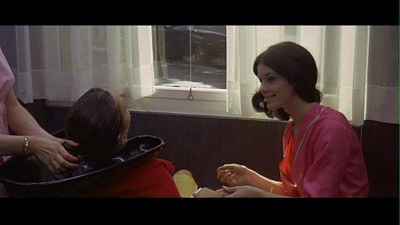
Though many of the elements Godard displays--construction, mechanics, commercials, fashion magazines, shopping, beauty parlors, Vietnam--seem disparate, in his theorizing, they are all combined. Progress demands consumption, consumption in turn has certain economic demands, and these economic demands lead to more oppressive politics, a way for the governing powers to further control the populace. In an early exchange, when Juliette's husband (Roger Montsoret) is listening to Lyndon Johnson talk about attacking North Vietnam, Juliette reads to him from a fashion magazine, wondering what stockings to buy. He can't believe she is concerned with such trivial things, she insists he has no culture. Godard wants us to see that it's in the interest of the powers that be to keep Juliette concerned about such superficialities, it keeps us from acknowledging the horrors that are occurring all around us.

Typing it out, I realize that this sounds vaguely like a crazy conspiracy theory, and there is something almost conspiratorial about this film. By whispering his narration, it's like Godard is inviting us into a huddle where he is sharing these volatile secrets. It also fits the faux documentary aesthetic, sometimes coming off like he doesn't want to disturb the characters onscreen or alert them to his presence. Some Godard theorists also think it's because he's grown less detached and more personal, that this is him confessing and telling his audience how he really feels. In Made in U.S.A., the taped confession was of a character and based on real-life political testimonies; in this case, it's all JLG.


There is an interesting line of inquiry to be followed in this film in terms of the sexual politics. It would actually be easy to paint Godard as a sexist himself. In Made in U.S.A., his last film with ex-wife Anna Karina, one interpretation sees him as portraying her as killing off his innocence. At the time of this film, Godard was nursing a broken heart and bruised ego after his new star, Marina Vlady, rejected his marriage proposal. Hence, it could be dirty editing room trickery to say she and her role are one and the same, to suggest all actresses are whores. This would mean the scene between husband and wife where Vietnam is considered less relevant by the woman than her leggings is Godard belittling women intellectually (and, indeed, the bespectacled Robert character, the mechanic who builds things while also clinging to his ideas and ideals, often looks like the director). I think this would be a false assumption, however, that it misses Godard's larger argument about capitalism vs. communism, and that all work is prostitution in its way. Robert doesn't own his own garage, after all, he toils for someone else the way a film director may toil for a producer or a studio.


If we're to accept a more positive view of the women in 2 or 3 Things, then it's a sympathetic ear Godard lends when he lets them tell their stories. He is also exposing the institutional crime that not only condones their subjugation, but perpetuates it; he prefaces many of their tales by pointing out how they are really just the same old stories we've heard before. Again, it comes down to our use of language and to communication. Near the end of the movie, he depicts two conversations in a café. One is between Robert and an unknown girl (Juliet Berto), and though it starts innocently enough, the man soon turns the topic to sex. Across the way, a student (Blandine Jeanson) talks to what is supposed to be a Nobel Prize-winning author (Jean-Pierre Laverne), but what begins as an exchange of theory turns into another chat about the banal. No one knows how to talk with one another anymore, especially not in the movies (or so says Robert).


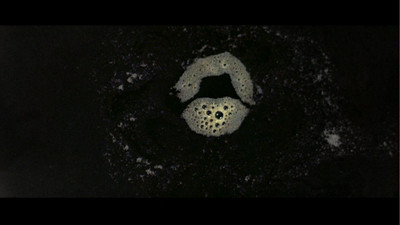
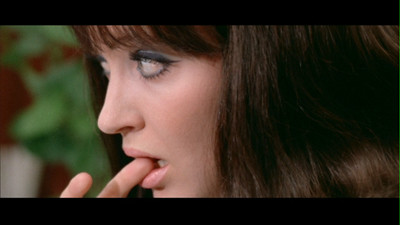
Lip prints in my coffee...


This adds more meaning to when Juliette and the other working girls talk to the camera about the ideas in their heads, about their descartesian philosophical conundrums. Then again, if they think and therefore are, Godard gives us another troubling irony here. These girls aren't sharing their innermost thoughts, they are sharing what the writer/director tells them to share. Are we back to him saying women have no mind of their own? Let's not forget, he's also letting us ogle them, admiring their beauty with and without clothes, all for the price of a ticket (or, as it were, a DVD). Again, I don't think so, but one would hope it's not a contradiction lost on the director. The Bertold Brecht quote Juliette recites at the outset is another piece of evidence working in Godard's favor.


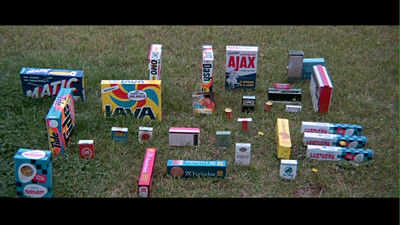
Godard's awareness is important becaue, ultimately, one of the main conclusions that the movie comes to, and one uttered by Juliette/Marina, is that what we see and experience and how we describe it not only effects us, but the world around us. And vice versa. When we build these cheaply made but overly priced commercial spaces that have no individual personality beyond the advertising that pushes us toward further consumption, it's no wonder we end up in an endless cycle of drudgery, unable to express ourselves, disinterested and shallow. In the final image of the film, Godard places an idyllic drawing of a loving couple in the middle of an arrangement of commercial products, a diorama of our materialistic lives. There we are, lost amongst the laundry detergent. These things take us back to zero, he moans, and we have to start over from there. Hit the button and go back to the start, or you'll end up so clean, scrubbed so sparkling white, you just might disappear.


"If by chance you can't afford LSD, then buy a color TV."


* The first time, it was because I was prompted by writer Matt Fraction. I told him I was working on a book called 12 Reasons Why I Love Her, and he replied, "Oh, like 2 or 3 Things I Know About Her?" I had to check and make sure they weren't alike; happily, they are not. Not that I couldn't steal from worse, but you know what I mean....


For a full rundown on the special features, read the full article at DVD Talk.

Wednesday, July 15, 2009

MADE IN U.S.A. - #481

"I understood very quickly. This affair had to remain murky for everyone, and my life was on the line."


Donald Westlake's Parker is the kind of guy who can never get a break. A bad dude who cleans many a house in all corners of the underworld, he starred in twenty-three novels, but you'd almost never know he had a movie career, too. Maybe it's some strange karma that, since Westlake wrote this crook's stories under the nom de plume Richard Stark, Parker's most famous cinema adaptations have changed his name to something else. The John Boorman flick Point Blank has Lee Marvin playing Walker, whereas Brian Helgeland's Payback cast Mel Gibson as Porter. Never mind that they were both based on the same novel, The Hunter, which was the start of the series. By all reports, poor Parker is faring better now that he's branching out into comic books. Darwyn Cooke's adaptation Parker: The Hunter is due to be released any day now, and by all advance reports, it's brilliant. (Read a preview at the publisher's website.)

In 1966, Jean-Luc Godard adapted a different novel, turning The Jugger into Made in U.S.A. and Parker into a woman in the process. Such are the things you can get away with when you don't bother to get the author's permission to turn his novel into a movie. Made in U.S.A. was reportedly barred from lighting up screens on this side of the Atlantic thanks to successful litigation by Westlake. I can't say I blame him, and from the looks of things, Made in U.S.A. is so far away from its alleged source material, I am not sure why Godard didn't just pretend he came up with it on his own.


In The Jugger, Parker travels to small-town Nebraska to silence an old heistman who knows too much about his past, only to find someone else has done the silencing for him. The question is, how much had the geriatric crook talked before the end came? In Made in U.S.A., Parker's stand-in is Paula Nelson, played by Anna Karina. She is visiting Atlantic-Cité to dig up the dirt on why her ex-fiancé, Richard P… (voiced by Godard on tape, but never actually seen) was put in that selfsame dirt. Paula is some kind of sexy secret agent, a smuggler perhaps, a sort of veteran of various wars. Richard was a communist, and though everyone involved with the murder and the cover-up act like gangsters, it's all political. It's the 1960s, and when looking through Godard's dark sunglasses, politics are the new criminal activity.

As with most Godard films, "plot" is of little importance in Made in U.S.A.. Paula has come to town, she's approached by a little man named Typhus (Ernest Menzer) who claims to have worked with Richard, she beats him with a shoe, she meets his novelist nephew (Yves Afonso) and his Japanese girlfriend (Kyoko Kosaka), hangs out in a café, hears an a cappella performance of "As Tears Go By" by Marianne Faithfull, eventually gets around to asking some questions. It's all rather loose and off-the-cuff, the driving force of the story coming back around almost like an afterthought. There are plenty of messages even when there is no story--advertising is overtaking everything, war is immoral, the times they are a-changin'--but as usual, they are so entwined within the medium, sorting it all out can seem both daunting and silly. The standard modus operandi of any private detective movie is that the more the shamus explains, the more obscured the facts become; Made in U.S.A. subverts this by never bothering to explain, it's only obfuscation. There is a little bit of voiceover, but it has a meta hue. Sometimes, it's not voiceover at all, but Paula or Widmark (Laszlo Szabo) turning to the camera and describing their conversation rather than having it. Likewise, a tape recording of Richard takes over the role of "narrator" once it surfaces, and in the final switch, Paula makes her own tape.


Made in U.S.A. begins with a dedication to Nicholas Ray and Samuel Fuller, and it's the Hollywood tradition that they represent that is more important to Godard than the Westlake novel (and also likely where the title comes from). A Walt Disney film starring Humphrey Bogart is how Paula self-reflexively describes it, suggesting it's Bogie's presence that makes it a meaningful gangster picture. The gangsters played by Jean-Pierre Leaud and Laszlo Szabo are named for the director Donald Siegel and the great film noir villain, Richard Widmark. Jean-Claude Bouillon's police inspector takes his surname from Robert Aldrich. Most of the streets mentioned are also names of famous writers and directors--Ben Hecht, Otto Preminger, etc.* Daisy Kenyon and Ruby Gentry are women paged at a spa. Leaud's tic of shaking up a puzzle as he walks is like an overly complicated version of George Raft flipping a coin in Hawks' Scarface (which Raft would parody himself a year later in Casino Royale). In this film, perhaps more than any other, Godard is placing himself in the American cinematic milieu, letting it enfold him, and then kicking the crap out of it on his way out.
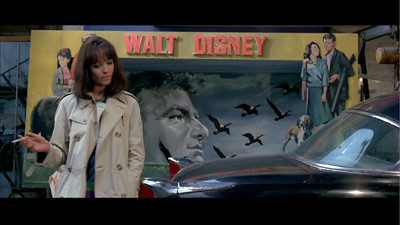


Given the political bend of the film, in addition to the American criminal mythology, American politics are also going to come up. Though Godard is none too thrilled with the conservative leanings of the French government, the war in Vietnam and the new rule of Richard Nixon has already taken the mark at the center of the world stage. The director's weariness over war is transferred to two hoods who are tired of the fighting, tired of chasing Paula. They are played by Sylvain Godet and Jean-Pierre Biesse, who are christened Robert McNamara and Richard Nixon, respectively. Maintaining a course of human misery requires a certain fortitude. Leaud's Siegel can't take it, only Widmark and Paula have the intestinal mettle to see this thing through.


Anna Karina wouldn't make a very convincing tough guy, and she doesn't really try for it. Her main weapons are her beautiful, smoky eyes, which are always watching, and her killer mod wardrobe, which is regularly commented on, its practical use being to distract. Though she seems indifferent at times, that is really unflappable persistence. At one point, she is clocked on the head and wakes up in Widmark's auto garage, and she's not really affected. She gets up and begins asking her questions right where she left off. Godard dresses her in bright colors, and he and his regular cinematographer, Raoul Coutard, give the rest of Atlantic-Cité a matching neon glare. Billboards and posters are everywhere, advertising something or other, but they are also starting to crack, peel, and fade. They are interchangeable props, often being changed and/or dumped as Paula watches. American values based on commercialism don't take long to go out of date.

Perhaps this is what Paula has really come to kill off, the creeping influence of American thinking. There must have been a bitter irony for Godard that the country that gave him his beloved art was seeking to mold the world to its capitalist ways through that same art. (I am sure the global market has made that all the worse for him; I can't imagine him enjoying a Starbucks and a Big Mac.) If we choose to see Paula as a stand-in for Godard rather than one for Westlake's anti-hero, then once she has avenged Richard, there is no choice but to retreat from this strange American amalgam to something more European. Having political-minded journalist and filmmaker Philippe Labro--who himself studied and traveled in the United States before returning to France and serving in the military in the Algerian war, a path that likely inspired much of Paula's backstory--pick her up at the border in a car with the word Europe painted on the side* is the kind of deliberate agitprop symbol that was becoming increasingly attractive to Godard at the time. The film ends with them in the car discussing how the two-way thinking of right and left has become outmoded. Yet, typical of a movie that has gone out of its way to avoid clear answers, so too are no solutions offered before cutting to black. Paula asks, "How then?" and the only reply: FIN.


"About Richard…I think it had to do with revenge. But this whole business of yours is not very clear."

So, Parker may not get his due in Made in U.S.A., but maybe he couldn't have handled it, anyway. This world is not black-and-white enough for most gangsters. There is no putting it right, one must be comfortable with the imbalance remaining. Crime pictures often end with realizations that all this running around robbing and killing is pointless, but there are still clear roles being played, and the underworld remains self-contained. In Godard's version, the pointlessness has spread, and it requires a disaffected Anna Karina and her deadly shoes to make her way through it. The usual toughs are too tired and too overwhelmed to get out.


* This reminds me of current practices in the Batman comics where they name Gotham streets after famous Bat writers and artists.

** The car logo is actually for Europe 1, the radio service Labro works for in real life.


For a full rundown on the special features, read the full article at DVD Talk.

More Parker images inspired by the new graphic novel:


* Colleen Coover


* J. Bone


Monday, July 6, 2009

WHITE DOG - #455


Samuel Fuller's 1982 racial shocker White Dog is one of those infamous movie that cinephiles always heard about but rarely had the opportunity to see. Buried before its stateside release for a variety of reasons, most of which involved a studio that misunderstood the film Fuller had given them, it had the distinction of being the last picture the patriotic Fuller shot on American soil, and given the toothsome commentary promised by White Dog's rather startling concept, it made most of us feel pretty secure that we were missing out on a lost classic. The man who shook up racial convention in Shock Corridor returning to such controversial subject matter had to be a must-see, right?

Well, yes and no.


Now that White Dog is available on DVD at last, it is faced with the daunting task of living up to its largely imagined reputation, and while it does so in terms of subject, we're still faced with a social parable that is shaky in its delivery. Sam Fuller was never a filmmaker known for his subtlety, and some of his choices in White Dog are rather hamfisted even for him. Though the reports that many of the Hollywood numbskulls that sank the movie misconstrued White Dog as being racist serve to tell us the kind of asinine thinking that killed the glorious 1970s (Fuller takes his own shots at Star Wars and its ilk in White Dog), I can see where studio execs might have been confused by what they'd been handed. At times, White Dog is as clumsy as an After School Special and as over-the-top as the most exploitative drive-in B-reeler; at other times, it's philosophically daring and politically progressive. Does the audience who wants to see dogs mauling people want a treatise on racism, and vice versa? The answer, if you know anything about exploitation pictures, is obviously to the affirmative, but let's not forget, we're talking about the asinine here.

Based on a story by Romaine Gary (one of Jean Seberg's husbands), and shooting from a script co-written by Fuller and Curtis Hanson (later the director of L.A. Confidential, among other things), White Dog tells the story of Julie (Kristy McNichol), a young actress who, while driving late at night in the Hollywood Hills, strikes a white german shepherd with her car. Unable to find its owner, she keeps the dog herself (though if she gives it a name, I didn't catch it). This turns out to be a lucky turn for her. When a rapist breaks into her home, the dog subdues the creep and holds him down until the cops come. This scene yields one of those hilariously bad moments that mar the picture. When the dog breaks through a second-story window to chase the attacker, I had flashbacks to that regularly circulated clip of Helen Hunt jumping out of a window after taking angel dust. [Helen Hunt YouTube Clip]
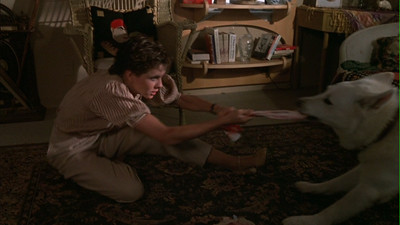


In fact, this dog-to-the-rescue scenario sets off a rather bizarre and largely unexplored subplot where, arguably, the dog becomes sexually fixated on Kristy McNichol. (Funny, I couldn't see her appeal when I was a kid and she was popular, but I do get what the dog sees in her now.) While, yes, his stealing her panties and sticking himself between her and her boyfriend (Jameson Parker, one of the Simons on "Simon & Simon") is fairly accurate dog behavior, given that the rest of White Dog encourages us to pay attention to who the dog looks at and how, and to be suspicious of what he is thinking, you can forgive me for assigning him some interspecies affection here.

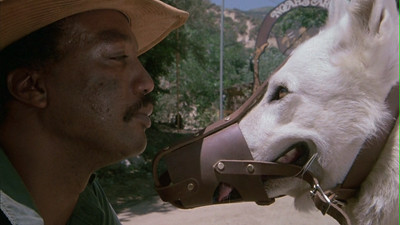
Because, you see, what Julie is soon to discover is that her dog doesn't just mangle people who would do her harm, but he goes off for seemingly no reason at other times, as well. That boyfriend, who, having served his usefulness, is soon to disappear from the picture, tells Julie that her fluffy pal is an attack dog and needs to be put to sleep, but it's not until Julie takes the cur to Noah's Ark, an animal ranch where they train wild animals to behave themselves for the sake of movies, TV shows, and commercials, that she's told the full extent of his purpose. When the canine attacks an African American man working at the ranch, one of the Ark's owners, Carruthers (a rotund and hairy Burl Ives) sees it right away: this hound is a "white dog," a killer trained to fixate on black people.


Carruthers reiterates that the best thing to do is put the dog down, but his black partner, Keys (Paul Winfield, TV's "Julia" and King), disagrees. Keys sees an important challenge in the dog. An animal is not racist by nature, that is learned behavior. Some hateful human being trained this dog to be this way, carrying on an unctuous tradition that dates back to slave days. If Keys can break this dog of its bad habits, he can prove that racism can be broken. Old dogs can be taught new tricks, and racial hatred can be unlearned.
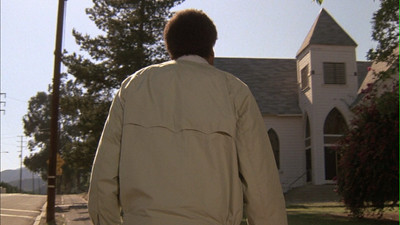
This is when White Dog starts to get good. Up until this point, the movie has played as a cross between a horror flick and one of those Tori Spelling movies on Lifetime where she doesn't realize her boyfriend is a killer. (For the record, the White Dog adaptation predates the Cujo movie by a year; Stephen King's book was released in 1981.) "Kristy McNichol is sleeping with a serial killer! How long before he turns on her?!" We've even seen him go out and attack a black man driving a cleaning truck, forcing him off the road and into a shop window (another scene staged as an awful cliché), information Julie is not privy to. Now do you see why I was wondering if the dog was going to kill the boyfriend?


There is quite a significant shift in White Dog upon Keys joining the narrative. It stops being a story about the girl and her animal and starts being about his crusade to change a way of thinking. Fuller saw the clash between man and animal as two powerful forces coming together to settle a grudge that spanned centuries. He staged it as a gladiator match, going so far as to instruct production designer Brian Eatwell (prior credits include multiple Nicolas Roeg movies) to design a domed cage for them to do battle. It's reason vs. violence, civilized behavior vs. primitive brutishness. Fuller is not afraid to let Keys preach it, either, and he gives the man several speeches about the importance of what is happening and the danger of flinching in the face of the task. When the three humans collude to cover up the dog's connection to his most recent killing, there is even a chance for Fuller to use Burl Ives' character to take a swipe at bureaucracy. The people who create the law and those who enforce it don't understand what is necessary to fix the problem. As he says it, all they know are "long words and long prison terms."

The crucial scene of this last murder is staged in a church, which continues the horror movie overtones that permeate White Dog. (Seeing the animal's snowy fur so regularly and so easily stained with red blood is also quite terrifying.) Putting this foul crime on hallowed ground could have been cheesy, but Fuller turns it into one of a couple of visually dazzling scenarios in the picture. Keys arriving at the site is shot so it looks like a leftover from To Kill a Mockingbird. The church reinforces the moral imperative of the situation, while the stained glass of St. Francis of Assisi underlines Keys' role in it. It's a perfect example of where Fuller's heavy style can actually make something work in ways no other director could get away with. Likewise, in an earlier scene, when Julie sees the dog unleashed for the first time while she is working on a movie set, the rear projection that frames her illustrates her disorientation in an impressively nauseous and surreal manner.


By the end of the movie, the jumbled first half is a distant memory and Fuller has largely redeemed himself. Julie has even met the man who trained the dog, and as it turns out--predictably, though not necessarily far-fetched--he is a kindly grandfather who arrives with a Whitman Sampler and two adorable granddaughters. This paves the way for the powerful ending, where Keys must give the dog his final test. There is a fear that the dog could lose his sanity in the deprogramming, and Keys wants to make sure he is tamed rather than turned into a killer of another kind. This is apparently Fuller's intention with the end of the film, to suggest that the dog has snapped by being dragged from one extreme to another, but I got even more out of it. Given Burl Ives' physical resemblance to the dog's original owner, Keys not only broke the dog of his hatred of black people, but so much so, that in the dog's eyes, he has now turned on the man who victimized him, the one who made him a monster. It's a more powerful conclusion than one would expect, no knee-jerk easy solution being provided to the rather significant problem.


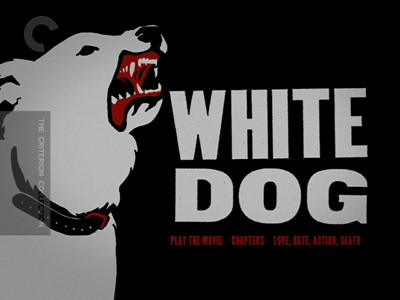
White Dog is another Criterion with particularly good packaging. The multiple Eric Skillman drawings that grace the cover, booklet, and the disc itself are graphically pleasing, particularly the very simple palette of red, white, and black. I like the cover of the disc, with the dog's facial features on a white background, no defining outline.

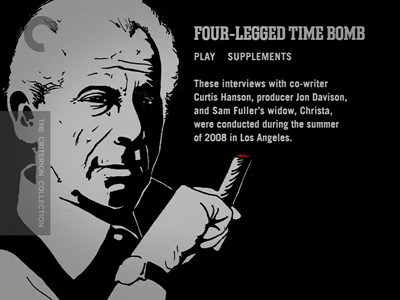
The supplemental feature with interviews with producer Jon Davison, co-writer Curtis Hanson, and the director's widow, Christa Lang-Fuller, is also essential viewing. Not only does it shed light on this particular production, but it also serves as a vivid portrait of how movies can come together and how an indifferent or even hostile studio environment can destroy it. Additionally, it gives us a glimpse of Sam's later working years through people who knew him.


Saturday, July 4, 2009

FOR ALL MANKIND - #54

"You know what the trouble is, Brucie? We used to make shit in this country. Build shit. Now we just put our hand in the next guy's pocket."

- Frank Sobotka, The Wire - The Complete Second Season


Though Criterion's brilliantly remastered reissue of the 1989 space race documentary For All Mankind isn't due in stores until July 14, it seems a fitting movie for a July 4th review. Though it's not actually all that like me to pause and reflect on my country's independence, not even on this day of all days, it's hard to avoid at this particular juncture in our history. With cries for a more fair democracy ringing out of Iran reminding us of our own origins, and with the U.S. itself seeming to take one step forward (a black President at last!) and stumbling a couple of steps back (gay marriage still struggling, the economy tanking), perhaps part of the problem is that guys like me don't take enough time to sit and think about how we got where we are and what it can say about where we're going.

Some conservative pundits are trying to roll the morality dice and claim it's a lack of values that has brought our downfall (we don't pray enough, we don't make enough babies, etc.). It strikes me as the same old song, the easy out. Look back over history, and the general populace has never been good enough for the morality police; to be facetious about it, the heart has always wanted what it wants, and it's always used the loins to get that stuff. To my mind, where perhaps these people have won, however, is in the underlying argument that, to their mind, part of what leads people astray is the fact that they think too much. Science, technology, advances in human achievement--this is all just stinkin' thinkin'. Better to not ponder, you just give yourself a headache. Which might be well and good if we took better care of our farmers, our autoworkers, our teachers, the people who go out and do what needs to be done every day, those hard-working folks that provide us with what is fundamental to our society. They are always the first to be devalued whenever someone tries to curb anything that goes against their personal "greater good," and this holds true whatever side of the aisle you stand on, whatever hole you punch in the voting booth.


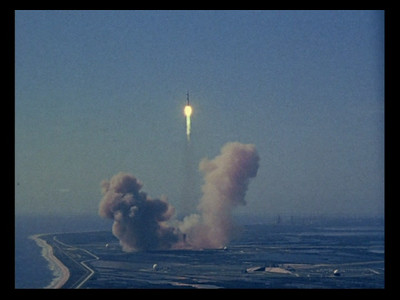
This is why I lead with the quote from Frank Sobotka, the fictional union leader from The Wire, whose frustrations with the obstacles stacked against the working man compelled him to leave the straight and narrow path. It speaks to the frustration of many and the argument that for America to regain its footing as an economic leader, we have to start making stuff again, inventing stuff, leading the way. While this may seem a bit far afield of the space race, the truth is, our reasons for going to the moon are not that dissimilar, and our waning interest in finding new and undiscovered wonders is part and parcel with our waning drive to innovate and manufacture. Al Reinert chooses to open For All Mankind with the following excerpt from John F. Kennedy's 1962 speech in favor of space exploration.


[Link to video of full speech]


"We choose to go to the moon in this decade and do the other things, not because they are easy but because they are hard, because that goal will serve to organize and measure the best of our energies and skills...." Is there anything that speaks to the American spirit more than that? It brings to mind Kennedy's poet laureate, Robert Frost, and perhaps his most famous poem, "The Road Not Taken", which is all about choosing to forge a new path, not going to the same old way, exploring all the unknowns that life has to offer. "I took the one less traveled by, and that has made all the difference."


Space has not been called "the final frontier" for nothing. Once Manifest Destiny took us from one coast of this continent to the other, what else was left? We could go down in the depths of the ocean, or up to the heights of space. For all the bad that was done in the name of Manifest Destiny, we can't fault the spirit of it or deny that the American will to move forward achieved great things. So, when did we stop looking? When did we stop wanting to see?

To those who say, "But why go into space? What's there to find?" I reply "Why not? Everything!" Though the better and far more eloquent reply is this film. For All Mankind should change any skeptical mind about traveling the stars. I used to be one of those skeptics, one who thought our money was better spent elsewhere, and though Reinert's documentary is not the sole catalyst for bringing me back around--I, like every child born before the Challenger tragedy, at one point wanted to be an astronaut--it's still the best explanation I can give you.

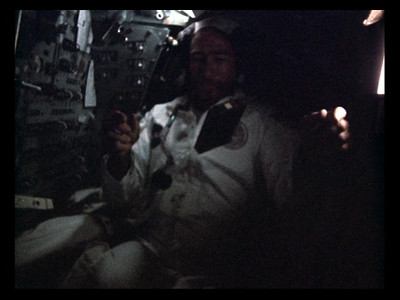
Reinert cut For All Mankind together using footage shot entirely by NASA. They had cameras in the control room, on the launch pad, and in the rockets themselves. Movies shot by the astronauts in their space capsules are accompanied by the real audio between the ship and mission control, as well as some humorous musical accompaniment from the astronauts' individual tape players. Each crew member got their own personal cassette deck and one tape to go with it. How amazing to hear Buck Owens and Merle Haggard performing songs especially for the rocket jocks, complete with words of encouragement! That is how much we once cared about boldly going where no man has gone before. Science wasn't scary, it was exciting. Of course the cowboys were on board, those guys never wanted to sit still.


Better yet are the reminiscences from the astronauts that Reinert has collected. These are not put together in a narrative, "so it all went like this" kind of way, but instead, to give us the general impressions of space travel, to illuminate what it must be like. Thus, amazing shots of the Earth taken from incredible distances are accompanied by the men who took those shots talking about what it was like to stare out of a tiny window and see the whole of our planet nestled in the infinite blackness of the universe. Can you imagine? To witness such things as no one else had ever witnessed them, even on film--had these men not gone out and gotten this footage, we would have never seen our own world from that vantage point. We'd be no better for not having this record than had we continued to think the world was flat. Knowing matters.

In getting access to these archives, Reinert was granted unprecedented access to the space missions. For All Mankind isn't just a portrait of what was seen, it is also a portrait of what was done. Reinert is just as fascinated by the men who pulled off these feats as he is by the feats themselves, and so equal measure is given to what is happening back down in Houston and to how the space-faring astronauts spent their time. There is always something compelling about men getting together to pursue a common goal. If you think of movies like All the President's Men, which makes journalistic research exciting, or Zodiac, where the procedures of police investigation are more important than shoot-outs, a bunch of guys in a room talking and strategizing can be quite dramatic. Hell, Jay Roach's Recount made political lawyering and counting ballots feel like a race to stop a mad bomber, even with the audience already knowing how it would all turn out. Such is the case here, and Reinert looks for all the humanity, such as the crisis-fueled excitement over malfunctions or the things that keep the two crews connected, be it sharing personal news about a party or the world news. Hearing the sports scores can keep a fellow grounded even when he's in zero gravity.
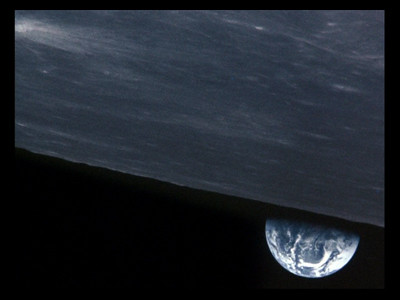


Enhancing the visual poetry of stars and spinning planets, Brian Eno has provided Reinert with a dreamy ambient score, one of the composer's best works. It could have been easy to overdo it with the spacey stuff, or even lazy to go with something overly New Agey and all lasers and synths. Instead, Eno shows a passion for the material, and he works in an emotional range that stems from the thrill of discovery and the sensation of the travels. It's beautiful work [see/hear the clip below, though note it's takend from an older source than this new edition DVD]. In their new edition, newly mastered in high-def and available in standard and Blu-ray formats, Criterion has really brought For All Mankind into a whole new era. Eno's score sounds tremendous, and the film looks newly minted. The blue of our blue planet is incredible to see, the details of the clouds giving it texture and form, and the contrast against the deep black sky is startling. Also, the flotsam and jetsam of the outer atmosphere and the debris that tumbles off the rocket--every piece is crystal clear. You've never seen the craters of the moon--the first lunar landing takes up the last third of For All Mankind--in such spectacular relief. If you've only seen the rebroadcast news footage, the tiny television feed, you haven't seen it at all.
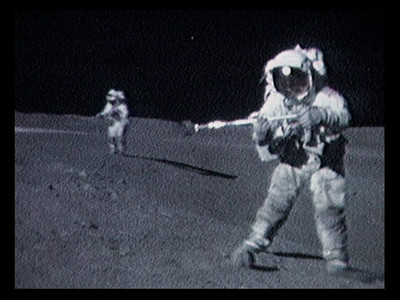
The new edition of For All Mankind has a documentary called "An Accidental Gift" that explores where the material came from and why NASA was so careful to capture it all. It wasn't as much for the posterity or the glory--though you can tell they knew, they felt, that it was important--as much as it was just to preserve the details for future study. It was meant to be no more than the documentation of the process, not a self-conscious historical record; nor was it Art. Thanks to Reinert, who dug through it all and made this film, it's now both. NASA kept all this stuff so one day they could look back and learn something; Al Reinert shaped it into cinema so we could, too.


And that's why we should go in space, why we should keep going, why it's worth the money. Because every time we do, we know something we didn't know before, even if it's to discover how much we really don't know. It keeps us humble and striving. Like one of the astronauts said to Reinert, just by going to this place we had never been, a place we were never meant to be in an environment that was not built for us, the curve of human evolution was bent forever.

So, next time someone asks you why we're exploring Mars, explain to them that it's because if we didn't, we would, as a species, flatline. We do it for the sake of all mankind.


"And this is one of those timeless moments. Something real, something urgent, something important is happening. The human race is fumbling toward the light through outer darkness; and there is a feeling here of movement, of genuine wonder. The sense of isolation dissipates."

- Harlan Ellison, writing on Voyager II
"Saturn, November 11th," reprinted in Stalking The Nightmare