This review originally written for DVDTalk.com in 2011.
Last week, after seeing David O. Russell's marvelous new boxing movie The Fighter, I commented to a friend that it doesn't make any sense that I haven't gotten into watching boxing proper, because every time I see a boxing movie, I think I should. It's my favorite sports genre. In fact, I don't really consider boxing movies to be sports movies. They are separate from the rest, their own thing. I would never automatically want to go see a baseball movie, or one about football or basketball or hockey, but if it's about a boxer, okay, sign me up.
Of course, one of the greats of the genre is Raging Bull, Martin Scorsese and Robert De Niro's 1980 biography of Jake La Motta. You could easily claim that it's the heavyweight champion of all boxing movies, and I don't think I'd argue with you. It's a pugilistic masterpiece, a dangerously choreographed piece of work that explodes in great dervishes of fury and falls back with the heaviest of heartbreaks.
Jake La Motta was a middleweight fighter whose heyday was the 1940s. An Italian boy raised in the Bronx, La Motta was a force of nature. Throughout Raging Bull, he is regularly referred to as an animal, even if he's only called by his nickname once. For Jake, every moment of his life is a fight, whether he's dancing on the canvas or drinking in a nightclub or eating his dinner at home. Every person in his life is an opponent, and he is always working out the angles to make sure that no one gets the better of him. Every conversation is an opportunity for one of his foes to underestimate him, and every riposte a potential knockout punch.
Raging Bull follows Jake over the decade as he swings his way toward an eventual title fight, the distant achievement that eludes him for the bulk of his career--most other boxers are scared to brawl with him--and once he's got it, it's only downhill after. The bouts are shown briefly, lingering longest on the more important matches, including his longtime rivalry with Sugar Ray Robinson (Johnny Barnes). Scorsese famously kept his camera inside the ring, keeping us close in the clinches, letting us feel each pummeling. This gives Raging Bull its lasting immediacy, while the decision to shoot in black-and-white ensures its timelessness. History is alive in the moment, yet there is the usual classic Hollywood vibe that only Scorsese can do without making it look like he's playing dress-up.
For as memorable as these skirmishes are, however, they are only a small part of Raging Bull. The movie is adapted from Jake La Motta's autobiography, with a script by Paul Schrader (Mishima [review]) and Mardik Martin (Mean Streets), and it shows the rise and fall, warts and all. The unsavory elements include a thrown fight and a later vice charge. They also show Jake's violent streak, and his abuse of those around him. The two most important relationships in Jake's life are his brother Joey (Joe Pesci) and his second wife Vickie (Cathy Moriarty). He meets Vickie when she is 15 and while he is still married. It's hard to say what she sees in him, but he clearly sees the beautiful young blonde as some golden prize. He's a jealous creature, though, and one used to getting his way. He browbeats both Vickie and Joey, both of whom only want the best for him, and when words aren't enough, he raises a hand to them, as well.
In 2009, James Toback's documentary Tyson earned a lot of praise for the way it probed the personality of Mike Tyson and the culture of violence that created him. Toback uses the fighter's own words to try to poke at the contradictions in his character. Is he the beast most believe him to be? Scorsese explores similar questions about La Motta, though Raging Bull is more effective because, unlike Toback, Scorsese doesn't seem desperate to exonerate his subject. He's just as fascinated by what the warrior lifestyle is doing to the man who takes the punches, but he also sees the tragedy such a figure inflicts on the world around him. Sure, the business and lifestyle of boxing might force a man into dark corners, but such a man is trained to fight back. La Motta turns the hurt around tenfold.
I could go on and on about the virtues of Raging Bull. Thelma Schoonmaker's invisible mis-en-scene deserves praise, as does Michael Evje and Gary S. Gerlich's tremendous sound design. They use distorted wildlife noises to soundtrack the fight scenes, and they pull the audio in and out, mimicking the elasticity of time Jake experiences in the ring. Michael Chapman's artful photography pulls similar moves. Dialing down the playback speed to a molasses crawl effects the reality of a complex action like a good punch combo. They say an expert in any field experiences the moment when they perform their most complicated tasks differently, something similar to how, when we're in a car crash, the scant few seconds leading to impact seem to go on forever. At the same time, Scorsese and Chapman orchestrate tremendous zooms and pans, capturing the speed and force of a La Motta jab.
Likewise, not enough can be said about the unbelievable cast. Pesci is a fireball, and he and De Niro have an unmatched rapport onscreen. As a duo, they have never been as fresh as they are in Raging Bull. You can believe they are brothers who have lived together all their lives. The rhythm of their back-and-forth lacks any self-consciousness, it just flows naturally. Cathy Moriarty is also remarkable as Vickie. It's easy to miss the range she shows here if you don't keep in mind that the actress, who was approaching her 20s, starts off the movie playing 15, several years younger than she actually was, and ends playing a few years older than her real age. The change isn't sweeping--not as obvious as, say, De Niro's weight gain as Jake--but keep your eye on her, see how her body language and presence changes from her first scenes with Jake, when she's got a slight touch of the awkward teen in the way she quietly slumps, and then compare it to the strong woman who eventually stands up to the bruiser.
The movie still belongs to De Niro, of course. He's in nearly every scene, and though it's one of his more mimicked roles, it's one of his least mannered. The De Niro tics disappear under La Motta's agility and, eventually, his girth. Though the actor is less recognizable under the prosthetic nose and curly hair, it's not really about the props, it's about how he carries himself. We've seen him rage in other movies, we've heard him pull out the New York accent, but Jake is a whole other person. He's not Travis Bickle or Jimmy Conway, he's not even really De Niro. It's easy to take swipes at the actor now for a perceived lessening of quality control in regards to choices he makes, but you know what, screw you. He made Raging Bull; your snark pales by any comparison.
Raging Bull regularly tops lists of the best films of the 1980s and rides high on any more expansive round-ups of cinema's best. As with most of the other usual suspects, be it Citizen Kane or It's a Wonderful Life [review] or Casablanca, the reverence exists for a reason. Raging Bull really is that good. Time passed and repeat viewings only stand to prove the level of craft that Martin Scorsese, Robert De Niro, et al., were operating at. Good storytelling and solid application of technique is the impenetrable armor of classic cinema: you can never pierce it or tear it down.
Showing posts with label paul schrader. Show all posts
Friday, April 3, 2020
Saturday, June 30, 2018
CAT PEOPLE - #833
“Is simplicity best
The narrowest path
Is always the holiest
So walk on barefoot for me
Suffer some misery
If you want my love”
- Martin L. Gore, “Judas”
It’s kind of nuts how well that opening verse from Depeche Mode’s 1993 album track “Judas” so fits what is going on with director Jacques Tourneur (Out of the Past) and producer Val Lewton’s 1942 black-and-white horror film Cat People. It’s not just thematically accurate, but it’s also descriptive of the aesthetic technique. Cat People is about as unfussy a film as there has ever been. It’s the perfect example of how a filmmaker can effectively stoke the audience imagination by showing less, rather than more.
But it all starts with a script, and DeWitt Bodeen’s screenplay is itself spare. There isn’t much plot here. A young man meets a young woman at the zoo, and a romance is ignited. Oliver (Kent Smith) is intrigued by the pretty lass who is sketching cats outside the panther cage. Played by French movie star Simone Simon (La bête humaine [review], La ronde [review]), Irena is a strange girl, a Serbian immigrant who clings to folklore from the old country. Specifically, that once upon a time her people were vanquished by a righteous King, and those who escaped his wrath scattered across the world, their wickedness taking feline form. Even after they are married, Irena keeps Oliver at arm’s length, believing should they so much as kiss, she will transform into a leopard and tear her husband apart.
At first Oliver indulges these fantasies, but once he starts to worry she is taking these fables too seriously, he connects Irena with Dr. Judd (Tom Conway), who doesn’t believe these supernatural tales, but may not be on the up-and-up, either. And adding to this love quadrangle is Oliver’s co-worker Alice (Jane Randolph), that annoying sort of do-gooder who tamps down her own desires to make sure that the man she wants does what is right. Too bad she didn’t figure for the complicated, sociopathic emotional range of a jealous kitten.
Much of Cat People smolders slowly. In the early stages of their union, Irena’s wild stories don’t carry much threat. That’s because Tourneur withholds anything that would concretely suggest her claims are more than delusion. He ties the revelations of Irena’s truth to her jealousy. The more heated she gets about Alice, the closer we get to seeing her claws come out. In many ways, this little monster movie is a modern stalker story, the good guy unable to shake the troubled woman, and she strikes out at the one who would replace her.
Yet, that in itself is maybe too simple a reading. For as little as goes on above the surface, plenty can be gleaned from what lies underneath. Bubbling through all of this is a commentary on puritanical values, and particularly how they affect young women. Irena’s fear of her own sexuality is only warranted if her beliefs turn out to be true, but she has good reason to be scared of the masculine sex, and her fighting back against Dr. Judd is inarguably a justified defense. Here is a man in a position of trust who betrays the social contract. In the #metoo era, many might also gravitate to the fact that Irena is not believed, and that prevents her from finding a less deadly solution or obtaining real help. Wrapped up in all this, we can see a certain xenophobia, as well: Irena is different, and perhaps if she had embraced a more modern American lifestyle and been more like Alice, she’d be more comfortable in her own skin. Which is somewhat contrary to the beliefs of the time, but Hollywood was always progressive in its morals.
Good horror should be malleable in this way and stay relevant to contemporary issues, but I suspect Tourneur and Lewton were less high-minded than all that. Their primary focus was more likely just to scare filmgoers, and they seized upon relatable primal urges to create a vehicle for that. Most of the frights here are more unnerving than terrifying--though there is one pretty good jump scare, where the orchestra provides a screechy sound effect when the bus pulls in to pick up a nervous Alice*--but that’s okay. Tourneur is experimenting with the horror of the things that exist just beyond the reach of our senses--the things we can’t see, but think we do; the things we aren’t sure we hear. One of the most effective scenes is when Judd gets his comeuppance. Irena’s transformation happens entirely off-screen, but the doctor’s reaction tells us all we need to know--even if once again we only think we know what he is seeing. The tussle itself appears merely as shadows cast on walls, including one with a mural of a menacing panther (lest we forget, Irena is a cat!). We hear more than we see. Same with the earlier scene when Alice is at the pool. The echoes of her screams are more chilling than anything that might jump into the water with her.
It’s underkill, not overkill. It’s simplicity. Compare how light on its feet this Cat People is to Paul Schrader’s overdone, moronic 1980s remake for a quick object lesson in why less is more.
Or skip Schrader altogether and go with something more akin to a middle ground: the 1944 “sequel” The Curse of the Cat People, recently re-released on Blu-ray by Kino. In terms of follow-ups, Curse is in the vein of The Bride of Frankenstein for how it expands on the original and becomes its own weird thing. We can chalk some of that up to the movie originally being intended as a stand-alone feature with no connection to Cat People at all. It only morphed into a second entry in a series when Cat People became so successful.
Pretty much everyone except Tourneur returns for The Curse of the Cat People. Gunther V. Fritsch originally took charge of the director’s chair but himself was replaced by Robert Wise (The Day the Earth Stood Still, West Side Story). The new story features Jane and Oliver as the concerned parents of a young daughter, Amy (Ann Carter), who lives more in her imagination than she does in the real world. There is further cause for worry when Amy befriends the disturbed neighborhood dowager (Julia Dean) and starts talking to an imaginary friend that just so happens to be Irena.
The “cat” aspect of Cat People is completely dropped for this realm of gothic childhood fantasy, but that doesn’t make The Curse of the Cat People any less compelling. The dilemma of a child who is at odds with the world around her being put into peril by both her fantastical indulgences and the adults who won’t believe her has an inherent tension that will keep you guessing what will happen, while also hoping it won’t all go wrong. Fritsch and Gunther have a more up-front style--does Elizabeth Russell chasing Amy up the staircase remind anyone else of Kathleen Byron coming unhinged in Black Narcissus [review]?--but that works here. This time, what is “unseen” is actually witnessed by the little girl, casting the doubters in a whole different light.
Criterion’s edition of Cat People features a great cover and interior poster by influential comics artist Bill Sienkiewicz. Fans of the TV show Legion tangentially know his work as he originally created the character with Chris Claremont. And their legendary run on the New Mutants comic series is an inspiration for the movie that should be out sometime in the next year or so. Sienkiewicz’s work changed how artists approached a comic book page, combining painting and digital in fascinating ways. Look for his Elektra: Assassin graphic novel with Frank Miller, his own Stay Toasters, or if you can find it, his Classics Illustrated version of Moby Dick.
* This effect of a scare coming from the arrival of an otherwise mundane object is known as a “Lewton bus,” and perhaps the most perfect use of it was in the episode of The Simpsons where the Psycho theme is being played by an orchestra riding public transport.
Sunday, May 20, 2018
BEYOND THE HILLS - #923
Last night driving home I was listening to NPR’s Fresh Air review of Paul Schrader’s First Reformer, in which Justin Chang tries to align Schrader’s deep knowledge of Christianity with the director’s philosophical and political interests, noting how the two collide for a compelling narrative that turns theological ideas into a psychological thriller. Romanian writer/director Cristian Mungiu (4 Months, 3 Weeks, and 2 Days) walks a similar tightrope in his 2012 drama Beyond the Hills, though from the look of it, keeps any personal doubts about religion much closer to his vest. In Beyond the Hills, we can interpret that certain characters have a less than favorable opinion of the church, but for the most part, Mungiu’s script is populated with believers. It’s maybe just a question of how much they believe.
Beyond the Hills is set in a remote Orthodox monastery in the mountains of Romania. Though a bit of a drive from the nearest township, the church still serves the community, both through the worship services they hold and the charity work they do. The monastery itself is run by a priest that the nuns call Papa, or more formally Father (played by Valeriu Andriutä), a man of unwavering conviction. Running the place with him is the Mother Superior, or Mama (Dana Tapalagä), a middle-aged woman. The rest of the nuns are younger, of varying ages and background. One, Voichita (Cosmina Stratan), joined the faith after she outgrew the orphanage where she spent most of her young life.
At the orphanage, Voichita befriended Alina (Cristina Flutur), and the two looked out for one another. At the start of Beyond the Hills, Alina is returning home from Germany with the intent of taking Voichita from the monastery and going back to Germany, where they will take a job as waitresses on a cruise ship. When Voichita waivers in her resolve, Alina becomes adamant. As resistance builds, the young woman has a mental break, threatening self-harm and violence against everyone else, before succumbing to a seizure. Unsure what to do, the nuns take Alina to the hospital; the doctors prescribe rest and medication. Now Alina insists on staying at the monastery and near Voichita, but as her behavior becomes more erratic, Papa and Mother Superior begin to question whether she is mentally ill or possessed by an evil spirit.
It’s a question that is not really put to the test, even as the priest tries to perform an exorcism on Alina. He and his charges believe the devil is working through the girl; those who will later find out what happened think another way. Mungiu offers no evidence to support either claim. We aren’t even privy to what Voichita believes in the end, even though the traumatic ordeal is transformative for her. In some ways, who we side with as the viewer is up to our own beliefs. The only real takeaway is that, at some point, no matter how strong the faith, all humans come crashing down to earth, and our actions here have true consequences.
To go too much deeper into the film’s final turns would be to give too much away. Beyond the Hills is unpredictable in its naturalism and honesty. Best to go in as an open and willing co-conspirator and let the events unfold. Mungiu leaves a lot of holes for us to fill in. For instance, is there more to Alina and Voichita’s relationship than they are willing to share with Voichita’s peers? There’s much to suggest that they could have perhaps been lovers. But then, maybe not. Their bond could be just as deep without that being a factor. Because there is also something childish about how they interact, as if they have not yet fully grown up.
The key to all this, though, is the utter realism Mungiu imbues into the product. The natural settings and costuming, lit to look as they would in real life, reflect a world that is separate to that around it. For a good portion of the picture, until we see the first cell phone, the timeframe is not really identifiable. The sparse life at the monastery is purposely without convenience, and so it feels antiquated. Oleg Mutu’s on-the-ground photography places the viewer smack dab in the middle of the action, moving with the drama in the immediate, sometimes even feeling a step behind what’s happening and trying to catch up. Effectively, this makes each viewer as much of a participant as an observer. It feels that close.
Likewise, the performances of Beyond the Hills’ ensemble feel spontaneous and of the moment. Many of the cast members are first-timers, but their acting is pitch perfect and completely devoid of mannerism. Much more is often said through how they observe one another than via dialogue (acting is listening!). From the first scenes, we feel we know these people--Voichita’s nervous longing, Alina’s insistent need, Papa’s hubristic privilege. We fear for them and root against him. Then again, that could just be my own prejudice regarding religious authority.
For me, the lynchpin is Alina. Even if we don’t logically understand her reactions, our empathy for her plight means we grasp them emotionally. Here Mungiu uses our position as intimate outsiders wisely. We can only see so much. The chaos of her attacks and the retaliation against her--where Alina tends to get buried under the nuns in their black robes piling on--means we never get a clear view of the violence, yet we somehow feel wronged, we feel suffocated. Our interpretative gauge has the reactionary clergy on one side, and Voichita’s deep concern on the other, and we can’t quite get the balance required. It’s like Voichita is the heroine of a horror movie, and we need her fright in order to calibrate our own.
Thus, the sudden shift to reality that comes in the final portion of the movie, the arrival of the narrative wake-up call, is both disarming and cathartic. We must be pulled out of this confusion before we succumb to it ourselves. Beyond the Hills is a deeply satisfying drama, right down to the perfect last shot--our own fall to earth, or more accurately the earth rising up to meet us, with only a screen to deflect the dirt.
Saturday, July 18, 2009
SIDELINE: AN INTERVIEW WITH YOURS TRULY

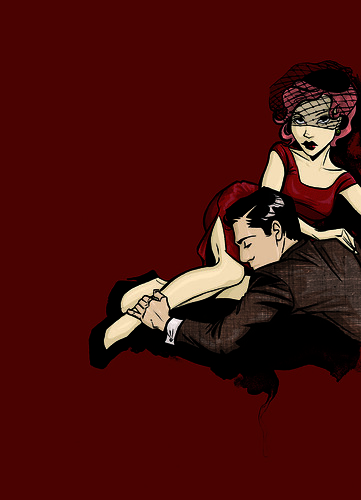
Mark Coale, proprietor of Odessa Steps Magazine has posted an older interview he did with me over on his Earth Three blog. The occasion is this week's release of my new comic book with Joëlle Jones, the hardboiled noir-homage You Have Killed Me
You can read the piece in its entirety on Mark's blog. He and I share a magnificent Criterion obsession, and he asks me a few question about that, as well.
Q: As of this writing [Summer 2008], what's the best Criterion you've watched lately?
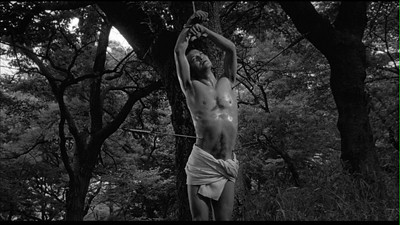
A: I had a weekend where I watched Yukio Mishima's Patriotism and then Mishima, Paul Schrader's biopic of the Japanese author, back to back. In terms of packaging and content, both were excellent, and though I'd had some limited contact with Mishima in years past, these films made me realize I probably should delve deeper into his library. As a person and as a writer, he had a lot of similar concerns to what shows up in my work, including a romantic yearning to stand against the tide and to, essentially, stand for something rather than caving in to modernity. He was also preoccupied with suicide, as are many of my characters. If you watch Patriotism, which he wrote, directed, and starred in, and you see him playing a Japanese solider disemboweling himself, it's quite powerful, particularly when you chase it with the Schrader picture and all the extras that come with it and hear about how he ended his own life the same way. It's easy to see why his widow demanded the movie be buried while she was alive. The scene in Patriotism where he slices his belly open is gruesome, and not just by 1960s standards, but any standards.
Q: Here's the obligatory Desert Island question. What five Criterions would you take with you? Feel free to cheat and name box sets as one entry.
A: In the Mood For Love, dir. Wong Kar-Wai
The Cranes are Flying, dir. Mikhail Kalatozov
Days of Heaven, dir. Terrence Malick
Contempt, dir. Jean-Luc Godard
Sullivan's Travels, dir. Preston Sturges
The first three are pretty rock solid. Godard would also always take
the fourth slot, though there are a couple of others I might debate
over. I'd also be able to change the last slot a million times before
walking out the door, but I figure I needed a comedy in there.
I can't believe I've only reviewed one of those five. I'll have to do something about that!
Read a large preview of You Have Killed Me.
Sunday, June 29, 2008
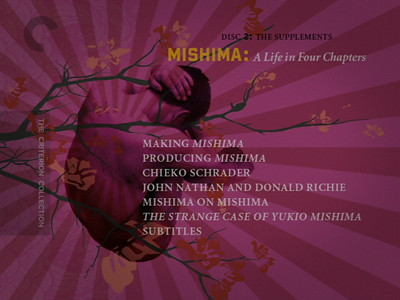
MISHIMA: A LIFE IN FOUR CHAPTERS - #432

Paul Schrader's 1985 biopic of the Japanese author Yukio Mishima, Mishima: A Life in Four Chapters, is a thoughtful and inventive examination of a writer's life and how it both influences and is influenced by his work. It's a rare case of a willfully arty film that manages to make the question of style over substance immaterial, as they ultimately are one and the same.
As the title suggests, Mishima is broken into four sections, each meant to portray an important stage in the author's life and show the progression of his ideas toward the extreme activist he would eventually become. Each chapter begins with a "present day" sequence that takes place on November 25, 1970, the day Mishima (played by Ken Ogata, recently seen in The Hidden Blade
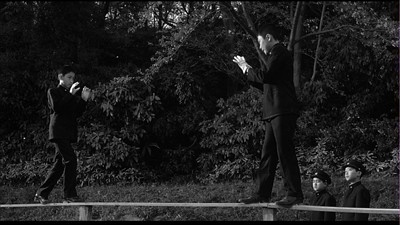
From these scenes of Mishima on his way to his mission, Schrader shifts each of the first three chapters into the writer's past. Starting with the boy at age 5 (Yuki Nagahara) and working his way forward into his teen years, and then into his artistic triumphs and adulthood. The flashbacks are all filmed in black-and-white, which serves to differentiate them from the second stories. In addition to the flashbacks, Schrader also chooses one of Mishima's many novels that best exemplifies that period of the work, and he creates a miniature adaptation of said work.

The story begins with chapter 1, "Beauty," where the awkward young boy grows into a man, looking to change his position as a misfit in this world and embrace love and the goodness that life has to offer, the things that are beauty personified. For this section, Schrader chooses to adapt the 1953 novel The Temple of the Golden Pavilion, the story of a Buddhist acolyte (Yasosuke Bando) with a severe stuttering problem whose "deformity" prevents him from finding love, forcing him to always remain separate. He fixates on the golden temple where he is studying and eventually becomes intent on its destruction. Turning it to rubble blots out the false promise he can never fulfill. This action actually teaches him something about beauty, about how it's best to halt it at its apex rather than let age diminish its luster.
From there, Schrader moves to chapter 2, "Art," where Mishima, tasting his first blush of success, begins to ponder how to resolve the false and finite nature of beauty and realize the artist's purpose of preserving said beauty. In his novel Kyoko's Place a young actor turned body builder (Kenji Sawada) realizes that despite his personal perfection, bodies decay. Art is nice, but it requires no sacrifice. He enters into an abusive relationship with a female gangster (Setsuko Karasuma) who begins to use his body as a living sculpture. Real blood is a greater expression of true beauty and art than the false blood spilled on a theatrical stage.
This lesson informs chapter 3, "Action," where Mishima begins to question his role in the world. Words can express ideas, but like how beauty without art fades, so too do ideas go nowhere without action to back them up. The novel for this section is Runaway Horses, a later work about a young soldier (Toshiyuki Nagashima) who forms a cabal of like-minded youths to stage a revolution and restore Japan's honor. As his plan falls apart, he tries one last action before turning his sword on himself. Here the fiction dovetails nicely with the reality, as we go into chapter 4, "Harmony of Pen and Sword," which concerns itself entirely with Mishima's last day on Earth, along with commentary taken from his last book of personal writing, Sun and Steel. (Again, fiction gives way to reality--though reality as seen by Yukio Mishima.)

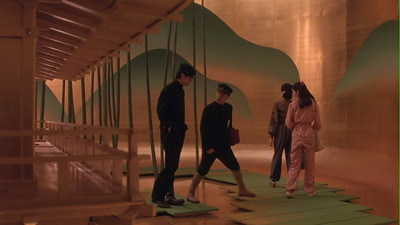
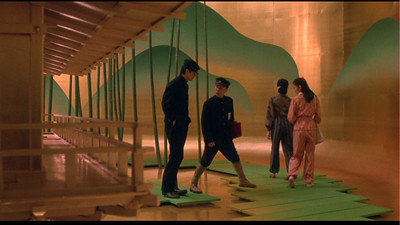
Each of the novel adaptations is filmed in a colorful, abstract style that borrows from classical and contemporary theatre. Golden Pavilion is the most abstracted, with the sets being obvious facades, while Kyoko reflects a more neon and illusory 1950s. As Schrader moves the timeline forward, each style gets a little more realistic, until it collides with the reality of Mishima's story and the actions of the Shield Society. All of the chapters show the parallels between the writer's life and his fictions, with his childhood struggles to be understood transforming into the acolyte's stuttering, his destruction of canonized literary stylizations being his razing of the Golden Pavilion. So, too, is he later a stage actor, a body builder, and the revolutionary soldier, as the man of letters wrestles with his self-image and the truth of his self-expression.
It's as deep as I've seen anyone go into the life of an artist, certainly multiple steps up from the overly obvious moments of inspiration we see in modern biopics of creative types of various stripes. Schrader and his co-writers, Leonard Schrader (his brother) and the Japanese adapter Chieko Schrader (his sister-in-law), are searching for the true connections, going beyond the standard tale of one life and digging deep into material to show how the writer lives many different existences. He borrows from real events to inform his fiction, but then must alter his life to live up to the ideal he created for himself.
Through it all, Mishima's obsession with death is clear. From his missed opportunity to die for his country in WWII (his own surprising cowardice haunting him ever since) and his study of samurai texts, he begins to dream of an exit that has greater meaning than passing away from old age while home in bed. If action is the only way to give ideas true meaning, then the final action must matter, too.
Though ostensibly an American production--Mishima was produced by George Lucas and Francis Ford Coppola for Coppola's Zoetrope Studios--the film was shot entirely in Tokyo using Japanese actors speaking Japanese. The distinctive costume and production design was also by a Japanese artisan, Eiko Ishioka, who prior to this had worked in mediums other than film, but has since gone on to design costumes for Bram Stoker's Dracula and The Cell
It's a bizarre contradiction. The author's work is still venerated in his home country, so why must his life be taboo? Could the irony be that in the act Mishima saw as his final achievement of his artistic ideal, he actually boomeranged back to being the outcast?

Criterion releases Mishima: A Life in Four Chapters as a double-disc set in conjunction with its separate release of the short film Mishima wrote, directed, and starred in himself. 1966's Patriotism adapts a short story he wrote about a soldier and his wife committing seppuku in 1936, and two scenes about the filming and release of Patriotism are included in Mishima. For information about Patriotism, read my review of it here.
Though Mishima was released on DVD by Warner Bros. in 2001, it has been out of print for some time. That disc generally got very high marks. There have been some changes made between the transfer seven years ago and the new one, however, some of which will be up to debate as far as what some people might prefer, but all of which are approved by Paul Schrader and cinematographer John Bailey, so ultimately you'll have to take it up with them.
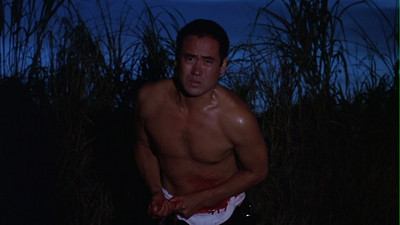
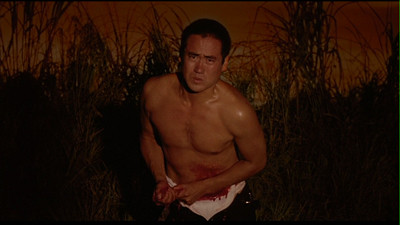
The most notable change, and the one that should make just about everyone happy is that the old transfer was a 1.75:1 aspect ratio, and the Criterion disc restores the film to its original ratio of 1.85:1, meaning more information now appears on screen. There have been some color changes and digital enhancements made to some scenes on Schrader's insistence, and these will only be noticeable to those who know the old DVD by heart. Overall, I thought this transfer looked pretty good, with the distinctive color schemes popping in all the right ways and none of the pixilation that sometimes marred the older release.

2001

2008

2001

2008
Overall, I think the colors of the movie pop way more in the new version, while the old one looks faded and grainy by comparison.
The original Japanese soundtrack has been mixed in Dolby Digital stereo and sounds very good. Philip Glass' marvelous score for the picture is the true test of any mix of this movie, and his orchestration rings through loud and clear.
There are a couple of alternate audio options for viewers to choose from. There were several versions of the narration recorded for the movie. The default option is the Japanese language narration, but you can also choose the late Roy Scheider's English voiceover that was included in the theatrical release or Paul Schrader's somewhat different voiceover recorded as a guide track for Scheider (available here for the first time; the other two options were on the old DVD).

Mishima: A Life in Four Chapters - Criterion Collection is a beautiful art object unto itself. Really, Criterion deserves a round of applause for this one. Designer Neil Kellerhouse, along with co-art director Sarah Habibi, has created a bright, embossed boxed set that is as garishly distinctive as Eiko Ishioka's set design and that also plays on the puzzle element of the movie's structure. The outer slipcase has enough room to hold both the DVD sleeve and the 56-page book that comes in the set. The four-sided gatefold sleeve has two trays for the DVDs and a breakdown of the four chapters of the movie printed on the inside. The book has photos, credits, a new critical essay by Schrader-expert Kevin Jackson, information on the film's ban in Japan, and an on-set account from Eiko Ishioka.
Sometimes a DVD set comes along where the nature of a unique production is matched by an equally extraordinary DVD package. Mishima: A Life in Four Chapters - Criterion Collection is one of those sets. Paul Schrader's biopic of the controversial and provocative Japanese author works on multiple levels to break down the writer's life, to show how much of it is interior and how fact and fiction blend into one another. From the script to the production design and the music, every stage of this production strove for something special. This new double-disc set peels the curtain back further to show us how they achieved what they did and more about the reality of the subject. This is one other art films should emulate when making their way to DVD. Don't just fill the space, but fill it well--a sentiment Yukio Mishima could likely get behind.

For a full rundown on the special features, read the full article at DVD Talk.
Monday, December 31, 2007
SIDELINE: MORE REVIEWS FOR 12/07
Given that I write more reviews than what you see here, below is a list of non-Criterion films I covered in the past month that may be of interest to Criterion fans.
IN THEATRES...
* Persepolis, a wonderful animated adaptation of the comic that I daresay improves on the original while maintaining its spirit.
* There Will Be Blood, the masterpiece P.T. Anderson skeptics have been waiting for. And what about Daniel Day-Lewis? And that Jonny Greenwood soundtrack? Cor!
* The Walker, Paul Schrader's new film never quite gets up to speed, despite some excellent performances by Woody Harrelson and Lauren Bacall.
* Youth Without Youth, wherein Francis Ford Coppola returns to directing and makes an ambitious indie project. Sad to say, his reach exceeds his grasp.
ON DVD...
* Becoming John Ford, an excellent documentary leading into the hardcore re-release project of the director's oeuvre.
* Essentials Director Series - Jean-Luc Godard, a box collecting four previously released Godard DVDs, three from his early career and his most recent commercially available effort, Notre Musique.
* Film Noir: Five Classics from the Studio Vauluts, a handful of Kino noirish DVDs tossed in a box, proving the term classic is fluid. Includes work from Fritz Lang, Michael Powell, Anthony Mann, and Ida Lupino.
* First Snow, the Guy Pearce thriller that may be the best overlooked film of 2007.
* I Am Cuba - The Ultimate Edition, Mikhail Kalatozov's revolutionary visual poem given a new three-disc set. You must get this!
IN THEATRES...
* Persepolis, a wonderful animated adaptation of the comic that I daresay improves on the original while maintaining its spirit.
* There Will Be Blood, the masterpiece P.T. Anderson skeptics have been waiting for. And what about Daniel Day-Lewis? And that Jonny Greenwood soundtrack? Cor!
* The Walker, Paul Schrader's new film never quite gets up to speed, despite some excellent performances by Woody Harrelson and Lauren Bacall.
* Youth Without Youth, wherein Francis Ford Coppola returns to directing and makes an ambitious indie project. Sad to say, his reach exceeds his grasp.
ON DVD...
* Becoming John Ford, an excellent documentary leading into the hardcore re-release project of the director's oeuvre.
* Essentials Director Series - Jean-Luc Godard, a box collecting four previously released Godard DVDs, three from his early career and his most recent commercially available effort, Notre Musique.
* Film Noir: Five Classics from the Studio Vauluts, a handful of Kino noirish DVDs tossed in a box, proving the term classic is fluid. Includes work from Fritz Lang, Michael Powell, Anthony Mann, and Ida Lupino.
* First Snow, the Guy Pearce thriller that may be the best overlooked film of 2007.
* I Am Cuba - The Ultimate Edition, Mikhail Kalatozov's revolutionary visual poem given a new three-disc set. You must get this!
Labels:
film noir,
godard,
john ford,
kalatozov,
Mikhail Kalatozov,
other reviews,
paul schrader
Subscribe to:
Posts (Atom)