Saturday, January 19, 2008

MISS JULIE - #416


August Strindberg is an important figure in 20th-century theatre. The Swedish playwright's productions strove for a new sense of naturalism and explored the psychological landscape of the featured characters. His turn-of-the-century drama, Miss Julie, was scandalous not just because it dug at the marrow of injustice in social constructs and portrayed its titular heroine as having a potent sexuality, but also because Strindberg demanded real props be on stage and structured his script as one long scene without any act breaks. His effect on live drama in general, and Swedish theatre in particular, is still being felt today. Certainly there would have been no Ingmar Bergman without August Strindberg.

There were several film productions of Miss Julie before Alf Sjöberg's, but it was this 1951 production, now on DVD from Criterion, that finally allowed the conflicted socialite to make the transition from playhouse to movie house. Much like Bergman after him, Sjöberg had his hand in both worlds. (The two actually worked together once, with Sjöberg directing Bergman's screenplay Torment.) The director's film version of Miss Julie came on the heels of a successful stage revival he helmed. While such a connection often spelled trouble for filmed versions of stage plays, with the conventions of the traditional theatre translating to a stiff mis-en-scene in the newer art form, Sjöberg proved adept at both crafts, and thus understood what it took to make Miss Julie a successful film while also keeping Strindberg's meaning and artistry intact.

The whole of Miss Julie takes place over one night, during the midsummer festival when the Swedes celebrate the midnight sun and a full day of light. At a posh country estate, the servants play while the boss is way. The Count (Anders Henrikson) is celebrating elsewhere, only his daughter Julie (Anita Björk) remains. She is ready to dance and drink with the lower class, especially her handsome footman Jean (Ulf Palme). Jean is caught between his duty and his manhood, knowing with his brain that he needs to submit to his mistress' orders but desiring in his loins for her to submit to his. Jean is the object of many a girl's affection on the estate, but he is engaged to the cook, Kristin (Märta Dorff).

Strindberg's original play actually takes place entirely in the kitchen, as the strained triangle of Julie, Jean, and Kristin battle across social and sexual lines. Smartly, Sjöberg takes the action out of the house and restructures the story as a whirlpool of flirtation and memory. Moving at a feverish pace, the push and pull between Julie and Jean explores questions of social and class status, gender roles, and even the sincerity of the participants. Though there are a couple of instances where two lusty lovers succumb to their baser desires--first between servant girl Viola (Inga Gill) and the haunting farmhand (Max von Sydow), then between Julie and Jean, and more later with Viola, who gets around--there are far more emotional orgasms, with blood rushing to the head and igniting emotions, and then the flip of post-coital guilt as the blood rushes back, leaving Jean and Julie to deny everything they just said.


Not being constrained by time and space, Sjöberg is free to expand beyond the core cast (Sydow's role is invented for the film, serving as the peeping eye and guilty conscience of social convention) and also bring to life scenes of dialogue as honest-to-goodness flashbacks. Thus, we get extended sequences of a young Jean (Jan Hagerman) first seeing a young Julie (Inger Norberg), fomenting a love that burns through the years only to finally explode on this night. (He literally crawls out of the muck in order to first set eyes on her.) We also see the home life that fostered Julie's confused mental state. Her mother (Lissi Alandh) was a progressive feminist who turned the Count's farm upside-down, assigning masculine duties to the female servants and vice versa. Raising Julie as a boy, dressing her in boy clothes, she encouraged the daughter to break out of prescribed roles. When this experiment fails and Julie is yanked back into the lifestyle she was reared to reject, Mom is unable to let the issue rest, turning her husband into a cuckold and exacting a revenge that is still felt in the household.

Thus, Julie's confusion stems from her wanting to act on her yearnings but feeling there is punishment awaiting anyone who does. She indulges in petty displays of power that stand as substitutes for the sex she can only spy at through peepholes, feeling a mixture of arousal and disgust. I couldn't take my eyes of off Anita Björk during Miss Julie, not just because she's a beautiful actress, but she is so adept at creating an air of crazy all around her, I was afraid I would miss something. It's interesting to note that this is the same year that Vivien Leigh gave a similarly impressive performance as the similarly fractured Blanche DuBois in 1951's other big-screen stage adaptation, Elia Kazan's film translation of Tennessee Williams' A Streetcar Named Desire. While Ulf Palme is no Marlon Brando, there are macho parallels to be drawn between Jean the footman and Stanley Kowalski, both of whom persecute these woman for their lusty desires to the point of breaking them.

It's been a while since I've seen Streetcar, but I'd actually posit that Sjöberg is able to run a little more wild than Kazan. The open Swedish countryside and the ongoing, hazy state of near-twilight (photographed beautifully by Göran Strindberg, a descendant of August) creates a false feeling of passion and freedom in Julie, making it all the more stifling when she must return to the house, the kitchen, and her old life. Blanche DuBois can never quite break through those walls, and thus the release experienced at the close of the Williams play is one of further confinement. Arguably, Julie's last act of the Strindberg play finally gets her off of daddy's plantation.

Then again, based on your point of view, she may be trading one restrictive life for another. It all depends on what you believe comes after....


For technical specs and special features, read the full article at DVD Talk.

SIDELINE: A LIST, A LIST

Right now, I am working on my review of the new release of Alf Sjöberg's adaptation of Miss Julie (#416). I have been excited for this DVD since it was announced, having fond memories of having read some August Strindberg plays when I was in college. Their impact stayed with me to such a degree, that when I needed to reference a play that a young actress might be starring in a revival of in my novel Have You Seen the Horizon Lately?, I chose Miss Julie.

At the time I was looking over the final proofs for that book, Peter Becker posted an entry on the Criterion blog about different places that films from the collection were popping up. Being fully aware of how reference-laden my own work is, and how those references tend to correspond to things I enjoy, I decided that during my last read-through, I'd make a list of the Criterion movies that get mentioned in Horizon. So, for my own self-indulgent edification, here it is:

I vitelloni (#246)
Mr. Arkadin (#322)
The Third Man (#64)
Hiroshima, Mon Amour (#196)
The Unbearable Lightness of Being (#55)
Rebecca (#135)
The Lady Vanishes (#3)
The Face of Another (#395)

I also invoke the name of Ingmar Bergman in reference to his private island, as well as Jean-Luc Godard. Let's hope we finally see a DVD release of the film discussed, Two or Three Things I Know About Her, sometime soon.

Friday, January 18, 2008

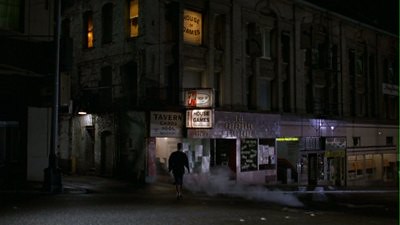
HOUSE OF GAMES - #399


When slick con man Mike (Joe Mantegna) first meets haughty therapist Dr. Margaret Ford (Lindsay Crouse), he explains to her about how people have "tells." It's the little things a person does that gives away when he or she is lying. One of the men Mike is playing cards with (Ricky Jay), for instance, fiddles with his ring when he is bluffing in the game. Learn someone's tell, and you have the ability to predict what they are going to do next.

This is the crucial moment of David Mamet's 1987 debut, House of Games, when Margaret, whose specialty is studying compulsions and obsessions, decides to cross a line and observe criminal wildlife in its natural habitat. It's also the closest House of Games gets to having a tell of its own. Because if there is one thing that this snappy, dramatic crime flick doesn't do, it's telegraph to the viewer where it's going to go next. Mamet's ability to keep his cards to himself is what sets his movie above the average grifter picture.

We've had a lot of pretty okay con men movies in recent years, things like Matchstick Men and Confidence. While these films were decent enough the first time around, they fail the test of time because they are too hung up on their own need to try to trick the audience into falling for their narrative schemes. Watching them, you know that double-crosses are coming, and when it comes down to it, that's all those movies have. This means the watcher spends the entirety of the picture thinking ahead, guessing who is ultimately screwing whom. Once the magician has explained how he did it, his act ceases to be interesting.

Not so in House of Games. Mamet understands that in order to instigate a true cinematic sleight of hand, he has to look his audience dead in the eyes and give them something to watch. In House of Games, it's the tango Mike pulls Margaret into. The seduction of the criminal underworld is the true seduction of the movie, and we follow the good doctor into the back rooms and peek behind the curtain with her. There may be twists aplenty ahead of us, but we're too busy enjoying the polished dialogue and the charismatic performance of Joe Mantegna to ever glance at the map. This car is going straight ahead, and we'll take the curves as they come.

As a first time director, Mamet shows an assured hand. The script is based on a story he wrote with Jonathan Katz, best known for his Dr. Katz TV show. Presumably, though not a therapist himself, Katz provided a lot of the psychology and Mamet produced the marked cards. Though he may be able to guard the secrets of his narrative, the tell-tale signs of the Mamet style are already in evidence even as far back as 1987. It's kind of funny, because for other first-time directors, the arch tone and the stiff-necked camera movements would suggest a lack of confidence, but for Mamet they are the first signs of some of his best assets.

House of Games - Criterion Edition is a DVD I could watch over and over, even after knowing how Mamet creates his grand illusion. The script doesn't rely on cheap tricks, and his characters aren't straw men propped up to serve a function. Rather, it's an honest to goodness crime story with an underlying psychology that only makes the film get better the more you understand it. As a viewer, I am Mamet's willing patsy, and I'll let him take me for a ride whenever he feels like it.


Originally written August 19, 2007. For technical specs and special features, read the full article at DVD Talk.

Thursday, January 17, 2008

ARMY OF SHADOWS - #385


At a crucial point in Jean-Pierre Melville's 1969 ode to the French Resistance, Army of Shadows (L'armée des Ombres), his hero, Gerbier (played with a sober, contemplative gait by Lino Ventura), has been captured by the Nazis and is marked for execution. In a twist of cruelty, the Germans line up their prisoners and tell them to run. If they can reach the far wall of the rather large room they are in, they will live to be shot a different day. If they are gunned down before they get to the other side, well, c'est la vie.

When the head Nazi starts the race, Gerbier is convinced he will not run, but once the bullets begin to fly, his legs start pumping and he's beating feet just like the rest of them. He's not happy with himself for doing so, but it's not out of any self-loathing or recriminations for being a coward. What bothers him is that everyone thought he would run, and they turned out to be right. How did they know?

There is not a lot of self-reflection in Army of Shadows. Melville, who also adapted the screenplay from a novel by Joseph Kessel, doesn't spend much time building up his heroes or explaining the mechanics of the resistance movement. By the time he plops us down into the middle of the campaign to liberate France from the Nazi invaders, the action is already underway. So, this scene comes off less as an object lesson in German cruelty and more as an existential parable. Why indeed would they think Gerbier would run from their gunfire? It's a stand-in for the bigger question: why did they think the French would lay down and die? Gerbier's run for self-preservation is a sprint for his country.

As portraits of patriotism go, Army of Shadows is a strange, wonderful beast. There are no rah-rah moments where defiant Frenchmen stand and wave the French flag and sing "La Marseillaise." To speak is a sin. You can be locked up just for publicly referring to a Nazi official as a "jackass." Instead, the men and women who work with Gerbier operate as a silent pocket universe, separate from the rest of France, and even separate from the rest of the Resistance movement. It is implied that there is a more extensive network of freedom fighters--and indeed, they even have a great leader who unites them all (Paul Meurisse)--but any contact we see between this group and their comrades is rare. They exist out of time, out of space.


Really, Melville infuses his entire film with this surreal, almost Kafka-esque quality. The movie proper opens with Gerbier in the back of a truck, being driven out to a remote, countryside prison. Were you to stumble into Army of Shadows with no context, you'd be forgiven for thinking it was a No Exit-style tale about lost men in a nonexistent world, prisoners of a made-up war. The gendarme that escorts Gerbier even refers to it as the "Phony War," a rarely used term for the German takeover. None of it feels quite real.

Which is Melville's stroke of genius. He doesn't let Army of Shadows get tangled up in the larger picture. Rather, his film is about a handful of people, how individuals refused to accept fate and instead chose to run. At times, their efforts seem futile, like spitting into the ocean. Gerbier and crew don't blow up Gestapo headquarters, we don't see them liberate rations from supply trucks. Really, we end up seeing them simply avoiding getting caught more than anything. Like Robert De Niro's secret agents in The Good Shepherd, after a while they start to appear like they are doing what they are doing just to be doing it, an organization feeding on itself just as it perpetuates its own reason for being. But that's the true existential conflict, the mark of the philosophical warrior, to keep acting--because not to act, not to run, equals death. For instance, Jean-Francois (Jean-Pierre Cassel), one of Gerbier's top agents, makes the ultimate sacrificial gesture, and he does so knowing full well that no one will know he has done it. He even obscures the action himself, throwing a curtain over it by making his cohorts think he's chickened out.

It's rare to see a celebration of stoicism that remains stoic right to the end, but Melville is praising the sacrifice of people who did what they did with no expectation of praise. The full price of that sacrifice is apparent in the carefully chosen moments when they have to accept actions they would have never undertaken were circumstances different, such as Gerbier having to conduct his first murder of a traitor (and how much more easy it is later), or the excellent Simone Signoret, playing the formidable Mathilde, seeing her resolution coming and knowing that this time it's better if she doesn't run. The conclusion of Army of Shadows is fatalistic and almost melancholy, and yet Melville and his characters clench their jaws for it, never crumbling. Anything less, though, and we wouldn't understand the full consequence. In these moments, in the crisis of conscious Gerbier experiences after the Nazi death game, everyone must ask how far they would go, and if sometimes going too far means coming full circle and betraying your own ideals. Only then, when you keep pushing despite the doubts, is true heroism achieved, be it heroic or not. It's the director's final tribute, staying true to the strength that kept his countrymen going.


Originally written May 15, 2007. For technical specs and special features, read the full article at DVD Talk.

Wednesday, January 16, 2008

LES ENFANTS TERRIBLES - #398


Midway through Les enfants terribles, the titular children, strange brother and sister duo Elisabeth (Nicole Stéphane) and Paul (Edouard Dermithe), create a game where they must each shoplift something entirely useless from a seaside store. They even force their spineless pal Gérard (Jacques Bernard) to go along with it, sending him back in for another, larger item when he breaks the rules and turns up with a hair brush. Jean Cocteau, the narrator, who also happens to be the author of the film and the novel it is based on, informs the audience that this pointless action has been undertaken simply so the kids can feel they are dangerous, nothing more. Random cruelty with no result.

It's the nutshell scene of Les enfants terribles, the moment that crystallizes the themes and the characters. The 1950 film, newly released on DVD in North America by the Criterion Collection, was adapted by Jean Cocteau and the master French filmmaker Jean-Pierre Melville, working from the writer's most famous novel, and what they came up with was borne of one of the most contentious partnerships in film history. The friction created real sparks, however, and they all end up on the screen. You can even argue that the pull the real world threatens to exert on Elisabeth and Paul in the picture is symbolic of these two headstrong artists working toward one goal. The grounded reality of a Melville movie meets the flighty interior opera of a Cocteau piece, and it's magic.

The film opens at a boy's school during winter. A snowball fight erupts, and Paul takes a shot in the chest. He's a weak boy, and it fells him, taking him out of school for the duration. The effeminate student who hurled the offending snowball is Dargelos (Renée Cosima), who becomes a sort of spectral image of death that haunts Paul from there on out. Dargelos becomes the poster boy for everything that Paul cannot do, the life he is too precious to live. Paul surrounds himself with photos of boxers and actors, all of whom have an eerie resemblance to Dargelos and also a much more interesting life than Paul himself.

Paul shares his photo-laden room with Elisabeth, his sister. She has already given up her life in order to care for their sick mother, and the two create their own world within the confines of their apartment, crafting strange codes and games that only they understand how to play. When their mother dies, so goes the last remaining boundaries. The kids are now free to live their lives as petulantly and abstractly as they want. Picture them as more isolated ancestors to Bertolucci's siblings in The Dreamers. Without the pop-culture backbone to weave their dramas around, they must invent every macabre scenario themselves. When Gérard is not around to pick on, they attack each other. When he is there, they use him as a pawn. As the film proceeds, they get more selfish, more demeaning, and any sense of a family bond completely erodes.


Things get particularly nasty once love enters into the picture. There are ill-defined incestuous overtones to the relationship between Elisabeth and Paul. They often gaze at one another with feral, lusty eyes. Melville uses mirrors as places where they not only search for their true selves, but where their sibling lurks behind them, waiting for what is to be revealed. Gérard loves Elisabeth, but he's too scared to admit it, and when she brings home a co-worker, Agathe, Paul is immediately smitten with her. Yet, rather than deal with it, he taunts her mercilessly. By some coincidence, she looks just like Dargelos (and is, in fact, played by the same actress), which is a big part of his obsession with her, and also the signal that she will eventually be the catalyst for the final moves in both Elisabeth and Paul's grand games.

Jean Cocteau's narration intrudes on the scene regularly, often explaining what we are looking at in a replication of detail, and also commenting on it. He points out the characters' lies, mistakes, and self-denial. He practically dictates their actions like a malicious god, or maybe another mean little child like the ones he writes about, trapping these rodents in a maze of his design. There is certainly an echo of a deus ex machina in the fatal car crash that takes Elisabeth's rich American husband (Melvyn Martin) from her the day after their wedding. Melville shows the wreckage while Cocteau explains his famous metaphor of the spinning wheel of the car being like the seemingly dwindling yet continuous nature of human life.

This moves the quartet of teens to a new home, a massive mansion with eighteen rooms and an unwieldy gallery where the dead man collected art objects willy nilly. This ups the scale of the drama, shifting the story into the final act and sending Elisabeth and Paul down the track toward their most evil, self-serving games. Melville frames everything with a haunting staginess. Characters often look up into an unspecified light, standing frozen as a moment is marked and pondered. Their lives are so far removed from reality, their environment so abstract, it's only the camera that can confine them.


Originally written July 19, 2007. For technical specs and special features, read the full article at DVD Talk.

Monday, January 14, 2008

POSTWAR KUROSAWA - ECLIPSE SERIES 7


Akira Kurosawa began his career as a film director in 1941, not exactly the best time to jump with both feet into the pool. Under the strictures of the wartime government, Kurosawa the artist could only paddle so far before having to submit to the nationalistic demands of the time. His first handful of films were part of the war effort, propaganda akin to the rah-rah war movies Hollywood was pumping out on this side of the Pacific.

Once WWII was over, the landscape changed and restrictions were lifted. Starting in 1946, the fledgling director finally had the freedom to explore issues that were important to him. Looking out across the postwar landscape, Kurosawa saw a country struggling to re-establish its identity, caught between the mistakes of the past and a present that was not their own. Though the militaristic Japanese government had been defeated, in their place were the occupying U.S. forces. Rebuilding had begun, but it would take some time for the country to come into its own.

Amidst this, it would also take some time for the great director to come into his own. Postwar Kurosawa is a document of that trajectory, the five films in the set representing rungs in a ladder that would allow Kurosawa to achieve some of his greatest work. Amidst the period these films were made, he would also helm such classics as Ikiru, Rashomon, and Seven Samurai. The movies collected here represent some of his lesser-known works, and the Postwar Kurosawa box is Series 7 in Criterion's Eclipse Series, a specialty label created specifically as a speedy, affordable way to bring oft-neglected segments of a larger oeuvre to the public. Together, these movies show an artist discovering his style and mastering his craft. In the struggles of his people, Kurosawa would find answers to questions that weighed on his soul, establishing some of the major themes of his work. In particular, his need to make sense of a senseless war would be something he'd chase for the rest of his life, the same issues emerging in later films like Dreams and Rhapsody in August. For those of us who only know the major works, here we will find the foundation for them.


* No Regrets for Our Youth (110 minutes - 1946): In celebration of his newfound freedom as a filmmaker, Kurosawa tackled a rather difficult subject: pre-War oppression within his own country. Based loosely on real events, No Regrets opens at a university in Kyoto where the head of the college (Denjiro Okochi) has been fired because he opposed aggressive governmental changes after Japan's occupation of Manchuria. In a period that was analogous to the Communist witch hunts in America in the 1950s, any dissenters were branded "Reds" and publicly discredited. A group of politically minded students emerge at the school, lead by the idealistic Noge (Susumu Fuhita) and his weak-willed sidekick Itokawa (Akitake Kono). As the two boys develop along opposing political lines, they court the affections of the professor's daughter, Yukie (Setsuko Hara).

The story of No Regrets is really Yukie's. She begins as a selfish girl who taunts the men, particularly Itokawa, when they don't measure up to her own impossible standards. As she matures, she is torn between the safe life that Itokawa offers, going with the flow and staying with the system, and the more dangerous world of Noge, where actions carry important consequences, good and bad. Naturally, she chooses to have a life with meaning, and despite the daunting obstacles that she faces, finds even greater reservoirs of courage within herself.

No Regrets for Our Youth is a stirring drama, even if sometimes it takes a while to get that stir going. The slower pace of the film is reminiscent of Yasujiro Ozu, Japan's premiere master filmmaker. (Setsuko Hara would actually go on to star in many of Ozu's next wave of films.) Sometimes, the message prevails over the narrative, leading to overtly political dialogue that grinds the story's momentum down. Yet, the film regains that momentum more and more as Yukie finds her place as an activist and as a woman. Hara's sincere performance works to turn each of her character's defeats into very real triumphs.


* One Wonderful Sunday (109 min. - 1947): Kurosawa took a completely different approach for his immediate follow-up to No Regrets. One Wonderful Sunday is a bittersweet portrait of a young married couple who had their lives interrupted by the war. Living in Tokyo, Yuzo (Isao Numazaki) and Masako (Chieko Nakakita) struggle to make ends meet. Though a veteran, Yuzo hasn't found a lot of opportunities now that he's out of the service. The couple lives apart, working separate jobs and scraping to get by. They meet every Sunday and use what little money they managed to save over the week to have a day together.

The film chronicles one of these Sundays together, and the ups and downs the pair encounters. For every good moment they find, there is some immediate retribution for it. Every step they think they are taking forward knocks them back two. Kurosawa uses their wanderings through the city to show various levels of society, from homeless street children to the denizens of night clubs, and how they get by in postwar conditions. We see the rubble of the bombed-out city, the near-crippling desperation, and also the indomitable hope. In that paradigm, Masako represents the hope, always managing to stay optimistic as her husband sinks lower and lower.

Despite some rather dark scenarios, Kurosawa still manages to show how dreams are kept alive. Out of money after accidentally overspending in a café, the couple realize that they still have the only thing they really need to get by: each other. In a couple of sweet pantomimes, they act out their fantasies about owning their own café, and Yuzo also entertains his wife by conducting an invisible symphony after he is unable to take Masako to the real one. (I was reminded of Renoir conducting the phantom orchestra in The Rules of the Game.) At its summation, One Wonderful Sunday is a symphony that Kurosawa has conducted for his countrymen--one he even invites them to participate in, knocking on the fourth wall in order to encourage them to have some faith in his performers. Like the Schubert piece that Yuzo pretends to conduct, Kurosawa's is a message that remains unfinished, and thus open-ended. The director is saying that though they aren't where they want to be yet, as long as they can dream and keep the vision from fading, Japan can still get there.


* Scandal (105 min. - 1950): Akira Kurosawa made several movies between One Wonderful Sunday and Scandal, including such notable career highlights as Drunken Angel and Stray Dog. One of the reasons these films made such an impact is that it began the fruitful relationship between the director and his most famous leading man, Toshiro Mifune. A force of nature, Mifune's good looks and charisma burn up the screen. He's one of those actors, like Marlon Brando and James Dean would be in the years to come, whose natural presence made it impossible not to watch him, and he forever changes one's view of what acting can be.

In Scandal, Mifune plays Ichiro Aoe, a rebel painter whose canvases reflect the world as he sees it. As one onlooker notes, the mountain that Aoe is painting as red is not actually red; the artist's defense is that when he looks at it, red is how the mountain appears to him. A chance meeting with Miyako Saigo, a famously reclusive singer (Yoskio Yamaguchi), catches the attention of greedy paparazzi, and they sell a snap of the two together to a licentious tabloid publisher (Sakae Ozawa). The ensuing gossip rocks both Aoe and Miyako's worlds, and refusing to let his truth be altered by anyone, Aoe decides to take the magazine to court.

Scandal wonderfully shows the high level of craft Kurosawa had developed in the preceding four years. The confidence in the filmmaking he displays in this drama of intrigue is light years beyond the stiff and mannered direction that slowed No Regrets for Our Youth. Co-writing the screenplay with his regular collaborator Ryuzo Kikushima, the director benefits from indulging his attraction to the eccentricities of everyday people. Nearly upstaging Mifune here is another Kurosawa regular, the chameleonic Takashi Shimura (he also had a bit part in No Regrets). In Scandal, he plays Hiruta, the downtrodden lawyer who takes on Aoe's case. Hiruta is a victim of his own bad nature. The middle-aged man has barely any law practice to speak of, and the sins of the father are karmically visited on his sweet-natured daughter (Yoko Katsuragi), who has been laid up in bed with tuberculosis for five years. She sees her father constantly making the wrong choices, and she can't stand to watch him cheat Aoe.

One of Kurosawa's greatest strengths has always been to let the characters simply behave as they are without forcing a lot of visual histrionics or overdoing the melodrama. We already saw his capacity for this once in Sunday, but the technique is more interesting in this later film. For a movie called Scandal, it doesn't feel at all scandalous. Rather than revel in lurid details and thus betraying his own message, Kurosawa simply lays out the circumstances and let's the characters react as they may. There is no eleventh hour, hail-mary play in the courtroom, nor does he even resort to forcing a love affair into the climax, despite a knee-jerk audience response that causes us to wish the painter and the singer really would fall in love. There are so many places where Kurosawa could have used the standard Hollywood tricks to make Scandal more sensationalistic, but his treatise against the gossip-mongering press is all the more powerful for letting the truth of the situation speak on its own behalf.


* The Idiot (166 min. - 1951): The passionate labor of love Kurosawa made after the breakthrough Rashomon, this adaptation of Fyodor Dostoevsky's nineteenth-century novel is a strange mess. Grasping for something lyrical, Kurosawa ends up clutching at a narrative that often slips through his fingers. Transferring the story into his time and his country, he creates a fable for a world whose morals have gone off-center. It's just that the film itself is off-center, too. Despite moments of intense brilliance, The Idiot is scattered and almost too narrow in its structure. Perhaps the director's original four-and-a-half hour cut had far fewer gaps in it, but the final studio version feels riddled with holes.

Kameda (Masayuki Mori) is an epileptic whose lifelong illness and the trauma he suffered in the war have made his mind a tad bit soft. Newly released from a prison camp, where he narrowly escaped execution, he goes to live with his uncle (Takashi Shimura again) in Sapporo, hoping to find some peace and quiet to recharge. Once there, however, his brutal honesty disrupts the social order of the town. His absence of malice and his pure moral thinking, providing a skewed Christ-like example, call attention to the townspeople's own bad behavior. Attracted to the town harlot, Taeko (a smoldering Setsuko Hara), as a healer is attracted to a wound, he becomes embroiled in criss-crossing love lives. Kameda's greatest rival is also his first civilian friend, the primal rich boy Akama (Mifune). As the two wage a mental battle for Taeko's hard, Kameda is also drawn to the more chilling but caring Ayako (Yoshiko Kuga).

The Idiot is essentially a long string of talking-heads sequences that, despite being elegantly framed by Kurosawa's cinematic eye, tend to all run on longer than seems necessary. Motivation switches on a dime, and the story takes the long way around to get anywhere it's going. Yet, as I said, individual scenes can be amazing, and all of the performances are remarkable. The power of the actors kept me glued to the screen, and the marvel of seeing a great auteur digging deep for something meaningful makes The Idiot worth sitting through. Its goals may be mightier than what Kurosawa could get on film, but there is something fascinating about watching him try.


* I Live in Fear (103 min. - 1955): Jumping ahead a couple of years, by the time Kurosawa made I Live in Fear, he was established as an international sensation. Thus, it feels rather daring that he would make such a politically minded drama.

Toshiro Mifune, in excellent old man make-up, stars as Kiichi Nakajima, a wealthy patriarch whose anxiety over the possibility of a nuclear war has caused him to seek ways to save his family from the atomic holocaust. He has a plan to move everyone to Brazil, including his two mistresses and his illegitimate children, trading the clan's coal foundry for a farm. Seeing their livelihood about to be squandered and not particularly wanting to be transplanted to South America, Nakajima's eldest children and their mother have filed a court petition to have their father declared incompetent. When the family temporarily wins, the father, feeling a new sense of urgency, tries to get a hold of money by other means, as well as pulling a last-ditch attempt to change his offspring's minds.

Crossing paths with Nakajima, and serving as a kind of audience stand-in and the occasional Greek chorus, is Dr. Harada (Shimura). Harada is a dentist who has been appointed as special counsel for family court, and of the men hearing Nakajima's case, he's the one who becomes sympathetic to the old man's convictions. It's through him that Kurosawa poses the central question of the movie: is there such a thing as an irrational response when faced with something as monumentally irrational as a hydrogen bomb?

I Live in Fear avoids being preachy or overtly political by letting Nakajima's descent into despair do all the talking. There is no need for pontificating when the particulars are woven so well into the story. Given the petty bickering of the family and the sincere concern shown by their father, it's hard not to be swayed to Nakajima's side. Only one of the children--and a son-in-law, thus an outsider--ever sees that maybe there was a better way to handle the problem, that the desperation the old man was driven to may have been avoided. The final shot of I Live in Fear is hauntingly poetic, suggesting that madness lies on either side of the sanitarium door. It's just a matter of which psychosis you subscribe to: turning your eyes away from the inevitable, or looking for it everywhere.


The great thing about Criterion's Eclipse label is being able to sample a portion of a director's career, either linked by theme or time frame, and see how ideas and styles developed. Postwar Kurosawa – Eclipse Series 7 gives us both sides of that coin. These pieces not only represent a decade of work in the Japanese auteur's life, but also his questioning of the Japanese identity following World War II. In these five films, often set amongst the rubble of war-damaged Tokyo, Akira Kurosawa hones his penchant for individualistic characters. We also see him establish his ensemble players and cement his most fruitful working collaboration, with the charismatic actor Toshiro Mifune. Not all of these are top-of-the-line classics, but they get close, and both Scandal and I Live in Fear are as good as any of the director's other more commonly discussed pictures. Postwar Kurosawa represents an important segment of the filmography of one of cinema's greatest storytellers.

For technical specs and special features, read the full article at DVD Talk.

Saturday, January 12, 2008

BLAST FROM MY OWN PAST: THE BAD SLEEP WELL - #319 (Plus, Ozu and Hou Hsiao-hsien)

This piece was originally published on January 31, 2006, as part of my old "Can You Picture That?" column written for the Oni Press website. I've chosen to reprint it in its entirety, partially because I had a request last year from a reader searching for the Café Lumiere review now that it was offline.

THERE IS A LIGHT


Yasujiro Ozu stands alongside Akira Kurosawa as the two most influential original masters of Japanese Cinema. Had he lived, he would have turned one-hundred in 2003. To mark that occasion, Taiwanese director Hou Hsiao-hsien has made what may be the finest movie of his career, Café Lumiere.

Released on DVD at the end of September, Café Lumiere has been a long time coming for stateside film fans. At the beginning of last year, Film Comment magazine named it as the best movie of 2004 that had yet to be released in North America. Having gained notice for his previous films, including the excellent Millennium Mambo, Hsiao-hsien was poised as a breakout talent. His tackling an Ozu-like tale was expected to be an interesting experiment to watch play out.


I am far from an Ozu expert, but my rudimentary understandings of his films is that he was mainly concerned with showcasing the lives of modern Japanese families. Sometimes, these could be very ordinary people, like the family in Early Summer (1951), and other times, he looked at what would happen when an out-of-the-ordinary life collided with the ordinary, such as when the traveling actors invade a small town in Floating Weeds (1959). While his stock and trade was understated melodrama, he wasn’t afraid of humor. Anyone who has seen his 1959 masterpiece Good Morning has never forgotten, for instance, the little boy who farts every time you push his forehead. His most primary theme was looking at how Japan was growing, examining how the older generation viewed the younger generation and usually siding with progress.

On the surface, there are some similarities between Ozu and Hsiao-hsien. Both seem to like characters who are searching for some kind of stability, and both employ an unhurried pacing to their storytelling. Hsiao-hsien, however, is not nearly as concerned with traditional narrative, choosing a free-form style that owes more to the French New Wave than traditional moviemaking. So, the question seemingly becomes how to attach that unmoored passion with Ozu’s simple sentimentality.

The result is breathtaking. Café Lumiere is stunningly haunting and quiet. It lacks both the melodrama and the laughter of Ozu’s classic oeuvre, but at the same time, Hsiao-hsien manages to create his own family of characters that are just as endearing as any portrayed by the master. (And the title is perfect for a movie where one filmmaker pays homage to another, as the Lumiere Brothers are often considered the founders of cinema, having put on the first public screening of a motion picture in 1895.)

There isn’t a lot of story to Café Lumiere. Yoko (Yo Hitoto) is a young Japanese girl living on her own. She divides her time between her Tokyo home and Taiwan, where she is researching a project on Jiang Wen-ye, a famous composer. She also occasionally goes to see her parents, including a trip for a ritual cleansing of the family gravestones. The small unit of three doesn’t speak much, and their initial conversations are just an exchange of basic pleasantries. Yoko, however, has a bombshell to drop: she’s pregnant and has no interest in marrying the father. The family reacts in its way, which is almost a non-reaction. As in Ozu, Yoko’s elders don’t know how to relate to her as a modern woman. They possibly see her as akin to the foolish girl in the strange dream Yoko had where a goblin came in and kidnapped a child under her watch. She is too young and incapable of such responsibilities. (Courtney Crumrin fans will likely appreciate the storybook Yoko looks through that details just such a misadventure, a European folk tale that Ted Naifeh referenced in one of his comics.)


These opening scenes are done in long takes, usually with the camera several feet away, sometimes just outside the room or far enough back into it that we can see the whole area and everyone in it. The action is commonplace, such as a family sitting at a table or Yoko on the train. Yoko spends the first scene with her back to the audience, talking on the phone, and we don’t really get a good look at her face until midway through the picture. The phone call is also one-sided. We never hear who is on the other end of any phone conversations, including with the Taiwanese man who is purported to be the father of her child. The effect is one of simultaneous distance and intimacy: we are at arm’s length, and yet we are seeing private lives play out. There is also a sense of mystery. Is Yoko just as distanced from everyone else, and if so, why? I started to wonder who exactly the father really was, because things are complicated by the presence of Hajime (Tadanobu Asano).

Hajime is a bookseller who helps Yoko track down CDs of Wen-Ye’s music, and they are trying to puzzle out where a long-gone jazz club he used to visit may have been. Hajime has his own private obsessions: he loves trains. He likes the order of them, he likes knowing their names, and he travels around with a tape recorder capturing their specific sounds. Their relationship seems entirely professional, except Yoko brings Hajime gifts and looks a little jealous when she is told some gossip about him having a bookstore groupie. The first real intimacy of the movie occurs when Hajime visits Yoko at her apartment and he shows her a computer program he has created that is an artistically visual map of the Japanese train system. He portrays himself at the center of it, as a fetal creature with a microphone growing in the womb of the railways. Here, Hsiao-hsien moves his camera in tight, almost on top of his actors. As they share their secret passions, they are finally connecting, finally opening up. It’s a technique he uses again when Yoko interviews Wen-Ye’s wife, and she shares cherished memories about the pictures in her photo album.

Café Lumiere is as subtle as it is moving. It doesn’t build to any great Hollywood climax, and yet one can’t help but be involved. It’s such an odd sensation when you watch a film that has such an obviously leisured pace, because so often it passes in a flash, as if the attention it requires of you as a viewer pulls you out of time. I was totally engrossed. As a tribute to Ozu, my feeling is that what Hsiao-hsien has done is abstracted the essential elements of his teacher’s work and grown something new out of them. Hsiao-hsien takes his own style and applies the lessons of the master to it, and I can’t imagine anything more flattering.


As a DVD, Café Lumiere is of exceptional quality. The lighting has a natural feel, and the colors are all warm. One scene between Yoko and Hajime in a Taiwanese café is particularly beautiful. An overhead ceiling lamp illuminates Hajime’s drink, creating an angelic spotlight on him. Additionally, the sound is crisp and captures the real noise of busy streets, creating the effect that there is movement all around you.

There are also plenty of extras, including short interviews with Hototo, Asano, and Hsiao-hsien, and “Metro Lumiere,” an hour-long French documentary about the filmmaker’s process, where Hsiao-hsien discusses his goals and his impressions of Ozu. Most interesting were his stories about the difference in filming in Japan as opposed to Taiwan, and how he and his crew often went after scenes in real life settings guerilla-style.

And before we switch gears, I’d be remiss if I didn’t note that Film Comment has once again put Hou Hsiao-hsien at the top of their list, citing Three Times as the best film of 2005 awaiting stateside distribution. Excellent! Something to look forward to! [EDIT: It has, of course, since been released, and I review it here.]

* * *


As for the other old master, Criterion has recently put out a new disc of one of Akira Kurosawa’s lesser known social dramas, The Bad Sleep Well. Hopefully this wonderful disc, with its gorgeous picture and sound quality, will increase the film’s reputation, because it certainly deserves it.


Made in 1960, The Bad Sleep Well was the first film from Kurosawa’s independent production company. Interwoven with themes and elements from Shakespeare’s Hamlet, it’s a story of corporate corruption and intrigue starring Kurosawa regulars like Toshiro Mifune and Takashi Shimura. A scandal is breaking out over a construction project where it appears that the government organization commissioning the work awarded a private company the contract despite their bid being several million yen higher than everyone else’s. Suicides within the company’s upper ranks have only added to the controversy. Just what are these people trying to hide?

I don’t want to get too much into the plot, because it takes a couple of twists and turns, and the way they suck the first-time viewer in is part of the experience. You aren’t even sure who your Hamlet stand-in is until about half an hour into the movie. What I can tell you is that this is one of the most expertly shot pictures in the Kurosawa canon. The opening sequence is rightly praised as one of Kurosawa’s most efficient and innovative. Set at a wedding, the ceremony is interrupted by quiet police officers, catty reporters (an excellent device to clear out a lot of exposition), and nervous executives using their toast time to try to save face. The real intrigue begins, however, when a mysterious cake is wheeled into the banquet hall. Sculpted to look like the company’s massive office building, a single red rose sticks out of the window the first casualty of greed hurled himself from. No one knows who sent the cake, no one knows why.


Kurosawa uses his patented pan focus to great effect in The Bad Sleep Well. Many of the complicated shots and some of Kurosawa’s off-kilter directing techniques are discussed at great length in the bonus documentary, part of the long Japanese series “It Is Wonderful to Create!” that Criterion has been including on a lot of their recent Kurosawa DVDs. Pan focus is when everything within the frame is visible with equal clarity, a technique also preferred by Orson Welles. Probably the most impressive and ironic uses of the style is in a scene where two characters sit in their car watching a funeral. The camera is placed in the back seat, and we look past our spies, through the windshield and across the road, and we can see everything going on at the funeral while a calypso soundtrack from within the car draws attention to what a sham the event is.

For 1960, The Bad Sleep Well was progressive and daring. It’s a cynical film that makes no bones about what kind of evil greed can drive men to and how high in our society this corruption goes. And it’s not hard to be just as cynical when we realize how biting this message still is forty-six years later.