Showing posts with label jan troell. Show all posts

Saturday, February 13, 2016

THE NEW LAND - #797


For many, The New Land will be where Jan Troell’s two-part Swedish immigrant story set in 19th-century America really starts to take off. In many ways, The Emigrants [review] was merely preamble to get us here.

Released in 1972, a year after the previous entry, The New Land picks up the story of the Nilsson family almost immediately after the final scene in The Emigrants. Karl Oskar (Max von Sydow) has claimed a patch of riverside Minnesotan land as his own, and he’s bringing Kristina (Liv Ullman) and the kids, along with his younger brother Robert (Eddie Axberg), to start transforming it into a home and farm. The work will be hard, but it ends up being rewarding, and the Nilssons become part of a growing community of Swedish transplants.

Of course, the more people that come from the old country, the more the problems previously left behind that start to catch up with them. Believers in the Orthodox Church, for instance, begin to introduce the same pressure to believe along accepted lines back into the community worship. The new arrivals also start to assimilate well, though not always in the best way. One man takes a Native American as his wife, while also taking on the inherent racism that white Americans felt toward the “savages.” Troell doesn’t layer it on too thick, but he definitely sees the irony in the land of the free that denies freedom to others via the easy adoption of Manifest Destiny.


Much of what we see the Nilssons go through is fairly standard for this kind of tale. The building of the farm goes as expected, with the occasional setback, but mostly with positive progress. What sets The New Land apart is the core relationship between Karl Oskar and Kristina, who definitely strain at times to maintain harmony as they grow old together, but who genuinely try to be there for one another. As more kids keep coming, for instance, Kristina has trouble taking her pregnancies to term, and there is much to explore in what that means for their union and also how it tests their faith. Likewise, how that faith changes over time, with the notion that God helps those who help themselves taking precedence over leaving things entirely up to His will.

The weird thing about the ongoing additions to the family being so prominent is that Troell never gives any of the children an identity, and it’s never quite clear how many there are. They appear only rarely, and are mostly out of sight throughout The New Land. Troell doesn’t give the kids much thought or importance, which becomes abundantly clear as we see the parents aging at much more rapid pace than their progeny. Over a decade passes in this half of the story, yet none of the kids ever seem to become teenagers who could help work the land, even as their mother and father become stooped and frail.


In terms of side characters, Troell is far more interested in Robert and the dysfunctional fraternal relationship between him and Karl Oskar. Midway through the first act, shortly after the farm is on its feet, Robert and his buddy (Pierre Lindstedt) set course for California in search of gold. The younger man returns some years later, looking worse for wear but boasting much success--something Karl Oskar has a hard time believing. Through a set of intriguing flashbacks, Troell shows us the reality of the boy’s journey. These slices are immediately separated in style from the main narrative. There is a minimum of audible dialogue in Robert’s story, the director instead choosing to let music and sound effects take charge of the montage. Rhythmic percussion sets the pace for quickened storytelling, with the oddness of the audio perhaps intended to represent the hearing problems Robert suffers due to a beating he took when he was a farmhand in Sweden. As we discover, the younger brother got a much harsher dose of wilderness living than Karl Oskar, yet he still can’t quite prove himself to the elder sibling.


Troell also uses music to underscore some violent sequences in the film, though to a much less convincing effect. The Native Americans pushed out of Minnesota tried to reclaim their land through both legal means and, eventually, force. The preacher Danjel (Allen Edwall) and his family are attacked and killed, and Troell enlists composers Bengt Ernryd (the I am Curious... series) and Georg Oddner to drop a hallucinatory organ dirge on the scene, which creates an odd, dreamlike effect, calling back to a bad vision Kristina had about Native men invading her home earlier in The New Land. The music adds an almost horror-like element to the grisly murders, even as the performances fail the material. Let’s just say the Swedish actors don’t make the most of their death scenes.


This violence is followed by a somewhat plodding final act. The breaking of the peace casts a shroud of death over everything, and the Nilssons are pushed along the path to the inevitable. I don’t think Troell intended to juxtapose the heinous retaliation of the American government toward natives with Kristina’s ruined health, or to suggest that her illness is the result of bad karma; rather, it seems he’s intending to convey what a difficult life all the immigrants had chosen, how the conditions were far from the idyll the fanciful reports of the infant country conjured in their minds, but yet perhaps worth the struggle regardless. The whole film yellows from this literary jaundice, looking as ill as it did in the seasick portions of The Emigrants.

This is maybe the downside of the chosen dramatic structure. As the goal of the characters is to merely keep living, the film can only follow them until they don’t. The movie ends, but it’s a fade out that covers years. Life is nothing if not anticlimactic. Even so, there is still a sense of accomplishment, and the feeling of experience shared. Which is basically what we signed up for when hitting play on The Emigrants and The New Land, so in that, Jan Troell is very successful.


This disc was provided by the Criterion Collection for purposes of review.

Thursday, February 11, 2016

THE EMIGRANTS - #796

"The greenest fields lie furthest away."


This is going to sound facetious, but it’s apt: Swedish director Jan Troell’s 1971/72 dual-header is essentially what we’d get if Werner Herzog were hired to direct The Lord of the Rings.

Bear with me.

Two very long (3 hours and up!) interconnected movies, neither of which is entire unto itself, detailing a long trek through unforgiving nature and an impossible but worthy goal. No magic, no fantasy, no indulgent effects showpieces; rather, harsh living, insurmountable odds, and an indifferent universe all plotting against people banded together to get from one end of the globe to the other.

Based on a book by Vilhelm Moberg, this ambitious adaptation by Troell (Everlasting Moments [review]) follows the Nilsson clan in the mid-19th Century as they pull up stakes in Sweden and head for America in search of the myth of a better life they’ve read about in newspapers and pamphlets. The journey begins with The Emigrants, which is essentially the events leading up to their decision to leave, their trip across the ocean, and then their further delving deep into the American heartland, destination Minnesota, to lay new stakes in the New World. Once they get there, the film is done, and what happens next is for the concluding volume.


Max von Sydow (The Seventh Seal [review]) leads the cast as Karl Oskar, a farmer who can’t catch a break. One year the snow kills his crops, the next year a heat wave. He is married to Kristina (Liv Ullmann, Autumn Sonata [review]), and together they have three children--though that number will shift as the story carries on, both regressing and progressing. Fed up with what he considers cursed soil, Karl Oskar plots with his younger brother, Robert (Eddie Axberg, My Life as a Dog [review]), a slow-witted farmhand, to make the move. Though, as Karl Oskar is warned, once he has decided on this journey, he will discover he has far more relatives than he had previously realized. Kristina’s uncle Danjel (Allan Edwall, Fanny and Alexander [review]) has been leading his own Christian congregation, one separate from the dominant church, and he and his followers have been persecuted for it. He wants to go along and bring the faithful with him.

So it is that a rather healthy-sized group sets off to sail the Atlantic for a better tomorrow. The build-up comprises the first third of The Emigrants, and the sailing the second. Unsurprisingly, the passage the Nilssons can afford is not the best, and they are crammed into the hull of a ship with little food and no real ability to cope with the seas and disease. A much smaller group lands on the American shore, and the final third of the film goes along with them as they head by train and river for Minnesota, seemingly finding what they have been looking for.


Troell is content to let the story roll at its own pace, and his presentation is unadorned and naturalistic. Conditions are severe, and we feel the drudgery and the disappointment as things grow progressively more difficult and take more time. The nausea that dominates the ocean voyage practically comes through the screen. Try not to feel a little green around the gills yourself. Troell wants to re-create the time with a rigorous and exacting attention to detail, down to the small talk and diversions. The only bits that don’t come across as believable are the hairstyles, which change not at all over a 10-week voyage, and some of the American accents of the people they encounter upon landing. But those are pretty insignificant nits to pick.


Unsurprisingly, The Emigrants can be a bit of a struggle to watch, but not an unrewarding one. Though the pacing is slow, Troell packs the script, which he co-wrote with Bengt Forslund, his collaborator on Here is Your Life, with plenty of personal conflict, be it the difficulties of marriage or the clash of ideas, as opposing views of religion and rational thought criss-cross within the group. (In one excellent moment of ironic piety, we discover a reformed wanton woman (Monica Zetterlund) has gained the honest to goodness moral high ground without remotely tempering her personality.) These are brought to life by a fine cast, with the expected exceptional performances by von Sydow and Ullmann. He plays Karl Oskar as a man tripped-up by his own vanity (the American will is strong in this one!) but who generally wants to do what is right; she gives Kristina a foundation of concern and compassion, tempering her motherly instincts with a practicality her husband sometimes lacks. He is the dreamer, and she is the one who often has to find each dream’s shape.

So, strap in when you have a full night ahead of you, and maybe prepare to take a break when the intermission pops up midway through each feature. For as much as a commitment as these two can be, when you get to the end of The Emigrants, you’ll want to know what happens next.

Onward to The New Land


This disc was provided by the Criterion Collection for purposes of review.


Monday, June 28, 2010

EVERLASTING MOMENTS - #520

"You see what you want to see."


Everlasting Moments was Sweden's official submission for the 2009 Academy Awards, and it's further proof that something was rotten in the Oscar pool that year for the Japanese film Departures [full review] to have taken the statue. Jan Troell's movie is a fully realized portrait of a working-class Swedish family doing everything they can to get by and to survive the violence and anger that sits at the head of their dinner table. The narrative begins in 1909 and spans across World War I, though the external strife of political upheaval and bombshells has nothing on the internal strife of the Larsson family. It's like a companion piece to Bergman's Fanny & Alexander, just without all the mysticism.


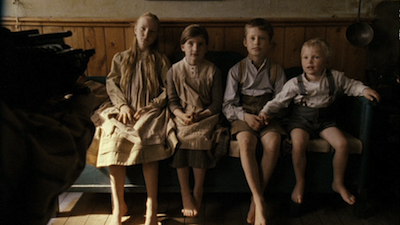
Maria and Sigfrid Larsson (played by Maria Heiskanen and Mikael Perbrandt) already have four kids when the movie starts, and by the end of it they have seven. The story is told by little Maja (Nellie Almgren for the early scenes, Callin Öhrvall for most of the movie), the eldest girl in the family. She is a watchful child, saying more in narration than she does in the events she relates. The Larsson apartment is cramped but they muddle through. Maria takes in sewing and other odd jobs, and Sigfrid works down at the docks. They are members of the neighborhood Temperance Society whenever Sigfrid manages to stay sober, and when he doesn't, look out! The brawny papa gets loud, likes to make his kids sing for his entertainment, and doesn't mind issuing punishment to those who get in his way. Sigfrid is a bit of a lost soul, his head swayed as easily by politics as it is turned by a woman. His flirtation with Socialism passes quickly enough, but his rough ways carry on.

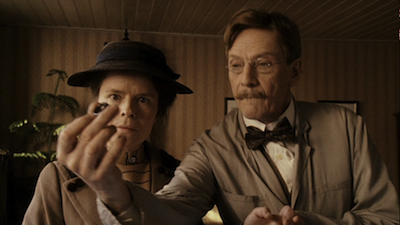
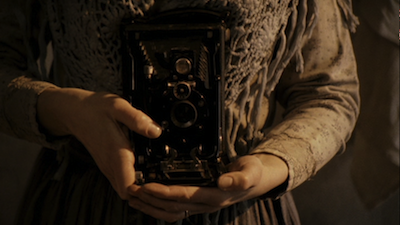
It's up to Maria to hold her family together, something she does with sullen reserve. One day, while going through their closet, she finds an old camera at the bottom of one of the drawers. Thinking she can maybe sell it on the sly and get a little extra food money, she takes it to Sebastian Pedersen (Jesper Christensen), owner of the local photo studio. Impressed by the workmanship in the old machine, and taken by something he sees in Maria, Pedersen encourages her to learn to use the device. He gives her film and chemicals to develop her pictures, saying her camera is collateral for the payment on the supplies. He will sell it eventually, she just needs to take some snapshots to prove it's in good working order. >wink wink<


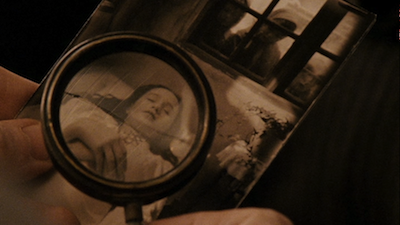
Maria first turns to conventional subjects, like her cat and her children, but the artistic bug bites her good. When a neighbor asks her to take a photo of her deceased child before the funeral, Maria not only realizes that she can use her camera for positive things (including making money), but she also shows that she has a gift for knowing the right moment to grab her shot. Pedersen is especially touched by her work, and his validation touches her. It's one of the most tender of many tender moments between them. Theirs will be an ongoing affair, but one that never crosses a certain line. The only kiss the two share is the one Maria gingerly places on his cheek as a thank you.


Though there is a will-they-or-won't-they quality to the Maria and Pedersen relationship, Everlasting Moments is not a will-they-or-won't-they romantic movie. Rather, it's a movie about loneliness and desire--and not necessarily the sort of desire that yearns to curb that loneliness with another person, but one that seeks to find solace in personal passion. For Maria, it is photography, and her bond with Pedersen--or Uncle Piff Paff Puff, as the kids end up calling him, based on his version of "Say cheese!"--grows out of their shared love of the captured image. He even takes up a movie camera and shows her the wonders of the moving image. The picture's most light-hearted family moment follows after Maria and the kids go to see a silent Charlie Chaplin comedy with Pedersen providing live violin music. When they go home, they draw on Chaplin moustaches and copy his routines. It's a lot of fun until Dad stumbles in and thinks they are making fun of him. The scene turns violent shortly after.

Sigfrid is like a ticking time bomb in Everlasting Moments. There is not a quiet moment he can't explode. In some ways, he is a monster, but in others, he is the most tragically flawed of all the characters. Troell, along with main writer Niklas Rådström, who based the script on the memoir of Maja Öman, portrays Sigfrid as sympathetic, caught in the same jail as everyone else but cursed to flail harder against its metaphorical walls. He can't see the good in Maria's photography, nor can he see a positive future for his children when his second-oldest boy has an opportunity to enter religious study and Maja is offered a German tutorial. It's only after he rescues an abused horse in the street that Sigfrid comprehends what it means to have something outside of yourself to care about. He is said to have a gift for understanding horses, and only he could see that this one was worth saving. Though no one makes the connection in the movie, this also says a lot about his relationship with Maria. No one can understand why she keeps taking him back. She's the only person that can see he is worth saving. Maria Heiskanen and Mikael Perbrandt play their characters with quiet courage. They don't need to voice their pain, it's obvious in their bearing. Everlasting Moments is by no means a dour film, but its greatest moments of vulnerability are when the characters are allowing themselves to be happy, not when they share their sadness. The acting is flawless.


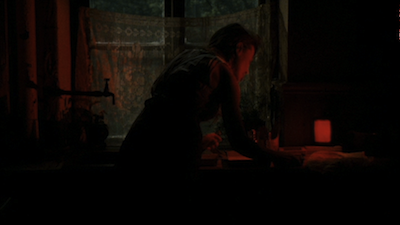
In addition to directing the movie and contributing to the story, Jan Troell also shot Everlasting Moments alongside co-cinematographer Mischa Gavrjusjov. Not surprisingly for a film about a woman who is in love with images, Everlasting Moments replicates the look of old movies and photographs. Night scenes are often shot in natural light, so they look stark and grainy, while a couple of scenes are cast in sepia, reinforcing the importance of memory and how its preservation permeates everything. When Maria is developing her photos, the red glow of the dark room is really the crimson of an illicit tryst. Sigfrid is aware of it when he spies her working alone. It's this privacy that makes him a cuckold, not anything she might ever do with Pedersen.


As far as the drama goes, there is much about Everlasting Moments that is fraught with emotion. A few scenes are harrowing and make your heart jump into your throat for fear they will go the wrong way. After all, we can't remember the good times without remembering the bad. Yet, it's the good that will ultimately out. Troell finds just the right way to close out his story, bringing this troubled family to a place of peace that is both heart-warming and logical. There is real growth here, and like life, it comes on gradually so that, as an audience, we are surprised when it happens while also knowing deep down that all is as it should be.


As it turns out, Maria Larsson wasn't just a real person (the original Swedish title of the movie is Maria Larssons eviga ögonblick, or Maria Larsson's Everlasting Moments), but she is a distant relative of Agneta Ulfsäter-Troell, the director's wife and also the third writer contributing to the story. This real-life connection and a look at her actual photographs is the focus of the featurette "The True Story of Maria Larsson" (9 minutes, 15 seconds) and for part of the documentary "Troell Behind the Camera" (28 mins.). The former is actually narrated by Agneta Ulfsäter-Troell, who explains about the photos and shares some of the information behind them. The longer piece moves away from the source material and to the making of the movie, with Jan Troell letting us in on his process and sharing his obvious joy for moviemaking.

The director is also the full focus of the final extra, the hour-long feature Troell's Magic Mirror. This scholarly look at Troell's life and career reaches all the way back to his childhood and leads us into his rich cinematic life. It's not snappy by Hollywood standards, but the level of information is deep and worth the effort to watch it.


Watch the Everlasting Moments trailer.

For a full rundown on the special features, read the full review at DVDTalk.